Stay Vigilant, CFOs: Your Compensation Strategy Matters More Than Ever

https://www.forbes.com/sites/paulmcdonald/2022/06/15/stay-vigilant-cfos-your-compensation-strategy-matters-more-than-ever/?sh=697b638f18f7

There’s been some speculation in the news lately that wage growth in the United States might be topping out. This could be the case for some employers, especially smaller companies that don’t have much more give in their current staffing budget. However, don’t think for a moment that compensation is suddenly losing its power as a tool to help secure top talent in a market where unemployment is low, the quits rate is high, and there are nearly twice as many open jobs as there are available workers.

The suggestion that employers are becoming more conservative in their salary offers also might be hopeful thinking for those trying to control rising inflation. Federal Reserve Chair Jerome Powell, for example, recently referred to the labor market as “unsustainably hot.”

While some big companies may be considering cooling down on hiring, some are paying higher wages to median-salaried employees than they did before the pandemic. (Significantly so, in some cases — think six figures.) And although the U.S. economy has seen some job-shedding in recent months, layoffs overall are at their lowest level on record.

The takeaway for chief financial officers (CFOs) is that you can’t afford to sit back and wait on wages. You can never really be sure when or if it will “top out,” especially in this unusual economy and candidate-driven hiring market. Your business needs to be prepared to provide standout compensation packages to hire stellar candidates — and keep your best people, too.

Compensation remains the not-so-secret weapon for besting competitors targeting the same talent, including the high performers who are already part of your organization. The trick is to use compensation as an offensive strategy that gives you more control. Following are three ways to help your organization make that pivot:

1. Review Current Employees’ Compensation Levels Now

While its name has been overexposed in the media, the Great Resignation is real and still in motion. Some are even referring to the phenomenon now as the “Forever Resignation”— a cycle of voluntary turnover that may never end. Buzzy labels aside, the pandemic has fundamentally changed the way people look at work, and what it means to them. They aren’t as willing to put up with things they don’t like about their job — like a low rate of pay. They know they have options, and they will seek them out.

Nearly two-thirds of U.S. workers who left their jobs in 2021 cited insufficient compensation as a reason for quitting, according to a Pew Research Center survey. To avoid turning your company’s valued staff into part of the “Class of 2022,” don’t wait for them to ask for a raise. Make sure to review their current compensation and if needed, bump it up, or extend another financial perk, like a spot bonus or paid time off.

And, if you find that employees are beating you to the punch, encourage an open discussion about pay. For example, if this person’s job responsibilities recently expanded or they’ve gained new skills, an immediate raise (or the promise of one soon) may be in order. If the employee is just feeling the crunch from inflation, offering a flexible work arrangement to reduce the burden of a costly commute might be an alternative solution for in-office workers.

2. Designate an Expert to Oversee the Compensation Process

In addition to taking stock of staff compensation levels as soon as possible, consider putting a formal process in place to ensure these levels will be monitored and adjusted proactively.

Compensation analysis will require, among other things, keeping tabs on the latest salary research and market trends, analyzing and updating job descriptions, and setting pay ranges and communicating them to staff. Look for someone in your human resources organization who could take the lead on managing this critical process. Because the market has changed so fast, it’s critical to keep continual tabs on what’s happening with pay rates and hiring dynamics for your company’s most mission-critical roles.

3. Watch Out for Pay Compression

The need to pay higher salaries to top candidates is in many cases resulting in new hires earning more than existing staff. Even small differences in pay between employees who are performing the same job, regardless of their skills or experience, can turn into big staffing headaches — namely, turnover. Feelings of resentment and disengagement can especially rise in the workforce when new hires with less experience are paid the same as, or more than, tenured employees in the same positions, or when individual contributors are paid more than their managers.

Inflation, competition for in-demand talent and the company’s failure to keep up with current market rates for compensation can all lead to pay compression. Conducting regular pay audits as described above and quickly bringing up the base salary of underpaid employees are solutions for resolving and, ideally, preventing, pay compression.

When raises aren’t an option, consider offering compelling non-monetary perks such as upskilling opportunities, better benefits, health and wellness programs, a more welcoming corporate culture, or all of the above.

That said, you can be sure that, no matter what, leading employers will continue to pay salaries that will attract the top talent they need to drive innovation and stay competitive.

Cartoon – Our Most Valuable Asset

Companies ignoring employee demands will falter

Dive Brief:

  • Companies that fail to adjust to labor shortages and satisfy the growing demands of workers will likely falter as they lose the battle for talent, BlackRock CEO Larry Fink said in a letter to CEOs.
  • “No relationship has been changed more by the pandemic than the one between employers and employees,” Fink said, noting that “employees across the globe are looking for more from their employer — including more flexibility and more meaningful work.” Fink, while leading the world’s largest asset manager, has sought for a decade to influence corporate behavior through an annual CEO letter.
  • “As companies rebuild themselves coming out of the pandemic, CEOs face a profoundly different paradigm than we used to,” Fink said. Companies can no longer overlook employee mental health, insist that staff work in the office five days per week and provide modest wage increases for low- and middle-income workers.

Dive Insight:

CFOs considering an increase in prices and employee wages need to balance the imperative to sustain profits with pressures from the worst inflation and labor shortages in decades.

The persistence of COVID-19 has slowed the labor market’s post-lockdown recovery and churned up company payrolls. Fink noted that in November the quits rate, or the number of workers who left their jobs as a percent of total employment, rose to 3%, a record high first breached in September.

CFOs aiming to attract and retain employees with wage increases must take into account a 7% jump in the consumer price index (CPI) during the 12 months through December — the biggest surge since 1982.

“Workers demanding more from their employers is an essential feature of effective capitalism,” Fink said. Describing “a new world of work,” he said, “companies not adjusting to this new reality and responding to workers do so at their own peril.

“Turnover drives up expenses, drives down productivity and erodes culture and corporate memory,” Fink said. BlackRock manages more than $10 trillion in assets for institutional and retail investors.

In order to satisfy workers, CEOs must look beyond pay and workplace flexibility, Fink said. The coronavirus “shone a light on issues like racial equality, childcare and mental health — and revealed the gap between generational expectations at work.”

Fink also reiterated his support for “stakeholder capitalism,” saying that “a company must create value for and be valued by its full range of stakeholders in order to deliver long-term value for its shareholders.”

“Stakeholder capitalism is not about politics. It is not a social or ideological agenda. It is not ‘woke,’” he said. “It is capitalism driven by mutually beneficial relationships between you and the employees, customers, suppliers and communities your company relies on to prosper.”

Most stakeholders expect companies to help “decarbonize” the global economy, Fink said, predicting that so-called sustainable investment will surge well beyond the $4 trillion total.

BlackRock has asked companies to set short-, medium- and long-term targets for greenhouse gas reductions which “are critical to the long-term economic interests of your shareholders,” he said.

At the same time, “divesting from entire sectors — or simply passing carbon-intensive assets from public markets to private markets — will not get the world to net zero,” Fink said, adding that “BlackRock does not pursue divestment from oil and gas companies as a policy.”

Fink’s annual letter drew fire from environmentalists.

The letter “is just another rehashing of the same vague rhetoric, without any meaningful new commitment to actually help lead the necessary transition to a climate-safe future,” Ben Cushing, the Sierra Club’s fossil-free finance campaign manager, said in a statement.

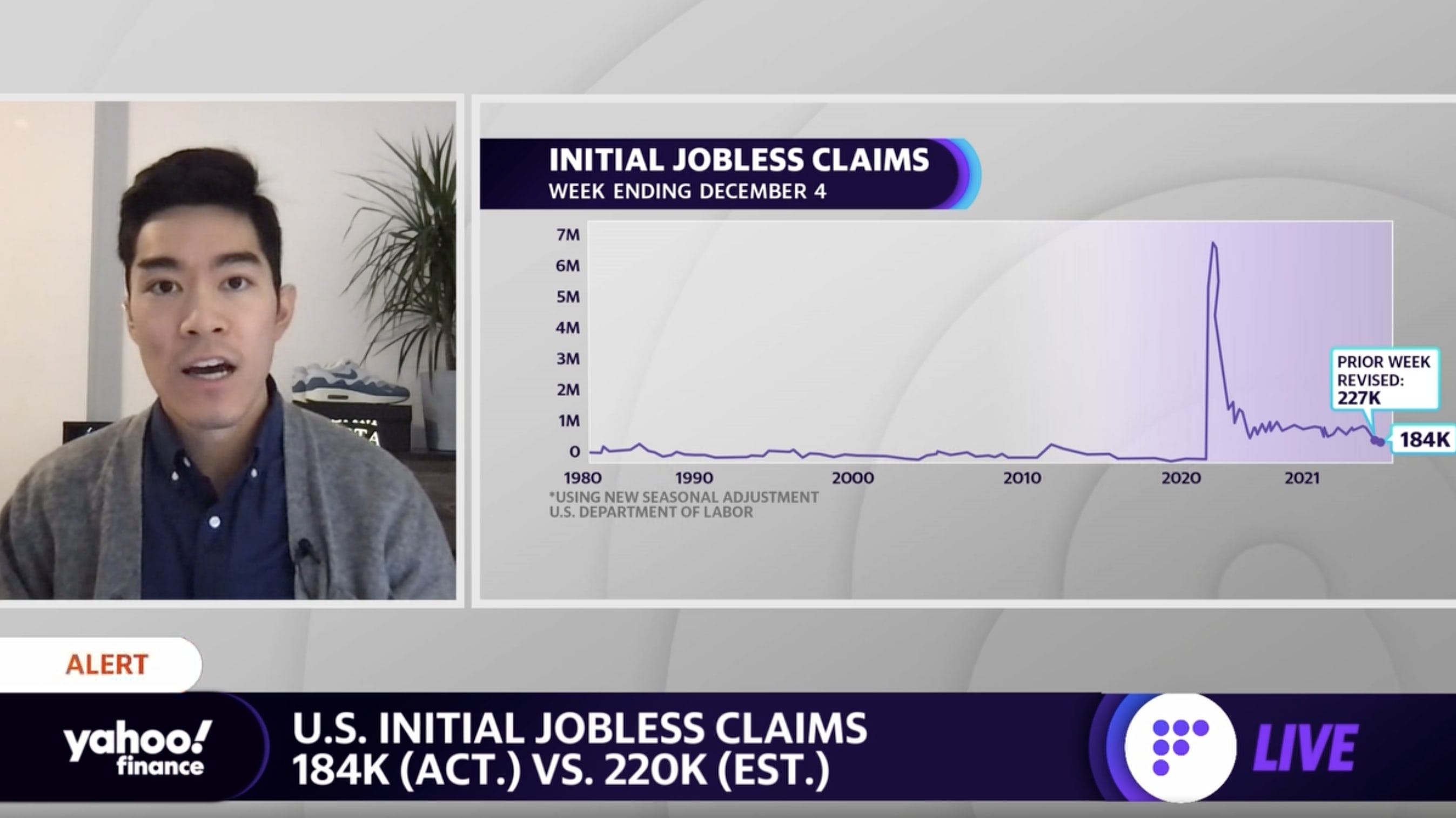
New jobless claims totaled 184,000 last week, reaching lowest since 1969

https://finance.yahoo.com/news/weekly-unemployment-claims-week-ended-dec-4-2021-192034644.html

Weekly U.S. jobless claims fell to 184,000, lowest level since 1969

New initial jobless claims improved much more than expected last week to reach the lowest level in more than five decades, further pointing to the tightness of the present labor market as many employers seek to retain workers. 

The Labor Department released its weekly jobless claims report on Thursday. Here were the main metrics from the print, compared to consensus estimates compiled by Bloomberg:

  • Initial unemployment claims, week ended Dec. 4: 184,000 vs. 220,000 expected and an upwardly revised 227,000 during prior week 
  • Continuing claims, week ended Nov. 27: 1.992 million vs. 1.910 million expected and a downwardly revised 1.954 million during prior week

Jobless claims decreased once more after a brief tick higher in late November. At 184,000, initial jobless claims were at their lowest level since Sept. 1969. 

“The consensus always looked a bit timid, in light of the behavior of unadjusted claims in the week after Thanksgiving in previous years when the holiday fell on the 25th, but the drop this time was much bigger than in those years, and bigger than implied by the recent trend,” Ian Shepherdson, chief economist for Pantheon Macroeconomics, wrote in an email Thursday morning. “A correction next week seems likely, but the trend in claims clearly is falling rapidly, reflecting the extreme tightness of the labor market and the rebound in GDP growth now underway.”

After more than a year-and-a-half of the COVID-19 pandemic in the U.S., jobless claims have begun to hover below even their pre-pandemic levels. New claims were averaging about 220,000 per week throughout 2019. At the height of the pandemic and stay-in-place restrictions, new claims had come in at more than 6.1 million during the week ended April 3, 2020. 

Continuing claims, which track the number of those still receiving unemployment benefits via regular state programs, have also come down sharply from pandemic-era highs, and held below 2 million last week. 

“Beyond weekly moves, the overall trend in filings remains downward and confirms that businesses facing labor shortages are holding onto workers,” wrote Rubeela Farooqi, chief U.S. economist for High Frequency Economics, in a note on Wednesday. 

Farooqi added, however, that “the decline in layoffs is not translating into faster job growth on a consistent basis, which was evident in a modest gain in non-farm payrolls in November.” 

“For now, labor supply remains constrained and will likely continue to see pandemic effects as the health backdrop and a lack of safe and affordable child care keeps people out of the workforce,” she added. 

Other recent data on the labor market have also affirmed these lingering pressures. The November jobs report released from the Labor Department last Friday reflected a smaller number of jobs returned than expected last month, with payrolls growing by the least since December 2020 at just 210,000. And the labor force participation rate came in at 61.8%, still coming in markedly below its pre-pandemic February 2020 level of 63.3%. 

And meanwhile, the Labor Department on Wednesday reported that job openings rose more than expected in October to top 11 million, coming in just marginally below July’s all-time high of nearly 11.1 million. The quits rate eased slightly to 2.8% from September’s record 3.0% rate. 

“There is a massive shortage of labor out there in the country that couldn’t come at a worst time now that employers need workers like they have never needed them before. This is a permanent upward demand shift in the economy that won’t be alleviated by companies offering greater incentives to their new hires,” Chris Rupkey, FWDBONDS chief economist, wrote in a note Wednesday. “Wage inflation will continue to keep inflation running hot as businesses fall all over themselves in a bidding war for talent.”

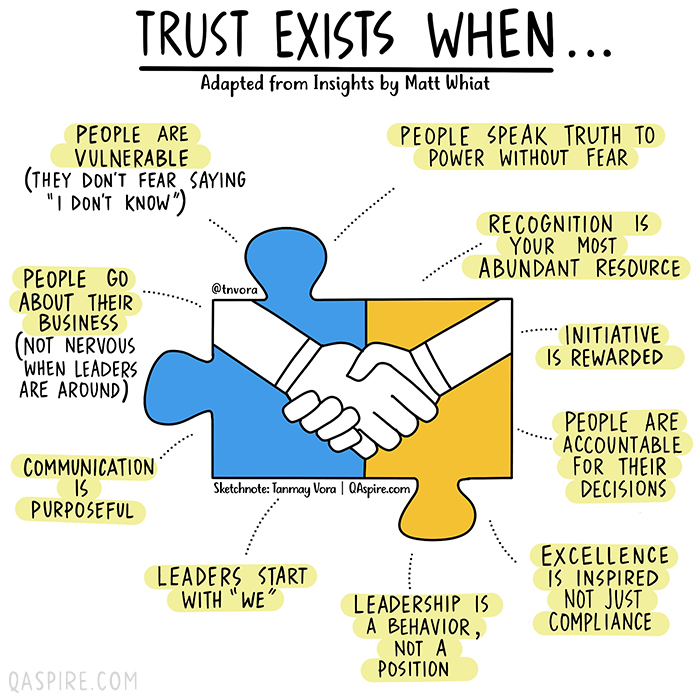
Signs of a High-Trust Environment

In the era of great awakening, leaders have to step up and be conscious about building trust with people they work with.

The old rules and hierarchies, that were already becoming obsolete, have now been thrown out of the window. People look for integration of work and well-being knowing that work is what you do, not a place you go to.

Opportunities are abound and excellent people have ample choices (they always had). It is high time that organizations and leaders think this through carefully to first align their own mindset to this new reality and then take conscious actions to build teams, practices and processes that are not just high-performing but also have a strong fabric of trust woven in.

Employees, after all, are volunteers who exercise their choice of working with you. Effective leadership is about making it worth for them.

Building high-trust environment means putting the human back at the center of how a business functions and building everything – purpose, culture, processes, structures, rituals, systems, tools and mindsets – around it.

How would we know if we are working in an environment where we can trust others and that we are trusted? We can always answer this based on our intrinsic feeling but if you are a leader who is working hard to build trust, here are a few vital signs that you need to look for.

How much nurse pay is rising—and why

Travel Nurse Guaranteed Pay: The Truth - The Gypsy Nurse

Amid a nationwide staffing shortage, rising demand for nurses has led hospitals to increase salaries and other benefits to attract and retain workers, Melanie Evans reports for the Wall Street Journal.

Hospitals increase salaries, benefits to keep up with nursing demand

Hospitals across the country have been struggling amid staffing shortages, particularly of nurses, Evans reports. According to health care consultancy Premier, nurse turnover rates have increased to around 22% this year, up from the annual rate of about 18% in 2019.

“We are employing more nurses now than we ever have, and we also have more vacancies than we ever had,” said Greg Till, chief people officer at Providence Health & Services.

To retain their current nurses and attract new staff, many hospitals have increased their nurses’ salaries to remain competitive in the job market, Evans reports.

For example, HCA Healthcare, one of the largest hospital chains in the country, said it increased nurse pay this year to keep up with Covid-19 surges and compete with rivals also trying to fill vacant positions.

Similarly, Jefferson Health in May raised salaries for its nearly 10,000 nurses by 10% after the system discovered that rivals had increased their compensation. “The circumstances required it,” said Kate Fitzpatrick, Jefferson’s chief nurse executive.

In addition, Citizens Memorial Hospital in Bolivar, Mo., this month raised its nurses’ salaries by up to 5% after rivals in other nearby cities increased their workers’ wages. Sarah Hanak, Citizen Memorial’s CNO, said the hospital also increased the hourly wages of nurses working overnight shifts by around 15% to ensure sufficient staffing for those shifts.

“We were forced to,” Hanak said. “We absolutely have to stay competitive.”

Overall, the average annual salary for RNs, not including bonus pay, grew to $81,376, according to Premier—a 4% increase across the first nine months of the year. This is larger than the 3.3% increase in the average annual nurse salary for 2020 and the 2.6% increase in 2019, Evans writes.

In addition to salary increases, some organizations, such as Providence, are also offering other benefits to attract and retain nurses, such as more time off, greater schedule flexibility, and new career development opportunities. Many hospitals are also hiring new graduates to work in specialized roles in ORs and other areas, allowing them to advance their careers more quickly than they would have before.

Overall, this rising demand for nurses has allowed those entering the workforce to negotiate higher salaries, more flexible working hours, and other benefits, Evans writes.

“I think you get to write your ticket,” said Tessa Johnson, president of the North Dakota Nurses Association.

Nurse compensation increases were inevitable—here’s why

It was inevitable that we would get to this point: baseline nurse compensation on a clear upward trajectory. Inevitable because this boils down to laws of supply and demand. Amid a clear nursing shortage, organizations are being forced to raise baseline compensation to compete for increasingly scarce qualified nurses. This is true in nearly every market, even for those considered to be ‘destination employers.’

If anything, what’s most surprising in the data from Premier is the moderated increase of around 4%. From a worker’s perspective, that’s not even covering cost of living increases due to inflation. However, amid this new data, it’s important to keep two things in mind:

Two considerations for health care leaders

  1. New data only captures baseline compensation.Differentials—which organizations must standardize and expand across shifts, specialties, and even settings—plus overtime put baseline compensation much higher. Not to mention lucrative sign-on bonuses, that members tell us are increasingly table stakes in their markets. In general, we don’t recommend this type of incentive that does nothing for retention. You’re better off investing those resources in baseline compensation as well as beefing up your RN bonus plan to incentivize retention.
  2. There is a new floor for wages (and it’s only going up from here).

Open questions (and important indicators) we are assessing

  • What happens to wages for entry-level clinical roles? As the shortage of RNs persists, organizations will need to make a shift to team-based models of care, and those are only possible with a stable workforce of entry-level personnel. Right now, that part of the health care workforce is anything but stable. When you consider their work and their wages in comparison to out-of-industry players that pay the same or better, that’s a clear area where investment is required. 
  • Will the share of nurses working permanently with travel agencies return to pre-pandemic levels? That’s to say, what will those RNs who experienced the traveler lifestyle and pay value more moving forward: the flexibility and premium pay or stability of permanent employment? Even if this number stabilizes a couple percentage points above pre-pandemic levels, that will aggravate provider’s sense of shortage.