1.3 million Americans filed first-time unemployment claims last week

https://www.cnn.com/2020/07/16/economy/unemployment-benefits-coronavirus/index.html

1.3 million people filed for first-time unemployment last week

It’s still not easy to remain employed in the US, nearly four months after the coronavirus pandemic began upending the economy.

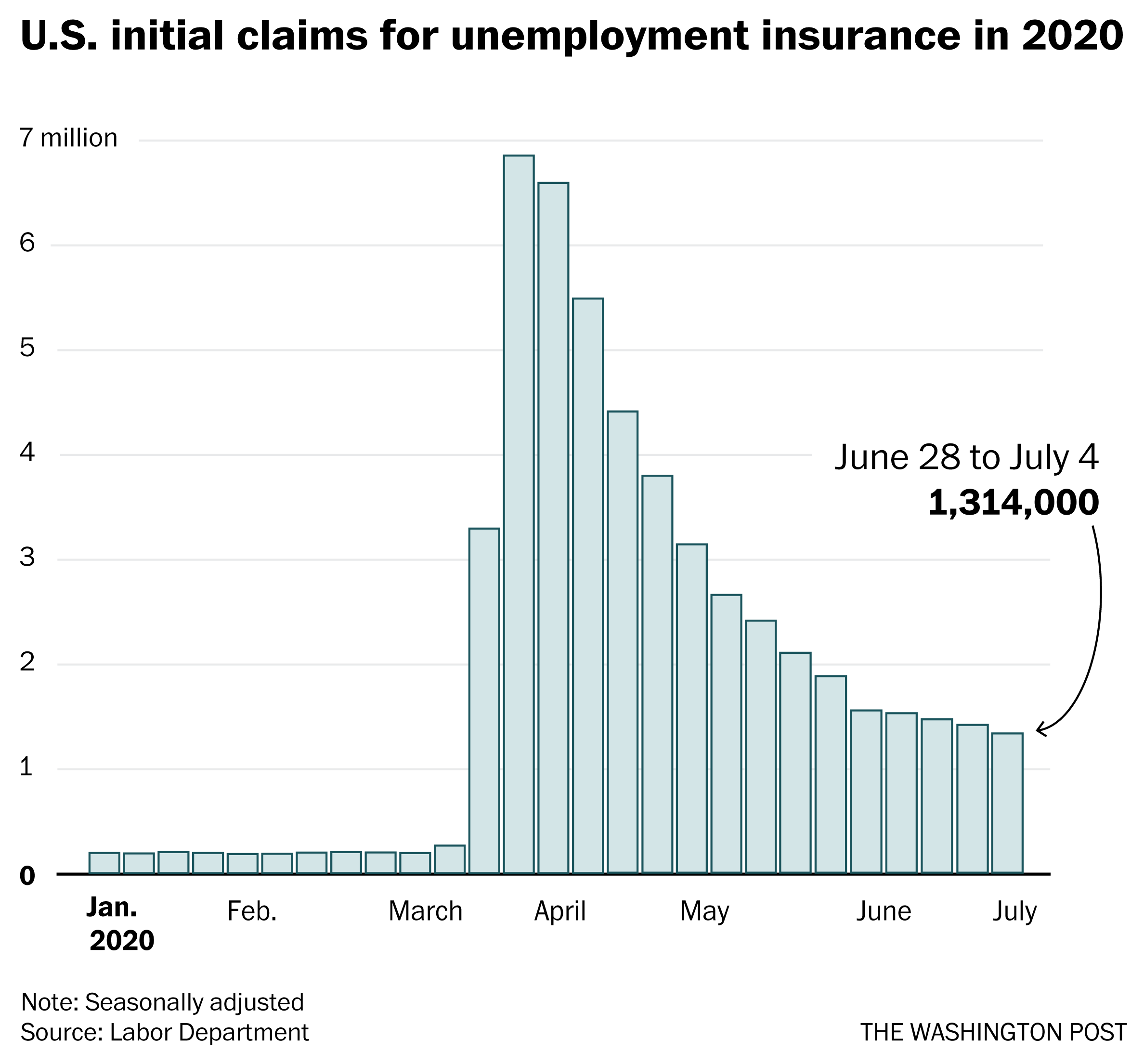
Another 1.3 million people filed first-time jobless claims on a seasonally adjusted basis for the week ending July 11, according to the Department of Labor. That’s down 10,000 from the prior week’s revised level.
On an unadjusted basis, more than 1.5 million people filed first-time claims, up almost 109,000 from the week before. The seasonal adjustments are traditionally used to smooth out the data, but that has tended to have the opposite effect during the pandemic.
Weekly first-time unemployment applications have been on the decline for more than three months since their peak in the last week of March. But last week’s drop was less than expected.
“Overall, filings remain high and are declining at a stubbornly slow pace,” said Rubeela Farooqi, chief US economist for High Frequency Economics, noting that the risk of mounting permanent job losses is high. “The pace could slow even further or reverse in coming weeks in response to a surge in virus cases and related closures of businesses.”
Continued claims, which count workers who have filed claims for at least two weeks in a row, stood at more than 17.3 million for the week ending July 4, down 422,000 from the prior week. These claims peaked in May at nearly 25 million.
In addition, about 928,500 million people in 47 states filed for first-time pandemic unemployment assistance last week, down almost 118,000 from the week before. And almost 14.3 million people claimed continued pandemic benefits across 48 states for the week ending June 27. That’s up nearly 406,000 from the prior week.
The pandemic program was created by Congress in March to respond to the coronavirus outbreak. It provides temporary benefits to workers who typically aren’t eligible for payments, including freelancers, independent contractors, the self-employed and certain people affected by the coronavirus. It expires at the end of the year.
Looking at all workers participating in an array of unemployment programs, just over 32 million Americans claimed jobless benefits the week ending June 27, down about 433,000 from the prior week.
That total includes those in the traditional and pandemic unemployment programs, as well as the pandemic emergency unemployment compensation program, which has nearly 936,500 filers. Lawmakers created it in March to provide those who have exhausted their benefits with an additional 13 weeks of payments. It also expires at the end of 2020.


5.4 million Americans lost health insurance

https://www.axios.com/newsletters/axios-vitals-285240f4-9110-4c86-ad7e-e0c37085a957.html?utm_source=newsletter&utm_medium=email&utm_campaign=newsletter_axiosvitals&stream=top

Medicare for All (@AllOnMedicare) | Twitter

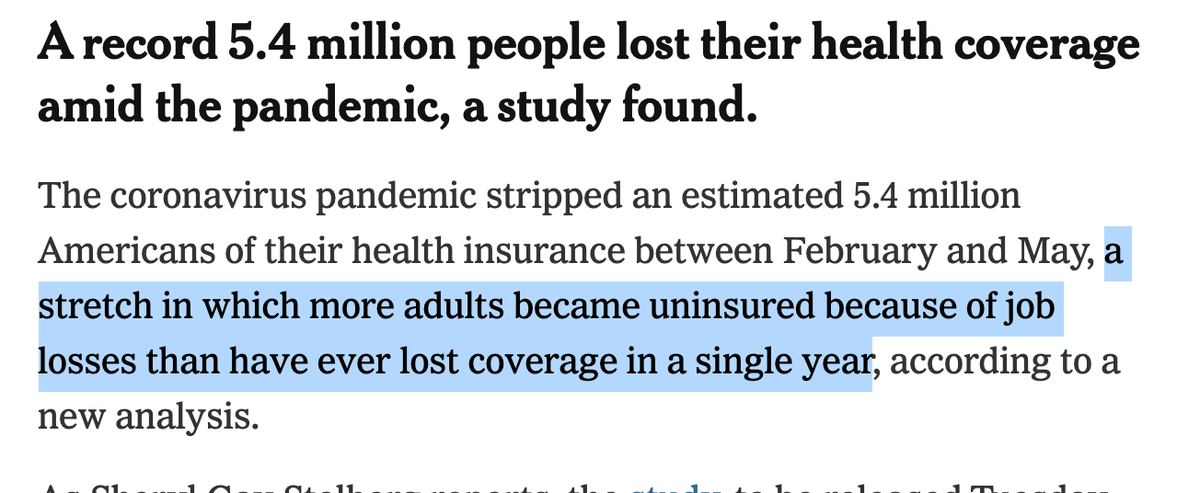
Roughly 5.4 million adults in the U.S. lost their health insurance from February to May after losing their jobs, according to a new estimate from Families USA, a group that favors the Affordable Care Act.

Why it matters: There are more adults under 65 without insurance in Southern states, which are the same states setting new records for single-day coronavirus infections along with rising hospitalizations, Axios’ Orion Rummler writes.

What they found: 3.9 million adults lost health insurance over one year during the Great Recession, per Families USA’s analysis. It only took four months in this current crisis for an estimated 5.4 million Americans to lose health insurance.

  • More than 20% of adults in Georgia, Florida, South Carolina, North Carolina, Mississippi, Oklahoma and Texas were without insurance as of May.
  • All of these states have set new records in the past two weeks for their highest number of coronavirus infections in a single day, per data from the COVID Tracking Project.
  • 46% of adults who lost coverage due to the pandemic came from five states: Florida, New York, Texas, California and North Carolina.

The backdrop: 21 million Americans were unemployed in May, according to the Bureau of Labor Statistics’ nonfarm payrolls report.


Cartoon – Importance of Maintaining Employee Morale

Dilbert: Boosting Morale | Monar Consulting, Inc.

Another 1.3 million people applied for new jobless benefits last week as the pandemic’s toll on the economy continued

https://www.washingtonpost.com/business/2020/07/09/another-13-million-people-applied-new-jobless-benefits-last-week-pandemics-toll-economy-continued/?fbclid=IwAR0cDN8SNbJF-SoMktqUOPJyJQ5ZTwvqENXxZzkbXhcygOOrgVxVDotPlHI

Another 1.3 million people applied for new jobless benefits last ...

Another 1.3 million people filed for unemployment for the first time last week, a slight decrease from the week before, as novel coronavirus cases and closures surged around the country, according to data released Thursday by the Department of Labor.

The numbers of new unemployment filings have remained above a million each week since the pandemic began mid-March. That number has averaged about 1.4 million the past four weeks.

In addition, states reported that another 1 million claims were made under the Pandemic Unemployment Assistance program, which grants jobless benefits for gig workers, self-employed workers and contractors, the agency reported.

When combined, the two numbers for initial unemployment claims have ticked up the past three weeks, from 2.24 million in mid-June to 2.44 million last week.

The numbers for the first few days of July come as rising cases of coronavirus infections have hit states and counties nationwide, touching off a new round of closures and restrictions and sending some workers back to the unemployment insurance queue for the second time in just a few short months.

“The bad news is that initial claims are still historically very high and they suggest that damage is continuing to accumulate in the economy,” Adam Ozimek, chief economist at Upwork, said in an interview.

The unemployment rate, which is tabulated separately from the weekly jobless claims, has trended downward the past two months, to 11.1 percent last month, as many laid off or furloughed workers in industries like food service and retail were called back to work. Yet a rising number of workers have reported permanent layoffs.

And the jobless statistics don’t capture the damage from the new round of cases yet.

“All these factors look more like an economy that is riding into a recession than out of one,” Ozimek said. “At this stage in the game, when we’re this far from initial shock, it becomes less likely that new layoffs are the types of jobs that snap back.”

The numbers of people continuously receiving benefits at the end of June has also trended gradually downward. The last week of June saw 18.1 million people on unemployment insurance, down from 19.3 million people the week before that, as re-hirings have slightly outpaced new layoffs week by week.

But as hopes fade for a quick rebound from the pandemic — the United States reported more than 60,000 new cases on Wednesday, a new high — signs of longer term economic damage are emerging.

Levi Strauss & Co. said this week that it planned to cut about 15 percent of its nonretail and nonmanufacturing positions, or about 700 jobs this year. United Airlines warned it may need to furlough nearly 40 percent of its workforce this year, about 36,000 employees. Industrial and aerospace manufacturer the Barnes Group said it would layoff 400 workers; BAE Systems, a defense and aerospace company, said it planned to layoff 300 employees.

There are many workers like Samantha Hartman, 29, whose temporary layoff — she was furloughed in March from Rosen Hotels & Resorts, the hospitality company she works for in Orlando — became permanent this week.

Hartman said her supervisor called her this week to tell her that the company had tried to come up with a way to keep employees but found their hands tied with almost no business coming in.

“Everything is up in the air,” Hartman said. “I fully expect not to find another job in this industry.”

The company, which received a Paycheck Protection Program small business loan of more than $6 million according to the Orlando Sentinel, announced Wednesday that it would layoff a “substantial” amount of its workforce by July 31.

Hartman, who has a heart condition, said the company is letting her keep her health care through August. She moved to Orlando two years ago for the job. Now, she says she’ll probably move back with her family in California when her lease is up next year.

She said Florida’s challenges — including large delays in unemployment insurance processing, mishandling of the coronavirus response, a governor she doesn’t trust — make her less likely to stay in Florida. “If I’m going to struggle financially, I’d rather do that back home where I have a support system,” Hartman said.

Plunging consumer demand amid the virus’s surge and ensuing shutdowns have shuttered businesses across the country. Bed Bath & Beyond announced it would close 200 stores; Brooks Brotherswhich filed for bankruptcy protection this week, said it would close 51 stores.

And there’s a grim waiting game for what are expected to be widespread layoffs in state and municipal governments, as budgets are drastically pared to meet declining tax revenue.

Initial weekly jobless claims remain well above the record before the pandemic, of 695,000 in 1982. They have dropped every week since the peak of 6.9 million, from a week in late March, but have plateaued for more than a month.


June’s cautious economic recovery is based in part-time work and vulnerable industries

https://www.washingtonpost.com/business/2020/07/02/junes-cautious-economic-recovery-is-based-part-time-work-vulnerable-industries/?fbclid=IwAR290sM5RZgwuxNMBDi1chv_i1ulzy4zY2KF4f1cDUMCsiTTpME2wkGVM6s&utm_campaign=wp_main&utm_medium=social&utm_source=facebook


The June unemployment rate of 11.1 percent, down from a peak of 14.7 percent in April, reflects a continuing, cautious economic recovery. What those numbers don’t show is an increase in employment driven disproportionately by part-time work and industries that are vulnerable to another shutdown.

The unemployment rate is a blunt tool. It takes into account anyone who works, even if they work for only one hour a week. And part-time employment has recovered much more quickly from April’s catastrophic losses than full-time employment. While full-time employment is still 12 percent lower than it was in February, part-time employment is back to pre-pandemic levels.

According to the Labor Department’s survey of American households, many of those workers would work full-time if they could and are working part-time only because of poor economic conditions. The number of people pushed into part-time work has more than doubled since February. Meanwhile, the number of people who work part-time by choice is still down by 23 percent.


The unemployment rate isn’t wrong: Part-time work is still work. However, those jobs have already proved to be vulnerable to a slowing economy. Anyone pushed into part-time work by the coronavirus’s initial shock to the economy may be even more vulnerable in the case of future shutdowns. And part-time workers may not have access to benefits such as health insurance that are available to full-time workers.

The industries that bounced back in May and June are also at the mercy of future shutdowns as coronavirus cases surge across the Sun Belt. For instance, unemployment in leisure and hospitality is still very high but dropped by 10 percentage points from April’s staggering 40 percent. Retail and wholesale unemployment dropped by a third. In contrast, finance, government and professional services have had a slow start to recovery. Unemployment in the information industry actually increased from May to June.


If the greatest gains in employment are in industries that suffered most in the early stages of the pandemic, those gains are vulnerable to future waves of shutdowns. Meanwhile, less-volatile industries may continue to be slow to bounce back. A Congressional Budget Office report predicted that the unemployment rate is expected to stay above its pre-pandemic levels through the end of 2030.


358K healthcare jobs added in June; hospitals see 1st gain since March

https://www.beckershospitalreview.com/workforce/358k-healthcare-jobs-added-in-june-hospitals-see-1st-gain-since-march.html?utm_medium=email

Medical Jobs - Free Listing

Healthcare added 358,000 jobs in June, with hospitals seeing their first modest gain since March, according to the latest jobs report from the U.S. Bureau of Labor Statistics.

The June count compares to 312,400 healthcare jobs added in May, and 1.4 million healthcare jobs lost in April. 

Within ambulatory healthcare services, dentist offices saw the biggest job gains in June, with more than 190,000 new jobs. Physician offices saw more than 80,000 job gains, and other healthcare practitioners’ offices had more than 48,000 gains in June.

Hospitals added 6,700 jobs in June, the first job gains seen since losing 26,700 jobs in May and 134,900 positions in April.

Nursing and residential care facilities lost 18,300 jobs last month, compared to 36,600 jobs lost in May.

Overall, the U.S. added nearly 4.8 million jobs in June, marking the second months of gains. The U.S. lost 20.5 million jobs in April, but added 2.5 million in May. The unemployment rate also declined to 11.1 percent in June, compared to 13.3 percent in May.

To view the full jobs report, click here.


Pre And Post Coronavirus Unemployment Rates By State, Industry, Age Group, And Race

https://www.forbes.com/sites/mikepatton/2020/06/28/pre-and-post-coronavirus-unemployment-rates-by-state-industry-age-group-and-race/#65c42c6555eb

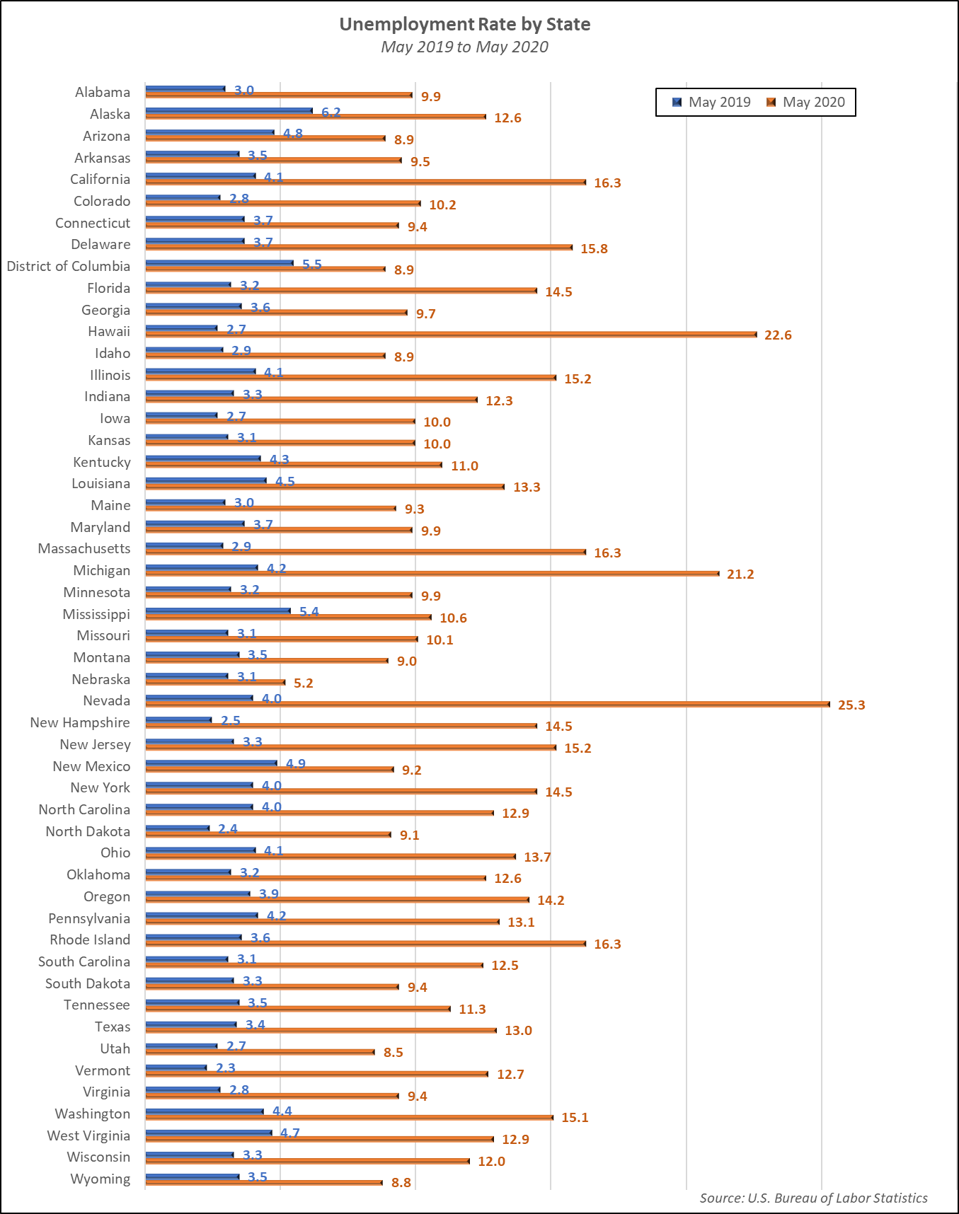
Unemployment by State-May 2019 to May 2020

The coronavirus has decimated the U.S. economy and benched nearly 40 million American workers. In the past several days, the U.S. has logged its highest number of new Covid-19 cases since the pandemic began. These combined with other factors, which we will discuss, is jeopardizing the future employment of millions of workers and the viability of thousands of businesses. Here’s how unemployment has increased for every state, industry, age group, and race, and why.

Unemployment by State

The coronavirus and subsequent stay at home orders hit the labor force especially hard. As states attempted to reopen, a resurgence in the virus is causing many businesses to close again, some by choice, others by government mandate.

Nevada has been hit the hardest as the unemployment rate in the Silver State rose from 4.0% in May 2019 to a whopping 25.3% in May 2020. Nevada’s economy is heavily reliant on leisure and hospitality, which had the brunt of the job losses. Hawaii, the second hardest hit state saw unemployment rise from 2.7% in May 2019 to 22.6% in May 2020. Which is the only other state with unemployment above 20% in May 2020? Michigan, where unemployment rose from 4.2% to 21.2% year over year. What state has fared best? Nebraska, which also has one of the most diverse economies of all states. Deriving nearly 50% of its total GDP from five different industries, unemployment in the Cornhusker State rose from 3.1% to a modest 5.2% from May 2019 to May 2020. Unemployment numbers for all states are shown in the following chart.

Unemployment by Industry

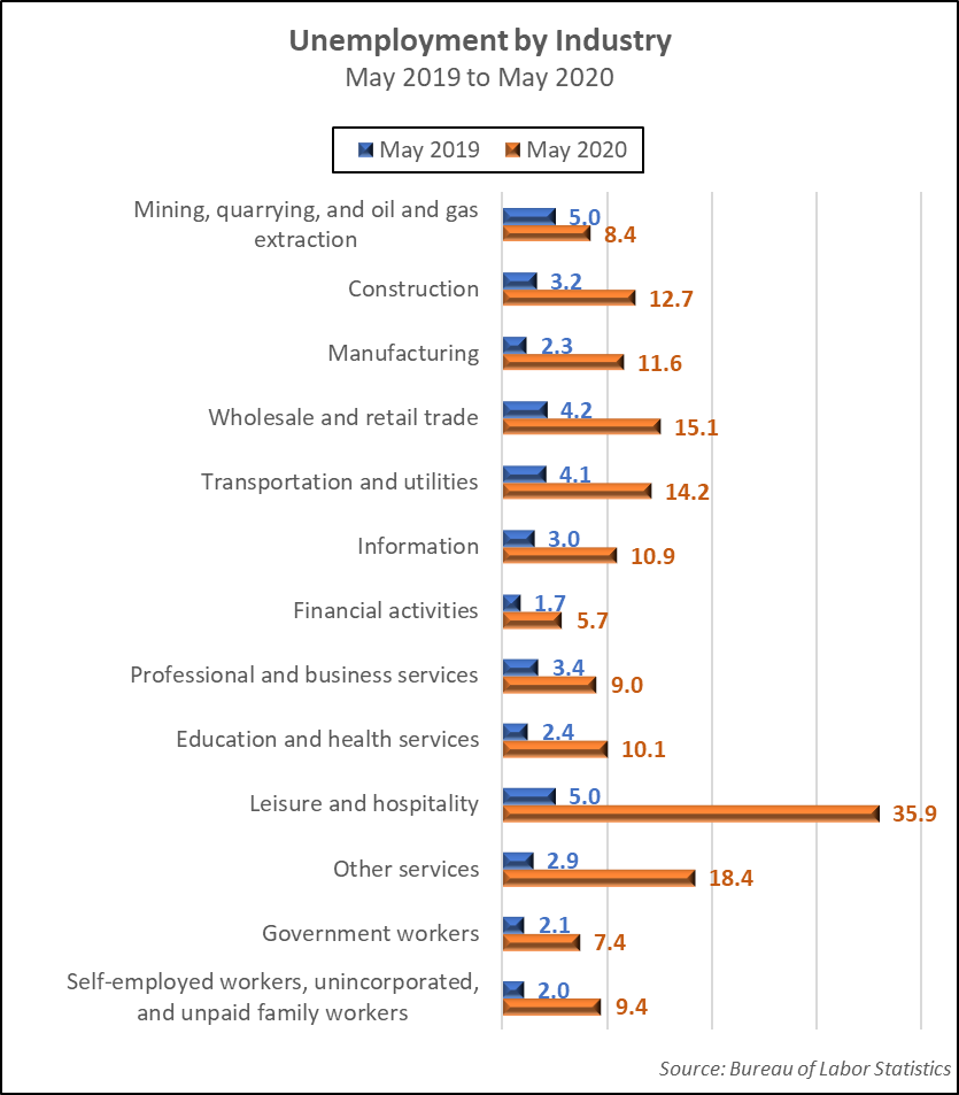
As mentioned in the previous section, the states that have fared best either have a more diverse economy or do not rely heavily on industries that have been hardest hit by the coronavirus. The most negatively affected is the leisure and hospitality industry where unemployment rose 618% from a low of 5.0% in May 2019 to a staggering 35.9% in May 2020. At a distant second, but still reeling, is the wholesale and retail trade industry, which saw unemployment rise from 4.2% to 15.1% during the same period. The rest of the industries are listed in the following chart.

Unemployment by Industry-May 2019 to May 2020

Unemployment by Age Group

Businesses need two things to exist: workers and customers. Without customers, there is no need for workers or the business for that matter. Some businesses require highly skilled workers while others operate well using unskilled labor. It is this unskilled labor group that has been hardest hit.

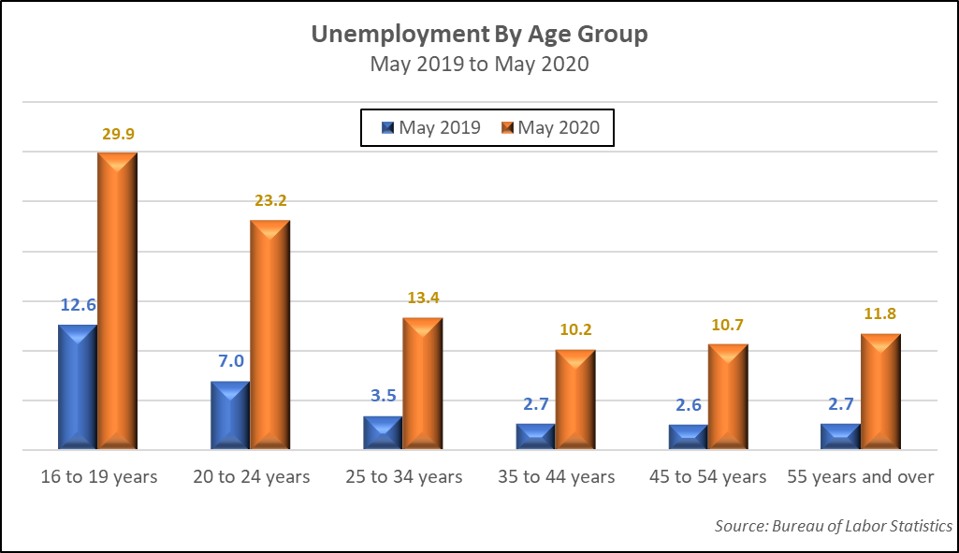
The greatest rise in unemployment is among workers under age 25. This is likely due to three factors. Younger workers typically have fewer marketable skills, less work experience, and less seniority. Many of these workers are in industries that have felt the greatest pain. Unemployment rates by age group are contained in the following chart.

Unemployment by Age Group-May 2019 to May 2020

Unemployment by Race/Ethnicity

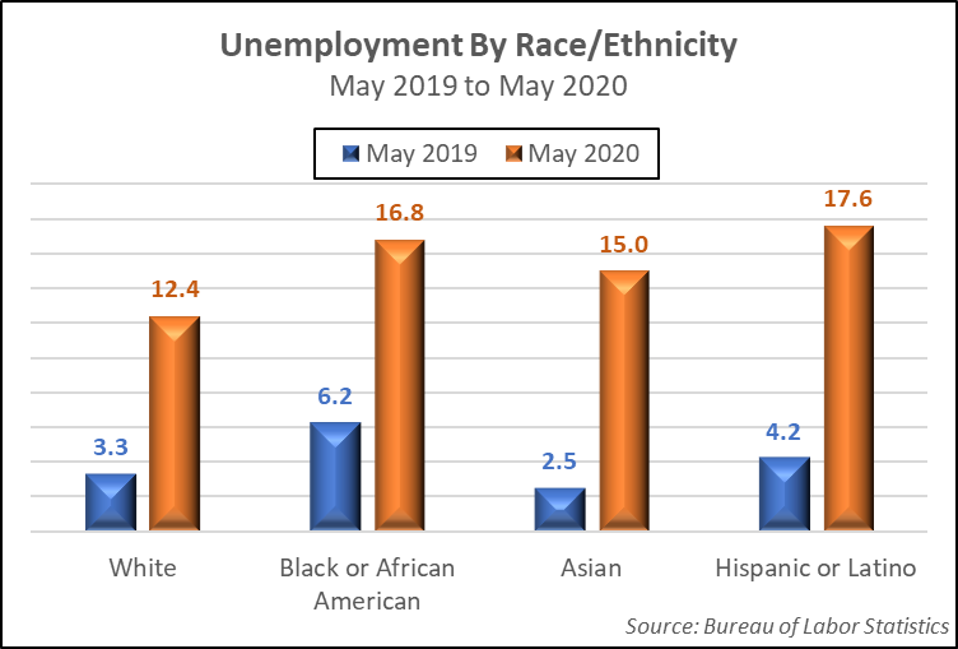
Question: Prior to Covid-19, was unemployment among blacks / African Americans at a record low as President Trump has claimed? Using the available data, which extends back to January 1972, the answer is yes. This new record low was achieved in October and November of 2019 when unemployment among black or African American workers fell to 5.1%. The previous record low was 5.2% in December 1973. The current rate is 16.8%, which is less than the highest rate of 20.7% logged in December 1982. The most recent high in unemployment for this group was 19.3% in March 2010. It has been steadily declining since then. Numbers for White, Asian, and Hispanic or Latino and black or African American workers are listed in the following chart.

Unemployment by Race or Ethnicity-May 2019 to May 2020

Businesses need workers, workers need businesses, and both depend on customers. Since the pandemic began, consumer demand has fallen sharply. With the probability that a vaccine will not be available until early 2021 at the soonest, plus a disregard for recommended safety protocols by many individuals, namely wearing masks and social distancing, it is highly unlikely that the economy will return to normal for several years.

Will the president continue to hold rallies? Will he set an example by wearing a mask? Will the protests and violence continue? Will other large gatherings continue? Unless Americans make a collective and conscious choice to mask up and social distance, we will be forced to live in a depressed economy for longer than necessary. The choice is up to us.