Supreme Court upholds ACA in 7-2 decision, leaving intact landmark US health law during pandemic

The Supreme Court on Thursday issued an opinion upholding the Affordable Care Act by a 7-2 vote, allowing millions to keep their insurance coverage amid the coronavirus pandemic.

In the decision, the court reversed a lower court ruling finding the individual mandate unconstitutional. However, the court did not get to the key question of whether the individual mandate is severable from the rest of the law. Instead, the court held the plaintiffs do not have standing in the case, or a legal right to bring the suit.

Justice Stephen Breyer wrote the opinion while Justices Samuel Alito and Neil Gorsuch filed dissenting opinions.

Breyer wrote that a court must address a plaintiffs’ injuries. But Breyer found there were no injuries, so he asked: “What is that relief? The plaintiffs did not obtain damages.” Breyer added, “There is no one, and nothing, to enjoin.”

A wide swath of industry cheered Thursday’s news.

The American Medical Association called it a victory for patients, so too did America’s Essential Hospitals, a safety net trade group that called it a win. The American Hospital Association said the more than 30 million of Americans who obtained coverage from the law can “breathe a sigh of relief.”

Millions of Americans gained health insurance coverage as a result of the Affordable Care Act, President Barack Obama’s landmark law passed in 2010 and reshaped virtually every corner of American healthcare. The latest challenge threatened to undo coverage gains under the law that helped drive down the uninsured rate to a record low.

Proponents feared the law was in greater jeopardy following the death of Supreme Court Justice Ruth Bader Ginsburg, part of the court’s liberal wing, which shrunk to just three of a total of nine justices without her.

Those fears now seem to be overblown. Chief Justice John Roberts joined the courts liberals in upholding the law, as did two of President Donald Trump’s Supreme Court picks, Justices Brett Kavanaugh and Amy Coney Barrett.

In a rare move, Trump’s DOJ declined to defend the ACA, when the challenge was brought by a group of red states and two men with marketplace plans. Former California Attorney General Xavier Becerra, now HHS secretary, led a group of blue states to defend the law in federal court. 

Recap of the controversial case

The case centers on the individual mandate, the part of the law that compelled Americans to purchase health insurance or pay a fee. The framers of the ACA believed the mandate would help drive healthy people to ensure they weren’t just filled with sick people, risking higher costs and adverse selection for insurers.

Congress effectively killed the mandate in 2017 by setting the penalty to $0.

The plaintiffs’ legal argument was strategic. They directly targeted the linchpin that saved the law in 2012. The Supreme Court largely upheld the ACA in 2012 when it ruled the mandate could be considered a tax and therefore was constitutional. Roberts infuriated conservatives by siding with liberals in that case.

Take that penalty away, by zeroing it out, and the plaintiffs argue the law is no longer constitutional because it can no longer be considered a tax if no money is collected

The key question before the Supreme Court was whether they could simply pluck the individual mandate from the remainder of the monumental health law, throw the entire law out or find some middle ground. 

The plaintiffs have argued that the individual mandate is so intertwined and closely linked to the rest of the law that the entire piece of legislation must fall if the individual mandate is ruled unconstitutional.

Before arriving at the Supreme Courta lower court ruled in 2019 the mandate was unconstitutional but sent back the key question of whether the mandate could be extracted from the remainder of the law back to the district court. The federal appeals court ruling by a three-judge panel came down along party lines: two Republicans and one Democrat.     

A question of standing

Some legal experts have criticized the challenge because the individual plaintiffs, two Texas men, no longer face any financial penalty if they were to forgo coverage. SCOTUS’ ruling agrees with that logic.

The two men joined the case originally brought by a group of red states. Legal experts said it would have been harder for the group of red states to prove an injury than the two men, John Nantz and Neill Hurley.    

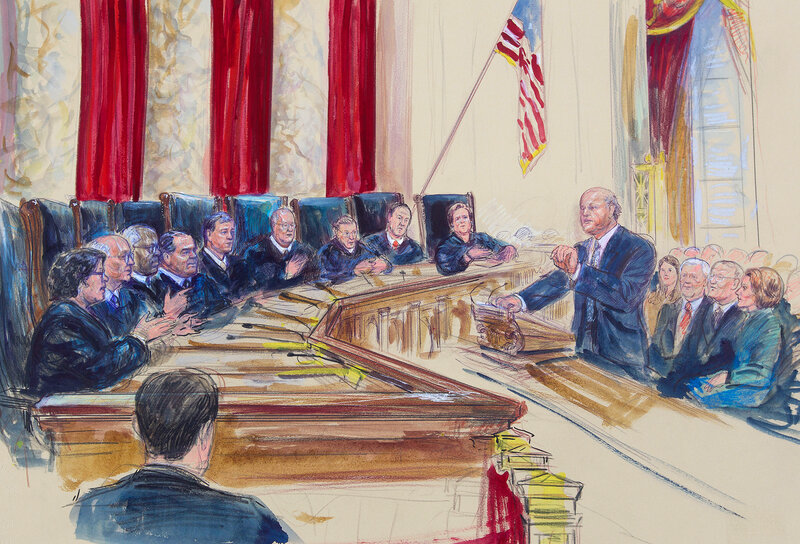
The court seemed skeptical of whether the plaintiffs had standing to bring the case during oral arguments in November. Justices spent a large portion of the two-hour hearing on the topic. 

The word standing was mentioned at least 59 times, according to the court’s transcript of the hearing, outnumbering other key words such as severability, another important legal concept in the case. 

In one now-telling exchange from oral arguments, Gorsuch seemed confused over the premise of the challenge to begin with: “I guess I’m a little unclear who exactly they want me to enjoin and what exactly do they want me to enjoin them from doing?”

Supreme Court upholds Affordable Care Act

https://www.healthcarefinancenews.com/news/supreme-court-upholds-affordable-care-act

The Supreme Court has upheld the constitutionality of the Affordable Care Act in a decision released this morning. 

The Republican state plaintiffs, led by Texas, have failed to show they have standing to attack as unconstitutional the ACA’s minimum essential coverage provision, the justices said. 

“Therefore, we reverse the Fifth Circuit’s judgment in respect to standing, vacate the judgment, and remand the case with instructions to dismiss,” they said.

Justice Stephen Breyer delivered the majority opinion, in which Chief Justice John Roberts and Justices Clarence Thomas, Sonia Sotomayor, Elena Kagan, Brett Kavanaugh and Amy Coney Barrett joined. 

Justice Samuel Alito filed the dissenting opinion in which Judge Neil Gorsuch joined. 

1 in 3 Americans skip care due to cost concerns, survey shows

Americans most likely to skip health care due to cost: survey

In the past year, cost was a bigger factor driving Americans to skip recommended healthcare than fear of contracting COVID-19, according to a report released June 1 by Patientco, a revenue cycle management company focusing on patient payment technology.

Patientco surveyed 3,116 patients and 46 healthcare providers, finding 34 percent of female patients and 30 percent of male patients have avoided care in the past year citing concerns about out-of-pocket costs.

Below are three more notable findings from the report:

  1. Healthcare affordability is not an issue that affects only Americans with low incomes, as 85 percent of patients with household incomes greater than $175,000 are less likely to defer care when flexible payment options are offered.
  2. Across all ages, income levels and education levels, most patients said they struggled to understand their medical bills and what they owed. Nearly two-thirds of patients said they did not understand their explanation of benefits, did not know what they should do with the information in their explanation of benefits, or waited too long to obtain their explanation of benefits.
  3. Forty-five percent of patients said they would need financial assistance for medical bills that exceed $500, and 66 percent of patients said the same for medical bills that exceed $1,000.

Supreme Court’s ACA ruling looms

Some States Make Obamacare Backup Plans, As Supreme Court Decision Looms :  Shots - Health News : NPR

The U.S. Supreme Court is heading into the last month of its current term with one major healthcare case, the move to invalidate the ACA, yet to be decided, The New York Times reported June 1. 

A coalition of Republican-leaning states, led by Texas, have asked the court to strike down the ACA, signed into law in 2010. The states argue that the entire ACA is invalid because, in December 2017, Congress eliminated the law’s tax penalty for failing to purchase health insurance. The states argue that the individual mandate requiring Americans to gain health insurance or pay a penalty is inseparable from the rest of the law and became unconstitutional when the tax penalty was eliminated.

The Supreme Court heard oral arguments in the case in November, and at least five Supreme Court justices indicated support for not striking down the entire ACA.

The court is expected to rule on the matter before its nine-month term ends at the end of June, Reuters reported. 

Average benchmark premiums for ACA exchange plans decline again in 2021: report

Affordable Care Act

Average benchmark premiums for plans on the Affordable Care Act’s exchanges have fallen for the third straight year, according to a new analysis.

Researchers at the Urban Institute, a left-leaning think tank, found that the average benchmark premium on the exchanges fell by 1.7% for 2021. That follows decreases of 1.2% in 2019 and 3.2% in 2020.

By contrast, premiums for employer-sponsored plans increased by 4% in both 2019 and 2020, according to the report. Data for 2021 on the employer market are not yet available, the researchers said.

The national average benchmark premium was $443 per month for a 40-year-old nonsmoker, according to the report, before accounting for any tax credits.

The researchers found much significant variation in premium levels between states, though the difference in growth rates was smaller. Minnesota reported the lowest average benchmark premium at $292 per month, and the highest was in Wisconsin at $782 per month.

Average benchmark premiums topped $500 in 10 states, according to the report.

One of the key trends that’s slowing premium growth is increasing competition in the exchanges, as many insurers are expanding their offerings or returning to the marketplaces to offer plans, according to the report.

“New entrants included national and regional insurers, Medicaid insurers, and small start-up insurers,” the researchers wrote.

Medicaid insurers are those who operated exclusively in the Medicaid managed-care market before 2014; they have increased their participation in the Marketplaces over time. Medicaid insurers are experienced in establishing narrow, low-cost provider networks that allow them to offer lower premiums than other insurers.”

UnitedHealthcare, for example, participated in just four regions included in the study in 2017, but had upped its participation to 11 for 2021. Aetna participated in three regions included in the study in 2017 before fully exiting the exchanges; CVS Health CEO Karen Lynch told investors earlier this year that the insurer plans to return to the marketplaces in 2022.

Several states have also launched programs that aim to lower premiums, according to the report. These include reinsurance programs, which have been rolled out in 12 states as of this year. Some states have also expanded Medicaid in recent years, which leads to some low-income people with costly health needs switching to that program, the researchers said.

Missouri backtracks on Medicaid expansion

What You Need to Know About Medicaid Expansion in Missouri - Health Forward  Foundation

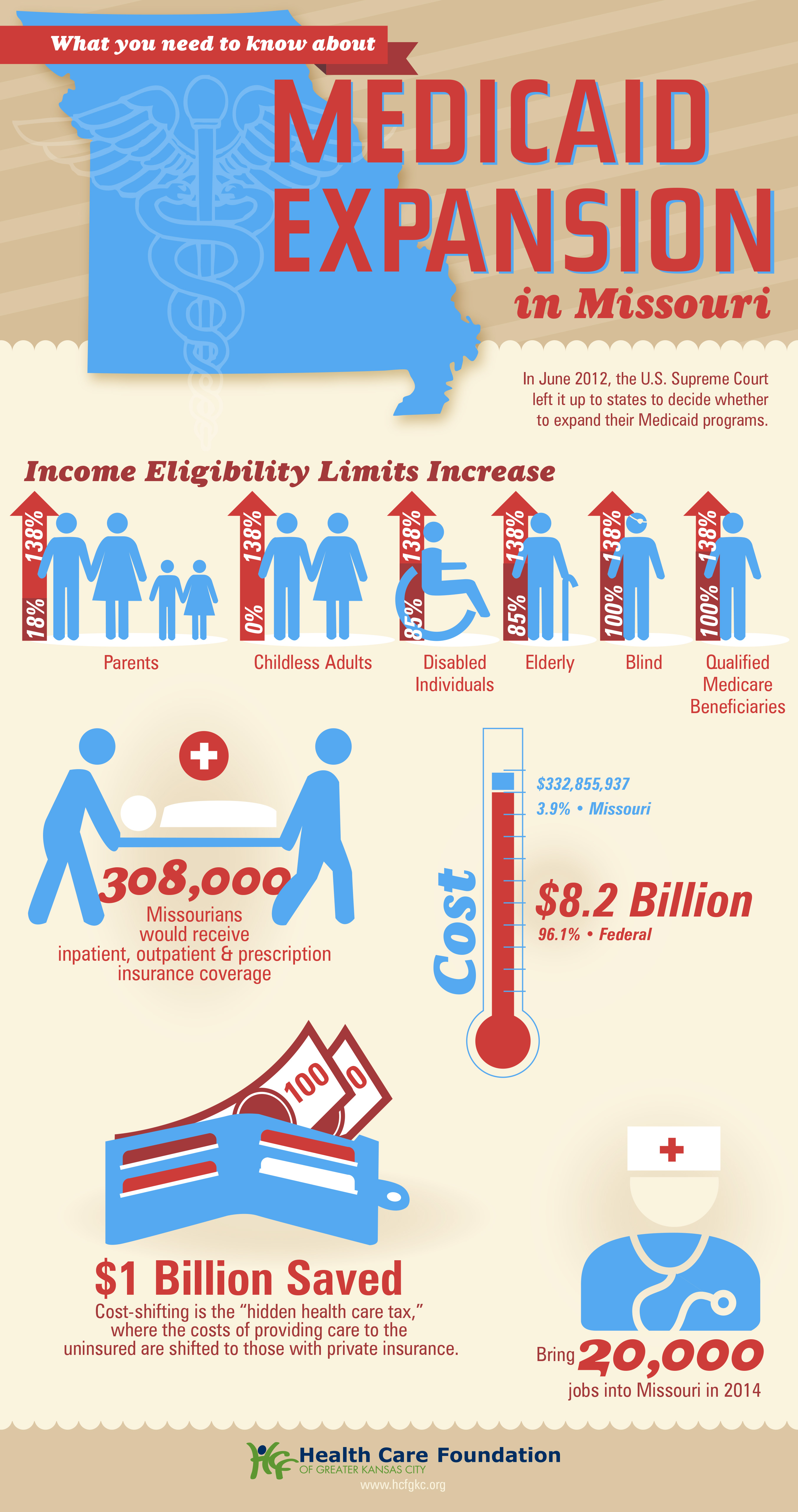
Missouri Gov. Mike Parson announced Thursday that his state would not expand Medicaid coverage to 275,000 residents who will become eligible on July 1st, despite a 2020 ballot initiative in which a majority of the state’s voters approved the expansion. Because the Missouri legislature has blocked funding for the expansion, Parson declared that the state’s Medicaid program, MO HealthNet, would run out of money if it moved forward.

The legislature’s decision to block funding was bolstered by an appeals court opinion last year, which challenged the expansion because the ballot initiative did not include a funding mechanism for widening coverage.

Under the Affordable Care Act (ACA), the federal government would have picked up 90 percent of the cost of expanding Medicaid in the state, in addition to boosting funding for existing Medicaid enrollees by 5 percent, thanks to a measure in the recent American Rescue Plan Act. 

The governor’s decision leaves in place one of the strictest Medicaid eligibility standards in the nation: a family of three in Missouri must earn less than 21 percent of the federal poverty level—$5,400 per year—in order to qualify for coverage. The expansion measure would have opened the program to childless adults, and raised the eligibility limit to 138 percent of the federal poverty level.

The Missouri Hospital Association called the decision an “affront” to voters, pointing out that the state is currently running a budget surplus, and could easily allocate funds for the expansion. The status of Medicaid expansion in Missouri, which would become the 38th state to undertake expansion since the ACA’s passage, will ultimately be decided by court ruling, according to observers.

Meanwhile, like other states (mostly in the Southeast) that have resisted Medicaid expansion, Missouri will continue to see tax dollars flow out of the state to fund benefits in states that have expanded eligibility—despite the express will of voters. Given ample evidence that Medicaid expansion boosts access to care, health status, and health system sustainability, it’s nearly unfathomable that the politics of “Obamacare” continue to complicate the extension of this critical safety-net program.

Cartoon – On the Front Lines

Letters: Herd immunity vs. herd mentality; Now that you may have time read  some good legislation; more responses (3/31/20) – The Denver Post

A Texas-sized showdown on Medicaid expansion

https://mailchi.mp/da8db2c9bc41/the-weekly-gist-april-23-2021?e=d1e747d2d8

Medicaid expansion could give insurance to over one million Texans |  Progress Texas

The showdown between the Biden administration and the state of Texas over Medicaid expansion continued to escalate this week. Sen. John Cornyn (R-TX) said he planned to place a hold on the confirmation of Chiquita Brooks-LaSure to become Administrator of the Centers for Medicare & Medicaid Services (CMS), until his concerns over the agency’s move last week to rescind a waiver extension previously granted by the Trump administration were addressed.

The so-called “1115 waiver”—worth more than $11B annually—would have extended by a decade Texas’ ability to use Medicaid funds to cover hospital costs for uninsured residents, rather than expanding Medicaid coverage under the Affordable Care Act (ACA). In rescinding the waiver extension, the Biden administration cited the lack of a public notice process before the waiver was granted, and said that the state’s existing waiver would instead expire next year, as previously scheduled.

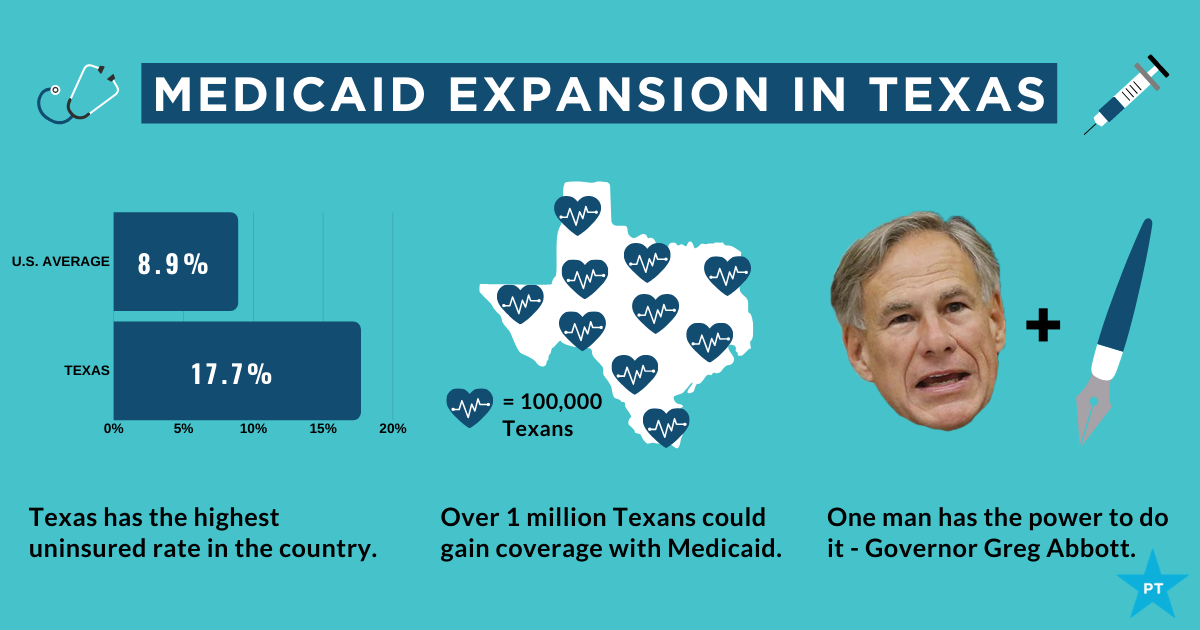
Sources inside the administration told the Washington Post last week that the move was intended to force Texas’ hand on Medicaid expansion; the state is one of 12 that have not expanded Medicaid, leaving it with the largest share of uninsured residents of any state, with eligibility currently limited to pregnant women, children, people with disabilities, and families with monthly incomes under $300 per month, or 13.6 percent of the federal poverty level.
 
Enticing the dozen remaining holdout states to expand Medicaid is an important policy priority for the new administration. A key component of the recently passed American Rescue Plan Act is a package of enhanced incentives for those states to expand eligibility, offering an extended 90 percent federal match, in addition to increased funding for existing Medicaid populations.

Although none of the non-expansion states have budged yet, there has been renewed focus among state lawmakers on Medicaid expansion, including in Texas, where the idea had garnered bipartisan support. However, on Thursday, the Texas legislature voted down a proposal aimed at pushing the state toward expanding coverage for the uninsured, by an 80-68 margin. Meanwhile, the rescission of Texas’ waiver has angered the state’s Republican leadership, along with the Texas Hospital Association, whose members have benefited from the waiver’s use of funds to reimburse them for delivering uncompensated care.

While Cornyn’s hold will not ultimately stop the confirmation of the new CMS leader, the escalation on both sides over the past several days surely makes finding a compromise solution less likely. The Biden health policy team is said to be developing a new proposal, as part of an upcoming legislative package, to use the ACA marketplace to offer coverage to people in non-expansion states who might otherwise be eligible for Medicaid—yet another attempt to address one of the longest-standing points of contention stemming from the 2010 health reform law.

The Medicaid showdown is far from over.