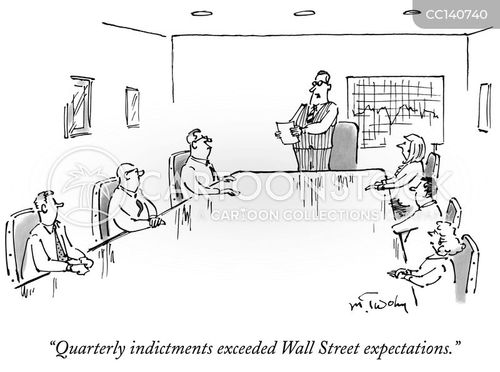
As a Nightmare Brews on Wall Street for CVS, Executives Scramble to Quell Investors

wrote Monday about how the additional Medicare claims CVS/Aetna paid during the first three months of this year prompted a massive selloff of the company’s shares, sending the stock price to a 15-year low.

During CVS’s May 1 call with investors, CEO Karen Lynch and CFO Thomas Cowhey assured them the company had already begun taking action to avoid paying more for care in the future than Wall Street found acceptable.

Among the solutions they mentioned: 

Ratcheting up the process called prior authorization that results in delays and denials of coverage requests from physicians and hospitals; kicking doctors and hospitals out of its provider networks; hiking premiums; slashing benefits; and abandoning neighborhoods where the company can’t make as much money as investors demand.

On Tuesday at the Bank of America Securities Healthcare Conference, Cowhey doubled down on that commitment to shareholders and provided a little more color about what those actions would look like and how many human beings would be affected. As Modern Healthcare reported:

Headed into next year, Aetna may adjust benefits, tighten its prior authorization policies, reassess its provider networks and exit markets, CVS Chief Financial Officer Tom Cowhey told investors. It will also reevaluate vision, dental, flexible spending cards, fitness and transportation benefits, he said. Aetna is also working with its employer Medicare Advantage customers on how to appropriately price their business, he said. 

Could we lose up to 10% of our existing Medicare members next year? That’s entirely possible, and that’s OK because we need to get this business back on track,” Cowhey said.

Insurers use the word “members” to refer to people enrolled in their health plans. You can apply for “membership” and pay your dues (premiums), but insurers ultimately decide whether you can stay in their clubs. If they think you’re making too many trips to the club’s buffet or selecting the most expensive items, your membership can–and will–be revoked.

That mention of “employer Medicare Advantage customers” stood out to me and should be of concern to people like New York Mayor Eric Adams, who was sold on the promise that the city could save millions by forcing municipal retirees out of traditional Medicare and into an Aetna Medicare Advantage plan. A significant percentage of Aetna’s Medicare Advantage “membership” includes people who retired from employers that cut a deal with Aetna and other insurers to provide retirees with access to care. Despite ongoing protests from thousands of city retirees, Adams has pressed ahead with the forced migration of retirees to Aetna’s club. He and the city’s taxpayers will find out soon that Aetna will insist on renegotiating the deal.

Back to that 10%. Aetna now has about 4.2 million Medicare Advantage “members,” but it has decided that around 420,000 of those human beings must be cut loose. Keep in mind that those humans are not among the most Internet-savvy and knowledgeable of the bewildering world of health insurance. Many of them have physical and mental impairments. They will be cast to the other wolves in the Medicare Advantage business.

Welcome to a world in which Wall Street increasingly calls the shots and decides which health insurance clubs you can apply to and whether those clubs will allow you to get the tests, treatments and medications you need to see another sunrise.

As Modern Healthcare noted, Aetna is not alone in tightening the screws on its Medicare Advantage members and setting many of them adrift. Humana, which has also greatly disappointed Wall Street because of higher-than-expected health care “utilization,” told investors it would be taking the same actions as Aetna.

But Aetna in particular has a history of ruthlessly cutting ties with humans who become a drain on profits. As I wrote in Deadly Spin in 2010:

Aetna was so aggressive in getting rid of accounts it no longer wanted after a string of acquisitions in the 1990s that it shed 8 million (yes, 8 million) enrollees over the course of a few years. The Wall Street Journal reported in 2004 that Aetna had spent more than $20 million to install new technology that enabled it “to identify and dump unprofitable corporate accounts.” Aetna’s investors rewarded the company by running up the stock price. 

I added this later in the book:

One of my responsibilities at Cigna was to handle the communication of financial updates to the media, so I knew just how important it was for insurers not to disappoint investors with a rising MLR [medical loss ratio, the ratio of paid claims to revenues]. Even very profitable insurers can see sharp declines in their stock prices after admitting that they had failed to trim medical expenses as much as investors expected. Aetna’s stock price once fell more than 20% in a single day after executives disclosed that the company had spent slightly more on medical claims during the most recent quarter than in a previous period. The “sell alarm” was sounded when the company’s first quarter MLR increased to 79.4% from 77.9% the previous year.

I could always tell how busy my day was going to be when Cigna announced earnings by looking at the MLR numbers. If shareholders were disappointed, the stock price would almost certainly drop, and my phone would ring constantly with financial reporters wanting to know what went wrong.

May 1 was a deja-vu-all-over-again day for Aetna. You can be certain the company’s flacks had a terrible day–but not as terrible as the day coming soon for Aetna’s members when they try to use their membership cards.

Speaking of Lynch, one of the people commenting on the piece I wrote Monday suggested I might have been a bit too tough on Lynch, who I know and liked as a human being when we both worked at Cigna. The commenter wrote that:

After finishing Karen S. Lynch’s book, “Taking Up Space,” I came to the conclusion that she indeed has a very strong conscience and sense of responsibility, not totally to shareholders, but more importantly to the insured people under Aetna and the customers of CVS.”

I don’t doubt Karen Lynch is a good person, and I know she is someone whose rise to become arguably the business world’s most powerful woman was anything but easy, as the magazine for alumni of Boston College, her alma mater, noted in a profile of her last year. Quoting from a speech she delivered to CVS employees a few years earlier, Daniel McGinn wrote

Lynch began with a story to illustrate why she was so passionate about health care. She described how she’d grown up on Cape Cod as the third of four children. Her parents’ relationship broke up when she was very young and her father disappeared, leaving her mom, Irene, a nurse who struggled with depression, as a single parent. In 1975, when Lynch was 12, Irene took her own life, leaving the four children effectively orphaned. 

During her speech, several thousand employees listened in stunned silence as Lynch explained how her mom’s life might have turned out differently if she’d had access to better medical treatment, or if there’d been less stigma and shame about getting help for depression. She then talked about how an insurance company like Aetna could play a role in reducing that stigma, increasing access to care, and helping people live with mental illness. 

I’m sure when she goes home at night these days, Lynch worries about what will happen to those 420,000 other humans who will soon be scrambling to get the care they need or to find another club that will take them. Their lives most definitely will turn out differently to appease the rich people who control her and the rest of us.

But she is stuck in a job whose real bosses–investors and Wall Street financial analysts–care far more about the MLR, earnings per share and profit margins than the fate of human beings less fortunate than they are.
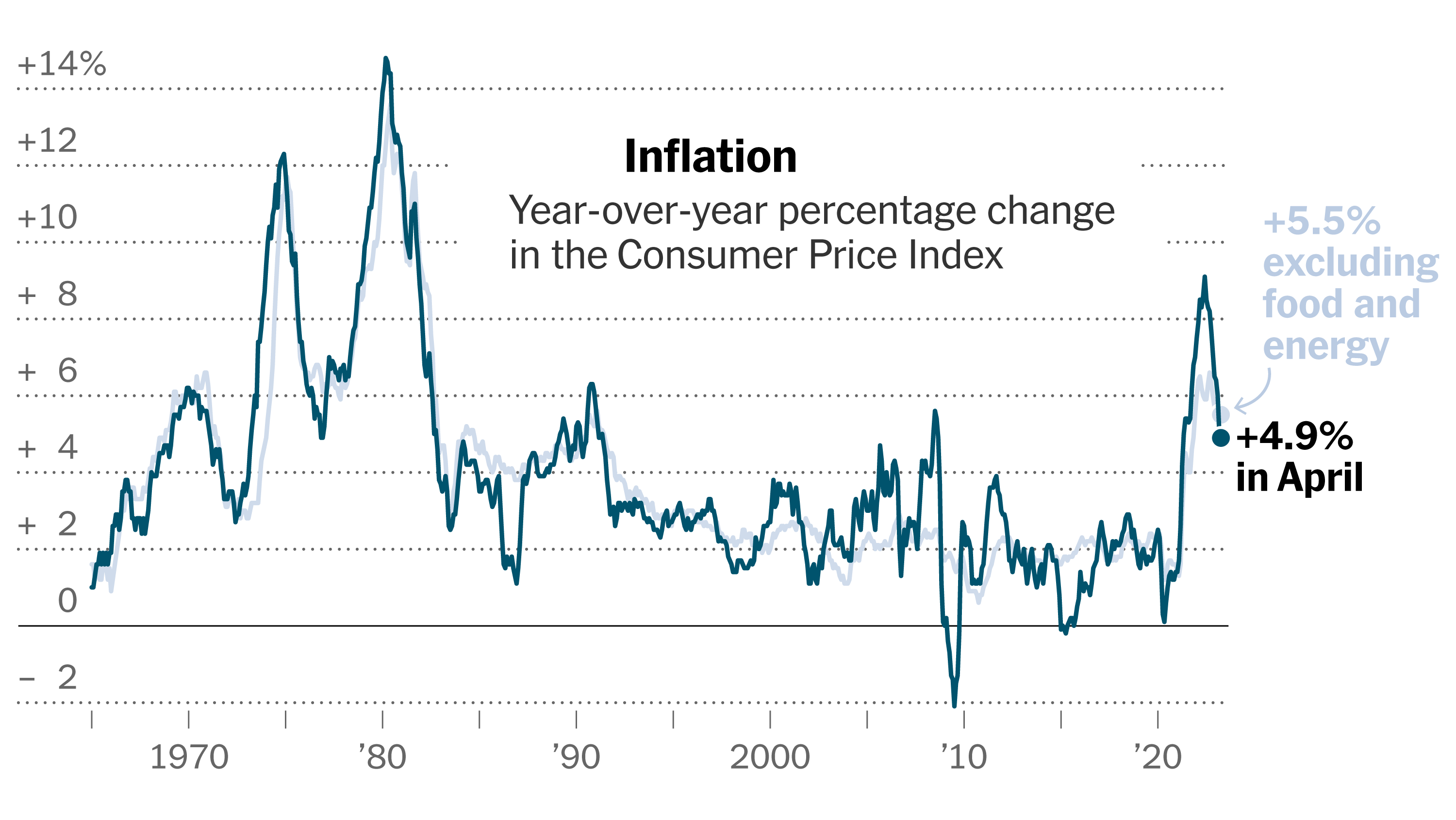

Inflation pressures ease in April as consumer prices rise at slowest pace in three months

https://finance.yahoo.com/news/inflation-pressures-ease-in-april-as-consumer-prices-rise-at-slowest-pace-in-three-months-123222215.html

US consumer price increases cooled during the month of April, according to the latest data from the Bureau of Labor Statistics released Wednesday morning.

The Consumer Price Index (CPI) rose 0.3% over the previous month and 3.4% over the prior year in April, a slight deceleration from March’s 3.5% annual gain in prices and 0.4% month-over-month increase.

April’s monthly increase came in lower than economist forecasts of a 0.4% uptick. The annual rise in prices matched estimates, according to data from Bloomberg, and marked the slowest gain in three months.

On a “core” basis, which strips out the more volatile costs of food and gas, prices in April climbed 0.3% over the prior month and 3.6% over last year — cooler than March’s data. Both measures met economist expectations.

Investors now anticipate two 25 basis point cuts this year, down from the six cuts expected at the start of the year, according to updated Bloomberg data.

Markets rose following the data’s release, with the 10-year Treasury yield (^TNX) falling about 6 basis points to trade around 4.38%.

“The lack of a nasty surprise this time around is welcomed,” Bankrate senior economist analyst Mark Hamrick wrote in reaction to the print. Still, Hamrick added, “with the 3.4% year-over-year headline increase and 3.6% in the core (excluding food and energy), these remain irritatingly high. The status of the battle against inflation requires that interest rates remain elevated in the near-term.”

Following the data’s release, markets were pricing in a roughly 53% chance the Federal Reserve begins to cut rates at its September meeting, according to data from the CME FedWatch Tool. That’s up from about a 45% chance the month prior.

Shelter, gas prices remain sticky

Notable call-outs from the inflation print include the shelter index, which rose 5.5% on an unadjusted, annual basis, a slowdown from March. The index rose 0.4% month over month and was the largest factor in the monthly increase in core prices, according to the BLS.

Sticky shelter inflation is largely to blame for higher core inflation readings, according to economists.

The index for rent and owners’ equivalent rent (OER) each rose 0.4% on a monthly basis, matching March’s rise. Owners’ equivalent rent is the hypothetical rent a homeowner would pay for the same property.

Lodging away from home decreased 0.2% in April after rising 0.1% in March.

Energy prices continued to rise in April, buoyed by higher gas prices. The index jumped another 1.1% last month, matching March’s increase. On a yearly basis, the index climbed 2.6%.

Gas prices rose 2.8% from March to April after climbing 1.7% the previous month.

The food index increased 2.2% in April over the last year, with food prices flat from March to April. The index for food at home decreased 0.2% over the month while food away from home rose another 0.3%.

Other indexes that increased in April included motor vehicle insurance, medical care, apparel, and personal care. Motor vehicle insurance, a standout in March’s report after the category jumped 2.6%, climbed another 1.8% in April.

The indexes for used cars and trucks, household furnishings and operations, and new vehicles were among those that decreased over the month, according to the BLS.

CVS CEO to Wall Street: People in Medicare Advantage Are in for a World of Hurt as We Focus on Profits

ALSO: We’re premiering our Magic Translation Box to help you decipher corporate jargon and understand what’s coming down the pike.

If you are enrolled in an Aetna Medicare Advantage plan, now might be a good time to get more nervous than usual.

Wall Street is not happy with Aetna’s parent, CVS Health. In response to that unhappiness, triggered by the company’s admission that it has been paying more claims than usual, CVS execs have promised to do whatever it takes to get profit margins back to a level investors deem suitable. 

That means the odds have increased that Aetna will refuse to cover the treatments and medications your doctor says you need. It also means CVS/Aetna likely will increase your premiums next year and might dump you altogether. The company has a long history of doing just that, as you’ll see below. 

Medicare Advantage companies in general are facing what Wall Street financial analysts call headwinds, and those winds are now coming from several sources: increased Congressional scrutiny of insurers’ business practices, Biden administration efforts to end years of overpayments that have cost taxpayers hundreds of billions of dollars, enrollee discontent, and a gathering storm of negative press. 

To understand the pressures CVS CEO Karen Lynch and her C-Suite team are under to satisfy the company’s remaining shareholders (many have fled), you need to know and understand what they told them in recent weeks–and what she undoubtedly will have to say again, with conviction, this coming Thursday when CVS holds its annual meeting of shareholders. You can be certain Lynch’s staff has prepared a binder chock full of the rudest questions she could face from rich folks (mostly institutional investors) who’ve become a little less rich in recent months as the golden calf calf called Medicare Advantage has lost some of its luster. (My former colleagues and I used to put together such a CEO-briefing binder during my Cigna days, which coincided with Lynch’s years at Cigna.)

To help with that understanding, we’re introducing the HEALTH CARE un-covered Magic Translation Box (MTB). We’ll fire it up occasionally to decipher the coded language executives use when they have to deal with analysts and investors in a public setting. We’ll start with what Lynch and her team told analysts on May 1 when CVS announced first-quarter 2024 results that caused a stampede at the New York Stock Exchange.

Lynch: We recently received the final 2025 (Medicare Advantage) rate notice (from the Center for Medicare and Medicaid Services), and when combined with the Part D changes prescribed by the Inflation Reduction Act, we believe the rate is insufficient. This update will result in significant added disruption to benefit levels and choice for seniors across the country. While we strive to deliver benefit stability to seniors, we will be adjusting plan-level benefits and exiting counties as we construct our bid for 2025. We are committed to improving margins.

Magic Translation Box: Can you believe it? CMS did not bend to industry pressure to pay MA plans what we demanded for next year. We only got a modest increase, not enough, in our opinion, to protect our profit margins. To make matters worse, starting next year we won’t be able to make people enrolled in Medicare prescription drug plans (Part D) pay more than $2,000 out of their own pockets, thanks to the Inflation Reduction Act President Biden signed in 2022. So, to make sure you, our most important stakeholder, once again have a good return on your investment, we will notify CMS next month that we will slash the value of Medicare Advantage plans by reducing or eliminating some benefits, like dental, hearing and vision, that attract people to MA plans in the first place. And, for good measure, we’ll be dumping Medicare Advantage enrollees who live in zip codes where we can’t make as much money as we’d like. For them: too bad, so sad. For you: more money in your bank account. And for extra good measure, to keep seniors from blaming greedy us for what we have in store for them, our industry will be bankrolling dark money ads to persuade voters that Biden and the Democrats are the bad guys cutting Medicare. 

Later during CVS’s earnings call, CFO Thomas Cowhey reiterated Lynch’s remarks about reducing benefits.

Cowhey: So, we’ve given you all the pieces to kind of understand why we think it (Medicare Advantage) will lose a significant amount of money this year. But as you think about improvement there, obviously there’s a lot of work that we still need to do to understand what benefits we’re going to adjust and what ones we can and can’t…To the extent that we don’t believe we can credibly recapture margin in a reasonable period of time, we will exit those counties…(And) as we’ve all mentioned we’re going to be taking significant pricing actions and really it’s going to depend on what our competitors do.

Magic Translation Box: We’re under the gun to figure this out because we have to notify CMS by June 3 how much we will increase Medicare Advantage premiums and cut benefits next year and which counties we’ll abandon altogether. We’ll also be watching what our competitors do, but we know from what they’ve been telling you guys that they, too, will be dumping enrollees, hiking premiums and slashing benefits. 

To make sure investors couldn’t miss what they were saying, Lynch jumped back into the conversation to make clear they knew they were #1 in her book:

Lynch: I’m just going to reiterate what I said in my prepared remarks. (You can bet what follows were prepared, too.) We are committed to improving margin in Medicare Advantage [emphasis added] and we will do so by pricing for the expected trends. We will do so by adjusting benefits and exiting service counties. And we are committed to doing that.

Magic Translation Box: Have I made myself clear? We will do whatever it takes to deliver the profits you expect. We will keep a closer eye on how much care people are trying to get and we’ll swing into action faster next time if we see evidence of an uptick. There will be carnage, but you guys rule. You mean a lot more to us than those old and disabled people who don’t have nearly as much money as you do in their bank accounts. 

This will not be the first time Aetna has dumped health plan enrollees who were a drain on profits. In 2000, when Medicare Advantage was called Medicare+Choice, Aetna notified the Clinton administration it would stop offering Medicare plans in 14 states, affecting 355,000 people, more than half of Aetna’s total Medicare enrollment at the time. Other companies, including Cigna, did the same thing. My team and I wrote a press release to announce that Cigna would be bailing from almost all the markets where we sold private Medicare plans.

We of course blamed the federal government (i.e., the Democrats) for being the skinflints that made it necessary to bail. Our CEO at the time, Ed Hanway, said the government just couldn’t be relied upon to be a reliable “partner.” 

Back then, just a relatively small percentage of Medicare beneficiaries were in private plans. Today, more than half of Medicare-eligible Americans are enrolled in a Medicare Advantage plan, which means the disruption could be much worse this time. Some people in counties where Aetna and other companies stop offering plans likely will not find a replacement plan with the same provider network, premiums and benefits.

But in most places, those who get dumped will be stuck in the volatile, often nightmarish Medicare Advantage world, unable to return to traditional Medicare and buy a Medicare supplement policy to cover their out-of-pocket obligations.

That’s because in all but a handful of states, seniors and disabled people will not be able to buy a Medicare supplement policy as cheaply as they could within six months of becoming eligible for Medicare benefits. After that, Medicare supplement insurers, including Aetna, get their underwriters involved. If your health isn’t excellent, expect to pay a king’s ransom for a Medigap policy.

Medical Properties Trust selling spree continues, Utah deal closes

The deal is expected to generate approximately $1.1 billion in in cash for the liquidity-strapped hospital landlord.

Dive Brief:

  • Medical Properties Trust has sold the majority of its interests in five Utah hospitals for $886 million, the hospital landlord said Friday. The hospitals included in the deal are currently leased to a subsidiary of CommonSpirit Health.
  • The buyer is an unspecified investment firm’s newly formed joint venture. The JV also granted MPT a $190 million non-recourse secured loan — meaning if MPT defaults, the lender cannot collect MPT’s other assets or income. In total, MPT expects the two transactions to generate $1.1 billion in immediate cash, according to the announcement.
  • The sale comes just three days after the landlord sold five hospitals to Prime Healthcare for $350 million.

Dive Insight:

MPT is on a selling spree in order to free up liquidity.

The Birmingham, Alabama-based real estate investment trust has said it’s been heavily exposed during the Dallas-based Steward Health Care’s financial meltdown.

Steward accounted for 19.2% of MPT’s assets as of Dec. 31 and was the largest tenant in its portfolio, according to MPT’s 2023 annual report. The for-profit physician owned network began delaying rent payments to MPT in September, and only paid $16 million of its required $70 million of rent during the fourth quarter. At the same time, MPT was funding multiple rounds of asset-backed loans to Steward, according to the filing.

MPT reported a net loss of $556 million for fiscal year 2023, citing the Steward shortfall as a significant contributor to the results.

The loss of Steward’s rent cushion — coupled with increasing interest rates and $1.3 billion of debt coming due within the next year — motivated the company to pursue several sales early this year, MPT said.

During its fourth quarter earnings call, investors asked whether Steward’s financial instability could play out in the their dividend checks moving forward. 

“The dividend is not dependent on Steward’s rent. It’s more dependent on our ability to close some of these liquidity transactions,” MPT CEO Edward K. Aldag Jr. said. MPT announced its quarterly dividend of $0.15 per share alongside the Utah deal

Aldag said the company hoped to sell enough property to shore up at least $2 billion in liquidity. With the Utah deal closed, the CEO said in a release that he is now “confident” MPT will exceed that threshold.

MPT’s stock price was up 20.8% when the markets opened Monday morning, trading at $4.80 per share. 

Nightmare on Wall Street for Medicare Advantage Companies

Wall Street has fallen out of love with big insurers that depend heavily on the federal government’s overpayments to the private Medicare replacement plans they market, deceptively, under the name, “Medicare Advantage.”

I’ll explain below. But first, thank you if you reached out to your members of Congress and the Biden administration last week as I suggested to demand an end to the ongoing looting by those companies of the Medicare Trust Fund.

As I wrote on March 26, the Center for Medicare and Medicaid Services was scheduled to announce this week how much more taxpayer dollars it would send to Medicare Advantage companies next year. On January 31, CMS said it planned to increase the amount slightly to account for the increased cost of health care, based on how much more the government likely would spend to cover people enrolled in the traditional Medicare program. It uses traditional Medicare as a benchmark.

Big insurers like UnitedHealthcare, Humana and Aetna, owned by CVS, howled when CMS released its preliminary 2025 rate notice that day. They claimed they wouldn’t be getting enough of taxpayers’ dollars. So they launched a high-pressure campaign to get CMS to give them more money. They demanded extra billions because, they said, their Medicare Advantage enrollees had used more prescription drugs and went to the doctor more often in 2023 and January of this year than the companies had expected.

The industry’s pressure campaign has been going on for years, and CMS usually caves to insurers’ demands. But this time, tens of thousands of taxpayers and Medicare enrollees sent letters and signed petitions demanding that CMS hold the line. And CMS did, to Wall Street’s shock.

CMS announced after the market closed Monday that it was sticking to its plan to increase payments to Medicare Advantage plans by 3.7% – more than $16 billion –from 2024 to 2025. That would mean that it would pay companies that operate MA plans between $500 and $600 billion next year, considerably less than insurers wanted.

Shocked investors began running for the exits right away. When the New York Stock Exchange closed at 4 p.m. ET on Tuesday, more than 52 million shares of the companies’ stock had been traded–many millions more than average–driving the share prices of all of them way down. And the carnage has continued throughout this week.

By the end of trading yesterday, UnitedHealth, Humana and CVS/Aetna had lost nearly $95 billion in market capitalization. To put that in perspective, that’s more than the entire market cap of CVS, which fell to $93 billion yesterday.

All seven of the big for-profit companies with Medicare Advantage enrollment had a bad week, although Cigna, where I used to work and which announced recently it is getting out of the Medicare Advantage business next year, suffered the least. Its shares were down a little more than 1% as of yesterday afternoon.

Humana, the second largest MA company, which last year said it was getting out of the commercial insurance business to focus more fully on Medicare Advantage, by contrast, was the biggest loser of the bunch–and one of the biggest losers on the NYSE. Its shares fell more than 13% on Tuesday. As of yesterday, they were still down nearly 12%.

The headline of Josh Nathan-Kazis’s story in Barrons was an apt summary of what happened: Humana Stock is Down. Wall Street’s Love Affair Is Ending in Tears.

Noting that Humana’s stock has fallen 40% this year, he wrote:

Last fall, the insurer Humana was on top of the world. The stock was trading above $520 per share, as the company’s major bet on Medicare Advantage—the privately-run, publicly-funded insurance program for U.S. seniors—seemed to be paying off.

Long a darling of Wall Street’s analyst class, the stock had returned nearly 290% since the start of 2015, handily outperforming the S&P 500 over the same period.

Over the past five months, that position has crumbled. Humana shares were down to $308 Tuesday morning, as the outlook for Medicare Advantage and, by extension, for Humana’s business, has grown dimmer and dimmer.

Humana shares dived 12.3% early Tuesday, after the latest blow to the future prospects for the profitability of the Medicare Advantage business. Late Monday, the Centers for Medicare and Medicaid Services announced Medicare Advantage payment rates for 2025 that fell short of investor expectations.

The other companies also had a disastrous week. Shares of UnitedHealth, the biggest of the group in terms of Medicare Advantage enrollment (and overall revenues and profits), had fallen by 7% by the end of the day yesterday. CVS/Aetna’s shares were down 7.1%; Elevance’s were down 3.37%; Molina’s were down 7.15%; and Centene’s were down 7.33%.

When I was at Cigna, one of my responsibilities was to handle media questions when the company announced quarterly earnings, mergers and acquisitions, and whenever there was a major event like the CMS rate notice. The worst days of my 20-year career in the industry were when some kind of news triggered a stock selloff. I had to try to put the best spin possible on the situation. But my job was relatively easy compared to what the CEO, CFO and the company’s investor relations team had to do.

You can be certain they have been on the phone and in Zooms all week with Wall Street financial analysts, big institutional investors and even the company’s big employer customers in attempts to persuade them that the sky has not fallen.

You can also be certain that the companies will now shift their focus to the political arena. To keep this from happening again, they will begin pouring enormous sums of your premium dollars into campaigns to help elect industry-friendly candidates for Congress and the presidency this November. We provided a glimpse of where they’re already sending those donations in a story last November. We will continue to monitor this in the months ahead.

Inflation slowing as Wall Street looks bullish on healthcare sector

Wall Street’s roil has stabilized somewhat in recent days, with the S&P 500 brushing up against its 200-day moving average and rising more than 10 percent since its October lows, as of publication time.

The index’s 50-day moving average is trending up, according to financial data firm Refinitiv. But it still must climb another 7.4 percent to form a “golden cross,” which is when a stock or index’s short-term moving average rises above one of its longer-term moving averages. The S&P 500’s 20-day and 100-day moving averages are closer to the milestone, only needing increases of 5 percent and 1.2 percent, respectively.

The Dow Jones Industrial Average has already formed a small golden cross: its 20-day moving average is 1.2 percent higher than its 200-day moving average.

Investors Optimistic about Healthcare Sector

 Investors are most optimistic about the Healthcare sector, which is trading close to its 3-year average “price to earnings-per-share” ratio of 48.1x, according to Simply Wall Street.

 Analysts are expecting an annual earnings growth of 13.4 percent, higher than the sector’s past year earnings growth of 5 percent.

 Merck and Johnson & Johnson were among last week’s top gainers driving the market.

Inflation Appears to be Slowing

 The recent lower-than-expected inflation figures could indicate it is slowing.

 The Fed may continue raising rates, considering the strength in recent labor market and retail sales data.

Dow plunges more than 1,800 points as rising COVID-19 cases roil Wall Street

Dow plunges more than 1,800 points as rising COVID-19 cases roil Wall Street

Dow plunges 1,800 as investors turn jittery over new wave of ...

Stocks plummeted Thursday as the emergence of new coronavirus hotspots and a caution from the Federal Reserve chairman shook Wall Street after months of steady gains.

The Dow Jones Industrial Average closed with a loss of 1,861 points, plunging 6.9 percent for its worst day of losses since March. The S&P 500 index closed with a loss of 5.9 percent, and the Nasdaq composite sunk 5.3 percent on the day.

All three major U.S. stock indexes closed with their steepest single-day losses since crashing in March amid the beginning of lockdowns imposed to slow the spread of COVID-19. Thursday’s losses come after more than two months of steady recovery toward the record highs seen before the pandemic derailed the economy.

Despite the loss of more than 21 million jobs and the deaths of more than 110,000 Americans due to the coronavirus, investors had gradually upped their bets on a quick economic recovery through April and May as states began loosening business closures and travel restrictions.

The surprise addition of 2.5 million jobs in May, according to the Labor Department, also fueled hopes for a quicker than expected rebound from a recession of unprecedented scale and speed.

But Thursday’s abrupt reversal comes as states across the U.S. see spiking COVID-19 cases and diminishing hospital capacity to handle a new wave of infections.

Week-over-week case counts are rising in half of all U.S. states, and only 16 states plus the District of Columbia have seen their total case counts decline for two consecutive weeks.

North Carolina, California, Mississippi and Arkansas are all facing record levels of hospitalizations, and the virus appears to be quickly spreading in Houston, Phoenix, South Carolina and Missouri.

Some market experts also attribute Thursday’s losses to Fed Chairman Jerome Powell’s Wednesday prediction of a “long road” to recovery.

During a Wednesday press conference, Powell said that while the U.S. may see significant job growth in coming months as people return to their jobs,” the country is “still going to face, probably, an extended period where it will be difficult for many people to find work.”

“What we’re trying to do is create an environment in which they have the best chance either to go back to their old job or to get a new job,” he continued.

President Trump, who frequently lashes out at the Fed when markets turn south, blasted the Fed for underestimating how quickly the U.S. economy could recover and how soon a COVID-19 vaccine would be available.

“The Federal Reserve is wrong so often. I see the numbers also, and do MUCH better than they do. We will have a very good Third Quarter, a great Fourth Quarter, and one of our best ever years in 2021. We will also soon have a Vaccine & Therapeutics/Cure. That’s my opinion. WATCH!” Trump tweeted.

Trump’s top economic advisor Larry Kudlow also criticized Powell, urging the Fed chief to ease up on the dour forecasts

“I do think Mr. Powell could lighten up a little when he has these press offerings. You know, a smile now and then, a little bit of optimism,” Kudlow said on Fox Business Network.

“I’ll talk with him and we’ll have some media training at some point.


Sports bettors may be a driving force behind the stock market surge

https://www.axios.com/sports-betting-stock-market-surge-0e945773-d676-4f0a-a6a0-a0f92611b10b.html

Sports bettors may be a driving force behind the stock market ...

Professional investors have largely abandoned the stock market amid the coronavirus pandemic, but sports bettors and bored millennials have jumped into the retail stock trading market with both feet.

Why it matters: They may be a driving force pushing U.S. stocks to their recent highs — and potentially driving them further.

What’s happening: Online brokerages have seen a record number of new accounts opened this year, and the big four — E-Trade, TD Ameritrade, Charles Schwab and Interactive Brokers — executed as many trades in March and April as in the whole first half of last year, per public disclosures.

  • Equity strategists at Deutsche Bank note there is “plenty of evidence” that new retail investors have been buying since the stock market began to crash and that professional money managers are “now chasing” them.

Between the lines: Robinhood, whose easy-to-use app makes the transition between sports betting and trading seamless, boasts a similar customer base to most sportsbooks, notes Marc Rubinstein in his newsletter, Net Interest.

  • “43% of North American men aged 25-34 who watch sports also bet on sports at least once per week, and that’s the same group that has flocked to Robinhood,” Rubinstein writes.
  • “On the basis that their customers love sports betting, there’s something meta about DraftKings itself having worked its way into more Robinhood portfolios than practically any other stock over the past month.”

The big picture: Sports betting and stock trading aren’t all that different. In fact, most online betting platforms are modeled on stock exchanges, and Nasdaq itself provides sportsbooks with technology that was born in the financial markets.

  • The comparisons between the two have only increased with the rise of legal sports betting and the surge in mobile stock trading, two activities that cater to the thrill of short-term gains and losses.
  • “For a gambler, investing has a ton of similarities,” said Barstool Sports founder Dave Portnoy, who has begun streaming his day-trading sessions for an audience that normally consumes sports betting content.
  • Barstool also changed its daily gambling radio show from “Picks Central” to “Stocks Central” — further evidence of the crossover between the two.

Meanwhile, most professional investors were sitting on the sidelines.

  • Nearly $5 trillion now sits in money market funds, which are effectively savings accounts, the largest total on record and about $1 trillion more than the record high during the global financial crisis.
  • In its note to clients, Deutsche strategists add that for “large swathes of the equity market in the U.S. as well as globally … positioning is still extremely low.”

Professionals have also been buying bonds rather than stocks as U.S. equity indexes raced back from their lows over the last two months.

  • Data from the Investment Company Institute shows equity funds saw six straight weeks of outflows from the week ending April 22 to the week ending May 27, totaling $78.2 billion. Bond funds, on the other hand, have had seven straight weeks of inflows through May 27, totaling $91.7 billion.
  • Professional traders have finally started dipping their toes back into the stock market in June, according to Bank of America’s data, which showed $6.2 billion into stocks last week, compared with $32.5 billion into bonds.
  • BofA’s Bull & Bear indicator rose from its lowest possible level — 0.0 — where it had been since March 25 to move to 0.4 last week, still indicating a paucity of institutional investors buying stocks.

The bottom line: Day trading has replaced sports betting as a form of entertainment for many Americans during the shutdown, and this phenomenon could partly explain the current disconnect between the economy (down) and the stock market (up).