Health systems have recently been the subject of high-profile media accusations that they prioritize “profits over patients”, as an unflattering New York Times series has framed it.
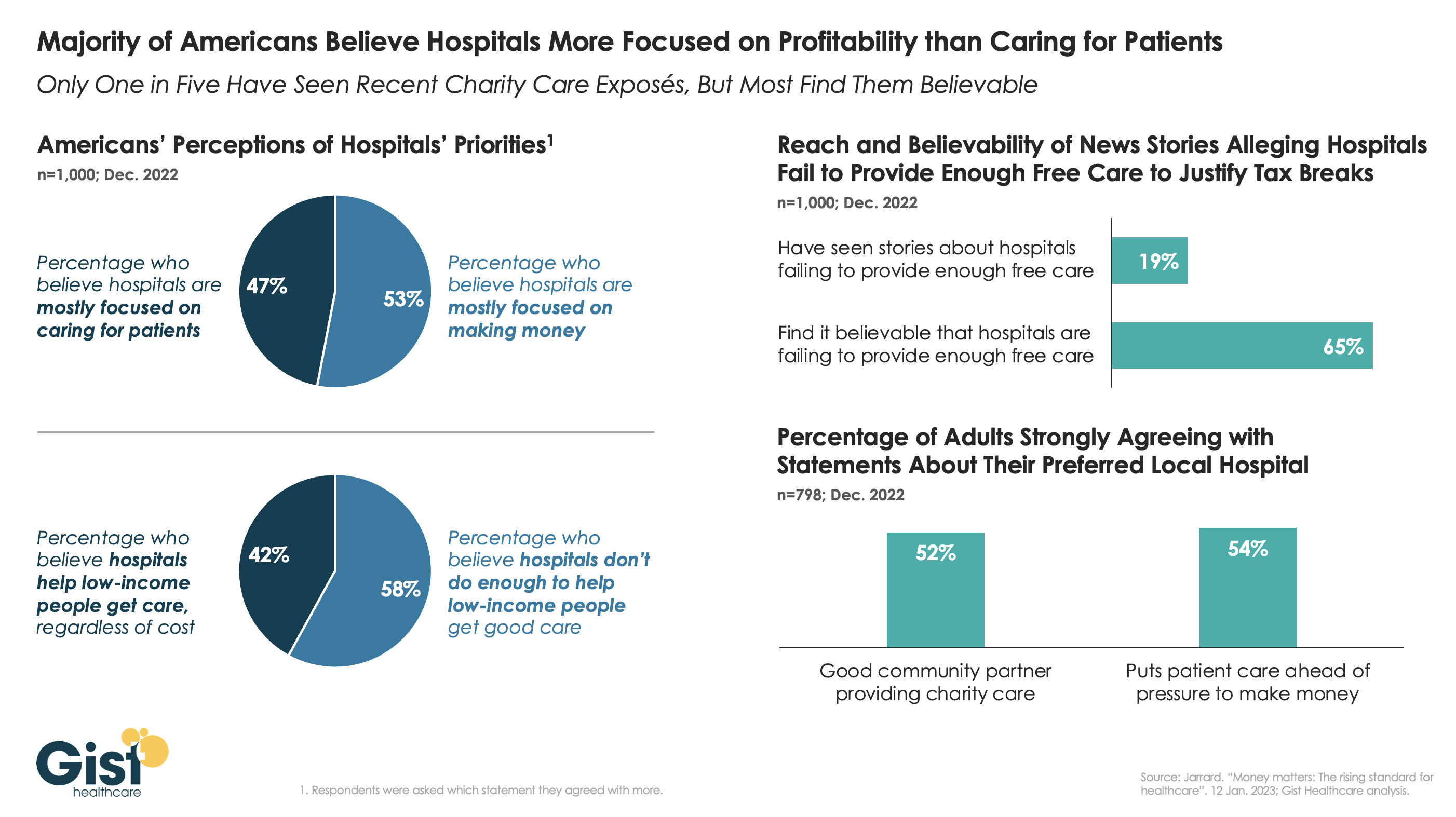
New consumer survey data from strategic healthcare communications consulting firm Jarrard Inc. shows that while consumers find some merit in these claims, they tend to see their local hospital in a better light. As shown in the graphic above, a majority of US adults believe that, on a national level, hospitals are more focused on making money than caring for patients, and that they don’t do enough to help low-income people access high quality care.
Despite only one in five survey participants having seen news stories alleging hospitals fail to provide enough charity care in exchange for tax breaks, 65 percent of survey respondents find those allegations believable.
But while the consumer perception of hospitals may be suffering nationally, the responses were quite different when consumers were asked about their preferred local hospital. More than half strongly agreed that their preferred local hospital is a good community partner—one that puts patient care ahead of making money.
(Just as with Congress: people love to criticize the institution, while continuing to return their own representatives to Washington.) While the negative national attention can be disheartening, at the end of the day, to consumers,healthcare is local, and health systems must continue to build direct consumer relationships to strengthen patient loyalty.
Less than 15 percent of board members overseeing the nation’s top hospitals have a professional background in healthcare, while more than half have a background in finance or business services, according to a study published Feb. 8 in the Journal of General Internal Medicine.
The study’s authors represent Harvard Medical School and Brigham and Women’s Hospital in Boston and the University of Alabama at Birmingham. They wrote that they sought to understand which professions are represented most among hospital boards because they may influence the organization’s goals and overall strategy — there also had been little research done around the topic previously.
The study began in July by examining the 20 top-rated hospitals by US News & World Report in 2022, which are all nonprofit academic medical centers in urban areas.
Only 15 of the 20 facilities publish board information online, and IRS filings for the remaining were incomplete or outdated.
For the 15 hospitals that provide information on their board members, the authors sorted their professional backgrounds across 11 industry sectors using the North American Industry Classification System, which is the federal standard. For board members with healthcare backgrounds, they were further categorized as trained physicians, nurses, or other workers.
Four key takeaways:
1. At the 15 examined hospitals, there were 567 board members. The study was able to sort 529 into professional categories.
2. Among the 529 board members, 44 percent had a background in finance. Among them, more than 80 percent led private equity funds, wealth management firms, or multinational banks. The remainder were in real estate (14.7 percent) or insurance (5.2 percent).
3. The second and third most common sectors were health services (16.4 percent) and professional and business services (12.6 percent).
4. Across the 15 hospitals, 14.6 percent of board members were healthcare professionals — primarily physicians (13.3 percent) and followed by nurses (0.9 percent).
The study noted that its findings may not represent all hospitals because it only studied the highest-ranked, and some of those hospitals do not publicly report information on their board members. The study also did not examine “the community ties of board members to gauge local accountability of board decisions.”
The authors also noted that they did not examine the racial and gender makeup of boards, which they said merits further review — in 2018, 42 percent of U.S. hospital boards had all-white members and 70 percent of members were male.
Workforce problems in U.S. hospitals are troublesome enough for the American College of Healthcare Executives to devote a new category to them in its annual survey on hospital CEOs’ concerns. In the latest survey, executives identified “workforce challenges” as the No. 1 concern for the second year in a row.
Financial challenges, which consistently held the top spot for 16 years in a row until 2021, were listed the second-most pressing concern in the American College of Healthcare Executives’ annual survey.
Although workforce challenges were not seen as the most pressing concern for 16 years, they rocketed to the top quickly and rather universally for healthcare organizations in the past two years. Most CEOs (90 percent) ranked shortages of registered nurses as the most pressing within the category of workforce challenges, followed by shortages of technicians (83 percent) and burnout among non-physician staff (80 percent).
Here are the most concerning issues hospital CEOs ranked in 2022, along with the score of how pressing CEOs find each issue.
1. Workforce challenges (includes personnel shortages and staff burnout, among other issues) — 1.8
2. Financial challenges — 2.8
3. Behavioral health and addiction issues — 5.2
4. Patient safety and quality — 5.9
5. Governmental mandates — 5.9
6. Access to care — 6.0
7. Patient satisfaction — 6.6
8. Physician-hospital relations — 7.6
9. Technology — 7.7
10. Population health management — 8.6
11. Reorganization (mergers and acquisitions, partnerships and restructuring) — 8.7
Within financial challenges, most CEOs (89 percent) ranked increasing costs for staff and supplies as the most pressing, followed by operating costs (66 percent) and Medicaid reimbursement (63 percent). CEOs are less concerned about price transparency and moving away from fee-for-service.
Seventy-eight percent of CEOs ranked lack of appropriate facilities/programs as most pressing within the category of behavioral health and addiction issues. That was followed by lack of funding for addressing behavioral health and addiction issues (77 percent).
The results are based on a survey administered to CEOs of community hospitals (non-federal, short-term, non-specialty hospitals). ACHE asked respondents to rank 11 issues affecting their hospitals in order of how pressing they are. Results are based on responses from 281 executives.
Here is a summary of recent credit rating downgrades, going back to the last Becker’s roundup on Jan. 17.
Operating concerns and a bleak financial outlook for some resulted in the following changes:
Geisinger Health System (Danville, Pa.): Moody’s Investors Service downgraded Geisinger Health System’s outstanding bonds from “A1” to “A2” Feb. 13 amid expectations of continued cash flow weakness.
The outlook for the system, which has about $1.3 billion in debt, is stable.
Marshfield (Wis.) Clinic Health System: The system suffered a credit downgrade because of recent operating losses and amid expectations of no immediate financial improvement.
The S&P Global move Feb. 7 to downgrade the system to “BBB+” from “A-” follows a similar move from Fitch Jan. 18.
Marshfield signed a memorandum of understanding with Duluth, Minn.-based Essentia Health to discuss a potential merger Oct. 12 that would include 25 hospitals.
Tower Health (West Reading, Pa.): Troubled Tower Health, which is currently undergoing a strategic review and selling off several assets, suffered a rating downgrade on its bonds, S&P Global reported Feb. 6, adding that the outlook is negative.
“The downgrade reflects Tower Health’s significant ongoing operating losses that are expected to continue in fiscal 2023, and a steep decline in unrestricted reserves to a level that we view as highly vulnerable,” said S&P Global Ratings credit analyst Anne Cosgrove.
Fairview Health (Minneapolis): Moody’s Investors Service downgraded the revenue bond ratings of Fairview Health from “A3” to “Baa1.”
The downgrade reflects Moody’s projection that weak operating performance will be challenging to overcome due to increased labor costs and lower inpatient volume. Inflation and annual transfers to the University of Minnesota in Minneapolis will also hamper margins, Moody’s said.
Roseville, Calif.-based Adventist Health plans to go from seven networks of care to five systemwide to reduce costs and strengthen operations, according to a Feb. 15 news release shared with Becker’s.
Under the reorganization, Adventist Health will have separate networks for Northern California, Central California, Southern California, Oregon and Hawaii.
“Reducing the number of care networks strengthens our operational structure and broadens the meaning and purpose of our network model as well as the geographical span of one Adventist Health,” Todd Hofheins, COO of Adventist Health, said in the release. “This also reduces overhead and administrative costs.”
The reorganization will result in job cuts, including reducing administration by more than $100 million.
“Our commitment to rural and urban healthcare remains steadfast, and we are expanding to other locations to invest and transform the integrated delivery of care,” Kerry Heinrich, president and CEO of Adventist Health, said in the release.
Specifically, the health system has a recently approved affiliation agreement for Mid-Columbia Medical Center in The Dalles, Ore., to join Adventist Health, the health system said. The agreement is pending final regulatory and state approvals.
Meanwhile, Adventist Health filed a Worker Adjustment and Retraining Notification Act notice with California officials Feb. 15.
Adventist Health will eliminate job functions and positions for employees at its corporate office campus along with some remote roles, the notice states.
Layoffs from Adventist Health began Feb. 1 and will continue into April, according to the notice.
Adventist Health said it has provided all affected employees 60 days’ written notice of the layoff. The health system expects about 59 employees to be separated from employment with Adventist Health.
Employees affected by the layoffs include administrative directors, directors, managers and project managers, among others.
“We recognize that these changes impact people’s lives and want to respect each affected individual,” Joyce Newmyer, chief people officer for Adventist Health, said in the health system’s release. “We will make every effort to identify other opportunities for team members impacted.”
Chicago-based CommonSpirit Health, one of the largest healthcare systems in the country operating 138 hospitals in 21 states, has reported $451 million in operating losses for the six-month period ending Dec. 31.
Those figures compared with operating losses of $47 million for the same period in the prior year. Overall income for the second half of 2022 totaled a $213 million loss, but there was a gain of $200 million in the final quarter as stronger investment returns kicked in.
Staffing expenses continue to be a “major challenge,” CommonSpirit said. While salaries and benefits decreased $80 million in the final quarter, there was an overall increase of $140 million, or 1.7 percent, in such expenses over the second half of the year.
“We are meeting our challenges head on by scaling programs that drive growth, create a better experience for patients, and support our employees,” CFO Dan Morissette said in a statement. “At the same time we are working hard to reduce our costs so we can sustain these essential services in the long term.”
CommonSpirit estimated costs from its October cybersecurity event at approximately $150 million. The health system held $14.6 billion in debt as of Dec. 31.
Here are four health systems that recently had their credit rating upgraded by Fitch Ratings, Moody’s Investors Service or S&P Global Ratings:
1. Cooper University Health Care received upgrades from both S&P and Moody’s. S&P upgraded the Camden, N.J.-based system from “BBB+” to “A-,” praising Cooper for its focus on cost containment, revenue improvement, expanding market share and developing key services to gain more tertiary referrals and limit outpatient migration to Philadelphia academic medical centers.
Moody’s raised the system’s bond ratings from “Baa1” to “A3” and said it expects Cooper’s operating margins will be maintained through execution of its performance improvement plan and strong growth in key service lines.
2. Loma Linda (Calif.) University Medical Center’s rating was raised to “BB+” from “BB” by Fitch. “The upgrade … incorporates LLUMC’s major new hospital, which is now open, and the system has been operating in their new environment for more than one year, removing a considerable risk factor,” Fitch said in a report.
3. Mercy Health’s credit rating was upgraded from “A-” to “A” by Fitch. The rating agency said the Rockford, Ill.-based system’s operating profile is expected to remain strong in the longer term.
4. Orlando (Fla.) Health’s rating was upgraded to “AA-” from “A+” by Fitch. The ratings agency said in a report the bump “reflects the continued strength of OHI’s operating performance, growth in unrestricted liquidity and excellent market position in a demographically favorable market.”
Franklin, Tenn.-based Community Health Systems, one of the largest for-profit health systems in the country,reported $179 million net income in 2022, a 51.4 percent drop from the $368 million net income reported the prior year.
The drop was driven by a decline in net operating revenues, fewer inpatient admissions and what CHS termed “unfavorable changes” in payer mix.
Total operating costs and expenses for the year ended Dec. 31 were $11.4 billion, up from $11 billion in 2021. Net operating revenues were $12.2 billion in 2022, down slightly from $12.4 billion the prior year.
Net income in the final three months of the year totaled $446 million compared with $223 million in the same period in 2021.
“We were pleased with our progress during the final quarter of the year, including solid volume growth in admissions, adjusted admissions and surgeries,” CEO Tim Hingtgen said in a statement. “We also significantly reduced contract labor from its peak in early 2022 while improving overall employee recruitment and retention levels.”
CHS, which owns or leases 79 affiliated hospitals with approximately 13,000 beds and operates more than 1,000 sites of care, also released guidance for 2023, predicting annual revenues of between $12.2 billion and $12.6 billion. Such figures compare with $12.2 billion in 2022.
The system, which is also predicting a net loss in 2023 between 0.05 and 0.65 a share, recorded long-term debt of $11.6 billion as of Dec. 31 compared with $12.1 billion at the same time in 2021.
President Joe Biden last night highlighted several healthcare priorities during his State of the Union address, including efforts to reduce drug costs, a universal cap on insulin prices, healthcare coverage, and more.
COVID-19
In his speech, Biden acknowledged the progress the country has made with COVID-19 over the last few years.
“Two years ago, COVID had shut down our businesses, closed our schools, and robbed us of so much,” he said. “Today, COVID no longer controls our lives.”
Although Biden noted that the COVID-19 public health emergency (PHE) will come to an end soon, he said the country should remain vigilant and called for more funds from Congress to “monitor dozens of variants and support new vaccines and treatments.”
The Inflation Reduction Act
Biden highlighted several provisions of the Inflation Reduction Act (IRA), which passed last year, that aim to reduce healthcare costs for millions of Americans.
“You know, we pay more for prescription drugs than any major country on earth,” he said. “Big Pharma has been unfairly charging people hundreds of dollars — and making record profits.”
Under the IRA, Medicare is now allowed to negotiate the prices of certain prescription drugs, and out-of-pocket drug costs for Medicare beneficiaries are capped at $2,000 per year. Insulin costs for Medicare beneficiaries are also capped at $35 a month.
“Bringing down prescription drug costs doesn’t just save seniors money,” Biden said. “It will cut the federal deficit, saving tax payers hundreds of billions of dollars on the prescription drugs the government buys for Medicare.”
Caps on insulin costs for all Americans
Although the IRA limits costs for seniors on Medicare, Biden called for the policy to be made universal for all Americans. According to a 2022 study, over 1.3 million Americans skip, delay purchasing, or ration their insulin supply due to costs.
“[T]here are millions of other Americans who are not on Medicare, including 200,000 young people with Type I diabetes who need insulin to save their lives,” Biden said. “… Let’s cap the cost of insulin at $35 a month for every American who needs it.”
With the end of the COVID-19 PHE, HHS estimates that around 15 million people will lose health benefits as states begin the process to redetermine eligibility.
The opioid crisis
Biden also addressed the ongoing opioid crisis in the United States and noted the impact of fentanyl, in particular.
“Fentanyl is killing more than 70,000 Americans a year,” he said. “Let’s launch a major surge to stop fentanyl production, sale, and trafficking, with more drug detection machines to inspect cargo and stop pills and powder at the border.”
He also highlighted efforts by to expand access to effective opioid treatments. According to a White House fact sheet, some initiatives include expanding access to naloxone and other harm reduction interventions at public health departments, removing barriers to prescribing treatments for opioid addiction, and allowing buprenorphine and methadone to be prescribed through telehealth.
Access to abortion
In his speech, Biden called on Congress to “restore” abortion rights after the U.S. Supreme Court overturned Roe v. Wade last year.
“The Vice President and I are doing everything we can to protect access to reproductive healthcare and safeguard patient privacy. But already, more than a dozen states are enforcing extreme abortion bans,” Biden said.
He also added that he will veto a national abortion ban if it happens to pass through Congress.
Progress on cancer
Biden also highlighted the Cancer Moonshot, an initiative launched last year aimed at advancing cancer treatment and prevention.
“Our goal is to cut the cancer death rate by at least 50% over the next 25 years,” Biden said. “Turn more cancers from death sentences into treatable diseases. And provide more support for patients and families.”
According to a White House fact sheet, the Cancer Moonshot has created almost 30 new federal programs, policies, and resources to help increase screening rates, reduce preventable cancers, support patients and caregivers and more.
“For the lives we can save and for the lives we have lost, let this be a truly American moment that rallies the country and the world together and proves that we can do big things,” Biden said. “… Let’s end cancer as we know it and cure some cancers once and for all.”
Healthcare coverage
Biden commended the fact that “more American have health insurance now than ever in history,” noting that 16 million people signed up for plans in the Affordable Care Act marketplace this past enrollment period.
In addition, Biden noted that a law he signed last year helped millions of Americans save $800 a year on their health insurance premiums. Currently, this benefit will only run through 2025, but Biden said that we should “make those savings permanent, and expand coverage to those left off Medicaid.”
Advisory Board’s take
Our questions about the Medicaid cliff
President Biden extolled economic optimism in the State of the Union address, touting the lowest unemployment rate in five decades. With job creation on the rise following the incredible job losses at the beginning of the COVID-19 pandemic, there is still a question of whether the economy will continue to work for those who face losing Medicaid coverage at some point in the next year.
The public health emergency (PHE) is scheduled to end on May 11. During the PHE, millions of Americans were forced into Medicaid enrollment because of job losses. Federal legislation prevented those new enrollees from losing medical insurance. As a result, the percentage of uninsured Americans remained around 8%. The safety net worked.
Starting April 1, state Medicaid plans will begin to end coverage for those who are no longer eligible. We call that the Medicaid Cliff, although operationally, it will look more like a landslide. Currently, state Medicaid regulators and health plans are still trying to figure out exactly how to manage the administrative burden of processing millions of financial eligibility records. The likely outcome is that Medicaid rolls will decrease exponentially over the course of six months to a year as eligibility is redetermined on a rolling basis.
In the marketplace, there is a false presumption that all 15 million Medicaid members will seamlessly transition to commercial or exchange health plans. However, families with a single head of household, women with children under the age of six, and families in both very rural and impoverished urban areas will be less likely to have access to commercial insurance or be able to afford federal exchange plans. Low unemployment and higher wages could put these families in the position of making too much to qualify for Medicaid, but still not making enough to afford the health plans offered by their employers (if their employer offers health insurance). Even with the expansion of Medicaid and exchange subsidies, it, is possible that the rate of uninsured families could rise.
For providers, this means the payer mix in their market will likely not return to the pre-pandemic levels. For managed care organizations with state Medicaid contracts, a loss of members means a loss of revenue. A loss of Medicaid revenue could have a negative impact on programs built to address health equity and social determinants of health (SDOH), which will ultimately impact public health indicators.
For those of us who have worked in the public health and Medicaid space, the pandemic exposed the cracks in the healthcare ecosystem to a broader audience. Discussions regarding how to address SDOH, health equity, and behavioral health gaps are now critical, commonplace components of strategic business planning for all stakeholders across our industry’s infrastructure.
But what happens when Medicaid enrollment drops, and revenues decrease? Will these discussions creep back to the “nice to have” back burners of strategic plans?
Writing for Forbes, Sachin Jain, president and CEO of SCAN Group and Health Plan, argues that “toxic positivity,” or the idea that one should only focus on what’s going right rather than identifying and working on the underlying causes of a problem, is rampant throughout the healthcare industry and offers a few ideas on how to fix it.
Toxic positivity in healthcare
Jain writes that toxic positivity is a “somewhat understandable reaction to seemingly insurmountable obstacles, which perhaps explains toxic positivity’s ascendancy in the healthcare industry.” But now, toxic positivity is “bleeding into situations involving challenging but fully solvable problems.”
For example, Jain writes that nearly every company in the healthcare industry eventually pays a marketing agency to craft “glorious-sounding mission statements” that are then used by leaders whenever they are confronted with their shortcomings.
“Your health system just christened a new billion-dollar hospital, but is unleashing bill collectors on the indigent? Our mission is clear: Patients first!” Jain writes. “Your startup appears to be serving only the wealthiest and healthiest retirees, while pulling no cost from the healthcare system? We’re proudly committed to doing right by seniors by offering value-based care!”
Jain clarifies that he doesn’t believe all healthcare executives are cynically trying to avoid hard issues. Rather, they are “often too far removed from the front lines of the system, and even their own companies’ patient-facing operations, to witness the flaws.”
Often executives don’t notice the flaws in their health systems until a loved one needs help, Jain writes. “Only then do the industry’s leaders confront the reality that, at a person’s most vulnerable point in life, healthcare companies often treat you like a consumer … instead of just taking care of you.”
Without that reality check, it’s easy for executives to rely on their lofty mission statements and value propositions, and to “see their companies as distinct from, rather than intrinsically connected to, the industry’s biggest issues,” Jain writes.
How to fix toxic positivity
One simple intervention won’t fix toxic positivity in the healthcare industry, Jain writes, but companies can start by talking about their flaws.
“In a perfect world, the healthcare industry would commit to a culture of relentless interrogation of its flaws as a means of driving to better results,” Jain writes. Healthcare leaders need to “stop hiding behind company mission statements and ‘just-so stories’ about their impact and start speaking publicly about the steep challenges we each face as we fall short of fulfilling our specific corporate mission,” Jain adds. That means publicly addressing issues at events and discussing strategies for addressing them.
Private behavior within a company can also help reverse toxic positivity, Jain writes. Leaders should continue celebrating the accomplishments of frontline healthcare providers, but they should also “bring a critical eye to their operations and demand — not just encourage — that their colleagues help them uncover ways they can individually and collectively do better.”
That means asking questions like, “If our organization disappeared tomorrow and people were forced to find their healthcare insurance or services or devices elsewhere, would anyone be truly worse off and why?” Jain writes. If your company doesn’t have an answer for that, then you should work harder to increase your replacement value and drive competitive differentiation.
Addressing toxic positivity also means addressing the flaws in value-based care and having “honest, authentic conversations about what works and what doesn’t and why,” Jain writes. “About whether companies that proclaim to improve care are merely benefitting from arbitrage opportunities in reimbursement systems or are actually, meaningfully improving service to patients.”
Executives need to stop treating the healthcare industry like all other industries and “call BS on the idea that it’s somehow okay to be financially successful without making an actual difference in anyone’s lives,” Jain writes.
The healthcare industry needs to welcome thoughtful, critical, and reflective voices to every table, Jain writes. “Because nothing — absolutely nothing — will actually get better without them.”









 HENRY KOTULA