How likely is COVID-19 hospitalization for vaccinated Americans?

CDC Charts Show Hospitalization Rates for Unvaxxed, 2 Doses, 3 Doses

Data from federal, state, and local health agencies show COVID-19 case, hospitalization, and death rates are much lower for vaccinated Americans than they are for the unvaccinated.

The first week of December 2021, when Omicron was first detected in the US, unvaccinated adults were nearly 25 times more likely to be hospitalized than vaccinated adults. While Omicron caused a big spike in COVID-19 cases, vaccinated people continued to be less likely to be hospitalized than the unvaccinated.

In King County, Wash., which includes Seattle, unvaccinated people were 13 times more likely to be hospitalized for coronavirus since December than people who were fully vaccinated.

New York City was one of the first areas in the US to get hit with Omicron. During the week ending January 15, 0.6% of all unvaccinated people were hospitalized with COVID-19 , compared with 0.02% of all vaccinated people.

These two areas have some of the most up-to-date data that illustrates the differences in susceptibility and severity of coronavirus based on vaccination status. But other state and local health agencies as well as the Centers for Disease Control and Prevention (CDC) also provide data that shows vaccine effectiveness.

As of January 26, 210 million Americans, or 64% of the population, were considered fully vaccinated after completing the initial series of COVID-19 shots. Twenty-six percent of Americans had received a booster dose.

National data isn’t as recent but shows lower hospitalization risks among the boosted.

CDC data compiled from hospitals in 12 states shows that, in the week before Christmas, unvaccinated people ages 50 to 64 were 32 times more likely to be hospitalized with COVID-19 than people in the age range who got a booster shot. They were eight times more likely to be hospitalized with COVID-19 than fully vaccinated people without a booster.

Unvaccinated people 65 and older were about 50 times more likely to be hospitalized than those who were fully vaccinated and received a booster.

More recent data from across the country suggests vaccinated people continue to experience lower hospitalization rates.

Georgia and North Dakota are two states publishing recent data on hospitalizations for people who have received a booster shot.

These comparisons do not account for age, so they don’t directly show the effectiveness of boosters. But the available data suggests vaccinated people are hospitalized at lower rates than unvaccinated people, just like before the Omicron wave.

In the first week of December, the combination of Georgia’s unvaccinated population and those receiving only one dose of the vaccine were 10 times more likely to be in a hospital with COVID-19 than the boosted population.

Georgia counts anyone in a hospital who tests positive for COVID-19 as a COVID-19 hospitalization.

Hospitalization rates in the state increased for everyone regardless of vaccination status during the Omicron wave. But the gap between the boosted population and the unvaccinated or partially vaccinated remained.

As of mid-January, the weekly hospitalization rate for Georgia’s booster group was a third of the rate for the combined unvaccinated and not fully vaccinated population. As of January 31, 48% of Georgians were not fully vaccinated, while 17% had received a booster.

During the same period in North Dakota, unvaccinated and partially vaccinated people were about twice as likely to be hospitalized with COVID-19 compared with the vaccinated. The hospitalization gap was three times greater for those with boosters.

Several other states published data on hospitalizations through mid-January. They all show vaccinated Americans at much lower risk.

No Surprises Act implementation includes telehealth

https://www.healthcarefinancenews.com/news/no-surprises-act-implementation-includes-telehealth

Independent physician groups, which include telehealth docs, must now accept a rate that someone else has negotiated, expert says. 

The No Surprises Act has providers scrambling to understand the implications of a law that went into effect earlier this month.

Under the law, patients treated by an out-of-network physician can only be billed at the in-network rate. It protects patients from receiving surprise medical bills from the ER or air ambulance providers or for non-emergency services from out-of-network physicians at in-network facilities.

Patients can no longer receive balance bills – the difference between what the provider charges and what the insurer pays – or be charged a larger cost-sharing amount.

The congressional intent was to save patients sometimes thousands of dollars in unexpected, or surprise, medical bills. But applying the No Surprises Act to clinical care is being left to providers to sort out. 

A big question is the definition of an emergency and the benchmark used to determine when it ends, according to Kyle Faget, a partner at Foley who is co-chair of the firm’s Health Care and Life Sciences Practice Groups. She asked: Does the emergency end when the patient is stabilized, or should another standard apply? This includes emergency services for mental health and substance-use disorders.

Another question is around pre-planned services. Patients have to be notified who is providing the care and whether the physician is in-network. If the physician is out-of-network, patients must provide consent. But that can be tricky, for instance, if a patient scheduled for a planned C-section gets an out-of-network doctor who was not scheduled at the time the appointment was made.

At some hospitals, a new layer of administration is needed to comply with the law, Faget said.

Another area not well understood is how the law affects telehealth consults in the ER.

TELEHEALTH AND THE NO SURPRISES ACT

The law states that if treated by a telehealth clinician, the patient can only be billed the in-network rate, said Faget, who specializes in telehealth law.

Telehealth is often used in the ER, according to Faget. Most ER visits require a physician consultation, with hands-on medical care provided by a clinician other than the physician.

Pre-COVID-19, providers were in the embryonic stage of providing virtual emergency care, she said. The pandemic, and a shortage of physicians, spurred virtual care in the ER. 

These telehealth providers often work on a contracted basis. They are likely credentialed at the hospital but are not hospital employees, Faget said.

This means they are not credentialed with the insurer. Under the No Surprises Act, they are now subject to the in-network rates negotiated by the hospital. 

Telehealth ER physicians could negotiate their own contracts with insurers, but as a small group, they are not likely to get the higher rates they had prior to the implementation of the No Surprises Act.

“It’s an arduous contracting process, and small-group bargaining power is low,” Faget said. “The big hospital system has bargaining power. Those groups providing telehealth services won’t necessarily have agreements in place and, by definition, are out-of-network.”

Independent physician groups, which include telehealth docs, must now accept a rate that someone else has negotiated, Faget said. This fact can be more of an issue than the lower rate they’re now being paid, she said.

“I think telehealth will adapt,” Faget said. “I think it will become the way of doing business.”

WHY THIS MATTERS

The bottom line is that the No Surprises Act is doing what it promised to do – saving patients from getting a large bill not covered by insurance.

Surprise bills are a moral and ethical issue, Faget said. Patients, at their most vulnerable in the ER, are sent home only to get a $5,000 bill they never saw coming.

“It’s like kicking a person when they’re down,” Faget said.

However, in the larger healthcare ecosystem, ending surprise medical bills will ultimately result in cost-shifting, she said. 

“Think about the system globally: somebody is paying for something somewhere,” Faget said. “At the end of the day, somebody’s going to have to pay.”

THE LARGER TREND

Providers have told her that the No Surprises Act incentivizes insurance companies to lower their payments, Faget said.

The American Society of Anesthesiologists has accused BlueCross BlueShield of North Carolina of doing this. A letter sent by BCBS of North Carolina to anesthesiology and other physician practices this past November threatens to terminate physicians’ in-network status unless they agree to payment reductions ranging from 10% to over 30%, according to ASA. 

The ASA saw this as proof of its prognostication to Congress upon passage of the No Surprises Act: that insurers would use loopholes in the law to leverage their market power.

The AHA and AMA have sued the Department of Health and Human Services  over implementation of a dispute-resolution process in the law they say favors the insurer. The arbitrator must select the offer closest to the qualifying payment amount. Under the rule, this amount is set by the insurer, giving the payer an unfair advantage, according to the lawsuit. 

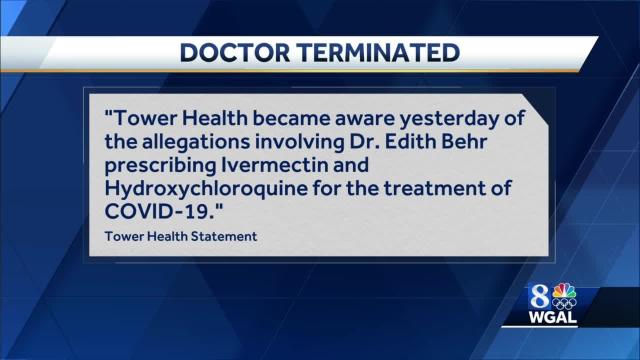
Tower Health fires physician accused of prescribing ivermectin, hydroxychloroquine to treat COVID-19

Tower Health doctor fired for allegedly prescribing ivermectin,  hydroxychloroquine to treat COVID

A Pennsylvania physician accused of prescribing ivermectin and hydroxychloroquine to treat and prevent COVID-19 has been terminated from Tower Health, PennLive reported Feb. 4.

Edith Behr, MD, is allegedly linked to Christine Mason, a woman who used a Facebook account to connect people to a physician for hydroxychloroquine and ivermectin prescriptions. A social media user claimed Dr. Behr was the source of the prescriptions and reported her to authorities and her employer, according to PennLive

West Reading, Pa.-based Tower Health officials became aware of the allegations against Dr. Behr Feb. 2 and took immediate action. 

“Tower Health became aware yesterday of the allegations involving Dr. Edith Behr prescribing ivermectin and hydroxychloroquine for the treatment of COVID-19,” Tower Health said in a Feb. 3 statement to PennLive. “We investigated the matter and, as a result, Dr. Behr’s employment with Tower Health Medical Group has been terminated effective immediately.”

Dr. Behr was a surgeon at Phoenixville (Pa.) Hospital, which is owned by Tower Health, according to the report. 

Ivermectin and hydroxychloroquine have not been approved by the FDA for prevention or treatment of COVID-19.

Labor Market Trends

January jobs report: Payrolls jump by 467,000 as unemployment rate rises to  4.0%

Good morning. Here’s Axios chief economic correspondent Neil Irwin and markets correspondent Emily Peck with what you need to know about today’s surprising jobs numbers.

After days of doom-and-gloom talk about how bad the January jobs numbers would be due to the Omicron variant, they turned out to be, um, great?

  • Employers added 467,000 jobs last month, despite millions out sick.

Why it matters: It’s rare for any jobs numbers to be stunning, but these were. They leave little doubt that this remains a tight job market in which employers are doing everything they can to hold on to their workers.

The big picture: Some of the biggest job gains were in categories that have strong seasonal patterns, normally adding workers in the fall and then cutting those temporary workers in January.

  • But employers, desperate for staff, appear to have held onto those workers in greater numbers than in a normal year.
  • Due to the statistical process of seasonal adjustment, “cutting fewer workers than usual for this time of year” gets translated as “adding lots of jobs.”

By the numbers: Leisure and hospitality added 151,000 jobs; retail added 61,000; and transportation and warehousing added 54,000.

Between the lines: The report offered more evidence that this is an exceptionally tight labor market with inflationary pressures brewing, giving the Federal Reserve the green light for interest rate increases.

  • Average hourly earnings rose a robust 0.7%, and are up 5.7% over the last year. Employers are being forced to pay up to fill their job openings.

Yes, but: Omicron really did have an effect. The report said 6 million people were unable to work because their employers were closed or lost business due to the pandemic, up from 3.1 million in December.

What they’re saying: “Had the prior relationship between Covid cases and employment held true, 800k daily new Covid cases would have led to 2.3 million job losses,” Julia Pollak, chief economist at ZipRecuiter, tweeted. “Instead, we saw 467,000 job GAINS!”

The bottom line: This is an incredibly strong labor market that is poised to strengthen further as Omicron fades.

Why is America’s Covid-19 death rate so high?

Death Rates In The U.S. During Pandemic Far Higher Than Other Countries :  Shots - Health News : NPR

Covid-19 death rates in the United States are “eye-wateringly” high compared with other wealthy nations—a problem that several health experts say underscores the shortfalls of the country’s pandemic response.

U.S. Covid-19 death rates exceed those of other wealthy nations

According to CDC data, over 880,000 Americans have died from Covid-19 since the beginning of the pandemic—a death toll greater than that of any other country. And during the current omicron wave, Covid-19 deaths are now greater than the peak number seen during the delta wave and more than two-thirds as high as record numbers seen last winter before vaccines were available, the New York Times reports.

Moreover, since Dec. 1, when omicron was first detected in the United States, the proportion of Americans who have died from Covid-19 has been at least 63% higher than other large, wealthy countries, including Britain, Canada, France, and Germany, according to a Times analysis of mortality figures.

Currently, the daily Covid-19 death rate in the United States is nearly double that of Britain and four times that of Germany. The only large European countries to surpass the United States’ Covid-19 death rates have been the Czech Republic, Greece, Poland, Russian, and Ukraine—all of which are less wealthy nations where the most effective treatments may be limited.

“Death rates are so high in the States—eye-wateringly high,” said Devi Sridhar, head of the global public health program at the University of Edinburgh. “The United States is lagging.”

Similarly, Joseph Dieleman, an associate professor at the University of Washington, said the United States “stands out” with its high Covid-19 death rate. “There’s been more loss than anyone wanted or anticipated,” he said. 

Vaccination shortfalls plague the U.S.

Lagging Covid-19 vaccination rates among Americans likely contributed to the country’s outsized death toll compared with other nations, several health experts said.

Currently, around 64% of the U.S. population has been fully vaccinated. However, several peer countries, including Australia (80%), Canada (80%), and France (77%), have achieved higher vaccination rates.

Unvaccinated people make up the majority of hospitalized Covid-19 patients, according to the Times, but lagging vaccination and booster rates among vulnerable groups, such as older Americans, has also led to increased hospitalizations.

Around 12% of Americans ages 65 and older are not fully vaccinated, and among those who are fully vaccinated, 43% still have not received a booster shot, leaving them with waning immunity against the omicron variant. In comparison, only 4% of Britons ages 65 and older are not fully vaccinated, and only 9% have not had a booster shot.

“It’s not just vaccination—it’s the recency of vaccines, it’s whether or not people have been boosted, and also whether or not people have been infected in the past,” said Lauren Ancel Meyers, director of the University of Texas at Austin’s Covid-19 modeling consortium.

Similarly, former FDA Commissioner Scott Gottlieb said that the United States‘ lagging vaccination rates compared to the U.K.’s, particularly for boosters, may be due to “protracted wrangling” that “may have sowed confusion, sapping consumer interest.”

How the U.S. could fare in future Covid-19 waves

According to some scientists, the gap between the United States and other wealthy nations may soon begin to narrow. Although U.S. vaccination rates have been slow, the delta and omicron waves have infected so many people that overall immunity against the coronavirus has increased—which could potentially help blunt the effect of future waves.

“We’ve finally started getting to a stage where most of the population has been exposed either to a vaccine or the virus multiple times by now,” said David Dowdy, an epidemiologist at the Johns Hopkins Bloomberg School of Public Health. “I think we’re now likely to start seeing [American and European Covid-19 death rates] be more synchronized going forward.”

However, other experts noted that the United States has other disadvantages that could make future Covid-19 waves difficult. For example, many Americans have chronic health problems, such as diabetes and obesity, that increase the risk of severe Covid-19 outcomes.

Overall, health experts said the impact of future Covid-19 waves will depend on what new variants emerge, as well as what level of death people decide is tolerable.

“We’ve normalized a very high death toll in the U.S.,” said Anne Sosin, who studies health equity at Dartmouth University. “If we want to declare the end of the pandemic right now, what we’re doing is normalizing a very high rate of death.”