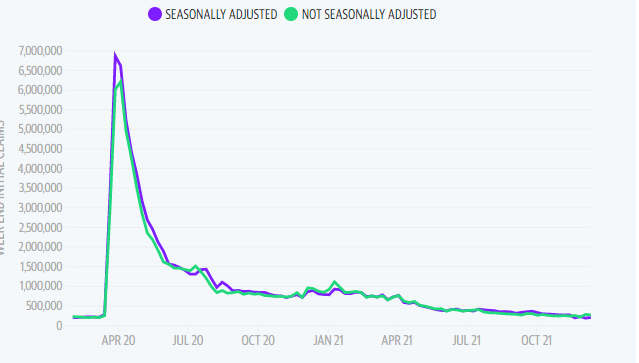
First-time unemployment filings fell by 8,000 claims from the previous week’s reading, marking the second lowest print during the pandemic and signaling continued recovery in the labor market as high demand for workers pours into the new year.
The Labor Department released its latest report on initial and continuing claims on Thursday at 8:30 a.m. ET. Here were the main metrics from the print, compared to consensus estimates compiled by Bloomberg:
Initial jobless claims, week ended Dec. 25: 198,000 vs. 206,000 expected and upwardly revised to 206,000 during prior week
Continuing claims, week ended Dec. 18: 1.716 million vs. 1.875 million expected and downwardly revised to 1.856 million during prior week
The newest print brings the four-week moving average to 199,300 in the week ending Dec. 25, Bloomberg data reflected. Continuing claims dropped to a fresh pandemic low of 1.716 million. Forecast for this week’s jobless claims release ranged from 190,000-225,000 from 22 economists surveyed by Bloomberg.
First-time filings for unemployment remained below the 2019 average of 218,000, when the unemployment rate was at a half-century low of 3.5%, according to Bloomberg. The current unemployment rate is also expected to edge down to 4.1% in December as the labor market continues to tighten.
At 205,000, last week’s initial unemployment claims were on par with economist forecasts and below pre-pandemic levels yet again. Earlier in December, jobless claims fell sharply to 188,000, the lowest level since 1969. The prints serve an early indication of the relative strength expected to show in December’s jobs report, though the economic impact of the virus remains unclear.
“Fortunately, there’s no evidence in this data of a new wave of fresh job loss,” Bankrate senior economic analyst Mark Hamrick said, commenting on last week’s figures. “New claims are only slightly above the lowest point in decades notched a couple of weeks ago.”
“With so much uncertainty now and the high level of concern about the Omicron variant, we’ll take stability when we can get it,” Hamrick added.
“It’s stunning to see how much the rate has fallen in the last five months,” he told Yahoo Finance Live. “We expect that pace of decline to slow, but it doesn’t take much to get below 4%, even with a tick up in the labor participation rate, which has been depressed over the last year and a half.”
Record cases of COVID-19 may discourage workers from looking for work as U.S. households continue to cite fear of COVID or virus-related caretaking needs as reasons for staying out of the job market.
“The pandemic’s resurgence is affecting the economy,” Hamrick said in a note last week. “The question is for how long and how much, and it is too early to know the answers.”
At the 390-bed Terrace View nursing home on the east side of Buffalo, 22 beds are shut down. There isn’t enough staff to care for a full house, safely or legally.
That means some fully recovered patients in the adjacent Erie County Medical Center must stay in their hospital rooms, waiting for a bed in the nursing home. Which means some patients in the emergency department, who should be admitted to the hospital, must stay there until a hospital bed opens up. The emergency department becomes stretched so thin that 10 to 20 percent of arrivals leave without seeing a caregiver — after an average wait of six to eight hours, according to the hospital’s data.
“We used to get upset when our ‘left without being seen’ went above 3 percent,” said Thomas Quatroche, president and chief executive of the Erie County Medical Center Corp., which runs the 590-bed public safety net hospital.
Nursing home bed and staff shortages were problems in the United States before the coronavirus pandemic. But the departure of 425,000 employees over the past two years has narrowed the bottleneck at nursing homes and other long-term care facilities at the same time that acute care hospitals are facing unending demand for services due to a persistent pandemic and staff shortages of their own.
With the omicron variant raising fears of even more hospitalizations, the problems faced by nursing homes are taking on even more importance. Several states have sent National Guard members to help with caregiving and other chores.
Hospitalizations, which peaked at higher than 142,000 in January, are rising again as well, reaching more than 71,000 nationally on Thursday, according to data tracked by The Washington Post. In some places, there is little room left in hospitals or ICUs.
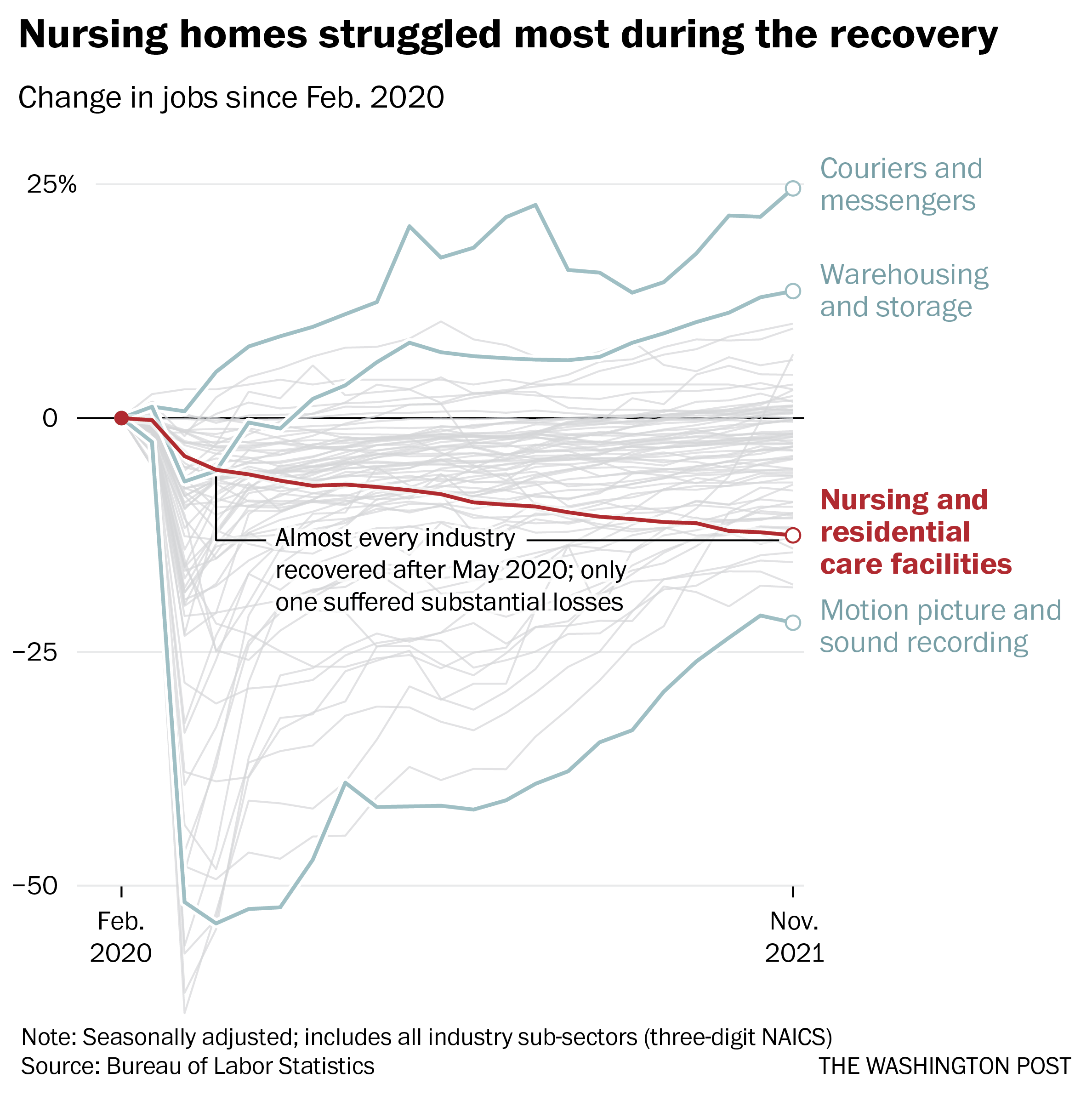
About 58 percent of the nation’s 14,000 nursing homes are limiting admissions, according to a voluntary survey conducted by the American Health Care Association, which represents them. According to the U.S. Bureau of Labor Statistics, 425,000 employees, many of them low-paid certified nursing assistants who are the backbone of the nursing home workforce, have left since February 2020.
“What we’re seeing on the hospital side is a reflection of that,” said Rob Shipp, vice president for population health and clinical affairs at the Hospital Association of Pennsylvania, which represents medical providers in that state. The backups are not just for traditional medical inpatients ready for follow-up care, he said, but psychiatric and other patients as well.
A handful of developmentally disabled patients at Erie County Medical Center waited as long as a year for placement in a group setting, Quatroche said. Medical patients recovered from illness and surgery who cannot go home safely may wait days or weeks for a bed, he said.
“I don’t know if everyone understands how serious the situation is,” Quatroche said. “You really don’t know until you need care. And then you know immediately.”
Nearly 237,000 workers left during the recovery, data through November show. No other industry suffered anything close to those losses over the same period, according to the Bureau of Labor Statistics.
Workers in the broader health-care industry have been quitting in record numbers for most of the pandemic, plagued by burnout, vulnerability to the coronavirus and poaching by competitors. Low-wage workers tend to quit at the highest rates, Labor Department data show, and nursing home workers are the lowest paid in the health sector, with nonmanagerial earnings averaging between $17.45 an hour for assisted living to $21.19 an hour for skilled nursing facilities, according to the BLS.
Nursing home occupancy fell sharply at the start of the pandemic, but inched back upward in 2021, according to the nonprofit National Investment Center for Seniors Housing and Care. One major force that held it back was worker shortages.
“Operators in the business have said we could admit more patients, but we cannot find the staff to allow that to happen,” said Bill Kauffman, senior principal at the organization.
Shortages have spawned fierce talent wars in the industry, Brookdale Senior Living Chief Executive Officer Cindy Baier said in a recent earnings call. When they don’t have enough workers, restaurants can reduce service hours and hospitals can cut elective surgeries, but nursing homes don’t have the option of eliminating critical services, she said. They must close beds.
“We are in the ‘people taking care of people’ business around-the-clock, 365 days a year,” she said.
Nursing homes tend to gain workers during a recession but can struggle to hire during expansions, according to an analysis of county-level data from the Great Recession recently published in the health care provision and financing journal Inquiry.
Steady income from their resident population and government programs such as Medicaid makes them recession-proof, and their low pay and challenging work conditions mean they’re chronically understaffed, said one of the study’s authors, Indiana University health-care economist Kosali Simon.
When recessions occur, nursing homes go on a hiring spree, filling holes in their staff with qualified workers laid off elsewhere.
“People during a recession may lose their construction jobs or jobs in retail sectors, and then look for entry-level positions at places like nursing homes where there is always demand,” Simon said.
Now, amid the “Great Resignation” and the hot job market, the opposite is happening. In sparsely populated areas and regions where pay is lower, the problem is even worse.
The Diakonos Group, which operates 26 nursing homes, assisted-living facilities and group homes in Oklahoma, closed an 84-bed location for seniors with mental health needs in May “simply because we couldn’t staff it any longer,” said Chief Executive Officer Scott Pilgrim. Patients were transferred elsewhere, including Tulsa and Oklahoma City, he said.
The home in rural Medford, which depended entirely on Medicaid payments, “was never easy to staff, but once we started through covid and everything, our staff was just burned out.”
Diakonos boosted certified nursing assistants’ pay from $12 an hour and licensed practical nurses’ pay from $20 an hour, used federal and state assistance to offer bonuses and employed overtime, but workers kept leaving for better health-care jobs and positions in other industries, he said.
“I’ve never been able to pay what we ought to pay,” Pilgrim said. Eventually he began to limit admissions and eventually was forced to close.
“The hospitals are backed up,” he said. “They’re trying to find anywhere to send people. We get referrals from states all around us. The hospitals are desperate to find places to send people.”
In south central Pennsylvania, SpiriTrust Lutheran is not filling 61 of its 344 beds in six facilities because of the worker shortage, said Carol Hess, the company’s senior vice president.
“I have nurses who went to become real estate agents,” she said. “They were just burned out.”
Pay raises of $1 to $1.50 an hour and bonuses brought the lowest-paid workers to about $15 an hour, Hess said, and the company is planning a recruiting drive after Jan. 1. But the prognosis is still grim.
“We’re competing with restaurants for our dining team members,” Hess said. “We’re competing with other folks for cleaning and laundry and others.” In the area around Harrisburg where SpiriTrust employees live, some schools that turned out certified nurse assistants closed during the pandemic and haven’t reopened.
The nursing homes have begun borrowing licensed practical nurses from WellSpan Health, the nearby hospital system that discharges many of its patients to SpriTrust after they recover. About 15 have began their orientations this month, she said, and the two systems are collaborating to pay them.
The bed shortage is causing backups that can average several days in the hospital, said Michael Seim, the hospital system’s chief quality officer. That gives the hospitals an interest in helping any way they can, he said.
“We have between 80 and 100 patients waiting for some type of skilled care,” Seim said this month. The hospital has begun caring for more people at home, enrolling 400 people so far in a program that sends clinicians to check on them there. More than 90 percent have said they are happy with the program.
“I think the future of hospital-based care is partnerships,” Seim said. “It’s going to be health systems partnering across their service areas … to disrupt the model we have.”
Healthy individuals who have been vaccinated, and especially those who have been boosted, appear unlikely to develop severe infections from the omicron variant that would land them in the hospital, say medical experts who have monitored the effects of the newest coronavirus variant since it was identified over four weeks ago.
While omicron has sent U.S. infections soaring to levels not seen since last winter’s wave, it appears to have less severe effects than the delta variant, according to a handful of international studies and early data from several U.S. hospitals.
Those infected by the omicron variant are 15 to 20 percent less likely to go to an emergency room, and 40 percent less likely to be hospitalized overnight, compared with those infected with delta, according to English data analyzed by scientists from Imperial College London. That aligns with early U.S. data from some hospitals.
At the Houston Methodist hospital system, about 15 percent of symptomatic individuals have ended up hospitalized — around a 70 percent reduction compared with those infected by the delta variant, said James Musser, chair of pathology and genomic medicine.
A separate study from Britain, which is not yet peer reviewed, found that people infected with omicron were almost 60 percent less likely to enter the hospital than those infected with delta.
“What is absolutely clear is there is lower rate of hospitalization with our omicron patients in our hospital system,” Musser said. “That does not necessarily mean that this variant is quote-unquote ‘less virulent.’ The jury’s still out on that. What we know now is that … if you are immunized and, more importantly, if you are boosted, you’re going to stay out of substantial trouble.”
He and other experts warn against complacency, however, cautioning that millions of Americans, particularly the unvaccinated, remain vulnerable to more serious disease from the most transmissible coronavirus variant to date.
Other factors that might lead to greater risk include an individual’s age, the type of vaccine or booster they received, and whether they have underlying health problems, such as heart disease or obesity, said Michael Osterholm, director of the Center for Infectious Disease Research and Policy at the University of Minnesota and a member of President Biden’s covid-19 transition task force.
“Have you previously had infection? Were you vaccinated? How many doses of vaccine, and was it more than six months ago? So in some ways this is almost like a calculus problem. It’s got a lot of moving parts to it and we’re trying to figure it out,” Osterholm said.
Doctors also caution that far more people will become infected with omicron simply because of its transmissibility. If even a small fraction of those land in the hospital, they worry that health care systems that are already short-staffed because of delta infections could be overwhelmed — with potentially dire results for those needing critical care as a result of car accidents, heart attacks, strokes, or any number of things that bring people to emergency rooms.
“We need to be respectful of the fact that our hospital system has been under this kind of duress for such a long time,” said Larry Corey, a virologist at the Fred Hutchinson Cancer Research Center in Seattle. “We need to do everything we can to not allow the situation, where there’s such crowding and such intensity that we can’t optimally take care of the people who get severe disease.”
Anthony S. Fauci, Biden’s chief medical adviser, said the rapid increase in the numbers of people getting infected with the omicron variant will invariably put additional strain on the system.
“We’re going to have a real challenge to the health-care delivery system — namely the number of beds, the number of ICU beds and even the number of health care providers,” Fauci said in an interview. “Even vaccinated people are getting breakthrough infections. So if you get enough nurses and doctors infected, they are going to temporarily be out of action. And if you get enough of them out of action, you could have a double stress on the health care system.”
The welcome news for most people who are vaccinated and boosted is that omicron infections often mimic the symptoms of the common cold. Those with two shots of vaccine, but no booster, also appear to fare relatively well, though they may develop more intense symptoms that may last longer, experts said.
In a series of Twitter posts, Craig Spencer, who teaches emergency medicine at Columbia University Medical Center, said every boosted patient he has seen in the emergency room has had no difficulty breathing or shortness of breath. Those who have had two doses of either the Pfizer or Moderna vaccines also have had mild symptoms, he said, “but more than those who had received a third dose.”
But almost every patient who had to be hospitalized was unvaccinated, he said.
“No matter your political affiliation, or thoughts on masks, or where you live in this country, as an ER doctor you’d trust with your life if you rolled into my emergency room at 3am, I promise you that you’d rather face the oncoming Omicron wave vaccinated,” Spencer wrote.
Children are also filling up hospital beds in many parts of the country, especially in New York. State officials issued a warning on Christmas Eve after a fourfold increase in hospitalizations in children under 18 in New York City between Dec. 5 and last week. About half of the admissions were children under 5, who are not eligible for vaccination, according to the New York Department of Health.
Experts cautioned that those at higher risk of severe infection to previous variants probably remain vulnerable to this one.
It’s not yet clear whether older, boosted individuals and those with underlying conditions, such as diabetes and heart disease, face the same lowered risk with omicron. Answering such questions is key to assessing the likely trajectory of the variant in the U.S. since it is older and less healthy than many of its global peers.
So far, though, early U.S. data echoes what has been seen in South Africa and Britain, where omicron waves are slightly ahead of this country’s.
A group of Scottish scientists said recently that vaccinated people appear to have some protection against symptomatic infection from omicron, although less than they did against delta. A third dose or booster of an mRNA vaccine was associated with a 57 percent reduction in the odds of developing a symptomatic omicron case.
In the Johns Hopkins Hospital emergency department, physicians are seeing more infections than atany other point in the pandemic, but most of the cases are not severe, said Stuart Ray, a professor of medicine in the division of infectious diseases. But he warned that there is not yet “reassuring evidence” the United States will be spared from a disruptive wave of infections and complications.
The country faces other challenges with omicron in terms of its medicine cabinet. Two of the three existing intravenous treatments called monoclonal antibodies — those from Regeneron and Eli Lilly — do not work against the variant. Some Republican governors had touted the ability of those with covid-19 to receive monoclonal antibodies, spurring some Americans to see those treatments as an alternative to getting vaccinated.
The only monoclonal antibody that does work, sotrovimab from Vir Biotechnology and GlaxoSmithKline, is in short supply and will not be available to many of those who become infected. The Food and Drug Administration authorized two easy-to-take antiviral pills last week and one has high efficacy against omicron, but it will be in initial short supply. Distribution of the pills is expected to begin shortly.
It is also unclear whether the surge in the United States will follow the same pattern as South Africa’s, which rapidly passed the peak of omicron cases last week.
South Africa’s population is significantly younger and has far lower vaccination rates, with about 35 percent of the population immunized, and virtually no oneboosted.The country also grappled with a delta variant wave that infected a far greater portion of the population than it did in the United States.
The significant number of South African residents infected with delta compared with the United States could prove to be an important distinction that might make more Americans vulnerable to omicron, said Chris Beyrer, an epidemiologist at the Johns Hopkins Bloomberg School of Public Health.
Beyrer also noted that infections in the United States, Britain and Germany seemed to be increasing at a significantly faster rate than they were in South Africa.
“This is an incredibly infectious virus and it is moving right along,” Beyrer said. He added that the United States has numerous tools — including ready access to vaccines and booster shots, the new antiviral medicines, testing and masking — that could help curb its effects.
But referring to those who have refused to follow public health guidelines, Beyrer said, “We have a lot of resistance so that makes us vulnerable to infection.”







 HENRY KOTULA