


Cartoon – Leadership Greatness

The federal government is increasingly cracking down on alleged fraud, especially in the Medicare Advantage program. In privately run MA plans, CMS pays companies on a per-member basis, then adjusts payments based on the acuity or severity of their member’s health status, as supported by provider data like diagnostic codes. Generally, the sicker the member, the higher the plan’s reimbursement.
That’s led to allegations of plans hiking risk scores to overinflate members’ health needs, resulting in higher payments from CMS. Watchdogs have been finding higher incidence of fraud and abuse as the MA program becomes more popular, growing to cover more than 40% of all Medicare beneficiaries.
Oak Street isn’t a traditional plan itself, but enters into full-risk contracts with Medicare Advantage plans, and via CMS’ direct contracting program, in which it assumes full responsibility for patients’ medical expenses in exchange for a fixed per-member, per-month payment. The Chicago-based company is the latest target of a federal inquiry into whether it violated the False Claims Act.
According to the primary care company, the DOJ sent a civil investigative demand on Nov. 1 asking for information about Oak Street’s relationships with third-party marketers and transportation partners.
Oak Street does provide patients transportation to appointments when they need it and has various ways for finding new patients, including community partnerships, but it’s unclear what the DOJ is specifically investigating, CEO Mike Pykosz told investors.
“We have had no meaningful conversations with the government,” Pykosz said. “I’m not really sure what the link is.”
The CEO noted it’s not unusual for such inquiries to take months to resolve, particularly in the hyper-regulated healthcare industry, but said he wouldn’t speculate further.
A civil investigative demand is a form of administrative subpoena, and doesn’t denote any regulatory or legal action itself. However, it is used by the government to kick off investigating potential False Claims violations, and determine whether there’s sufficient evidence to warrant filing an action, according to the National Law Review.
Penalties for violating the act could range from $11,655 to $23,331 per violation, plus triple damages. Total penalties have resulted recently in some significant payouts from MA participants. Notably, in late August, integrated health system Sutter Health agreed to pay $90 million to settle whistleblower allegations of risk adjustment fraud, in the largest False Claims Act settlement against a hospital system in the MA program.
Analysts noted the inquiry, while in early stages, is a point of concern for Oak Street’s future stock performance.
“This creates a new potential risk factor that we are unlikely to get clarity on for some time,” SVB Leerink analyst Whit Mayo wrote in a note.
Oak Street, which also provides services to patients with a range of insurance options, had an otherwise solid quarter, eclipsing $1 billion of year-to-date revenue for the first time in the company’s history.
The highly infectious delta variant did contribute to higher expenses, as it has with other providers.
Oak Street reported $15 million in costs from COVID-19 admissions in the first half of the year, and another $10 million in the third quarter. COVID-19-related expenses surged in the latter half of August and continued into September, but tailed off early into the fourth quarter, CFO Tim Cook said.
The majority of Oak Street’s patients are in northern U.S. markets, however, which experienced coronavirus surges last year during the winter as more people stayed indoors.
“We will see what happens in November and December,” Cook said. “While COVID costs are going to be lower in Q4, unfortunately we’re not in a world where they’re going to be zero.”
In the quarter, the primary care provider’s medical claims expense doubled year over year to almost $310 million. Oak Street’s medical loss ratio of 82.2% was lower than analysts expected, though management said they expected it to be higher in the fourth quarter.
Pykosz and Cook called out medical costs from new patients brought in during 2021 as a system-wide stressor.
Because diagnoses from 2020 claims are used to determine 2021 risk scores, fewer claims last year could mean lower risk scores and lower payments for plans this year. Oak Street’s patients, especially older adults in low-income communities, used fewer services last year during COVID-19, which resulted in lower revenues this year even as costs expanded.
Management said they expected to get back on track in 2022 as patients new to Oak Street this year will contribute to higher reimbursement next year, closing the current medical-cost gap between tenured and new patients.
“This is certainly an outlier year from every other year we’ve had results,” Pykosz said.
Oak Street, which was founded in 2012 and went public in August 2020 at a $9 billion valuation, reported a net loss of almost $110 million in the quarter, compared to a loss of $59 million at the same time last year.
Oak Street continued expanding its membership and network in the quarter, reporting 69% at-risk patient growth and opening 15 new centers in seven new markets.
Oak Street’s competition in the value-based primary care space has ramped up this year, as peers One Medical acquired a rival value-based medical chain and VillageMD got a hefty new investment from drugstore partner Walgreens.
But Pykosz pointed to Oak Street’s exclusive relationship with senior group AARP and its acquisition of specialty telehealth provider RubiconMD as differentiators, while noting there’s room for a number of players in the space.
“At this point we don’t feel there’s a lot of pressure or competitive dynamics pressuring our performance,” Pykosz said.
In the third quarter, Oak Street served 100,500 risk-based patients, representing 76% of its total patient base. The company expects at-risk patient volume to grow to between 111,500 and 113,500 patients this year.

Despite being a legacy hospital operator, Tenet’s outpatient surgery business is key to its long-term strategy.
After the latest deal closes, USPI will operate 440 surgery centers in 35 states, Tenet said Tuesday. The acquisition will boost USPI’s footprint in existing markets, such as Florida where it already operates 47 centers and will gain an additional 15. USPI will also enter new markets, such as Michigan, with a sizable footprint at the outset, executives said Tuesday.
The deal includes 65 mature centers and 27 that have opened in the past year or will soon open and start performing their first cases. Tenet may also spend an additional $250 million to acquire equity interests from physician owners.
Tenet leaders touted SCD’s service line mix, pointing out that a significant portion of the cases performed by these centers are for musculoskeletal care, which includes total joint and spine procedures.
The deal is expected to generate $175 million in EBITDA during the first year, executives said.
SVB Leerink analysts characterized the deal as savvy and said it will reshape the company’s earnings towards a “faster growing, higher margin, and improved capital return profile.”
Heading into 2021, Tenet had expected a greater share of its earnings power to come from its outpatient surgery business. This deal accelerates that aim over the long-term.
In 2014, Tenet’s ambulatory surgery business accounted for just 5% of the company’s overall earnings. Prior to this latest deal, Tenet expected the unit to account for 42% of its overall earnings in 2021.
This latest announcement follows Tenet’s deal in October with Compass Surgical Partners to acquire its ownership and management interests in nine ambulatory surgery centers located in Florida, North Carolina and Texas for an undisclosed sum.
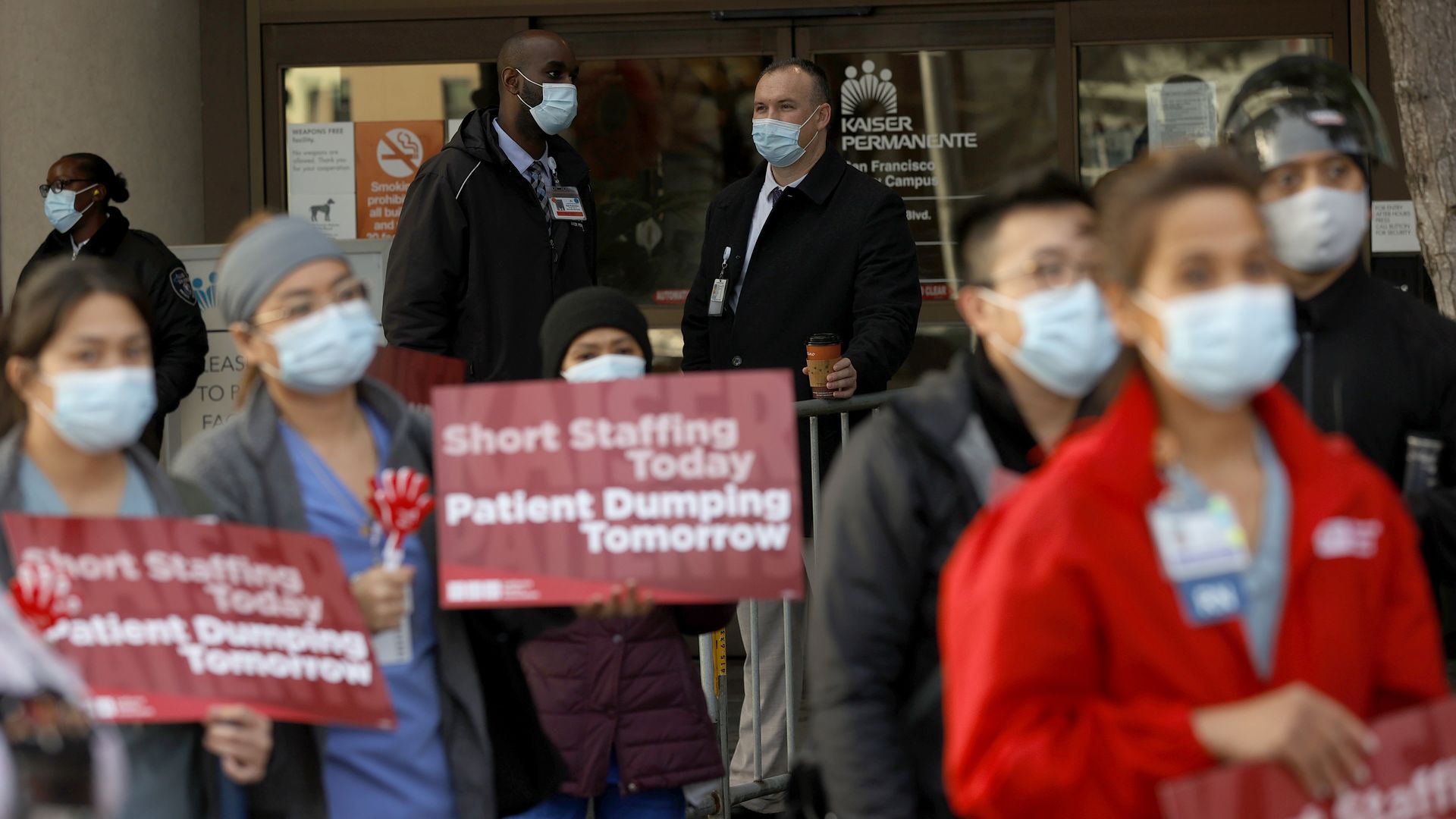
Union leaders representing nearly 50,000 health care workers and medical staff reached a tentative agreement in a labor dispute Saturday, avoiding a strike set to begin Monday.
Why it matters: The breakthrough in talks comes as nurses, front-line technicians and other hospital employees face worker shortages and burnout due to the ongoing COVID-19 pandemic.
The big picture: More than 30,000 Kaiser Permanente employees in Oregon, Washington, California and other states threatened to walk out on Monday over lower pay for new hires, Reuters reports.
What they’re saying: “This agreement will mean patients will continue to receive the best care, and Alliance members will have the best jobs,” Hal Ruddick, executive director of Alliance, said in the statement.
What’s next: The agreement heads to union members for ratification, and, if ratified, it will become retroactive to Oct. 1.

Monthly premiums that cover physician and outpatient care for Medicare patients will increase by 15% next year, the Biden administration said in a notice Friday evening.
Why it matters: People on Medicare are getting slammed with a big hike during an election year, due largely to the big price tag from the questionable Alzheimer’s treatment, Aduhelm, and uncertainty stemming from the coronavirus.
By the numbers: Standard Medicare Part B premiums will be $170.10 per month next year, up from $148.50 per month this year.
Between the lines: Medicare is still determining whether it will pay for Aduhelm yet, but federal actuaries have to plan for a “high-cost scenario of Aduhelm coverage,” regulators said.
The bottom line: The pandemic has made it difficult to predict future Medicare spending, such as trying to determine whether patients will get more non-COVID care that had been put off.
People who have health insurance but get sick with rare diseases that require out-of-network care continue to face potentially unlimited costs.
The big picture: Federal regulations cap how much people pay out of pocket for in-network care, but no such limit exists for out-of-network care.
Zoom in: Cindy Beckwith, 57, of Bolton, Connecticut, was diagnosed with pulmonary artery sarcoma, a rare tumor on a main artery. She also has fibromuscular dysplasia, a rare blood vessel condition.
The bill: $20,138.40 from Penn Medicine, the parent of UPHS, a profitable system with $8.7 billion of revenue last year.
Between the lines: The new surprise billing regulation only protects patients if they get non-emergency care from out-of-network doctors at in-network facilities.
The other side: Beckwith’s hospital and insurance providers did not make anyone available for interviews.
The resolution: After Axios submitted a HIPAA authorization waiver, signed by Beckwith, to Penn Medicine to discuss Beckwith’s case, Beckwith received a call from Penn Medicine, whom she hadn’t heard from in months.
https://www.yahoo.com/news/austria-orders-nationwide-lockdown-unvaccinated-120902629.html

The Austrian government has ordered a nationwide lockdown for unvaccinated people starting at midnight Sunday to combat rising coronavirus infections and deaths.
The move prohibits unvaccinated people 12 and older from leaving their homes except for basic activities such as working, grocery shopping, going for a walk — or getting vaccinated.
Authorities are concerned about rising infections and deaths and that soon hospital staff will no longer be able to handle the growing influx of COVID-19 patients.
“It’s our job as the government of Austria to protect the people,” Chancellor Alexander Schallenberg told reporters in Vienna on Sunday. “Therefore we decided that starting Monday … there will be a lockdown for the unvaccinated.”
The lockdown affects about 2 million people in the Alpine country of 8.9 million, the APA news agency reported. It doesn’t apply to children under 12 because they cannot yet officially get vaccinated.
The lockdown will initially last for 10 days and police will go on patrol to check people outside to make sure they are vaccinated, Schallenberg said, adding that additional forces will be assigned to the patrols.
Unvaccinated people can be fined up to 1,450 euros ($1,660) if they violate the lockdown.
Austria has one of the lowest vaccination rates in Western Europe: only around 65% of the total population is fully vaccinated. In recent weeks, Austria has faced a worrying rise in infections. Authorities reported 11,552 new cases on Sunday; a week ago there were 8,554 new daily infections.
Deaths have also been increasing in recent weeks. On Sunday, 17 new deaths were reported. Overall, Austria’s pandemic death toll stands at 11,706, APA reported.
The seven-day infection rate stands at 775.5 new cases per 100,000 inhabitants. In comparison, the rate is at 289 in neighboring Germany, which has already also sounded the alarm over the rising numbers.
Schallenberg pointed out that while the seven-day infection rate for vaccinated people has been falling in recent days, the rate is rising quickly for the unvaccinated.
“The rate for the unvaccinated is at over 1,700, while for the vaccinated it is at 383,” the chancellor said.
Schallenberg also called on people who have been vaccinated to get their booster shot, saying that otherwise “we will never get out of this vicious circle.”



 HENRY KOTULA