5 new responsibilities for the beyond-finance CFO

https://www.cfodive.com/spons/5-new-responsibilities-for-the-beyond-finance-cfo/607630/

The Urgent Need to Redefine the Office of the CFO

For years, pioneering CFOs steadily extended their duties beyond the boundaries of the traditional finance and accounting function. Over the past year, an expanding set of beyond-finance activities – including those related to environmental, social and governance (ESG) matters; human capital reporting; cybersecurity; and supply chain management – have grown in importance for most finance groups. Traditional finance and accounting responsibilities remain core requirements for CFOs, even as they augment planning, analysis, forecasting and reporting processes to thrive in the cloud-based digital era. Protiviti’s latest global survey of CFOs and finance leaders shows that CFOs are refining their new and growing roles by addressing five key areas:

Accessing new data to drive success ­– The ability of CFOs and finance groups to address their expanding priorities depends on the quality and completeness of the data they access, secure, govern and use. Even the most powerful, cutting-edge tools will deliver subpar insights without optimal data inputs. In addition, more of the data finance uses to generate forward-looking business insights is sourced from producers outside of finance group and the organization. Many of these data producers lack expertise in disclosure controls and therefore need guidance from the finance organization.

Developing long-term strategies for protecting and leveraging data – From a data-protection perspective, CFOs are refining their calculations of cyber risk while benchmarking their organization’s data security and privacy spending and allocations. From a data-leveraging perspective, finance chiefs are creating and updating roadmaps for investments in robotic process automation, business intelligence tools, AI applications, other types of advanced automation, and the cloud technology that serves as a foundational enabler for these advanced finance tools. These investments are designed to satisfy the need for real-time finance insights and analysis among a mushrooming set of internal customers.

Applying financial expertise to ESG reporting – CFOs are mobilizing their team’s financial reporting expertise to address unfolding Human Capital and ESG reporting and disclosure requirements. Leading CFOs are consummating their role in this next-generation data collection activity while ensuring that the organization lays the groundwork to maximize the business value it derives from monitoring, managing and reporting all forms of ESG-related performance metrics.

Elevating and expanding forecasting – Finance groups are overhauling forecasting and planning processes to integrate new data inputs, from new sources, so that the insights the finance organization produces are more real-time in nature and relevant to more finance customers inside and outside the organization. Traditional key performance indicators (KPIs) are being supplemented by key business indicators (KBIs) to provide sharper forecasts and viewpoints. As major new sources of political, social, technological and business volatility arise in an unsteady post-COVID era, forecasting’s value to the organization continues to soar.

Investing in long-term talent strategies – Finance groups are refining their labor model to become more flexible and gain long-term access to cutting-edge skills and innovative thinking in the face of an ongoing and persistent finance and accounting talent crunch. CFOs also are recalibrating their flexible labor models and helping other parts of the organization develop a similar approach to ensure the entire future organization can skill and scale to operate at the right size and in the right manner.


CFOs might find PCAOB evidence-quality guide a useful auditor check

An opinion that’s supported by irrelevant or unreliable data might not be accurately capturing company performance.

How well is the opinion of your company’s performance supported by the evidence the auditor’s using?

Public Company Accounting Oversight Board (PCAOB) staff have released guidance on what constitutes relevant and reliable evidence for supporting audit opinions.

If evidence auditors are using isn’t relevant or from a reliable source, or if the reliability of the evidence itself is questionable, that can call into question the soundness of the opinion.

“In some cases, information that was determined by the auditor to be more relevant may not be the most reliable, and vice versa,” the guidance, released October 7, says.

Data availability

PCAOB was created in 2002 as part of the Sarbanes-Oxley Act to help ensure auditors don’t allow accounting problems in public companies to get past them and put investors at risk. 

The new guidance tries to put guardrails around auditors’ growing use of external evidence to support their opinions. 

The use of external evidence, like so many things today, is fueled by the widespread availability of data that companies, regulators and other entities collect and release. The question the guidance tries to answer is which data is relevant and reliable and which isn’t.

“Advancements in technology in recent years have improved accessibility and expanded the volume of information available to companies and their auditors from traditional and newer external sources,” the document says. 

Reliability

In general, data generated by regulators or entities that are themselves regulated — stock exchanges are mentioned — can be counted on to be more reliable than data generated by other types of organizations. 

Similarly for data that’s generated by organizations vs. data that is derived through analyses of other organizations’ data. The more raw the data is, in other words, the better chance it’s reliable.

Relevance

Relevance is the other big issue, and the guidance provides several use cases for thinking about that. For example, weather data can be relevant evidence for assessing the accuracy of a company’s sales data, presumably because bad weather can reduce brick-and-mortar sales, but only if the data is used correctly. 

“Before using the weather data in developing certain expectations – e.g., for substantive analytical procedures related to product revenue – the auditor would need to understand the relationship between weather data and company activities,” the guidance says.

A company’s year-end stock price, obtained from an exchange, is another example. That data can be used to compare against the price the company is using to support its valuation of an instrument.

“The exchange price would represent the fair value of the instrument,” the document says. 

The guidance is directed at auditors, but it’s relevant to CFOs for checking whether their auditor is using external evidence appropriately in its assessment of company performance.

Possible strike looms for 28,000 Kaiser workers in Southern California

80,000 Kaiser Permanente workers to strike nationwide in October | Fox  Business

Nurses and other healthcare workers have voted to authorize a strike at Kaiser Permanente in Southern California, according to a union news release.

The vote covers 21,000 registered nurses, pharmacists, midwives, physical therapists and other healthcare professionals represented by the United Nurses Associations of California/Union of Health Care Professionals, as well as 7,000 members of United Steelworkers. It does not mean a strike is scheduled. However, it gives bargaining teams the option of calling a strike. Unions representing the workers would have to provide a 10-day notice before striking.

The vote comes as Oakland, Calif.-based Kaiser is negotiating for a national contract with UNAC/UHCP, along with about 20 other unions in the Alliance of Health Care Unions. The alliance, which has been in negotiations with Kaiser since April, covers more than 50,000 Kaiser workers nationwide.

UNAC/UHCP said union members are facing “protracted understaffing” amid record levels of burnout during the COVID-19 pandemic.

“While healthcare workers are facing record levels of burnout after 18 months of the COVID pandemic, they continue to deal with protracted understaffing. Talks at the table center on how to recruit to fill open positions that impact patient care and service,” the union said in a news release. “Kaiser Permanente … wants to slash wages for new nurses and healthcare workers and depress wages for current workers trying to keep up with rising costs for food, housing and other essentials.”

Kaiser has defended its pay amid a challenging pandemic, saying its proposal includes wage increases for current employees “on top of the already market-leading pay and benefits,” as well as a market-based compensation structure for those hired in 2023 and beyond.

In a statement shared with Becker’s Oct. 11, the system also emphasized its continued focus on high-quality, safe care.

“In the event of any kind of work stoppage, our facilities will be staffed by our physicians along with trained and experienced managers and contingency staff,” the system said. 

This strike would affect Kaiser hospitals and medical centers in Anaheim, Bakersfield, Baldwin Park, Downey, Fontana, Irvine, Los Angeles, Ontario Vineyard, Panorama City, Riverside, San Diego, West Los Angeles and Woodland Hills, as well as various clinics and medical office buildings in Southern California.

Hospitals still spending more on PPE, labor as result of COVID-19

Dive Brief:

  • Hospitals across the country have spent more than $3 billion on personal protective equipment since the start of the COVID-19 pandemic, though costs have steadily declined since the worst shortages experienced during the second quarter of 2020, according to an analysis from Premier, a group purchasing organization.
  • Before the pandemic, hospitals normally spent about $7 on PPE costs per patient per day. That figure shot to $20.40 during the second quarter of last year, and during the first quarter of this year was around $12.45 per patient per day, according to Premier.
  • Hospitals are also still paying more for qualified clinical labor — roughly $24 billion more in total per year compared to before the pandemic, according to another Premier analysis out last week.

Dive Insight:

PPE was in short supply early in the pandemic, spurring bidding wars and financially straining hospitals as they suffered from the budgetary fallout of canceled elective surgeries and other lucrative services.

While supply chain challenges have since eased and costs are down since their peak, hospitals are still spending more on PPE than before the pandemic, and consumption and demand remains strong in light of the delta variant, according to the report.

Premier used a database representing 30% of U.S. hospitals across all regions from September 2019 through last month to track spending trends, looking at costs for eye protection, surgical gowns, N95 respirators, face masks, exam gloves and swabs. It then calculated total costs measuring quantities used per patient, per day, multiplied by the percent change in pricing for the quarter.

Ultimately, hospitals are still using far more N95 respirators than they were prior to the pandemic.

Demand is still up for eye protection, surgical gowns and face masks, though pricing is close to pre-pandemic levels for those items. Costs for surgical gloves and N95 respirators are still above pre-pandemic levels, according to the analysis.

While most PPE costs have steadily declined for hospitals, other expenses have not, namely labor costs.

Contract labor costs have fluctuated, though they reached record highs amid COVID-19 surges, commanding record rates from providers. And nursing shortages, especially, have been so dire that hospitals are spending more on recruiting and retaining for the positions, boosting benefits and offering steep sign on bonuses.

Clinical labor costs are up 8% on average per patient, per day compared to before the pandemic, according to the earlier Premier analysis. That translates to about $17 million in additional annual labor expenses for the average 500-bed facility.

As of last month, overtime hours are up 52% since before the pandemic. The use of agency and temporary labor is up 132% for full-time employees and 131% for part-time employees.

The most expensive labor choices for hospitals are contract labor and overtime, typically adding 50% or more to an employee’s hourly rate, according to Premier.

For that report, Premier used a database with daily data from about 250 hospitals, bi-weekly data from 650 hospitals and quarterly data for 500 hospitals from October 2019 through August to analyze workforce trends among employees in emergency departments, intensive care units or nursing areas.

Labor shortages will strain hospital budgets through 2022, Moody’s says

https://www.healthcaredive.com/news/labor-shortages-pressure-hospital-budgets-expenses/607759/

Dive Brief:

  • The delta variant of the coronavirus continues to pile on staffing challenges for hospitals as they spend more resources on recruiting and retaining employees, jack up benefit options and offer steep sign-on bonuses, according to a Tuesday report from Moody’s Investors Service.
  • Those expenses will strain hospital profitability at a time when lucrative non-emergency procedures are on hold in some areas to handle incoming COVID-19 inpatients. Moody’s expects the weight on hospital budgets to continue through next year.
  • Although demand for temporary nursing staff dipped last week, it is still well beyond pre-pandemic levels, according to data gathered by Jefferies analysts. Crisis jobs — those that are rapid response or bill more than $100 an hour — represent more than three quarters of staffing firm Aya Healthcare’s openings, the third highest percentage Jefferies has recorded.

Dive Insight:

The highly contagious delta variant is wreaking havoc on the U.S. healthcare system as mostly unvaccinated people are filling ICUs more than a year and half into the pandemic. Clinicians who have throughout that time been stressed working long and difficult hours are reporting intense burnout as some mull leaving the profession altogether.

Meanwhile, vaccine mandates have gone into effect for many hospitals. Although they report that the vast majority of employees are complying, even the small losses of those who refuse can take a hit to staffing resources.
This need has driven increases to the salaries nurses can command, as well as to benefit packages, sign-on bonuses and the offer of services like child care, Moody’s said.

The report also noted that the current shortage — unlike previous ones — also includes nonclinical staff such as dietary and environmental services workers.

While Moody’s focuses on nonprofit operators, expense challenges will be an important metric to watch during the upcoming earnings season. Although all major for-profit hospital operators beat Wall Street expectations on earnings and revenue in Q2 and most posted profit increases, expenses were a rising line item.

Hospital labor expenses rise

For-profit health systems’ labor costs year over yearhttps://datawrapper.dwcdn.net/G7DCw/2/

And consultancy Kaufman Hall has warned U.S. hospitals will lose about $54 billion in net income this year, while an earlier Moody’s report predicted impacts to the country’s health system from COVID-19 will last for decades.

As the Biden administration works to encourage more vaccinations through a combination of carrots and sticks, it remains unclear when delta may peak and what future variants could bring. Even after hospitals are on more stable ground in terms of capacity, further challenges will remain as patients return for care they deferred earlier.

And there are more long-term concerns as well. “Even after the pandemic, competition for labor is likely to continue as the population ages — a key social risk — and demand for services increases,” according to the Moody’s report.

Jefferies analysts agreed, saying the demand for temp nurses will go down but remain elevated. “Additionally, the fundamental demand drivers for nurses that existed even before COVID (i.e., nurse population demographics) have been boosted by the lingering effects of the pandemic on the profession and are likely to boost demand for temp staffing post-2022,” they wrote in the Wednesday note.

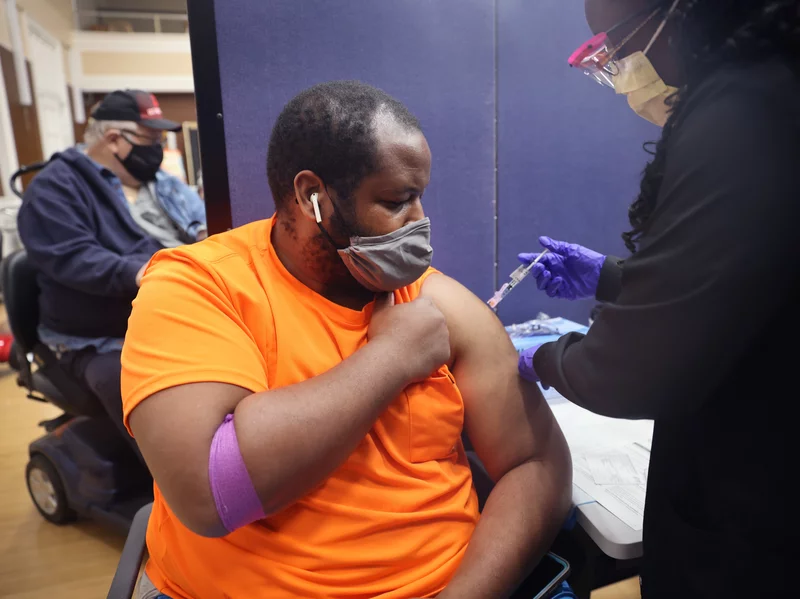
Breakthrough infections might not be a big transmission risk. Here’s the evidence

Conventional wisdom says that if you’re vaccinated and you get a breakthrough infection with the coronavirus, you can transmit that infection to someone else and make that person sick.

But new evidence suggests that even though that may happen on occasion, breakthrough infections might not represent the threat to others that scientists originally thought.

Ross Kedl, an immunologist at the University of Colorado School of Medicine, will point out to anyone who cares to listen that basic immunology suggests the virus of a vaccinated person who gets infected will be different from the virus of an infected unvaccinated person.

That’s because vaccinated people have already made antibodies to the coronavirus. Even if those antibodies don’t prevent infection, they still “should be coating that virus with antibody and therefore helping prevent excessive downstream transmission,” Kedl says. And a virus coated with antibodies won’t be as infectious as a virus not coated in antibodies.

Scant evidence for easy transmission of breakthrough infections

In Provincetown, Mass., this summer, a lot of vaccinated people got infected with the coronavirus, leading many to assume that this was an example of vaccinated people with breakthrough infections giving their infection to other vaccinated people.

Kedl isn’t convinced.

“In all these cases where you have these big breakthrough infections, there’s always unvaccinated people in the room,” he says.

In a recent study from Israel of breakthrough infections among health care workers, the researchers report that in “all 37 case patients for whom data were available regarding the source of infection, the suspected source was an unvaccinated person.”

It’s hard to prove that an infected vaccinated person actually was responsible for transmitting their infection to someone else.

“I have seen no one report actually trying to trace whether or not the people who were vaccinated who got infected are downstream — and certainly only could be downstream — of another vaccinated person,” Kedl says.

There’s new laboratory evidence supporting Kedl’s supposition. Initially, most vaccine experts predicted that mRNA vaccines like the ones made by Pfizer and Moderna that are injected into someone’s arm muscle would generate only the kinds of antibodies that circulate throughout the body.

But that might not be the whole story.

“I think what was the big surprise here is that the mRNA vaccines are going beyond that,” says Michal Caspi Tal, until recently an instructor at Stanford University’s Institute for Stem Cell Biology and Regenerative Medicine and now a visiting scientist at the Massachusetts Institute of Technology.

What Tal has found is that in addition to the circulating antibodies, there was a surprisingly large amount of antibodies in mucosal membranes in the nose and mouth, two of the primary entry points for the coronavirus.

The vaccinated aren’t “sitting ducks”

Immunologist Jennifer Gommerman of the University of Toronto found this as well.

“This is the first example where we can show that a local mucosal immune response is made, even though the person got the vaccine in an intramuscular delivery,” Gommerman says.

If there are antibodies in the mucosal membranes, they would likely be coating any virus that got into the nose or throat. So any virus that was exhaled by a sneeze or a cough would likely be less infectious.

Gommerman says that until now, it seemed likely that a vaccine that was delivered directly to the mucosal tissue was the only way to generate antibodies in the nose or throat.

“Obviously a mucosal vaccination would be great too. But at least we’re not sitting ducks,” Gommerman says. “Otherwise everyone would be getting breakthrough infection.”

Now, these studies by Gommerman and Tal have yet to undergo peer review, and some have already suggested that the antibodies they have described may not confer true mucosal immunity.

But there’s other evidence that a vaccinated person’s breakthrough infection may not transmit efficiently to others.

Marion Pepper, an immunologist at the University of Washington, says a recent study from the Netherlands looked at how well virus from vaccinated people could infect cells in the lab.

Pepper says the answer was not well.

“If you actually isolate virus from people who are getting a secondary infection after being vaccinated, that virus is less good at infecting cells,” Pepper says. “It’s not known why. Is it covered with an antibody? Maybe. Has it been hit by some other kind of immune mediators, cytokines, things like that? Maybe. Nobody really knows. But the virus does seem to be less viable coming from a vaccinated person.”

More studies are emerging that suggest there’s something different about the virus coming from a vaccinated person, something that may help prevent transmission.

Whatever it is, the University of Colorado’s Kedl says it’s one more reason that getting vaccinated is a good idea.

“Because you’re going to be even more protected yourself. And you’re going to be better off protecting other people.”

Kedl says that’s what you call a win-win situation.