The U.S. may be on the verge of another surge in coronavirus cases, despite weeks of good news.
The big picture:Nationwide, progress against the virus has stalled. And some states are ditching their most important public safety measures even as their outbreaks are getting worse.
Where it stands: The U.S. averaged just under 65,000 new cases per day over the past week. That’s essentially unchanged from the week before, ending a six-week streak of double-digit improvements.
Although the U.S. has been moving in the right direction, 65,000 cases per day is not a number that indicates the virus is under control. It’s the same caseload the U.S. was seeing last July, at the height of the summer surge in cases and deaths.
What we’re watching: Texas Gov. Greg Abbott on Tuesday rescinded the state’s mask mandate and declared that businesses will be able to operate at full capacity, saying risk-mitigation measures are no longer necessary because of the progress on vaccines.
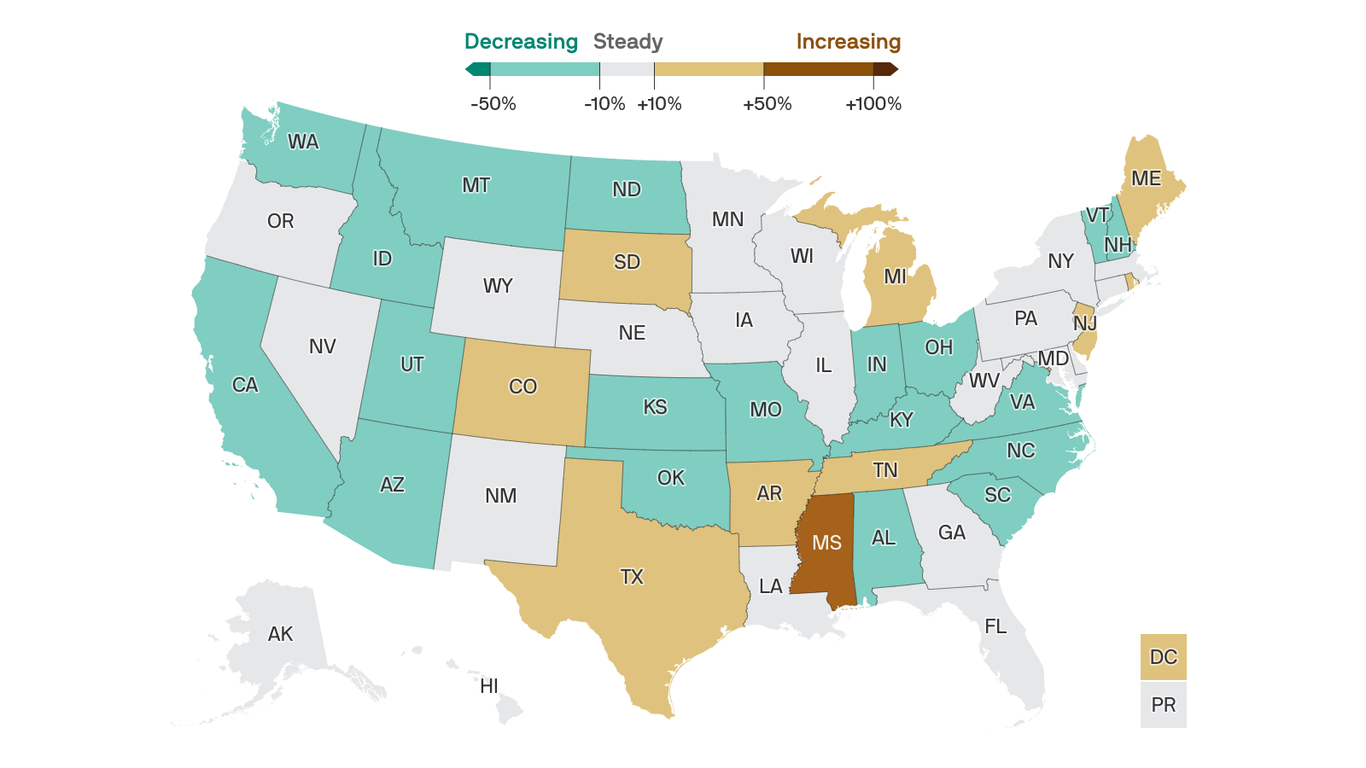
But the risk in Texas is far from over. In fact, its outbreak is growing: New cases in the state rose by 27% over the past week.
Mississippi Gov. Tate Reeves also scrapped all business restrictions, along with the state’s mask mandate, on Tuesday. New cases in Mississippi were up 62% over the past week, the biggest jump of any state.
The daily average of new daily cases also increased in eight more states, in addition to Mississippi and Texas.
How it works:If Americans let their guard down too soon, we could experience yet another surge — a fourth wave — before the vaccination campaign has had a chance to do its work.
The vaccine rollout is moving at breakneck speed. The U.S. should have enough doses for every adult who wants one by May, President Biden said this week.
At the same time, however, more contagious variants of the coronavirus are continuing to gain ground, meaning that people who haven’t gotten their vaccines yet may be spreading and contracting the virus even more easily than before.
What’s next: The bigger a foothold those variants can get, the harder it will be to escape COVID-19 — now or in the future.
The existing vaccines appear to be less effective against two variants, discovered in South Africa and Brazil, which means the virus could keep circulating even in a world where the vast majority of people are vaccinated.
And that means it’s increasingly likely that COVID-19 will never fully go away — that outbreaks may flare up here and there for years, requiring vaccine booster shots as well as renewed protective measures.
The bottom line: Variants emerge when viruses spread widely, which is also how people die.
Whatever “the end of the pandemic” looks like — however good it’s possible for things to get — the way to get there is through ramping up vaccinations and continuing to control the virus through masks and social distancing. Not doing those things will only make the future worse.
“Getting as many people vaccinated as possible is still the same answer and the same path forward as it was on December 1 or January 1 … but the expected outcome isn’t the same,” Shane Crotty, a virologist at the La Jolla Institute for Immunology in San Diego, told Reuters.
The Federal Trade Commission has closed its investigation of the merger between Atrium Health Navicent and Houston Healthcare System following news the two have abandoned their plans for a deal.
FTC staff had recommended commissioners challenge the merger on grounds that it would have led to “significant harm” for area residents and businesses in the form of higher healthcare costs, the FTC alleged.
The tie-up between two of the largest systems in central Georgia would also hamper investment in facilities, technologies and expanded access to services, according to a statement released Wednesday.
Dive Insight:
FTC Acting Chairwoman Rebecca Kelly Slaughter said in the statement, “This is great news for patients in central Georgia.”
When the deal was originally announced, Atrium Health Navicent promised to spend $150 million on Houston over a decade, earmarking the money for routine capital expenditures and strategic growth initiatives, according to a previous review of the transaction by the state attorney general’s office.
After engaging with consultants at Kaufman Hall in 2017, leaders at Houston, an independent system, decided they needed to find a strategic partner to weather long-term challenges and ultimately picked Navicent.
Navicent recently merged with North Carolina-based Atrium Health, formerly known as Carolinas HealthCare System. At the time, the deal gave Atrium a foothold in the state of Georgia.
Healthcare consolidation has continued at a steady clip despite the pandemic, and the FTC will be closely investigating any deal involving close competitors. The agency is seeking to expand its arsenal to block future mergers by researching new theories of harm.
The FTC attempted to block a hospital deal in Philadelphia last year but has since abandoned its challenge after a series of setbacks in court. The judge was not swayed that the consolidation of providers would lead to an increase in prices given the plethora of healthcare options in the area.
Renton, Wash.-based Providence is being investigated by California’s attorney general, Xavier Becerra, over allegations that it inappropriately applied religious care restrictions at Hoag Memorial Hospital in Newport Beach, Calif., the Los Angeles Timesreported March 3.
Several women’s health specialists from Hoag submitted a confidential complaint to the attorney general’s office in October, prompting the investigation. The physicians claim Heritage Healthcare, Providence’s physician management division, refused to pay for contraceptive services for HMO patients at Hoag and delayed miscarriage treatment authorizations, among other allegations, according to the complaint referenced by the news outlet.
The physicians also reported Heritage specifically referenced the Ethical and Religious Directives for Catholic Health Care Services, which are put forth by the United States Conference of Catholic Bishops, in at least one instance when it declined to pay for a patient’s intrauterine device insertion.
Applying the directives would be in violation of conditions set by now-Vice President Kamala Harris, who approved an affiliation between Hoag and Irvine, Calif.-based St. Joseph Health, a Catholic healthcare system, when she was California’s attorney general in 2014. In 2016, St. Joseph merged with Providence, which required Providence to maintain the pre-merger conditions related to women’s health services at Hoag. The only service for which Hoag was subjected to a ban was “direct abortions,” according to the Los Angeles Times report.
In a letter sent to the involved institutions March 2, Mr. Becerra requested Providence provide documents related to the issues by March 23.
“This office is monitoring whether the Catholic Ethical and Religious Directives are or have been applied to any aspect of a service, procedure, or other activity associated with a medical billing code, with the exception of direct abortions, performed by Hoag obstetrician/gynecologists,” the letter reads.
In an emailed statement to the Los Angeles Times, Providence said it “welcomes the Attorney General’s request for further information, and is confident that the review will demonstrate that Providence has always complied with all requirements under the merger conditions.”
In May, Hoag filed a lawsuit seeking to end its affiliation with Providence.
The CEO of a chain of medical clinics in Michigan and Ohio was sentenced March 3 to 15 years in prison and ordered to pay $51 million in restitution for his role in a $150 million healthcare fraud scheme, according to the U.S. Justice Department.
Mashiyat Rashid was sentenced after pleading guilty in 2018 to money laundering and conspiracy to commit healthcare fraud and wire fraud. Twenty other defendants, including 12 physicians, have been convicted for their involvement in the scheme.
Mr. Rashid, who served as CEO of Tri-County Wellness Group from 2008 to 2016, developed and approved a corporate policy to administer unnecessary back injections to patients in exchange for prescriptions of over 6.6 million doses of medically unnecessary opioids, according to the Justice Department.
Many patients experienced pain from the unnecessary injections, and some developed adverse conditions, including open holes in their backs, according to testimony at Mr. Rashid’s trial. Physicians at the clinics denied patients, including those addicted to opioids, medication until they agreed to get the injections, according to court documents.
According to evidence presented at trial, Mr. Rashid only hired physicians who were willing to administer the unnecessary injections in exchange for a split of the Medicare reimbursements for the procedures. Tri-County Wellness Group was paid more for facet joint injections than any other medical clinic in the U.S., according to the Justice Department.
Proceeds of the fraud were used to fund private jets and to buy luxury cars, real estate and tickets to NBA games, prosecutors said. Mr. Rashid was ordered to forfeit to the U.S. government $11.5 million in proceeds traceable to the healthcare fraud scheme, including commercial and residential real estate and Detroit Pistons season tickets.
Mercy Hospital & Medical Center in Chicago has secured a nonbinding purchase agreement with Insight Chicago just months before it is slated to close its doors, according to the Chicago Tribune.
Under terms of the deal, still being negotiated, Insight Chicago would operate Mercy Hospital as a full-service, acute care facility. Insight Chicago is a nonprofit affiliated with a Flint, Mich.-based biomedical technology company.
The deal is subject to regulatory approval, but if it goes through, it would keep the 170-year-old safety-net hospital open.
Securing a potential buyer is the latest in a series of events related to the Chicago hospital.
On Feb. 10, Mercy filed for bankruptcy protection, citing mounting financial losses and losses of staff that challenged its ability to provide safe patient care.
The bankruptcy filing came just a few weeks after the Illinois Health Facilities and Services Review Board rejected a plan from Mercy’s owner, Trinity Health, to build an outpatient center in the neighborhood where it planned to close Mercy. The same board unanimously rejected Livonia, Mich.-based Trinity’s plan to close the hospital in December.
The December vote from the review board came after months of protests from physicians, healthcare advocates and community organizers, who said that closing the hospital would create a healthcare desert on Chicago’s South Side.
Mercy said that until the pending deal with Insight Chicago is signed and approved by regulators, it still plans to close the facility. If the agreement is reached before the May 31 closure, Mercy will help transition services to Insight Chicago, according to theChicago Sun-Times.
Insight Chicago told local NPR affiliateWBEZthat it has a difficult task ahead to build community trust and address the financial issues that have plagued the Chicago hospital.
“I think the big main point we want to understand between now and then is the community needs to build trust with the community, and I think to build trust we have to tell the truth and be sincere,” Atif Bawahab, chief strategy officer at Insight, told WBEZ. “And there’s a reality of the situation as to why [the hospital] is going bankrupt and why several safety net hospitals are struggling.”
In its bankruptcy filing, Mercy said its losses have averaged about $5 million per month and reached $30.2 million for the first six months of fiscal year 2021. The hospital also said it has accumulated debt of more than $303.2 million over the last seven years, and the hospital needs more than $100 million in upgrades and modernizations.
West Reading, Pa.-based Tower Health is looking for a partner to buy the entire system, which comprises six hospitals, according to the Reading Eagle.
“We are compelled to pursue every possible avenue available to protect and preserve the future of care at all of our hospitals and facilities,” Tower said in a statement to The Philadelphia Inquirer on Feb. 26. “As part of this process, we will examine potential partnerships for the entire Tower Health system with like-minded health systems that share our same values and passion for clinical excellence.”
The health system had previously said it was looking for buyers for its hospitals, with the exception of its flagship facility, Reading Hospital in West Reading, according to the Inquirer.
On March 1, Tower Health was hit with a three-notch credit downgrade by Fitch Ratings. The credit rating agency said its long-term “B+” rating and negative outlook for the system reflect significant ongoing financial losses from the COVID-19 pandemic and operational challenges following the 2017 acquisition of five hospitals.
S&P lowered its rating on Tower Health by two notches, to “BB-” from “BB+,” on March 2.
Tower Health had operating losses of more than $415 million in fiscal year 2020, and it expects an operating loss of about $160 million in fiscal 2021, according to Fitch.
UnitedHealth subsidiary Optum signed a definitive agreement to acquire Atrius Health, a 715-physician group based in Newton, Mass., according to The Boston Globe.
Optum said March 2 the agreement was signed the evening of March 1 after UnitedHealth’s board approved the transaction. Atrius’ board also unanimously approved the deal.
The deal will need approval from Massachusetts’ Health Policy Commission, the Department of Public Health and the Federal Trade Commission.
If the deal is approved, it would expand Optum’s presence in Massachusetts. The organization had previously acquired Worcester, Mass.-based Reliant Medical Group in April 2018.
Optum reportedly had been interested in purchasing Atrius, which has 30 locations in Massachusetts, for a few years and submitted a bid for it in 2019 when the medical group was looking for a partner. In 2019, Atrius decided to remain independent. However, Atrius said it decided to reignite potential partnership talks again due to the pressures of the pandemic.
“We looked at many alternatives and chose [Optum] because of cultural alignment, the benefit we could provide for patients, the stability it could provide for our practice, and the help we can provide to the commonwealth as it pertains to managing medical spend,” Atrius President and CEO Steven Strongwater, MD, told the Boston Business Journal.



/the-us-federal-trade-commission--ftc--bu-71968930-e5e36febe53543aaa53329c6c17fc982.jpg)