Medicare Advantage plans pay physicians less than original Medicare

https://www.healthcarefinancenews.com/news/medicare-advantage-plans-pay-physicians-less-original-medicare

MA pays 10% to 15% less than what is paid by the government in original Medicare, report says.

A new study confirms what the American Medical Association and other medical groups have long been saying about physician pay: Medicare reimbursement is not keeping up with inflation.

In original Medicare, doctors are paid one-third less than a decade ago, the report said. Medicare reimbursement rates for outpatient procedures have decreased every year since 2016, for an overall decline of 10%.

Over the same period, inflation has risen by almost 30%, according to the report.

The report also sheds light on Medicare Advantage reimbursement. Medicare Advantage plans pay physicians an estimated 10% to 15% less than what is paid by the government in traditional Medicare, according to the 2025 Omniscient Health Physician Medicare Income Report

This can create negative margins for physicians considering MA plans take roughly twice as long to reimburse providers compared to original Medicare along with factoring in prior authorization and denials, the report said. 

An estimated 54% of Medicare beneficiaries are enrolled in a MA plan.

WHY THIS MATTERS

The MA reimbursement gap is driving shifts in network participation. A 2024 survey by the Healthcare Financial Management Association found that 19% of health systems have stopped accepting at least one MA plan, with another 61% planning to do so or actively considering it, according to the Omniscient report.

“Despite the rising demand for care from an aging U.S. population, the financial strain is forcing physicians to rethink whether they will continue serving Medicare patients,” said Meade Monger, CEO of Omniscient Health, a healthcare data science company. “High-volume Medicare practices, especially those in primary care and rural areas, are increasingly unable to sustain operations under current revenue structures.”

The federal government’s push toward streamlining and speeding up the prior authorization process and requiring an electronic process over paper represents improvement, the report said. Some insurers have announced plans to decrease the number of procedures that require prior auth.

But payment rates need to change, said Omniscient, which recommends policymakers index Medicare reimbursement rates to inflation and set payment standards for MA plans. 

THE LARGER TREND

On Tuesday, the American Medical Association released what it called flawed proposals in the Centers for Medicare and Medicaid Services’ physician payment rule released in July.

Despite getting a 3.6% payment boost after five consecutive years of cuts, physician pay, after adjusting for practice-cost inflation, has plummeted since 2001, the AMA said.

The proposed 2026 Medicare Physician Fee Schedule includes a 2.5% cut in work relative-value units (RVUs, which measure a physician’s time, technical skill, mental effort, decision-making and stress) and physician intraservice time for most services, the AMA said. This reduction would affect 95% of the services that doctors provide. 

The cut is based on an assumption of greater efficiency and less time involved for each service, an assumption that is not grounded in new data or physician input, the AMA said. 

CMS also proposes a reduction in practice-expense RVUs, which are the costs of running a practice, such as staff, equipment, supplies, utilities and overhead.

The bottom line, the AMA said, is that physician payment for services performed in a facility will drop overall by 7%.

CMS is accepting comments on its proposed rule until Sept. 12.

The ACA Subsidy Expiration Will Hit Millions Hard

When Congress passed pandemic-era enhancements to Affordable Care Act (ACA) premium subsidies in 2021, it wasn’t just a policy tweak — it was a lifeline. But unless lawmakers act, those subsidies will vanish on January 1, 2026.

According to KFF, the average ACA enrollee could see premiums spike 75% overnight. For many, that will mean a choice between things like their health coverage and rent or food. The Congressional Budget Office estimates more than 4.2 million people could lose coverage over the next decade as a result. Below is where the expired subsidies will hurt the hardest:

1. Young adults… and their parents’ wallets

Young people who’ve aged out of their parents’ plans and buy coverage through the ACA marketplaces will see some of the steepest jumps. 

If they decide to forgo coverage, as KFF Health News warns: The so-called “‘insurance cliff’ at age 26 can send young adults tumbling into being uninsured.” 

The parents and families of these young adults could be left scrambling to cover unexpected medical bills — the kind that can derail a family’s finances for years.

2. Main street entrepreneurs

The ACA is the only real option for many small-business owners, freelancers and gig workers. These are the folks that conservatives say we should encourage to build and grow their own businesses who make up the backbone of Main Street. Losing the enhanced subsidies means many will face premiums hundreds of dollars higher per month. Some will be forced to close shop and turn to jobs at out-of-town corporations flush enough to afford to offer subsidized coverage to their workers, a direct hit to local economies.

3. States already in crisis

States aren’t in a position to plug the gap. Politico reports that California, Colorado, Maryland, Washington, and others are scrambling to soften the blow, but even the most ambitious state-level plans can’t replace hundreds of millions in lost federal funding.

And this comes right after Medicaid cuts in the One Big Beautiful Bill Act that will hit hospitals, clinics and low-income communities. In Washington state alone, officials expect premiums to jump 75% when the subsidies expire, with one in four marketplace enrollees dropping coverage. That means more uninsured patients showing up in ERs, less preventive care, and more strain on already struggling rural hospitals.

4. (Already) disappearing alternatives to Big Insurance

The ACA marketplaces aren’t just a safety net for individuals but also home to smaller non-profit and regional health plans that give Americans an alternative to the “Big 7” Wall Street-run insurance conglomerates. These community-rooted plans are already facing financial headwinds from shrinking enrollment and Medicaid funding cuts. When premiums spike in 2026, many could lose enough members to be forced out of the market entirely.

And here’s the real danger: The Big 7 can weather this storm. Their huge market capitalizations, government contracts, pharmacy benefit manager (PBM) divisions and sprawling care delivery businesses give them insulation from ACA marketplace losses. In fact, they may see this as an opportunity to buy up the smaller competitors that fail, which would further consolidate their dominance over our health care system. Or they could just decide to flee the ACA marketplace entirely because the population will skewer sicker and older, creating a death spiral that the big insurers will not want to touch. What little consumer choice exists outside the big corporate insurers could vanish, and even that could disappear.

5. <65 year olds

Perhaps the most vulnerable group will be Americans in their 50s and early 60s who lose their jobs or retire early (often not by choice) and find themselves too young for Medicare but facing incredibly high premiums on the individual market. Under ACA rules, insurers can charge older enrollees up to three times more than younger adults for the same coverage. The enhanced subsidies have been the only thing keeping many of these premiums within reach.

Take those subsidies away, and a 60-year-old who loses employer coverage could see their monthly premium shoot into four figures. For those living off severance, savings or reduced income, choosing to gamble with their health and wait it out until 65 may be the only option.

Congress knows the stakes. Will they act?

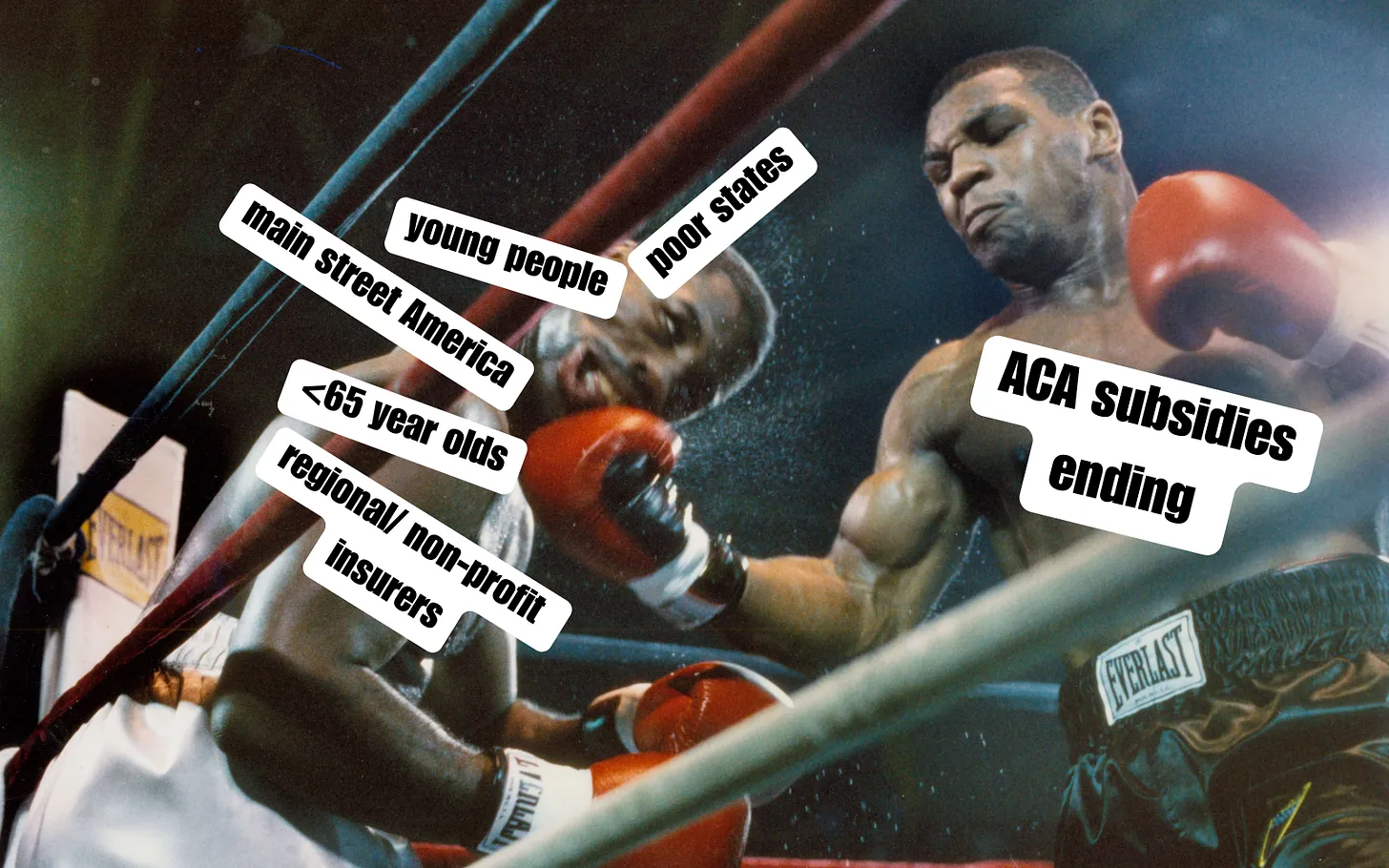
Making the subsidies permanent would cost $383 billion over 10 years, which would be a political hurdle for a Congress intent on deep budget cuts. But the cost of inaction is far higher, both in human and economic terms. These subsidies have kept coverage affordable for millions, fueled small business growth, and stabilized state health systems during one of the most turbulent economic periods in recent memory. Without them, the hit to many folks could be a Frazier-level K.O.

But let’s face it — what I’m advocating for isn’t perfect either. The prospect of extending these subsidies raises a question: Should taxpayers be footing the bill for health insurance premiums when insurance corporations are reporting tens of billions in annual profits and paying hefty dividends to shareholders?

The short answer, for now, unfortunately, is yes. Because this is the deck we’ve been dealt and we can’t let Americans fall into medical debt, lose their homes – or their lives. Extending the ACA subsidies is not pretty. But for Americans, it’s just a bob and weave.

July 2025 Actions are the Turning Point for U.S. Healthcare

July 2025 will be the month U.S. healthcare leaders recognize as the industry’s modern turning point. Consider…

  • On July 4, the One Big Beautiful Bill Act was signed into law setting in motion $960 billion in Medicaid cuts over the decade and massive uncertainty among those most adversely impacted—low income and under-served populations dependent on public programs, 8 to 11 million who used now-suspended marketplace subsidies to buy insurance coverage, and hundreds of state and local health agencies left in funding limbo.
  • On July 15, the Bureau of Labor Statistics reported the June Consumer Price Index rose .3% bumping the LTM to 2.7% (lower than LTM of 3.4% for medical services). Prices have edged up.
  • On July 31, President Trump issued an Executive Order to 17 drug companies ordering them to reduce prices on their drugs by September 29 or else. And CMS issued final rules for FY2026 Medicare payments to hospitals, rehab and other providers reflecting increases ranging from 2.5-3.3% effective October 1.
  • And on the same day, the Bureau of Labor issued its July 2025 jobs report that showed a disappointing net gain of 73,000 jobs plus downward revisions for May and June of 258,000 sparking Wall Street anxiety and President Trump to call the results “rigged” before firing BLS head Erika McEntarfer. Note: healthcare added 55,000 in July—the biggest of any sector and more than its 42,000 average monthly increase.

Collectively, these actions reflect rejection of the health industry by the GOP-led Congress.

It follows 15 years of support vis a vis the Affordable Care Act (2010) and pandemic recovery emergency funding (2020-2021). In that 15-year period, the bigger players got bigger in each sector, investment of private equity in each sector became more prevalent, costs increased, affordability for consumers and employers decreased, and the public’s overall satisfaction with the health system declined precipitously.

For the four major players in the system, the passage of the “big, beautiful bill” was a disappointment. Their primary concerns were not addressed:

  • Physicians wanted relief from annual payment cuts by Medicare preferring reimbursement tied directly to medical inflation. And insurer’ prior authorization and provider reimbursement was a top issue. Status: Not much has changed though adjustments are promised.
  • Hospitals wanted continuation of federal Medicaid funding, protection of the 340B drug purchasing program, rejection of site-neutral payment policies, higher Medicare reimbursement and relief from insurer prior authorization frustrations. Status: Medicaid funding is being cut forcing the issue for states. CMS payment increases for 2026 are lower than operating cost increases. Insurers have promised prior-auth relief but details about how and when are unknown. And Congress posture toward hospitals seems harsh: price transparency compliance, safety event reporting, and cost concerns are bipartisan issues.
  • Insurers wanted sustained funding for state Medicaid and Medicare Advantage programs and federal pushback against drug prices and hospital consolidation. Status: Congress appears sympathetic to enrollee complaints and anxious to address insurer “waste, fraud and abuse” including overpayments in Medicare Advantage.
  • Drug companies oppose “Most Favored Nation” pricing and want protections of their patents and limits on how much insurers, pharmacy benefits managers, wholesalers, online distributors and other “middlemen” earn at their expense. Status: to date, little action despite sympathetic rhetoric by lawmakers. Status: to date, Congress has taken nominal action beyond the Inflation Reduction Act (2022) though 23 states have passed legislation requiring PBMs, insurers and manufacturers to disclose drug prices and 12 states have established Prescription Drug Affordability Boards to monitor prices.

My take:

The landscape for U.S. healthcare is fundamentally changed as a result of the July actions noted above. It is compounded by public anxiety about the economy at home and global tensions abroad.

These July actions were a turning point for the industry: responding appropriately will require fresh ideas and statesmanship. Transparency about prices, costs, incentives and performance is table stakes. Leaders dedicated to the greater good will be the difference.

Inside the Midyear Panic at UnitedHealth

https://healthcareuncovered.substack.com/p/inside-the-midyear-panic-at-unitedhealth

Imagine you’re facing your midyear performance review with your boss. You dread it, even though you’ve done all you thought possible and legal to help the company meet Wall Street’s profit expectations, because shareholders haven’t been pleased with your employer’s performance lately.

Now let’s imagine your employer is a health insurance conglomerate like, say, UnitedHealth Group. You’ve watched as the stock price has been sliding, sometimes a little and on some days crashing through lows not seen in years, like last Friday (down almost 5% in a single day, to $237.77, which is down a stunning 62% since a mid-November high of $630 and change).

You know what your boss is going to say. We all have to do more to meet the Street’s expectations. Something has changed from the days when the government and employers were overly generous, not questioning our value proposition, always willing to pick up the tab and pay many hidden tips, and we could pull our many levers to make it harder for people to get the care they need. 

Despite government and media reports for years that the federal government has been overpaying Medicare Advantage plans like UnitedHealth’s – at least $84 billion this year alone – Congress has pretended not to notice. There is evidence that might be changing, with Republicans and Democrats alike making noises about cracking down on MA plans. 

Employers have complained for ages about constantly rising premiums, but they’ve sucked it up, knowing they could pass much of the increase onto their workers – and make them pay thousands of dollars out of their own pockets before their coverage kicks in. Now, at least some of them are realizing they don’t have to work with the giant conglomerates anymore.

Doctors and hospitals have complained, too, about burdensome paperwork and not getting paid right and on time, but they’ve largely been ignored as the big conglomerates get bigger and are now even competing with them.

UnitedHealth is the biggest employer of doctors in the country. But doctors and hospitals are beginning to push back, too. 

Since last fall, UnitedHealth and its smaller but still enormous competitors have found that “headwinds” are making it harder for them to maintain the profit margins investors demand. That is mainly because, despite the many barriers patients have to overcome to get the care they need, many of them are nevertheless using health care, often in the most expensive setting – the emergency room. They put off seeing a doctor so long because of insurers’ penny-wise-pound-foolishness that they had some kind of event that scared them enough to head straight to the ER. 

It’s not just you who is dreading your midyear review. Everybody, regardless of their position on the corporate ladder, and even the poorly paid folks in customer service, are in the same boat. And so is your boss. Nobody will put the details of what has to be done in writing. They don’t have to. Your boss will remind you that you have to do your part to help the company achieve the “profitable growth” Wall Street demands, quarter after quarter after quarter. It never, ever ends. You know this because you and most other employees watch what happens after the company releases quarterly financials. You also watch your 401K balance and you see the financial consequences of a company that Wall Street isn’t happy with. And Wall Street is especially unhappy with UnitedHealth these days.

And when things are as bad as they are now at UnitedHealth’s headquarters in Minnesota, you know that a big consulting firm like McKinsey & Company has been called in, and that those suits will recommend some kind of “restructuring” and changes in leadership to get the ship back on course. You know the drill. Everybody already is subject to forced ranking, meaning that at the end of the year, some of your colleagues, regardless of job title, will fall below a line that means automatic termination. You pedal as fast as you can to stay above that line, often doing things you worry are not in the best interest of millions of people and might not even be lawful. But you know that if you have any chance of staying employed, much less getting a raise or bonus, you have to convince your superiors you are motivated and “engaged to win.” No one is safe. Look what happened to Sir Andrew Witty, whose departure as CEO to spend more time with his family (in London) was announced days after shareholders turned thumbs down on the company’s promises to return to an acceptable level of profitability. 

If you are at UnitedHealth, you listened to what the once and again CEO, Stephen Hemsley, and CFO John Rex, who got shuffled to a lesser role of “advisor” to the CEO last week, laid out a new action plan to their bosses – big institutional investors who have been losing their shirts for months now. You know that what the C-Suite promised on their July 29 call will mean that you will have to “execute” to enable the company to deliver on those promises. And you know that you and your colleagues will have to inflict a lot more pain on everybody who is not a big shareholder – patients, taxpayers, employers, doctors, hospital administrators. That is your job. And you will try to do it because you have a mortgage, kids in college and maxed-out credit cards.  

Here’s what Hemsley and his leadership team said, out loud in a public forum, although admittedly one that few people know about or can take an hour-and-a-half to listen to:

  • Even though UnitedHealth took in billions more in revenue, its margins shrank a little because it had to pay more medical claims than expected.
  • Still, the company made $14.3 billion in profits during the second quarter. That’s a lot but not as much as the $15.8 billion in 2Q 2024, and that made shareholders unhappy.
  • Enrollment in its commercial (individual and employer) plans increased just 1%, but enrollment in its Medicare Advantage plans increased nearly 8%. That’s normally just fine, but something happened that the company’s beancounters couldn’t stop.
  • Those seniors figured out how to get at least some care despite the company’s high barriers to care (aggressive use of prior authorization, “narrow” networks of providers, etc.)

To fix all of this, Hemsley and team promised:

  • To dump 600,000 or so enrollees who might need care next year
  • To raise premiums “in the double digits” – way above the “medical trend” that PriceWaterhouseCoopers predicts to be 8.5% (high but not double-digit high)
  • Boot more providers it doesn’t already own out of network
  • Reduce benefits

Throughout the call with investors (actually with a couple dozen Wall Street financial analysts, the only people who can ask questions), Hemsley and team went on and on about the “value-based care” the company theoretically delivers, without providing specifics. But here is what you need to know: If you are enrolled in a UnitedHealth plan of any nature – commercial, Medicare or Medicaid or VA (yes, VA, too) – expect the value of your coverage to diminish, just as it has year after year after year.  

The term for this in industry jargon is “benefit buydown.”

That means that even as your premiums go up by double digits, you will soon have fewer providers to choose from, you likely will spend more out-of-pocket before your coverage kicks in, you might have to switch to a medication made by a drug company UnitedHealth will get bigger kickbacks from, and you might even be among the 600,000 policyholders who will get “purged” (another industry term) at the end of the year.

Why do we and our employers and Uncle Sam keep putting up with this?

Yes, we pay more for new cars and iPhones, but we at least can count on some improvements in gas mileage and battery life and maybe even better-placed cup holders. You can now buy a massive high-def TV for a fraction of what it cost a couple of years ago. Health insurance? Just the opposite. 

As I will explain in a future post, all of the big for-profit insurers are facing those same headwinds UnitedHealth is facing. You will not be spared regardless of the name on your insurance card. If you still have one come January 1. Pain is on the way. Once again. 

The Fundamental Problem at the Heart of American Health Insurance

Administrative waste, denials, and deadly incentives — the U.S. model shows what happens when profit rules.

The United States is the only country where a health insurance executive has been gunned down in the street. But that’s not the only thing that’s unique about American health insurance.

Almost all of our peer countries – advanced, free-market democracies — have health insurance companies. In some cases (Germany, Switzerland, Japan), private health insurance is the chief way to pay for medical care. In others (such as Great Britain), private insurance works as a supplement to government-run health care systems. But there’s a fundamental difference between health insurance elsewhere and the U.S. system. 

In all the other advanced democracies, basic health insurance is not for profit; the insurers are essentially charities. They exist not to pay large sums to executives and investors, but rather to keep the population healthy by assuring that everyone can get medical care when it’s needed. 

America’s health insurance giants are profit-making businesses. Indeed, in the insurers’ quarterly earnings reports to investors, the standard industry term for any sums spent paying people’s medical bills is “medical loss.” They view paying your doctor bill as a loss that subtracts from the dividends they owe their stockholders. 

When I studied health care systems around the world, I asked economists and doctors and health ministers why they want health insurance to be a nonprofit endeavor. Everyone gave essentially the same answer:

There’s a fundamental contradiction between insuring a nation’s health and making a profit on health insurance.

Health insurance exists to help people get the preventive care and treatment they need by paying their medical bills. But the way to make a profit on health insurance is to avoid paying medical bills. Accordingly, the U.S. insurance giants have devised ingenious methods for evading payment — schemes like high deductibles, narrow networks of approved doctors, limited lists of permitted drugs, and pre-authorization requirements, so that the insurance adjuster, not your doctor, determines what treatment you get. 

Other countries don’t allow those gimmicks. In America, the patient pays twice — first the insurance premium, and then the bill that the insurer declines to pay. That’s why Americans hate health insurance companies — as reflected in the tasteless barrage of angry social media commentary aimed at the victim, not the perpetrator, of the sidewalk shooting in 2024  of UnitedHealthcare’s CEO Brian Thompson in New York City. 

Another unique aspect of U.S.-style health insurance is the huge amount of money our big insurers waste on administrative costs. Any insurance plan has administrative expenses; you’ve got to collect the premiums, review the patients’ claims, and get the payments out to doctors and hospitals.

In other countries, the administrative costs are limited to about 5% of premium income; that is, insurers use 95% of all the money they take in to pay medical bills. But the U.S. insurance giants routinely report administrative costs in the range of 15% to 20%.

When the first drafts of the Affordable Care Act (“Obamacare”) were floated on Capitol Hill in 2009, the statutory language called for limiting insurers’ admin costs to 12% of premium income. Then the insurance lobby went to work. The final text of that law allows them to spend up to 20% of their income on salaries, marketing, dividends, and other stuff that doesn’t pay anybody’s hospital bill. 

There is one American insurance system, however, that is as thrifty as foreign health insurance plans. Medicare, the federal government’s insurance program for seniors and the disabled, reports administrative costs in the range of 3% — about one-fifth as much as the big private insurers fritter away. And Medicare’s administrators — federal bureaucrats — are paid less than a tenth as much as the executives running the far less efficient private insurance firms. 

Americans generally believe that the profit-driven private sector is more efficient and innovative than government. In many cases, that’s true. I wouldn’t want some government agency designing my cell phone or my hiking boots.

But when it comes to health insurance, all the evidence shows that nonprofit and government-run plans provide better coverage at lower cost than the private plans from America’s health insurance giants.

If we were to make basic health insurance a nonprofit endeavor, as it is everywhere else, or put everybody on a public plan like Medicare, the U.S. would save billions and improve our access to life-saving care. Then Americans might stop celebrating on social media when an insurance executive is killed. 

What’s at stake from GOP megabill’s coverage losses

https://www.axios.com/2025/07/01/real-cost-health-coverage-losses

Nearly 12 million people would lose their health insurance under President Trump’s “big, beautiful bill,” an erosion of the social safety net that would lead to more unmanaged chronic illnesses, higher medical debt and overcrowding of hospital emergency departments.

Why it matters: 

The changes in the Senate version of the bill could wipe out most of the health coverage gains made under the Affordable Care Act and slash state support for Medicaid and SNAP.

  • “We are going back to a place of a lot of uncompensated care and a lot of patchwork systems for people to get care,” said Ellen Montz, a managing director at Manatt Health who oversaw the ACA federal marketplace during the Biden administration.

The big picture: 

The stakes are huge for low-income and working-class Americans who depend on Medicaid and subsidized ACA coverage.

  • Without health coverage, more people with diabetes, heart disease, asthma and other chronic conditions will likely go without checkups and medication to keep their ailments in check.
  • Those who try to keep up with care after losing insurance will pay more out of pocket, driving up medical debt and increasing the risk of eviction, food insecurity and depleted savings.
  • Uninsured patients have worse cancer survival outcomes and are less likely to get prenatal care. Medicaid also is a major payer of behavioral health counseling and crisis intervention.

Much of the coverage losses from the bill will come from new Medicaid work reporting requirements, congressional scorekeepers predict. Work rules generally will have to be implemented for coverage starting in 2027, but could be earlier or later depending on the state.

  • Past experiments with Medicaid work rules show that many eligible people fall through the cracks verifying they’ve met the requirements or navigating new state bureaucracies.
  • Often, people don’t find out they’ve lost coverage until they try to fill a prescription or see their doctor. States typically provide written notices, but contacts can be out of date.
  • Nearly 1 in 3 adults who were disenrolled from Medicaid after the COVID pandemic found out they no longer had health insurance only when they tried to access care, per a KFF survey.

Zoom out: 

The Medicaid and ACA changes will also affect people who keep their coverage.

  • The anticipated drop-off in preventive care means the uninsured will be more likely to go to the emergency room when they get sick. That could further crowd already bursting ERs, resulting in even longer wait times.
  • Changes to ACA markets in the bill, along with the impending expiration of enhanced premium subsidies, may drive healthier people to drop out, Montz said, skewing the risk pool and driving up premiums for remaining enrollees.
  • States will likely have to make further cuts to their safety-net programs if the bill passes in order to keep state budgets functioning with less federal Medicaid funding.

The other side: 

The White House and GOP proponents of the bill say the health care changes will fight fraud, waste and abuse, and argue that coverage loss projections are overblown.

Reality check: 

Not all insurance is created equally, and many people with health coverage still struggle to access care. But the bill’s impact would take the focus off ways to improve the health system, Montz said.

  • “This is taking us catastrophically backward, where we don’t get to think about the things that we should be thinking about how to best keep people healthy,” she said.

The bottom line: 

The changes will unfold against a backdrop of Health Secretary Robert F. Kennedy Jr.’s purported focus on preventive care and ending chronic illness in the U.S.

  • But American health care is an insurance-based system, said Manatt Health’s Patricia Boozang. Coverage is what unlocks access.
  • Scrapping millions of people’s health coverage “seems inconsistent with the goal of making America healthier,” she said.

Antipating the Impact of the Baby Boom on Medicare


In perusing the excellent work of the Peterson-Kaiser Health System Tracker project, we recently came across an analysis (depicted on the left, below) of Medicare spending patterns broken down by age of beneficiary. Based on 2014 data, the analysis shows how much was spent per capita in traditional Medicare fee-for-service on beneficiaries of each age. (The analysis excludes Medicare Advantage data, and also doesn’t include beneficiaries aged 65, for whom a full year of spending data wasn’t available.)

What’s interesting is how spending patterns differ across age cohorts—inpatient spending peaks at age 92 and then declines, spending on physician services peaks at age 85, skilled nursing and hospice spending ramp up quickly for much older beneficiaries. To see how these patterns might play out if applied to the Baby Boom generation, we combined the Peterson-Kaiser analysis with our earlier look at generational aging. The result is the chart on the right, below, which shows how each bucket of spending will increase over the coming 25 years given aging of the population.
 
A couple of interesting observations from this (admittedly imperfect) analysis.

First, the sheer size of the baby boom generation will drive a huge increase in Medicare spending over the next 25 years. And a full third or more of the total Medicare spend on Baby Boomers isn’t even captured here—that will come via payments to Medicare Advantage plans.

Second, inpatient care drives a huge amount of the total spend. It’s clear that an urgent priority is finding ways to shift spending from the light grey bars (inpatient) to the other segments—we need to pull forward the shift from inpatient to other settings from where it was in 2014’s population. Recall that this is traditional Medicare—strategies like accountable care organizations (ACOs) and other care management/population health reforms will be critical here.

Finally, in addition to changing the trend with innovations in care delivery models, we should expect technology and pharmaceuticals to play a role in inflecting the shape of this graph. Whether that impact will produce a net savings or a net increase in spending remains to be seen.

How to save $80 billion a year on prescription drugs

https://www.axios.com/newsletters/axios-vitals-2b22d854-43a4-481f-aa30-d1b14d859e29.html?utm_source=newsletter&utm_medium=email&utm_campaign=newsletter_axiosvitals&stream=top

Illustration of a bill with money print on it.

Medicare could have saved almost $80 billion, just in 2018, by matching the U.K.’s prices for prescription drugs that don’t have any competition, according to a new study released in Health Affairs yesterday.

Why it matters: Medicare’s drug benefit was designed to keep prices in check through competition. But competition doesn’t always exist, and the U.S. doesn’t have many options to keep prices down in those cases.

  • Unlike the other three countries examined in the study, the U.S. doesn’t regulate drug prices.

Details: This study focuses on a group of single-source brand-name drugs in Medicare Part D that have been on the market for at least 3 years. Researchers compared U.S. prices for those drugs to prices in the U.K., Japan and Ontario.

  • On average, after accounting for rebates, Medicare paid 3.6 times more than the U.K., 3.2 times more than Japan, and 4.1 times more than Ontario.
  • The longer a drug was on the U.S. market, the larger that gap grew.
  • If Medicare Part D had adopted the average price from those countries, it would have saved an estimated $72.9 billion on sole-source drugs in 2018 alone.

Between the lines: The Trump administration wants to rely on international prices for Medicare Part B, which covers drugs administered in a doctor’s office. But this study shows that there are also a lot of savings to be had in Medicare Part D, which covers drugs you pick up at a pharmacy.

The other side: “An international reference pricing system could result in American seniors losing access to their choice of medicine, and waiting years longer for new breakthrough treatments,” the trade group PhRMA said in a statement.

The bottom line: The political interest in cutting drug prices is real, but we’re still a very long way from President Trump’s stated goal of matching other countries’ prices.


The CBO analyzed what it would take to shift to a single-payer system. Here are 5 takeaways

https://www.fiercehealthcare.com/payer/5-takeaways-from-cbo-s-analysis-a-single-payer-system?mkt_tok=eyJpIjoiTURRNU5HTmpZbU5tT1RFeiIsInQiOiJLcVdxN0dKUU5iaEdMTGtaMG9xbFdtdEgxdXJBbndhTUNyMWN6UTZzbGJhTHFkS3Z4eTRBZkFGNUxcLzlyZUxvMHpOUDRDbmptdGE4aHVoMk4wS1NTYUlWMFVPMmFxNEEzTkJcL1RDODhYa3psN0VkNFhFdTVqYjlDSHltaTdPMUFxIn0%3D&mrkid=959610

Image result for congressional budget office

As chatter about “Medicare-for-All” ideas heats up—at least among the field of Democratic presidential hopefuls—the Congressional Budget Office decided to offer its own take.

Well, sort of.

Wednesday, the CBO issued a report that dove into the key considerations policymakers might want to think about before they overhaul the U.S. healthcare into a single-payer system. Putting it mildly, they said, the endeavor would be a “major undertaking.”

They don’t actually offer up specific cost estimates on any of the Medicare-for-All bills floating around, though other researchers put Bernie Sanders’ Medicare-for-All plan at between $32.6 trillion and $38.8 trillion over the first decade.

But the CBO analysts did weigh in on a slew of different approaches to financing, coverage, enrollment and reimbursement that could be built into a single-payer plan.

“Establishing a single-payer system would be a major undertaking that would involve substantial changes in the sources and extent of coverage, provider payment rates and financing methods of healthcare in the United States,” the CBO said.

So what exactly did the CBO have to say about what it would take to create a single-payer system? Here are some key takeaways:

1. There could be a role for private insurance—or not

There has been plenty of heated debate around Medicare for All focused on the role that existing private coverage could—or could not—play in that system. Most insured Americans are enrolled in a private plan today, including about one-third of Medicare beneficiaries.

If they’re allowed, commercial plans could play one of three roles in a single-payer system, according to the report: as supplemental coverage, as an alternative plan or to offer “enhanced” services to members in the government plan. 

Allowing private insurers to offer substitutive plans is unlikely, because they could potentially offer broader provider networks or more generous benefits, which would draw people into them. A solution to this issue could be mandating that providers treat a minimum number of patients who are enrolled in a single-payer plan.

Private payers could also offer coverage for care that is traditionally outside of the purview of government programs, such as dental care, vision care and hearing care.

Supplemental plans like these are offered in the existing Medicare program, and several countries with single-payer systems allow this additional coverage.

For example, in England, private plans offer “enhancements” to members of the government plan, including shorter wait times and access to alternative therapies, But members of these plans must pay for it in addition to tax contributions to the country’s National Health Service. 

2. Other government programs could stick around

In addition to Medicare and Medicaid, the federal government operates several health programs targeting individual populations: the Veterans Affairs health system, TRICARE and Indian Health Services.

A single-payer system could be designed in a way that also maintains these individualized programs, the CBO said. Canada does this today, where its provinces operate the national system while it offers specific programs outside that for indigenous people, veterans, federal police officers and others.

There could also be a continuing role for Medicaid, according to the report. 

“Those public programs were created to serve populations with special needs,” the CBO said. “Under a single-payer system, some components of those programs could continue to operate separately and provide benefits for services not covered by the single-payer health plan.”

On the flip side, though, a single-payer plan could choose to fold members of those programs into the broader, national program as well, the office said. 

3. A simplified system could also mean simplified tech

Taiwan’s government-run health system has a robust technology system that can monitor patients’ use of services and healthcare costs in near real-time, according to the report.  

Residents are issued a National Health Insurance card that can store key information about them, including personal identifiers, recent visits for care, what prescriptions they use and any chronic conditions they may have.  Providers also submit daily data updates to a government databank on service use, which is used to closely monitor utilization and cost. Other technology platforms in Taiwan can track prescription drug use and patients’ medical histories.

However, getting to a streamlined system like this in the U.S. would be bumpy, the CBO said. It would face many of the same challenges the health system is already up against today, such as straddling many federal and state agencies and addressing the needs of both rural and urban providers.

But the payoffs could be significant, according to the report. 

“A standardized IT system could help a single-payer system coordinate patient care by implementing portable electronic medical records and reducing duplicated services,” the agency wrote. 

4. How to structure payments to providers? Likely global budgets

Most existing single-payer systems use a global budget to pay providers, and may also apply in tandem other payment approaches such as capitation or bundled payments according to the report.

How these global budgets operate varies between countries. Canada’s hospitals operate under such a model, while Taiwan sets a national healthcare budget and then issues fee-for-service payments to individual providers. England also uses a national global budget.

Global budgets are rare in the U.S., though Maryland hospitals operate under an all-payer system. These models put more of the financial risk on providers to keep costs within the budget constraints. 

Many international single-payer systems pay based on volume, but the CBO said value-based contracting could be built into any of these payment arrangements.

5. Premiums and cost-sharing are still in play, especially depending on tax structures

A government-run health system would, by its nature, need to be funded by tax dollars, but some countries with a single-payer system do charge premiums or other cost-sharing to offset some of those expenditures.

Canada and England operate on general tax revenues, while Taiwan and Denmark include other types of financing. Danes pay a dedicated, income tax to back the health system, while the Taiwanese have a payroll-based premium. 

The type of tax considered would have different implications on financing, according to the CBO. A progressive tax rate, for instance, would impose higher levies on people with higher incomes, while a consumption tax, such as one added to cigarettes, would affect people more evenly.

Policymakers will also have to weigh when to impose new taxes, shifting the economic burden between generations. 

The CBO did not offer any cost estimates in terms of the amount the federal government would need to raise in taxes to fund a single-payer program.


Truth #5 – Costs To Operate Medicare Are Not Lower Than Private Insurance Plans

https://www.linkedin.com/pulse/truth-5-costs-operate-medicare-lower-than-private-plans-weinberg/

By Denny Weinberg

Another favorite topic at the heart of the US healthcare debate is whether governments can run health insurance programs at lower operating costs than private insurance companies.

Two Sides Square Off

Private Industry Supporters: Some argue that governments regularly prove incompetent running large complex operations at a low costs. Regularly cited is the US mail system and the VA; more locally, public schools and DMV’s. And in the case of Medicare and Medicaid, something about these programs appears to set up a breeding ground for costly fraud and theft, they might argue. Finally, this group argues that competition inherently creates innovation, productivity and lower unit operating costs, something that does not naturally occur with government programs.

Government Supporters: On the other side, many argue that the sheer scale of a single program like Medicare creates consistency and low unit costs, the result of economies of scale. Further, that by extending that program to even more Americans, those scale economies will improve more. This group argues that the profit motive of private companies can only result in higher costs, not lower, enriching investors and executives.

What Do The Numbers Say?

As I researched this point, I found that cost effectiveness arguments between Medicare and Private Insurance is an old one, with each side pretty dug in. But there are some important themes associated with the underlying math.

Comparing Costs vs Percentages:

Government program supporters like to compare operating costs using percentages. The common percentage used is “operating cost as a percent of medical services”. They Argue that Medicare costs only about 2%-3% of the costs of medical services paid. They will further argue that private health plan costs are, by comparison anywhere from 10% to 25% of the costs of medical services they pay. Their conclusion is, “Medicare has far lower operating costs, and is therefore the much more efficient program.”

Private market supporters dispute this “percentage comparison”, and instead look at “operating costs $’s per capita” and compare those. They argue that when compared in this $ per capita measure, monthly Medicare operational costs are well over $100 per capita, while monthly private insurance cost of operations are well less than $100 per capita. Their conclusion is, “Private market providers have far lower operating costs, and are therefore much more efficient than Medicare”.

Why Is This Comparison Of Operating Costs of Medicare and the Private Market So Difficult?

1) As much as 50% of all US healthcare occurs in the last few months of a person’s life. This dynamic is a major driver of Medicare Coverage and its operating costs. It is far less of a driver of private healthcare coverage for younger and mostly working Americans and the related operating costs, confusing the comparisons.

2) Many diseases of aging are much more common in Medicare than in private health coverages. The most expensive is Kidney Care, and ultimately transplant or Dialysis, (which has its own category in Medicare). Beyond that, Cancers, Heart Disease, Dementia/Alzheimer’s and others are far more significant drivers of continuing costs for those covered by Medicare than those on private insurance coverages at younger ages, confusing the comparisons.

3) Workplace related coverages more often coordinate coverage with workers compensation, or even car and homeowners insurance coverages than those with Medicare Coverages. This produces different operating costs and medical coverages under the private health coverages, confusing the comparisons.

4) Private Insurance coverages are or have been subject to significant state Premium Taxes and other health care related state and federal taxes. These are often categorized as “Operating Costs” in comparisons, confusing the comparisons.

5) Some comparisons don’t capture all government expenses that support the Medicare program, perhaps to advantage this argument. Examples of services performed for Medicare by other parts of the government that aren’t accounted for: The Social Security Administration collects premiums, the Internal Revenue Service collects taxes for the program, the F.B.I. provides fraud prevention services, and at least seven other federal agencies and departments also do work that benefits Medicare, confusing the comparisons.

6) As pointed out in previous installments, a large and rapidly increasing portion of the Medicare eligible population opts out of traditional Medicare and purchases a Private Plan alternative from private companies. This is now approximately 40%. Operating costs are imbedded in the coverage price and not easily separated for purposes of comparison any longer, confusing the comparisons.

Conclusion?

As some of this discussion indicates, it is nearly impossible to formulate a clear comparison between Medicare operating costs and “the private market”. However, it also appears unlikely that the original Medicare Program administration, when properly compared, is more efficient than the highly competitive private market. That market now provides many low price, high value alternatives for rapidly growing number of Medicare eligibles. It is those same private market players who provide specialized solutions for younger and more often working American families at lower per capita costs than the Medicare Program, the measure that this writer is moved to support.