Doctors Are Fed Up With Being Turned Into Debt Collectors

https://www.bloomberg.com/news/articles/2018-11-15/doctors-are-fed-up-with-being-turned-into-debt-collectors

Highlighting a key implication of the rise in high-deductible health plans, both on the ACA exchanges and in employer-sponsored insurance, the article describes a question now commonly faced by doctors and hospitals—how best to collect their patients’ portion of the fees they charge? As one Texas doctor tells Bloomberg, reflecting the experience of the Maldonados from the other side of the equation, “If [patients] have to decide if they’re going to pay their rent or the rest of our bill, they’re definitely paying their rent.” He reports that the number of people dodging his calls to discuss payment has increased “tremendously” since the passage of the ACA. Another Texas doctor reports that his small practice had to add an additional full-time staff member just to collect money owed by patients, adding further overhead to his practice’s costs and making it more likely that he, like many other doctors, will eventually seek shelter by being employed by a larger delivery organization. That trend, as has been repeatedly shown, further increases the cost of care, exacerbating the increase in insurance costs for families like the Maldonados. This Gordian knot of increasing costs, rising deductibles, and growing premiums has left us with a healthcare system that’s forcing difficult decisions at every turn, for patients and providers.

Physicians, hospitals and medical labs are grappling with the rise in high-deductible insurance.

Doctors, hospitals and medical labs used to be concerned about patients who didn’t have insurance not paying their bills. Now they’re scrambling to get paid by the ones who do have insurance.

For more than a decade, insurers and employers have been shifting the cost of care onto their workers and customers, tamping down premiums by raising patients’ out-of-pocket costs. Last year, almost half of privately insured Americans under age 65 had annual deductibles ranging from $1,300 to as high as $6,550, government data show.

Now, instead of getting paid by insurance companies on a predictable schedule, health-care providers have to engage in an awkward dance. One moment they’re removing a pre-cancerous skin mole. The next, they’re haranguing patients to pay what’s become a growing portion of the total medical bill.

“It’s harder to collect from the patient than it is from the insurance,” said Amy Derick, a doctor who heads a dermatology practice outside Chicago. “If the plans change to a higher deductible, it’s harder to get the patients to pay.”

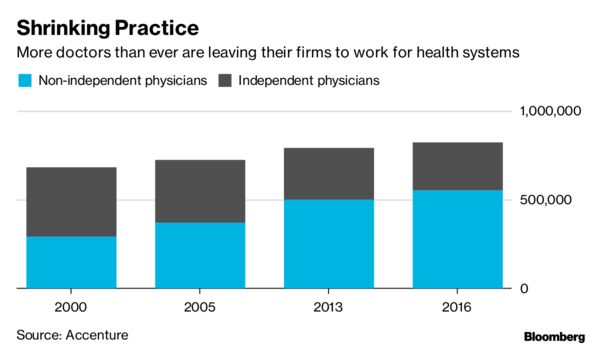
Independent physicians cited reimbursement pressures as their biggest concern for staying in business, according to a report by Accenture Plc in 2015.

“If they have to decide if they’re going to pay their rent or the rest of our bill, they’re definitely paying their rent,” said Gerald “Ray” Callas, president of the Texas Society of Anesthesiologists, whose Beaumont, Texas, practice treats about 40,000 people annually. “We try to work with the patient, but on the other hand, we can’t do it for free because we still maintain a small business.”
Accenture

In 2016, Callas introduced payment options that allow patients with expensive plans to pay a portion of the bill upfront or on a monthly basis over several years. Even so, Callas said the number of people avoiding his calls after surgery has increased “tremendously” each year since the Affordable Care Act passed in 2010.

Derick instituted a “time-out” option a few years back that gives patients the billing codes before a procedure, allowing them to call their insurance companies for estimates. Even with the program, collection rates are slower, especially at the beginning of the year when insurance plan deductibles reset.

Even large medical companies with national operations are facing the problem. Quest Diagnostics Inc., the lab-testing giant, said 20 percent of services billed to patients in the third quarter of this year went unpaid, costing the company about $80 million in lost revenue.

“We certainly have a high bad-debt rate for the uninsured,” Chief Financial Officer Mark Guinan said in a telephone interview. “But really the biggest driver is people with insurance. It’s their coinsurance and their high deductibles, and they don’t always pay their bills.”

Another testing company, Laboratory Corp. of America Holdings, reported its first year-over-year uptick in unpaid bills in the first quarter of 2016. At the time, Chief Executive Officer David King said high-deductible plans, higher copays and greater incidences of non-covered services led to more dollars being shifted to patients. LabCorp declined requests for comment.

Northwell Healthcare Inc., a network of more than 700 hospitals and outpatient facilities, lost $106.9 million to unpaid services in 2015. Others have reported the same: Acute-care and critical-access hospitals reported$55.9 billion in bad debt for 2015, according to data compiled by the American Hospital Directory Inc. 

“High-deductible plans have had a very big impact,” said Richard Miller, Northwell’s chief business strategy officer.
Kaiser Family Foundation, American Hospital Association

When it comes to reimbursement, a common denominator across the health-care industry is the archaic process through which bills are processed — a web of medical records, billing systems, health insurers and contractors.

High deductibles only add to the red tape. Providers don’t have real-time, fully accurate information on patient deductibles, which fluctuate based on how much has already been paid. That forces providers to constantly reach out to insurance companies for estimates.

Tarek Fakhouri, a Texas surgeon specializing in skin cancer, had to hire an additional staff member just to reason through bills with patients and their insurers, a big expense for an office of six or seven employees. About 10 percent of Fakhouri’s patients need payment plans, delay their skin-cancer surgeries until they’ve met their deductibles, or have to choose an alternative treatment.

According to a study earlier this year by the Journal of American Medical Association, primary-care physicians at academic health-care systems lose about 15 percent of their revenue to billing activities like calling insurance companies for estimates.

“It’s an unnecessary added cost to the health-care system to have to hire staff just to sit there on hold with insurance companies to find out what a patient’s deductible status is,” said Fakhouri.

Callas, Derick, and Fakhouri said they all know physicians who have left private practice altogether, some for the sole purpose of ending their dual roles as bill collectors. According to a study by the American Medical Association, less than half of doctors were self-employed as of 2016 — the lowest total ever. Many left their own practices in favor of hospitals and large physician groups with more resources.

To cope with the challenge, labs and hospitals are investing millions in programs designed to help patients understand what they owe at the point of care. Northwell has been implementing call centers and facilities where patients can ask questions about their bills.

“There’s a burden on both sides,” said Callas. “But health-care providers get caught in the middle.”


A Sense of Alarm as Rural Hospitals Keep Closing

The potential health and economic consequences of a trend associated with states that have turned down Medicaid expansion.

Hospitals are often thought of as the hubs of our health care system. But hospital closings are rising, particularly in some communities.

“Options are dwindling for many rural families, and remote communities are hardest hit,” said Katy Kozhimannil, an associate professor and health researcher at the University of Minnesota.

Beyond the potential health consequences for the people living nearby, hospital closings can exact an economic toll, and are associated with some states’ decisions not to expand Medicaid as part of the Affordable Care Act.

Since 2010, nearly 90 rural hospitals have shut their doors. By one estimate, hundreds of other rural hospitals are at risk of doing so.

In its June report to Congress, the Medicare Payment Advisory Commission found that of the 67 rural hospitals that closed since 2013, about one-third were more than 20 miles from the next closest hospital.

study published last year in Health Affairs by researchers from the University of Minnesota found that over half of rural counties now lack obstetric services. Another study, published in Health Services Research, showed that such closures increase the distance pregnant women must travel for delivery.

And another published earlier this year in JAMA found that higher-risk, preterm births are more likely in counties without obstetric units. (Some hospitals close obstetric units without closing the entire hospital.)

Ms. Kozhimannil, a co-author of all three studies, said, “What’s left are maternity care deserts in some of the most vulnerable communities, putting pregnant women and their babies at risk.

In July, after The New York Times wrote about the struggles of rural hospitals, some doctors responded by noting that rising malpractice premiums had made it, as one put it, “economically infeasible nowadays to practice obstetrics in rural areas.”

Many other types of specialists tend to cluster around hospitals. When a hospital leaves a community, so can many of those specialists. Care for mental health and substance use are among those most likely to be in short supply after rural hospital closures.

The closure of trauma centers has also accelerated since 2001, and disproportionately in rural areas, according to a study in Health Affairs. The resulting increased travel time for trauma cases heightens the risk of adverse outcomes, including death.

Another study found that greater travel time to hospitals is associated with higher mortality rates for coronary artery bypass graft patients.

In many communities, hospitals are among the largest employers. They also draw other businesses to an area, including those within health care and others that support it (like laundry and food services, or construction).

A study in Health Services Research found that when a community loses its only hospital, per capita income falls by about 4 percent, and the unemployment increases by 1.6 percentage points.

Not all closures are problematic. Some are in areas with sufficient hospital capacity. Moreover, in many cases hospitals that close offer relatively poorer quality care than nearby ones that remain open. This forces patients into higher-quality facilities and may offset negative effects associated with the additional distance they must travel.

Perhaps for these reasons, one study published in Health Affairs found no effect of hospital closures on mortality for Medicare patients. Because it focused on older patients, the study may have missed adverse effects on those younger than 65. Nevertheless, the study found that hospital closings were associated with reduced readmission rates, which is regarded as a sign of increased quality. So it seems consolidating services at larger hospitals can sometimes help, not harm, patients.

“There are real trade-offs between consolidating expertise at larger centers versus maintaining access in local communities,” said Karen Joynt Maddox, a cardiologist and health researcher with the Washington University School of Medicine in St. Louis and an author of the study. “The problem is that we don’t have a systematic approach to determine which services are critical to provide locally, and which are best kept at referral centers.”

Many factors can underlie the financial decision to close a hospital. Rural populations are shrinking, and the trend of hospital mergers and acquisitions can contribute to closures as services are consolidated.

Another factor: Over the long term, we are using less hospital care as more services are shifted to outpatient settings and as inpatient care is performed more rapidly. In 1960, an average appendectomy required over six days in the hospital; today one to two days is the norm.

Part of the story is political: the decision by many red states not to take advantage of federal funding to expand Medicaid as part of the Affordable Care Act. Some states cited fiscal concerns for their decisions, but ideological opposition to Obamacare was another factor.

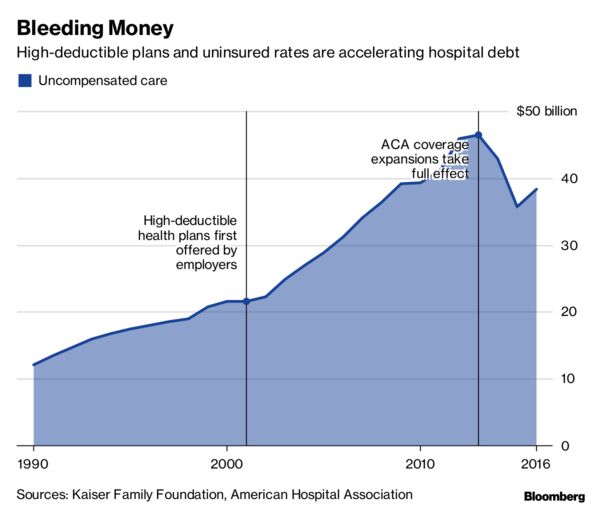
In rural areas, lower incomes and higher rates of uninsured people contribute to higher levels of uncompensated hospital care — meaning many people are unable to pay their hospital bills. Uncompensated care became less of a problem in hospitals in states that expanded Medicaid.

In a Commonwealth Fund Issue Brief, researchers from Northwestern Kellogg School of Management found that hospitals in Medicaid expansion states saved $6.2 billion in uncompensated care, with the largest reductions in states with the highest proportion of low-income and uninsured patients. Consistent with these findings, the vast majority of recent hospital closings have been in states that have not expanded Medicaid.

In every year since 2011, more hospitals have closed than opened. In 2016, for example, 21 hospitals closed, 15 of them in rural communities. This month, another rural hospital in Kansas announced it was closing, and next week people in Kansas, and in some other states, will vote in elections that could decide whether Medicaid is expanded.

Richard Lindrooth, a professor at the University of Colorado School of Public Health, led a study in Health Affairs on the relationship between Medicaid expansion and hospitals’ financial health. Hospitals in nonexpansion states took a financial hit and were far more likely to close. In the continuing battle within some states about whether or not to expand Medicaid, “hospitals’ futures hang in the balance,” he said.


Hospitals prepare for uncompensated care payment change

https://www.healthcaredive.com/news/hospitals-prepare-for-uncompensated-care-payment-change/530719/


Hospitals will soon get paid for uncompensated care differently, and though supporters of the change say it will create a fairer measurement, hospitals are leery about how the move will affect their bottom lines.

Starting Oct. 1, CMS will begin a three-year phase-in for how it pays hospitals for uncompensated care. No longer will they get paid based solely on a Medicaid, dual-eligible and disabled patient headcount. Instead, hospitals will need to provide patient-level detail of the services performed, as well as total uncompensated care totals.

Rita Numerof, co-founder and president of Numerof & Associates, told Healthcare Dive that counting heads is easier for hospitals, but it’s not always accurate. That distortion can result in institutions having an “unfair advantage” in terms of payments under the Disproportionate Share Hospital program. Instead, CMS will now gauge the actual care experience.

Numerof said the move looks to target flaws in the current payment model and improve transparency and accountability. “I think that looking at the services that are provided rather than just looking at the number of people and making an assumption about what their utilization is is a lot more accurate,” she said.

Chuck Alsdurf, director of healthcare finance policy and operational initiatives at Healthcare Financial Management Association, told Healthcare Dive the change “levels the playing field” for hospitals. However, several issues and concerns remain.

Worksheet S-10 and uncompensated care

CMS recently released its hospital inpatient prospective payment system final rule for fiscal year 2019, which included a provision that will require hospitals to use Worksheet S-10 to provide patient-level compensated care information that can be used to make payments to disproportionate share hospitals.

That patient-level data includes forms in which hospitals must attest to a patient’s eligibility, such as whether the person meets the criteria through disability, dual eligibility or Medicaid.

At the same time, CMS will audit Worksheet S-10 data in the fall and says it will continue provider education efforts and look to improve Worksheet S-10 instructions.

CMS made the change to improve the accuracy in the way that DSH payments are made. “Historically, the approach has been a head-count approach, essentially taking a look and totaling up the number of Medicaid patients, dual patients and those that are disabled,” Numerof said.

The new method isn’t as easy as a headcount, but it improves accuracy and is closer to what a hospital is actually owed.

According to the agency, about half of hospitals that receive uncompensated care payments felt the need to modify their S-10 data. Alsdurf said that’s not a large enough number to assume the data is accurate or reliable. “HFMA members view this as half of the hospitals possibly submitted imprecise data based on vague instructions that impact their hospital payments. So, at the current time, we do not feel this model is clear or accurate enough to utilize for such a significant distribution of funds,” he said.

Critics charge that the change might hurt Medicaid expansion states and help hospitals in states that didn’t expand the program. Now, hospitals calculate Medicaid Patient Days and send that information along to CMS. However, supporters of the change say that non-expansion states with fewer Medicaid recipients now lose out on uncompensated care payments compared to expansion states.

In a letter to CMS about the change, Dallas-based Parkland Memorial Hospital CEO Frederick Cerise said his facility is one of the largest providers of uncompensated care in Texas, which has not expanded Medicaid.

He said Parkland supports the change and called using S-10 data a “more exact measure.” The system provided $2.37 billion in uncompensated care in FY 2015. More than three-fourths of the system’s payer mix is unfunded (nearly half) or Medicaid (almost one-third).

The American Hospital Association agrees that Worksheet S-10 has the potential to provide a more accurate measure of uncompensated care costs. However, Erika Rogan, senior associate director of policy at AHA, told Healthcare Dive in a statement the group has concerns about the “accuracy and consistency of the S-10.”

Meanwhile, America’s Essential Hospitals, which represents more than 325 member hospitals with much of the country’s uncompensated care, sent a 44-page letter to CMS in June listing a series of concerns and recommendations to resolve the issues.

“The high cost of providing complex care to struggling Americans leaves our hospitals with limited resources, driving them to find increasingly innovative strategies for high-quality care,” AEH CEO Bruce Siegel said. “But improving care coordination and quality while staying true to a mission of helping those in need can be a delicate balance. This balance is threatened by payment cuts to hospitals.”

What does the change mean for hospitals?

Uncompensated care costs in community hospitals are on the rise after years of decreases following the Affordable Care Act.

Uncompensated care is bad debt charges plus financial assistance charges. This includes caring for uninsured patients unable to pay their bills. Uncompensated care doesn’t include underpayments from Medicare or Medicaid.

The AHA earlier this year said 4,840 community hospitals provided a total of $38.3 billion in uncompensated care in 2016, up from $35.7 billion at 4,862 community hospitals in 2015. And uninsured numbers have increased in the years since 2016, so those numbers are likely higher now.

Hospitals are concerned about any change that might result in them losing out on uncompensated care funding. However, what the change will mean for hospitals depends on multiple factors, including patient mix, location and how much the facility already relies on uncompensated care payments.

The AHA had hoped CMS would put into place protections to shield hospitals hurt by the change. In its comments to CMS, the hospital group requested a stop-loss policy that would kick in if hospitals lost more than 10% of DSH payments in a year after using the S-10 worksheet. AHA estimated that nearly one-fifth of hospitals might face that problem in FY 2019. AEH also requested a stop-loss policy.

Ultimately, CMS didn’t put in that provision. Numerof said she understands the agency’s choice. Hospitals need to understand where the market is headed and build infrastructure and systems to meet those demands accordingly. She added that no other business would request stop-loss protection based on changes like the S-10.

Concerning community relations, Alsdurf doesn’t expect the change will have an impact. “Hospitals will continue to provide care to those who cannot afford it, so I don’t think this change will have any impact on the community, positive or negative,” he said.

How should hospitals prepare?

There are still questions about the S-10, but hospitals can’t wait for CMS to provide all answers and clarifications. The change is here and hospitals need to move forward with the information available to them.

This process means maximizing uncompensated care payments in the new system. One step is for hospitals to make sure their charity care and bad debt policies are updated and that those policies are followed, so they receive the level of payments they’re owed.

Alsdurf said hospitals are already collecting Medicaid days data. Now they’ll have to add another piece. He expects the change will be minor for reporting and data gathering practices.

“Until they receive feedback from CMS on their data, it’s hard to do much other than make sure they feel good about the data … I’d suggest they begin running reports from their billing systems and reconciling the data (if they haven’t already) to the S-10 worksheet for FY 2014 to present,” Alsdurf said.

He added that hospitals should also continue to review their data as CMS provides more explicit instructions about S-10 in the coming months.


Increase in uncompensated hospital care could be one effect of short-term coverage rule

https://www.healthcarefinancenews.com/news/increase-uncompensated-hospital-care-could-be-one-effect-short-term-coverage-rule?mkt_tok=eyJpIjoiWVdZNE1URmxNREk1T1RsbCIsInQiOiIrbiszc25vVXhkU1NvMkJadnRGTEJhQnNYRDNBcmwyTmFHdnhVem5aS1lZT1wvSkhXYUZqOHNTQTlzZU5iaWtWYjZpN3FydGtadm5Ic1MzMFJwMnFsQWpWWFRZVEdJYkxNM3F4S0QzbHJqSDNSM09iK09tZFZaWTEyWkY0YVIyZGoifQ%3D%3D

Short-term limited duration plans finalized by the Trump Administration on Wednesday could subject patients to catastrophic medical bills and medical bankruptcy, stakeholders told the Departments of Health and Human Services, Labor and Treasury in commenting on the final rule.

Enrollees suffering acute health emergencies, debilitating injuries that lead to permanent disabilities, or the onset of chronic conditions could end up facing financial hardship until they can enroll in an individual or group market plan that provides the coverage they need, according to the final rule.

The rule extends short-term, limited duration coverage from three months to a year, with extensions available for up to three years.

Devastating for hospital ERs

America’s Health Insurance Plans said it was concerned the new plans could catch some consumers unaware and facing high medical expenses when the care they need isn’t covered or exceeds their coverage limits.

Hospitals could be affected by an increase in uncompensated care because the plans are not qualifying health plans mandated to cover the essential benefits of the Affordable Care Act, those commenting on the final rule said.

Stakeholders said the proposed changes could have a devastating impact on hospital emergency rooms, since ERs are required to provide care regardless of coverage status or one’s ability to pay.

“In addition, the lack of coverage of essential health benefits may also lead to an increased reliance on emergency departments as consumers delay or do not seek primary care, exacerbating existing acute and chronic conditions,” the final rule said.

One commenter said this may also lead to increased boarding of mental health patients in emergency departments, where some have an average stay of 18 hours.

If a short-term, limited-duration insurance policy excludes treatment in hospital emergency rooms, there is the possibility that there could be increases in uncompensated care provided by hospitals, according to the departments which issued the rule.

However, there is no reason to believe that all short-term, limited-duration insurance policies will exclude such coverage, the rule said.

In addition, short-term limited duration plans could result in a decrease in uncompensated care if people who otherwise had no insurance become insured.

Many commenters expressed concern that extending the maximum duration of short-term, limited-duration coverage would weaken the single risk pools and destabilize the individual market by syphoning young, healthy individuals from ACA plans. This would leave on the exchanges only those with higher expected health costs and those receiving subsidies in the individual market.

An estimated 70 percent of ACA enrollees receive a subsidy of a premium tax credit.

The departments acknowledge that relatively young, healthy individuals in the middle-class and upper middle-class whose income disqualifies them from obtaining premium tax credits  are more likely to purchase short-term, limited-duration insurance.

“As people choose these plans rather than individual market coverage, this could lead to adverse selection and the worsening of the individual market risk pool,” the rule said.

It could also result in higher premiums for some consumers remaining in the Affordable Care Act market as healthier consumers choose short-term plans and their lower premiums, the rule said.

Individuals who choose to purchase short-term, limited-duration insurance are expected to pay a premium that is approximately half of the average unsubsidized premium in the exchange.

Mixed results

Individual market premiums increased 105 percent from 2013 to 2017, in the 39 states using Healthcare.gov in 2017, while the average monthly premium for the second-lowest cost silver plan for a 27-year-old increased by 37 percent from 2017 to 2018.

Premiums for unsubsidized enrollees in the exchanges are expected to increase by 1 percent in 2019 and by 5 percent in 2028.

In 2019, when the short-term plans go into effect, enrollment in these plans will increase by 600,000. About 100,000 of these consumers will have been previously uninsured.

Enrollment in the ACA exchange in 2019 is expected to decrease by 200,000.

By 2028, enrollment in individual market plans is projected to decrease by 1.3 million, while enrollment in short-term, limited-duration insurance will increase by 1.4 million, according to the final rule.

The net result will be an increase in the total number of people with some type of coverage by 0.1 million in 2020 and by 0.2 million by 2028.

Benefits of short-term plans include increased profits for insurers of these plans and potentially broader access to providers compared to ACA market plans.

Short-term plan shortcomings include high deductibles and cost-sharing requirements.

For example, in Phoenix, Arizona, the out-of-pocket cost-sharing limit for a 40-year-old male can be as high as $30,000 for a 3-month period. Another commenter pointed out that in Georgia, a plan had a 3-month out-of-pocket limit of $10,000, but did not include the deductible of $10,000, resulting in an effective 3-month out-of-pocket maximum of $20,000.

ACA plans also have high premiums and out-of-pocket costs, the rule said. In 2018, deductibles average nearly $6,000 a year for bronze single coverage and more than $12,000 a year for bronze family coverage.

Matt Eyles, president and CEO of America’s Health Insurance Plans said, “Consumers deserve more choices, particularly those who do not qualify for federal subsidies and must pay the full premium.  Consumers should clearly understand what their plan does and does not cover. The new requirement for short term plans to make clearer disclosures to consumers is an important improvement. We also appreciate that the rule affirms the role of states to regulate these plans, including the option to reduce the duration period for short-term coverage.”


Hospital bad debt rises in tandem with growing share of patient financial responsibility

http://www.healthcarefinancenews.com/news/hospital-bad-debt-rises-tandem-growing-share-patient-financial-responsibility?mkt_tok=eyJpIjoiTmpWaFpXRXlaRE13TVdOayIsInQiOiI3eUgrK0tQYitiVERnY1RVeGk0enpGRUZDdUJBck44ZTQ0WFhqVFkxZWd2M0krd0JyU1ViQ0JnTk5xd0FkK0tHUXlyaURuaDRwUWJwRlhSTTBpT1lJdTQ5VjRia0VId3dNZ1h6ZWY3UVhSZElQK3RtcmFiUndmbW5ZeGZxUmRUbSJ9


The trend even includes Medicare bad debt, which results when hospitals exhaust efforts to collect from beneficiaries and must be paid back.

Hospitals continue to face financial challenges as the landscape shifts, and the challenge posed to hospitals by patient balances after insurance, or PBAI, is growing. That’s according to a new TransUnion Healthcare analysis that showed PBAI rose from 8 percent of the total bill responsibility during the first quarter of 2012 to 12.2 percent during the same quarter in 2017.

Commercially insured patients experienced a PBAI increase of 67 percent from $467 to $781, the analysis showed. The rising trend fueled an 88 percent increase in total hospital revenue attributed to PBAI over the 5-year period.

As patients take on more risk and shoulder more of their own healthcare costs, uncompensated care is also rising. TransUnion cited the American Hospital Association’s 2017 Hospital Fact Sheet, which said uncompensated care increased by $2.6 billion dollars in 2016, the first increase in three years. Rising PBAI has no doubt amplified bad debt for providers, contributing to that rise.

Jonathan Wiik, principal for healthcare strategy at TransUnion, said he expects the figure to have risen in 2017 and again in 2018.

The analysis also indicated that Medicare Bad Debt, which happens when Medicare patients don’t pay their deductibles and coinsurance, rose from $3.14 billion in 2012 to $3.69 billion in 2016, a 17 percent increase. If a hospital feels it has exhausted all efforts to get money from a Medicare beneficiary who has an outstanding copay coinsurance or deductible, and they have documented their efforts to collect, Medicare will actually pay the hospital back though not dollar-for-dollar. Wiik said Medicare pays about 65 cents on the dollar for that payback so the hospital still loses some money, about a third of the bill to be exact.

“A great example of that is a hip surgery patient that has Medicare, has a $1,000 deductible and never paid it,” Wilk said. “The hospital would have gotten $650 back but lost $350.”

The trend indicates that hospitals continue to experience reimbursement pressure that can be tied directly to the increase in how much of their own medical cost patients are now taking on

“That’s a very scary thing. For the average elective surgery the number used to be 10 percent, now it’s 30. Patients are great volume for hospitals but they are horrible payers compared to insurance companies. They cost twice as much to collect from and they take three times as long to pay. That’s an administrative burden for the hospital-cost to collect – it’s significantly higher to collect from a patient than from a insurer,” Wilk said.

To show just how much the payer landscape has shifted for hospitals, patients are now generally ranked as a top tier payer for hospitals, right after Medicare and Medicaid. Then comes PBAI and then commercial, according to Wiik. And with patients in the top of a hospital’s AR ranking, he’s seeing some clinics do deductible holds in which they delay their claim while a related hospital claim processes. They don’t send it in until the patient meets the deductible through the hospital. Once it is met then the clinic will send in their claim and get paid right away because the payer is paying, not the patient.

A big part of the problem is a huge gap in benefits literacy for patients coupled with the driving force of consumerism.

“They don’t understand the magnitude of the costs they they are going to get hit with. A relatively simple elective surgery will blow a $2,500 dollar deductible out of the water almost every time. Patients don’t realize that until it happens so hospitals should be engaging them early and putting patient-facing estimates in front of them. And it’s really not about collecting money from patients anymore it’s about getting them financing,” Wiik said.

That means proactively setting up payment plans to spread debt out over time, which protects not only the patient experience but also the hospital’s revenue. Plus it’s a more pleasant conversation to have. If patients are a higher ranking payer, hospitals should be putting into place more policies to deal with their needs and requirements, treating them like the force they are becoming.

“Imagine if you were going in for knee surgery and your hospital sent you a text that said here’s your payment plan would you like to start that now. I think a lot of patients would appreciate that. It doesn’t happen. But it should. The technology is there. You can buy groceries online now and go pick them up. It’s all billed electronically now.”

It can be hard to do estimates and set up payment plans early because medical costs cost can vary so much, but patients want that kind of experience. They put it on the hospitals to figure out how to get them a bill that is at least close to what they were expecting, and set them up to pay for it.

“They are going to go somewhere where that experience is frictionless. That’s what hospitals have to be aware of,” Wilk said. “The market is highly competitive when it comes to that type of stuff and the ones who are innovating and engaging patients are going to get those millennials and the folks that live paying their bills online.”


Moody’s: 3 ways the GOP tax bill will hurt nonprofit hospitals

https://www.beckershospitalreview.com/finance/moody-s-3-ways-the-gop-tax-bill-will-hurt-nonprofit-hospitals.html

Image result for Tax Bill implications for nonprofit hospitals

The Republicans’ tax overhaul plan, which is expected to become law soon, has negative credit implications for nonprofit hospitals and health systems, according to Moody’s Investors Service.

Here are three ways the tax bill will hurt nonprofit hospitals and health systems.

1. The tax bill will repeal the ACA’s individual insurance mandate. This will cause the uninsured population to rise and raise uncompensated care costs, which will negatively affect healthcare organizations’ operating margins and cash flow, according to Moody’s.

2. The tax plan’s limits on tax-exempt refundings is negative for all issuers of tax-exempt debt, including nonprofit hospitals and health systems, as these financings have been used to reduce long-term borrowing costs and take advantage of lower interest rates, according to Moody’s.

3. The tax bill will slash the corporate tax rate to 21 percent from 35 percent. This change has negative implications for nonprofit hospitals and health systems, as it “makes tax-exempt bonds a less attractive investment for banks and other financial institutions, which will weaken demand, especially for direct bank loans and private placements,” according to Moody’s.

Tax Bill Is Likely to Undo Health Insurance Mandate, Republicans Say

Image result for Tax Bill Is Likely to Undo Health Insurance Mandate, Republicans Say

House and Senate negotiators thrashing out differences over a major tax bill are likely to eliminate the insurance coverage mandate at the heart of the Affordable Care Act, lawmakers say.

But a deal struck by Senate Republican leaders and Senator Susan Collins of Maine to mitigate the effect of the repeal has been all but rejected by House Republicans, potentially jeopardizing Ms. Collins’s final yes vote.

“I don’t think the American people voted for bailing out big insurance,” said Representative Dave Brat, Republican of Virginia, who opposes a separate measure to lower insurance premiums that Ms. Collins thought she had secured.

The sweeping tax overhaul approved Saturday by the Senate would eliminate penalties for people who go without insurance, a change not in the tax bill passed last month by the House. But the House has voted many times to roll back the mandate, most recently in a bill to dismantle the Affordable Care Act, and House members were enthusiastic about going along.

“Mandating people to buy a product was a bad idea to begin with,” said Representative Rob Woodall, Republican of Georgia. “We made people do something that was supposed to be good for them. But they are telling us by the millions how much they dislike the mandate.”

The individual mandate was originally considered indispensable to the Affordable Care Act, a way to induce healthy people to buy insurance and thus to hold down insurance premiums for sicker customers. The Obama administration successfully defended the mandate in the Supreme Court. But recent economic research suggests that the effect of the mandate on coverage is somewhat smaller than previously thought.

With little more than a week remaining until the annual open enrollment period ends, 3.6 million people have selected health plans for 2018 in the 39 states that use the federal marketplace, the Trump administration reported Wednesday. That is 22 percent higher than at this point last year, despite uncertainty about the mandate’s future and efforts by Republicans and the administration to undermine the law.

But because the sign-up period is only half as long, it appears likely that enrollment will end up lower than in the last period.

Without a mandate, some healthy people are likely to go without coverage, leaving sicker people in the market, and prices are likely to rise more than they otherwise would. The Congressional Budget Office said last month that repealing the individual mandate would increase average premiums on the individual market about 10 percent, and it estimated that the number of people without health insurance would rise by 13 million.

Regardless, the requirement has proved to be one of the most unpopular parts of the 2010 law, and House Republicans were happy to see it go. Representative Richard Hudson, Republican of North Carolina, called the Senate provision “a great move.”

The repeal also frees up money that Congress can use to reduce tax rates. The budget office said it would save the federal government more than $300 billion over 10 years — mainly because fewer people would have Medicaid or subsidized private insurance.

The mandate repeal’s effect on health insurance markets did concern Ms. Collins, and to win her vote for the Senate tax bill, the Senate majority leader, Mitch McConnell of Kentucky, offered her a deal, in writing: He would support two bipartisan bills to stabilize markets and hold down premiums, in the absence of the individual mandate.

One bill would provide money to continue paying subsidies to insurance companies in 2018 and 2019 to compensate them for reducing out-of-pocket costs for low-income people. President Trump cut off the “cost sharing” subsidies in October, more than a year after a federal judge ruled that the payments were unconstitutional because Congress had never explicitly provided money for them. The payments would resume under this measure, drafted by Senators Lamar Alexander, Republican of Tennessee, and Patty Murray, Democrat of Washington State.

The second bill would provide $5 billion a year for grants to states in 2018 and 2019. States could use the money to help pay the largest health claims, through a backstop known as reinsurance, or to establish high-risk pools to help cover sick people.

Ms. Collins has released a copy of her agreement with Mr. McConnell in which he pledged to support passage of the two measures before the end of the year. His signature was displayed prominently at the top of the first page. But the deal has landed with a thud in the House, where Republicans appear loath to support legislation that they view as propping up a health law that they have pledged to repeal.

“Our members wince at voting to sustain a system that none of them supported,” said Representative Tom Cole, Republican of Oklahoma.

The Senate could attach the Alexander-Murray legislation to a government funding measure, hoping that Republicans in the House would be willing to swallow it as part of a measure to avoid a government shutdown. But Mr. Cole said House Republicans would be “very offended” at such an approach.

“I don’t think we’re in the mood to be blackmailed by anybody,” he said.

Mr. Brat, a member of the conservative Freedom Caucus, assailed the deal with Ms. Collins as an example of horse trading that is characteristic of the Washington swamp that he said voters had repudiated.

Likewise, Representative Mark Walker of North Carolina, the chairman of the conservative Republican Study Committee, said of the Alexander-Murray bill, “There’s no appetite for that over here.”

Ms. Collins said on Wednesday that she believed the House would “take a serious look” at the two bills intended to hold down insurance premiums and that Mr. Trump, in several recent meetings, had assured her that he also supported those bills.

“I don’t think this effort is over by any means,” Ms. Collins said.

For Democrats, eliminating the insurance mandate penalties provides yet another reason to oppose the tax bill.

“The individual mandate is at the heart of the Affordable Care Act,” said Representative James E. Clyburn, Democrat of South Carolina. “Repealing it, as the G.O.P. tax scam does, is a deliberate attempt to undercut the law, create chaos in the health insurance marketplaces, increase premiums and decrease choice and coverage.”

Ms. Murray indicated that even if Ms. Collins secures her deal, Democrats would remain steadfast.

“Our bill, the Alexander-Murray bill, was designed to shore up the existing health care system,” not to “solve the new problems in this awful Republican tax bill,” she said.

Meanwhile, the damage to the Affordable Care Act may already have been done. Daniel Bouton, an enrollment counselor in Dallas, said he worried that the Trump administration’s decision to cut advertising for open enrollment had prevented millions of people from learning about the shortened sign-up period. He also said that the Senate’s recent vote to undo the individual mandate as part of its tax bill would discourage people from signing up.

“You’re going to have people who say, ‘Well, perfect, I don’t have to buy insurance anymore,’” Mr. Bouton said.


Ryan eyes push for ‘entitlement reform’ in 2018

http://thehill.com/homenews/house/363642-ryan-pledges-entitlement-reform-in-2018?utm_source=&utm_medium=email&utm_campaign=12524

Image result for cutting entitlements

House Speaker Paul Ryan (R-Wis.) on Wednesday said House Republicans will aim to cut spending on Medicare, Medicaid and welfare programs next year as a way to trim the federal deficit.

“We’re going to have to get back next year at entitlement reform, which is how you tackle the debt and the deficit,” Ryan said during an interview on Ross Kaminsky’s talk radio show.

Health-care entitlements such as Medicare and Medicaid “are the big drivers of debt,” Ryan said, “so we spend more time on the health-care entitlements, because that’s really where the problem lies, fiscally speaking.”

Ryan said he’s been speaking privately with President Trump, who is beginning to warm to the idea of slowing the spending growth in entitlements.

During his campaign, Trump repeatedly promised not to cut Medicare, Medicaid or Social Security.

“I think the president is understanding choice and competition works everywhere, especially in Medicare,” Ryan said.

House and Senate Republicans are currently working on their plans for tax reform, which are estimated to add more than $1 trillion to the deficit. Democrats have voiced concerns that the legislation could lead to cuts to the social safety net.

Ryan is one of a growing number of GOP leaders who have mentioned the need for Congress to cut entitlement spending next year.

Last week, House Ways and Means Committee Chairman Kevin Brady (R-Texas) said that once the tax bill was done, “welfare reform” was up next.

Sen. Marco Rubio (R-Fla.), last week, said “instituting structural changes to Social Security and Medicare for the future” will be the best way to reduce spending and generate economic growth.

Rep. Jeb Hensarling (R-Texas), chairman of the House Financial Services Committee, told Bloomberg TV that “the most important thing we can do with respect to the national debt, what we need to do, is obviously reform current entitlement programs for future generations.”

Ryan also mentioned that he wants to work on changing the welfare system, and Republicans have in the past expressed a desire to add work requirements to programs such as food stamps.

Speaking on the Senate floor while debating the tax bill last week, Senate Finance Committee Chairman Orrin Hatch (R-Utah) said he had a “rough time wanting to spend billions and billions and trillions of dollars to help people who won’t help themselves, won’t lift a finger and expect the federal government to do everything.”

His comments were echoed by Ryan.

“We have a welfare system that’s trapping people in poverty and effectively paying people not to work,” Ryan said Wednesday. “We’ve got to work on that.”


Repealing the Individual Health Insurance Mandate Restricts Freedom

http://www.commonwealthfund.org/publications/blog/2017/dec/repealing-the-individual-health-insurance-mandate-restricts-freedom

Image result for free rider problem


Two short months after they appeared to move past their campaign to dismantle the Affordable Care Act (ACA), Senate Republicans passed a tax reform package that includes a repeal of the law’s individual health insurance mandate. House Republicans have indicated they will follow suit.

The mandate is an easy target. Since before the ACA was passed, it has been portrayed as un-American. President Trump articulated this criticism during his inaugural address to Congress, when he argued that “mandating that every American buy government-approved health care was never the right solution for our country.” It has also been labeled anti–free market, and it has been called an affront to personal freedom.

It is none of these things.

An individual mandate to purchase health insurance was first proposed in the U.S. by the conservative Heritage Foundation, which in 1989 saw it as a way of creating healthy insurance pools, a solution to what they saw as the “free-rider” problem in health care, and as an alternative to a single-payer system. It was first passed into law by Mitt Romney, the Republican governor of Massachusetts, who promoted it as a market-based idea grounded in the principle of individual responsibility.

Does the individual mandate restrict freedom? Yes, but not unreasonably, and it isn’t unique in this regard. The 49 state laws requiring drivers to carry auto insurance also restrict individual freedoms, as do fishing licenses and nearly all taxes. In the case of compulsory auto insurance, every state except New Hampshire has made the calculation that the harm of curtailing freedom is outweighed by associated goods — for compulsory auto insurance this is the sense of security one gets from knowing that if a faulty driver hits you he or she will have the means to pay your medical bills or repair your car. When one turns to health insurance, the associated goods are much more profound.

The benefit of the individual insurance mandate derives from the collective goods we all receive from increased participation in insurance markets — these include lower rates of uncompensated care, healthier insurance markets, and ultimately lower premiums and better access to health care.. It helps makes the ACA marketplaces sustainable, thereby giving millions a source of comprehensive health insurance, and millions more the peace of mind knowing that they have a place to go if they ever need to buy it.  For these last reasons, the individual mandate actually enhances freedom. Having universally available, high-quality health insurance frees us from the fear of being one illness away from financial ruin, from being tethered to a job (or relationship) because it is the only means of coverage, and frees us and our loved ones from the physically or financially disabling effects of an unmanaged illness.

Repealing the individual mandate and the destabilizing of health insurance markets that will follow will harm a lot of Americans. The Congressional Budget Office projects that 13 million people will lose their health insurance because of the repeal.

Nonetheless, Republicans appear poised to move ahead. Crippling the marketplaces hasn’t garnered the ire of key Republican governors who weighed in strongly on the large Medicaid cuts proposed as part of earlier repeal bills. And senators who may have been concerned about the consequences of repeal cared more about passing tax reform — a must-have political victory for Republicans.

The other reason why this newest attack on the ACA may be more successful than earlier ones is that, from the outset, the individual mandate has never had strong public support; it polls lower than other key provisions and has been the target of a disproportionate share of the harsh rhetoric aimed at the law. The Obama administration was never able to sell the public on the connection between a strong mandate and high-quality, affordable health insurance, so for some it has felt like pointless government intrusion.

Regardless of how people feel about the mandate, the facts are clear: millions of Americans have benefited from it and live more freely because of it. Congress should remove the individual mandate repeal from the tax bill to help ensure that 13 million people don’t lose the freedoms it has given them.

Outlook Darkens for Not-for-Profit Hospitals

http://www.healthleadersmedia.com/finance/outlook-darkens-not-profit-hospitals?spMailingID=12500545&spUserID=MTY3ODg4NTg1MzQ4S0&spJobID=1300449776&spReportId=MTMwMDQ0OTc3NgS2

Image result for bulls and bears


The revised outlook from Moody’s comes amid a larger-than-expected drop in cash flow this year and the ongoing uncertainty regarding federal healthcare policy for public and not-for-profit hospitals.

Moody’s Investors Service has downgraded from stable to negative its 2018 outlook for the not-for-profit hospital sector based on an expected drop in operating cash flow.

“Operating cash flow declined at a more rapid pace than expected in 2017, and we expect continued contraction of 2%-4% through 2018,” said Eva Bogaty, a Moody’s vice president.

“The cash flow spike from insurance expansion under the Affordable Care Act in 2014 and 2015 has largely worn off, but cash flow has not stabilized as expected because of a low revenue and high expense growth environment,” Bogaty said.

In a briefing released Monday, Moody’s said hospital revenue growth is slowing and is expected to remain slightly above medical inflation, which declined to a low of 1.6% in September. Hospitals can’t translate volume growth into stronger revenue growth because of the lower reimbursement rate increases across all insurance providers and higher expense growth.

In addition, rising exposure to governmental payers will dampen revenue growth for the foreseeable future due to a rapidly aging population and low reimbursement rates. Medicare and Medicaid, represent 60% of gross patient revenue in 2017, Moody’s said.

Key drivers of expense growth include rising labor costs, driven by an acute nursing shortage and ongoing physician and medical specialist hiring. Technology costs are also rising as systems are upgraded and IT staff is needed for training and maintenance. While the ACA’s arrival heralded a drop in bad debt from 2014-16, bad debt rebounded in 2017 and will continue to grow at a rate of 6%-7% in 2018, Bogaty said.

“Rising copays and use of high deductible plans will increase bad debt for both expansion and non-expansion states,” she said.

In the near-term, uncertainty regarding federal healthcare policy will have a marginal fiscal impact on NFP hospitals. Bogaty said ambiguity surrounding the ACA does affect the planning and modelling of long-term strategies, while recent federal tax proposals will add to rising costs for hospitals.

The outlook could be revised to stable if operating cash flow resumes growth of 0%-4%. A change to positive could result from expectations of accelerated operating cash flow growth of more than 4% after inflation, Moody’s said.