China Marks the Wuhan Lockdown Anniversary Amid Spiraling COVID-19 Cases and With Risky Holiday Travel Looming

This aerial photo, taken on Jan. 20, 2021, shows the construction site of the Huangzhuang quarantine center in Shijiazhuang, north China’s Hebei Province.

When authorities came to Dr. Liu Chun’s hospital in the central Chinese city of Changsha with a request for 130 volunteers, it took just two hours for all slots to be filled. As a respiratory doctor specializing in ICU patients, Liu felt it was her duty to join the group of medical workers summoned 340 kilometers north, to Wuhan, where rumors of a mysterious pneumonia-like illness had been circulating for weeks. At first, Liu, 48, wasn’t terribly worried. Her husband and 12-year-old daughter were supportive; she didn’t bother telling her elderly parents of her plans.

But when she arrived in Wuhan on Feb. 8, 2020, she saw panic on the tear-streaked faces of her team members. One colleague was busy scribbling his will. Female staff had been instructed to cut their hair brutally short and men to shave it almost entirely.

“I was a little nervous,” she tells TIME.

Liu was charged with setting up a field hospital for COVID-19 patients outside Tongji Hospital in Wuhan. The city of 11 million had been sealed since Jan. 23 in an unprecedented lockdown that was to last 76 days. Officials ordered Liu to accept 50 patients within hours of her arrival, despite a dire shortage of medicine, PPE and ventilators.

It was only then that the severity of the disease became apparent. Liu would check on patients and return within an hour to find they had quietly passed.

“It really shocked me,” she says. “We began to call it the ‘silent killer.’”

She spent a lot of time calming and counseling terrified nurses. “I began to feel the burden of looking after everyone,” Liu recalls, while fearing for her own safety, even in a hazmat suit. Whenever a bead of sweat would drip from her cheek into her mouth, “I would get that salty taste and briefly fear that I’d been contaminated.”

Liu was among the first clinicians to confront COVID-19, and the panic and confusion she felt one year ago has sadly now burdened frontline workers around the globe. As Wuhan marks the first anniversary of its unprecedented lockdown, the city’s experiences are the cause of both hope and caution as the virus again takes hold in the country where it was first discovered.

Portrait of Dr. Liu Chun at Hunan Xiangya Hospital in Changsha, China, on Dec. 1, 2020.

China has enjoyed months of relatively low coronavirus figures, but it recorded 222 new coronavirus cases on Jan. 21, following 223 on Jan. 20 and 133 the day before that. The new more infectious U.K. strain has also been detected in at least four cities. This comes just before the Lunar New Year festivities, when migrant workers all over China expect to head home to celebrate the holiday with their families. The movement of holidaymakers, involving some 200 million people, is humanity’s biggest annual migration. This year, it could be a potentially catastrophic spreader of disease.

The government is handling the resurgence with trademark ruthlessness. More than 23 million people have been ordered to remain inside their homes in northern China to stymie new outbreaks—double the number confined in Wuhan when the pandemic first erupted. A temporary quarantine center capable of housing 4,000 suspected cases has been thrown up outside the city of Shijiazhuang, just under 300 kilometers southwest of the capital Beijing. Its residents—like those of two other major cities—are forbidden from venturing outside.

According to state media, some 20,000 residents of 12 villages near Shijiazhuang were rudely awoken by sirens early last week and bused to government-run quarantine centers. Business magazine Caixin reported that in one district of Shijiazhuang, an old man was tied to a tree after venturing out to buy cigarettes, prompting the suspension of local officials.

Millions of people in five Beijing neighborhoods have now been ordered not to leave the city and to report for testing after two cases of the new variant were discovered. Shanghai meanwhile reported three cases on Thursday and has mandated the testing of all hospital staff. Arrivals from domestic high and medium-risk areas of the country are also obliged to undergo 14 days quarantine.

Zhang Wenhong, head of the city’s COVID-19 response, told reporters “These cases reminded the public that the virus has never been away from us and epidemic prevention and control will become a new normal.”

China’s ongoing fight against COVID-19

The resurgence has rendered Wuhan’s anniversary especially sensitive for the ruling Chinese Communist Party (CCP). Unhappy with accusations that officials bungled the handling of the outbreak’s early stages and silenced whistle-blowers, the party has sought to rewrite the past year as a tale of decisive courage under strongman President Xi Jinping.

Already, there is a cavernous exhibition hall in Wuhan commemorating the lockdown, with holograms of medical staff, letters from front-line health workers and a replica of a mass quarantine site just like those now being hastily erected in Shijiazhuang. A towering photo of Xi takes pride of place by a timeline of the measures he is said to have personally taken to stem the virus’ spread. In fact, Xi was neither seen nor heard during the early stages the outbreak. Premier Li Keqiang was the public face of Beijing’s response, while on the ground the undisputed heroes were everyday people who kept shelves stocked and bellies full.

Qian Ranhao was in charge of a distribution hub for online retailer JD.com, just 3 miles from Wuhan’s Jinyintan Hospital, where some of the first COVID-19 patients were treated. He was tasked with dispatching vital supplies of masks, drugs and disinfectant to the hospital each day, sleeping in the warehouse each evening to avoid taking the virus home to his heavily pregnant wife.

“She was nervous about me because I was on the street,” Qian tells TIME. “Even when I did return eventually home, we made sure to stay in different rooms.”

Qian’s son was born safely in August, but countless tales of tragedy have been expunged from the official account. The CCP’s already formidable talent for rewriting history has been honed even further under Xi, who has removed presidential term limits and fostered a cult of personality. In recent weeks, censors have scrubbed terms like “first anniversary” and “whistleblower” from Chinese social media, where paeans from corporate sponsors exalting Wuhan’s remarkable sacrifice and recovery are instead plentiful.

A medical worker collects a swab sample from a child at a COVID-19 testing site in Daxing District of Beijing, capital of China, Jan. 20, 2021.

The GDP of Hubei province—of which Wuhan is the capital—fell 39.2% in the first quarter of 2020, but recovered strongly to post a mere 5% contraction over the cataclysmic year. Across China, official data suggests GDP grew 2.3% last year, though the economy has been extremely unbalanced. Speaking at a December forum promoting economic development along the Yangtze River, which runs through Wuhan, Wang Zhonglin, the city’s top official, entreated the residents not to “slow down efforts to work toward becoming an international metropolis.”

That the message is being painstakingly curated and controlled is underscored by last month’s sentencing to four years in prison of Zhang Zhan, 37, a citizen journalist who had chronicled Wuhan’s lockdown. Scientists are also under strict orders not to report anything that may corroborate the belief that the virus originated inside China. WHO team belatedly arrived in Wuhan last week to investigate the source of the coronavirus, but it’s uncertain how much freedom they will have to visit places they deem of interest following their two weeks quarantine. Two of the party were denied entry after testing positive for COVID-19 antibodies.

The government has meanwhile unveiled sweeping plans to vaccinate 50 million people before the Lunar New Year holiday in mid-February, and has so far managed to inoculate 10 million. State employees have been expressly forbidden from traveling over the holiday, and officials have urged everyone else to avoid it if possible. That’s a tough ask for the many millions of casual workers for whom the holiday is their only opportunity each year to reunite with loved ones.

Some 1.7 billion trips are expected during the festival, according to China’s Transport Ministry. That represents a 40% drop on 2019 figures, and a new rule requires travelers to present a negative nucleic acid test upon arrival at their hometowns. Nevertheless, one year after the start of the Wuhan lockdown, officials must be nervous.

Gang Fang, assistant professor of biology at NYU Shanghai, says the potential for seeding outbreaks is very real and officials are well aware of the stakes.

“If officials don’t control cases in their local area they will lose their job and political career,” he tells TIME. “Controlling the virus is their most important responsibility right now.”

Lawsuit Challenges GA’s 1332 Waiver, ACA in the Biden Pandemic Plan

Lawsuit Challenges GA's 1332 Waiver, ACA in the Biden Pandemic Plan |  Health Affairs

On January 14, 2021, Planned Parenthood Southeast and the Feminist Women’s Health Center filed a lawsuit challenging the Trump administration’s approval of Georgia’s waiver under Section 1332 of the Affordable Care Act (ACA). The lawsuit was filed in federal district court in DC. This post summarizes that legal challenge as well as parts of President Biden’s recent proposed pandemic relief package that relate to the ACA and coverage. The $1.9 trillion American Rescue Plan includes several coverage-related proposals and would follow the pandemic relief passed by Congress in December 2020.

Advocates Challenge The Approval of Georgia’s 1332 Waiver

Regular readers know that the Trump administration—through the Centers for Medicare and Medicaid Services (CMS) and the Treasury Department—approved a broad waiver request from Georgia under Section 1332 of the ACA. The approved waiver authorizes the state to establish a reinsurance program for plan year 2022 and eliminate the use of HealthCare.gov beginning with plan year 2023. CMS and Treasury approved the waiver application on November 1, 2020. The history of Georgia’s waiver application and approval is summarized in prior posts as well as in the complaint filed in the lawsuit.

The reinsurance portion of the waiver is straightforward; of the 16 states with an approved Section 1332 waiver, all but one state has established a state-based reinsurance program. But the second part of the waiver application, known as the Georgia Access Model, is far more controversial. This is the broadest waiver yet to be approved under Section 1332 and relies on interpretations of Section 1332 made in much-criticized Trump-era guidance from 2018.

Critics have long argued that Georgia’s proposal fails to satisfy Section 1332’s procedural and substantive guardrails, meaning it could not be lawfully approved by the Trump administration. Given this controversy, legal challenges to the waiver approval were expected.

The Lawsuit

Planned Parenthood Southeast and the Feminist Women’s Health Center—represented by Democracy Forward—filed a lawsuit in federal district court in DC on January 14, 2021. The lawsuit alleges that the Trump administration’s 2018 guidance and approval of Georgia’s waiver are unlawful because these actions violate Section 1332 of the ACA and the Administrative Procedure Act (APA). The lawsuit also cites many of the Trump administration’s ongoing efforts to undermine the ACA as evidence that the 2018 guidance and waiver approval are part of a pattern of ACA sabotage.

In particular, the plaintiffs argue that the 2018 guidance and waiver approval are contrary to Section 1332, exceed the scope of the agencies’ authority (by allowing states to waive non-waivable provisions of the ACA), and are arbitrary and capricious. They also argue that the waiver approval failed to satisfy procedural requirements under the ACA and APA because Georgia and the Trump administration rushed through the process without adequate time for public comment and without adequate clarification of how the state intends to approach key issues.” Here, the lawsuit points to the fact that Georgia went through four iterations of its waiver application, that its application was incomplete, and that only eight comments (less than one half of one percent) of the 1,826 total comments submitted during the most recent federal public comment period were in support of the Georgia Access Model.

As such, the plaintiffs ask the court to vacate both the approved waiver and the 2018 guidance and declare that they are unlawful. They also ask that the federal government be enjoined from taking further action on Georgia’s waiver or considering other waivers under the 2018 guidance. The plaintiffs acknowledge that the reinsurance portion of the waiver is uncontroversial and that the focus of the lawsuit is on the Georgia Access Model; however, the plaintiffs challenge approval of the waiver as a whole and ask the court to set aside the waiver in whole or in part. The plaintiffs have not sued Georgia, although it is possible that Georgia may ask to intervene in the litigation to defend its interests.

Much of the lawsuit turns on how the Trump administration interpreted the statutory guardrails under Section 1332 and long-standing concerns about direct enrollment and enhanced direct enrollment. Federal officials can grant a Section 1332 waiver only if a state demonstrates that their proposal meets certain statutory “guardrails.” These guardrails ensure that a waiver proposal will 1) provide coverage that is at least as comprehensive as ACA coverage ( “comprehensiveness” guardrail); 2) provide coverage and cost-sharing protections that are at least as affordable as ACA requirements (“affordability” guardrail); 3) provide coverage to at least a comparable number of residents as under the ACA ( “coverage” guardrail); and 4) not increase the federal deficit. The Obama administration issued guidance in 2015 on its interpretation of these guardrails.

In 2018, the Trump administration replaced that guidance and adopted its own interpretation, which many argued was inconsistent with Section 1332. The 2018 guidance tried to pave the way for the Trump administration to approve waivers where only some coverage under the waiver (instead of all coverage) satisfied the comprehensiveness and affordability guardrails. Under this view, waivers could be approved even if only some coverage under the waiver was as comprehensive, as affordable, and as available as coverage provided under the ACA. The 2018 guidance would also allow waivers to expand access to plans that do not have to meet the ACA’s requirements. (Separately, the Trump administration issued a final rule to codify the 2018 guidance’s interpretations into regulations.)

The lawsuit argues that the Georgia Access Model violates all four statutory guardrails because it will “drastically underperform the ACA.” The waiver proposal could lead to net enrollment losses in Georgia, which violates the coverage guardrail. The waiver could lead some consumers to enroll in non-ACA plans (such as short-term plans) with benefit gaps, which violates the comprehensiveness guardrail. And consumers will have to pay higher premiums and out-of-pocket costs through higher broker commissions, reduced competition, and adverse selection against the ACA markets, which violates the affordability guardrail and potentially the deficit neutrality guardrail (since higher ACA premiums mean higher federal outlays in the form of premium tax credits).

As health care providers in Georgia, Planned Parenthood Southeast and the Feminist Women’s Health Center allege they will be harmed for several reasons. They argue that the Georgia Access Model will make it more difficult and expensive for their patients to obtain health insurance. Fewer patients with health insurance will result in higher levels of uncompensated care. More uncompensated care will strain the plaintiffs’ resources and limit other services, such as community outreach. The loss of coverage resulting from the waiver will leave their patients in worse health and develop more complex treatment needs, making it more expensive for plaintiffs to treat those patients as a result. And approval of the waiver will make it more complicated for the plaintiffs to assist their patients with enrollment.

What Happens Next

The lawsuit was assigned to Judge James E. Boasberg of the federal district court for DC. Health policy watchers know Judge Boasberg as the judge who repeatedly invalidated the Trump administration’s approval of state Section 1115 waivers with work and community engagement requirements. He is thus no stranger to assessing the legality of waiver approvals under the APA and other federal statutes.

The lawsuit will proceed, and the Biden administration will be responsible for filing a response in court. One potential option could be for the Biden administration to ask the court for a stay while it revisits the approved waiver and perhaps holds another round of public comment on the most recent version of the waiver (which, as the lawsuit points out, was never submitted for public comment). The Biden administration could consider any new comments in reevaluating approval of the Georgia Access Model.

If the federal government newly concludes that the proposal fails to satisfy the substantive guardrails, it could have grounds to amend, suspend, or terminate Georgia’s waiver, so long as certain procedures are followed. This is because the terms and conditions of the waiver agreement between the federal government and Georgia (as well as implementing regulations) always give the federal government “the right to suspend or terminate a waiver, in whole or in part, any time before the date of expiration, if the Secretaries determine that the state materially failed to comply with the terms” of the waiver.

Georgia’s waiver agreement includes some unique terms and conditions relative to waivers in other states. Those terms seem designed to limit the federal government’s ability to suspend or terminate Georgia’s waiver. But the federal government can do so as long as it complies with relevant procedures. This includes notifying Georgia of its determination, providing an effective date, and citing reasons for the amendment or termination (i.e., why the Georgia Access Model fails to satisfy Section 1332’s substantive guardrails). Georgia would have 90 days to respond, with the possibility of providing a corrective action plan to come into compliance with the waiver conditions. Georgia must also be given an opportunity to be heard and challenge the suspension or termination.

Alternatively, the Biden administration could regularly assess and monitor the state’s compliance with the terms and conditions and its progress, or lack thereof, in implementing the Georgia Access Model. Federal officials do this with all waivers. Under the waiver approval, Georgia must, for instance, satisfy requirements related to funding, reporting and evaluation, development of an outreach and communications plan, and operational standards for eligibility determinations. If Georgia fails to comply with these terms and conditions, that too would be grounds to initiate the process to amend or terminate parts or all of Georgia’s waiver.

Coverage Provisions In Biden’s American Rescue Plan

On January 14, a few days before taking office, President Biden issued a 19-page fact sheet outlining his proposed American Rescue Plan to contain the COVID-19 virus and stabilize the economy. The announcement praised the bipartisan package adopted in December 2020 as “a step in the right direction” but notes that Congress did not go far enough to fully address the pandemic and economic fallout. Following Inauguration Day, Biden is expected to lay out an additional economic recovery plan. 

Among many other initiatives, the comprehensive $1.9 trillion plan would provide funding for a national vaccination program, create a new public health jobs program, provide funding for schools to reopen safely, extend and expand emergency paid leave, extend and expand unemployment benefits, raise the minimum wage, and deliver $1,400 in support for people across the country. The Biden plan also calls for preserving and expanding health insurance, noting that 30 million people were uninsured even before the pandemic and that millions may have lost job-based coverage in 2020.

First, the American Rescue Plan calls for Congress to provide COBRA subsidies through the end of September. Presumably, these subsidies would be available from the beginning of 2021, rather than subsidizing premiums from 2020. COBRA subsidies during an economic emergency are not new. Congress subsidized COBRA premiums during the 2008 recession, with mixed results. Full COBRA subsidies were included in the original Heroes Act passed by the U.S. House of Representatives in May 2020, although not in the revised Heroes Act that was passed by the House in October 2020. But neither bill was ever taken up by the U.S. Senate. It is not clear from the fact sheet whether the Biden administration is aiming for full COBRA subsidies where the government would pay 100 percent of the premiums for COBRA coverage for laid-off workers and furloughed employees—or some other amount (e.g., 80 percent of premiums).

Second, the American Rescue Plan would accomplish one of candidate Biden’s key campaign promises by expanding and increasing the value of premium tax credits under the ACA. Democrats in Congress have repeatedly passed legislation that would accomplish what the American Rescue Plan fact sheet seems to call for. For instance, the Patient Protection and Affordable Care Enhancement Act—passed by the House in July 2020—would have expanded the availability of premium tax credits to those whose income is above 400 percent of the federal poverty level and made those credits more generous by reducing the level of income that an individual must contribute towards their health insurance premiums to 8.5 percent for those with the highest incomes. This subsidy expansion and enhancement would improve the affordability of coverage for millions of Americans who purchase coverage in the individual market.

Beyond COBRA and ACA subsidies, the American Rescue Plan calls for additional funding for veterans’ health care needs and for the Substance Abuse and Mental Health Services Administration and the Health Resources and Services Administration to expand access to behavioral health services. The proposal would also increase the federal Medicaid assistance percentage (FMAP) to 100 percent for the administration of COVID-19 vaccines to help ensure that all Medicaid enrollees will be vaccinated. The proposal does not appear to otherwise mention Medicaid, which is serving as a key safety net as incomes have dropped for millions of Americans, despite bipartisan support for an enhanced FMAP during the pandemic.

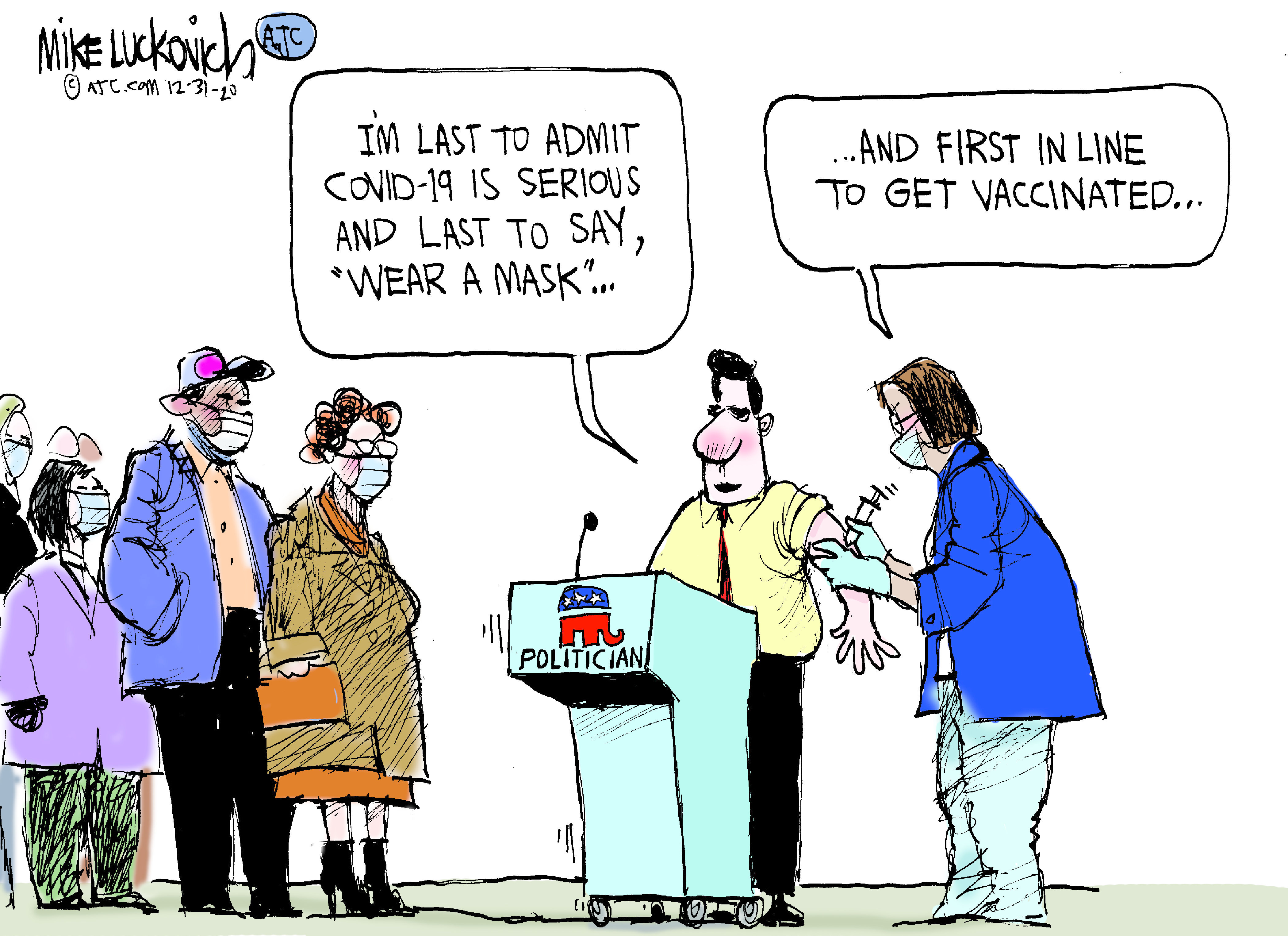
Cartoon – State of the Union on Covid Denial

Editorial cartoons for Jan. 3, 2021: Good riddance, 2020 - syracuse.com

Hospital Group Cuts Off Donations to Election Deniers

Riot at U.S. Capitol prompted review of campaign contributions.

The American Hospital Association (AHA) has suspended contributions to legislators who voted against accepting the results of the Electoral College, the organization said in a statement.

The group did not provide details on exactly which legislators would now be cut off from AHA funding. As of Jan. 18, the association had not returned a request for comment from MedPage Today.

A total of 147 GOP members of Congress voted to overturn the presidential election results: 139 in the House and eight in the Senate.

In the statement, AHA called the January 6 events at the Capitol an “assault on our democracy,” and said it immediately launched a review of its donation practices to “ensure they are guided by our Association’s vision and mission, as well as the democratic values we share as a nation.”

AHA’s board of trustees decides on its political contributions after consulting with the steering committee of its Political Action Committee, along with state hospital association partners and hospital and health system leaders from lawmakers’ states and districts, the organization said.

“Hospitals and health systems have a special role to play as community leaders, healers, and caregivers for our patients and the wider communities we serve,” AHA said in the statement.

In a Jan. 7 blog post, AHA President and CEO Rick Pollack wrote that “peaceful protest is a cherished right and hallmark of our democracy, but vandalism, violence and mob rule have always been out of bounds, and need to stay that way.”

“Throughout our nation’s history, Americans have taken pride in the peaceful transfer of power at the highest level,” Pollack wrote. “It’s part of our precious heritage and distinguishes us from so many other nations of the world. But that gap seems to have narrowed this week and should concern all of us.”

Pollack and AHA called on the country to come together and begin the healing process, particularly as the nation’s COVID-19 crisis worsens.

“With so many critical issues and challenges facing our country, including putting an end to the COVID-19 pandemic and improving our health care system, we must come together now,” Pollack stated.

A Warning From California

https://view.newsletters.time.com/?qs=2f6c9ce95c5cc497353555bcde854be27f2912b888d5db7cf6697393570b5a03d79b3dd7c5b1f74a43f8b5801ed5e237e5fe79c3965907b24dd6a8da7062f0c6efaa12e73db5bac67e9866303e48171f

FDA and FTC Issue Warning Letters to Seven Companies Selling Fraudulent  COVID-19 'Treatments' | BioSpace

Over the last year, COVID-19 has taught us painful lessons about the pitfalls of wishful thinking. Early in the pandemic, some people speculated that the virus would slow down over as the weather got warmer over the summer months; instead, the U.S. experienced a deadly wave of new cases. A few months ago, I hoped that here in Southern California, it would be easier for people to avoid spreading the virus than in colder parts of the country, because people can socially distance outdoors more easily year-round. Instead, our outbreak is now among the world’s deadliest—on Monday, California became the first state to report more than 3 million cases of the virus. Here in Los Angeles County, so many people are dying that officials temporarily lifted air quality regulations to permit more cremations, the Los Angeles Times reports.

California’s struggles to contain COVID-19 can at least partly be attributed to pandemic fatigue—after nearly a year of wearing masks and avoiding contact with others, people’s resolve is simply wearing thin. However, while we may feel done with the virus, it isn’t done with us—between 70 and nearly 120 people per 100,000 have died of COVID-19 in California every day in the last week, while more than 3,200 have died each day nationwide; the U.S. just today passed the grim milestone of 400,000 COVID-19 deaths.

If California can’t get its outbreak under control, more pain could lie ahead. Officials have discovered that new variants of the virus are spreading in the Golden State, including a more transmissible strain first identified in the U.K., where caseloads are skyrocketing and hospitals are overwhelmed. What’s happening here in California could be a bellwether for the rest of the country, as the virus continues its spread mostly unchecked across the country and world.

Regardless of which variant is spreading, experts say the defensive measures remain the same: we need to keep wearing our masks (new research shows just how effective they are), maintaining physical distance from others, and spend as much time as possible at home. It’s natural to want to give up—or even bend just a little—and spend time with friends and family we haven’t seen in ages, or do other risky things. That temptation is all the more real now that multiple highly effective vaccines are here, and the end of the pandemic seems within sight. But the vaccination process has gone frustratingly slowly so far, and not enough of us have the necessary protection to let our collective guard down, especially given the presence of at least one highly transmissible mutation.

With those alarming new variants spreading across the globe, it’s probably time to recalibrate our behavior in favor of safety—until more people are inoculated, it’s vital for us to reduce spread through other proven means. In the coming weeks, Californians and Americans elsewhere must buckle down, with their eyes on the final mission: ensuring that as many people as possible survive to see the end of the pandemic.

VACCINE TRACKER

While 28.4 million doses of the COVID-19 vaccine have been shipped to various U.S. states as of this morning, only about 10.6 million doses have been administered thus far, according to TIME’s vaccine trackerrepresenting 3.2% of the overall U.S. population.

India launched its nationwide coronavirus vaccine rollout on Saturday, starting with healthcare workers, according to the New York Times. Prime Minister Narendra Modi has said that the 1.3 billion-person country aims to vaccinate 300 million healthcare and other front line workers by July. More than 10.5 million people have been infected in India, and more than 152,500 people have died.

Yesterday, New York Governor Andrew Cuomo asked Pfizer whether his state could purchase vaccines directly from the pharmaceutical company, thus bypassing the federal government. But Dr. Celine Gounder, who’s advising President-elect Joe Biden on the pandemic, said that such a strategy could create problems. “I think we’ve already had too much of a patchwork response across the states,” Grounder said in an interview with CNBC today; she also argued that Cuomo’s idea could create a bidding war among states for vaccines.

TODAY’S CORONAVIRUS OUTLOOK

The Global Situation

More than 95.5 million people around the world had been diagnosed with COVID-19 as of 3 p.m. E.T. today, and more than 2 million people have died. On Jan. 18, there were 514,013 new cases and 9,276 new deaths confirmed globally.

Here’s how the world as a whole is currently trending:

Here’s where daily cases have risen or fallen over the last 14 days, shown in confirmed cases per 100,000 residents:

And here is every country with over 1.5 million confirmed cases:

Hua Chunying, a spokeswoman for China’s foreign ministry, is pushing back on findings from an independent World Health Organization report that was critical of Beijing’s early response to the COVID-19 outbreak. China’s early lockdowns, Chunying said, helped reduce deaths and infections, Al Jazeera reports. Still, China has been criticized for failing to adequately disclose the scope and nature of the outbreak when it first began.

German leaders have agreed to extend a lockdown for businesses and schools until Feb. 14 and to require medical masks on public transportation, Reuters reports. While Germany is now reporting fewer than half as many new cases as it was a month ago, experts have raised concerns about new coronavirus variants that are thought to be more contagious, some of which have been detected in the country.

The Situation in the U.S.

The U.S. had recorded more than 24 million coronavirus cases as of 3 p.m. E.T. today. More than 400,000 people have died. On Jan. 18, there were 141,999 new cases and 2,422 new deaths confirmed in the U.S.

Here’s how the country as a whole is currently trending:

And here’s where daily cases have risen or fallen over the last 14 days, shown in confirmed cases per 100,000 residents.

President-elect Joe Biden plans to continue a travel ban on non-U.S. citizens from European countries and Brazil, reversing outgoing President Donald Trump’s order to end the ban on Jan. 26, six days into Biden’s presidency. Jennifer Psaki, Biden’s incoming press secretary, tweeted that the Biden administration plans “to strengthen public health measures around international travel.” A week ago, the U.S. Centers for Disease Control and Prevention ordered that almost all airline passengers must have a negative coronavirus test or proof of recovery before entering the U.S.

The growth of “pharmacy deserts”

https://www.axios.com/pharmacy-deserts-cities-prescriptions-45c32271-37ac-4105-b1bb-e2d2436b88c1.html

Neighborhoods in cities like Chicago are rapidly becoming places where people can’t fill medical prescriptions locally because their drugstores have shuttered or don’t accept Medicaid.

Why it matters: The pandemic has accelerated the growth of “pharmacy deserts” as unprofitable and less-profitable stores have closed. It’s a worrisome trend for the urban poor, who are less likely to try online pharmacies and more likely to let their drug regimens lapse when they can’t get medication locally.

Driving the news: Effective Dec. 1, Medicaid patients in Illinois — of which there are 400,000, per the Chicago Tribune — could no longer get their prescriptions filled at Walgreens, a prevalent chain headquartered in a Chicago suburb.

  • The change came because Aetna, which provides contracts with the state of Illinois to serve Medicaid recipients, dropped Walgreens as a provider. CVS — a top Walgreens rival — owns Aetna as well as the pharmacy benefits manager CVS Caremark.
  • CVS “has no pharmacies in five key West Side neighborhoods,” per the Tribune.
  • Illinois state Rep. La Shawn Ford called Aetna’s decision “pathetic” and told the Tribune, “It’s an attack not just on Black people, but on those that are struggling during the pandemic.”

The backstory: Researcher Dima Qato coined the term “pharmacy desert” in a 2014 article that found there were far fewer pharmacies in Chicago’s Black neighborhoods than in white and mixed neighborhoods.

  • Medicaid policies like the one in Illinois “are all over the country, where Medicaid dictates where and where you can go fill your medication,” Qato tells Axios. “And that leads to certain pharmacies having less patients in them, which leads to less profits, which leads to closures.”
  • Qato — who recently took a post as a professor at the University of Southern California, and is in the process of moving from Chicago — said that the new Medicaid policy in Illinois is generating “a lot of outrage in the community right now.”
  • Per Qato’s definition, people live in a “pharmacy desert” if they can’t fill a prescription within a half-a-mile of their homes (for low-income people without cars), and a mile for others.
  • “We’ve estimated it for Chicago at a third of the city’s population, with substantial difference by racial composition,” Qato says.

Between the lines: Because pharmacies get the lowest reimbursements for filling Medicaid prescriptions, they’re more likely to close stores in low-income neighborhoods and open them in wealthy ones, notes Antonio Ciaccia, chief strategy officer of 3 Axis Advisors, a consultancy focused on the drug supply chain.

  • “We’re seeing a general retreat from impoverished areas,” said Ciaccia, who serves as an adviser to the American Pharmacy Association.

Of note: Studies draw a direct line between pharmacy closures and people stopping their vital medications — with terrible health outcomes.

  • Adults over 50 were more likely to drop their cardiovascular pills after their local drug store closed, according to a study published in the Journal of the American Medical Association in 2019 (of which Qato is the lead author). 
  • Benjy Renton, the Middlebury College senior who has been closely tracking the COVID-19 outbreak, noted on Twitter that pharmacy deserts could hold back the administration of vaccines.

What’s next: While “food deserts,” where inner-city residents lack access to fresh and healthy groceries, are a bigger problem in places like New York City, pharmacy access is a growing concern. The number of drugstores has declined 20% in NYC since 2016, according to Jonathan Bowles, executive director of the Center for an Urban Future.

  • “I for one will miss the 70 Duane Reades that closed this year,” was the headline of an an article that New York Magazine’s “Curbed” ran on Dec. 30. (Duane Reade is owned by Walgreens.)

“Pharmacy deserts” could become vaccine deserts

https://www.axios.com/pharmacy-deserts-coronavirus-vaccine-deserts-af21445b-17b4-4da2-81d8-178d4a54af0f.html?fbclid=IwAR2YVwuGGKEhJPymAgMGD2Y3jTXQ7S1Gizr9LtAqc2MrtMkXr_pHP2WGzEA

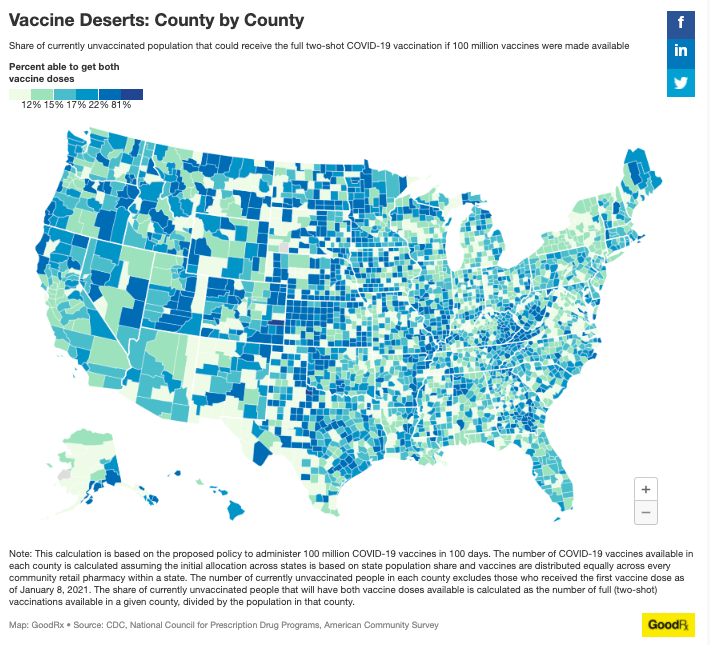
Millions of Americans who live in “pharmacy deserts” could have extra trouble accessing coronavirus vaccines quickly, according to a new analysis by GoodRx.

Why it matters: Places without nearby pharmacies, or with a large population-to-pharmacy ratio, may need to rely on mass vaccination sites or other measures to avoid falling behind.

The big picturePharmacies will play a huge role in the vaccine rollout, especially as shots become more available to the general population.

  • But if people have to drive far to get a shot, or if pharmacies can’t keep up with local demand, that could leave millions of Americans vulnerable to the virus for longer than people in better-served areas.
  • “Pharmacy deserts in turn create ‘vaccine deserts’ — where the rate of vaccination is slower simply because there aren’t enough vaccination appointments available due to limited pharmacy capacity,” the GoodRx analysis says.
  • “The rollout of the COVID-19 vaccine may take even longer without additional resources like mass vaccination sites,” it says.

By the numbers: The incoming Biden administration has set a goal of vaccinating 100 million people in 100 days, or about 16% of the unvaccinated U.S. population, per GoodRx.

  • But “nearly half of all counties would have a slower local vaccination rate, generating further healthcare access inequities in areas that are already more likely to be under-resourced in the fight against COVID-19,” the analysis concludes.
  • 177 counties don’t have any pharmacies at all, leaving 635,000 people forced between foregoing a vaccine or potentially driving long distances to get one.

US passes 400,000 coronavirus deaths

https://thehill.com/policy/healthcare/534765-us-passes-400000-coronavirus-deaths?rnd=1611069180

COVID update: US passes 400,000 deaths; Rebekah Jones arrested

The United States on Tuesday passed 400,000 deaths from COVID-19, a stunning total that is only climbing as the crisis deepens. 

The country is now averaging more than 3,000 coronavirus deaths every day, according to Johns Hopkins University data, more than the number of people killed in the Sept. 11, 2001, terror attacks, and the daily death toll has been rising. The effects of a surge in gatherings and travel over the holidays are now coming into focus. 

The grim milestone of 400,000 deaths came on the last full day in office for President Trump, who has long rejected criticism of his handling of the pandemic.

The situation threatens to get even worse as a new, more contagious variant of the virus becomes more prevalent. The Centers for Disease Control and Prevention (CDC) warned last week that one of the new variants, first discovered in the United Kingdom, could be the predominant strain in the U.S. by March. 

Vaccines offer hope, but it is crucial for the inoculation campaign to progress as quickly as possible to get as many people protected before the new variant takes greater hold. 

The U.S. vaccination campaign has started slowly, though there are signs it is beginning to pick up some speed. President-elect Joe Biden has pledged a more aggressive federal role in the vaccination effort, including using the National Guard and the Federal Emergency Management Agency to set up more vaccination sites.

In the short term, however, the country is in for a bleak period. 

Biden’s incoming CDC director, Rochelle Walensky, said Sunday on CBS’s “Face the Nation” that she expects 500,000 COVID-19 deaths by the middle of February. 

“I think we still have some dark weeks ahead,” she said. 

The country passed 300,000 deaths in mid-December.

At the end of March, as the crisis was beginning, Trump said that if deaths are limited to between 100,000 and 200,000 “we all, together, have done a very good job.” The country has long ago exceeded those numbers. 

The U.S. has by far the most COVID-19 deaths of any country in the world. Brazil follows with around 210,000, and India and Mexico are around 150,000, according to Johns Hopkins University. 

More than 124,000 people are in the hospital with coronavirus in the U.S., according to the COVID Tracking Project, though the number is starting to decline somewhat from a peak of over 130,000 about a week ago. 

The spread of the more contagious variant, however, threatens to send that number spiking again.