What Will U.S. Labor Protections Look Like After Coronavirus?

https://hbr.org/2020/04/what-will-u-s-labor-protections-look-like-after-coronavirus?utm_medium=social&utm_source=facebook&utm_campaign=hbr&fbclid=IwAR1fNFaJM-Tz1jCoBQ3bTVJG5zdbuqcExQOujKz87J34csjOhRLm8C2Dxjo

As I was writing the draft of this article, I was checking my symptoms and awaiting the results of a test I underwent for Covid-19. This virus has upended my life, as it has for every last one of us, no matter where we fall on the socio-economic scale.

But the consequences fall more heavily on those at the bottom end of the wage distribution. That includes those risking their health as they sell us groceries, check our vitals, and sanitize our hospitals. Easily lost amid the chaos, however, is how this crisis may be an opportunity to improve employee protections — and not temporarily but permanently.

During bull markets, employers and policymakers often paint the hardships befalling low-wage workers as stemming from those workers’ personal failures. But when markets crash, we learn how these workers’ troubles were indicative of persistent, system-wide weaknesses.

As Warren Buffett wrote of the insurance failures exposed by 1993’s Hurricane Andrew, “It’s only when the tide goes out that you learn who’s been swimming naked.” Pundits cite Buffet to refer to firms that appear healthy during bull markets, only to get eaten alive during downturns. This month, however, the markets exposed a new group of skinny dippers: a government and an economic system that fail workers, and employers who haven’t or can’t fill this gap in public policy.

In response to the novel coronavirus, the stock market has been mostly in a free fall since late February. The low-wage service sector is facing widespread layoffs. And the tumbling markets have uncovered other deep inequalities among workers, who fall into two groups: those with access to employment protections like affordable healthcare, remote work accommodations, paid time off, and job security — and those without.

This second group, which includes the working class, often lack healthcare or face high out-of-pocket expenses. There are nearly 24 million uninsured working-age adults in the United States. Those with only a high school diploma or who did not complete high school are the least likely to be insured. Moreover, racial and ethnic minority groups face significant barriers to “good jobs.” They form 60% of the uninsured population but only 40% of the total population.

A quarter of all U.S. workers have no access to paid sick leave. Work-from-home options are slim, but many can’t afford not to work. Among workers at the bottom 10th of the earnings distribution, only 31% have paid sick leave. For comparison, 94% of the top 10% of earners have paid sick leave.

While many professionals enjoy protections that can help them ride out the pandemic with their livelihoods and family’s health intact, workers in the low-wage service sector have few options or resources to stay home to care for themselves, let alone their loved ones. And that burden to provide care largely falls on women. The workers lacking healthcare and paid sick leave are also the most vulnerable to layoffs and lost hours. The fate of service workers in travel and food services indicate what’s to come. Similarly, gig economy workers, migrant laborers, and those in the informal economy are particularly vulnerable.

How did we get here? Since the late 1970s, executives have prioritized boosting dividends for shareholders over protecting their employees, whose work has been outsourced, digitized, and downsized. In our book, Divested: Inequality in the Age of Finance, Ken-Hou Lin and I show how this shift in corporate governance undermined workers’ bargaining power. Although insurance coverage increased from the Affordable Care Act, overall working conditions, protections, and pay have diminished.

A more robust safety net would help to mitigate the consequences for workers today as it shores up the economy against future downturns. For years, U.S. policymakers have considered universal healthcare impractical because of its large scope and high startup costs. But as new unemployment claims surge to historical levels and Americans face the medical precarity of a pandemic, this crisis has laid bare the underlying problem of linking healthcare to employment.

Sick leave and universal healthcare would ease the stressors workers face and ensure the sick have time to recover, making them more productive when they return to work. Without the costs of insuring workers, employers could pay more. An income boost would generate more spending and stimulate the economy.

Broader protections would also support the self-employed, contract workers, and prospective entrepreneurs. The United States has lower rates of self-employment (6.3%) than countries with universal healthcare (e.g., Spain has 16%), and a lower share of employment at small businesses than any OECD country except Russia. Reducing the reliance on big businesses would free workers to find jobs that better fit their skills, creating a more nimble and innovative economy.

The current moment provides an opportunity to make lasting changes to the status quo and improve conditions for all workers. As sociologists have theorized, crises and crashes expose cracks in the systems upholding inequality. And history provides a clue for how crises can provide opportunities to transform society in ways that reduce inequality. After the Great Crash of 1929, unemployment spiked, reaching 25% by 1933. In less than three years, Franklin D. Roosevelt’s New Deal reduced unemployment to 9%.The New Deal achieved this feat through a vast and broad range of public works and conservation projects.

The New Deal transformed American society — from erecting iconic buildings and statues, to saving the whooping crane, to developing the rural United States, to planting a billion trees. New Deal workers built and renovated 2,500 hospitals, 45,000 schools, and 700,000 miles of roads. The New Deal hired 60% of the unemployed, including 50,000 teachers and 3,000 writers and artists, such as Jackson Pollock and Willem de Kooning. The New Deal modernized, preserved, and employed the country, while reducing inequality between the haves and have-nots.

Facing a similar economic threat in the wake of the pandemic, we have a comparable once-in-a-century opportunity to make lasting changes that address the pressing problems of today, from inequality to climate change.

In today’s crisis, we could double down on the “trickle-down” approach of the 2008 financial crisis: stimulus to the banks, corporations, and their investors combined with tax cuts and temporary wage support as a short-term Band-Aid for immiserated workers. But Lin and I find that this approach left many workers flailing and worsened inequality, because the banks deposited, rather than invested, the stimulus funding and corporations borrowed the money to buy back their stocks, enriching top executives and shareholders.

Last week, the president signed into law a sweeping $2 trillion plan that combines money for states, loans for distressed businesses, and tax relief, paid leave, unemployment benefits, and cash for most citizens. But this plan only gives workers temporary benefits. Although the bill has stricter oversight and restricts buybacks, it is unlikely to reduce inequality unless it addresses the structural conditions making some workers more vulnerable.

While a New Deal approach may be infeasible amid a contagious virus, we can and should enact permanent policies protecting all workers. Sick leave and healthcare should be universal rights. We could adopt a “flexicurity” labor policy modeled on the Danish one. The Danes provide both flexibility for employers to hire and fire workers as needed and security for workers through generous benefits and retraining opportunities during unemployment.

Meanwhile, in my household, after 2.5 weeks of symptoms—from a dry cough to a tight chest to a low fever—my test results came back negative. Thanks to the healthcare and insurance provided by my employer, I will continue to do the work I care about.

While I am on the mend, the workers who sell our groceries, serve us food, clean our workplaces, and drive us to the doctor also need to take care. In this pandemic, they are risking their health and lives. And they deserve the same level of care as the people they serve: access to both preventative medicine and comprehensive treatment, and time to take a break, recover, and care for their loved ones. The coronavirus is our chance to extend these protections during times of crisis and far into the future.
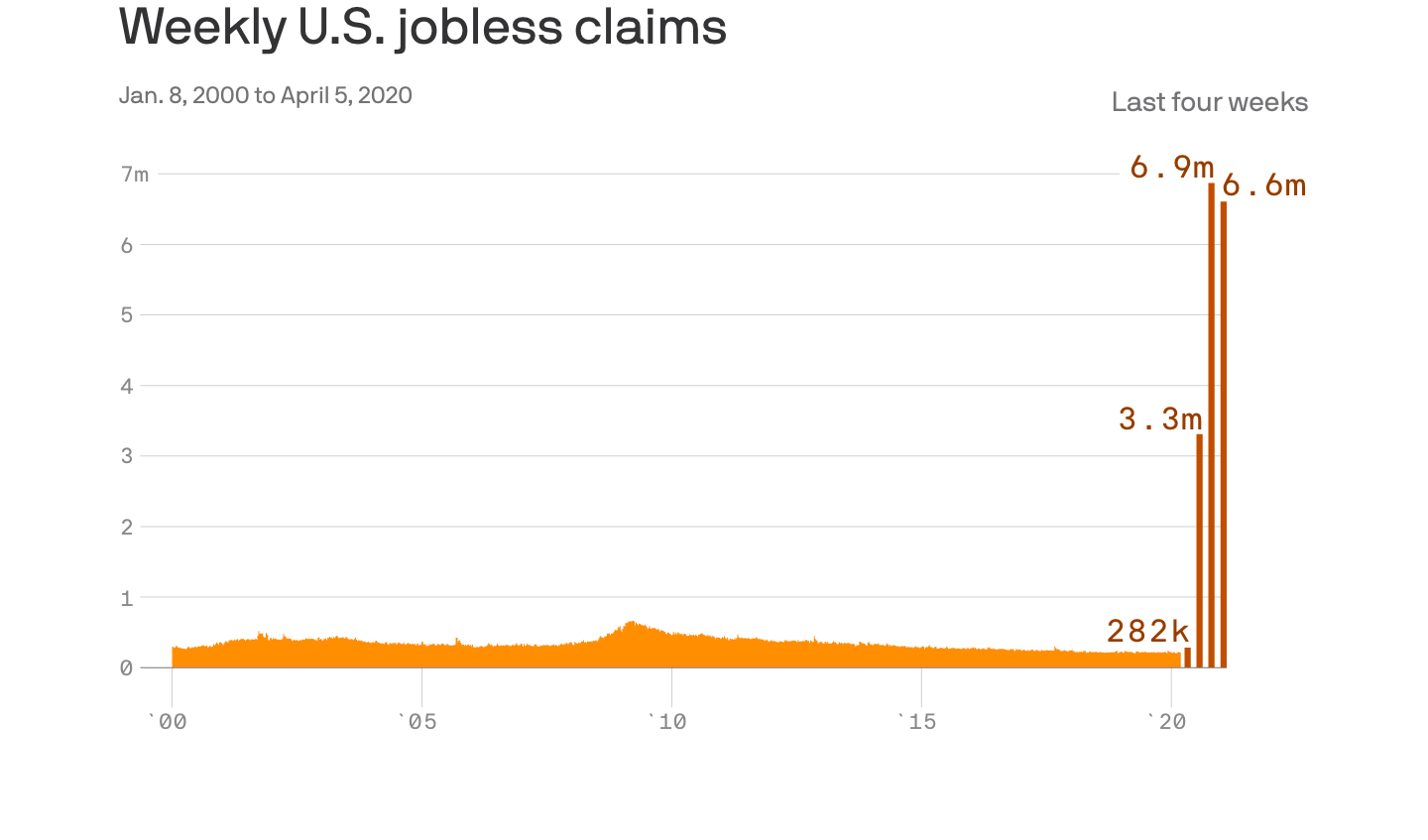


Another 6.6 million jobless claims filed last week amid coronavirus crisis

https://www.axios.com/coronavirus-unemployment-filings-6cb04d2d-9cc4-45b4-a473-9acbf4c99d43.html?stream=top&utm_source=alert&utm_medium=email&utm_campaign=alerts_all

Another 6.6 million jobless claims filed last week amid ...

Another 6.6 million Americans filed for unemployment last week, the Labor Department announced Thursday.

Why it matters: It adds to the staggering 10 million jobless claims in recent weeks — by far the sharpest spikes in American history — as the world economy has ground to a halt in an effort to contain the coronavirus outbreak.

  • The once-again colossal number of filings was worse than the 5 million that Wall Street had expected.
  • Last week’s unemployment claim numbers, which government data had pegged at 6.65 million, were revised upward to 6.87 million — the highest ever recorded.

The big picture: The data lags by a week, so while a large portion of the economic shutdown is now evident over the last three weeks, there may still be more huge numbers yet to come.

  • The $2.2 trillion coronavirus stimulus package opened the door to a surge of new unemployment filings, allowing the self-employed and independent contractors to claim benefits.


Pay Cuts, Furloughs, Redeployment for Doctors and Hospital Staff

https://www.medpagetoday.com/infectiousdisease/covid19/85827?xid=nl_mpt_investigative2020-04-08&eun=g885344d0r&utm_source=Sailthru&utm_medium=email&utm_campaign=InvestigativeMD_040820&utm_term=NL_Gen_Int_InvestigateMD_Active

Pay Cuts, Furloughs, Redeployment for Doctors and Hospital Staff ...

— Health systems see massive disruption from COVID-19

In Michigan, Trinity Health is furloughing 2,500 of its 24,000 employees. In Florida, Sarasota Memorial Health Care is taking “immediate steps to reduce costs, including temporary furloughs and reduced hours” for workers.

In less than 1 month, COVID-19 has made swift, deep cuts in hospital billings. Despite high volumes in the first 2 weeks, March revenue plunged by $16 million at Sarasota Memorial. Surgery cases fell by more than 50%, and volumes dropped by 45% at two emergency care centers and by 66% at seven urgent care centers.

Squeezed by plummeting income and climbing COVID-19 expenses, hospitals and health systems are bracing themselves for system-wide disruption by announcing temporary layoffs, reassignments, and pay cuts.

Many changes, like Trinity’s furloughs in Michigan, affect mainly non-clinical workers. Some alter compensation or duties for doctors, nurses, and other healthcare providers.

“In all parts of the country, physicians are being asked to sign agreements or acknowledgments for pay cuts ranging from 20% to 75%, depending on what their specialty is, where they are, and what the institutions are doing,” said Scott Weavil, JD, a California lawyer who counsels physicians nationwide about employment contracts.

“Many of these providers are not on the front lines of COVID, but they are still working,” Weavil noted. “Babies are being born. People are having accidents and visiting emergency departments. Urgent surgeries are happening. Physicians are at work or on call and ready to help if needed. And in most of these environments, there are patients who have tested positive for COVID-19,” he told MedPage Today.

“Ob/gyns aren’t doing a lot of elective procedures like hysterectomies, but they are delivering babies for COVID-positive patients, wearing donated cloth masks that may or may not be effective,” Weavil added.

In some cases, doctors have been sidelined and face the prospect of dwindling income as patient volumes fall. “We have 2,600 physicians and advanced-practice providers,” said Mark Briesacher, MD, senior vice president and chief physician executive of Intermountain Healthcare in Salt Lake City. “About 800 of them are on a patient volume-related type of contract, similar to what you would have in private practice.”

Because non-urgent and elective procedures are being delayed, some of these clinicians now see 30% to 50% fewer patients and could face big income drops, Briesacher told MedPage Today. “But we’ve put a floor in place,” he said: these providers will receive their usual pay until May 30, then 85% of that amount until normal patient volumes resume.

Redeployment can help practitioners make up lost income, Briesacher added. “A general surgeon often has critical care training,” he noted. “When this increase in patient care needs due to COVID-19 does come to Utah, we can deploy that surgeon to work in our ICUs with a critical care doctor, and if they’re working fulltime, they’ll get paid the same as they were before.”

Reassignment does not stop with doctors at Intermountain: hospital nurses can be deployed to screening desks, drive-through testing sites, or telehealth centers and will keep their current rate of pay, spokesperson Daron Crowley said.

“I recently reviewed a COVID-19 compensation plan of a health system in Florida that would give physicians their base or draw, or a midpoint between their 2019 base and their 2019 overall compensation,” noted Weavil, the attorney. “That seemed pretty good, but it came at a cost: the physicians had to agree to practice outside of their normal setting, as long as they were credentialed for the work.”

“At first blush, the credentialing requirement sounded like a protection; if you are a psychiatrist, you’d think ‘they’re not going to send me to the ICU,’ and normally, that’s correct,” Weavil continued.

But hospitals are adopting emergency credentialing provisions during COVID-19 and “doctors can be forced to practice pretty far afield of their specialty,” he said. In some ways, the situation resembles residency, he pointed out: “You have an attending physician who knows what she’s doing directing fish-out-of-water physicians who have been conscripted into service beyond their specialties.”

The list of hospital systems announcing major changes — including pay cuts for hospital executives, as Trinity Health in Michigan has done — grows each day. Boston Medical Center Health System has furloughed 700 employees; Cincinnati-based Bon Secours Mercy Health has announced it will do the same. Kentucky’s Appalachian Regional Healthcare will furlough about 500 staff members. South Carolina’s Prisma Health will lay off an undisclosed number of clinical, corporate, and administrative workers. Tenet Healthcare in Dallas has furloughed 500 fulltime positions.

Furloughing staff “was an extremely difficult decision, and one that we did not make lightly,” Sarasota Memorial CEO David Verinder wrote in a letter to employees.

“Staff have gone above and beyond to care for our patients throughout this crisis, even as they have been anxious about the health and well-being of themselves and their families,” he continued. “But as the health care safety net for the region, we must do all we can to continue fulfilling that critical role in the weeks ahead and for the long-term.”


The Most Appalling COVID-19 Lie

https://www.medpagetoday.com/infectiousdisease/covid19/85741?xid=nl_mpt_investigative2020-04-08&eun=g885344d0r&utm_source=Sailthru&utm_medium=email&utm_campaign=InvestigativeMD_040820&utm_term=NL_Gen_Int_InvestigateMD_Active

The Most Appalling COVID-19 Lie | MedPage Today

— Doctor breaks down the worst fallacy

Please forgive the basic nature of this video. I’ve enjoyed spending some time with my family finally after my quarantine expired. I wasn’t planning on making a video this weekend, but everybody’s in bed now and I felt that this was important.

I have done a few interviews recently and I’ve been asked the same question every time, which is what is the worst piece of misinformation you’ve heard about coronavirus. The first time I answered I said one of those conspiracy theories that we’ve all heard, but I quickly realized actually that isn’t the most damaging misconception about the current virus at all. The most harmful perception about COVID-19 is that it’s a disease that only affects the very old or the infirm.

The Intensive Care National Audit and Research Centre is a body that collects information from all the intensive care units in the U.K. and they’ve been publishing data about the COVID-19 patients here. I briefly mentioned one of their results in a previous video and I’ve been posting updates on Twitter. The most recent, which is about the first 775 patients admitted with COVID-19 to intensive care units in the U.K., came out a couple of days ago. I put it up on Twitter and it got quite a lot of attention, and so I felt it was useful to talk about that here as well.

The European Society of Intensive Care Medicine (ESICM) has published some preliminary results — I don’t have the full data set yet — for an even bigger group of patients — I think something like 1,800 patients. But from what I have seen, the results are very comparable.

The first headline is that the average age of patients admitted is 60 years old. Now, that doesn’t mean the average age of people getting coronavirus is 60. It’s just that out of the patients admitted to intensive care units with COVID-19 in the U.K., the average age — both mean and median — is around 60. The reason I say it like that is because admissions to ITU [intensive treatment unit] are prioritized for those that have the best chance of survival.

The right-hand column is quite useful here. It shows results for admissions to ITU over the last couple of years in the U.K. for patients with non-COVID viral pneumonia to act as a comparator. We can see immediately that in comparison to the usual viral pneumonia admissions, COVID admissions have a better baseline in that 91% are fully independent compared to 73% normally and fewer have pre-existing comorbidities or medical problems.

You can also see they are much more likely to be mechanically ventilated — i.e., intubated on a breathing machine, a ventilator — which is reflective of the profound hypoxia or low oxygen levels that we’re seeing in COVID-19 and the guidance that these patients deteriorate fast, and so doctors should intubate early.

An interesting pattern that’s emerged from every country’s cohorts is that men are more affected by this than women; 70% of severe infections requiring ITU are male, and perhaps most sobering is that out of all the patients admitted to ITU so far in the U.K., almost half have died — 48%. Comparing that with the usual admissions we see in ICU for viral pneumonia, like say influenza, only 22% of those died. If it needs to be repeated again, this is not “just like the flu.”

If you look at just 16- to 49-year-olds, although numbers are low at the moment, a quarter of them admitted to ITU have died. It remains true that 80% of people that get COVID-19 will have a self-limiting illness, the way I did, that does not require hospital admission. Your risk goes up with increasing age and the pre-existence of medical conditions.

However, overall one in five people that get this will have a severe infection, perhaps requiring hospital admission. Out of that, a quarter will require admission to intensive care. As these figures show, the average age for that subgroup is only 60, and half of those patients die.

Something that’s not captured in these figures is that death is just one marker. If you spend a week on a ventilator and 2 weeks in the hospital overall and then go home alive, that’s hardly what I’d call a mild infection. As I’ve said before, the main risk for most of us is not from the virus itself, but the effect that it’ll have on how healthcare functions in our respective countries.

On the subjects of healthcare, we’ve now seen three doctors here in the U.K., several in America, and 51 in Italy lose their lives directly because of COVID-19 — many or perhaps even most of whom were fit and well beforehand. To my sisters and brothers in healthcare, especially those going into battle like this without the appropriate armor — which is something that I just cannot believe is happening in developed countries, it shouldn’t be happening — I salute you.

That’s it. That’s the video. This isn’t aimed at any particular age group nor political affiliation. I find it remarkable I even have to say that second point because somehow this has become a partisan issue, which again I can’t understand.

Perhaps, if this does have an intended audience, it’s the middle-aged politicians who maybe also think that they’re too young for this disease and promote this appalling fallacy that COVID-19 is only killing patients who would have died sooner or later otherwise. Just stop f**king around.