Coronavirus and Healthcare Reform

Coronavirus and Healthcare Reform

2020.03.07 coronavirus_structure

At this writing, the number of COVID-19 cases worldwide has reached 100,000 with 3,500 deaths.  These numbers will be higher by tomorrow.

What does this have to do with U.S. healthcare reform? A lot.

Two current background articles drive home the point that a well-functioning public health system is critical for responding to a pandemic like 2019 coronavirus disease (COVID-19), especially in its early phases. And it means that the healthcare system – including a robust public health infrastructure — should be about health, not just about profit and greed.

Let’s Put This in Context:  Is COVID-19 “Just Another Flu”?

WHO reports that annual cases of influenza A and B worldwide range from 3 to 5 million, causing 290,000 to 650,000 respiratory deaths.  That’s a lot more than COVID-19, at least so far. So what’s the big deal?

The big deal is that, This Is Not a Competition, not an either-or between influenza virus and coronavirus. Otherwise this would be like asking, Would you rather be killed by an airplane crash, by tobacco-related cancer, or by pollution-related pneumonia? The answer is, of course, none of the above.

What these types of deaths and illness have in common is being in part preventable by known public health measures, with different interventions needed for each one. Likewise, influenza A and B deaths are in part preventable. Prevention relies on the elaborate and sophisticated worldwide influenza vaccine program. It includes monitoring influenza strains alternating between Northern and Southern hemispheres, annual adjustment of vaccine components, production, distribution, and public messaging.

But unlike influenza, currently COVID-19 is not preventable, since vaccine development and testing will take a year or more.  And WHO is modeling that COVID-19 is at best only partially containable by general non-pharmaceutical measures. For example, one worst-case model of the pandemic estimates that two-thirds of the world’s population could be infected, once it runs its course.  This has epidemiologists scrambling to calculate the actual transmissibility and actual mortality rates so as to refine predictions more accurately and to help plans for mitigating its spread.

So, no, COVID-19 is not “just another flu,” as the President implied in a March 4 off-the-cuff interview. COVID-19 is to be sure, a “flu-like illness,” but it has unique (as yet not fully characterized) epidemiologic characteristics, and it requires a completely different public health strategy, at least in the short- and medium-term. The President is reckless to minimize either disease – both diseases are widespread and lethal — especially since proper public messaging is a key to rallying a coherent response by individuals, communities, and nations.

How Bad Could It Be? Comparison to 1918 Spanish Flu

Could the COVID-19 pandemic wreak the same devastation as the 1918 Spanish flu? Spanish flu eventually infected 500 million people worldwide, effectively 25 percent of the total global population. And it killed up to 100 million of them. “It left its mark on world history,” according to University of Melbourne professor James McCaw, a disease expert who mathematically modelled the biology and transmission of the disease, and who was quoted today by the Australian Broadcasting Company (ABC).

What SARS-CoV2 (severe acute respiratory syndrome-corona virus strain 2), the agent that causes COVID-19 disease, has in common with the H1N1/Spain agent  is novelty, transmissibility, and lethality. Novelty means that it is antigenically new, so that no one in the world is already immune or even partially cross-immune. Transmissibility means it’s easily spread by aerosol (coughing) or surface contact (hand to nose). Lethality means its significant death rate.

On the one hand, Dr. McCaw hopes that public health measures against COVID-19 will be more effective than in 1918. For one, experts and the general public now know about viruses. In 1918, virology was in its infancy.

“We’re not going to see that sort of level of mortality, that mortality was driven by the social context of the outbreak,” predicts Dr. Kirsty Short, a University of Queensland virologist, also quoted by the ABC. “We had a viral outbreak, at the same time as the end of a world war.”

In addition, modern medicine means much better care is available now than it was then. “We’ve already got a lot of scientists working on novel therapies and novel vaccines to try to protect the general population,” Dr Short says.

Professor McCaw points to an apparent initial success in Wuhan Province. “What’s happened in China gives very clear evidence that we can get what’s called the ‘reproduction number’ under one. So at the moment in China, on average, each person infected with coronavirus is passing that infection on to fewer than one other person. If people hadn’t changed their behaviour, we would have expected somewhere around the millions of cases in China by now instead of the comparatively small number of around 100,000.” So, he says, it looks like the transmissibility of coronavirus can be significantly modified through social distancing and good hygiene.

On the other hand, best-case calculations from these Australian epidemiologists appear to discount other factors that could actually worsen the pandemic in 2020 compared with 1918 – rapid international travel and higher concentration of people in urban centers.

Both Dr. Short and Professor McCaw admit that in the early days of a pandemic accurate predictions remain difficult to make.

Nevertheless, they both make clear that in battling the coronavirus, the national and international public health systems – and the public’s trust in them – will be key.

Public Health Approach Is the Key

The importance of public health actions is underscored by a second report today by two experts from the Center for Strategic and International Studies, a Washington think tank.

Samuel Brannen and Kathleen Hicks write in Politico.com,

Last October, we convened a group of experts to work through what would happen if a global pandemic suddenly hit the world’s population. The disease at the heart of our scenario was a novel and highly transmissible coronavirus. For our fictional pandemic, we assembled about 20 experts in global health, the biosciences, national security, emergency response and economics at our Washington, D.C., headquarters. The session was designed to stress-test U.S. approaches to global health challenges that could affect national security. As specialists in national security strategic planning, we’ve advised U.S. Cabinet officials, members of Congress, CEOs and other leaders on how to plan for crises before they strike, using realistic but fictional scenarios like this one.

Here are their conclusions:

  • Early and preventative actions are critical. They praise bipartisan Congressional support, including $50 million allocated to the CDC Infectious Diseases Rapid Response Reserve Fund, the passage of the 2019 Pandemic and All-Hazards Preparedness and Advancing Innovation Act, and the continuation of the Global Health Security Agenda.
  • Communication is vital—but a decline in trust makes it harder. A critical ingredient for addressing pandemics is public order and obedience to protocols, rationing, and other measures that might be needed. Today, public trust in institutions and leaders is fragile, with routine evidence of intentional disinformation by foreign actors and elected officials alike. Misstatements about science are particularly damaging to the credibility of scientists and health officials seeking to guide response to the pandemic. Amid the hyperpartisanship of the current U.S. political environment in a presidential election year, politicization of the coronavirus outbreak could undermine public health efforts.
  • International cooperation is also key. A virus knows no borders, as we have already seen with the real-world outbreak, and here a concerning change is heightened mistrust among countries. In the midst of trade tensions, fraying of international relationships, increased meddling by one country in the internal politics of another, and growing military tensions in hot spots around the globe, organizations such as the World Health Organization are increasingly caught in the middle, unable to play their intended neutral function.
  • The private sector will be vital to managing the outbreak. There’s a good reason the President gathered pharmaceutical executives on Monday, March 2. The U.S. federal government is rightly at the center of the response to this likely pandemic, but it is the private sector that holds the bulk of the technological innovation to producing treatments and cures. One bit of good news on this front: There is already in place a highly effective public-private partnership structure in the Coalition for Epidemic Preparedness Innovations, which is making important contributions in the current race for a vaccine.
  • The principal conclusion of our scenario was that leaders simply don’t take health seriously enough as a U.S. national security issue. Congress holds few hearings on the topic, especially in the defense committees, and the White House last year eliminated a top National Security Council position focused on the issue.

Healthcare Reform:  We’re All in This Together

The impending epidemic of coronavirus in the U.S. also brings up important practical questions in the whole healthcare system, as reported in, for example, the New York Times and Kaiser Family Foundation.

Who will have access to testing?  Who will pay? Will copays designed to keep patients with trivial illnesses from overutilizing the health system now backfire by delaying their testing and care?  These kinds of questions are not at issue in countries with universal access.

However, even those countries will struggle to cope with the pandemic. For example, the United Kingdom faces a shortage of intensive care unit beds after a decade of downsizing its bed capacity.

This drives home the point that public health infrastructure is necessary but not sufficient for managing a pandemic. Namely, the U.K.’s bed shortage shows that public health is but one component of the broader task of maintaining a nation’s strategic risk preparedness. Calculating the surge capacity of inpatient beds for an unexpected pandemic emergency should not be left just to hospital administrators. This is also why the President should restore both bio-preparedness positions dropped by him in 2018 from the National Security Council and the Homeland Security Department.

Conclusion:  Right, Privilege or, Rather, Social Contract?

Is healthcare a right or a privilege? The coronavirus tells us, Neither. Instead, this virus reminds us that healthcare is better framed as part of the social contract, the fundamental duty of governments to their citizens to defend them from clear threats, both currently present and foreseeable, not only military, but also economic, cyber, and in this case biological. Can Americans and their leaders put aside petty polemical bickering over healthcare reform and recognize the healthcare system for what it is, part of the backbone of a healthy, resilient nation?


The Velvet Rope Economy: How Inequality Became Big Business

https://mailchi.mp/9e118141a707/the-weekly-gist-march-6-2020?e=d1e747d2d8

Image result for Velvet Rope

FROM THE GIST BOOKSHELF

Feed your head—read this.

Income inequality has become a central topic in our national political debate in the wake of the financial crisis. The gap between the “haves” and “have nots” has grown steadily, and addressing that gap has become a key priority for a new generation of politicians, economists, and policymakers. But inequality has also become a lucrative business opportunity in many parts of the economy, a phenomenon that New York Times economics reporter Nelson Schwartz entertainingly (and unsettlingly) describes in his new book, The Velvet Rope Economy: How Inequality Became Big Business.

Based on a series of Times articles by Schwartz from the past several years, the book describes life on both sides of the “velvet rope”: how services have become faster, better, and higher quality for those with the ability to pay extra, and how the rest of us are getting left behind. He describes how the familiar amusement-park “Fast Pass” approach has pervaded other parts of our lives, from school sports to social services to travel, and yes, to healthcare.

Across the economy, businesses increasingly cater to the top tier of customers, providing privileged access, concierge services, and special perks. As Schwartz describes it, “This pattern—a Versailles-like world of pampering for a privileged few on one side of the velvet rope, a mad scramble for basic service for everyone else—is being repeated in one sphere of American society after another.”

It’s a phenomenon we see in healthcare every day, as rural hospitals are shuttered, access to care is restricted for Medicaid patients, and wait times for new primary care appointments soar to six weeks or more, while concierge physician practices and cash-based, on-demand services proliferate. Most troubling, in Schwartz’s view: this intentional, class-based separation causes those on one side of the “velvet rope” to misunderstand, and even denigrate, those on the other.

That aptly describes our current political dynamic—Schwartz provides a useful (and highly readable) window into how businesses seek to profit from that division. Worth a read.


Two candidates remain: Mr. Medicare for All and Mr. Public Option

https://mailchi.mp/9e118141a707/the-weekly-gist-march-6-2020?e=d1e747d2d8

Image result for Medicare for All and Public Option

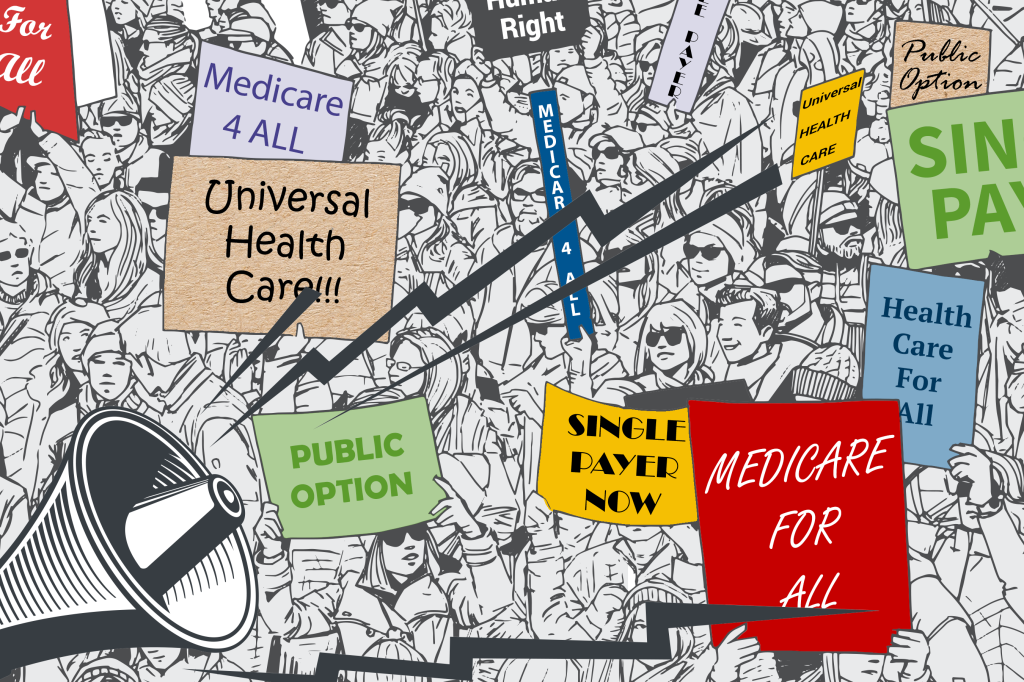
The past week in Presidential politics has been momentous—but not clarifying—for determining both the eventual Democratic nominee and the healthcare platform of the party. Between the first ballots cast in South Carolina and the last votes counted in California, the field of viable candidates for the nomination has been winnowed to two: Vermont Sen. Bernie Sanders and former Vice President Joe Biden. The coming weeks will feature a knock-down, drag-out fight for delegates in the run-up to what is likely to be a contested convention in Milwaukee in mid-July, pitting Biden’s “establishment” wing of the party against Sanders’ “progressive” wing.

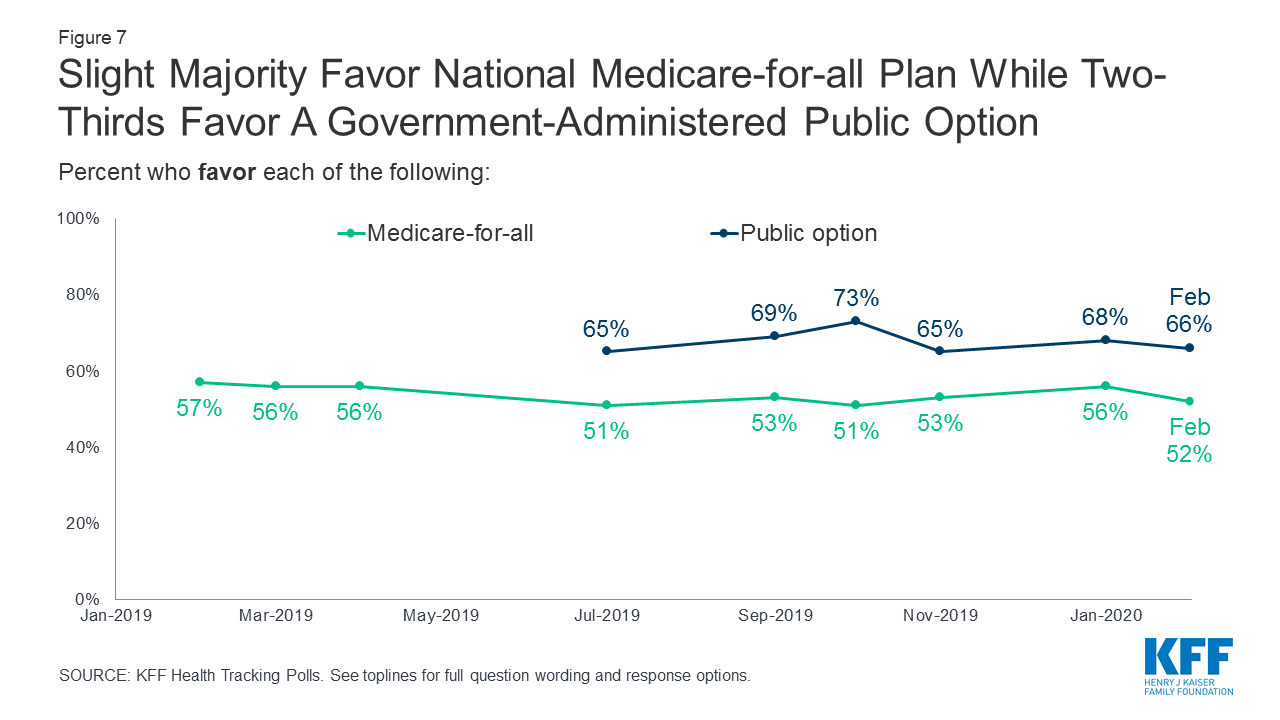
On the healthcare front, that means a continued debate between defenders of the Affordable Care Act (ACA), who want to extend coverage, as Biden does, using a government-run “public option” plan, and supporters of single-payer, “Medicare for All” (M4A) coveragewhich Sanders advocates. That’s the same argument Democrats have been having since the campaign started, and while healthcare remains the top issue of concern for primary voters, polls indicate that both plans are popular with the electorate.

We continue to believe that the public option plan is a far more likely outcome than M4A, but only if the Democrats win control of the Senate—a prospect which appears more possible given billionaire Mike Bloomberg’s post-Super Tuesday endorsement of Biden, and plans to devote his substantial campaign resources to support Democratic candidates across the ballot. Some of that money will surely be spent in Montana, where Gov. Steve Bullock is poised to announce plans to run against incumbent Sen. Steve Daines (R-MT), in a critical race that could be the most expensive Senate contest in history.

And for an indication of how the politics of a public option would play out, look no further than Colorado, where the Democratic legislature moved forward with its version of the plan this week, over the objections of the hospital and insurance lobbies.

Finally, looming over the general election campaign will be the pivotal Texas vs. California case, which the Supreme Court agreed to take up in this fall’s term. That case will ensure that healthcare will remain the centerpiece of American political debates regardless of who leads the Democratic ticket. Buckle up.


Why State Efforts to Mandate Coronavirus Testing Will Fall Short

Why State Efforts to Mandate Coronavirus Testing Will Fall Short

Image result for ERISA

To cope with incipient coronavirus outbreaks, Washington and New York have announced emergency directives requiring insurers to cover COVID-19 testing without cost-sharing. The states recognize that high deductibles and other out-of-pocket payments discourage people from getting tested, which in turn threatens public health.

Both states have acted pursuant to laws governing the regulation of insurance. In Washington, for example, the state insurance commissioner is empowered to issue orders addressing “medical coverage to ensure access to care” when the governor declares an emergency. Similarly, New York’s Superintendent of Financial Services says that it will issue an “emergency regulation” to require insurers to cover testing without cost-sharing (though the precise authority to issue that regulation is a little vague).

But the directives are more limited in scope than they appear, and will provide no help at all to the approximately 100 million people nationwide who receive coverage through self-insured employers. As with so many problems that arise in health law, the reason is the Employee Retirement Income Security Act of 1974 (ERISA).

When Congress adopted ERISA, it wasn’t thinking very hard about health insurance. It was thinking about pension plans, which many employers had chronically underfunded, leaving retired employees high and dry. So Congress adopted ERISA to offer some basic protections for employees. In exchange, Congress preempted any state laws that “relate to” employee benefit plans.

Congress carved out an exception to ERISA’s broad preemptive scope for laws regulating insurance. That’s a domain that’s traditionally been left to the states. Washington and New York can thus tell private insurers—including those that offer employer-sponsored coverage—to abide by their emergency rules.

But lots of firms don’t actually buy insurance for their employees. Instead, larger firms usually “self-insure,” meaning that they pay for their employees’ health expenses themselves. (Odds are that, if you’re employed, you work at a self-insured firm—61% of people with employer-sponsored coverage do.) And ERISA clarifies that employers, when they self-insure, aren’t to be treated as insurers.

The upshot of this convoluted scheme is that the states can’t regulate self-funded employer plans. They’re regulated, instead, by the U.S. Department of Labor under ERISA. But because Congress didn’t think of ERISA as a regulation of health insurance, it didn’t authorize the kind of emergency health regulations that Washington and New York are now drawing on.

That’s one reason the federal government has looked so feckless when it’s tried to say that it will guarantee access to testing. Vice President Pence, for example, said yesterday that testing is an “‘essential health benefit,’ which means the test will be covered by health insurance plans, Medicare and Medicaid.”

But the EHB rules don’t apply at all to large employers or to Medicare. Even if they did, insurers can (and do!) impose cost-sharing for EHBs, and could do so for a COVID-19 test. It’s a completely meaningless statement.

Nor can the federal government slide coronavirus testing into the part of the Affordable Care Act that requires coverage without cost-sharing for high-quality preventive services designated by the U.S. Preventive Services Task Force. Not only is that task force ill-equipped to move quickly, but the ACA says that its recommendations can only take effect after a “minimum interval” that “shall not be less than 1 year.” That’s much too late.

Unless I’m missing something, the federal government simply does not have the legal power to require employers to cover coronavirus testing without cost-sharing. The Association of Health Insurance Plans has said that its members may voluntarily waive cost-sharing, but they may not, and in any event AHIP doesn’t represent employers, who get to make the final call on what they do and don’t cover.

Congress will have to act—and it should act immediately to assure swift, reliable, and no-cost access to testing services. The broader lesson, though, is that Congress’s blunderbuss approach to preemption under ERISA has led to a situation in which neither the states nor the federal government is equipped to regulate the coverage practices of large, self-insured employers. That gap in legal authority could have pernicious consequences in the coming months.


Ever-Rising Health Costs Worsen California’s Coronavirus Threat

Ever-Rising Health Costs Worsen California’s Coronavirus Threat

Image result for Ever-Rising Health Costs Worsen California’s Coronavirus Threat

As California and the nation prepare for the spread of the new coronavirus disease known as COVID-19, it is important to be reminded of another significant threat to the health of our people: the high costs of health care.

It is striking that one of the first steps policymakers must consider in the wake of an outbreak is waiving consumer cost sharing such as copays and co-insurance for coronavirus testing and treatment. Why? We’ve known for decades that the use of patient cost sharing is a blunt instrument that leads people to skimp on necessary services. In an era when the average deductible facing a working family in California now exceeds $2,700, it’s not hard to imagine how many people missed detection and treatment opportunities because they could not afford to pay for them.

The discussion around COVID-19 cost sharing is a reminder that coronavirus testing and treatment is not the only thing Californians forgo because of cost. The latest CHCF health policy poll found that in the last year, more than half of California families delayed or skipped care due to cost, including avoiding recommended medical tests or treatments, cutting medication doses in half, or postponing physical or mental health care. These practices are spreading, and they are making us sicker. Forty-three percent of those who postponed care said it made their conditions worse.

A close look at the survey data (PDF) shows that many Californians experience these problems, regardless of their health insurance status, income, or residence in high- or low-cost regions. And worries over health care costs are even more widely shared. More than two-thirds of state residents are worried about medical bills and out-of-pocket costs, including almost 60% of those with employer-sponsored insurance. These concerns reflect two unfortunate realities: We are all vulnerable to disease, and no one is immune from ruinous medical bills because of it.

A key reason for the growth in cost-related problems and worries for California families is the rise in underlying expenses within our health care system. Economists point to several factors that drive systemwide expenses, including new medical technologies and Californians’ health status. But none of these factors explains away the overall rise and dramatic variation in prices for the same procedures in different parts of the state, even after controlling for the complexity of the procedure and underlying costs like physician wages.

CHCF surveys of employer-sponsored insurance over the last decade show how much of this rise is being shifted to working California families in the form of higher insurance premiums and deductibles. The chart below shows the cumulative increase of inflation and wages along with premiums and deductibles for the average California family covered by a preferred provider organization (PPO) in a workplace health plan. While wage growth has barely kept pace with inflation, family premiums increased at more than twice that rate. It is especially striking that deductibles increased almost four times as much as wages.

California will not be an affordable place to live and raise a family unless it confronts the problem of unjustified, underlying health care costs. Expanding health insurance coverage, increasing subsidies, and limiting out-of-pocket expenses solve immediate problems, but sustained progress demands that we reduce systemwide expenditures for services that are not making Californians any healthier. Evidence suggests the opportunity for savings is significant.

In his state budget (PDF) released in January, California Governor Gavin Newsom proposed establishing an Office of Health Care Affordability to address underlying health care cost trends and to develop strategies and cost targets for different sectors of the health care industry. Other states have established offices or cost commissions of this type. A recent CHCF publication examined how four states have structured and empowered their commissions to successfully do this work.

As we confront the public health threat of COVID-19, we must remember that widespread cost-related access problems and worries already afflict most families in the state. In ways that few people anticipated before this year, this cost issue isn’t just a problem for strapped families — it’s a threat to the well-being of every last one of us.


Pharma is on a stock buyback spree

https://www.axios.com/newsletters/axios-vitals-38324a12-c0f6-4610-bbc9-675192c94df1.html?utm_source=newsletter&utm_medium=email&utm_campaign=newsletter_axiosvitals&stream=top

Image result for stock buybacks

Pharmaceutical companies spending on R&D and buybacks.

In 2018, the year the Republican tax law went into full effect, 12 of the largest pharmaceutical companies spent more money buying back their stock than they spent on drug research and development, Axios’ Bob Herman reports.

The big picture: When billions of dollars became available to the biggest drug companies, their main priority was to juice earnings, along with the paydays of their executives and investors — not investments in new treatments or relief for patients who can’t afford their drugs.

By the numbers: Axios analyzed the stock buybacks and R&D expenses of the 12 largest American pharmaceutical companies, by revenue, between 2016 and 2019.

  • These companies repurchased $69.1 billion of their stock in 2018, while spending $65.9 billion on researching new medicines.
  • Over the entire four-year period, stock buybacks for these 12 companies totaled $183 billion, and research expenses were $251 billion. They’re sitting on another $47 billion that has been earmarked for stock buybacks.
  • Two drugmakers — Amgen and Biogen — spent more on stock buybacks for the entire period than they spent on R&D. Amgen’s stock repurchases ($31.6 billion) were more than twice as much as research ($15.3 billion).

What they’re saying: Amgen said in a statement that it repurchased large quantities of stock because the tax law allowed the company to bring home cash that was parked overseas. Biogen submitted a statement saying it has a “deep commitment to R&D,” but did not address questions about its stock buybacks.


Congress releases $8.3B coronavirus funding package. Here’s what’s in it

https://www.fiercehealthcare.com/hospitals-health-systems/congress-releases-8-3b-coronavirus-funding-package-here-s-what-s-it?mkt_tok=eyJpIjoiWXpZek1tWm1NakprWTJaaSIsInQiOiJFYkFWWlwvYzc5c09JOWNiV1ZmSXlqclZsSU5RYnNBQ1NGd2EyQTdiYUdoa3BpV2ZwMTlyZ0xwcWNSNkthZ0pnbDRxR0IrWGNwZmFrcDhWQ3FjNkdzSUx6YTRKM3RHVWhPaitCXC8wRE5rRHM1a3dSRVBNTFdodnBiY0tkclQxSTVRIn0%3D&mrkid=959610

Image result for Congress releases $8.3B coronavirus funding package. Here's what's in it

Congress is expected to pass a major $8.3 billion spending package to help providers and local governments handle the spread of the coronavirus and to boost the development of vaccines and tests of the virus.

Here are key parts of the spending package released Wednesday:

  • $500 million for an emergency telehealth waiver. The bill would waive certain Medicare restrictions for telehealth, including that a Medicare beneficiary can use telehealth services even if they aren’t in a rural community. “This provision would also allow beneficiaries to receive care from physicians and other practitioners in their homes,” a summary of the package said;
  • $2.2 billion to the Centers for Disease Control and Prevention to help state and local health agencies. The funding would include a provision to reimburse state or local costs for coronavirus response and preparedness activities from Jan. 20 to the end of this supplemental;
  • Nearly $1 billion to buy drugs and medical supplies. This procurement will include $500 million for drugs, masks and personal protective equipment that can be distributed to state and local health agencies in areas that are in shortage. It also includes funding for increasing the supply of biocontainment beds, which are secured areas used for patients with highly contagious diseases; and
  • More than $3 billion to support the research and development of vaccines, diagnostics and other treatments for the coronavirus. Any vaccine or diagnostic developed via taxpayer funds must also “be available for purchase by the federal government at a fair and reasonable price,” the summary said. The bill also enables the Department of Health and Human Services to ensure any vaccine or diagnostic can be affordable in the commercial market, but doesn’t elaborate on how.

The package sailed through the House on Wednesday and could be taken up quickly by the Senate.

Provider groups bracing for a coronavirus outbreak praised the spending package.

“This bill will provide essential assistance to caregivers and communities on the front lines of this battle,” said Chip Kahn, president and CEO of the Federation of American Hospitals, in a statement.


Supreme Court Will Hear First Major Abortion Case Since Two Trump Appointees Joined

https://www.wsj.com/articles/supreme-court-will-hear-first-major-abortion-case-since-two-trump-appointees-joined-11583192925?mod=hp_lista_pos2

Image result for Supreme Court Will Hear First Major Abortion Case Since Two Trump Appointees Joined

Case will test new conservative makeup’s approach to precedent.

The Supreme Court hears its first major abortion case Wednesday since two Trump nominees joined the bench, potentially signalling whether—and how much——reproductive rights may change under a bolstered conservative majority.

“There’s a lot on the line in this case, and more than most people realize,” said Mary Ziegler, a law professor at Florida State University and author of the forthcoming book “Abortion and the Law in America.”

Most prominently, the case involves the Supreme Court’s approach to precedent, since it largely is a replay of an issue the court decided in 2016, when by a 5-3 vote it struck down a Texas law requiring that abortion providers obtain admitting privileges at a nearby hospital.

The case also tests the strategy for antiabortion forces, who have been divided over the best way to roll back court precedents recognizing women’s constitutional right to end pregnancy. While some advocates seek to reverse outright Roe v. Wade, the 1973 decision recognizing abortion rights, others believe a more prudent approach is to carve away at the precedent through increasingly restrictive regulations that would spare the Supreme Court the controversy of directly overruling a landmark case.

The law in question, known as the Louisiana Unsafe Abortion Protection Act, isn’t based on a state policy to protect potential life, an interest that the Supreme Court has recognized as valid justification for some abortion restrictions.

Instead, it is based on the argument that abortion itself can be harmful to women, and that restricting access to the procedure therefore is beneficial to women. For that reason, the state’s brief contends that abortion providers shouldn’t be permitted to challenge the law on behalf of their patients, arguing that “a serious conflict of interest” exists between them and Louisiana’s women.

In striking down the Texas law in 2016, the court found the admitting-privilege requirement provided no health benefits to women while forcing many of the state’s abortion clinics to close.

The opinion, by Justice Stephen Breyer, cited evidence that admitting privileges do little to ensure continuity of care, as the state maintained, because when abortion has complications, they generally arise not at the clinic but days after the procedure, when the patient would visit her regular physician or local hospital. The court also observed that hospital admitting privileges aren’t a general credential but are granted for other purposes, such a doctor’s ability to bring in patients for treatment.

Statistically, however, only a tiny number of women require hospitalization after abortion, the court said. “In a word, doctors would be unable to maintain admitting privileges or obtain those privileges for the future, because the fact that abortions are so safe meant that providers were unlikely to have any patients to admit,” Justice Breyer wrote.

But that decision, Whole Woman’s Health v. Hellerstedt, hinged on since-retired Justice Anthony Kennedy, a maverick conservative who joined more liberal justices in the majority. With the late Justice Antonin Scalia’s seat vacant, three conservatives dissented, contending that the majority skirted procedural rules to throw out the Texas law.

President Trump, who appointed Justice Brett Kavanaugh to the vacancy, had as a candidate predicted his Supreme Court picks would vote to overrule Roe v. Wade.

In September 2018, three months after Justice Kennedy’s retirement, the Fifth U.S. Circuit Court of Appeals, in New Orleans, upheld a Louisiana admitting-privileges law that critics argue is identical to the Texas measure struck down two years earlier. The appellate court found the Louisiana Unsafe Abortion Protection Act wouldn’t burden abortion rights in Louisiana to the degree the Texas law did in its state.

An abortion clinic in Shreveport, La., June Medical Services LLC, and three doctors who perform the procedure appealed to the Supreme Court.

That puts the spotlight particularly on Justice Kavanaugh, whose remarks and writings, which have praised the dissent in Roe and supported a Trump administration policy to prevent an underage illegal immigrant from obtaining an abortion, have given hope to abortion opponents.

However, the focus may equally fall on Chief Justice John Roberts, who typically has voted against abortion-rights positions in Supreme Court cases—but he also has stressed an institutional interest in distinguishing the courts from political bodies, where outcomes on legislation can swing wildly based on the latest election results. For that reason, he may be hesitant to overrule even a decision he opposed simply because Justice Kennedy’s retirement presents an opportunity.

In February 2019, he joined the court’s liberal wing to block implementation of the Louisiana law while the appeal proceeded; four other conservatives dissented, although Justice Kavanaugh appended a statement suggesting he was taking a middle ground. He said he wasn’t persuaded that the Louisiana doctors had fully explored opportunities to obtain hospital-admitting privileges.

Should a frontal assault on recent precedent alienate the chief justice or another conservative justice, it probably would end prospects for similar admitting-privilege laws.

But the door could remain open for other abortion restrictions that aren’t covered by existing precedent, particularly if the court signals a readiness to pare back the ability of abortion providers to challenge regulations, or suggests it is more inclined to defer to legislative judgments regarding the safety of abortions rather than evidence, such as scientific research or the views of the medical profession, presented at trial court.