Pros and Cons of Different Public Health Insurance Options

https://www.commonwealthfund.org/publications/journal-article/2018/nov/pros-cons-public-options-2020-democratic

Image result for Pros and Cons of Different Public Health Insurance Options

Options for Expanding Health Care Coverage

It is more than likely that Democratic candidates for the 2020 presidential election will propose some type of public health insurance plan. In one of two Commonwealth Fund–supported articles in Health Affairs discussing potential Democratic and Republican health care plans for the 2020 election, national health policy experts Sherry Glied and Jeanne Lambrew assess the potential impact and trade-offs of three approaches:


  • Incorporating public-plan elements into private plans through mechanisms such as limits on profits, additional rules on how insurers operate, or the use of Medicare payment rates.
  • Offering a public plan — some version of Medicare or Medicaid, for example — alongside private plans. Such a plan could be offered to specific age groups, like adults 50 to 64 who are not yet eligible for Medicare, to enrollees in the Affordable Care Act’s (ACA) marketplaces, or to everyone under 65, including those working for self-insured employers. It also could be made available in regions of the country where there is little health care competition.
  • Replacing the current health care financing system with a “Medicare for all” single-payer system administered by the federal government. Some single-payer proposals would allow consumers to purchase supplementary private insurance to help pay for uncovered services.


Issues for Consideration in 2020

The authors find trade-offs in each type of public plan. First, a single-payer system would significantly increase the federal budget and require new taxes, a politically challenging prospect. On the other hand, federal spending might decrease if a public plan were added to the marketplace or if public elements were added to private plans. In 2013, the Congressional Budget Office estimated that a public plan, following the same rules as private plans, would reduce federal spending by $158 billion over 10 years, while offering premiums 7 percent to 8 percent lower than private plans. A single-payer approach would lower administrative costs and profits, and likely reduce health care prices as well. By assuming control over the financing of health care, the federal government could reduce administrative complexity and fragmentation. On the flip side, the more than 175 million Americans who are privately insured would need to change insurance plans.


public–private choice model would help ensure that an affordable health plan option is available to Americans. While politically appealing, this option presents implementation challenges: covered benefits, payment rates, and risk-adjustments all need to be carefully managed to ensure a fair but competitive marketplace. A targeted choice option might be adopted by candidates interested in strengthening the ACA marketplaces in specific regions or for specific groups (as with the Medicare at 55 Act). It would benefit Americans whose current access to affordable coverage is limited, but the same technical challenges associated with a more comprehensive choice model would apply.


Finally, to lower prices for privately insured individuals, public plan tools such as deployment of Medicare-based rates could be applied to private insurance, either across the board or specifically for high-cost claims, prescription drugs, or other services. The major challenge here is setting prices that would appropriately compensate providers.


The Big Picture

Under the ACA, the percentage of Americans who had health insurance had reached an all-time high (91 percent) in 2016, an all-time high, and preexisting health conditions ceased to be an obstacle to affordable insurance. But Americans remain concerned about high out-of-pocket spending and access to providers, and fears over losing preexisting-condition protections have grown. While most Democratic presidential candidates will likely defend the ACA and seek to strengthen it, most recognize that fortifying the law will not be enough to cover the remaining uninsured, rein in rising spending, and make health care more affordable.


While the health reform proposals of Democratic candidates in 2020 will likely differ dramatically from those of Republican candidates, recent grassroots support for the ACA’s preexisting condition clause may indicate a willingness by both political parties to support additional government intervention in private insurance markets.


The biggest health care issues of the 2020 election

https://www.brookings.edu/podcast-episode/biggest-health-care-issues-of-2020-election/

Image result for brookings cafeteria

Polls show that health care is one of the top issues American voters care about, but ideas about controlling costs and expanding coverage are divided along partisan lines.

This episode features a deep dive into health care policy and what Democratic presidential candidates and Republican Party leaders are offering as their solutions. Guests are two of Brookings’s top health policy experts: Christen Linke Young is a fellow in the USC-Brookings Schaeffer Initiative for Health policy and, among her many roles in public service, served in the White House as a senior policy advisor for health.

Matthew Fiedler is also a fellow with the Schaeffer Initiative and was previously chief economist of the Council of Economic Advisers in the White House, where he oversaw the council’s work on health care policy. Both Young and Fiedler have contributed a few explainer pieces on health policy as part of the Policy 2020 project here at Brookings.

Also, meet Annelies Goger, a new David M. Rubenstein Fellow in the Metropolitan Policy program at Brookings.

Click to access BrookingsCafeteria_FiedlerLinkeYoung-TRANSCRIPT.pdf


Five health care fights to watch in 2020

Five health care fights to watch in 2020

Image result for 2020 healthcare issues

Advocates hope lawmakers can beat the odds and move major health care legislation in the new year.

2019 opened with bipartisan talk of cracking down on drug prices and surprise medical bills. But it ended without major legislation signed into law on either front, and a host of other health care battles, including a lawsuit threatening the entire Affordable Care Act, looming over the coming election year.

Here are five health care fights to watch in 2020. 


Drug pricing

Lowering drug prices was supposed to be an area for potential bipartisan action in 2019, but the effort ran into a brick wall of industry lobbying and partisan divisions. 

There is a push to finally get legislation over the finish line in 2020, though.

Speaker Nancy Pelosi (D-Calif.) is calling for attaching drug pricing legislation to a package of expiring health care programs, like community health center funding, that must be renewed by May 22. She hopes the pressure from that deadline helps carry a larger package, but that is far from certain, especially as the election gets closer.

Democrats point to President Trump’s vow to support allowing the government to negotiate drug prices during his 2016 campaign. While Trump backed off that pledge this year, they hold out hope he might come back around. Senate Majority Leader Mitch McConnell (R-Ky.) is also strongly opposed to the idea, and has concerns about a more modest bill from Sens. Chuck Grassley (R-Iowa) and Ron Wyden (D-Ore.) that could provide a more realistic bipartisan path.

“The president said when he ran and until relatively recently that he would support negotiated prices and I expect at some point he will go back to that, and we’re just going to keep pushing the Senate to try to achieve that,” said House Energy and Commerce Committee Chairman Frank Pallone Jr. (D-N.J.).


Surprise billing

The other major health care initiative that Pelosi says she wants in the May package is protecting patients from surprise medical bills.

That effort has also fallen prey to intense industry lobbying and congressional infighting. 

Backers of a bipartisan bill from the House Energy and Commerce Committee and Senate Health Committee on the issue pushed for including the measure in a year-end spending and were deeply frustrated when it was left out.

A key factor was House Ways and Means Committee Chairman Richard Neal (D-Mass.) putting forward the outline of a rival plan days before this month’s funding deadline, showing a split on the way forward.

“It’s certainly going to be harder [next year],” said Shawn Gremminger, senior director of federal relations at Families USA, a liberal health care advocacy group.

“You are now under six months out from the general election,” he said about moving legislation in May 2020.

Backers have a tough road ahead. They will have to bridge the divide between the competing plans and overcome lobbying from powerful doctor and hospital groups, who worry the legislation could lead to damaging cuts to their payments.


ObamaCare

Outside of Capitol Hill negotiating rooms, the GOP lawsuit to overturn the Affordable Care Act is looming large. 

A federal appeals court last week issued a long-awaited ruling on the fate of the law, though it did little to settle the issue. The 5th U.S. Circuit Court of Appeals ruled that the law’s mandate to have health insurance is unconstitutional, but punted on the question of whether any of the rest of the law should also be struck down, instead sending it back to the lower court.

The most tangible effect of the move could be to push a final Supreme Court decision on the fate of the law past the 2020 elections, though it’s possible the justices could still choose to take the case sooner.

Democrats intend to hammer Republicans over the lawsuit during next year’s campaign, though, a strategy that paid off for the party during the 2018 midterms when they focused on health care. 

The Democratic group Protect Our Care launched a national TV ad on Friday, saying “President Trump and Republicans just won a major decision in their lawsuit to repeal health care from millions of American families,” and warning of the loss of pre-existing condition protections.


Medicare for All 

In the Democratic presidential race, “Medicare for All” is a central dividing line.

How the issue plays out in 2020 will depend in large part on who wins the Democratic nomination. If progressives like Sens. Bernie Sanders (I-Vt.) or Elizabeth Warren (D-Mass.) win the nomination, Republicans will be able to go full bore on their attacks that private health insurance would be eliminated under the proposal.

Even more moderate candidates like former Vice President Joe Biden and South Bend, Ind., Mayor Pete Buttigieg PETER (PETE) PAUL BUTTIGIEGPoll: Biden remains ahead of Sanders by 10 points2020 predictions: Trump will lose — if not in the Senate, then with the votersButtigieg’s former chief of staff to be sworn in as mayoral successorMORE would face attacks that their public option plans are a step down the road toward eventually implementing full-scale single payer.

The internal debate on the issue has faded somewhat from its peak. Health care has not featured as prominently in the last two debates, and some of the fighting has shifted to other areas, like candidates’ fundraising practices.

But the issue is still simmering and could burst back to open warfare among Democrats at any point.


Vaping

The battle over e-cigarette flavors will likely resume in 2020 as the Trump administration and Congress try to cut rising youth vaping rates.

Public health advocates are pushing the administration to clear the market of flavors like mint and fruit that they argue are fueling a youth vaping epidemic.

Trump said he would eliminate those flavors in September, but has appeared to back down after backlash from vaping advocates and the e-cigarette industry.

Now he says he would like to find a compromise that preserves such flavors for adults while keeping them away from kids.

Advocates like the Campaign for Tobacco-Free Kids plan to pressure Trump to follow through on his word, though it’s looking unlikely.

However, the e-cigarette market could also look vastly different after May 2020, when companies must apply to the Food and Drug Administration to stay on the market

The industry must prove its products benefit public health, a big ask for companies like Juul, whose products are favored by kids who vape.

House Democrats also plan to vote on a bill that would ban flavored e-cigarette and tobacco products, but it’s not clear if it will get a vote in the Senate.


Health Care in 2019: Year in Review

https://www.commonwealthfund.org/blog/2019/health-care-2019-year-review

Health care was front and center for policymakers and the American public in 2019. An appeals court delivered a decision on the Affordable Care Act’s (ACA’s) individual mandate. In the Democratic primaries, almost all the presidential candidates talked about health reform — some seeking to build on the ACA, others proposing to radically transform the health system. While the ACA remains the law of the land, the current administration continues to take executive actions that erode coverage and other gains. In Congress, we witnessed much legislative activity around surprise bills and drug costs. Meanwhile, far from Washington, D.C., the tech giants in Silicon Valley are crashing the health care party with promised digital transformations. If you missed any of these big developments, here’s a short overview.


1. A decision from appeals court on the future of the ACA: On December 18, an appeals court struck down the ACA’s individual mandate in Texas v. United States, a suit brought by Texas and 17 other states. The court did not rule on the constitutionality of the ACA in its entirety, but sent it back to a lower court. Last December, that court ruled the ACA unconstitutional based on Congress repealing the financial penalty associated with the mandate. The case will be appealed to the U.S. Supreme Court, but the timing of the SCOTUS ruling is uncertain, leaving the future of the ACA hanging in the balance once again.


2. Democratic candidates propose health reform options: From a set of incremental improvements to the ACA to a single-payer plan like Medicare for All, every Democratic candidate who is serious about running for president has something to say about health care. Although these plans vary widely, they all expand the number of Americans with health insurance, and some manage to reduce health spending at the same time.


3. Rise in uninsured: Gains in coverage under the ACA appear to be stalling. In 2018, an estimated 30.4 million people were uninsured, up from a low of 28.6 million in 2016, according to a recent Commonwealth Fund survey. Nearly half of uninsured adults may have been eligible for subsidized insurance through ACA marketplaces or their state’s expanded Medicaid programs.


4. Changes to Medicaid: States continue to look for ways to alter their Medicaid programs, some seeking to impose requirements for people to work or participate in other qualifying activities to receive coverage. In Arkansas, the only state to implement work requirements, more than 17,000 people lost their Medicaid coverage in just three months. A federal judge has halted the program in Arkansas. Other states are still applying for waivers; none are currently implementing work requirements.


5. Public charge rule: The administration’s public charge rule, which deems legal immigrants who are not yet citizens as “public charges” if they receive government assistance, is discouraging some legal immigrants from using public services like Medicaid. The rule impacts not only immigrants, but their children or other family members who may be citizens. DHS estimated that 77,000 could lose Medicaid or choose not to enroll. The public charge rule may be contributing to a dramatic recent increase in the number of uninsured children in the U.S.


6. Open enrollment numbers: As of the seventh week of open enrollment, 8.3 million people bought health insurance for 2020 on HealthCare.gov, the federal marketplace. Taking into account that Nevada transitioned to a state-based exchange, and Maine and Virginia expanded Medicaid, this is roughly equivalent to 2019 enrollment. In spite of the Trump administration’s support of alternative health plans, like short-term plans with limited coverage, more new people signed up for coverage in 2020 than in the previous year. As we await final numbers — which will be released in March — it is also worth noting that enrollment was extended until December 18 because consumers experienced issues on the website. In addition, state-based marketplaces have not yet reported; many have longer enrollment periods than the federal marketplace.


7. Outrage over surprise bills: Public outrage swelled this year over unexpected medical bills, which may occur when a patient is treated by an out-of-network provider at an in-network facility. These bills can run into tens of thousands of dollars, causing crippling financial problems. Congress is searching for a bipartisan solution but negotiations have been complicated by fierce lobbying from stakeholders, including private equity companies. These firms have bought up undersupplied specialty physician practices and come to rely on surprise bills to swell their revenues.


8. Employer health care coverage becomes more expensive: Roughly half the U.S. population gets health coverage through their employers. While employers and employees share the cost of this coverage, the average annual growth in the combined cost of employees’ contributions to premiums and their deductibles outpaced growth in U.S. median income between 2008 and 2018 in every state. This is because employers are passing along a larger proportion to employees, which means that people are incurring higher out-of-pocket expenses. Sluggish wage growth has also exacerbated the problem.


9. Tech companies continue inroads into health care: We are at the dawn of a new era in which technology companies may become critical players in the health care system. The management and use of health data to add value to common health care services is a prime example. Recently, Ascension, a huge national health system, reached an agreement with Google to store clinical data on 50 million patients in the tech giant’s cloud. But the devil is in the details, and tech companies and their provider clients are finding themselves enmeshed in a fierce debate over privacy, ownership, and control of health data.


10. House passes drug-cost legislation: For the first time, the U.S. House of Representatives passed comprehensive drug-cost-control legislation, H.R. 3. Reflecting the public’s distress over high drug prices, the legislation would require that the government negotiate the price of up to 250 prescription drugs in Medicare, limit drug manufacturers’ ability to annually hike prices in Medicare, and place the first-ever cap on out-of-pocket drug costs for Medicare beneficiaries. This development is historic but unlikely to result in immediate change. Its prospects in the Republican–controlled Senate are dim.


5 trends and issues to watch in the insurance industry in 2020

https://www.fiercehealthcare.com/payer/top-5-trends-and-issues-to-watch-insurance-industry-2020

Image result for 5 trends and issues to watch in the insurance industry in 2020

The insurance industry appears likely to have another big year in 2020, as growth in government and commercial markets is expected to continue.

But a presidential election and new transparency initiatives could throw some major curveballs to payers.

Here are the top five issues and trends to watch out for in the next year:

Medicare Advantage diversifies

Enrollment growth in Medicare Advantage is likely to continue next year, as more than 22 million Medicare beneficiaries already have a plan. But what will be different is diversification into new populations, especially as insurers pursue dually eligible beneficiaries on both Medicare and Medicaid.

“This is being made possible because of strong support from government,” said Dan Mendelson, founder of consulting firm Avalere Health.

Support for Medicare Advantage “transcends partisanship and that has been true under Trump and Obama,” he added.

New benefit designs, such as paying for food or transportation to address social determinants of health, are also going to increase in popularity. The Centers for Medicare & Medicaid Services (CMS) has made it easier for plans to offer such supplemental benefits.

Get ready for transparency, whether you like it or not

This past year saw CMS release a major rule on transparency that forces hospitals to post payer-negotiated rates starting in 2021 for more than 300 “shoppable” hospital services.

The rule, which is being contested in court, could fundamentally change how insurers negotiate with hospitals on how to cover those services. The rule brings up questions about revealing “private information for the sake of transparency,” said Monica Hon, vice president for consulting firm Advis.

But it remains unclear how the court battle over the rule, which has garnered opposition from not just hospitals but also insurers, will play out. Hospital groups behind the lawsuit challenging the rule have had success getting favorable rulings that struck down payment cuts.

“I think there is going to be a lot of back and forth,” Hon said. “Whatever the result is that will impact how payers and providers negotiate rates with this transparency rule.”

Don’t expect major rules in 2020

2020 is a presidential and congressional election year, and traditionally few major initiatives get going in Congress. But experts say the same goes for regulations as administrations tend not to issue major regulations in the run-up to the vote in November, said Ben Isgur, leader of PwC’s Health Research Institute.

“What we will end up with is much more change on regulations on the state side,” Isgur said.

But new regulations on proposals that have been floated could be released. Chief among them could be a final rule to halt information blocking at hospitals and a new regulation on tying Medicare Part B prices for certain drugs to the prices paid in certain countries.

Congressional lawmakers are still hoping to reach a compromise on surprise billing, but they don’t have much time before campaigning for reelection in November.

A lot of the healthcare direction will be set after the presidential election in November. If a Democrat defeats President Donald Trump, then waivers for items like Medicaid work requirements and block grants will likely go by the wayside.

“Depending on who takes the White House and Congress, are we going to further repeal the Affordable Care Act and replace it or will we have Medicare for All,” Isgur said.

Insurers continue to go vertical in dealmaking

Insurers certainly weren’t shy about engaging in mergers and acquisitions in 2019, and that trend doesn’t appear likely to dissipate next year.

But the types of mergers might be different. Insurers and providers are increasingly looking at deals that would offer a vertical integration, such as acquiring more pharmacy services or a technology company to enhance the patient experience. Plenty of big-ticket vertical deals, such as CVS’ acquisition of Aetna and Cigna’s purchase of Express Scripts, have changed the industry landscape significantly.

“Deals in 2020 are going to be much more around the identity,” Isgur said. “Five years ago we had a lot of horizontal deals where health systems got bigger and regional payers got bigger.”

Payers continue to push patients away from hospitals

Insurers are going to try to find new ways to push patients toward outpatient services to avoid higher costs from going to a hospital.

For instance, “we are seeing a lot of payers not going to honor hospital imaging,” said Hon. “A lot of payers are saying we want you to go outside the hospital and that is a lot cheaper for us,” she said.

Instead, payers will try to steer patients toward imaging centers or physicians’ offices.

“We are seeing that with imaging and free-standing surgical centers now being able to do a lot more,” she added.

Insurers are also starting to use primary care more proactively to “ensure that they understand the needs of the patient, their needs are being addressed,” Mendelson said.


The world of private equity — 15 key observations

https://www.beckershospitalreview.com/hospital-transactions-and-valuation/the-world-of-private-equity-15-key-observations.html?origin=CFOE&utm_source=CFOE&utm_medium=email

Image result for the world of private equity

Private equity funds have significantly grown in number, size and significance in the last 20 years.

Recent high-profile acquisitions include a stake in the Manchester City soccer team and the purchase by Ithaca Holdings, backed by private equity firms, of Taylor Swift’s recording catalog. Along with private equity’s growth, it has also become an area of political focus, sure to be a talking point during the next presidential election. Following are 15 key observations on the current state of private equity.


1. Private equity raises money from investors and invests that capital in different types of companies. The most common investment is a leveraged buyout, whereby a fund buys a majority stake in a company, attempts to improve it, and then sell the company for a profit. Private equity funds also invest in distressed assets, real estate, other funds and venture capital. Private equity funds raised approximately $700 billion in 2018. This broadly goes into several different categories. This amount raised is slightly less than in 2017.


2. Private equity as an asset class has matured greatly. Increasingly, to have broad equity exposure, investors must also have exposure to private companies. Along with diversification, private equity has historically (but see points below) offered the potential for returns that beat the public markets. Private equity investment continues to increase, with investments in around 8,000 + private companies. By contrast, the US public markets are shrinking. According to the New York Times, in the mid-1990s, there were more than 8,000 publicly traded companies, and by 2016, there were only 3,627.


3. As private equity funds have grown to be a larger part of the equity market, their returns have regressed closer and closer to the public markets. The largest funds are closer in returns to the public markets. According to a recent Wall Street Journal report, private-equity funds of $10 billion or more posted 14.4 percent five-year annualized returns net of fees as of the end of September 2018, barely edging past the 14.1 percent return for the S&P 500. See “Wall Street Journal “Private Equity Funds are Raising Bigger and Bigger Funds. They Don’t Often Deliver.”


4. Private equity have generally outperformed the public markets during periods of volatility. In 2018, where there was political and economic uncertainty, the average private equity fund appreciated 8.2 percent while public market indexes had double-digit declines. See, “10 Predictions for Private Equity for 2019” by Antoine Drean. However, the statistic may be misleading as private equity can choose not to exit investments in more challenging markets. Also, there is a large variety of returns in different private equity funds.


5. The spread of returns from high returns to very low returns among private equity funds is very large. See McKinsey “Return Dispersion is much Greater in Private Equity than in Public Markets.” This means it’s become increasingly difficult to find the right private equity fund to invest with. It also means that successful funds can outperform the median by a significant degree. However, it is hard to consistently be a successful fund.


6. The 5 biggest private equity funds are largely considered to be the following – The Carlye Group, Kohlberg Kravis Roberts (KKR), The Blackstone Group, Apollo Global Management and TPG. Each has more than $100 billion in assets under management. The CEO, Chairman and Co-Founder of the Blackstone Group recent authored “What it Takes– Lessons in the Pursuit of Excellence”. This book provides a good primer on private equity.


7. Private equity mega funds, those funds with $5 billion or more in pooled capital, take up a larger and larger part of the investment area. 19 mega funds were raised in 2018. These 19 funds reflected 20 percent of all private equity fundraising. See McKinsey and Co “Private Markets Come of Age.” The 2019 Preqin Global Private Equity and Venture Capital Report discusses the growing concentration of capital amongst a relatively small number of funds. It reported at the end of 2018, that 62 percent of the total capital raised was committed to the 50 largest funds.


8. According to Pitchbook, private equity fundraising in the US hit an all-time high in 2019. Pitchbook reports that as of the beginning of November 2019, US buyout funds raised north of $246 billion. According to a Fitch Ratings report, Private equity is sitting with approximately $2.1 trillion globally to invest. See “Private equity fundraising in the US hits all-time high” by Eliza Haverstock. This amount of “dry powder” is at an all-time high. See “This is the Biggest Year Ever for Private Equity Funding. Where are the Deals?” Dallas Business Journal.

9. Investors, economists and politicians are signaling the likelihood of a recession in the near future. With a huge amount of money to deploy, funds are developing strategies to deal with an economic downturn. This may mean less new deals and a focus on margins of existing investments.


10. Private debt funds have grown greatly and raised more than $100 billion a year for the last 4 years. According to Preqin, there are now 417 private debt funds in the market. The market for investing in private debt funds seems to be slowing some in 2019 with less on track to be raised than the last four years. See, e.g., Institutional Investor, “Investors are backing off from private debt”. Here, the article headlines that investors are backing off from the once booming asset class. Oct 10, 2019. The largest private debt funds are often closely connected to the largest private equity funds. These include GSO Capital Partners which is related to Blackstone, KKR, Ares Management, OakTree Capital Management and Goldman Sachs via its Goldman Sachs Merchant Banking Division. Pitchbook reports the following firms as leading the private debt market: Antares Management, Ares, Barings, TwinBrook Capital Partners, The Carlye Group, Midcap Financial, NXT Capital, BMO Financial Group, Madison Capital Funding, and Citizens Bank. See also Bloomberg, December 18, 2019, “Apollo and Blackstone are Stealing Wall Street’s Loans Business.” The movement to these behemoth funds also having large direct debt financing funds will have a big impact on the business of other traditional lenders and financing sources.


11. According to SPG Global, multiples for PE funded deals are averaging close to 11.5 times EBITDA. They attribute this to the sinking cost of debt, a mountain of private equity dry powder, and larger equity investments. The leverage on deals is overall close to 5.5 times EBIDTA. The multiples differ dramatically based on the size of the deal, the growth trajectory of the company, the assessment of risk of the company, and several other factors.


12. As private equity funds grow larger and have more capital to deploy, there are less club deals. According to McKinsey, “in 2007, 27 percent of megadeals included more than one large global GP. By 2018, that number was 4 percent. Club deals were associated with several notable investment catastrophes and largescale bankruptcies.” However, co-investments, where investors invest alongside a private equity fund, often without paying some of the usual fees, are continuing to increase. These deals are becoming increasingly competitive and provide an opportunity to reduce the exposure of investing in a single company.


13. Increasingly the largest private equity funds have grown their own operations teams and have more operating partners and executives than they used to. For example, Blackstone is reported to have more than 2,400 employees. Carlye has close to 1,600 employees. KKR has 1,300 employees. Funds are also investing in analytics and other technology to manage the fund and platform companies.


14. Funds are diversifying their fundraising and investment strategies in interesting ways. On the investment side, some of the largest funds are starting to raise funds from retail investors. On the investment side, there are now funds like Dyal Capital which has raised $9 billion to invest in other private equity funds.


15. The total volume of dollars going into private equity related deals is growing. However, the total number of deals transacted has been fairly flat the last few years. The average dollar volume per deal is increasing. According to Bain, the number of individual transactions in 2018 decreased by 13 percent, to 2,936 worldwide — but total buyout value jumped 10 percent to $582 billion (including add-on deals). See Bain, Global Private Equity Report 2019. A related trend is private equity funds selling their stakes in companies to other private equity funds in secondary transactions. This is different from years past where the normal exit was to a strategic buyer or to the public markets – this secondary market is anticipated to continue to grow. Increasingly the volume of deals done is driven by add on or bolt on transactions added to platforms.


A look at what lies under the (high) deductible

https://mailchi.mp/f3434dd2ba5d/the-weekly-gist-december-20-2019?e=d1e747d2d8


With the continued growth in high deductible health plans (HDHPs) in both employer- and exchange-based insurance markets, a larger number of services are falling “under the deductible”, leaving patients responsible for the full cost of care

The graphic above illustrates the national cost ranges of ten common outpatient services, based on data from a publicly-available commercial claims databaseIt’s not just minor services like lab tests or diagnostic imaging that are falling under the deductible—many consumers are now paying full freight for a growing list of outpatient procedures like cataract or carpal tunnel surgery, or even knee arthroscopy.

Shopping can pay off: for any service, the highest-priced provider can be over three times the lowest-priced, translating into thousands of dollars of savings for patients with high-deductible plans.

Outpatient services now account for over half the revenue of many health systems. As deductibles climb, more and more of the (profitable) health system services are becoming “shoppable” for consumers—creating an imperative for systems to both lower costs and pursue rational pricing as scrutiny becomes more intense.


Christmas comes early for healthcare industry groups

https://mailchi.mp/f3434dd2ba5d/the-weekly-gist-december-20-2019?e=d1e747d2d8

Image result for Christmas comes early for healthcare industry groups

Today, President Trump is set to sign into law a $1.4T spending agreement that keeps the Federal government open and avoids a year-end budget showdown with Congress. The agreement is comprised of two separate spending packages, with a total of 12 budget bills, and includes good news for almost every segment of the healthcare industry.

It repeals the long-debated “Cadillac Tax” on high-cost health plans, which was a key funding mechanism for the ACA and was intended to force employers to encourage their employees to use healthcare services more frugally.

It also repeals the “device tax” on medical device manufacturers, and the separate fee on health insurers, both also part of the ACA.

In sum, those three repeals will reduce tax revenue by about $375B over the next decade and will remove a substantial portion of funding originally earmarked to sustain the 2010 health law.

Meanwhile, notably absent from the budget deal are measures to address surprise billing, which have proven difficult to finalize despite broad bipartisan support, and steps to reduce the cost of prescription drugs, a key legislative priority on both sides of the aisle.

Thanks to intense lobbying by various industry interest groups, and the toxic political environment in Washington, the year is drawing to an end with virtually no progress to show on either front.

As a result, despite a year’s worth of heated rhetoric about the high cost of care, the burden of health spending on individuals, and the need to rein in runaway health spending, 2019 is ending with almost every industry interest—pharmaceutical companies, device manufacturers, insurers, physician groups, and hospitals—largely avoiding accountability in the form of federal legislation. As we head into an election year, we’ll likely have to wait until after next November to see real progress on any of these issues. Merry Christmas.


Obamacare Ruling May Spare Republicans Some Political Pain

Image result for Obamacare Ruling May Spare Republicans Some Political Pain

The practical effect of the decision is likely to be months of delays, pushing the final outcome of the case beyond the 2020 election.

A federal appeals court in New Orleans handed Republicans a Christmas present.

The court had been considering a case with the potential to dismantle the entire Affordable Care Act, an outcome that could have set off waves of chaos and disruption leading up to the November election, and for which there was very little contingency planning.


The court had two main options. It could have agreed with the Trump administration, along with a set of Republican state officials and a district court in Texas, and overturned all of the law. Or it could have upheld Obamacare, undermining the arguments of the White House and its allies.

The court found a third way. In a decision at the close of business Wednesday, two of the three judges signaled their support for a key part of the Republicans’ legal argument. The two agreed with a lower court that Obamacare’s individual mandate had been made unconstitutional by a 2017 law that eliminated the financial penalty for remaining uninsured. But the judges punted on the case’s key question of what that meant for the rest of the health law, asking a lower court to reconsider it. The effect is likely to be months of delays, pushing the final outcome of the case beyond the 2020 election.


Starting in 2017, the Republicans’ failed effort to repeal and replace large portions of the health law was deeply unpopular and became a central campaign theme of the 2018 election, in which Democrats won a House majority. Democrats cast themselves as the protectors of Obamacare’s most popular provisions, especially its protections for Americans with pre-existing health conditions.

While most Democrats would have favored a court ruling that upheld Obamacare, a reprise of those politics could have given them a lift in an election year. Voters tend to trust Democrats more than Republicans on health care, but much of the debate during the primary season has focused on ambitious new expansions of government coverage. Those proposals do not enjoy the widespread support attached to the preservation of Obamacare’s core consumer protections.

Those dynamics have allowed Republicans to focus on arguments that they will protect private insurance and oppose socialism, without forcing them to articulate their own detailed health plans. President Trump has periodically hinted at an imminent Obamacare replacement plan, but he has yet to produce one. Mitch McConnell, the Senate majority leader, has declined to produce or advance a major health care bill in the Senate.


But if a court had ruled that all of Obamacare had to be wiped off the books, it would have been far harder for Republicans to avoid articulating their vision for health care. The public did not like their previous attempts in 2017, and there has been little progress, even behind the scenes, to produce an alternative plan more palatable to the public. Two concepts have emerged since then, one from a group of conservative think tanks, and one from the House Republican Study Committee. Neither has received much public attention by party leaders, and both share the basic structure of an earlier legislative plan that divided Republican legislators so much that it never made it to a vote.

Meanwhile, Democrats could have retreated to safer ground, by promising to reinstate popular Obamacare provisions.


If the court had overturned all of Obamacare, it could have meant major disruptions to the health system. Such a ruling, if upheld by the Supreme Court, would have eliminated consumer protections for people with pre-existing health conditions, and wiped away financial assistance that have helped millions of middle-class Americans buy their own coverage.

It would have erased the Medicaid expansion, which provides health insurance to millions of low-income Americans in three dozen states. It would have reversed Medicare policies that make prescription drugs more affordable for seniors, and Food and Drug Administration rules that have allowed cheaper copies of expensive biologic drugs to enter the market.

It would have undone major experiments in the delivery of care, meant to improve health care quality. It would have rolled back enhanced punishments for Medicare fraud. It would have reduced requirements that workplaces provide space for lactating mothers to pump breast milk, and requirements that chain restaurants post calorie counts for their food.

Around 20 million more Americans would have become uninsured, according to an estimate from the Urban Institute. Experts on Medicare policy said they were not even sure how some of the changes could have been carried out now that they have been enshrined in complex regulations and built on in subsequent laws.


None of those effects would have happened immediately, even if the Fifth Circuit had agreed in full with the lower court; the Supreme Court would have probably weighed in. But the prospect of such huge changes had the potential to reset the political conversation about health care in both parties. By avoiding a decision on the case’s consequences, the Fifth Circuit has effectively postponed that shift.

In a statement Wednesday night, President Trump applauded the court’s ruling that the individual mandate was unconstitutional. But he emphasized that the decision would not result in any meaningful changes to voters’ health care.

“The radical health care changes being proposed by the far left would strip Americans of their current coverage,” he said. “I will not let this happen. Providing affordable, high-quality health care will always be my priority. They are trying to take away your health care, and I am trying to give the American people the best health care in the world.”


Such a statement would have been harder to issue if the court panel had agreed with the arguments made by Mr. Trump’s lawyers and called for the reversal of Obamacare’s coverage expansions.

Democrats’ frustration with the court’s indecision was palpable. Chuck Schumer, the Senate minority leader, described the judges’ move as “cowardly.” The decision is “obviously an attempt to shield Republicans from the massive blowback they would receive from the public if the highest court in the land were to strike down the A.C.A. before the upcoming election,” he said in a statement.

It’s possible, of course, that the case will reach a final disposition sooner anyway. California’s attorney general, Xavier Becerra, announced that he and other Democratic state officials involved in the case would be appealing the decision to the Supreme Court. Even though the appellate court sent the case back to Texas, the country’s highest court could still choose to take it, should four justices wish to. But the most likely path involves months or years of additional litigation, with lingering uncertainty over the fate of Obamacare.


Fifth Circuit Appeals Court Strikes Down the Affordable Care Act’s Individual Mandate

https://www.commonwealthfund.org/blog/2019/fifth-circuit-appeals-court-strikes-down-affordable-care-acts-individual-mandate

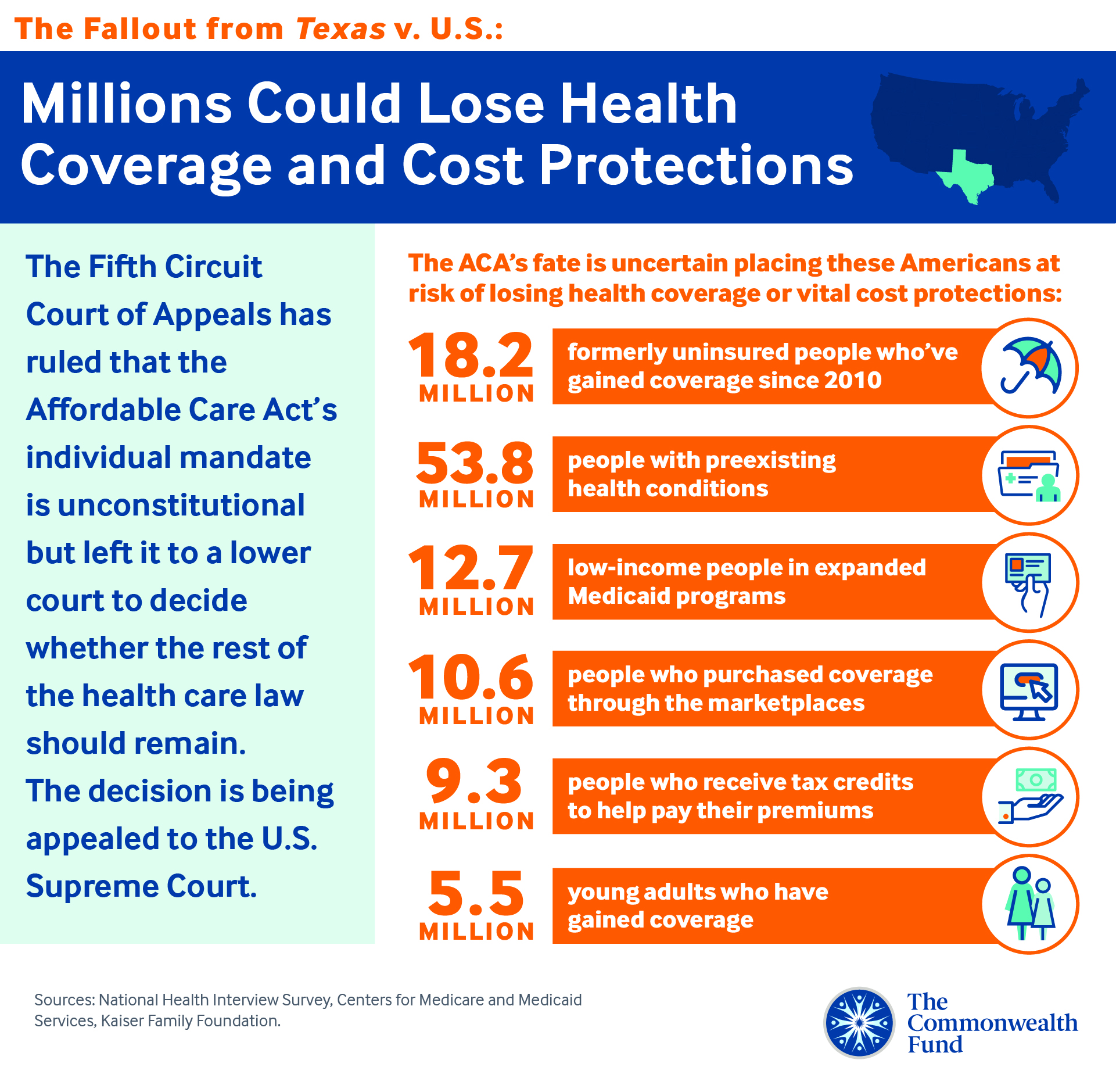
The Fallout from Texas v. U.S.:

Yesterday, a three-judge panel from the Fifth Circuit Court of Appeals struck down the Affordable Care Act (ACA)’s individual mandate. The judges agreed with a lower court decision issued in the case, Texas v. U.S., in December 2018 that the individual mandate is unconstitutional but, unlike the lower court, did not decide that the rest of the ACA is also unconstitutional. Instead, the judges remanded, or sent back, the decision to the same lower court judge to consider. California Attorney General Xavier Becerra, who is leading the 21 Democratic state attorneys general defending the law, along with the U.S. House of Representatives, immediately announced he would appeal the decision to the Supreme Court.

Whether the Supreme Court will decide to take the case now or wait for the decision of Judge O’Connor’s, of the lower court, is uncertain. If the Court decides to take the case now, they could expedite the briefing process and issue a decision in 2020. If it does not take the case now, a ruling will be delayed until after the 2020 presidential election.

No one knows how the Supreme Court will ultimately rule. But we do know that if the Court decides to strike down the ACA, the human toll will be immense and tragic. The law has granted unprecedented health security to millions:

  • 18.2 million formerly uninsured people have gained coverage since 2010
  • 53.8 million Americans with preexisting health conditions are now protected
  • 12.7 million low-income people are insured through expanded Medicaid
  • 10.6 million people have coverage through the ACA marketplaces, 9.3 million of whom receive tax credits to help them pay their premiums
  • 5.5 million young adults have gained coverage, many by staying on their parents’ plans
  • 45 million Medicare beneficiaries have much better drug coverage.

Such a decision will also trigger massive disruption throughout the U.S. health system. The health care industry represents nearly 20 percent of the nation’s economy; the ACA has touched every corner of it. The law restructured the individual and small-group health insurance markets, expanded and streamlined the Medicaid program, improved Medicare benefits, and reformed the way Medicare pays doctors, hospitals, and other providers. It was a catalyst for the movement toward value-based care and established a regulatory pathway for biosimilars — less expensive versions of biologic drugs. States have rewritten laws to incorporate the ACA’s provisions. Insurers, hospitals, physicians, and state and local governments have invested billions of dollars in adjusting to these changes.

The law’s popular preexisting health condition protections have made it possible for people with minor-to-serious health problems to apply for coverage in the same way healthier people have always done. These protections have given the estimated 53.8 million Americans with preexisting health conditions the peace of mind that they will never be denied health insurance because of their health.

More than 150 million people who get coverage through their employers now are eligible for free preventive care, and their children can stay on their policies to age 26.

The wide racial and income inequities in health insurance coverage that have been partly remedied by the ACA would return. Hospitals and providers, especially safety-net institutions, would struggle with mounting uncompensated care burdens and sicker and more costly patients who are not receiving the preventive care they need.

The ACA tore down financial barriers to health care for millions, many of whom were uninsured for most of their lives. It has demonstrably helped people get the health care they need in states across the country. Research indicates that Medicaid expansion has led to improved health status and lower mortality risk.

To date, neither the Trump administration, which has sided with the plaintiffs in the case, nor its Republican colleagues in Congress have offered a replacement plan in the event the law is struck down. The historic progress made by Americans, particularly those with middle and lower incomes and people of color, could unravel. Voters are already telling policymakers they are worried about their ability to afford health care. Yesterday’s decision and the uncertain path forward to the Supreme Court is certain to escalate those worries. With the nation entering the 2020 presidential election year, the Supreme Court may decide to take up the case this term.