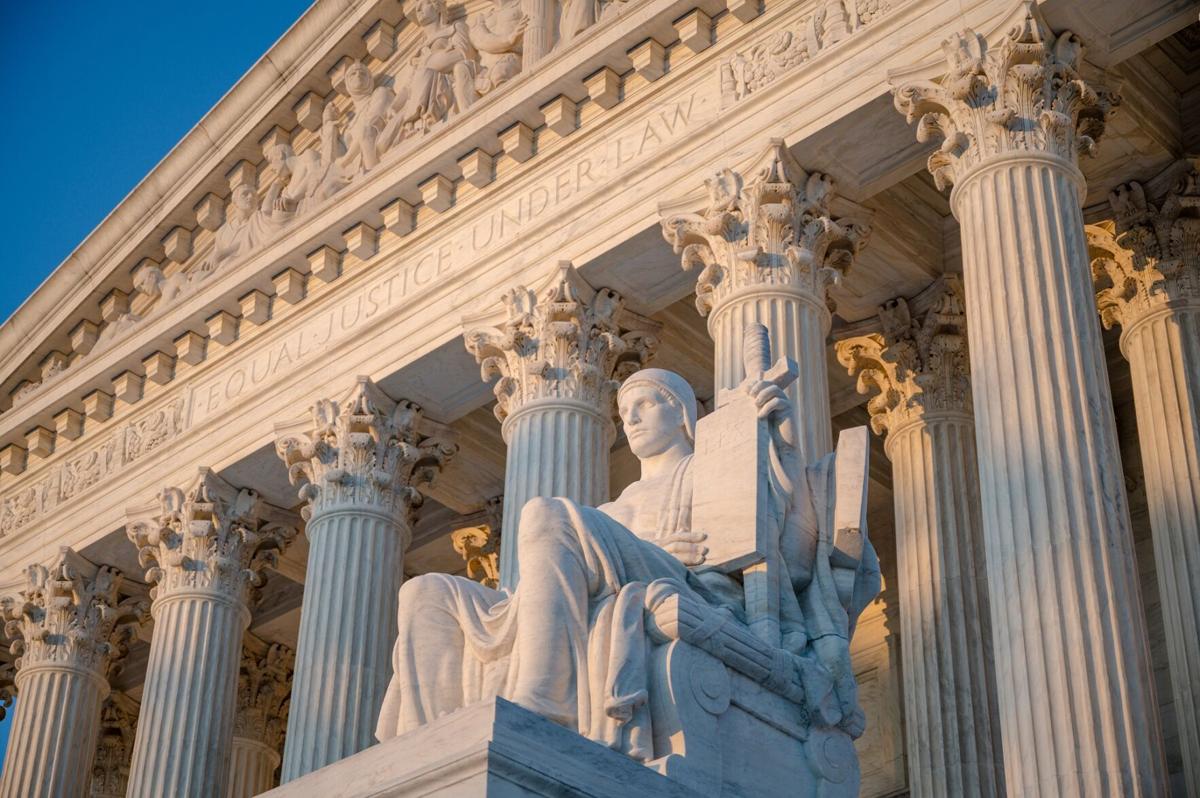
Even a solidly conservative Supreme Court could find a pretty easy path to preserve most of the Affordable Care Act — if it wants to.
The big picture: It’s too early to make any predictions about what the court will do, and no ACA lawsuit is ever entirely about the law. They have all been colored by the bitter political battles surrounding the ACA.
Even so, a handful of factors — the specifics of this case, the court’s recent precedents, even a few threads from Amy Coney Barrett’s Supreme Court confirmation hearings — can at least help draw a roadmap for a conservative ruling that would leave most of the ACA intact.
How it works: There are two steps to the current ACA case. First, the justices will have to decide whether the law’s individual mandate has become unconstitutional. If it has, they’ll then have to decide how many other provisions have to fall along with it.
The real action is in the second step — whether the mandate is “severable” from the rest of the law.
“If you picture severability being like a Jenga game — it’s kind of, if you pull one out, can you pull it out while it all stands? Or if you pull two out, will it still stand?” Barrett explained during Wednesday’s questioning.
“The presumption is always in favor of severability,” she said.
Severability is a question of congressional intent — whether Congress still would have passed the rest of a law if it knew it couldn’t have the piece the courts are striking down. And conservative judges make a point of relying only on a law’s text when determining congressional intent.
That should make the current case easy, the blue states defending the ACA argue: Congress zeroed out the mandate and left the rest of the law intact — a pretty clear sign that it intended for the rest of the law to operate in the absence of the mandate.
“It is abundantly clear that Congress wanted to keep the hundreds of other ACA provisions … without an enforceable minimum coverage provision, because that is the scheme Congress created,” Democratic attorneys general said in a brief.
The other side:The red states challenging the law, on the other hand, get further away from straight textualism.
They say the courts should instead look to Congress’ initial belief, when it passed the ACA in 2010, that the mandate was inextricably tied to protections for pre-existing conditions.
What we’re watching: Barrett acknowledged in this week’s hearings that the law has changed since it was first passed — a potentially encouraging sign, if you’re an ACA defender hoping the conservative justices will look at legislative text Congress wrote in 2017 instead of expert statements from 2010.
“Congress has amended the statute since” the 2012 Supreme Court ruling upholding the ACA, Barrett said Wednesday. “It has zeroed out the mandate, so now California v. Texas involves a different provision.”
A case from earlier this year— tied to another big-ticket Obama policy — might also help illuminate the current court’s approach to severability.
The court’s conservative majority ruled in June that the leadership structure of the Consumer Financial Protection Bureau was unconstitutional.
But a combination of four liberals and three conservatives then held that the whole agency didn’t have to be struck down because of it.
Yes, but: None of this means that the threat to the entire ACA, or to its protections for people with pre-existing conditions, has been exaggerated.
The Republican attorneys general who brought the case are asking the court to invalidate the entire statute. So is the Justice Department.
A federal judge ruled that the entire law had to fall. An appeals court couldn’t decide how much to strike, but said it would probably need to be more than just the mandate — and protections for pre-existing conditions would be next in line.
The bottom line: The ACA’s allies may not be able to save the remains of the individual mandate, but that’s a loss they can live with. And there is at least a clear path to a ruling, even from a conservative court, that would leave the rest of the law intact.
President-elect Joe Biden on Monday announced the members of his coronavirus task force, a group made up entirely of doctors and health experts,signaling his intent to seek a science-based approach to bring the raging pandemic under control.
Biden’s task force will have three co-chairs: Vivek H. Murthy, surgeon general during the Obama administration; David Kessler, Food and Drug Administration commissioner under Presidents George H.W. Bush and Bill Clinton; and Marcella Nunez-Smith, associate dean for health equity research at the Yale School of Medicine. Murthy and Kessler have briefed Biden for months on the pandemic.
Biden will inherit the worst crisis since the Great Depression, made more difficult by President Trump’s refusal to concede the election and commit to a peaceful transition of power. The Trump administration has not put forward national plans for testing, contact tracing and resolving shortages in personal protective equipment that hospitals and health-care facilities are experiencing again as the nation enters its third surge of the virus.
“Dealing with the coronavirus pandemic is one of the most important battles our administration will face, and I will be informed by science and by experts,” Biden said in a statement. “The advisory board will help shape my approach to managing the surge in reported infections; ensuring vaccines are safe, effective, and distributed efficiently, equitably, and free; and protecting at-risk populations.”
The United States is recording more than 100,000 new coronavirus cases a day and, on many days, more than 1,000 deaths, a toll expected to worsen during the crucial 10-week stretch of the transition. It remains unclear whether Trump or his top aides will oversee and lead a robust response to the pandemic during the transition, which could further exacerbate the crisis Biden and Vice President-elect Kamala D. Harris inherit.
The 13-member task force also includes former Trump administration officials, including Rick Bright, former head of the Biomedical Advanced Research and Development Authority, who, after being demoted, spoke out against the administration’s approach to the pandemic. Luciana Borio, director for medical and biodefense preparedness on Trump’s National Security Council until 2019, is also on the panel.
The group includes several other prominent doctors:
· Ezekiel Emanuel, chair of the Department of Medical Ethics and Health Policy at the University of Pennsylvania.
· Atul Gawande, a surgeon at Brigham and Women’s Hospital and a professor at Harvard Medical School who is a prolific author.
· Michael T. Osterholm, director of the Center for Infectious Disease Research and Policy at the University of Minnesota.
· Eric Goosby, global AIDS coordinator under President Barack Obama and professor of medicine at the University of California at San Francisco School of Medicine.
· Celine R. Gounder, clinical assistant professor of medicine and infectious diseases at New York University’s Grossman School of Medicine.
· Julie Morita, executive vice president of the Robert Wood Johnson Foundation, a philanthropy focused on health issues.
· Loyce Pace, president and executive director of the Global Health Council, a U.S.-based nonprofit organization dedicated to global health issues.
· Robert Rodriguez, professor of emergency medicine at the UCSF School of Medicine.
Rebecca Katz, director of the Center for Global Health Science and Security at Georgetown University Medical Center, and Beth Cameron, director for global health security and biodefense on the White House National Security Council during the Obama administration, are serving as advisers to the transition task force.
Task force members will work with state and local officials to craft public health and economic policies to address the virus and racial and ethnic disparities, while also working to reopen schools and businesses, the transition team said in a news release.
While the makeup of the task force garnered widespread praise, Peter Hotez, dean of the National School of Tropical Medicine at the Baylor College of Medicine, said the group needs more geographic diversity.
“They are all from the Acela corridor or the [San Francisco] Bay Area,” he said. “Who is going to be the field marshal or the supreme allied commander who goes into middle of the country and get this done? The coasts are doing okay but the red states are being hammered and the deaths are going to be extraordinary. There needs to be a frank reckoning between leaders of the two parties, to say we cannot let this happen.”
Public health experts said Biden should use the transition to provide leadership as the pandemic continues through a deadly stretch and begin communicating a strong national message.
“Clearly from the election outcomes, half the country doesn’t believe we’re in a crisis,” said Kavita Patel, a fellow at the Brookings Institution who worked on health policy in the Obama administration. Biden and Harris “have an incredible platform that can be used for communication. The country needs clear daily briefings that we thought we’d get from the White House coronavirus task force. They have an incredible platform, if not an official platform.”
Biden plans to call Republican and Democratic governors to ask for their help in developing a consistent message from federal and state leaders, according to three Biden advisers who spoke on the condition of anonymity because they were not authorized to speak publicly about these matters. He will urge governors to adopt statewide mask mandates and to provide clear public health guidance to their constituents, including about social distancing and limiting large gatherings.
The task force will have subgroups that focus on issues related to the response, including testing, vaccine distribution and personal protective equipment, according to two people familiar with the plans who spoke on the condition of anonymity to reveal plans that were not yet public.
In his victory speech Saturday, Biden addressed challenges in bringing the pandemic under control.
“We cannot repair the economy, restore our vitality or relish life’s most precious moments — hugging a grandchild, birthdays, weddings, graduations, all the moments that matter most to us — until we get this virus under control,” Biden said. “That plan will be built on a bedrock of science. It will be constructed out of compassion, empathy and concern. I will spare no effort — or commitment — to turn this pandemic around.”
Yet the plans Biden laid out on the campaign trail are set to collide with political realities. That includes a deeply divided nation in which more than 71 million people voted for Trump and the possibility of having to navigate a Republican-controlled Senate disinclined to support a greater federal role in testing and contact tracing, among other responsibilities now left mostly to the states.
Biden’s most ambitious plans will require significant congressional funding. Senate Majority Leader Mitch McConnell (R-Ky.) has said he would like to pass new coronavirus relief measures during Congress’s lame-duck session, and Congress faces a Dec. 11 government funding deadline. Biden and his team are poised to begin engaging with congressional Democrats on their priorities.
Biden’s plans include dramatically expanding testing and building a U.S. public health jobs corps to have 100,000 Americans conduct contact tracing. They also include ramping up production of personal protective equipment and implementing a vaccine distribution plan.
Murthy, who served as the 19th U.S. surgeon general, is a physician whose nomination was stalled in the Senate for more than a year because of his view that gun violence is a public health issue. Three months into the Trump administration, he was replaced as “the nation’s doctor” with more than two years left on his four-year term.
In 2016, he wrote a landmark report on drug and alcohol addiction, which put that condition alongside smoking, AIDS and other public health crises that previous surgeons general addressed. The report called the addiction epidemic “a moral test for America.” Murthy’s office sent millions of letters to doctors asking for their help to combat the opioid crisis.
The son of immigrants from India, he earned medical and MBA degrees at Yale before joining the faculty at Harvard Medical School, where his research focused on vaccine development and the participation of women and minorities in clinical trials.
After leaving his post as surgeon general, he wrote a book on loneliness and social isolation, including their implications for health, that grew out of his conversations with people in clinical practice and as surgeon general.
Several public health officials celebrated Nunez-Smith’s leadership role on the task force. Her research focuses on promoting health and health-care equity in marginalized populations, according to her Yale biography. She has also studied discrimination that patients endure in the health-care system — expertise that many said was welcome in an epidemic that is disproportionately affecting people of color.
Kessler was FDA commissioner from 1990 to 1997, during the George H.W Bush and Clinton administrations. He is well-known for his attempts to regulate cigarettes — an effort that resulted in a loss in the Supreme Court, which ruled that the agency did not have the authority. That prompted Congress to pass a law, enacted in 2009, that explicitly gave the agency that power.
Kessler, a pediatrician and lawyer, worked at the FDA to accelerate AIDS treatments and on food and nutrition issues. He oversaw the FDA’s development of standardized nutrition labels and notably ordered the seizure of orange juice labeled “fresh” because it was made from concentrate. He has written several books on diet, mental illness and other topics, and has served as dean of the medical schools at Yale and UCSF.
The U.S. Supreme Court is set to hear a case questioning the legality of the ACA on Nov. 10.
Five things to know:
1. At the center of the case is whether the health law should be struck down. In a brief filed June 25 in Texas v. United States, the Trump administration argues the entire ACA is invalid because in December 2017, Congress eliminated the ACA’s tax penalty for failing to purchase health insurance. The administration argues the individual mandate is inseverable from the rest of the law and became unconstitutional when the tax penalty was eliminated; therefore, the entire health law should be struck down.
2. The administration’s brief was filed in support of a group of Republican-led states seeking to undo the ACA. Meanwhile, California Attorney General Xavier Becerra is leading a coalition of more Democratic states to defend the ACA before the Supreme Court.
3. The case goes before the Supreme Court days after media outlets projected Joe Biden as the next president of the U.S. President-elect Biden has said he seeks to expand government-subsidized insurance coverage and wants to the bring back the ACA’s tax penalty for failing to purchase health insurance, according to The Wall Street Journal. If a change regarding the tax penalty did occur, the publication notes that Republicans’ argument on severability would no longer apply.
4. The case also goes before the Supreme Court about two weeks after the Senate voted Oct. 26 to confirm Amy Coney Barrett to the Supreme Court. Ms. Barrett previously criticized Chief Justice John Roberts’ 2012 opinion sustaining the law’s individual mandate, The New York Times reported, but she said during her confirmation hearings in October that “the issue in the case is this doctrine of severability, and that’s not something that I have ever talked about with respect to the Affordable Care Act.”
5. According to the Journal, the Supreme Court is not expected to make a decision in the case until the end of June.
After an exhausting and contentious election campaign, and a vote count that was prolonged by enormous voter turnout and record-breaking use of early and mail-in voting, the major news networks have now made their calls. Joseph R. Biden, Jr. will be the 46th President of the United States, and Kamala D. Harris will be the first woman, and first person of color, to become Vice President. Securing an electoral victory by achieving razor-thin victories in a number of battleground states, President-elect Biden received the largest number of votes of any candidate in American history. Although the Trump campaign vowed to pursue legal challenges to the validity of the election, Biden’s win appeared to be secure.
The election results came in the midst of a dramatic acceleration of the coronavirus pandemic.Over the last week, the average number of new cases per day in the US surpassed 96,000, up 54 percent from just two weeks earlier. On Friday the nation recorded a pandemic-high 132,700 new cases, along with at least 1,220 COVID deaths. Hospitalizations were up in most states, hospital bed and workforce capacity are strained, and public health experts warned that the coming weeks and months will bring even worse news. Unsurprisingly, the pandemic was a top issue on the minds of voters. According to exit polls, however, the electorate was deeply divided on the issue: 82 percent of Biden voters cited the pandemic itself as one of the most important issues in determining their vote, with only 14 percent of Trump voters agreeing. Conversely, 82 percent of Trump voters said the economy was the most important issue on their minds, as opposed to Biden voters, only 17 percent of whom listed the economy as their top issue. Based on that data, it appears that at least one important split among the electorate was “lives” versus “livelihoods”—whether the pandemic response, or its impact on the economy, was of greatest concern.
In the coming weeks, attention is likely to turn in earnest to addressing both aspects of the issue during the lame duck period. Senate Majority Leader Mitch McConnell (R-KY) has signaled that he intends toresume negotiations on a stimulus package with Democrats in the House, whose majority was diminished in the election. At this writing, it appears likely that control of the Senate will come down to the results of two runoff elections in Georgia, and McConnell will undoubtedly want to make the case that Senate Republicans have taken decisive action to bolster the economic recovery. It’s also possible that, as part of the Trump administration’s Operation Warp Speed, a coronavirus vaccine will be granted approval by the end of the year. Health officials at both federal and state levels must continue to work closely together to tackle the complex logistics of distributing and administering the vaccine, and it will be critical for the incoming administration to seek ways to collaborate with the Trump team to ensure a smooth transition of this vital work.
The outcome of the Senate runoffs in Georgia will determine whether the Biden administration must work with divided Congress, or an evenly split Senate in which Vice President-elect Kamala Harris casts the deciding vote. In either case, given the political realities underscored by the electoral result, it’s very unlikely than any of the more sweeping proposals in the Biden campaign platform—lowering the eligibility age for Medicare, establishing a government-run “public option” insurance plan, extending premium subsidies to middle-income workers—will advance very far. Rather, as we’ve discussed before, we’d expect a Biden administration’s first actions to focus on an enhanced federal response to managing the pandemic, including issuing a national mask mandate, enhancing efforts to augment and coordinate personal protective equipment (PPE) supply, and rejoining the World Health Organization.
As we look to the next two years, most healthcare policy changes are likely to come in the form ofregulatory reform, such as reversing waivers for Medicaid programs to establish work requirements and withdrawing flexibility for short-term plans that fail to comply with the Affordable Care Act (ACA). Other Trump-era regulatory changes might continue. There’s broad bipartisan support for efforts to make value-based Medicare payment reforms more successful, to increase price transparency, and to address the issues of surprise billing and the cost of prescription drugs. But even in if Democrats beat the odds and win back control of the Senate, we believe the Biden administration will have other legislative priorities that will supersede any attempt to dramatically overhaul healthcare coverage—voting reforms, climate change legislation, immigration reform, and long-overdue infrastructure investments.
Unless, that is, the Supreme Court throws a spanner in the works by overturning the ACA. Should the Court rule that the individual mandate is not severable from the rest of the law, and that the entire ACA is unconstitutional, the new administration would be forced to take quick action to protect coverage and insurance protections for millions of Americans. In that event, healthcare would rocket to the top of the agenda. Either the Biden team would be forced to find a compromise solution that could pass a divided Congress, or (if Harris is the tie-breaking vote) find a way to use the budget reconciliation process to address coverage. That potential drama lies months in the future, as we won’t know the outcome of the case until next spring. We’ll monitor the oral arguments in the ACA case closely, and let you know what we hear, and what we think it means for the future of the case.
In the coming weeks, we’ll be watching for answers to some of the big healthcare questions that lie ahead: How will the Trump administration handle the worsening pandemic situation in the 75 days between now and Inauguration Day? Will any new stimulus package include additional economic relief for healthcare providers? When and how will a COVID vaccine become widely available? And perhaps most importantly, what toll will the “third wave” of the pandemic take on a nation already exhausted by a difficult year, and a bitter political fight? Surely one reason to be optimistic is that, having turned out to vote in the largest numbers in a century, Americans are more engaged than ever in finding a way forward amid the problems that confront us. Let’s hope our political leaders from across the ideological spectrum will rise to the occasion, and meet this difficult moment with positive, constructive solutions.
There have been 9,487,080 coronavirus cases in the United States, and 233,729 people have died (Johns Hopkins). Around 3,743,527 people have recovered, and the United States has conducted 150,969,797 tests. Worldwide, there have been 48,107,322 confirmed cases of coronavirus, with 1,225,881 deaths. At least 31,917,411 people have recovered from the virus.
U.S. Reports More Than 100,000 New Cases on Wednesday, Following Second-Highest Daily Covid-19 Cases on Election Day; Hospitalizations Increase; Covid-19 Becomes Third Leading Cause of Death in Arkansas.
The U.S. recorded more than 91,000 new cases of Covid-19 on Election Day, Nov. 3, and more than 100,000 new cases on Wednesday, Nov. 4 (CNN, Johns Hopkins, NYT). Six states – Idaho, Maine, Minnesota, New Mexico, Ohio and Pennsylvania – reported single-day highs on Tuesday. And five states — Maine, Minnesota, Indiana, Nebraska and Colorado — set single-day case records on Wednesday. The seven-day average for daily new cases now tops 90,000, the highest since the pandemic began and more than twice as high as the average during the low point in early September.
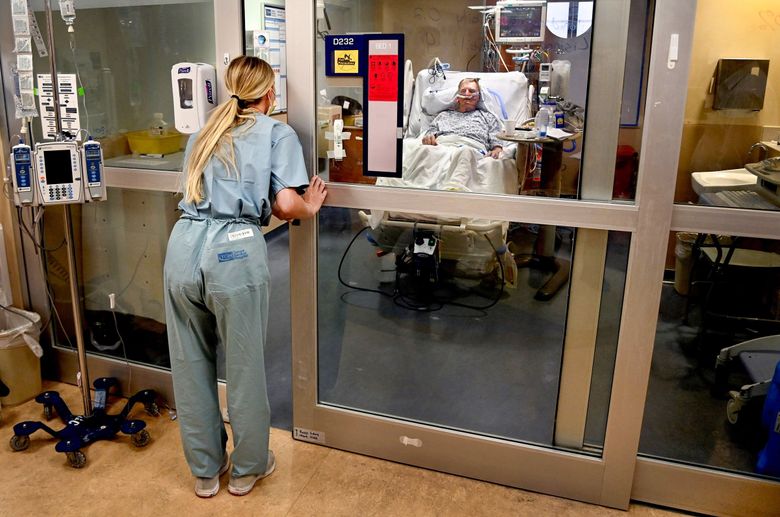
More than 50,000 people were hospitalized with the virus during voting on Tuesday. In the Midwest in particular, hospitalizations are rising steeply. Some Midwest hospitals are under strain as they work to provide care for large numbers of Covid-19 patients.
In Arkansas on Tuesday, Governor Asa Hutchinson announced that Covid-19 has become the third leading cause of death in the state, after cancer and heart attacks. “It is a deadly virus that takes people’s lives,” the governor said. “We want to make sure everybody understands the seriousness of it.” Bo Ryall, president and CEO of the Arkansas Hospital Association, asked residents to “please adhere to safety measures again” to help mitigate the strain on hospitals.
Despite increased production of protective gear, levels of N95 face masks are lower than recommended at many health-care facilities.
Manufacturers and health officials are reporting shortages of N95 masks, critical protective equipment for frontline workers (WSJ). Although supplies of masks, gloves, and other equipment have improved since the start of the pandemic, new Covid-19 surges around the country are making it difficult for health care facilities to keep up with demand for N95 masks.
Many facilities are being forced to ration and reuse supplies. In Michigan, approximately two-thirds of health systems report less than a three-week supply of protective equipment, far below the state’s recommended 90-day supply. In New Mexico, 90% of hospitals are now reusing N95 masks. State health officials around the country expect shortages to be exacerbated in the coming weeks as Covid-19 cases continue to rise.
Manufacturers are scrambling to keep up, ramping up production, and working with state officials to direct supplies to areas in greatest need. 3M, the largest manufacturer of N95 masks in the country, is producing four times the number of N95 masks per month compared to pre-pandemic production. Even so, Chief Executive Mike Roman told reporters, “N95s are still in high demand. We have more demand than we can supply.”
The coronavirus pandemic reached a dire milestone Wednesday when the number of new U.S. infections topped 100,000 in one day for the first time, continuing a resurgence that showed no sign of slowing.
The pandemic is roaring across the Midwest and Plains states. Seven states set records for hospitalizations for covid-19, the disease caused by the virus. And Connecticut, Iowa, Maine, Michigan, Minnesota, Nebraska and North Dakota saw jumps of more than 45 percent in their seven-day rolling average of new infections, considered the best measure of the spread of the virus.
The record, 104,004 cases, was reached a day after the deeply divided nation went to the polls to choose between President Trump and Democratic nominee Joe Biden, an election widely seen as a choice between fully reopening the economy and aggressively quelling the outbreak.
“It’s clear we’re heading into a period where we’re going to see increasing hospitalization and deaths in the U.S. And it worries me how little we’re doing about it,” said Tom Frieden, director of the Centers for Disease Control and Prevention during the Obama administration. “We know by now how fast this virus can move. You have to get ahead of it.”
After more than nine months of restrictions, some state leaders are hesitant to risk further pandemic fatigue, Frieden said.
But if case counts continue rising at the current rate and strong action isn’t taken, viral transmission may soon reach a point in some areas where nothing will stop the virus except another shutdown, he said.
“The numbers keep going up, and we’re only getting closer and closer to Thanksgiving and Christmas,” when some families are expected to congregate indoors and risk spreading the virus further, said Eleanor Murray, an assistant professor of epidemiology at Boston University. “For so many reasons, the next few weeks are going to be bad for us and good for covid.”
With Trump and his aides fighting to hold on to the White House, the federal response to the pandemic, which already leaves major responsibilities to the states, may be even more fractured, Murray said.
“Something that deeply worries me is either way this election goes, Trump will still be in charge the next few weeks, when cases are higher than they’ve ever been,” she said. “And he’s made clear there will be no top-down, coordinated action coming from the federal government.”
Despite months of surveys that clearly indicated strong voter disapproval of the president’s response to the pandemic could weigh heavily against his reelection effort, more voters chose the economy as the primary issue in casting their ballots, exit polling showed.
Even if Biden captures the White House, the results appear to signal that, for many people, covid-19 is not as daunting as the prospect of being unable to pay their bills or send their children to school.
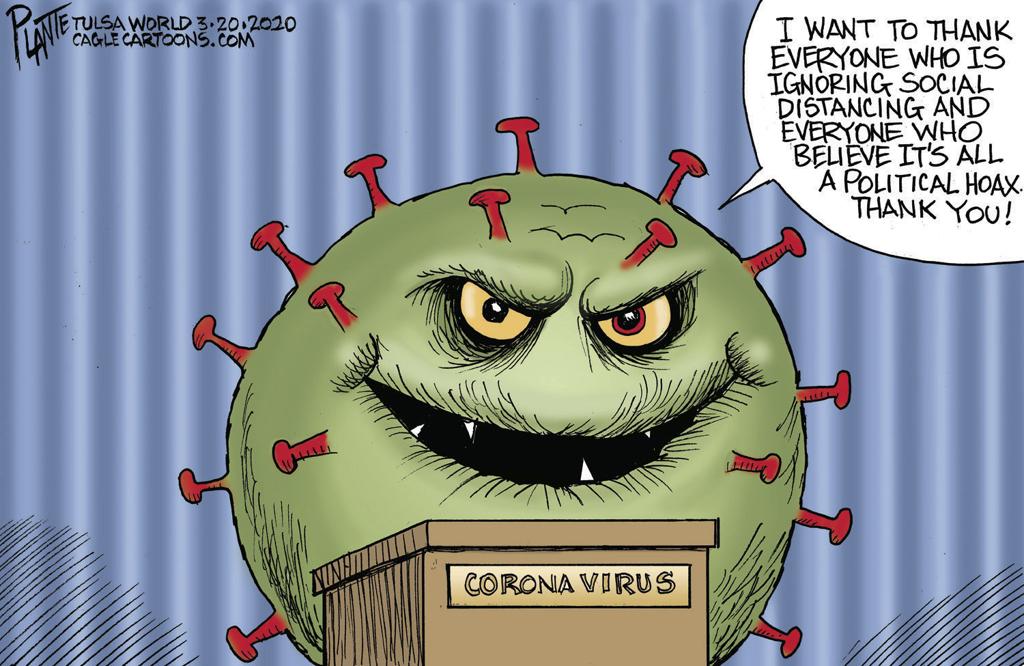
“I got news for you, pal. Covid-19 is over. It’s done,” said Nick Arnone, owner of HLSM, a software company for the power sports industry in Plains, Pa. “We have therapeutics, so deaths are way down. We are very close to a vaccine. We’ve got to ride it out now.
About 35 percent of voters said the economy was the most important issue for them, while about 17 percent cited the pandemic and about 2 in 10 were motivated most by racial inequality.
At the same time, however, just over half the voters said it is more important to contain the virus, even if that hurts the economy, while slightly more than 4 in 10 said rebuilding the economy is most critical, even if that impairs work to quell the virus.
In El Paso, where the pandemic is surging, James Clark said he voted for Biden because of the uncontrolled outbreak.
“Covid was the main reason . . . and the things he was saying specifically about it,” Clark said. “I mean there were some things Trump was doing well, too, but overall it was covid.”
Some analysts were surprised and concerned that voters appeared to view the decision before them as a choice between the virus and their livelihoods, rather than as intertwined problems that could be solved together.
“That was shocking to me, that Trump could convince so many people it was a choice between the economy and pandemic,” said Eric Topol, a cardiologist and head of the Scripps Research Translational Institute in San Diego. “I’m amazed the extent he pulled that off, because it’s so obviously a false dichotomy. There’s no way for the economy to thrive unless we get control of the pandemic.”
On the campaign trail, Biden warned voters of a “dark winter” and invoked empty chairs in homes where families grieved the death of a loved one. He suggested he would follow science and tighten restrictions in places where that was necessary.
Trump repeatedly declared that the country was “rounding the turn” on the pandemic and said a vaccine was almost ready to be distributed. “You know what we want? We want normal,” Trump said this past weekend in Butler, Pa.
The two political messages were consistent with the viewpoints of each candidate’s base, said Kathleen Hall Jamieson, director of the Annenberg Public Policy Center at the University of Pennsylvania.
Biden has much more support among urban voters and people of color who, until recently, have been hit harder by the pandemic. Trump’s base is more White and rural, constituencies that have been slammed by the virus only in recent weeks, as the number of infections soared in the Upper Midwest and Plains states, she said.
“Who’s more likely to know someone’s who’s died? People who are already more likely to be Democrats than Republicans,” Jamieson said. “The lived experience of the two constituencies, the base vote for each side, is different.”
In Florida, which Trump carried more easily than expected, Biden’s emphasis on the pandemic hampered grass-roots campaigning, said Susan MacManus, an emerita professor of political science at the University of South Florida. With Biden emphasizing social distancing, the Democratic campaign there followed his lead.
“The Republicans never let their foot off the pedal in terms of continuing to register [voters] and going door to door, all through the covid,” she said. “The Democrats, once covid hit, they made a conscious effort, not going door to door.”
Rep. Donna Shalala (D-Fla.), who appeared to be headed toward losing her seat to television newscaster Maria Elvira Salazar (R) in Miami, campaigned heavily on Trump’s response to the virus.
Stefan Baral, a physician and epidemiologist at Johns Hopkins School of Public Health, Wednesday faulted Democrats’ pandemic messaging, saying Biden did not adequately express empathy for the economic hardships caused by the pandemic-related shutdowns.
“This is a terrible virus. But empathy for all the folks who have lost their jobs and lost their opportunities and kids who are out of school — I just never felt that message of empathy come across at all,” Baral said.
When some people heard Biden talk about the dark winter ahead, they thought, “The first thing he’s going to do is close my business,” Baral said.
Voters also had to make up their minds amid a torrent of misinformation and purposeful distortion about the pandemic, said Matthew Seeger, a risk communication expert at Wayne State University in Michigan, who helped the CDC develop its past communications plans.
“The messaging around the pandemic has been deliberately confused and strategically manipulated to downplay its significance,” Seeger said. “You combine that with the fact that this is a slow-moving crisis with risk fatigue starting to settle in, and you can see why public perception is what it is.”
In Chandler, Ariz., a suburb southeast of Phoenix last week, Al Fandick said he considers the pandemic wildly overblown and masks largely pointless. Fandick, 53, who runs a transport company, said he found it absurd that he was required to wear a mask to enter a restaurant but could remove the face covering once he sat down.
“Having a face mask on while I walk into that restaurant, but then I can take that face mask off, that’s like having a peeing section in a pool,” Fandick said.
Aside from trips to visit people in the hospital, he never wore a mask until Maricopa County began mandating it for public spaces, a policy he vehemently opposes, he said.
“Don’t need the hassle,” he said.
On the other side of the gulf are those who see the accelerating pandemic and a possibly very deadly period ahead.
“It is demoralizing to feel like: Here we are in November. A third surge is not just underway, but has already surpassed past surges. And people still don’t understand what’s happening and what’s at stake,” said Murray of Boston University.
“We are in the middle of an emergency. We have cases higher than they have ever been since this pandemic started, and yet you will have people paying less attention than ever to covid,” Murray said. “We as a country are not in a place right now where it’s safe to do that.”






 HENRY KOTULA
