Hospital expenses per inpatient day across 50 states

Below are the adjusted expenses for nonprofit, for-profit and government hospitals per inpatient day in 2022 in every U.S. state, according to the latest estimates provided by Kaiser State Health Facts. 

The figures are based on information from the 2022 American Hospital Association Annual Survey. They are an estimate of the expenses incurred in a day of inpatient care and have been adjusted higher to reflect an estimate of outpatient service volumes, according to the Kaiser Family Foundation. 

The foundation notes the figures are “only an estimate of expenses incurred by the hospital” for one day of inpatient care and do not substitute actual charges or reimbursement for care provided.

National average 
Nonprofit hospitals: $3,167
For-profit hospitals: $2,383 
State/local government hospitals: $2,857

Alabama
Nonprofit hospitals: $1,984
For-profit hospitals: $1,723
State/local government hospitals: $1,929

Alaska 
Nonprofit hospitals: $2,130
For-profit hospitals: $3,152
State/local government hospitals: $1,905

Arizona
Nonprofit hospitals: $3,430
For-profit hospitals: $2,746
State/local government hospitals: $2,833

Arkansas
Nonprofit hospitals: $2,082
For-profit hospitals: $1,942
State/local government hospitals: $4,263

California
Nonprofit hospitals: $4,719
For-profit hospitals: $2,655
State/local government hospitals: $4,338

Colorado 
Nonprofit hospitals: $3,862
For-profit hospitals: $3,408
State/local government hospitals: $2,528

Connecticut 
Nonprofit hospitals: $3,223
For-profit hospitals: $2,584
State/local government hospitals: $5,234

Delaware
Nonprofit hospitals: $3,399
For-profit hospitals: $1,429
State/local government hospitals: n/a

District of Columbia
Nonprofit hospitals: $4,272
For-profit hospitals: $3,081
State/local government hospitals: n/a

Florida 
Nonprofit hospitals: $3,063
For-profit hospitals: $2,301
State/local government hospitals: $2,884

Georgia 
Nonprofit hospitals: $2,556
For-profit hospitals: $2,312
State/local government hospitals: $814

Hawaii
Nonprofit hospitals: $3,551
For-profit hospitals: n/a
State/local government hospitals: $1,598

Idaho
Nonprofit hospitals: $4,570
For-profit hospitals: $2,944
State/local government hospitals: $2,406

Illinois 
Nonprofit hospitals: $3,168
For-profit hospitals: $2,403
State/local government hospitals: $3,862

Indiana
Nonprofit hospitals: $3,327
For-profit hospitals: $2,865
State/local government hospitals: $2,686

Iowa
Nonprofit hospitals: $1,847
For-profit hospitals: $1,596
State/local government hospitals: $1,942

Kansas
Nonprofit hospitals: $2,287
For-profit hospitals: $2,551
State/local government hospitals: $2,314

Kentucky
Nonprofit hospitals: $2,485
For-profit hospitals: $2,637
State/local government hospitals: $3,484

Louisiana
Nonprofit hospitals: $2,788
For-profit hospitals: $2,336
State/local government hospitals: $2,345

Maine
Nonprofit hospitals: $2,944
For-profit hospitals: $1,154
State/local government hospitals: $1,082

Maryland
Nonprofit hospitals: $3,617
For-profit hospitals: $1,734
State/local government hospitals: n/a

Massachusetts
Nonprofit hospitals: $3,670
For-profit hospitals: $2,559
State/local government hospitals: $2,545

Michigan
Nonprofit hospitals: $2,546
For-profit hospitals: $2,449
State/local government hospitals: $893

Minnesota 
Nonprofit hospitals: $2,813
For-profit hospitals: n/a
State/local government hospitals: $2,273

Mississippi
Nonprofit hospitals: $1,615
For-profit hospitals: $1,753
State/local government hospitals: $1,229

Missouri
Nonprofit hospitals: $2,864
For-profit hospitals: $2298
State/local government hospitals: $2,379

Montana
Nonprofit hospitals: $2,192
For-profit hospitals: $2,708
State/local government hospitals: $750

Nebraska 
Nonprofit hospitals: $2,832
For-profit hospitals: $4,769
State/local government hospitals: $1,765

Nevada 
Nonprofit hospitals: $2,771
For-profit hospitals: $2,127
State/local government hospitals: $2,972

New Hampshire
Nonprofit hospitals: $3,030
For-profit hospitals: $2,720
State/local government hospitals: n/a

New Jersey
Nonprofit hospitals: $3,415
For-profit hospitals: $2,361
State/local government hospitals: $2,451

New Mexico 
Nonprofit hospitals: $2,973
For-profit hospitals: $2,686
State/local government hospitals: $3,710

New York 
Nonprofit hospitals: $3,721
For-profit hospitals: n/a
State/local government hospitals: $3,675

North Carolina 
Nonprofit hospitals: $2,810
For-profit hospitals: $2,391
State/local government hospitals: $2,411

North Dakota
Nonprofit hospitals: $2,308
For-profit hospitals: $4,196
State/local government hospitals: n/a

Ohio
Nonprofit hospitals: $3,402
For-profit hospitals: $2,447
State/local government hospitals: $3,761

Oklahoma
Nonprofit hospitals: $2,450
For-profit hospitals: $2,580
State/local government hospitals: $1,964

Oregon
Nonprofit hospitals: $3,827
For-profit hospitals: $3,368
State/local government hospitals: $5,155

Pennsylvania 
Nonprofit hospitals: $3,045
For-profit hospitals: $2,251
State/local government hospitals: $1,609

Rhode Island 
Nonprofit hospitals: $3,102
For-profit hospitals: n/a
State/local government hospitals: n/a

South Carolina 
Nonprofit hospitals: $2,430
For-profit hospitals: $1,874
State/local government hospitals: $2,598

South Dakota 
Nonprofit hospitals: $1,673
For-profit hospitals: $4,275
State/local government hospitals: $780

Tennessee
Nonprofit hospitals: $2,960
For-profit hospitals: $2,133
State/local government hospitals: $2,019

Texas
Nonprofit hospitals: $3,291
For-profit hospitals: $2,325
State/local government hospitals: $3,768

Utah
Nonprofit hospitals: $3,550
For-profit hospitals: $3,232
State/local government hospitals: $3,542

Vermont
Nonprofit hospitals: $3,079
For-profit hospitals: n/a
State/local government hospitals: n/a

Virginia
Nonprofit hospitals: $2,813
For-profit hospitals: $2,194
State/local government hospitals: $4,208

Washington
Nonprofit hospitals: $3,753
For-profit hospitals: $3,696
State/local government hospitals: $4,079

West Virginia
Nonprofit hospitals: $2,447
For-profit hospitals: $1,206
State/local government hospitals: $1,500

Wisconsin 
Nonprofit hospitals: $2,796
For-profit hospitals: $3,055
State/local government hospitals: $3,641

Wyoming 
Nonprofit hospitals: $3,092
For-profit hospitals: $3,133
State/local government hospitals: $1,485


Is the Tax Exemption for Not-for-Profit Hospitals at Risk?

Last Thursday, Seattle-based Providence Health System announced it is refunding nearly $21 million in medical bills paid by low-income residents of Washington and erasing $137 million more in outstanding debt for others. Other systems are likely to follow as pressure con mounts on large, not-for-profit systems to modify their business practices in sensitive areas like patient debt collection, price transparency, executive compensation, investment activities and others.

Not-for profit systems control the majority of the 2,987 nongovernment not-for-profit community hospitals in the U.S. Some lawmakers think it’s time to revisit to revisit the tax exemption. It has the attention of the American Hospital Association which lists “protecting not-for-profit hospitals’ the tax-exempt status” among its 15 Advocacy Priorities in 2024 (it was not on their list in 2023).

Background:  Per a recent monograph in Health Affairs: “The Internal Revenue Service (IRS) uses the Community Benefit Standard (CBS), a set of 10 holistically analyzed metrics, to assess whether nonprofit hospitals benefit community health sufficiently to justify their tax-exempt status. Nonprofit hospitals risk losing their tax exemption if assessed as underinvesting in improving community health. This exemption from federal, state, and local property taxes amounts to roughly $25 billion annually.

However, accumulating evidence shows that many nonprofit hospitals’ investments in community health meet the letter, but not the spirit, of the CBS.

Indeed, a 2021 study showed that for every $100 in total expenses nonprofit hospitals spend just $2.30 on charity care (a key component of community benefit)—substantially less than the $3.80 of every $100 spent by for-profit hospitals. A 2022 study looked at the cost of caring for Medicaid patients that goes unreimbursed and is therefore borne by the hospital (another key component of community benefit); the researchers found that nonprofit hospitals spend no more than for-profit hospitals ($2.50 of every $100 of total expense).”

In its most recent study, the AHA found the value of CBS well-in-excess of the tax exemption by a factor of 9:1. But antagonism toward the big NFP systems has continued to mount and feelings are intense…

  • Insurers think NFP systems exist to gain leverage in markets & states over insurers in contract negotiations and network design. They’ll garner support from sympathetic employers and lawmakers, federal anti-consolidation and price transparency rulings and in the court of public opinion where frustration with the system is high.
  • State officials see the mega- NFP systems as monopolies that don’t deserve their tax exemptions while the state’s public health, mental health and social services programs struggle.
  • Some federal lawmakers think the NFP systems are out of control requiring closer scrutiny and less latitude. They think the tax exemption qualifiers should be re-defined, scrutinized more aggressively and restricted.
  • Well-publicized investments by NFP systems in private equity backed ventures has lent to criticism among labor unions and special interests that allege systems have abandoned community health for Wall Street shareholders.
  • Investor-owned multi-hospital operators believe the tax exemption is an unfair advantage to NFPs while touting studies showing their own charity care equivalent or higher.
  • Other key NFP and public sector hospital cohorts cry foul: Independent hospitals, academic medical centers, safety-net (aka ‘essential’) hospitals, rural health clinics & hospitals, children’s hospitals, rural health providers, public health providers et al think they get less because the big NFPs get more.
  • And the physicians, nurses and workforces employed by Big NFP systems are increasingly concerned by systemization that limits their wages, cuts their clinical autonomy and compromises their patients’ health.

My take:

The big picture is this: the growth and prominence of multi-hospital systems mirrors the corporatization in most sectors of the economy: retail, technology, banking, transportation and even public utilities. The trifecta of community stability—schools, churches and hospitals—held out against corporatization, standardization and franchising that overtook the rest. But modernization required capital, the public’s expectations changed as social media uprooted news coverage and regulators left doors open for “new and better” that ceded local control to distant corporate boards.

Along the way, investor-owned hospitals became alternatives to not-for-profits, and loose networks of hospitals that shared purchasing and perhaps religious values gave way to bigger multi-state ownership and obligated groups.

The attention given large NFP hospital systems like Providence and others is not surprising. These brands are ubiquitous. Their deals with private equity and Big Tech are widely chronicled in industry journalism and passed along in unfiltered social media. And their collective financial position seems strong:  Moody’s, Fitch, Kaufman Hall and others say utilization has recovered, pandemic recovery is near-complete and, despite lingering concerns about workforce issues, growth in their core businesses plus diversification in new businesses are their foci. (See Hospital Section below).

I believe not-for-profit hospital systems are engines for modernizing health delivery in communities and a lightening rod for critics who think their efforts more self-serving than for the public good.

Most consumers (55%) think they earn their tax exemption but 34% have mixed feelings and 10% disagree. (Keckley Poll November 20, 2023). That’s less than a convincing defense.

That’s why the threat to the tax exemption risk is real, and why every organization must be prepared. Equally important, it’s why AHA, its state associations and allies should advance fresh thinking about ways re-define CBS and hardwire the distinction between organizations that exist for the primary purpose of benefiting their shareholders and those that benefit health and wellbeing in their communities.

PS: Must reading for industry watchers is a new report from by Health Management Associates (HMA) and Leavitt Partners, an HMA company, with support from Arnold Ventures. The 70-page report provides a framework for comparing the increasingly crowned field of 120 entities categorized in 3 groups: Hybrids (6.9 million), Delivery (5.8 million) and Enablers 17.5 million

“At the start of the movement, value-based arrangements primarily involved traditional providers and payers engaging in relatively straight-forward and limited contractual arrangements. In recent years, the industry has expanded organically to include a broader ecosystem of risk-bearing care delivery organizations and provider enablement entities with capabilities and business models aligned with the functions and aims of accountable care…Inclusion criteria for the 120 VBD entities included in this analysis were:

  • 1-Serve traditional Medicare, MA, and/or Medicaid populations. Entities that are focused solely on commercial populations were excluded
  • 2-Operate in population-based, total cost of care APMs—not only bundled payment models.
  • 3- Focus on primary care and/or select specialties that are relevant to total cost of care models (i.e., nephrology, oncology, behavioral health, cardiology, palliative care). Those exclusively focused on specialty areas geared toward episodic models (e.g., MSK) were excluded. –
  • 4-Share accountability for cost and quality outcomes. Business models must be aligned with provider performance in total cost of care arrangements. Vendors that support VBP but do not share accountability for outcomes were excluded.

HMA_VBP-Entity-Landscape-Report_1.31.2024-updated.pdf (healthmanagement.com) February 2024

The rising debate about hospital community benefits: Sanders vs AHA

We’ve been getting more and more questions about our Fair Share Spending work that assesses whether hospitals are giving back enough in financial assistance and community health investments to justify their generous tax breaks. Two new reports—one from a United States Senate committee and one from the American Hospitals Association—delve into this space and provide very different views. Here’s what you need to know.

Sanders report calls out hospitals

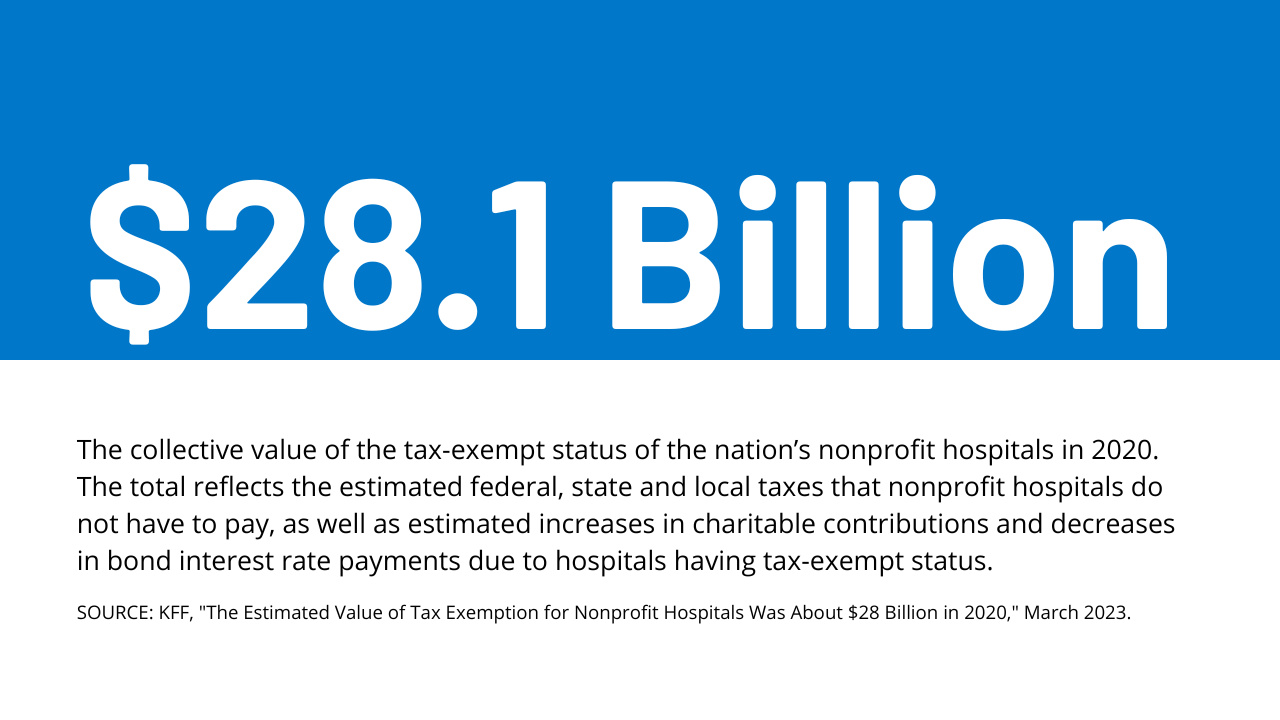
Nonprofit hospitals receive an estimated $28 billion in total tax breaks each year, but give back far less in meaningful community benefits.Lown Institute report found that nonprofit hospitals received $14 billion more in tax breaks than they spent on financial assistance and community health programs in 2020, what we call a Fair Share Deficit. About three quarters of hospitals failed to give back to their communities in amounts commensurate with their tax exemption.

In August, four US Senators sent letters to the IRS asking for clarification on how hospitals are complying with the community benefit standard. And this week majority staff of the Senate Health, Education, Labor, and Pensions (HELP) Committee, chaired by Senator Bernie Sanders, released a report showing how some large hospital systems spend little on financial assistance, despite paying their CEOs whopping 8-figure salaries.

The Sanders report highlights examples of nonprofit hospitals engaging in aggressive billing activities such as sending patients’ medical debt to collections and denying care to patients with outstanding medical debt. The report also adds a new analysis of how much the 16 largest nonprofit hospital systems spend on financial assistance (free and discounted care for patients who can’t afford to pay). They find that 12 of these systems spent less than $0.02 for each dollar in revenue on financial assistance, and six gave less than $0.01. 

The report also called attention to “massive salaries” for some system CEOs, like Commonspirit which paid their CEO $35 million in 2021. Lown Institute data shows vast inequities at some hospitals, with some CEOs making up to 60 times what other hospital workers make.

This underinvestment in financial assistance causes real harm to patients. When hospitals charge patients for care they can’t afford, patients go into debt and often sacrifice basic needs and avoid additional care. An estimated 100 million Americans are in medical debt, and most owe at least some to hospitals. If hospitals paid off their $14 billion fair share deficit, it would be enough to erase the debt of 18 million Americans, which would be a huge step forward for fairness in the country.

AHA provides opposing view

The American Hospitals Association just published their analysis of hospital community benefit spending, finding that hospitals spent $130 billion in 2020, amounting to 15.5% of hospital expenses. That’s far more than other studies estimate

How can the AHA estimate be so different? The answer depends on what’s being counted as a “community benefit.” When you imagine programs to improve community health, you might think of free immunizations, health fairs and educational classes, food pantries and other nutritional assistance, investments in affordable housing, healthcare for the homeless, etc. However, spending on those types of programs made up only 1.8% of hospital expenses in 2020, according to the AHA’s report.

Financial assistance, free or discounted care for eligible patients, is another important category of community benefit spending. But the AHA report doesn’t break out this amount on its own; instead, they lump it in together with Medicaid shortfall and other unreimbursed costs of government programs.

While it’s important that hospitals care for patients with Medicaid, the “shortfall” they report does not go towards tangible community programs or into the pockets of patients. Instead, this is an accounting item related to the discounted prices in Medicaid. Hospitals offer discounts on care to insurers all the time, but these aren’t considered community benefits–why should Medicaid discounts be any different? Most hospitals already make up this shortfall from public insurers by charging private insurers more than their costs of care. The same goes for Medicare shortfall, which the AHA report also includes in their total, despite this not even being considered a “community benefit” by the IRS.

The AHA report also includes bad debt, which is money the hospital expected to get from patients but never received. The AHA argues this spending is a benefit to the community because many patients who don’t pay would have qualified for financial assistance. However, in the real world, policies on financial assistance vary widely and getting access to it can be easy or hard. If a hospital goes to great lengths to make their financial assistance application simple and accessible, and give more in assistance as a result, that should be rewarded. On the other hand, if hospitals make getting assistance hard and hound low-income patients to pay their bills or send their debt to collection agencies, that hardly seems like a “community benefit.”

What can policymakers do?

The Sanders report adds to existing evidence that nonprofit hospitals could do much more to improve community health and earn their tax-exempt status. How can federal policymakers improve transparency and incentives around the community benefit standard? See some of our key recommendations for Congress on this issue.

Hospitals’ ‘dire’ financial situation, in 4 charts

According to a new report from the  American Hospital Association (AHA), hospitals and health systems are facing significant financial pressures from rising expenses, including for labor, drugs, medical supplies and more. And without increased government support, the organization warns that patients’ access to care could be at risk.

Hospitals continue to see expenses grow, negative margins

In the report, AHA writes that several factors, including historic inflation and critical workforce shortages leading to a reliance on contract labor, led to “2022 being the most financially challenging year for hospitals since the pandemic began.”

According to data from  Syntellis Performance Solutions, overall hospital expenses increased by 17.5% between 2019 and 2022 — more than double the increases in Medicare reimbursements during the same time. Between 2019 and 2022, Medicare reimbursement only grew by 7.5%.

https://e.infogram.com/45b88e2f-36be-4acf-b83e-3f8441322ab5?parent_url=https%3A%2F%2Fwww.advisory.com%2Fdaily-briefing%2F2023%2F04%2F26%2Fhospital-challenges%3Futm_source%3Dmember_db%26utm_medium%3Demail%26utm_campaign%3D2023apr26%26utm_content%3Dmember_headline_final_x_infogram_x_x%26elq_cid%3D4778863%26x_id%3D&src=embed#async_embed

With expenses significantly outpacing reimbursement, hospital margins have been consistently negative over the last year. In fact, AHA noted that “over half of hospitals ended 2022 operating at a financial loss — an unsustainable situation for any organization in any sector, let alone hospitals.”

So far, this trend has continued into 2023, with hospitals reporting negative median operating margins in both January and February.

A recent analysis also found that the first quarter of 2023 had the largest number of bond defaults among hospitals in over 10 years. 

https://e.infogram.com/0e03ba0d-cad4-49b4-80da-201819ae9fab?parent_url=https%3A%2F%2Fwww.advisory.com%2Fdaily-briefing%2F2023%2F04%2F26%2Fhospital-challenges%3Futm_source%3Dmember_db%26utm_medium%3Demail%26utm_campaign%3D2023apr26%26utm_content%3Dmember_headline_final_x_infogram_x_x%26elq_cid%3D4778863%26x_id%3D&src=embed#async_embed

Where are hospital expenses increasing?

Between 2019, and 2022 hospital labor expenses increased by 20.8%, a rise that was largely driven by a growing reliance on contract labor to fill in workforce gaps during the pandemic. Even after accounting for an increase in patient acuity, labor expenses per patient increased by 24.7%.

Compared to pre-pandemic levels, hospitals saw a 56.8% increase in the rates they were charged for contract employees in 2022. Overall, hospitals’ contract labor expenses increased by a “staggering” 257.9% in 2022 compared to 2019 levels.

A sharp rise in inflation in recent months has also led to a significant increase in hospitals’ non-labor expenses, particularly for drugs and medical expenses. According to a report by  Kaufman Hall, just non-labor expenses would lead to a $49 billion one-year expense increase for hospitals and health systems.

Since 2019, non-labor expenses have grown 16.6% per patient. Hospitals’ expenses for drugs and medical supplies/equipment have seen similar increases per patient at 19.7% and 18.5%, respectively. Costs of laboratory services (27.1%), emergency services (31.9%), and purchased services, including IT and food and nutrition services, (18%) have also increased significantly per patient. 

https://e.infogram.com/8ea80e49-1f60-47cd-9429-dbd4a0869c60?parent_url=https%3A%2F%2Fwww.advisory.com%2Fdaily-briefing%2F2023%2F04%2F26%2Fhospital-challenges%3Futm_source%3Dmember_db%26utm_medium%3Demail%26utm_campaign%3D2023apr26%26utm_content%3Dmember_headline_final_x_infogram_x_x%26elq_cid%3D4778863%26x_id%3D&src=embed#async_embed

Outside of labor and non-labor expenses, AHA writes that policies from health insurers have also contributed to significant burden among hospital staff and increased administrative costs. Currently, administrative costs account for up to 31% of total healthcare spending — of which, billing and insurance makes up 82%.

https://e.infogram.com/27e64c96-bd58-4e5b-8efb-8748e4a3cc28?parent_url=https%3A%2F%2Fwww.advisory.com%2Fdaily-briefing%2F2023%2F04%2F26%2Fhospital-challenges%3Futm_source%3Dmember_db%26utm_medium%3Demail%26utm_campaign%3D2023apr26%26utm_content%3Dmember_headline_final_x_infogram_x_x%26elq_cid%3D4778863%26x_id%3D&src=embed#async_embed

What Congress can do to support hospitals

With the COVID-19 public health emergency ending on May 11, several important hospital waivers and flexibilities will soon end, and “[t]he downstream effects of this will be wide-ranging as hospitals will be faced with a set of additional challenges,” AHA writes.

“Rising costs for drugs, supplies, and labor coupled with sicker patients, longer hospital stays, and government reimbursement rates that do not come close to covering the costs of caring for patients have created a dire situation for hospitals and health systems,” said AHA president and CEO Rick Pollack.

“This is not just a financial problem; it is an access problem.

When healthcare providers cannot afford the tools and teams they need to care for patients, they will be forced to make hard choices and the people who will be impacted the most are patients. We can’t let that happen. Congress and others must act to preserve the care our nation needs and depend on.”

To address these financial challenges and ensure that hospitals are able to continue caring for patients, AHA has suggested several actions Congress could take to support hospitals going forward, including:

  • Enacting policies to support efforts to boost the healthcare workforce and ensure of future pipeline of professionals to combat longstanding labor shortages
  • Rejecting attempts to cut Medicare or Medicaid payments to hospitals, which could further reduce patients’ access to care
  • Encouraging CMS to use its “special exceptions and adjustments” to make retrospective adjustments to account for differences between what was implemented for fiscal year 2022 and what is currently projected
  • Creating a special statutory designation and providing additional support to hospitals that serve historically marginalized communities

“As the hospital field maintains its commitment to care in the face of significant challenges, policymakers must step up and help protect the health and well-being of our nation by ensuring America has strong hospitals and health systems,” AHA writes.

The Estimated Value of Tax Exemption for Nonprofit Hospitals Was About $28 Billion in 2020

Over the years, some policymakers have questioned whether nonprofit hospitals—which account for nearly three-fifths (58%) of community hospitals—provide sufficient benefit to their communities to justify their exemption from federal, state, and local taxes.

This issue has been the subject of renewed interest in light of reports of nonprofit hospitals taking aggressive steps to collect unpaid medical bills, including suing patients over unpaid medical debt, including patients who are likely eligible for financial assistance. Further, recent research indicates that nonprofit hospitals devote a similar or smaller share of their operating expenses to charity care in comparison to for-profit hospitals. In light of these concerns, several policy ideas have been floated to better align the level of community benefits provided by nonprofit hospitals with the value of their tax exemption.

This data note provides an estimate of the value of tax exemption for nonprofit facilities based on hospital cost reports, filings with the Internal Revenue Service (IRS), and American Hospital Association (AHA) survey data (see Methods for additional details). We define the value of tax exemption as the benefit of not having to pay federal and state corporate income taxes, typically not having to pay state and local sales taxes and local property taxes, and any increases in charitable contributions and decreases in bond interest rate payments that might arise due to receiving tax-exempt status.

Results

The total estimated value of tax exemption for nonprofit hospitals was about $28 billion in 2020 (Figure 1). This represented over two-fifths (44%) of net income (i.e., revenues minus expenses) earned by nonprofit facilities in that year. To put the value of tax exemption in perspective, our estimate is similar to the total value of Medicare and Medicaid disproportionate share hospital (DSH) payments in the same year ($31.9 billion in fiscal year 2020) (i.e., supplemental payments to hospitals that care for a disproportionate share of low-income patients which are intended, in part, to offset the costs of charity care and other uncompensated care).

https://datawrapper.dwcdn.net/MAZAW

The estimated value of federal tax-exempt status was $14.4 billion in 2020, which represents about half (51%) of the total value of tax exemption. This is primarily due to the estimated value of not having to pay federal corporate income taxes ($10.3 billion). In addition, we assumed that individuals contribute more to tax-exempt hospitals because they can deduct donations from their income tax base ($2.5 billion) and issue bonds at lower interest rates because the interest is not taxed ($1.6 billion). Our estimates of changes in charitable contributions and interest rates on bonds only account for federal tax rates for simplicity and may therefore understate the total value of tax exemption because they do not account for the effects of state taxes.

The total estimated value of state and local tax-exempt status was $13.7 billion in 2020, which represents about half (49%) of the total value of tax exemption. This amount includes the estimated value of not having to pay state or local sales taxes ($5.7 billion), local property taxes ($5.0 billion) or state corporate income taxes ($3.0 billion).

The total estimated value of tax exemption (about $28 billion) exceeded total estimated charity care costs ($16 billion) among nonprofit hospitals in 2020 (Figure 2), though charity care represents only a portion of the community benefits reported by these facilities. Hospital charity care programs provide free or discounted services to eligible patients who are unable to afford their care and represent one of several different types of community benefits reported by hospitals.

The Internal Revenue Service (IRS) also defines community benefits to include unreimbursed Medicaid expenses, unreimbursed health professions education, and subsidized health services that are not means-tested, among other activities. One study estimated that the value of tax exemption exceeded the value of community benefits broadly for about one-fifth (19%) of nonprofit hospitals during 2011-2018 or about two-fifths (39%) when considering the incremental value of community benefits provided relative to for-profit facilities. Other research suggests that nonprofit hospitals devote a similar or smaller share of their operating expenses to charity care and unreimbursed Medicaid costs—which accounted for most of the value of community benefits in 2017—when compared to for-profit hospitals.

https://datawrapper.dwcdn.net/JxC4B

The value of tax exemption grew from about $19 billion in 2011 to about $28 billion in 2020, representing a 45 percent increase (Figure 3). The value of tax exemption increased in most of the years (7 out of 9) in our analysis, though there was a notable decrease of $5.8 billion in 2018. The largest single-year increase was $4.1 billion in 2020. The large decrease in the value of tax exemption in 2018 coincided with the implementation of the Tax Cuts and Jobs Act of 2017, which permanently reduced the federal corporate income tax rate from 35 to 21 percent and therefore decreased the value of being exempt from federal income taxes.

https://datawrapper.dwcdn.net/Oiork

The large increase in the value of tax exemption in 2020 overlapped with the start of the COVID-19 pandemic. This increase primarily reflects a large increase in aggregate net income for nonprofit hospitals in 2020. Although there were disruptions in hospital operations in 2020, hospitals received substantial amounts of government relief, and it is possible that other sources of revenue, such as from investment income, may have also increased. Increases in net income in turn increased the value of not having to pay federal and state income taxes.

Increases in the estimated value of tax exemption over time also reflect net income growth that preceded the pandemic as well as increases in estimated property values, supply expenses, and charitable contributions, each of which would carry tax implications if hospitals lost their tax-exempt status (e.g., with some supply expenses being subject to sales taxes). Even when setting aside the strong financial performance of nonprofit hospitals in 2020 as a potential outlier, total net income among nonprofit facilities increased substantially in the preceding years, before increasing further in 2020. Although we are not able to directly observe the value of the real estate owned by hospitals, the estimated value of exemption from local property taxes—which is based on our analysis of property taxes paid by for-profit hospitals—increased by 63 percent from 2011 to 2019. Finally, the supply expenses in our analysis increased by 44 percent and charitable contributions increased by 49 percent from 2011 to 2019.

Discussion

The estimated value of tax exemption for nonprofit hospitals increased from about $19 billion in 2011 to about $28 billion in 2020. The rising value of tax exemption means that federal, state, and local governments have been forgoing increasing amounts of revenue over time to provide tax benefits to nonprofit hospitals, crowding out other uses of those funds. This has raised questions about whether nonprofit facilities provide sufficient benefit to their communities to justify this tax benefit. Federal regulations require, among other things, that nonprofit hospitals provide some level of charity care and other community benefits as a condition of receiving tax-exempt status. However, a 2020 Government Accountability Office (GAO) report raised questions about whether the government has adequately enforced this requirement. Further, some argue that the federal definition of “community benefits” is too broad—e.g., by including medical training and research that could benefit hospitals directly—though others believe that the definition is too narrow. Most states have additional community benefit requirements for nonprofit or broader groups of hospitals—such as providing charity care to patients below a specified income threshold—though there is little information about the effectiveness of these regulations or the extent to which they are enforced.

Several policy ideas have been floated at the federal and state level that would increase the regulation of community benefits spending among nonprofit hospitals or among hospitals more generally. These include proposals to create or expand state requirements that hospitals provide charity care to patients below a specified income threshold, mandate that nonprofit hospitals provide a minimum amount of community benefits, establish a floor-and-trade system where hospitals would be required to either provide a minimum amount of charity care or subsidize other hospitals that do so, create mechanisms to increase the uptake of charity care, expand oversight and enforcement of community benefit requirements, replace current tax benefits with a subsidy that is tied to the value of community benefits provided, and introduce reforms intended to better align community benefits with local or regional needs.

These policy options would inevitably involve tradeoffs. While they may expand the provision of certain community benefits, hospitals would incur new costs as a result, which could in turn have implications for what services they offer, how much they charge commercially insured patients, and how much they invest in the quality of care.

Irresponsible rhetoric should not drive public policy

https://www.aha.org/news/blog/2023-03-29-blog-irresponsible-rhetoric-should-not-drive-public-policy

The AHA has previously noted the third party observers who demonstrate a tenuous grasp of the data and rules regarding federal hospital transparency requirements. Now, some of those same entities with deep pockets and an apparent vendetta against hospitals and health systems have turned their attention toward the broader financial challenges facing the field. The results, as described in a recent Health Affairs blog, are as expected — a complete misunderstanding of current economic realities.

The three most egregious suggestions in this piece are that hospitals are seeking some kind of bailout from the federal government, employers and patients; that investment losses are the most problematic aspect of hospital financing; and that hospitals’ analyses of their financial situation are dishonest.

We debunk these in turn.

Hospitals are seeking fair compensation, not a government bailout. The authors state that hospitals are asking “constituents to foot the bill for hospitals’ investment losses.” This is patently false. Indeed, if you read the request we made to Congress cited in their blog, hospitals and health systems are simply asking to get paid for the care they deliver or to lower unnecessary administrative costs. This includes asking Medicare to pay for the days hospitals care for patients who are otherwise ready for discharge. Increasingly, this has occurred because there is no space in the next site of care or the patient’s insurer has delayed the authorization for that care. Keeping someone in a hospital bed for days, if not weeks, requires skilled labor, supplies and basic infrastructure costs. This doesn’t even account for the impact on a patient’s health for not being in the most appropriate care setting. Today, hospitals are not paid for these days. Asking for fair compensation is not a bailout; it is a basic responsibility of any purchaser.

While investment income may be down, hospitals and health systems have faced massive expense increases in the last year. The authors note that patient care revenue was up “by just below 1 percent in relative terms from 2021 to 2022,” suggesting that implies a positive financial trend. However, hospital total expenses were up 7% in 2022 over 2021, and were up by even more, 20%, when compared to pre-pandemic levels, according to Kaufman Hall. And it’s not just the AHA and Kaufman Hall saying this either: in its 2023 outlook, credit rating agency Moody’s noted that “margins will remain constrained by high expenses.” Hospitals should not need to rely on investment income for operations. However, many have been forced into this situation by substantial underpayments from their largest payers (Medicare and Medicaid), which even the Medicare Payment Advisory Commission (MedPAC), an independent advisor to Congress, has acknowledged. MedPAC’s most recent report showed a negative 8.3% Medicare operating margin. Hospitals and health systems are experiencing run-away increases in the supplies, labor and technology needed to care for patients. At the same time, commercial insurance companies are increasing their use of policies that can cause dangerous delays in care for patients, result in undue burden on health care providers and add billions of dollars in unnecessary costs to the health care system.

Hospitals and health systems are committed to an honest examination of the facts. The authors imply that the studies documenting hospitals’ financial distress are biased. They note that certain studies conducted by Kaufman Hall are based on proprietary data and therefore “challenging to draw general inferences.” They then go on to cherry-pick metrics from specific non-profit health care systems voluntarily released financial disclosures to make general claims about “the primary driver of hospitals’ financial strain.” The authors and their financial backers clearly seem to have a preconceived narrative, and ignore all the other realities that hospital and health system leaders are confronting every day to ensure access to care and programs for the patients and communities they serve.

It is imperative to acknowledge financial challenges facing hospitals and health systems today. Too much is at stake for the patients and communities that depend upon hospitals and health systems to be there, ready to care.

AHA: MedPAC’s 2024 Medicare payment recommendation is ‘out of touch with reality’

MedPAC’s recommendation that acute care hospitals don’t need a significant increase in 2024 Medicare rates is “totally insufficient and out of touch with reality,” according to the American Hospital Association.

“This view is one-sided, inaccurate and misleading,” Ashley Thompson, AHA’s senior vice president of public policy analysis and development, wrote in a March 23 blog post. “After years of once-in-a-lifetime events in the form of a global pandemic and record inflation, hospitals across the country are struggling to continue to fulfill their mission to care for their patients and communities.”

In its annual March report to Congress, MedPAC recommended an update to hospital payment rates of “current law plus 1 percent,” which the AHA says is not enough for many hospitals to keep their doors open. 

The commission found that most indicators of sufficient Medicare rates for providers were positive or improved in 2021, though it acknowledged that hospitals saw more volatile cost increases in 2022 compared to years prior. Hospital margins were also lower last year than in 2021, according to preliminary data, driven in part by providers facing higher than expected costs and capacity and staffing challenges.

The report also said that its 2024 payment recommendations “may not be sufficient” to sustain some safety-net hospitals with a low number of commercially insured patients, and proposed $2 billion in add-on payments.

Across the U.S., a total of 631 rural hospitals — or about 30 percent of all rural hospitals — are at risk of closing in the immediate or near future.

MedPAC’s recommendations for 2024 differ from how some health economists have recently described hospitals’ finances. In January, hospitals had a median operating margin of -1 percent according to Kaufman Hall, a finding that arrived on the heels of 2022 being named the worst financial year for hospitals since the start of the COVID-19 pandemic.

“It is also important to realize that MedPAC’s report and data has limitations,” Ms. Thompson wrote, referring to a misalignment in the calendar year MedPAC chose to analyze and how hospitals can differ in how they report their individual financial earnings.

MedPAC said its report reflects 2021 data, preliminary data from 2022, and projections for 2023, along with recent inflation rates.

“…cost reports are filed for hospitals’ own specific fiscal years, and because surges, relief payments, and eventual expense increases happened at different times for different hospitals, these calculated margins don’t necessarily provide a fully accurate picture of the financial reality in 2021,” Ms. Thompson wrote.

The AHA stressed that hospitals’ finances in 2023 face much different challenges compared to 2021, when the industry was more supported by strong investment returns and federal pandemic relief. 

“The fact that massive numbers of hospitals are not currently closing due to financial pressures should be seen as positive for patients and communities,” Ms. Thompson said. “Instead, some observers seem to be disappointed that more hospitals are not failing financially.”

A detailed response from the AHA to the MedPAC report is available here.

Why are 600+ rural hospitals at risk of closing?

https://www.advisory.com/daily-briefing/2023/03/22/rural-hospitals

A report from the Center for Healthcare Quality and Payment Reform (CHQPR) found that over 600 rural hospitals are at risk of closing in 2023, citing persistent financial challenges related to patient services or depleted financial resources.

More than 600 rural hospitals are at risk of closing in 2023

In the report, which was released in January, CHQPR identified 631 rural hospitals — over 29% nationwide — at risk of closing in 2023. However, compared to pre-pandemic levels, fewer rural hospitals are at immediate risk of closing because of the federal relief they received during the pandemic.

Among rural hospitals at risk of closing, CHQPR found two common contributing factors. First, these hospitals reported persistent financial losses of patient services over a multi-year period, excluding the first year of the COVID-19 pandemic. Second, these hospitals reported low financial reserves, with insufficient net assets to counter losses on patient services over a period of more than six years. 

In most states, at least 25% of the rural hospitals are at risk of closing, and in 12 states, 40% or more are at risk.

Meanwhile, more than 200 of these rural hospitals are facing an immediate risk of closing. According to CHQPR, these hospitals have inadequate revenues to cover expenses and very low financial reserves.

“Costs have been increasing significantly and payments, particularly from commercial insurance plans, have not increased correspondingly with that,” said Harold Miller, president and CEO of CHQPR. “And the small hospitals don’t have the kinds of financial reserves to be able to cover the losses.”

How rural hospital closures impact communities

In many cases, the closure of a rural hospital leads to a loss of access to comprehensive medical care in a community. Most of the at-risk hospitals are in areas where closure would result in community residents being forced to travel a long distance for emergency or inpatient care.

“In many of the smallest rural communities, the only thing there is the hospital,” Miller said. “The hospital is the only source. Not only is it the only emergency department and the only source of inpatient care, it’s the only source of laboratory services, the only place to get an X-ray or radiology. It may even be the only place where there is primary care.”

Many small hospitals also run health clinics. “There literally wouldn’t be any physicians in the community at all if it wasn’t for the rural hospital running that rural health clinic,” Miller said. “So if the hospital closes, you’re literally eliminating all health care services in the community.”

According to Miller, there has to be a fundamental change in the way hospitals are paid. “The problem that hospitals have faced though, is that they do two fundamentally different things — but they are only paid for one of them,” Miller said.

“Hospitals deliver services to patients when they are sick, and they are paid for that. But the other thing that hospitals do, which is essential for a community, is that they are available when somebody needs them — that standby capacity is critical for a community. But hospitals aren’t paid for that,” he added. (Higgs, Cleveland.com, 3/16; CHQPR report, accessed 3/20)

Advisory Board’s take

Why it is ‘not enough’ to simply stave off hospital closures

Hospital closures are a big deal — for all the reasons outlined above (and more) — but we cannot understate the importance of monitoring hospitals that are in or moving into the “at risk” category.

When hospitals fall into the “at risk” category, they are more likely to cut services to reduce costs. While this may help preserve hospital survival, it can have a devastating effect on patient access. For instance, a 2019 Health Affairs study found that rural hospital closures are associated with an 8% annual decrease in the supply of general surgeons in the years preceding closure.

While dangerous trends persist in maternal mortality, especially among Black women, obstetrics (OB) care is often placed on the chopping block for hospitals looking to rationalize services and stave off closure. According to the American Hospital Association (AHA), nearly 90 rural community hospitals closed OB units between 2015-2019. As of 2020, only 53% of rural community hospitals offered OB services, AHA reports.

Ultimately, these service closures carry massive implications for patient access and outcomes. As care delays result in higher-acuity downstream presentation, they can also increase the strain on the rest of the healthcare system.

So, yes, we need to stave off hospital closures. But to say “that’s not enough” is a massive understatement. In fact, many of the strategies hospitals deploy to stave off closure can create gaps that stakeholders must work together to fill.

This is especially true as we near the end of the COVID-19 public health emergency. As Medicaid redeterminations start ramping up, rural hospitals may see an increase in bad debt, especially among states that have not expanded Medicaid.

For example, the Alabama Rural Health Association reported that 55 of 67 counties in Alabama are considered rural, and CHQPR reported that 48% of rural hospitals in the state are at risk of closing. Meanwhile, the Wyoming Department of Health reported that 17 of 23 counties in the state are considered “Frontier,” which means there are fewer than six residents per square mile, and CHQPR reported that 29% of the state’s rural hospitals are at risk of closure.

When rural hospitals close their doors, the surrounding communities are left without access to timely, quality health care.

There is no silver bullet here — but Advisory Board researchers have created several resources to help stakeholders understand how to support rural hospitals:

Rural providers aren’t providing “rural healthcare” — they’re providing healthcare in a rural setting. While niche policies can help in pockets, rural providers need federal policymakers to consider rural needs in overall health policy to meet the magnitude of the crisis.

Lawmakers stress urgency of healthcare worker shortage

https://www.healthcaredive.com/news/lawmakers-fixes-healthcare-workforce-shortages/642994/

Addressing the education pipeline is one thing that legislators could focus on to improve nurse and physician shortages, medical school and health system leaders said.

As the healthcare industry continues to face pandemic-driven workforce challenges, lawmakers are exploring ways to boost the number of clinicians practicing in the U.S.

“A shortage of healthcare personnel was a problem before the pandemic and now it has gotten worse,” Chairman Sen. Bernie Sanders I-Vt., said during a Thursday Senate HELP committee hearing. “Health care jobs have gotten more challenging and, in some cases, more dangerous,” he said.

The country faces a shortage of up to 124,000 physicians by 2034, including 48,000 primary care physicians, according to the Association of American Medical Colleges.

Hospitals are currently facing shortages of registered nurses as burnout and other factors drive them to other roles. 

For example, 47-hospital system Ochsner Health in New Orleans has about 1,200 open nursing positions, Chief Academic Officer Leonardo Seoane said at Thursday’s hearing.

The workforce shortaged led Ochsner to close about 100 beds across its system during the past six months, leading to it use already-constrained emergency departments as holding bays for patients, he said.

Like other systems, labor costs have also been a concern due to a continued reliance on temporary staff to fill gaps. Ochsner’s non-agency labor costs grew just under 60% since 2019, while its costs for contract staff grew nearly 900%, he said.

“Our country is perilously short of nurses, and those we do have are often not working in the settings that could provide the most value,” Sarah Szanton, dean of Johns Hopkins School of Nursing said.

“This was true before the pandemic and has become more acute,” she said.

While many nurses left permanent roles for higher-paying contract positions during the pandemic, others have turned to jobs at outpatient clinics, coinciding with a shift toward non-hospital based care.

Registered nurse employment is nearly 5% above where it was in 2019, with nearly all that growth occurring outside of hospitals, Douglas Staiger, a professor of economics at Dartmouth College, found in his research and said at the hearing.

One major concern: Driving current and projected shortages in hospitals that lawmakers can address is the educational pipeline, medical school and health system leaders said.

Educational programs for nurses and physicians face site shortages and educators who are often allured by other higher-paying jobs in the industry.

Nursing educators in Vermont earn about $65,000 a year — about half of what nurses with similar degrees working in hospitals earn, Sanders said during the hearing. He asked members to consider expanding the Nurse Corps and nurse faculty loan repayments, among other programs.

Supporting partnerships between universities and hospitals to create more training opportunities is another way Congress can help, along with addressing high costs of tuition, James Herbert, president of University of New England, said during the hearing.

“Scholarship and loan repayment programs are critical to make healthcare education more accessible for those who would otherwise find it out of reach,” Herbert said.

That includes expanding and improving Medicare-funded physician residencies, he said.

Creating a more diverse workforce that looks more like the population it serves is another important task, and one lawmakers can address by supporting historically black colleges and universities.

Federal funding could help improve classrooms and other infrastructure at HBCUs “that have been egregiously are underfunded for decades,” in addition to expanding Medicare-funded residencies for hospitals that train a large number of graduates for HBCU medical schools, said James Hildreth Sr., president and CEO at Meharry Medical College in Nashville.

The American Hospital Association submitted a statement to the HELP subcommittee and said it also supports increasing the number of residency slots eligible for Medicare funds and rejecting cuts to curb long-term physician shortages.

Other AHA supported policies to address current and long-term workforce shortages include better funding for nursing schools and supporting expedited visas for foreign-trained nurses.

AHA also asked lawmakers to look into travel nurse staffing agencies, reviving requests it made last year alleging that staffing companies engaged in price gouging during the pandemic.

Last year some state lawmakers considered capping the rate hospitals can pay agencies for temporary nursing staff, though none ended up passing legislation to do so.

FTC proposes banning noncompete agreements

https://mailchi.mp/59374d8d7306/the-weekly-gist-january-13-2023?e=d1e747d2d8

Last Thursday, the Federal Trade Commission (FTC) released a proposed rule that would ban employers from imposing noncompete agreements on their employees. Noncompetes affect roughly 20 percent of the American workforce, and healthcare providers would be particularly impacted by this change, as far greater shares of physicians—at least 45 percent of primary care physicians, according to one oft-cited study—are bound by such agreements.

The rulemaking process is expected to be contentious, as the US Chamber of Commerce has declared the proposal “blatantly unlawful”. While it is unclear whether the rule would apply to not-for-profit entities, the American Hospital Association has released a statement siding with the Chamber of Commerce and urging that the issue continue to be left to states to determine.

The Gist: Should this sweeping rule go into effect, it would significantly shift bargaining power in the healthcare sector in favor of doctors, allowing them the opportunity to move away from their current employers while retaining local patient relationships.

The competitive landscape for physician talent would change dramatically, particularly for revenue-driving specialists, who would have far greater flexibility to move from one organization to another, and to push aggressively for higher compensation and other benefits.

Given that the FTC cited suppressed competition in healthcare as an outcome of current noncomplete agreements, the burden will be on organizations that employ physicians—including health systems and insurers, as well as private equity-backed corporate entities—to prove that physician noncompetes are essential to their operations and do not raise prices, as the FTC has suggested.