Talk Is Cheap: Now Trump Must Deliver On His Healthcare Promises

https://www.forbes.com/sites/robertpearl/2025/06/09/talk-is-cheap-now-trump-must-deliver-on-his-healthcare-promises/

President Donald Trump has made big promises about fixing American healthcare. Now comes the moment that separates talk from action.

With the 2026 midterms fast approaching and congressional attention soon shifting to electoral strategy, the window for legislative results is closing quickly. This summer will determine whether the administration turns promises into policy or lets the opportunity slip away.

Trump and his handpicked healthcare leaders — HHS Secretary Robert F. Kennedy Jr. and FDA Commissioner Dr. Marty Makary — have identified three major priorities: lowering drug prices, reversing chronic disease and unleashing generative AI. Each one, if achieved, would save tens of thousands of lives and reduce costs.

But promises are easy. Real change requires political will and congressional action. Here are three tests that Americans can use to gauge whether the Trump administration succeeds or fails in delivering on its healthcare agenda.

Test No. 1: Have Drug Prices Come Down?

Americans pay two to four times more for prescription drugs than citizens in other wealthy nations. This price gap has persisted for more than 20 years and continues to widen as pharmaceutical companies launch new medications with average list prices exceeding $370,000 per year.

One key reason for the disparity is a 2003 law that prohibits Medicare from negotiating prices directly with drug manufacturers. Although the Inflation Reduction Act of 2022 granted limited negotiation rights, the initial round of price reductions did little to close the gap with other high-income nations.

President Trump has repeatedly promised to change that. In his first term, and again in May 2025, he condemned foreign “free riders,” promising, “The United States will no longer subsidize the healthcare of foreign countries and will no longer tolerate profiteering and price gouging.”

To support these commitments, the president signed an executive order titled “Delivering Most-Favored-Nation (MFN) Prescription Drug Pricing to American Patients.” The order directs HHS to develop and communicate MFN price targets to pharmaceutical manufacturers, with the hope that they will voluntarily align U.S. drug prices with those in other developed nations. Should manufacturers fail to make significant progress toward these targets, the administration said it plans to pursue additional measures, such as facilitating drug importation and imposing tariffs. However, implementing these measures will most likely require congressional legislation and will encounter substantial legal and political challenges.

The pharmaceutical industry knows that without congressional action, there is no way for the president to force them to lower prices. And they are likely to continue to appeal to Americans by arguing that lower prices will restrict innovation and lifesaving drug development.

But the truth about drug “innovation” is in the numbers: According to a study by America’s Health Insurance Plans, seven out of 10 of the largest pharmaceutical companies spend more on sales and marketing than on research and development. And if drugmakers want to invest more in R&D, they can start by requiring peer nations to pay their fair share — rather than depending so heavily on U.S. patients to foot the bill.

If Congress fails to act, the president has other tools at his disposal. One effective step would be for the FDA to redefine “drug shortages” to include medications priced beyond the reach of most Americans. That change would enable compounding pharmacies to produce lower-cost alternatives just as they did recently with GLP-1 weight-loss injections.

If no action is taken, however, and Americans continue paying more than twice as much as citizens in other wealthy nations, the administration will fail this crucial test.

Test No. 2: Did Food Health, Quality Improve?

Obesity has become a leading health threat in the United States, surpassing smoking and opioid addiction as a cause of death.

Since 1980, adult obesity rates have surged from 15% to over 40%, contributing significantly to chronic diseases, including type 2 diabetes, heart disease and multiple types of cancers.

A major driver of this epidemic is the widespread consumption of ultra-processed foods: products high in added sugar, unhealthy fats and artificial additives. These foods are engineered to be hyper-palatable and calorie-dense, promoting overconsumption and, in some cases, addictive eating behaviors.

RFK Jr. has publicly condemned artificial additives as “poison” and spotlighted their impact on children’s health. In May 2025, he led the release of the White House’s Make America Healthy Again (MAHA) report, which identifies ultra-processed foods, chemical exposures, lack of exercise and excessive prescription drug use as primary contributors to America’s chronic disease epidemic.

But while the report raises valid concerns, it has yet to produce concrete reforms.

To move from rhetoric to results, the administration will need to implement tangible policies.

Here are three approaches (from least difficult to most) that, if enacted, would signify meaningful progress:

  • Front-of-package labeling. Implement clear and aggressive labeling to inform consumers about the nutritional content of food products, using symbols to indicate healthy versus unhealthy options.
  • Taxation and subsidization. Impose taxes on unhealthy food items and use the revenue to subsidize healthier food options, especially for socio-economically disadvantaged populations.
  • Regulation of food composition. Restrict the use of harmful additives and limit the total amount of fat and sugar included, particularly for foods aimed at kids.

These measures will doubtlessly face fierce opposition from the food and agriculture industries. But if the Trump administration and Congress manage to enact even one of these options — or an equivalent reform — they can claim success.

If, instead, they preserve the status quo, leaving Americans to decipher nutritional fine print on the back of the box, obesity will continue to rise, and the administration will have failed.

Test No. 3: Are Patients Using Generative AI To Improve Health?

The Trump administration has signaled a strong commitment to using generative AI across various industries, including healthcare. At the AI Action Summit in Paris, Vice President JD Vance made the administration’s agenda clear: “I’m not here this morning to talk about AI safety … I’m here to talk about AI opportunity.”

FDA Commissioner Dr. Marty Makary has echoed that message with internal action. After an AI-assisted scientific review pilot program, he announced plans to integrate generative AI across all FDA centers by June 30.

But internal efficiency alone won’t improve the nation’s health. The real test is whether the administration will help develop and approve GenAI tools that expand clinical access, improve outcomes and reduce costs.

To these ends, generative AI holds enormous promise:

  • Managing chronic disease: By analyzing real-time data from wearables, GenAI can empower patients to better control their blood pressure, blood sugar and heart failure. Instead of waiting months between doctor visits for a checkup, patients could receive personalized analyzes of their data, recommendations for medication adjustments and warnings about potential risk in real time.
  • Improving diagnoses: AI can identify clinical patterns missed by humans, reducing the 400,000 deaths each year caused by misdiagnoses.
  • Personalizing treatment: Using patient history and genetics, GenAI can help physicians tailor care to individual needs, improving outcomes and reducing side effects.

These breakthroughs aren’t theoretical. They’re achievable. But they won’t happen unless federal leaders facilitate broad adoption.

That will require investing in innovation. The NIH must provide funding for next-generation GenAI tools designed for patient empowerment, and the FDA will need to facilitate approval for broad implementation. That will require modernizing current regulations. The FDA’s approval process wasn’t built for probabilistic AI models that rely on continuous application training and include patient-provided prompts. Americans need a new, fit-for-purpose framework that protects patients without paralyzing progress.

Most important, federal leaders must abandon the illusion of zero risk. If American healthcare were delivering superior clinical outcomes, managing chronic disease effectively and keeping patients safe, that would be one thing. But medical care in the United States is far from that reality. Hundreds of thousands of Americans die annually from poorly controlled chronic diseases, medical errors and misdiagnoses.

If generative AI technology remains confined to billing support and back-office automation, the opportunity to transform American healthcare will be lost. And the administration will have failed to deliver on this promise.

When I teach strategy at Stanford’s Graduate School of Business, I tell students that the best leaders focus on a few high-priority goals with clear definitions of success — and a refusal to accept failure. Based on the administration’s own words, grading the administration on these three healthcare tests will fulfill those criteria.

However, with Labor Day just months away, the window for action will soon close. The time for presidential action is now.

Poll results: AGI and the future of medicine

Artificial general intelligence (AGI) refers to AI systems that can match or exceed human cognitive abilities across a wide range of tasks, including complex medical decision-making.

With tech leaders predicting AGI-level capabilities within just a few years, clinicians and patients alike may soon face a historic inflection point: How should these tools be used in healthcare, and what benefits or risks might they bring? Last month’s survey asked your thoughts on these pressing questions. Here are the results:

My thoughts: 

I continue to be impressed by the expertise of readers. Your views on artificial general intelligence (AGI) closely align with those of leading technology experts. A clear majority believes that AGI will reach clinical parity within five years. A sizable minority expect it will take longer, and only a small number doubt it will ever happen.

Your answers also highlight where GenAI could have the greatest impact. Most respondents pointed to diagnosis (helping clinicians solve complex or uncertain medical problems) as the No. 1 opportunity. But many also recognized the potential to empower patients: from improving chronic disease management to personalizing care. And unlike the electronic health record, which adds to clinicians’ workloads (and contributes to burnout), GenAI is widely seen by readers as a tool that could relieve some of that burden.

Ultimately, the biggest concern may lie not with the technology, itself, but in who controls it. Like many of you, I worry that if clinicians don’t lead the way, private equity and for-profit companies will. And if they do, they will put revenue above the interests of patients and providers.

Thanks to those who voted. To participate in future surveys, and for access to timely news and opinion on American healthcare, sign up for my free (and ad-free) newsletter Monthly Musings on American Healthcare.

* * *

Dr. Robert Pearl is the former CEO of The Permanente Medical Group, the nation’s largest physician group. He’s a Forbes contributor, bestselling author, Stanford University professor, and host of two healthcare podcasts. Check out Pearl’s newest book, ChatGPT, MD: How AI-Empowered Patients & Doctors Can Take Back Control of American Medicine with all profits going to Doctors Without Borders.

The Great Flattening

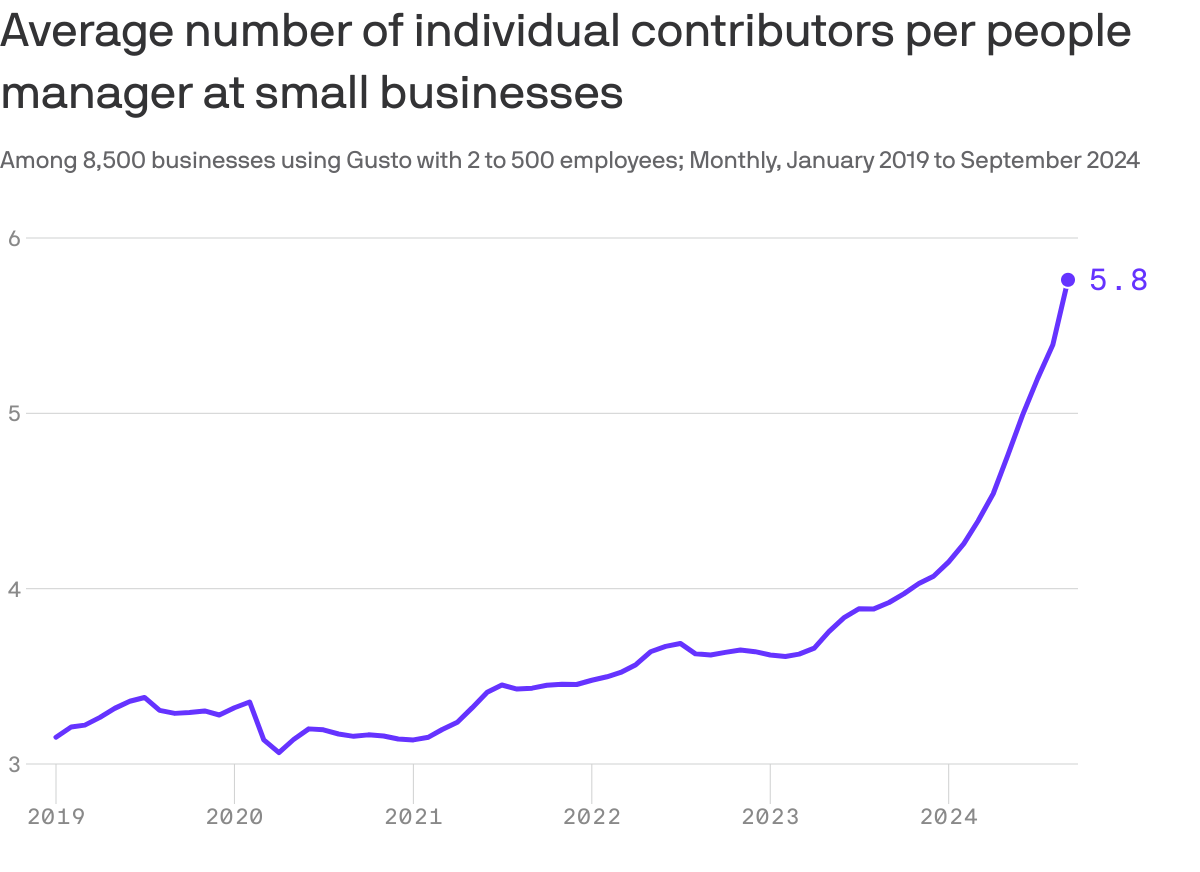
This chart may explain why your boss is taking longer to get back to you lately: They’ve got more underlings to watch over, Axios’ Emily Peck writes from a new analysis.

  • Why it matters: Middle managers — i.e., bosses who have bosses — were already quietly going extinct, and now AI may be hastening the process.

By the numbers: 

People managers now oversee about twice as many workers as just five years ago.

  • There are now nearly six individual contributors per manager at the 8,500 small businesses analyzed in a report by Gusto, which handles payroll for small and medium-sized employers.
  • That’s up from a little over three in 2019.

🎨 The big picture: 

Big Tech has been shedding middle managers for the past few years, a process that’s been dubbed the Great Flattening.

  • Reducing management layers is one of Microsoft’s stated goals in laying off thousands of workers this year as it ramps up its AI strategy.
  • Amazon CEO Andy Jassy last year announced an effort to reduce managers (memo).

91% Of Healthcare Is Government Subsidized. Is Your Coverage Safe?

https://www.forbes.com/sites/robertpearl/2025/03/24/91-of-healthcare-is-government-subsidized-is-your-coverage-safe/

Most Americans believe their healthcare is private, and the majority prefers it that way. Gallup polling shows more Americans favor a system based on private insurance rather than government-run healthcare.

But here’s a surprising reality: 91% of Americans receive government-subsidized healthcare.

Unless you’re among the uninsured or the few who receive no subsidies, government dollars are helping pay your medical bills — whether your insurance comes from an employer, a privately managed care organization or the online marketplace.

Now, as lawmakers face mounting budget pressures, those subsidies (and your coverage) could be at risk. If the government scales back its healthcare spending, your medical costs could skyrocket.

Here’s a closer look at the five ways the U.S. government funds healthcare. If you have health insurance, you’re almost certainly benefiting from one of them:

  1. Medicare, the government-run healthcare program for those 65 and older, covers 67 million Americans at a cost of more than $1 trillion annually. Approximately half of enrollees are covered through the traditional fee-for-service plan and the other half in privately managed Medicare Advantage plans.
  2. Medicaid and CHIP provide health coverage for around 80 million low-income and disabled Americans, including tens of millions of children. Even though 41 states have turned over their Medicaid programs over to privately managed care organizations, the cost remains public. Total Medicaid spending is $900 billion annually — the federal government pays 70% with states footing the rest.
  3. The online healthcare marketplace is for Americans whose employer doesn’t provide medical coverage or who are self-employed. This Affordable Care Act program offers federal subsidies to 92% of its 23 million enrollees, which help lower the cost of premiums and, for many, subsidize their out-of-pocket expenses. The Congressional Budget Office projects that a permanent extension of these subsidies, which are scheduled to end this year, would cost $383 billion over the next 10 years.
  4. Veterans and military families also benefit from government healthcare through TRICARE and VA Care, programs covering roughly 16 million individuals at a combined cost of $148 billion for the federal government annually.
  5. Employer-sponsored health insurance comes with a significant, yet often overlooked, government subsidy. For nearly 165 million American workers and their families, U.S. companies pay the majority of their health insurance premiums. However, those dollars are excluded from employees’ taxable income. This tax break, which originated during World War II and was formally codified in the 1950s, subsidizes workers at an annual government cost of approximately $300 billion. For a typical family of four, this translates into approximately $8,000 per year of added take-home pay.

With 91% of Americans receiving some form of government healthcare assistance, the idea that U.S. healthcare is predominantly “private” is an illusion.

Now, as the new administration searches for ways to rein in the growing federal deficit, all five of these programs (collectively funding healthcare for 9 in 10 Americans) will be in the crosshairs.

Twelve percent of the federal budget already goes toward debt interest payments, and this share is expected to rise sharply. Many of the bonds used to finance existing debt were issued back when interest rates were much lower. As those bonds mature and are refinanced at today’s higher rates, federal interest payments are projected to double within the next decade, according to the Congressional Budget Office.

With deficits mounting and borrowing costs soaring, most economists agree this trajectory is unsustainable. Lawmakers will eventually need to rein in spending, and healthcare subsidies will almost certainly be among the first targets. Policy experts predict Medicaid, which the House has already proposed cutting by $880 billion over the next decade, and ACA subsidies for out-of-pocket costs will likely be the first on the chopping block. But given the CBO’s projections, these cuts won’t be the last.

A Better Way: Three Solutions To Lower Healthcare Costs Without Cuts

Cutting some or all of these healthcare subsidies may seem like the simplest way to reduce the deficit. In reality, it merely shifts costs elsewhere, making medical care more expensive for everyone and increasing future government spending. Here’s why:

  • Eliminating subsidies doesn’t eliminate the need for care. Under the Emergency Medical Treatment and Labor Act (EMTALA), hospitals must treat emergency patients regardless of their ability to pay. When millions lose insurance, more turn to ERs for medical care they can’t afford. The cost of that uncompensated care doesn’t vanish. It gets passed on to state governments, hospitals and privately insured patients through higher taxes, inflated hospital bills and rising insurance premiums.
  • Delaying care drives up long-term costs. People who can’t afford doctor visits skip preventive care, screenings and early treatments. Manageable conditions like high blood pressure and diabetes then spiral into costly, life-threatening complications including heart attacks, strokes and kidney failures, which ultimately increase government spending.

The solution isn’t cutting coverage. It’s fixing the root causes of high healthcare costs. Here are three ways to achieve this:

1. Address The Obesity Epidemic

Obesity is a leading driver of diabetes, heart disease, stroke and breast cancer, which kill millions of Americans and cost the U.S. healthcare system hundreds of billions annually. Congress can take two immediate steps to reverse this crisis:

2. Enhance Chronic Disease Management With Technology

In every other industry, broad adoption of generative AI technology is already increasing quality while reducing costs. Healthcare could do the same by applying generative AI to more effectively manage chronic disease. According to the Centers for Disease Control and Prevention, improved control of these lifelong conditions could cut the frequency of heart attacks, strokes, kidney failures and cancers by up to 50%.

With swift and reasonable Food and Drug Administration approval, generative AI and wearable monitors would revolutionize how these conditions are managed, providing real-time updates on patient health and identifying when medications need adjustment. Instead of waiting months for their next in-office visit, patients with chronic diseases would receive continuous monitoring, preventing costly and life-threatening complications. Rather than restricting AI’s role in healthcare, Congress can streamline the FDA’s approval process and allocate National Institutes of Health funding to accelerate these advancements.

3. Reform Healthcare Payment Models

Under today’s fee-for-service system, doctors and hospitals are paid based on the how often they see patients for the same problem and the number of procedures performed. This approach rewards the volume of care, not the best and most effective treatments. A better alternative is a pay-for-value model like capitation, in which providers do best financially when they help keep patients healthy. To encourage participation, Congress should fund pilot programs and create financial incentives for insurers, doctors and hospitals willing to transition to this system. By aligning financial incentives with long-term health, this model would encourage doctors to prioritize prevention and effective chronic disease control, ultimately lowering medical costs by improving overall health.

The Time For Change Is Now

If Congress slashes healthcare subsidies this year, restoring them will be nearly impossible. Once the cuts take effect, the financial and political pressures driving them will only intensify, making reversal unlikely.

The voices shaping this debate can’t come solely from industry lobbyists. Elected officials need to hear from the 91% of Americans who rely on government healthcare assistance for some or all of their medical coverage. Now is the time to speak up.

In Healthcare, Most think We’re Shrewd and They’re Screwed

I never met Brian Thompson. His senseless death is first and foremost a human tragedy.

Second, it’s a business story that continues to unfold. Speculation about the shooter’s motive and whereabouts runs rampant.

But media attention has seized on a larger theme: the business of health insurance and its role in U.S. healthcare. 

Headlines like these illustrate the storyline that has evolved in response to the killing: health insurance is part of a complicated industry where business practices are often geared to corporate profit.

In this coverage and social media postings, health insurer denials are the focal point: journalists and commentators have seized on the use of Artificial intelligence-based tools used by plans like United, Cigna, Aetna and most others to approve/deny claims and Thompson’s role as CEO of UHG’s profitable insurance division.

The bullet-casing etchings “Deny. Defend. Depose” is now a T-shirt whistle to convey a wearer’s contempt for corporate insurers and the profit-seeking apparatus in U.S. healthcare. 

Laid bare in the coverage of Brian’s death is this core belief: the majority of Americans think the U.S. health system is big business and fundamentally flawed.

As noted in last week’s Gallup Poll, and in previous polling by Pew, Harris, Kaiser Family Foundation and Keckley, only one in three Americans believe the health system performs well. Accessibility, costs, price transparency and affordability are dominant complaints. They believe the majority of health insurers, hospitals and prescription drug companies put their financial interests above the public’s health and wellbeing. They accept that the health system is complex and expensive but feel helpless to fix it.

This belief is widely held: its pervasiveness and intensity lend to misinformation and disinformation about the system and its business practices. 

Data about underlying costs and their relationship to prices are opaque and hard to get. Clinical innovation and quality of care are understood in the abstract: self-funded campaigns touting Top 100 recognition, Net Promoter Scores are easier. The business of healthcare financing and delivery is not taught: personal experiences with insurers, hospitals, physicians and drugs are the basis for assessing the system’s effectiveness…and those experiences vary widely based on individual/household income, education, ethnicity and health status.  

The majority accept that operators in every sector of healthcare apply business practices intended to optimize their organization’s finances. Best practices for every insurer, hospital, drug/device manufacturer and medical practice include processes and procedures to maximize revenues, minimize costs and secure capital for growth/innovation. 

But in healthcare, the notion of profit remains problematic: how much is too much? and how an organization compensates its leaders for results beyond short-term revenue/margin improvement are questions of growing concern to a large and growing majority of consumers.

In every sector, key functions like these are especially prone to misinformation, disinformation and public criticism:

  • Among insurers, provider credentialing, coverage allowance and denial management, complaint management and member services, premium pricing and out-of-pocket risks for enrollees, provider reimbursement, prior authorization, provider directory accuracy, the use of AI in plan administration and others.
  • Among hospitals, price setting, employed physician compensation, 340B compliance, price and cost transparency, revenue-cycle management and patient debt collection, workforce performance composition, evaluation and compensation, integration of AI in clinical and administrative decision-making, participation in gainsharing/alternative payment programs, clinical portfolio and others.
  • And across every sector, executive compensation and CEO pay, Board effectiveness, and long-term strategies that balance shareholder interests with broader concern for the greater good.

The bottom line:

The public is paying attention to business practices in healthcare. The death of Brian Thompson opened the floodgate for criticism of health insurers and the U.S. healthcare industry overall. It cannot be ignored. The public thinks industry folks are shrewd operators and they’re inclined to conclude they’re screwed as a result.

AI in medicine: 3 easy questions to separate hype from reality

https://www.linkedin.com/pulse/ai-medicine-3-easy-questions-separate-hype-from-robert-pearl-m-d–ctznc/

Artificial intelligence has long been heralded as a transformative force in medicine. Yet, until recently, its potential has remained largely unfulfilled.

Consider the story of MYCIN, a “rule-based” AI system developed in the 1970s at Stanford University to help diagnose infections and recommend antibiotics. Though MYCIN showed early promise, it relied on rigid, predetermined rules and lacked the flexibility to handle unexpected or complex cases that arise in real-world medicine. Ultimately, the technology of the time couldn’t match the nuanced judgment of skilled clinicians, and MYCIN never achieved widespread clinical use.

Fast forward to 2011, when IBM’s Watson gained global notoriety by besting renowned Jeopardy! champions Ken Jennings and Brad Rutter. Soon after, IBM applied Watson’s vast computing power to healthcare, envisioning it as a gamechanger in oncology. Tasked with synthesizing data from medical literature and patient records at Memorial Sloan Kettering, Watson aimed to recommend tailored cancer treatments.

However, the AI struggled to provide reliable, relevant recommendations—not because of any computational shortcoming but due to inconsistent, often incomplete, data sources. These included imprecise electronic health record entries and research articles that leaned too heavily toward favorable conclusions, failing to hold up in real-world clinical settings. IBM shut down the project in 2020.

Today, healthcare and tech leaders question whether the latest wave of AI tools—including much-heralded generative artificial intelligence models—will deliver on their promise in medicine or become footnotes in history like MYCIN and Watson.

Anthropic CEO Dario Amodei is among the AI optimists. Last month, in a sprawling 15,000-word essay, he predicted that AI would soon reshape humanity’s future. He claimed that by 2026, AI tools (presumably including Anthropic’s Claude) will become “smarter than a Nobel Prize winner.”

Specific to human health, Amodei touted AI’s ability to eliminate infectious diseases, prevent genetic disorders and double life expectancy to 150 years—all within the next decade.

While I admire parts of Amodei’s vision, my technological and medical background makes me question some of his most ambitious predictions.

When people ask me how to separate AI hype from reality in medicine, I suggest starting with three critical questions:

Question 1: Will the AI solution speed up a process or task that humans could eventually complete on their own?

Sometimes, scientists have the knowledge and expertise to solve complex medical problems but are limited by time and cost. In these situations, AI tools can deliver remarkable breakthroughs.

Consider AlphaFold2, a system developed by Google DeepMind to predict how proteins fold into their three-dimensional structures. For decades, researchers struggled to map these large, intricate molecules—the exact shape of each protein requiring years and millions of dollars to decipher. Yet, understanding these structures is invaluable, as they reveal how proteins function, interact and contribute to diseases.

With deep learning and massive datasets, AlphaFold2 accomplished in days what would have taken labs decades, predicting hundreds of proteins’ structures. Within four years, it mapped all known proteins—a feat that won DeepMind researchers a Nobel Prize in Chemistry and is now accelerating drug discovery and medical research.

Another example is a collaborative project between the University of Pittsburgh and Carnegie Mellon, where AI analyzed electronic health records to identify adverse drug interactions. Traditionally, this process took months of manual review to uncover just a few risks. With AI, researchers were able to examine thousands of medications in days, drastically improving speed and accuracy.

These achievements show that when science has a clear path but lacks the speed, tools and scale for execution, AI can bridge the gap. In fact, if today’s generative AI technology existed in the 1990s, ChatGPT estimates it could have sequenced the entire human genome in less than a year—a project that originally took 13 years and $2.7 billion.

Applying this criterion to Amodei’s assertion that AI will soon eliminate most infectious diseases, I believe this goal is realistic. Today’s AI technology already analyzes vast amounts of data on drug efficacy and side effects, discovering new uses for existing medications. AI is also proving effective in guiding the development of new drugs and may help address the growing issue of antibiotic resistance. I agree with Amodei that AI will be able to accomplish in a few years what otherwise would have taken scientists decades, offering fresh hope in the fight against human pathogens.

Question 2: Does the complexity of human genetics make the problem unsolvable, no matter how smart the technology?

Imagine searching for a needle in a giant haystack. When a single answer is hidden within mountains of data, AI can find it much faster than humans alone. But if that “needle” is metallic dust, scattered across multiple haystacks, the challenge becomes insurmountable, even for AI.

This analogy captures why certain medical problems remain beyond AI’s reach. In his essay, Amodei predicts that generative AI will eliminate most genetic disorders, cure cancer and prevent Alzheimer’s within a decade.

While AI will undoubtedly deepen our understanding of the human genome, many of the diseases Amodei highlights as curable are “multifactorial,” meaning they result from the combined impact of dozens of genes, plus environmental and lifestyle factors. To better understand why this complexity limits AI’s reach, let’s first examine simpler, single-gene disorders, where the potential for AI-driven treatment is more promising.

For certain genetic disorders, like BRCA-linked cancers or sickle cell disease that result from a single-gene abnormality, AI can play a valuable role by helping researchers identify and potentially use CRISPR, an advanced gene-editing tool, to directly edit these mutations to reduce disease risk.

Yet even with single-gene conditions, treatment is complex. CRISPR-based therapies for sickle cell, for example, require harvesting stem cells, editing them in a lab and reinfusing them after risky conditioning treatments that pose significant health threats to patients.

Knowing this, it’s evident that the complications would only multiply when editing multifactorial congenital diseases like cleft lip and palate—or complex diseases that manifest later in life, including cardiovascular disease and cancer.

Put simply, editing dozens of genes simultaneously would introduce severe threats to health, most likely exceeding the benefits. Whereas generative AI’s capabilities are accelerating at an exponential rate, gene-editing technologies like CRISPR face strict limitations in human biology. Our bodies have intricate, interdependent functions. This means correcting multiple genetic issues in tandem would disrupt essential biological functions in unpredictable, probably fatal ways.

No matter how advanced an AI tool may become in identifying genetic patterns, inherent biological constraints mean that multifactorial diseases will remain unsolvable. In this respect, Amodei’s prediction about curing genetic diseases will prove only partially correct.

Question 3: Will the AI’s success depend on people changing their behaviors?

One of the greatest challenges for AI applications in medicine isn’t technological but psychological: it’s about navigating human behavior and our tendency toward illogical or biased decisions. While we might assume that people will do everything they can to prolong their lives, human emotions and habits tell a different story.

Consider the management of chronic diseases like hypertension and diabetes. In this battle, technology can be a strong ally. Advanced home monitoring and wearable devices currently track blood pressure, glucose and oxygen levels with impressive accuracy. Soon, AI systems will analyze these readings, recommend diet and exercise adjustments and alert patients and clinicians when medication changes are needed.

But even the most sophisticated AI tools can’t force patients to reliably follow medical advice—or ensure that doctors will respond to every alert.

Humans are flawed, forgetful and fallible. Patients skip doses, ignore dietary recommendations and abandon exercise goals. On the clinician side, busy schedules, burnout and competing priorities often lead to missed opportunities for timely interventions. These behavioral factors add layers of unpredictability and unresponsiveness that even the most accurate AI systems cannot overcome.

And in addition to behavioral challenges, there are biological issues that limit the human lifespan. As we grow older, the protective caps on our chromosomes wear down, causing cells to stop functioning. Our cells’ energy sources, called mitochondria, gradually fail, weakening our bodies until vital organs cease to function. Short of replacing every cell and tissue in our bodies, our organs will eventually give out. And even if generative AI could tell us exactly what we needed to do to prevent these failings, it is unlikely people would consistently follow the recommendations.

For these reasons, Amodei’s boldest prediction—that longevity will double to 150 years within a decade—won’t happen. AI offers remarkable tools and intelligence. It will expand our knowledge far beyond anything we can imagine today. But ultimately, it cannot override the natural and complex limitations of human life: aging parts and illogical behaviors.

In the end, you should embrace AI promises when they build on scientific research. But when they violate biological or psychological principles, don’t believe the hype.

New Senate Report on Prior Authorization in Medicare Advantage Begs a Question: Can Big Insurance Ever Be Regulated Adequately to Ensure Patient Care?

Last week, the Senate Permanent Subcommittee on Investigations, led by Sen. Richard Blumenthal (D-Connecticut), released a Majority Staff Report on rampant prior authorization (PA) abuses in Medicare Advantage (MA).

The report offers unique insight into recent trends in the use of prior authorization by Medicare Advantage plans and the strategy and motives behind insurance corporations’ use of it. 

While the findings won’t surprise those who’ve been following health policy trends, it is immensely concerning that between 2019 and 2022, the prior authorization denial rate for post-acute care in UnitedHealth’s Medicare Advantage plans doubled.

The denial rate for long-term acute care hospitals in Humana’s Medicare Advantage plans increased by 54% from 2020 to 2022. During this time, UnitedHealth, CVS/Aetna, and Humana increased their use of artificial intelligence (AI) for prior authorization reviews, often resulting in increasing denial numbers and decreasing (or absent) review time by human beings.

The report recommends that the Centers for Medicare and Medicaid Services (CMS) collect additional data, conduct audits of prior authorization processes, and expand regulations on the use of technology in PA reviews. While these recommendations would be positive steps, the report’s findings call into question whether Big Insurance can ever be trusted or regulated enough to prevent abuse of patients through prior authorization and other mechanisms. 

This report provides an in-depth look at insurers’ motivations. Sadly, those motivations are not to “make sure a service or prescription is a clinically appropriate option,” as UnitedHealth claims, but to decrease the amount spent on medical care to increase the corporations’ profits.

The report noted that CVS, which owns Aetna, saved $660 million in 2018 by denying Medicare Advantage patients’ claims for treatment at inpatient facilities. Around the same time, CVS found in its testing of a model to “maximize approvals,” which would be a good thing for patients, that the model jeopardized profits because it would lead to more care being covered. In 2022, CVS “deprioritized” a plan to increase auto-approvals because of the lost “savings” from denying patient care. 

The report found that the motivation to increase profits, without regard for patient care, was not unique to CVS/Aetna.

UnitedHealth’s naviHealth subsidiary provided this directive to its employees: “IMPORTANT: Do NOT guide providers or give providers answers to the questions” when speaking to a patient’s doctor about a prior authorization request. Instead of working collaboratively with doctors to get patients the care they need, UnitedHealth told its workers not to bother. In a training session offered to Humana employees involved in prior authorization reviews, the company explained that reviewers should deny a request for post-acute care even if a patient needed more intensive treatment. Humana told reviewers that the lack of an in-network lower-level care facility for patients to go to was not a reason to approve post-acute care and that usually the situations can be “sorted out,” presumably by the patient with no help from the insurer.

All three companies (UnitedHealth, Humana and CVS/Aetna), which dominate the Medicare Advantage program,  demonstrated a striking lack of motivation to protect and enhance patient care, instead showing a primary motivation to increase profits and margins. 

The subcommittee’s report also noted that UnitedHealth, CVS/Aerna, and Humana are increasingly using AI to make care decisions and cutting humans, especially doctors, out of the process. The researchers found that in 2022, UnitedHealth looked into how using AI and machine learning could aid in predicting which denials of post-acute care requests were most likely to be overturned.  One would hope this effort would be to decrease the number of wrongfully denied prior authorization requests and increase patient access to care.

However, the report includes a quote from a recap of a meeting on the project asking “what we could do in the clinical review process to change the outcome of the appeal,” meaning that UnitedHealth was interested in preventing the overturning of denials, not getting the decision right in the first place. The report also found evidence that naviHealth used artificial intelligence to help determine the coverage decisions for a patient’s post-acute care claim before any human post-acute care providers evaluated a case. The report’s authors found that denials for post-acute care facilities rose rapidly once naviHealth began managing these requests for UnitedHealth’s MA plans. 

These are just some of the findings in the 54-page report on Big Insurance’s use of prior authorization to deny Medicare Advantage patient requests for post-acute care.

The report’s findings demonstrate the abuse of prior authorization by the insurers, the motivation to increase profit and decrease patient care, and the use of AI to increase denials. Further, the findings underscore that prior authorization is a tool used by Big Insurance primarily to maximize profits. The report puts forward recommendations to cut down on abusive denials, which would have some positive impact.

More importantly, I believe the report provides more evidence that it is becoming exceedingly less likely that private and for-profit insurance companies can be regulated and act in a way that promotes patient health over profits.

The Four Questions Healthcare Boards must Answer

In 63 days, Americans will know the composition of the 119th Congress and the new occupants of the White House and 11 Governor’s mansions. We’ll learn results of referenda in 10 states about abortion rights (AZ, CO, FL, MD, MO, MT, NE, NV, NY, SD) and see how insurance coverage for infertility (IVF therapy) fares as Californians vote on SB 729. But what we will not learn is the future of the U.S. health system at a critical time of uncertainty.

In 6 years, every baby boomer will be 65 years of age or older. In the next 20 years, the senior population will be 22% of the population–up from 18% today. That’s over 83 million who’ll hit the health system vis a vis Medicare while it is still digesting the tsunami of obesity, a scarcity of workers and unprecedented discontent:

  • The majority of voters is dissatisfied with the status quo. 69% think the system is fundamentally flawed and in need of major change vs. 7% who think otherwise. 60% believe it puts its profits above patient care vs. 13% who disagree.
  • Employers are fed up: Facing projected cost increases of 9% for employee coverage in 2025, they now reject industry claims of austerity when earnings reports and executive compensation indicate otherwise. They’re poised to push back harder than ever.
  • Congress is increasingly antagonistic: A bipartisan coalition in Congress is pushing populist reforms unwelcome by many industry insiders i.e. price transparency for hospitals, price controls for prescription drugs, limits on private equity ownership, constraint on hospital, insurer and physician consolidation, restrictions on tax exemptions of NFP hospitals, site neutral payment policies and many more.

Fanning these flames, media characterizations of targeted healthcare companies as price gouging villains led by highly-paid CEOs is mounting: last week, it was Acadia Health’s turn courtesy of the New York Times’ investigators.

Navigating uncertainty is tough for industries like healthcare where demand s growing, technologies are disrupting how and where services are provided and by whom, and pricing and affordability are hot button issues.  And it’s too big to hide: at $5.049 trillion, it represents 17.6% of the U.S. GDP today increasing to 19.7% by 2032. Growing concern about national debt puts healthcare in the crosshairs of policymaker attention:

Per the Committee for a Responsible Federal Budget: “In the latest Congressional Budget Office (CBO) baseline, nominal spending is projected to grow from $6.8 trillion in Fiscal Year (FY) 2024 to $10.3 trillion in 2034. About 87% of this increase is due to three parts of the federal budget: Social Security, federal health care programs, and interest payments on the debt.”

In response, Boards in many healthcare organizations are hearing about the imperative for “transformational change” to embrace artificial intelligence, whole person health, digitization and more. They’re also learning about ways to cut their operating costs and squeeze out operating margins. Bold, long-term strategy is talked about, but most default to less risky, short-term strategies compatible with current operating plans and their leaders’ compensation packages. Thus, “transformational change” takes a back seat to survival or pragmatism for most.

For Boards of U.S. healthcare organizations, the imperative for transformational change is urgent: the future of the U.S. system is not a repeat of its past. But most Boards fail to analyze the future and construct future-state scenarios systematically. Lessons from other industries are instructive.

  • Transformational change in mission critical industries occurs over a span of 20-25 years. It starts with discontent with the status quo, then technologies and data that affirm plausible alternatives and private capital that fund scalable alternatives. It’s not overnight.
  • Transformational change is not paralyzed by regulatory hurdles. Transformers seek forgiveness, not permission while working to change the regulatory landscape. Advocacy is a critical function in transformer organizations.
  • Transformation is welcomed by consumers. Recognition of improved value by end-users—individual consumers—is what institutionalizes transformational success. Transformed industries define success in terms of the specific, transparent and understandable results of their work.

Per McKinsey, only one in 8 organizations is successful in fully implementing transformational change completely but the reward is significant: transformers outperform their competition three-to-one on measures of growth and effectiveness.

I am heading to Colorado Springs this weekend for the Governance Institute. There, I will offer Board leaders four basic questions.

  • Is the future of the U.S. health system a repeat of the past or something else?
  • How will its structure, roles and responsibilities change?
  • How will affordability, quality, innovation and value be defined and validated?
  • How will it be funded?

Answers to these require thoughtful discussion. They require independent judgement. They require insight from organizations outside healthcare whose experiences are instructive. They require fresh thinking.

Until and unless healthcare leaders recognize the imperative for transformational change, the system will calcify its victim-mindset and each sector will fend for itself with diminishing results. No sector—hospitals, insurers, drug companies, physicians—has all the answers and every sector faces enormous headwinds. Perhaps it’s time for a cross-sector coalition to step up with transformational change as the goal and the public’s well-being the moral compass.

PS: Last week, I caught up with Drs. Steve and Pat Gabbe in Columbus, Ohio. Having served alongside them at Vanderbilt and now as an observer of their work at Ohio State, I am reminded of the goodness and integrity of those in healthcare who devote their lives to meaningful, worthwhile work. Steve “burns with a clear blue flame” as a clinician, mentor and educator. Pat is the curator of a program, Moms2B, that seeks to alleviate Black-White disparities in infant mortality and maternal child health in Ohio. They’re great people who see purpose in their calling; they’re what make this industry worth fixing!

The Healthcare Workforce Crossroad: Incrementalism or Transformation

Congress returns from its July 4 break today and its focus will be on the President: will he resign or tough it out through the election in 120 days. But not everyone is paying attention to this DC drama.  

In fact, most are disgusted with the performance of the political system and looking for something better. Per Gallup, trust and confidence in the U.S. Congress is at an all-time low.

The same is true of the healthcare system:

69% think it’s fundamentally flawed and in need of systemic change vs. 7% who think otherwise (Keckley Poll). And 60% think it puts its profits above all else, laying the blame at all its major players—hospitals, insurers, physician, drug companies and their army of advisors and suppliers.

These feelings are strongly shared by its workforce, especially the caregivers and support personnel who service patient in hospital, clinic and long-term care facilities. Their ranks are growing, but their morale is sinking.

Career satisfaction among clinical professionals (nurses, physicians, dentists, counselors) is at all time low and burnout is at an all-time high.

Last Friday, the Bureau of Labor issued its June 2024 Jobs report. To no one’s surprise, job growth was steady (+206,000 for the month) –slightly ahead of its 3-month average (177,000) despite a stubborn inflation rate that’s hovered around 3.3% for 15 months. Healthcare providers accounted for 49,000 of those jobs–the biggest non-government industry employer.

But buried in the detail is a troubling finding: for hospital employment (NAICS 6221.3): productivity was up 5.9%, unit labor costs for the month were down 1.1% and hourly wages grew 4.8%–higher than other healthcare sectors.

For the 4.7 million rank and file directly employed in U.S. hospitals, these productivity gains are interpreted as harder work for less pay.  Their wages have not kept pace with their performance improvements while executive pay seems unbridled.

Next weekend, the American Hospital Association will host its annual Leadership Summit in San Diego: 8 themes are its focus: 

Building a More Flexible and Sustainable Workforce is among them. That’s appropriate and it’s urgent.

An optimistic view is that emergent technologies and AI will de-lever hospitals from their unmanageable labor cost spiral. Chief Human Resource Officers doubt it. Energizing and incentivizing technology-enabled self-care, expanding scope of practice opportunities for mid-level professionals and moving services out of hospitals are acknowledged keys, but guilds that protect licensing and professional training push back.

By contrast, the application of artificial intelligence to routine administrative tasks is more promising: reducing indirect costs (overhead) that accounts for a third of total spending is the biggest near-term opportunity and a welcome focus to payers and consumers.

Thus, most organizations advance workforce changes cautiously. That’s the first problem.

The second problem is this:

lack of a national healthcare workforce modernization strategy to secure, prepare and equip the health system to effectively perform.  Section V of the Affordable Care Act (March 2010) authorized a national workforce commission to modernize the caregiver workforce. Due to funding, it was never implemented. It’s needed today more than ever. The roles of incentives, technologies, AI, data and clinical performance measurement were not considered in the workforce’ ACA charter: Today, they’re vital.

Transformational changes in how the healthcare workforce is composed, evaluated and funded needs fresh thinking and boldness. It must include input from new players and disavow sacred cows. It includes each organization’s stewardship and a national spotlight on modernization.

It’s easier to talk about healthcare’s workforce issues but It’s harder to fix them. That’s why incrementalism is the rule and transformational change just noise.

PS: In doing research for this report, I found wide variance in definitions and counts for the workforce. It may be as high as 24 million, and that does not include millions of unpaid caregivers. All the more reason to urgently address its modernization.

The lifesaving potential of OpenAI’s GPT-4o update

https://www.linkedin.com/pulse/lifesaving-potential-openais-gpt-4o-update-robert-pearl-m-d–ngrmc/

Generative AI tools have made remarkable strides in medicine since the launch of ChatGPT in late 2022. Research has shown that AI, with expert clinician oversight, can significantly enhance diagnostic accuracy, treatment recommendations, and patient monitoring and analysis.

And yet, despite its impressive capabilities and buzz, generative AI is still in the early stages of adoption—both in U.S. healthcare and society.

While almost everyone has heard of genAI, less than a quarter of Americans use it regularly in their personal or professional lives. OpenAI’s newest update, GPT-4o, aims to change that.

In demos released during its spring update, OpenAI showed users engaged in natural, human-like conversations with GPT-4o. The AI interacted with people on their smartphones across video, audio and text, offering real-time spoken responses that sounded eerily human.

In the demo above, AI’s instant answers and friendly voice closely mimic the pace and inflection of normal dialogue. Not coincidently, GPT-4o’s voice sounded remarkably like Scarlett Johansson’s AI character in the movie Her (a decision OpenAI later walked back “out of respect”).

Regardless of the voice coming out of it, GPT-4o is at once awe-inspiring and unsettling. It also represents a significant departure from tech-industry norms. Most tech companies have long avoided creating AI “companions” because of ethical concerns, fearing people could form addictions that exacerbate isolation and loneliness.

What Will GPT-4o’s Rule-Breaking Mean For Medicine?

Critics point out that OpenAI and its peers have yet to resolve a host of major “trust” issues. These include accuracy, privacy, security, bias and misinformation. Of course, these will need to be resolved.

But by creating an AI experience that feels more like talking to a friend, or potentially a doctor, OpenAI has already leapt the tallest hurdle to mass acceptance and adoption. The company understands that humanizing GPT-4o—making it easier and more enjoyable to use—is essential for attracting a wide array of users, including the “late majority” and “laggards” described in Geoffrey Moore’s seminal 1991 book Crossing the Chasm.

Today, 70% of genAI’s non-users are Gen X (ages 44-59) and Baby Boomers (60-78). These generations, which comprise 136 million people, strongly prefer voice and video technologies to typing or touchscreens, and greatly prefer “conversational” AI apps to text-only ones.

They also make up the overwhelming majority of Americans with chronic diseases like diabetes, heart failure and cancer.

GenAI: From Mass Adoption To Mass Empowerment

Once consumers in their 50s, 60s and 70s become comfortable using GPT-4o for everyday tasks, they will then start to rely on it for medical inquiries, too. In a healthcare context, using GPT-4o will closely resemble a video visit or a phone call with a medical professional—two modalities that satisfy the majority of older patients. In fact, 93% of adults over age 70 say they value having telehealth as an option.

With broad adoption, GPT-4o (which will be embedded in next generations of ChatGPT) will empower the sickest Americans to take greater control of their own health, preventing up to hundreds of thousands of premature deaths each year from the complications of chronic disease: heart attacks, strokes, cancer and kidney failure. According to the Centers for Disease Control and Prevention, the effective management of chronic illness would reduce these complications by 30% to 50%, with a similar reduction in mortality.

Generative AI technology contains both the knowledge and ability to help accomplish this:

  • Knowledge. ChatGPT houses an extensive corpus of scientific literature, which includes a diverse and extensive dataset of clinical studies, guidelines from professional medical organizations and research published in top-tier medical journals. In the future, it will be updated with real-time data from medical conferences, health records and up-to-the-minute research, ensuring the AI’s knowledgebase remains both comprehensive and current.
  • Ability. To assist overburdened clinicians, genAI can provide patients with round-the-clock monitoring, insights and advice—empowering them to better diagnose and manage their own health problems. Future generations of these tools will connect with monitoring devices, informing patients about their health status and suggesting medication adjustments or lifestyle changes in clear and friendly terms. These tools will also remind people about preventive screenings and even facilitate testing appointments and transportation. These proactive approaches can reduce complications and improve health outcomes for the 130 million Americans living with chronic diseases.

Combatting Chronic Disease With GPT-4o

To dive deeper into genAI’s difference-making potential, let’s look at two major gaps in chronic disease management: diabetes and hypertension.

Diabetes is the leading cause of kidney failure, a major contributor to heart attacks and responsible for 80% of lower limb amputations. Effective management is possible for nearly all patients and would prevent many of these complications. Yet diabetes is well controlled in only 30% of cases across the United States.

Similarly, effective control of high blood pressure—the leading cause of strokes and a major contributor to kidney failure and heart attacks—is achieved only 55% to 60% of the time. Although some health systems achieve control levels above 90%, the best-available tools and approaches are inconsistently deployed throughout medical practices.

Medical monitoring devices plus AI could play a crucial role in managing hypertension. Imagine a scenario in which a doctor prescribes medication for hypertension and sends the patient home with a wearable device to monitor progress. After a month, the patient has 100 readings—90 normal and 10 elevated. The patient is unsure whether the 90 normal readings indicate all is well or if the 10 elevated ones signal a major problem. The doctor doesn’t have time to review all 100 readings and prefers not to clutter the electronic health record with this data. Instead of the patient waiting four months for the next visit to find out if all is well or not, a generative AI tool could quickly analyze the data (using the doctor’s instructions) and advise whether a medication adjustment is needed or to continue as is.

Today’s generative AI tools aren’t ready to transform medical monitoring or care delivery, but their time is coming. With the technology doubling in power each year, these tools will be 32 times more capable in five years.

Overcoming Barriers To Mass Adoption

Concerns about AI privacy, security and misinformation need to be solved before the majority of Americans will buy in to an AI-empowered future. Progress is being made on those fronts. For example, the leap from GPT-3.5 to GPT-4 saw an 82% reduction in hallucinations, a larger context window and better safety mechanisms.

In addition, clinicians worry about potential income loss if AI leads to healthier patients and reduced demand for medical services. The best solution is to shift from the current fee-for-service reimbursement model (which rewards the volume of medical services) to a value-based, capitated model. This system rewards doctors for preventing chronic diseases and avoiding their most serious complications, rather than simply treating life-threatening medical problems when they arise.

By adopting a pay-for-value approach, medical professionals will embrace genAI as a tool to help prevent and manage diseases (rather than seeing it as a threat to their livelihoods).

The release of GPT-4o shattered the industry norm against creating human-like AI, introducing ethical risks that must be carefully managed. However, the potential for genAI to save thousands of lives each year makes this risk worth taking.