Public Health Officials Face Wave Of Threats, Pressure Amid Coronavirus Response

Public Health Officials Face Wave Of Threats, Pressure Amid Coronavirus Response
Public health officials face wave of threats, pressure amid ...

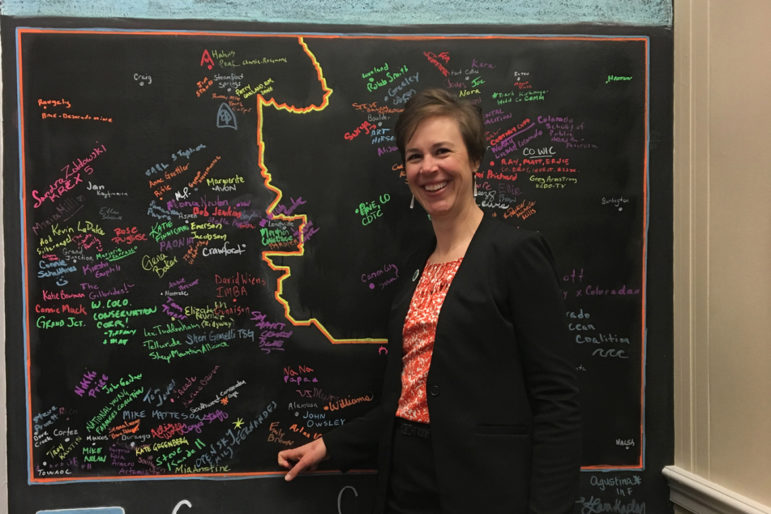
Emily Brown was director of the Rio Grande County Public Health Department in Colorado until May 22, when the county commissioners fired her after battling with her over coronavirus restrictions. “They finally were tired of me not going along the line they wanted me to go along,” she says.

Emily Brown was stretched thin.

As the director of the Rio Grande County Public Health Department in rural Colorado, she was working 12- and 14-hour days, struggling to respond to the pandemic with only five full-time employees for more than 11,000 residents. Case counts were rising.

She was already at odds with county commissioners, who were pushing to loosen public health restrictions in late May, against her advice. She had previously clashed with them over data releases and had haggled over a variance regarding reopening businesses.

But she reasoned that standing up for public health principles was worth it, even if she risked losing the job that allowed her to live close to her hometown and help her parents with their farm.

Then came the Facebook post: a photo of her and other health officials with comments about their weight and references to “armed citizens” and “bodies swinging from trees.”

The commissioners had asked her to meet with them the next day. She intended to ask them for more support. Instead, she was fired.

“They finally were tired of me not going along the line they wanted me to go along,” she said.

In the battle against COVID-19, public health workers spread across states, cities and small towns make up an invisible army on the front lines. But that army, which has suffered neglect for decades, is under assault when it’s needed most.

Officials who usually work behind the scenes managing everything from immunizations to water quality inspections have found themselves center stage. Elected officials and members of the public who are frustrated with the lockdowns and safety restrictions have at times turned public health workers into politicized punching bags, battering them with countless angry calls and even physical threats.

On Thursday, Ohio’s state health director, who had armed protesters come to her house, resigned. The health officer for Orange County, California, quit Monday after weeks of criticism and personal threats from residents and other public officials over an order requiring face coverings in public.

As the pressure and scrutiny rise, many more health officials have chosen to leave or been pushed out of their jobs. A review by KHN and The Associated Press finds at least 27 state and local health leaders have resigned, retired or been fired since April across 13 states.

In California, senior health officials from seven counties, including the Orange County officer, have resigned or retired since March 15. Dr. Charity Dean, the second in command at the state Department of Public Health, submitted her resignation June 4.

These officials have left their posts due to a mix of backlash and stressful, nonstop working conditions, all while dealing with chronic staffing and funding shortages.

Some health officials have not been up to the job during the biggest health crisis in a century. Others previously had plans to leave or cited their own health issues.

But Lori Tremmel Freeman, CEO of the National Association of County and City Health Officials, said the majority of what she calls an “alarming” exodus resulted from increasing pressure as states reopen. Three of those 27 were members of her board and well known in the public health community — Rio Grande County’s Brown; Detroit’s senior public health adviser, Dr. Kanzoni Asabigi; and the head of North Carolina’s Gaston County Department of Health and Human Services, Chris Dobbins.

Asabigi’s sudden retirement, considering his stature in the public health community, shocked Freeman. She also was upset to hear about the departure of Dobbins, who was chosen as health director of the year for North Carolina in 2017. Asabigi and Dobbins did not reply to requests for comment.

“They just don’t leave like that,” Freeman said.

Public health officials are “really getting tired of the ongoing pressures and the blame game,” Freeman said. She warned that more departures could be expected in the coming days and weeks as political pressure trickles down from the federal to the state to the local level.

From the beginning of the coronavirus pandemic, federal public health officials have complained of being sidelined or politicized. The Centers for Disease Control and Prevention has been marginalized; a government whistleblower said he faced retaliation because he opposed a White House directive to allow widespread access to the malaria drug hydroxychloroquine as a COVID-19 treatment.

In Hawaii, U.S. Rep. Tulsi Gabbard called on the governor to fire his top public health officials, saying she believed they were too slow on testing, contact tracing and travel restrictions. In Wisconsin, several Republican lawmakers have repeatedly demanded that the state’s health services secretary resign, and the state’s conservative Supreme Court ruled 4-3 that she had exceeded her authority by extending a stay-at-home order.

With the increased public scrutiny, security details — like those seen on a federal level for Dr. Anthony Fauci, the top infectious disease expert — have been assigned to state health leaders, including Georgia’s Dr. Kathleen Toomey after she was threatened. Ohio’s Dr. Amy Acton, who also had a security detail assigned after armed protesters showed up at her home, resigned Thursday.

In Orange County, in late May, nearly a hundred people attended a county supervisors meeting, waiting hours to speak against an order requiring face coverings. One person suggested that the order might make it necessary to invoke Second Amendment rights to bear arms, while another read aloud the home address of the order’s author — the county’s chief health officer, Dr. Nichole Quick — as well as the name of her boyfriend.

Quick, attending by phone, left the meeting. In a statement, the sheriff’s office later said Quick had expressed concern for her safety following “several threatening statements both in public comment and online.” She was given personal protection by the sheriff.

But Monday, after yet another public meeting that included criticism from members of the board of supervisors, Quick resigned. She could not be reached for comment. Earlier, the county’s deputy director of public health services, David Souleles, retired abruptly.

An official in another California county also has been given a security detail, said Kat DeBurgh, the executive director of the Health Officers Association of California, declining to name the county or official because the threats have not been made public.

DeBurgh is worried about the impact these events will have on recruiting people into public health leadership.

“It’s disheartening to see people who disagree with the order go from attacking the order to attacking the officer to questioning their motivation, expertise and patriotism,” said DeBurgh. “That’s not something that should ever happen.”

Many local health leaders, accustomed to relative anonymity as they work to protect the public’s health, have been shocked by the growing threats, said Theresa Anselmo, the executive director of the Colorado Association of Local Public Health Officials.

After polling local health directors across the state at a meeting last month, Anselmo found about 80% said they or their personal property had been threatened since the pandemic began. About 80% also said they’d encountered threats to pull funding from their department or other forms of political pressure.

To Anselmo, the ugly politics and threats are a result of the politicization of the pandemic from the start. So far in Colorado, six top local health officials have retired, resigned or been fired. A handful of state and local health department staff members have left as well, she said.

“It’s just appalling that in this country that spends as much as we do on health care that we’re facing these really difficult ethical dilemmas: Do I stay in my job and risk threats, or do I leave because it’s not worth it?” Anselmo asked.

Some of the online abuse has been going on for years, said Bill Snook, a spokesperson for the health department in Kansas City, Missouri. He has seen instances in which people took a health inspector’s name and made a meme out of it, or said a health worker should be strung up or killed. He said opponents of vaccinations, known as anti-vaxxers, have called staffers “baby killers.”

The pandemic, though, has brought such behavior to another level.

In Ohio, the Delaware General Health District has had two lockdowns since the pandemic began — one after an angry individual came to the health department. Fortunately, the doors were locked, said Dustin Kent, program manager for the department’s residential services unit.

Angry calls over contact tracing continue to pour in, Kent said.

In Colorado, the Tri-County Health Department, which serves Adams, Arapahoe and Douglas counties near Denver, has also been getting hundreds of calls and emails from frustrated citizens, deputy director Jennifer Ludwig said.

Some have been angry their businesses could not open and blamed the health department for depriving them of their livelihood. Others were furious with neighbors who were not wearing masks outside. It’s a constant wave of “confusion and angst and anxiety and anger,” she said.

Then in April and May, rocks were thrown at one of their office’s windows — three separate times. The office was tagged with obscene graffiti. The department also received an email calling members of the department “tyrants,” adding “you’re about to start a hot-shooting … civil war.”  Health department workers decamped to another office.

Although the police determined there was no imminent threat, Ludwig stressed how proud she was of her staff, who weathered the pressure while working round-the-clock.

“It does wear on you, but at the same time we know what we need to do to keep moving to keep our community safe,” she said. “Despite the complaints, the grievances, the threats, the vandalism — the staff have really excelled and stood up.”

The threats didn’t end there, however: Someone asked on the health department’s Facebook page how many people would like to know the home addresses of the Tri-County Health Department leadership. “You want to make this a war??? No problem,” the poster wrote.

Back in Colorado’s Rio Grande County, some members of the community have rallied in support of Brown with public comments and a letter to the editor of a local paper. Meanwhile, COVID-19 case counts have jumped from 14 to 49 as of Wednesday.

Brown is grappling with what she should do next: dive back into another strenuous public health job in a pandemic, or take a moment to recoup?

When she told her 6-year-old son she no longer had a job, he responded: “Good — now you can spend more time with us.”


Trump: U.S. will terminate relationship with the World Health Organization in wake of Covid-19 pandemic

Trump: U.S. will terminate relationship with the World Health Organization in wake of Covid-19 pandemic

Coronavirus Fears Grind International Diplomacy to a Halt

President Trump said Friday the U.S. would halt its funding of the World Health Organization and pull out of the agency, accusing it of protecting China as the coronavirus pandemic took off. The move has alarmed health experts, who say the decision will undermine efforts to improve the health of people around the world.

In an address in the Rose Garden, Trump said the WHO had not made reforms that he said would have helped the global health agency stop the coronavirus from spreading around the world.

“We will be today terminating our relationship with the World Health Organization and redirecting those funds to other worldwide and deserving urgent global public health needs,” Trump said. “The world needs answers from China on the virus.”

It’s not immediately clear whether the president can fully withdraw U.S. funding for the WHO without an act of Congress, which typically controls all federal government spending. Democratic lawmakers have argued that doing so would be illegal, and House Speaker Nancy Pelosi threatened last month that such a move would be “swiftly challenged.”

The United States has provided roughly 15% of the WHO’s total funding over its current two-year budget period.

The WHO has repeatedly said it was committed to a review of its response, but after the pandemic had ebbed. Last month, Robert Redfield, the director of the Centers for Disease Control and Prevention, also said the “postmortem” on the pandemic should wait until the emergency was over.

As the Trump administration’s response to pandemic has come under greater scrutiny, with testing problems and a lack of coordination in deploying necessary supplies, Trump has sought to cast further blame on China and the WHO for failing to snuff out the spread when the virus was centered in China.

During his remarks, Trump alleged, without evidence, that China pressured WHO to mislead the world about the virus. Experts say that if the U.S. leaves the WHO, the influence of China will only grow.

“The world is now suffering as a result of the malfeasance of the Chinese government,” Trump said. “China’s coverup of the Wuhan virus allowed the disease to spread all over the world, instigating a global pandemic that has cost more than 100,000 American lives, and over a million lives worldwide.” (That last claim is not true; globally, there have been about 360,000 confirmed deaths from Covid-19, the disease caused by the coronavirus.)

When Trump earlier this month threatened to yank U.S. funding in a letter, Tedros Adhanom Ghebreyesus, the WHO director-general, would only say during a media briefing that the agency was reviewing it. But he and other officials stressed that the agency had a small budget — about $2.3 billion every year — relative to the impact the agency had and what it was expected to do.

Mike Ryan, head of the WHO’s emergencies program, said the U.S. funding provided the largest proportion of that program’s budget.

“So my concerns today are both for our program and … working on how we improve our funding base for WHO’s core budget,” Ryan said. “Replacing those life-saving funds for front-line health services to some of the most difficult places in the world — we’ll obviously have to work with other partners to ensure those funds can still flow. So this is going to have major implications for delivering essential health services to some of the most vulnerable people in the world and we trust that other donors will if necessary step in to fill that gap.”


Why We Should Be Reading Albert Camus During the Pandemic

https://www.governing.com/context/Why-We-Should-Be-Reading-Albert-Camus-During-the-Pandemic.html?utm_term=READ%20MORE&utm_campaign=Why%20We%20Should%20Be%20Reading%20Albert%20Camus%20During%20a%20Pandemic&utm_content=email&utm_source=Act-On+Software&utm_medium=email

Looking at Albert Camus's “The Plague” - The New York Times

The author’s masterpiece, The Plague, will make you think, ask all sorts of Socratic questions of yourself and form resolutions about how you intend to measure your life after getting through this global catastrophe.

It’s amazing how many pandemic books there are, and how thoroughly the idea of a global pandemic had crept into our popular culture well before the current situation. My daughter and I watched the Tom Hanks movie Inferno over the weekend, mostly because we wanted to gaze at the city of Florence. It’s not a great movie, but it is visually stunning in several ways. The plot is not something I gave much attention to when I first saw the film a couple of years ago: a rich Ted-talking eccentric decides to kill off most of the people of the world to save the Earth from over-population and the ravages 16 billion people would mean for other species and the health of the biosphere.

When I first saw the film in 2016, I regarded the plotline (will the vial of lethal germs be released or not?) as nothing but the usual “James Bond” setup for whatever else happened in the film. This time I watched it with greater alertness.

The fact is, of course, that COVID-19 is a serious global nuisance that has disrupted the lives of all Americans in a way that almost nobody could have predicted (well, there is Bill Gates, of course), but it is not the Black Plague, which swept away somewhere between one-fourth and one-half of all Europeans between 1348-1352, or the Yellow Fever epidemic in Philadelphia, which killed one in 10 inhabitants of America’s largest city in 1793, or the Spanish Flu, which killed somewhere between 57 and 100 million people worldwide in 1918.

If the coronavirus eventually kills 5 million people worldwide, and a couple of hundred thousand Americans before the vaccines gallop in to save the day a year or 18 months hence, it will have been a comparatively minor event in the history of global pandemics. The moment when it appeared that the hospital and medical infrastructure of New York might collapse has now passed. And though the death toll continues to climb towards perhaps 150,000 American dead by Aug. 1, 2020, the national dread that created a sustained will-we-survive and how-will-we-cope conversation in virtually every household in the United States is mostly over. The question now is when and how (and if) the country can return to what the late John McCain called regular order.

In the past two months I have read more than a dozen pandemic books, from Daniel Defoe’s A Journal of the Plague Year (1721), to Stephen King’s endless The Stand (1978). They are all interesting. If you outline the takeaway insights from these books, written over the span of many hundreds of years, they all make essentially the same points:

  1. Every government starts in denial, moves through some form of coverup, and eventually has to come to terms with the facts on the ground. 
  2. The rich flee to their country estates (or the Hamptons) and whine about all the inconvenience.
  3. The poor (as always) do most of the suffering, not merely because they are poor and have less access to the Maslovian necessities of life, but because they wind up putting themselves into harm’s way to help other people and even help the undeserving rich.
  4. The only sure methods of dealing with the epidemic (before the coming of vaccines) are social distancing, masks and the avoidance of direct body contact, and quarantining — and these do work.
  5. Economic activity grinds to a halt, but new forms of employment emerge, such as enforcing quarantines or monitoring the spread of the disease through contact tracing.
  6. People who have contracted the disease but who do not yet exhibit symptoms are the principal transmitters of the disease to others.
  7. Government has no choice but to subsidize the lives of people who have no savings and cannot work, because the alternative is food riots, looting, and perhaps revolution.
  8. Quacks, charlatans, and mountebanks abound, as always, to exploit exploitable people.
  9. Bad leaders and some portions of the population spend their time embracing and spreading conspiracy theories and searching for some group, some nation, some tribe to blame for the catastrophe.
  10. Social mores, including sexual codes, begin to break down as people slowly adopt an “eat, drink, and be merry, for tomorrow you shall certainly die” attitude.
  11. The natural sociability of humanity is such that we invariably rush back into the public square too soon, before the disease has been mastered, thus causing a second or a third wave of infection and death.


Trump faces criticism over lack of national plan on coronavirus

Trump faces criticism over lack of national plan on coronavirus

COVID-19 National Health Plan – Primary Care – Central Patient ...

The Trump administration is facing intense criticism for the lack of a national plan to handle the coronavirus pandemic as some states begin to reopen.

Public health experts, business leaders and current administration officials say the scattershot approach puts states at risk and leaves the U.S. vulnerable to a potentially open-ended wave of infections this fall.

The White House has in recent days sought to cast itself as in control of the pandemic response, with President Trump touring a distribution center to tout the availability of personal protective equipment and press secretary Kayleigh McEnany detailing for the first time that the administration did have its own pandemic preparedness plan.

Still, the White House lacks a national testing strategy that experts say will be key to preventing future outbreaks and has largely left states to their own devices on how to loosen restrictions meant to slow the spread of the virus. Trump this week even suggested widespread testing may be “overrated” as he encouraged states to reopen businesses.

The Centers for Disease Control and Prevention (CDC) on Thursday night issued long-awaited guidance intended to aid restaurants, bars and workplaces as they allow employees and customers to return, but they appeared watered down compared to previously leaked versions.

Some experts said the lack of clear federal guidance on reopening could hamper the economic recovery. 

“A necessary condition for a healthy economy is a healthy population. This kind of piecemeal reopening with everyone using different criteria for opening, we’re taking a big risk,” said Mark Zandi, chief economist at Moody’s Analytics.

The lack of coherent direction from the White House was driven home this week by damaging testimony by a former top U.S. vaccine official who claims he was ousted from his post improperly.

“We don’t have a single point of leadership right now for this response, and we don’t have a master plan for this response. So those two things are absolutely critical,” said Rick Bright, who led the Biomedical Advanced Research and Development Authority until he was demoted in late April.

The U.S. faces the “darkest winter in modern history” if it does not develop a more coordinated national response, Bright said. “Our window of opportunity is closing.”

From the start, the White House has let states chart their own responses to the pandemic.

The administration did not issue a nationwide stay-at-home order, resulting in a hodgepodge of state orders at different times, with varying levels of restrictions.

Facing a widespread shortage, states were left to procure their own personal protective equipment, ventilators and testing supplies. Trump resisted using federal authority to force companies to manufacture and sell equipment to the U.S. government.

Without clear federal guidance, state officials were competing against each other and the federal government, turning the medical supply chain into a free-for-all as they sought scarce and expensive supplies from private vendors on the commercial market.

“The fact that we had questions about our ability to have enough mechanical ventilators, and you had states basically bidding against each other, trying to secure personal protective equipment …  it shouldn’t be happening during a pandemic,” said Amesh Adalja, a senior scholar at the Johns Hopkins University Center for Health Security.

Internally, the administration struggled to mount a unified front as various agencies jockeyed for control. Multiple agencies have been providing contradictory instructions.

At first, Department of Health and Human Services (HHS) Secretary Alex Azar led the White House coronavirus task force.

Roughly a month, later he was replaced by Vice President Pence. The Federal Emergency Management Agency (FEMA) was later tasked with leading the response to get supplies to states, while senior White House adviser Jared Kushner led what has been dubbed a “shadow task force” to engage the private sector. Now, FEMA is reportedly winding down its role, and turning its mission back over to HHS.

The CDC has been largely absent throughout the pandemic. Director Robert Redfield has drawn the ire of President Trump as well as outside experts, and he has been seen infrequently at White House briefings.

“I think seeing the nation’s public health agency hobbled at a time like this and looking over its shoulder at its political bosses is something I hoped I would never see, and I’ve been working with the CDC for over 30 years,” said Lawrence Gostin, a professor of public health at Georgetown University.

“I think that people will die because the public health agency has lost its visibility and its credibility and that it’s being politically interfered with,” he added.

The administration recently has taken some steps to improve on the initial response to the pandemic.

Ventilator production has increased, and the U.S. is no longer seeing a shortage of the devices. 

Testing has improved dramatically as well, though experts think the U.S. needs to be testing thousands of more people per day before the country can reopen.

The administration also unveiled plans to expand the Strategic National Stockpile’s supply of gowns, respirators, testing supplies and other equipment, after running out of supplies early in the pandemic.

Adalja said the administration’s positive steps are coming way too late. 

“It’s May 15, we should have been in this position January 15,” he said.

McEnany on Friday for the first time detailed the White House’s preparedness plan that replaced the Obama-era pandemic playbook, an acknowledgement that Trump’s predecessor did leave a road map, despite claims to the contrary from some of the president’s allies.

She did not give many specifics on the previously unknown plan. Instead, McEnany declared the Trump administration’s handling of the virus had been “one of the best responses we’ve seen in our country’s history.”

Yet as states look to reopen businesses and get people back to work, the White House is taking a back seat as governors set their own guidelines for easing stay-at-home orders and restrictions on social activities.

The White House in April issued a three-step plan for states to reopen their economies, but it has largely been ignored by states and by the president.

Dozens of governors have begun easing restrictions on businesses and social activities without meeting the White House guidelines. Trump has been urging them to move even faster, backing anti-lockdown protesters in Michigan, Virginia, Minnesota and Pennsylvania.

Even scaled-down guidance from federal agencies is critical for providing a road map for state and local leaders, and for businesses considering how best to resume operations, said Neil Bradley, chief policy officer with the U.S. Chamber of Commerce.

“We need guidance because it helps instill confidence about the right types of approaches to take, but when you begin to move away from guidance and into either regulations or very strict approach, then that’s increasingly going to be unworkable in lots of different locations,” Bradley said.