The world came together for a virtual vaccine summit. The U.S. was conspicuously absent.

https://www.washingtonpost.com/world/europe/the-world-comes-together-for-a-virtual-vaccine-summit-the-us-is-conspicuously-absent/2020/05/04/ac5b6754-8a5c-11ea-80df-d24b35a568ae_story.html?mkt_tok=eyJpIjoiTkdRelpUWXlNV1k0TW1WaSIsInQiOiJXSHJqUW1UV042bmt0Q1A5TUhJQ2dZOWFucFNYbmxtdTRsZUV2c0ltYzJmZkl5aU43NGJqbDdCZnB4Y0sxK0hJaXRzWjZmajAxN3V5aGZCbGQrS1wvcm1id2dVaGRZdld1TFpXMEt0VUkrMWtrMGJ6cko3VW5jVUZwZlpKR1d0eHEifQ%3D%3D

The world comes together for a virtual vaccine summit. The U.S. is ...

World leaders came together in a virtual summit Monday to pledge billions of dollars to quickly develop vaccines and drugs to fight the coronavirus.

Missing from the roster was the Trump administration, which declined to participate but highlighted from Washington what one official called its “whole-of-America” efforts in the United States and its generosity to global health efforts.

The online conference, led by European Commission President Ursula von der Leyen and a half-dozen countries, was set to raise $8.2 billion from governments, philanthropies and the private sector to fund research and mass-produce drugs, vaccines and testing kits to combat the virus, which has killed more than 250,000 people worldwide.

With the money came soaring rhetoric about international solidarity and a good bit of boasting about each country’s efforts and achievements, live and prerecorded, by Germany’s Angela Merkel, France’s Emmanuel Macron, Britain’s Boris Johnson, Japan’s Shinzo Abe — alongside Israel’s Benjamin Netanyahu and Turkey’s Recep Tayyip Erdogan.

“The more we pull together and share our expertise, the faster our scientists will succeed,” said Johnson, who was so stricken by the virus that he thought he might never leave the intensive care unit alive last month. “The race to discover the vaccine to defeat this virus is not a competition between countries but the most urgent shared endeavor of our lifetimes.”

A senior Trump administration official said Monday the United States “welcomes” the efforts of the conference participants. He did not explain why the United States did not join them.

“Many of the organizations and programs this pledging conference seeks to support already receive very significant funding and support from the U.S. government and private sector,” said the official, who spoke on the condition of anonymity under White House rules for briefing reporters.

Public health officials and researchers expressed surprise.

“It’s the first time that I can think of where you have had a major international pledging conference for a global crisis of this kind of importance, and the U.S. is just absent,” said Jeremy Konyndyk, who worked on the Ebola response in the Obama administration.

Given that no one knows which vaccines will succeed, he said, it’s crucial to back multiple efforts working in parallel.

“Against that kind of uncertainty we should be trying to position ourselves to be supporting — and potentially benefiting from — all of them,” said Konyndyk, a senior policy fellow at the Center for Global Development. “And instead we seem to be just focused on trying to win the race, in the hopes we happen to get one of the successful ones.”

Conference participants expressed a need for unity.

“We can’t just have the wealthiest countries have a vaccine and not share it with the world,” Canadian Prime Minister Justin Trudeau said.

“Let us in the international community unite to overcome this crisis,” Abe said.

Russia and India also did not participate. Chinese premier Li Keqiang was replaced at the last minute by Zhang Ming, Beijing’s ambassador to the European Union.

The U.S. official said the United States “is the single largest health and humanitarian donor in world. And the American people have continued that legacy of generosity in the global fight against covid-19.”

“And we would welcome additional high-quality, transparent contributions from others,” he said.

Asked three more times to explain why the United States did not attend, the official said he already had given an answer.

The U.S. government has provided $775 million in emergency health, humanitarian, economic and development aid for governments, international organizations and charities fighting the pandemic. The official said the United States is in the process of giving about twice that amount in additional funding.

There was one major American player at the virtual summit: the Bill and Melinda Gates Foundation, which promised to spend $125 million in the fight.

“This virus doesn’t care what nationality you are,” Melinda Gates told the gathering. As long as the virus is somewhere, she said, it’s everywhere.

Scientists are working around-the-clock to find a cure or treatment for the coronavirus. The World Health Organization says eight vaccines have entered human trials and another 94 are in development.

But finding an effective vaccine is only part of the challenge. When it’s discovered, infectious disease experts are predicting a scramble for limited doses, because there won’t be enough to vaccinate everyone on Day One. And deploying it could be difficult, particularly in countries that lack robust medical infrastructure.

Those that have begun human trials include a research project at Oxford University in England, which hopes to have its vaccine ready in the fall. The university started human trials on April 23. “In normal times,” British Health Secretary Matt Hancock said, “reaching this stage would take years.”

Other scientists are sprinting to create antiviral drugs or repurposing existing drugs such as remdesivir, which U.S. infectious diseases chief Anthony S. Fauci said he expected would be the new “standard of care.”

Other approaches now in trial include treatments such as convalescent plasma, which involves taking blood plasma from people who have recovered from covid-19 to patients who are fighting the virus, in the hope that the antibody-rich fluid will give the infected a helping hand.

Conference participants expressed hope that by working together, the world will find solutions more quickly — and they can then be dispersed to all countries, not only the wealthy, or those that developed vaccines first.

Many of the leaders stressed their support for the WHO. President Trump announced last month he was cutting off U.S. funding for the WHO because he said it had sided too closely with China, where the coronavirus arose. Trump says Chinese leaders underplayed the threat and hid crucial facts.

Public health analysts have shared some of those criticisms but have also criticized Trump for cutting off funding.

Peter Jay Hotez, dean of the National School of Tropical Medicine at Baylor College of Medicine, said the United States has always been the primary funder of new products for global health. The country invested $1.8 billion in neglected diseases in 2018, according to Policy Cures Research, more than two-thirds of the worldwide total.

Hotez said the United States shoulders the burden of investing in global health technologies, while countries such as China do not step up.

“More than one mechanism for supporting global health technologies — that may not be such as a bad thing,” he said. “If it was all under one umbrella, you risk that some strong-willed opinions would carry the day and you might not fund the best technology.”

Hotez is working on a coronavirus vaccine that uses an existing, low-cost technology, previously used for the hepatitis B vaccine, precisely because he is worried about equitable distribution of the vaccine.

“I’m not very confident that some of the cutting-edge technologies going into clinical trials, which have never led to a licensed vaccine before, are going to filter down to low- and middle-income countries anytime soon,” Hotez said. “I’m really worried.”


Researchers double U.S. COVID-19 death forecast, citing eased restrictions

https://www.reuters.com/article/us-health-coronavirus-usa/researchers-double-u-s-covid-19-death-forecast-citing-eased-restrictions-idUSKBN22G1T3?mkt_tok=eyJpIjoiTkdRelpUWXlNV1k0TW1WaSIsInQiOiJXSHJqUW1UV042bmt0Q1A5TUhJQ2dZOWFucFNYbmxtdTRsZUV2c0ltYzJmZkl5aU43NGJqbDdCZnB4Y0sxK0hJaXRzWjZmajAxN3V5aGZCbGQrS1wvcm1id2dVaGRZdld1TFpXMEt0VUkrMWtrMGJ6cko3VW5jVUZwZlpKR1d0eHEifQ%3D%3D

Researchers double U.S. COVID-19 death forecast, citing eased ...

A newly revised coronavirus mortality model predicts nearly 135,000 Americans will die from COVID-19 by early August, almost double previous projections, as social-distancing measures for quelling the pandemic are increasingly relaxed, researchers said on Monday.

The ominous new forecast from the University of Washington’s Institute for Health Metrics and Evaluation (IHME) reflect “rising mobility in most U.S. states” with an easing of business closures and stay-at-home orders expected in 31 states by May 11, the institute said.

“We expect that the epidemic in many states will now extend through the summer,” the IHME director, Dr. Christopher Murray, said in a statement.

The projections reinforced warnings from public health experts that a rising clamor to lift restrictions on commerce and social activities – in hopes of healing a ravaged economy – could exact a staggering cost in terms of human lives.

The novel coronavirus is already known to have infected almost 1.2 million people in the United States, including 68,762 who have died from COVID-19, the respiratory illness it causes, according to Reuters’ own tally.

The institute’s predictive coronavirus model, periodically revised to account for changing circumstances and scientific insights surrounding the pandemic, has become an influential data point often cited by the White House and public health authorities in gauging the crisis.

The IHME projections are presented as a statistical range of outcomes. The latest forecast predicts the cumulative number of U.S. deaths from COVID-19 will run from as few as 95,092 to as many as 242,890 by Aug. 4 – with 134,475 lives lost representing the most likely, middle ground.

By comparison, the previous revision issued on April 29 put the middle-case figure at 72,400 deaths, within a range between 59,300 and 114,200 fatalities.

Researchers double U.S. COVID-19 death forecast, citing eased ...

EASED SOCIAL DISTANCING

The upward spike reflects increasing human interactions as more states begin to ease social-distancing requirements – the chief public health tool available to curb the spread of a highly contagious virus for which there is no vaccine and no cure.

The relaxation of social-distancing rules will more than offset any decline in transmissions that might come from warmer weather and stronger containment measures, such as more wide-scale testing and tracing the contacts of infected people so they too can be tested and isolated, Murray said.

The revised IHME projections coincided with disclosure of an internal Trump administration forecast predicting a surge in COVID-19 cases killing 3,000 Americans a day by the end of May, up from a current daily toll that a Reuters tally places at around 2,000.

That projection, first reported by the New York Times and confirmed by a Reuters source, also forecast about 200,000 new coronavirus cases each day by the end of the month, up from the current rate of about 25,000 cases every 24 hours.

TRUMP’S PREDICTIONS

Asked about the confidential forecast, White House spokesman Judd Deere said: “This is not a White House document, nor has it been presented to the Coronavirus Task Force or gone through interagency vetting.”

President Donald Trump has given varying predictions for the number of people in the United States who will succumb to COVID-19. As recently as Friday, he said he hoped fewer than 100,000 Americans would die, and had talked last week of 60,000 to 70,000 deaths.

But on Sunday night, the president acknowledged the death toll may climb much higher.

“We’re going to lose anywhere from 75, 80 to 100,000 people. That’s a horrible thing,” he told Fox News.

In New York, the state that accounts for about a third of all U.S. infections, Governor Andrew Cuomo on Monday outlined plans to ease restrictions on a regional basis.

Without giving a specific time frame, Cuomo told a daily briefing that construction, manufacturing and the wholesale supply chain would be allowed to start up under the first phase of a four-step return to normality.

A second phase would permit insurance, retail, administrative support and real estate businesses to open again, followed by restaurants, food services, hotels and accommodation businesses in the third stage, Cuomo said. In the final phase, arts, entertainment and recreation facilities and education would restart.

Cuomo suggested that rural parts of New York might be relaxed ahead of “higher-risk regions,” including New York City.

California Governor Gavin Newsom said on Monday he would ease the state’s stay-at-home orders by Thursday, expanding the number of retail businesses that can provide curbside services.

“This is an optimistic day, as we see a little bit of a ray of sunshine,” Newsom told a news conference.

Florida began a gradual restart of its economy on Monday. In the first phase, retail merchants and restaurants will open, with indoor patronage limited to 25% of capacity. Eateries are also allowed to open outdoor seating with social distancing, and medical practices can resume elective surgeries and procedures.

In Ohio, Governor Mike DeWine was allowing construction and manufacturing to reopen on Monday, and letting office workers return.


The Health 202: Social distancing hasn’t been as effective in stemming U.S. coronavirus deaths as policymakers had hoped.

https://www.washingtonpost.com/news/powerpost/paloma/the-health-202/2020/05/05/the-health-202-social-distancing-hasn-t-been-as-effective-in-stemming-u-s-coronavirus-deaths-as-policymakers-had-hoped/5eb04b6d88e0fa594778ea5e/

Social distancing isn’t having the effects many had hoped for.

Despite encouraging signs on the nation’s East and West coasts, daily diagnosed cases of the novel coronavirus appear to still be on the rise in about 20 states. A number of rural counties have become unexpected hot spots in recent weeks, including in the Black Belt region of Mississippi and Alabama and in communities throughout Iowa and northern Texas around the Oklahoma panhandle. The country’s overall daily figures of diagnoses and deaths have plateaued, worrying health policymakers as many states move to reopen parts of their economy.

That steep curve of covid-19 cases in March and April isn’t receding the way it rose.

Hot spots are shifting geographically from New York City to areas around the country. For the past month, the figures have hovered around 30,000 diagnosed cases and around 2,000 deaths every day, former Food and Drug Administration commissioner Scott Gottlieb noted in a Wall Street Journal op-ed.

“Everyone thought we’d be in a better place after weeks of sheltering in place and bringing the economy to a near standstill,” he wrote. “Mitigation hasn’t failed; social distancing and other measures have slowed the spread. But the halt hasn’t brought the number of new cases and deaths down as much as expected or stopped the epidemic from expanding.”

President Trump, who last week suggested the novel coronavirus would disappear even without a vaccine, has now upgraded his prediction of fatalities to as many as 100,000 people. Nonetheless, he said in a New York Post interview yesterday that Americans are “starting to to feel good now. The country’s opening again. We saved millions of lives, I think.”

A leaked government report, still in draft version, predicts a spike in cases and deaths beginning on May 14.

The report, which the Centers for Disease Control quickly disavowed as an unfinished projection, suggests new cases could surge to 200,000 per day and daily American deaths could number more than 3,000 by June 1. That’s far more than what other models predict, but the Johns Hopkins epidemiologist who prepared it told my colleagues William Wan, Lenny Bernstein, Laurie McGinley and Josh Dawsey that 100,000 new cases per day by the end of the month isn’t out of the realm of possibility.

Former FDA commissioner Scott Gottlieb:

University of Michigan professor Justin Wolfers:

That’s not the only model showing discouraging figures for the month of May. A model out of the University of Washington, relied upon heavily by the administration, yesterday upgraded its U.S. fatality predictions for the virus’s first wave from 72,433 deaths to 134,475 deaths by Aug. 4.

These aren’t the trends many policymakers had hoped to see, after most Americans spent seven weeks at home under an unprecedented lockdown that has torched the once-booming economy and thrust millions into economic uncertainty. Protests against extended lockdowns are starting to mount around the country, and many governors have assembled and even embarked upon gradual plans to reopen businesses, schools and other public areas.

Nonetheless, a new Washington Post-University of Maryland poll out this morning shows sizable majority of Americans oppose the reopening of restaurants, retail stores and businesses.

Executive producer of 7News WHDH in Boston:

Social distancing did accomplish some important objectives. It undoubtedly saved the health-care system from being crushed by an overwhelming caseload of sick patients all at once.

And the United States is still outranked by half a dozen European countries when it comes to deaths per capita. The U.S. death rate is about 206 deaths per million people. That figure is 538 in Spain, 372 in France, 481 in Italy, 432 in the United Kingdom and 207 in Switzerland, according to a tally by Mother Jones.

But distancing clearly hasn’t been enough — at least the way it’s been carried out — to halt the spread of the highly contagious virus in some places.

New cases and deaths across the whole U.S. are about where they were 20 days ago, my colleague Philip Bump reports. He created a graphic where you can view the three-day averages of cases, deaths and tests performed by state (check it out here).

“The back of the mountain doesn’t look the way the front did,” Philip writes. “We saw a steady, exponential rise in confirmed cases and deaths each day for several weeks. But particularly with daily case totals, the period after the peak nationally has looked more like a plateau than a downward slide.”

Daily cases appear to be rising significantly in Delaware, Illinois, Indiana, Minnesota and Virginia. They’re also trending upward in Arizona, Colorado, D.C., Iowa, Kansas, Maryland, Mississippi, Nebraska, New Hampshire, New Mexico, North Carolina, Tennessee, Texas, Utah and Wisconsin.

Andy Slavitt, former head of the Centers for Medicare and Medicaid Services:

“There are so many emerging areas still throughout the country that our group has been trying to wave our hands about,” Marynia Kolak, a health and spatial data science researcher at the University of Chicago, told me.

Kolak and her colleagues are tracking covid-19 cases and deaths at the county level. They’ve been increasingly spotting clusters of the disease in rural areas. Kaiser Family Foundation researchers have also found that rural areas are experiencing a faster growth in cases, even as their total numbers remain far below those seen in urban settings.

One example: Five counties in Minnesota with significant meat-processing plants. State officials said about a quarter of cases reported over the weekend came from those counties.

One is Nobles County, home to a JBS USA pork processing plant in Worthington, with a population of around 22,000. It is scheduled to partially reopen this week, under an order by Trump to keep meat plants open.

The outbreaks in counties with meat-processing plants “illustrates how powerfully situations can change at the community level,” said Jan Malcolm, commissioner of Minnesota’s Department of Health.

Malcolm stressed how hard it is to stem the spread of the virus in these types of facilities.

“These are particularly challenging investigations,” Malcolm said. “Many of the workers involved don’t have phones, don’t provide phone numbers, aren’t answering calls. It’s been a very labor-intensive, shoe-leather kind of an approach.”


White House prohibits coronavirus task force members from testifying before Congress in May

https://thehill.com/homenews/administration/496016-white-house-prohibits-coronavirus-task-force-members-from-testifying?userid=12325

White House prohibits coronavirus task force members from ...

White House coronavirus task force members are prohibited from testifying before Congress this month under new guidance issued by the Trump administration Monday.

Task force members and key deputies have been instructed not to accept invitations to participate in congressional hearings in May, while other agencies responding to the pandemic are being advised to limit the number of hearings they attend.

Top administration officials argue the coronavirus task force and the primary agencies responding to the pandemic need to focus their attention and resources on response efforts, and that having them testify could use up critical hours.

“We’re telling agencies that during this unprecedented time our resources need to be dedicated toward the coronavirus. At this stage we really need everybody manning their stations and prioritizing coronavirus response work,” a senior administration official told The Hill.

The move comes just days after the White House blocked Anthony Fauci, the nation’s top infectious disease expert and a task force member, from testifying before a House panel.

The White House shot back at allegations it was attempting to silence officials, arguing it will allow for testimony at a later date.

“While the Trump Administration continues its whole-of-government response to COVID-19, including safely opening up America again and expediting vaccine development, it is counter-productive to have the very individuals involved in those efforts appearing at Congressional hearings,” White House deputy press secretary Judd Deere said in a statement last week.

According to the new guidance, “no more than one COVID-related hearing should be agreed to with the department’s primary House and Senate authorizing committee and appropriations subcommittee for the Department of Health and Human Services, Department of Homeland Security and the State Department” with a cap of four coronavirus-related hearings departmentwide through the end of the month.

White House chief of staff Mark Meadows is authorized to approve exemptions to the new protocol, and administration officials noted the guidance will be revisited and could change depending on the circumstances.

The new guidance comes as the Senate comes back into session and the House grapples with how to best bring members back to Washington safely amid the pandemic.

Fauci is currently slated to appear before the Senate Health, Education, Labor and Pensions Committee for a coronavirus-related hearing on May 12.

Other agencies and departments are permitted to accept hearing invitations but have been advised that they should prioritize putting resources toward pandemic response efforts.

“The demands on agencies’ staff and resources are extraordinary in this current crisis. Agencies must maximize their resources for COVID-19 response efforts and treat hearing requests accordingly,” the guidance says.

“Given these competing demands in these unprecedented times, it is reasonable to expect that agencies will have to decline invitations to hearings to remain focused on implementing of COVID-19 response, including declining to participate in multiple hearings on the same or overlapping topics.”

The administration previously issued guidance pulling back on hearings related to COVID-19 in March.


The good and bad news about asymptomatic coronavirus cases

https://www.axios.com/asymptomatic-carrier-coronavirus-fauci-b7ccb7e4-b972-412e-b461-0e07f0689cb7.html

The good news and bad news about asymptomatic coronavirus cases ...

We don’t yet know what proportion of people infected with the coronavirus are asymptomatic, but it’s becoming clear that there’s a large number of them.

Why it matters: The more people that have been asymptomatic carriers of the coronavirus, the lower its fatality rate. But asymptomatic carriers also present unique problems for stopping the virus’s spread, as they likely don’t know they have it.

The big picture: Until we can do widespread, reliable antibody testing to determine how many people have had the virus, the best data we have to go off of are one-off studies — which have suggested widely varying rates of asymptomatic carriers.

  • A study earlier this month found that 13.9% of 3,000 New Yorkers tested had signs of the coronavirus, suggesting that about 10 times the number of people who have officially tested positive have had it, per Bloomberg. That means a lot of people either couldn’t get tested, or never knew anything was wrong.
  • Around half of the soldiers on the Theodore Roosevelt aircraft carrier who tested positive for the coronavirus were asymptomatic, per the LA Times. Another study found that about 18% of positive cases on the Diamond Princess cruise ship were asymptomatic.
  • “We don’t know the definitive answer, but it probably is a substantial proportion,” infectious disease expert Anthony Fauci told me. “That is a non-scientifically based estimate, based on these dribs and drabs of information that we get.”

Between the lines: If asymptomatic cases are common, that mathematically increases the likelihood (age and pre-existing conditions aside) that you or I could catch the virus and be completely fine.

  • It also means that a lower percentage of people who get the coronavirus will need hospitalization, which is good news for the health care system.
  • In the darkest of plausible scenarios, where we fail to contain the virus and it spreads relatively unencumbered throughout the U.S., a high asymptomatic rate would translate into a lower death rate — a small comfort.

Yes, but: It also is hugely problematic for efforts to keep the coronavirus from spreading.

  • It could then spread undetected, and if there’s already a high number of asymptomatic cases, that means the virus may be more widespread than we thought.
  • It also makes the virus hard to track. “If you have so many asymptomatic people around, it’s going to be much more difficult to get your arms around contact tracing, because you’re going to have so many people who get exposed to someone who is asymptomatic,” Fauci said. That puts extra emphasis on the need to do surveillance testing even among healthy-seeming populations, particularly in places like prisons and nursing homes.

The bottom line: A low number of asymptomatic cases would mean the virus is deadlier than we’d like it to be, while a high number of such cases means it most likely has been more widely transmitted. The uncertainty around that complicates how to manage its spread.


New report says coronavirus pandemic could last for two years – and may not subside until 70% of the population has immunity

https://www.cbsnews.com/news/coronavirus-pandemic-update-two-years-70-percent-immunity/

Coronavirus (COVID-19) Recovery Depends on Herd Immunity, Doctor Says

As coronavirus restrictions around the world are being lifted, a new report warns the pandemic that has already killed more than 230,000 people likely won’t be contained for two years. The modeling study from the Center for Infectious Disease Research and Policy (CIDRAP) at the University of Minnesota also says that about 70% of people need to be immune in order to bring the virus to a halt.

For the study, experts looked at eight major influenza pandemics dating back to the 1700s, as well as data about the new coronavirus, to help forecast how COVID-19 may spread over the coming months and years. Out of the eight past flu pandemics, scientists said seven had a second substantial peak about six months after the first one. Additionally, some had “smaller waves of cases over the course of 2 years” after the initial outbreak.

A key factor in their prediction for the current pandemic revolves around herd immunity, which refers to the community-wide resistance to the spread of a contagious disease that results when a high percentage of people are immune to it, either through vaccination or prior exposure. 

“The length of the pandemic will likely be 18 to 24 months, as herd immunity gradually develops in the human population,” the report says. “Given the transmissibility of SARS-CoV-2” — the virus that causes COVID-19 — “60% to 70% of the population may need to be immune to reach a critical threshold of herd immunity to halt the pandemic.”

It will take time to reach that point, since data from blood tests show only a small fraction of the overall population has been infected so far, and a possible vaccine is still months if not a year or more away. It is not yet clear whether people who’ve recovered from the infection will be immune or how long such protection would last.

The report lays out several possible scenarios, including one in which a larger wave of illnesses may happen in the fall or winter of 2020 and then subsequent smaller waves in 2021. The researchers say this model — similar to the pattern seen in the devastating 1918 Spanish flu pandemic — would “require the reinstitution of mitigation measures in the fall in an attempt to drive down spread of infection and prevent healthcare systems from being overwhelmed.” 

Two other scenarios in the report involve either recurring peaks and valleys of outbreaks, or smaller waves of illness over the next two years.

In any case, the researchers said people must be prepared for “at least another 18 to 24 months of significant COVID-19 activity, with hot spots popping up periodically” in different geographic areas.

As the virus continues to circulate among the human population and outbreaks finally start to wane, they say it will likely “synchronize to a seasonal pattern with diminished severity over time.”


8 states reporting spikes in COVID-19 cases, deaths

https://www.beckershospitalreview.com/public-health/8-states-reporting-spikes-in-covid-19-cases-deaths.html?utm_medium=email

The week began with sharp increase in prices :: CottonYarn

The following eight states have reported sharp increases in new coronavirus cases and deaths:

1. On May 2, for the third day in a row, Texas reported more than 1,000 new coronavirus cases, according to CNBC. The state’s health department reported 1,293 new positive cases of COVID-19, the first weekend of the state’s limited reopening.

2. On May 2, New York reported 831 new cases of the coronavirus and 299 deaths, according to The Hill. Gov. Andrew Cuomo called the number of new COVID-19 deaths in the state “obnoxiously and terrifyingly high.”

3. Nearly 13 percent of all tests for the new coronavirus came back positive May 1 in Wisconsin, indicating a spike in new cases, WISN-TV, an ABC affiliate reports.

4. Georgia reported two days of nearly 1,000 new coronavirus cases on April 30 and May 1, according to The Atlanta Journal-Constitution. The confirmed case count reached 28,332 May 2, and the death toll from the disease increased to 1,174.

5. With 516 more cases confirmed in Tennessee May 3, the total number of positive cases in the state has jumped to 13,177, according to News Channel 5 Nashville.

6. On May 3, Missouri reported more than 200 new coronavirus cases, for the third day in a row, bringing the state’s total to 8,386 cases, KSDK, an NBC affiliate reports. St. Louis alone reported nearly 100 new COVID-19 cases May 3, CBS affiliate KMOV reports.

7. Pennsylvania reported 49,267 confirmed COVID-19 cases, as of May 3, according to CBS Pittsburgh. The state reported 962 new positive cases of the new virus and 26 more deaths, bringing the statewide death toll to 2,444.

8. The number of coronavirus cases in Massachusetts rose by 1,824, officials reported May 3, and the death toll increased by 158, bringing the statewide total to 68,087 cases and 4,004 deaths, NBC Boston reports.


US hospitals losing $1.4B in revenue per day

https://www.beckershospitalreview.com/finance/us-hospitals-losing-1-4b-in-revenue-per-day.html?utm_medium=email

Facing a financial squeeze, hospitals nationwide are cutting jobs

Hospitals across the U.S. are losing more than $1 billion in daily revenue as they experience significant declines in patient volume during the COVID-19 pandemic, according to a report from Crowe, a public accounting, consulting and technology company. 

With the exception of those in San Francisco and New York City, health systems across the country saw patient volume decline an average of 56 percent between March 1 and April 15. As a result, net revenue at hospitals with more than 100 beds dropped roughly $1.44 billion per day, according to the report.

The report, released May 1, said inpatient admissions are down more than 30 percent, emergency room visits dropped 40 percent and outpatient surgery volume plummeted 71 percent, compared to January.

“Hospitals and governments prepared for a surge in patient volume to treat those infected with the novel coronavirus,” Brian Sanderson, managing principal of healthcare services at Crowe, said. “However, any possible surges that might have been expected due to COVID-19 patient volume appear to be dramatically offset by a significant decline in volume in all other areas.”


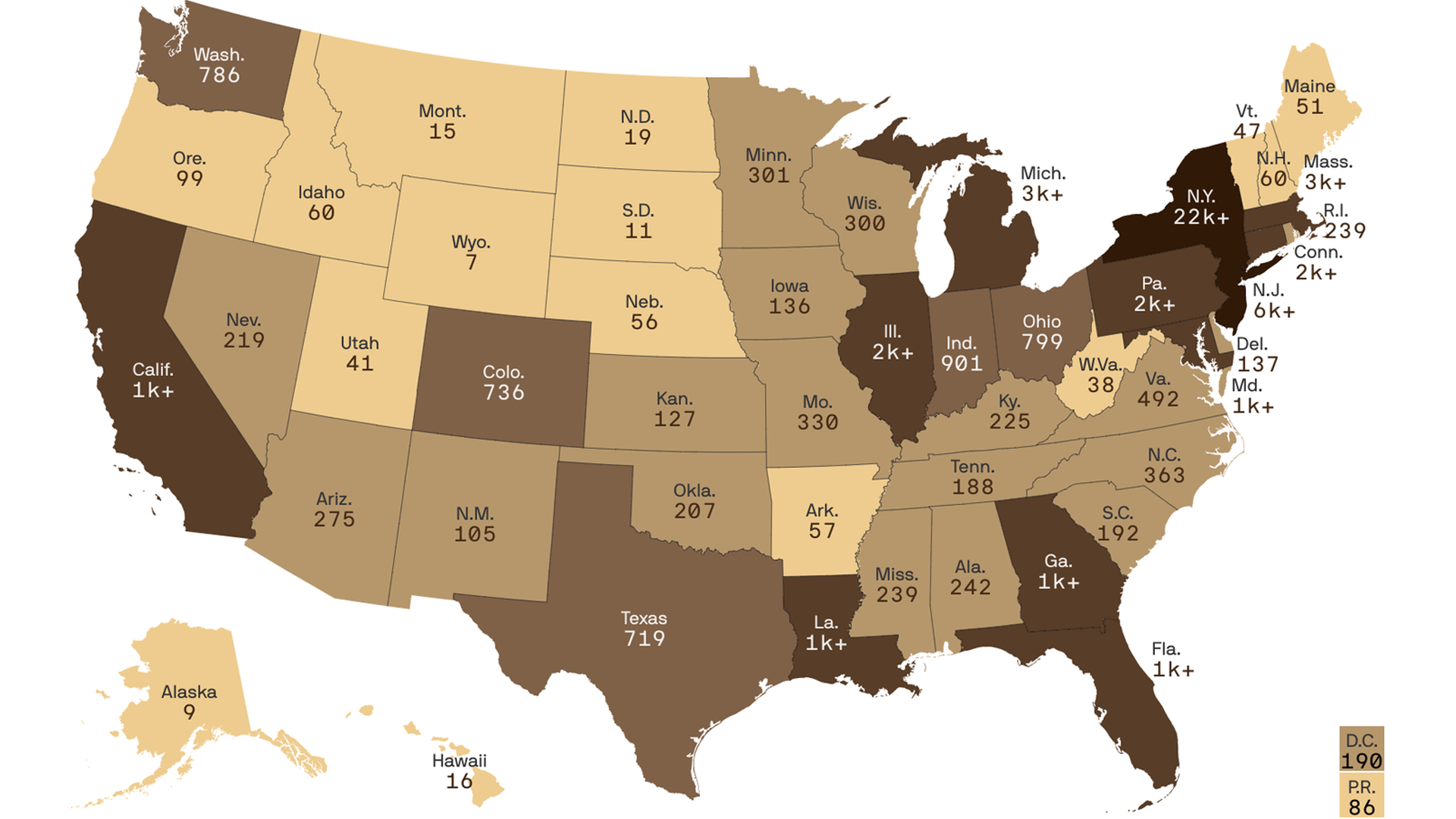
U.S. Coronavirus Updates

https://www.axios.com/coronavirus-west-virginia-first-case-ac32ce6d-5523-4310-a219-7d1d1dcb6b44.html

COVID-19 in the U.S.

As of May 3, 11pm EDT

Deaths     Confirmed cases

67,682         1,158,040

Kudlow defends claiming U.S. had coronavirus "contained" in ...


Former FDA commissioner Scott Gottlieb said on Sunday that despite widespread mitigation efforts, the coronavirus has exhibited “persistent spread” that could mean a “new normal” of 30,000 new cases and over 1,000 deaths a day through the summer.

The big picture: COVID-19 has killed over 66,000 Americans and infected over 1.1 million others in less than three months since the first known death in the U.S., Johns Hopkins data shows.

By the numbers: As states try to mitigate the spread of the coronavirus while easing restrictions, unemployment filings in the U.S. topped 30 million in six weeks, and the number of unemployed could be higher than the weekly figures suggest.

  • Over 175,000 Americans have recovered from the virus and over 6.8 million tests have been conducted in the U.S. as of Sunday.

Catch up quick: The number of deaths in states hit hardest by the coronavirus is well above the normal range, according the CDC.

Lockdown measures: Dozens of states have outlined plans to ease coronavirus restrictions, but the pandemic’s impact on our daily lives, politics, cities and health care will outlast stay-at-home orders.


Reopening is a risk for Republican governors

https://www.axios.com/coronavirus-reopening-republican-governors-cases-deaths-c0233fd4-8f92-448e-a11c-ec5bded1def1.html

Coronavirus reopening is a risk for Republican governors - Axios

Republican governors run a big risk — both to public health and their own political fortunes — if they open up their economies too soon, without adequate safeguards.

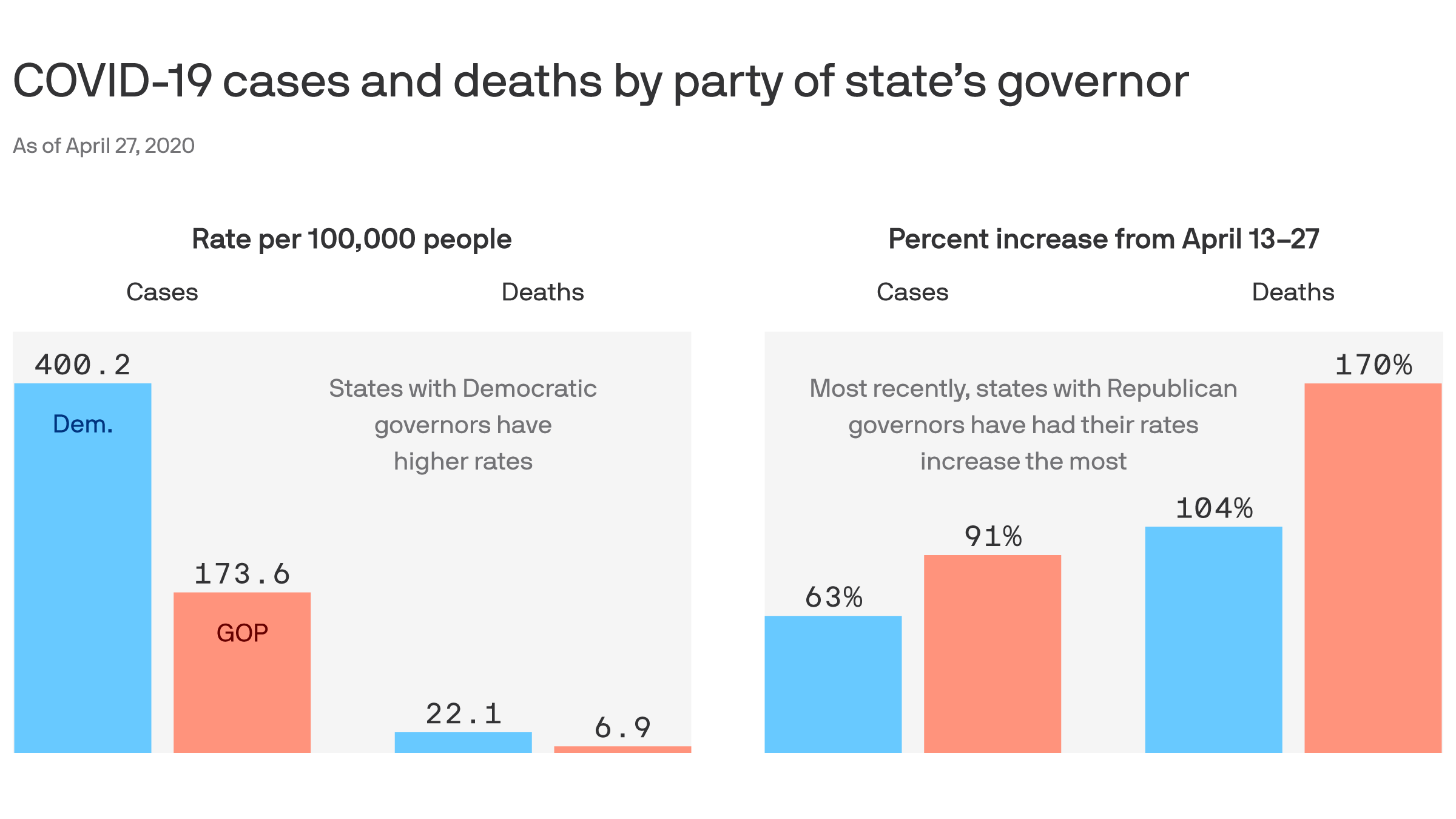
The big picture: The hardest-hit areas so far have mostly been in states with Democratic governors. But the number of coronavirus cases is now increasing more quickly in states with Republican governors.

By the numbers: Coronavirus cases and deaths are both higher in Democratic states than in Republican ones, even after adjusting for population.

  • However, over the last two weeks, reported infections have increased 91% in red states versus 63% in blue states.
  • We see the same pattern for COVID-19 deaths: 170% growth in red states vs. 104% in blue states.

Driving the news: Texas has begun easing its lockdown measures, and other red states are also moving quickly. Florida has reopened some beaches, and some southern states in particular never locked down as tightly as the Northeast and West coast.

  • Yes. but: Every governor wants to open up when they can to get the economy going, and there are some Democratic governors who are also taking steps to ease distancing measures.

Between the lines: The core of the Republican base in white, rural areas is at risk.

  • 20% of people living in non-metro areas are older than 65, compared with 15% in metro areas.
  • And rural residents under 65 are more likely to have pre-existing health conditions (26%), compared to their urban counterparts (20%).

The bottom line: Polls show that Republicans are far more likely than Democrats to think that the worst is behind us when it comes to COVID-19.

  • That may be partly because they, and the Republican governors, think this is largely someone else’s problem. It isn’t.