Tower Health furloughs 1,000 workers amid dramatic revenue drop

https://www.beckershospitalreview.com/finance/tower-health-furloughs-1-000-workers-amid-dramatic-revenue-drop.html?utm_medium=email

Under financial pressure from the COVID-19 pandemic, Philadelphia-based Tower Health has furloughed at least 1,000 employees, according to The Philadelphia Inquirer

Tower Health implemented the furloughs, which affect roughly 7 percent of the system’s 14,000-person workforce, after suspending elective procedures and shutting down many of its outpatient clinics. The seven-hospital system said it has lost as much as half its revenue, according to the report. 

Tower Health received more than $23 million in grants made available under the Coronavirus Aid, Relief and Economic Security Act, but it’s still facing financial pressure.

“These funds, while helpful, do not come close to making up for the decline in revenue Tower Health has experienced in March and into April,” a spokesperson told The Philadelphia Inquirer.

Tower Health joins more than 150 other hospitals and health systems across the U.S. that have furloughed workers in recent months. 


Melinda Gates: This is not a once-in-a-century pandemic.

https://www.businessinsider.com/melinda-gates-coronavirus-interview-vaccine-timeline-2020-4?linkId=87026774

Melinda Gates

‘We will absolutely have more of these.’ The billionaire philanthropist predicts a timeline for going back to normal.

  • Business Insider spoke with Melinda Gates about COVID-19, the prospect and timeline of making an effective vaccine, and how the world will be permanently changed by the coronavirus.
  • Gates said it would likely take about 18 months for a vaccine to become widely available, and that it should first go to healthcare workers to help them keep others safe.
  • She said this pandemic was not a once-in-a-century situation, like the Spanish flu. Because the world is now a global community, we’re likely to see other pandemics in our lifetimes, Gates said.
  • Even after things get back to normal, “our psyches are going to permanently changed … I hope we change to realize that we’re a global community.”

Melinda Gates is the cochair of the Bill & Melinda Gates Foundation, which has donated more than $45 billion to tackle some of the world’s toughest problems, including vaccination research and combating pandemics, from coronavirus to Ebola.

Gates and her husband have long been concerned about a pandemic and have warned that we need to be more prepared at a global level.

In a wide-ranging interview with Gates on Thursday afternoon, she gave her thoughts on the coronavirus pandemic, the inequality of it all, and how the world can go back to semi-normal. The highlights:

  • The world needs a vaccine delivered at mass scale to go back to “normal.” A realistic timeline is about 18 months, the same time it took to create an Ebola vaccine.
  • It is possible we won’t be able to find an effective vaccine for coronavirus, although Gates thinks that is highly unlikely.
  • The idea of herd immunity solving coronavirus is far-fetched. Gates said that would require more than half the population to get coronavirus (which isn’t anywhere close to happening) and a lot of death along the way.
  • To effectively roll out a vaccine, Gates believes you need to first give it to health workers, then to high-risk groups, then distribute it equitably to different countries and communities. The vaccine also has to cost very little with a fund to cover it for everyone. What the US is doing right now, pitting states against each other for supplies and allowing wealthy individuals to access tests first, would be disastrous for a vaccine rollout.
  • To prepare for the second wave of coronavirus this fall, or even a next pandemic, we need mass testing from the get-go, voluntary data sharing from people so that we can trace who has been tested and where they have been, and vaccine stockpiles so that you can distribute those as soon as you see signs of an outbreak.
  • Gates said there would “absolutely” be more pandemics in our lifetime. Coronavirus is not a once-in-a-century occurrence like the Spanish flu.
  • If you want to help vulnerable, poor communities survive coronavirus, Gates recommends giving to the WHO COVID Solidarity FundUnited Way, or America’s Food Fund.

We need a vaccine to be widely distributed before the world will start to feel normal again. Gates says we won’t get that for at least 18 months.

Alyson Shontell: How is it going in the Gates household?

Melinda Gates: Like all other families, it’s been a complete change of life for all of us. But we are also incredibly privileged, and we know that, and our kids know that. But yes, life has changed drastically. The kids are studying online. Bill and I are doing all of our meetings via video teleconference. I’m a terrible cook, so I’m heating things up a lot more, and everybody’s trying to pitch in to do what needs to get done in terms of things around the house.

And the other thing I would just say is every night, we’ve had this tradition for a long time of saying grace before meals. And what that looks like is that we all go around and say something we’re thankful for. Pretty much every night what comes up from the kids and us is we’re thankful for our health and for the fact that we’re not going hungry and the fact that we can still do our work and the kids can still learn. It’s kind of amazing.

Shontell: We heard Dr. Fauci say earlier this week that things probably won’t return to normal until we have a vaccine. What do you think is a realistic timeline for a wide distribution of a vaccine? Is anything faster than 18 months really safe?

Gates: I think it’s likely 18 months. Just from everything we know from working with our partners for many, many years on vaccines, you have to test the compounds. Then, you have to go into preclinical trials, then full-scale trials. And even though I’m sure the FDA will fast-track some of these vaccine trials like they did with Ebola, still by the time you get it through the trials safety- and efficacy-wise, then you have to manufacture the vaccine and manufacture at scale. I think it really is 18 months.

The good news that I’m seeing on that front, though, is so many scientists are coming forward, and I’m seeing CEOs come forward and say, “I have this platform we can use.” Pharmaceutical companies are coming together already to say, “How do we build up the manufacturing capacity so it’s there when we get a vaccine and we can basically just run it through the manufacturing process?” I’m seeing lots of good things come forward, but it’s a process that needs to run its full course, because you don’t want to put something in someone’s body that is harmful.

Shontell: Right. It seems like, in addition to creating something we’ve never had before, you do really have to do these human tests in a way that’s safe so that you’re not creating a vaccine that maybe cures coronavirus but gives you something else.

Gates: I’d add also that we need to know who it’s safe to give the vaccine to and in what dosages. We know COVID-19 is affecting people who are particularly vulnerable health-wise if they have diabetes, or a heart condition, or they have asthma. You have to make sure that, safety-wise, you’re not giving somebody a vaccine that’s going to affect their heart. So yeah, there are lots of issues there that have to be tested.

It’s possible we won’t be able to create a coronavirus vaccine, although Gates thinks that’s highly unlikely. Also, herd immunity is not the solution.

Shontell: If at the end of this 18-month period, or however long it is, we do feel like we’ve got a vaccine, what do you think that vaccine will actually look like? Is it possible that we actually won’t be able to create a vaccine at all? Could that be one scenario?

Gates: Well, it’s possible. We have to look at how far science has come even in the last five years. And the number of compounds we have, there’s something like 14,000 compounds that we, with our partners alone, have. And there are many, many, many others testing compounds that we’re looking at to see, “Is this promising?” Could that one be promising? And we have high throughput screening now of compounds. I really think we’re going to find a vaccine.

We found a vaccine for Ebola, right? And we did that in about an 18-month time frame, and that was hard. When I see the scientific community all coming together the way they are around the globe and sharing data and sharing information, we’re going to get a vaccine.

Shontell: OK, so you’d say that it’s a high likelihood.

Gates: High likelihood.

Shontell: That’s very, very good to know.

Gates: The other thing to think about is, in the meantime, there’s another whole strand of work going on, which is the therapeutics accelerator. Through the accelerator, we’re trying to find medicines so that if you get COVID-19, hopefully we can boost your immune system or tamp down the effect of the disease on you. So again, hopefully, we’ll come up with some medicines that will also help so people don’t get as sick as they’re getting and landing in the ICU, which is what’s truly tragic.

Shontell: Is there anything to this idea of herd immunity? Could we be closer than we think on that, or is that far-fetched thinking?

Gates: That’s still very far-fetched today. You don’t get herd immunity until you have a huge percent of your population that has had the disease. We know that from all the diseases in the past that humans have had. So no, we’re still a long way from herd immunity. And you can’t count on that because a lot of people are going to die in the meantime if you let the experiment run and you just let the disease run its course in communities. Sure, we could get herd immunity and we will get so much death. That’s why it’s so important to remind people the only tools we have today are physical distancing, handwashing, and wearing masks in public. We have to go with what we know works.

How to distribute a coronavirus vaccine to the masses: 1. Make it cheap and buy it for everyone. 2. Give it to healthcare workers. 3. Give it to the highest-risk people. 4. Come up with an equitable way for everyone else to get it (the US is screwing that up right now).

Shontell: Once we have a vaccine, what do you think is the best way to distribute it to the masses? Who should get it first? How would we do it on such a big scale?

Gates: We have to make sure that the vaccine is very low priced and that there’s a fund for buying it for everyone, whether you’re in a low-, middle-, or a high-income country. And that’s doable. We’ve done that with the Vaccine Alliance that exists today. That’s been in existence since 1990, so we know how to do that piece.

But we also have to distribute very carefully. The very first people that need to get this vaccine are healthcare workers, because if you can keep them safe, they can help keep others safe. Then you need to distribute it to the people who are the very most vulnerable. That is, they have underlying health conditions, some of the ones that we’ve talked about before. And from there, you then make it distributed completely equitably across society.

And even the United States is going to have to really work at that. COVID-19 is exposing all the inequities we have in our healthcare system. And so we need to look at, OK, does Mississippi get this vaccine at the same time California gets it and New York gets it? We can’t do this game that we’re playing right now where you have 50 different states competing for resources for masks and PPE, that makes zero sense. You need a national strategy that will equitably distribute this vaccine and we first look at the vulnerable populations.

Shontell: To touch on that point, as you mentioned, there are so many inequalities coming to light with this pandemic, from who has been able to get initial testing on to how it’s affecting different genders in different ways, to more African Americans in the US dying of this than other races. When you think about it, social distancing, stocking up on food, and handwashing are all privileges that some of the poorest communities don’t have.

You’ve done a lot of work on equality efforts, and you’ve said it’s the best way to fix everything in society is to level the playing field. How do we start leveling the playing field so the next time it’s better for everybody? How do we help the people who are in the poorest, most vulnerable communities right now?

Gates: We have to start by remembering that COVID-19 anywhere is COVID-19 everywhere. And if we keep that front and center in our minds, then we will start to think really deeply about these most vulnerable populations.

The thing that keeps me up at night — because I’ve traveled to Africa so many times and been in so many townships and slums — is if you are a person living in those conditions, you can’t begin to handwashing or social distance. In those situations, we need to start with food. People need to be able to feed themselves. And then if they feel like they have COVID symptoms, then they don’t have to go out of the house looking for food.

When I think forward about how we would do this, right now, we have to focus on the pandemic today right in front of us. We have to take the tools we have and try and distribute them as equitably as we possibly can. That means a national response that is thought out and strategic. So you start there.

When you plan for the future, you start to plan it out the way we did for other diseases that came into the world. You would create a vaccine stockpile. We’ve actually been quite involved with that for cholera, which we don’t get much in the United States anymore, but you get in a lot of places in the developing world or in refugee camps. And when there’s a stockpile of vaccine, then when you see an outbreak or a vulnerable population get it, it’s already basically paid for and you ship the vaccines out.

We have to have not a national stockpile of vaccines but an international stockpile of vaccines for something like COVID. We can predict some of these types of disease outbreaks; we just haven’t been planning it. We plan for things like an earthquake or a fire. We need to plan for disease. We are a global community. People travel. We’ve just learned that New York mostly got infected from people coming back from Europe. We have to plan for these things as a global community in the future.

How to be ready for the 2nd wave to hit this fall: Are you ready to give up your personal data and get tracked?

Shontell: Clearly, we were caught flat-footed and unprepared here in the US especially. There’s talk of a second wave of coronavirus potentially hitting in the fall. What are the things we need to do to plan for it? What has to be done by the end of the summer to put us all in a much better shape for it? And then I’m curious what we need to have in place to prevent something like this moving forward, if that’s even possible.

Gates: In terms of what we need to do to prepare ourselves this fall, first of all, all the way through this, we need to listen to the medical experts and the science experts. They know what’s real. We need to do the disease modeling to see where the outbreaks are going. We need to plan resources appropriately and share them in the United States with all the states in an equitable way.

And then we need to do massive testing. We have to have testing at wide scale so that you can get a test and you can know if you’re positive. And if you’re positive, then you self-isolate. Unless you get further disease, you then get telemedicine. You figure out if you need to go to the health system. And you have different tiers of the health system, places people can go for oxygen versus people who go to the ICU.

We can do that, kind of. You can do that triage of people if you have a test. To be frank, we also need to be able to share all that testing data so that eventually the US would be a place like South Korea, where I can literally prove on my phone “I took a test this morning — I’m COVID-free” or “Guess what? I had COVID before and I tested for antibodies in my system. I can be out in society working maybe now.” You could literally have a code on your phone that says, “Tested this morning” or “See? I have a COVID antibody.”

And so we can start to see who can be in society versus who needs to self-isolate. But without testing and contact tracing and some way of being able to prove to one another we’re safe, you can’t plan for a full eventual reopening of society. We need to do get that up and running at scale at a national level.

Preparing for the next epidemic is a whole different conversation. You’d have tests available from the get-go. You would have fought through the civil-liberties issues of people sharing their health information willingly or not willingly. Am I willing to share my health data so that you know if I got it?

Early on, people with COVID had symptoms we didn’t know to track. If we had known that from the get-go because they were able to share their information into a national database voluntarily, we would have known to tell people, “Look for these symptoms. Self-isolate just in case you have it.” We have to be able to start thinking through those types of systems as a country so that we’re prepared for whatever comes next.

Whose job is it to solve a pandemic, the elite’s or the government’s?

Shontell: Yes to all of that. Edelman put out on their annual Trust Barometer in January. They found that trust in media is really low right now. Trust in the government is really low too. But trust in business leaders is the highest group, and people seem to put the most faith in business leaders to solve some of society’s biggest problems.

You and Bill have done a tremendous amount with the foundation. You’re seeing Mark Zuckerberg giving a ton of money toward this. Sheryl Sandberg is doing the same. Jack Dorsey just pledged a big chunk of net worth to help fight COVID. Lots of people are stepping up. Bezos as well.

Is it the responsibility of business leaders to do this versus the government? Is this something we should come to expect? How do you kind of view the responsibility of the people who are in positions of the most privilege as we tackle something as wide-scale is this?

Gates: What I’m seeing is people stepping up. I sometimes wish people could see the number of emails we’re receiving daily at the foundation, not just Bill and me, but our scientists and our head of global health. We’re seeing CEOs come forward. We’re seeing philanthropists come forward. We’re seeing people who have knowledge and data saying, “Should we look at this? What should we do?” I am seeing the best of humanity come out right now in some of these leaders who are stepping forward and doing the right thing.

“Is this the responsibility of business?” was your question. It’s the responsibility of all of us. Business won’t be able to solve this. There’s no way business or philanthropy can solve this alone. It takes the government. It’s government who puts out huge amounts of money into our healthcare system to take care of everybody, to take care of the most vulnerable. It’s philanthropy and business and nonprofits coming together with government to have a national response. That is the only way we’re going to be able to care for all Americans.

But what I see is amazing scientists like Dr. Fauci stepping up and giving all the right messages. Those are the people we should be listening to, and I am seeing so many people come together behind the scenes to try and do the right thing. While the vulnerable is what keeps me up at night, one of the things that keeps me encouraged when I wake up in the morning is seeing so many people doing the right thing.

This is not just a once-in-a-century pandemic. ‘We are absolutely going to have more of these.’

Shontell: Is this a once-in-a-century pandemic like the Spanish flu, or do we need to expect to face more pandemics like this moving forward?

Gates: This is not a once-in-a-century pandemic. We are absolutely going to have more of these. This thing is highly infectious, COVID-19. But it is not nearly as infectious as measles. And we dealt with measles in the world. We know how to deal with measles. We’re going to see more, so we need to plan for them. And we haven’t planned for them as a global community.

Shontell: Why do you think we’ll see more pandemics?

Gates: We’ll see more because of all kinds of reasons, but mainly because we’re a global community and we travel and we spread disease.

Alyson: To end on a positive note, we are going to get through this, right? It will be hard, but we will get through this. I’m curious from your estimation: What timeline are we looking at for life to feel normal again? Or are we in a new normal, and are there things that we should expect to be permanently changed?

No one really knows when things will feel normal again. But be prepared for some permanent changes, including to your psyche.

Gates: I definitely think there are going to be things that are permanently changed. Our psyches are going to be permanently changed. We are learning some things about how to do more meetings online. We’re learning how to take care of each other online. People are reaching out to the elderly in their homes and doing video calls and sending emails or dropping a meal off. What’s going to change is our psyche, and I hope we change to realize that we’re a global community.

To the question of when does society reopen in what we think of as our normal form, nobody really knows the answer to that. It really is when we get a vaccine at scale.

Will we get, over time, probably some partial reopenings of society where you can do certain smaller group things or be out walking with one friend or two friends? I think we will start to see some partial reopenings.

We have to follow the data, though, of how is that working in Wuhan right now? How did it work in South Korea? How does it work in Germany? The places that are kind of ahead of us on both their response and when they got the disease? And then, we’ll start to be able to see, OK, where can we open up pockets of society over time? For right now, we need to be physically distant from one another.

Shontell: If the average person wants to give to help a vulnerable person or community, what’s the best way to do that other than social distancing? Is there some cause to give to or something that’s most helpful?

Gates: Yes. You could go globally. You could go to the WHO COVID Solidarity Fund. Locally, you could go to United Way. America’s Food Fund is another place you can go. I would give also to local domestic-violence organizations. We see domestic violence on the rise for many, many people, particularly women. Any of those would be amazing places to go and to give, even if you only give $10 — $10 or $100, it all makes a difference.

Shontell: I’m leaving this conversation very hopeful. Thank you for all efforts you and Bill and the foundation are doing in helping fight this. You were early to realizing the problems of pandemics, and we are grateful that you’re on it.

Gates: Thanks, Alyson. Be safe. Be well.


In front of White House, nurses read names of colleagues killed by coronavirus

https://www.washingtonpost.com/local/nurses-read-names-of-colleagues-who-died-of-the-coronavirus-in-front-of-the-white-house/2020/04/21/fc93184c-83e6-11ea-878a-86477a724bdb_story.html?fbclid=IwAR3uHwtfPR-JqZaeFCfIrwmVEzDRSN574QocAt932Pa2pyUt6oL9KC3Kka8&fbclid=IwAR2VQF-oNTrPWkrGFODp9d_WMPOzIUW-imvhPWPGZlU2SN32I6W7trHrjEA&fbclid=IwAR2vXZ6AGvzXd9kZp1naBhLYA8Z2MzWVpYi2zbfXUNM9ybmRZ6FhW1hASEU&utm_campaign=wp_main&utm_medium=social&utm_source=facebook

Coronavirus deaths: Nurses read names at White House of colleagues ...

Registered nurses gathered Tuesday in front of the White House to read the names of health-care workers who have died fighting the coronavirus pandemic.

Wearing masks and standing six feet apart, the nurses held up photographs of the deceased as Melody Jones, a member of the National Nurses United union, addressed the news media in an otherwise empty Lafayette Square.

The names came from all over the country — New York and Alabama, Puerto Rico and Nevada, California and Michigan, Florida and Maryland, New Jersey and the District.

A man in blue scrubs stood behind Jones as she read, holding a metallic gold sign painted with the message: “20 seconds won’t scrub ‘hero’ blood off your hands.”

“Let us remember and honor the ultimate sacrifice these nurses paid,” Jones said. “We commit ourselves to fight like hell for the living.”

The protest stood in stark contrast to demonstrations in recent days in some parts of the country in which protesters have demanded the reopening of nonessential businesses. Nurses have been spotted at those gatherings, too, standing arms crossed, in opposition to demonstrators, many of whom are unmasked and milling in crowds.

More than 9,000 health-care workers in the United States have tested positive for the novel coronavirus, according to figures from the Centers for Disease Control and Prevention. Those numbers are believed to be an undercount of infections due to a lack of tests in many areas.

The nurses said Tuesday that they wanted to bring their demands for more personal protective equipment directly to President Trump’s doorstep.

Health-care providers in hospitals, clinics, nursing homes, assisted-living facilities and rehabilitation centers have for weeks asked lawmakers and government agencies for more protective equipment to shield themselves and their vulnerable patients from the spread of covid-19.

National Nurses United last month petitioned the Occupational Safety and Health Administration to institute an emergency safety standard that would provide nurses with more protective gear, including N95 respirator masks, face shields, gowns, gloves and shoe coverings.

Health-care workers, governors and other officials have for weeks demanded that Trump enforce the Defense Production Act to order mass production of those materials. Many have also petitioned Congress to mandate Trump use his authority to help boost the production of such gear.

Last week, a protest in the shadow of the Capitol displayed the faces of health-care workers demanding better protection on 1,000 signs. The sign represented protesters that organizers said would not have been safe if gathered together on the Capitol lawn.


UPMC planning to ramp up elective surgeries despite state ban

https://www.beckershospitalreview.com/patient-flow/upmc-planning-to-ramp-up-elective-surgeries-despite-state-ban.html?utm_medium=email

UPMC to Ensure Patients Not Caught in Middle of Out-Of-Network ...

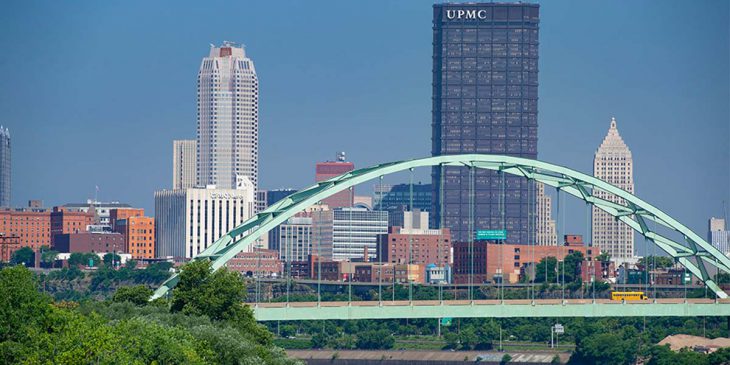
Within six weeks, UPMC plans to return elective surgeries to the level they were before the coronavirus pandemic shut them down, despite a ban on the surgeries ordered by Pennsylvania Gov. Tom Wolf in March, the Pittsburgh Post-Gazette reports.

The ban prohibiting elective surgeries statewide took effect in March, and state health department officials confirmed to the Post-Gazette that the ban is still in place. But the publication obtained a letter sent to UPMC surgeons dated April 15 that shows it making plans to ramp up elective surgeries.

The letter gives surgeons advice on how to justify the procedures, telling them to use terms such as “urgent,” “cancer” and “relief from suffering,” the Post-Gazette reports.

A UPMC spokesman said April 20 that the 40-hospital system believes it can perform elective procedures safely, according to the report. The spokesman also said that new CMS guidance offered healthcare organizations flexibility with regard to providing patients the care they need for nonurgent conditions.

“In the current environment, with proper protection and precautions, we believe that we can soon begin to treat patients who postponed needed treatments and procedures,” the spokesman said in a statement to the Post-Gazette.

A key driver for boosting the number of elective surgeries will be technology that received emergency FDA clearance March 29. That technology allows face masks used by clinicians during COVID-19 care to be sterilized for reuse up to 20 times, the Post-Gazette reports.

UPMC has been piloting the technology and plans to roll out its use to all surgical sites, a handout from an employee meeting April 16 shows.

The ban on elective surgeries, currently in place in 35 states, is hurting hospital finances. The Hospital and Healthsystem Association of Pennsylvania released a report April 20 that shows the pandemic could take a $10 billion toll on hospitals in the state.

If UPMC moves forward with its plans, it would be the first hospital in the state to return to performing elective surgery procedures.


Standing Up to a Tidal Wave of Ignorance, Fear and Abuse

Image may contain: one or more people, people standing, sky, tree and outdoor

Today I stood with some of my fellow nurses and faced a tidal wave of ignorance, fear, and abuse.

I was mocked. I was called more names than I can remember. I was told I was ignorant, unintelligent, and compassionless. I was accused of being a fake nurse, a paid protester, a fraud. I was told I was nothing. I had cigarette smoke blown in my face. I was sexually harassed. A few times, I was surrounded on all sides by multiple people yelling at me.

Desperation and fear bring out the worst in people. I will admit, I cried a bit. How could I not in the face of so much hate?

But I when I did, I was crying for my fellow healthcare workers on the front lines, who are working their asses off fighting this illness, who are being put at worse risk because of the lack of essential protective equipment in this country. I cried for those who have left their families behind to go help where the situation is most dire. I cried for those who have died and will continue to die, after working their hardest to help those who needed them.

I cried for every protester who doesn’t know how they are going to make ends meet, that are afraid for their businesses, their jobs, their homes, and their lives. I cried for every American who has received less than adequate help from the government, who felt like this is the only way for them to get the resources they need, and who have been failed by our president who has not implemented the measures required to help and protect our most vulnerable people.

I cried for every person at this protest that will inevitably get sick, and increase the spread in our state when we had been doing a pretty good job of flattening the curve and delaying the spread of covid-19 in Arizona. I cried for every person who will be infected by those that contracted the disease today.

But more important than the few tears I shed today, was that I stood strong for what is right.

I stood for using science, not feelings, to make important decisions in a pandemic. I stood for the healthcare workers who are going to keep working our hardest to help heal the sick, whether they appreciate it or not. I stood for those who couldn’t. I stood for the lives we have lost, many unnecessarily, to this virus. I stood strong and looked every protester fighting to open Arizona in the eye, so they would have to stare into the face of some of the individuals they are hurting with their ignorance. My hands cramped up from standing in this position so long, but I kept standing until everything died down.

And I will keep standing.


The Inside Story Of How The Bay Area Got Ahead Of The COVID-19 Crisis

https://khn.org/news/the-inside-story-of-how-the-bay-area-got-ahead-of-the-covid-19-crisis/

The Inside Story Of How The Bay Area Got Ahead Of The COVID-19 ...

Sunday was supposed to be a rare day off for Dr. Tomás Aragón after weeks of working around-the-clock.

Instead, the San Francisco public health officer was jolted awake by an urgent 7:39 a.m. text message from his boss.

“Can you set up a call with San Mateo and Santa Clara health officers this a.m., so we can discuss us all getting on the same page this week with aggressive actions, thanks,” said the message from Dr. Grant Colfax, director of San Francisco’s Department of Public Health.

“Will do, getting up now,” Aragón responded.

It was March 15, two days before St. Patrick’s Day, a heavy partying holiday and nightmare scenario for public health officials.

The novel coronavirus was spreading stealthily across the San Francisco Bay Area and public health officials were alarmed by the explosion of deaths in Italy and elsewhere around the globe. Silicon Valley would be next, case counts indicated.

Until then, they had primarily focused on banning mass gatherings. But they knew more had to be done — and wanted to present a united front.

Within a few hours of the text, Bay Area public health leaders jumped on a series of calls to debate options, including the most dramatic — a lockdown order that would shutter businesses, isolate families and force millions of residents to stay home.

They decided they had no choice. And they were able to move swiftly because they had a secret weapon: a decades-long alliance seeded in the early days of the AIDS epidemic that shields them from political blowback when they need to make difficult decisions.

Together, they would issue the nation’s first stay-at-home order, likely saving thousands of lives and charting the course for much of the country. Three days later, Gov. Gavin Newsom followed with his own order for California. New York came next, as have dozens of states since.

“This was one exhausting and difficult day for all of us,” Aragón later wrote in his journal. “We all wish we did not have to do this.”

Now, officials nationwide are weighing how to lift isolation orders as the rate of COVID-19 transmission slows — and protests against the orders mount. The Bay Area is again poised to lead, but with a warning: All of this could be for naught if it isn’t done right.

The coalition of county public health officers didn’t set out to lock down the Bay Area that fateful Sunday morning in mid-March. But as they discussed the exponential increase in Santa Clara County cases, where the hospitals were becoming overwhelmed by infected patients falling ever sicker, what they needed to do “started to crystalize,” said Dr. Sara Cody, the county’s public health officer.

“It felt huge to me,” she recalled, “because I knew how disruptive it would be.”

Elsewhere in the region, diagnosed cases were sparse. But decades of experience had shown the health officers that while they represent different jurisdictions, they are one region when it comes to infectious diseases. “We knew that it would be a matter of time before that was our experience,” said Dr. Matt Willis, Marin County’s public health officer, who contracted COVID-19 days later.

Cody told her colleagues that Italy was under siege, and her county was just two weeks away from a similar fate. If she could have locked down sooner, she told them, she would have.

“That was compelling,” said Dr. Lisa Hernandez, the public health officer for the city of Berkeley, which had not yet recorded any cases of community transmission. “We knew there was going to be St. Patrick’s Day parades and celebrations, so the timing was critical.”

Dr. Scott Morrow, California’s longest-serving public health officer, who heads operations in San Mateo County, said he also felt the urgency. “We thought, ‘Yes, the clock is ticking,’” he recalled.

County health officers in California have immense power to act independently in the interest of public health, including the authority to issue legally binding directives. They don’t need permission from the governor or mayors or county supervisors to act.

Even for this group, though, with all its collective strength, telling millions of Californians to shelter in place seemed risky at first. But the health officers involved had grown to trust one another, even if they don’t always see eye to eye.

For instance, they currently disagree on whether to require residents to wear face coverings. Some counties, including San Francisco and Marin, are requiring them in public, while others, like Santa Clara, are not.

On the first Sunday morning call, Aragón floated the idea of developing a coordinated recommendation that Bay Area residents stay at home. By the next confab, Cody, Santa Clara County’s health official, made the case that for social distancing to work, it had to be an order.

“Sara Cody was the courageous leader!” Aragón later wrote in his journal.

So forceful a move can be unpopular, but evidence shows it can also be the most effective, in the absence of treatment or a vaccine. “Here’s the rub on these methods — they only work if you do it really early,” said Dr. Howard Markel, a medical historian at the University of Michigan and an expert on the 1918 flu pandemic.

“When you do a quarantine, you stop the commerce, you stop the flow of money,” he said. “But on the other side of that are those whose lives are saved.”

This isn’t the group’s first pandemic. The alliance, formally called the Association of Bay Area Health Officials, was born in 1985 in the early days of the AIDS epidemic.

Dr. David Werdegar, who became health officer for San Francisco that year, was analyzing AIDS data for surrounding counties and asked their health officers to join him for dinner at Jack’s, an old bordello-turned-political hangout in the city that has since shuttered.

Most of the infectious disease research was happening in San Francisco at the time, but HIV was spreading, and one city couldn’t fight it alone.

“It was important that we share all the information we had,” said Werdegar, now in his 80s and retired.

Dr. Robert Melton, a former Monterey County health officer, said that working for nearly two decades with Bay Area public health giants taught him tremendous lessons. “Camaraderie is important in maintaining the energy to be able to focus on the common good, through good and bad,” he said.

That close-knit relationship among the 13 health officers — representing counties stretching across a large swath of Northern California from Napa to Monterey — continues to this day. Collectively, their public health actions touch about 8.5 million people.

They meet monthly and communicate regularly on Slack, a messaging app. Their diverse backgrounds and expertise, especially in an era of funding cuts, provide a deep well of public health knowledge from which to draw. Together, the group has joined forces to combat youth vaping, air pollution and measles outbreaks.

And they have also tackled various influenza scares, which is why they had an emergency response blueprint at the ready when cases of what would later be called COVID-19 first cropped up in Wuhan, China.

“We spent a couple years as a region thinking about pandemic planning, and that really helped us come a long way thinking about these policies for COVID-19,” said Dr. Erica Pan, the interim health officer for Alameda County.

So when they jumped on the call that Sunday, they were already in mid-conversation about how to respond. They brought their lawyers and, working into the predawn hours, translated their lockdown plan into legalese, one that would be enforceable with fines and misdemeanor charges.

They would make prime-time announcements across the region the next day, alongside elected officials. “This is not the moment for half-measures,” said San Jose Mayor Sam Liccardo. “History won’t forgive us for waiting an hour more.”

At first, the stay-at-home order applied just to the “Big Seven” counties surrounding the San Francisco Bay, whose officers peeled off from the larger group to issue it first. They shared their model ordinance with the others, who quickly followed.

Dr. Gail Newel, an OB-GYN and Santa Cruz County’s health officer, is not an infectious disease expert. She has relied heavily on the group’s expertise throughout her career, and especially now.

“It’s this incredible bank of knowledge and wisdom and experience that’s freely shared among the members,” she said. “And the whole Bay Area benefits by that shared knowledge bank.”

Roughly one month after they made the unprecedented decision to close the local economy, the risk seems to have paid off. It will be years before researchers have fully analyzed its impact, but officials across the Bay Area are cautiously optimistic. Others haven’t been so lucky.

Though there are important differences between the two regions, New York City, which issued a stay-at-home order four days after the Bay Area, saw its hospitals completely overwhelmed and had recorded more than 14,600 deaths as of Monday.

By comparison, the counties represented by the alliance have documented more than 215 deaths and hospitals haven’t been overtaken by a surge. In fact, hospitals brought online specifically to accommodate an overflow of patients are sitting largely empty.

Even within California, communities that waited to issue lockdown orders have emerged as COVID-19 hot spots, including Los Angeles, where Mayor Eric Garcetti followed suit three days after the Bay Area.

Internally, some of the Bay Area health officials have wondered if they made the right call. But “anytime I have any doubt, I just read another news report from New York or Detroit or New Orleans,” said Dr. Chris Farnitano, Contra Costa County’s health officer.

And the close-knit band is already undertaking its next task: reopening the economy without causing another spike in cases.

Before the orders are lifted, the officials say there must be rapid, widespread testing across the population. They want to hire disease investigators by the hundreds, if not the thousands, to trace the virus and quarantine those who have been infected. And until there is a vaccine, they may ask people to wear masks in public and continue social distancing, even in bars, restaurants and schools when they reopen.

“I was concerned that we might get a lot of resistance and it might get interpreted as alarmist and overreach,” said Marin County’s Willis. “Time has shown that it was really a vital step to take when we took it.”


Health Care Workers Stand Up To People Protesting Stay-At-Home Orders

https://nowthisnews.com/news/health-care-workers-stand-up-to-people-protesting-stay-at-home-orders

View image on Twitter

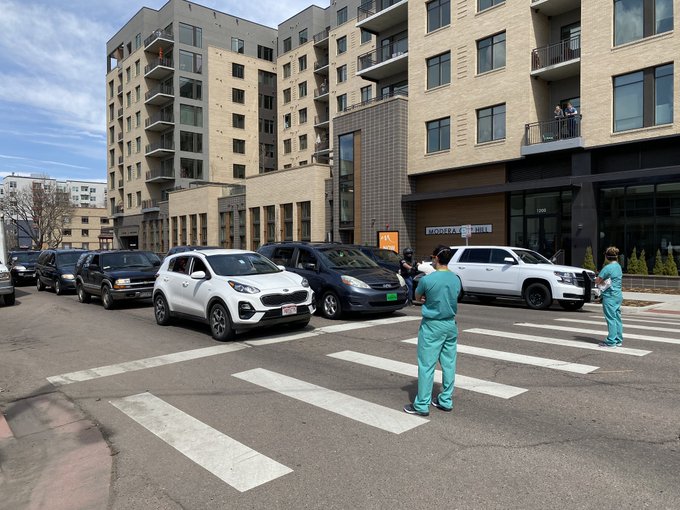
Remarkable scene at 12th and Grant, where two healthcare workers from a Denver-area hospital — they declined to say which or give their names — are standing in the crosswalk during red lights as a “reminder,” they say, of why shutdown measures are in place.

Two health care workers blocked a parade of protesters in Denver, Colorado on Sunday, who were storming the capitol to protest the state’s stay-at-home order.

Powerful images and videos of the standoff were widely shared on social media of the two unidentified people wearing scrubs and N95 masks, standing in a crosswalk blocking protesters’ vehicles. The two were identified as health care workers by photographers on the scene. 

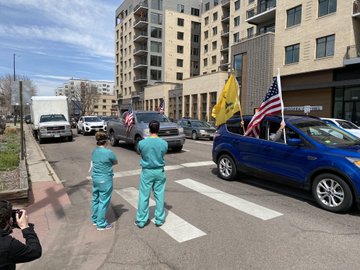
One video shared by Twitter user Marc Zenn, captured cars lined up and beeping their horns at the two medical workers, with a woman hanging out of her vehicle’s window shouting “Go to China if you want communism. Go to China,” and “You get to go to work, why can’t we?”

View image on Twitter

They say they’ve been treating COVID patients for weeks. Today most of the people driving by have been “very aggressive,” they say. I’ve been standing here for a few minutes and already seen two people get in their faces.

Hundreds of people showed up on foot and in their vehicles for two separate protests in Colorado’s capitol on Sunday. The protests were reportedly planned by ReOpen Colorado and “various Libertarian parties,” according to a local Denver news outlet. People attending the march were shown carrying American flags, “Don’t Tread on Me” flags, and signs about reopening businesses and schools.

“Coloradans have a first amendment right to protest and to free speech, and the Governor hopes that they are using social distancing and staying safe,” Colorado Gov. Jared Polis’ office said in a statement. “No one wants to reopen Colorado businesses and lift these restrictions more than the Governor, but in order to do that, Coloradans have to stay home as much as possible during this critical period, wear masks and wash their hands regularly to slow the spread of this deadly virus.”

As of Monday morning, Colorado has more than 9,700 cases of COVID-19, leading to at least 420 deaths, according to the Johns Hopkins coronavirus tracker. The state of Colorado is set to continue its stay-at-home order until at least April 26, to slow the transmission of the virus.  

Colorado isn’t the only state where protesters are demonstrating against their government’s stay-at-home orders—Several other states held protests over the weekend including Utah, Idaho, and Washington state. Last week, parts of Michigan, New York, Ohio, Virginia, North Carolina, and others also saw a wave of demonstrators

President Trump encouraged the protesters last week during his Friday press briefing and in tweets which said to “liberate” multiple states holding protests.

In a Politico poll, 81% of Americans agreed we “should continue to social distance for as long as is needed to curb the spread of coronavirus, even if it means continued damage to the economy.” An NBC News poll found that 60% of responders agreed with keeping at-home restrictions.


Current State of the Union

https://www.buzzfeednews.com/article/gabrielsanchez/huge-crowds-protest-coronavirus-trump-coronavirus-pandemic?fbclid=IwAR0abgB9Wpv2WAOhNgdYhQgNU6W6h1NnqoVcxxye4QTRBwQaSEsxzeIXyho

These Pictures Show Crowds Protesting Against Coronavirus Lockdowns At State Capitols

Conservative demonstrators gathered at the capitol buildings of Michigan, Kentucky, and North Carolina to protest against stay-at-home orders during a pandemic that has already left more than 26,000 Americans dead.


What is work sharing and how can it help the labor market?

https://www.brookings.edu/blog/up-front/2020/04/16/what-is-work-sharing-and-how-can-it-help-the-labor-market/?utm_campaign=Brookings%20Brief&utm_source=hs_email&utm_medium=email&utm_content=86505163

What is work sharing and how can it help the labor market?

When economic conditions worsen, as they did beginning in March 2020 because of the COVID-19 pandemic, employers often respond by laying off their employees. This can lead to very undesirable outcomes for society at large. Research shows that losing a job often causes decreased long-term earnings, health problems, and other adverse outcomes, the effects of which can last generations (Abraham and Houseman 2014). Layoffs create future costs for employers as well—once demand picks back up, firms will have to expend valuable resources on significant search, hiring, and training costs.

The U.S. unemployment insurance (UI) system can help. Its core function is to replace some of the earnings of workers who have lost their jobs, helping them to stay afloat during tough economic times. But the UI system can also support workers and employers as they reduce, rather than eliminate, employees’ work hours.

WHAT IS WORK SHARING?

A program called work sharing, or short-time compensation, encourages employers to temporarily reduce the hours of their employees rather than lay them off during an economic downturn. Work sharing allows employers to keep their skilled workforce and reestablish a full-time schedule when economic conditions improve. With this approach, employees continue to be paid for the hours they work, collecting pro-rated unemployment benefits that help cover the work hours they lose. For example, employers could reduce everyone’s hours by 20 percent and employees would qualify for 20 percent of the weekly unemployment benefit amount.

In a Hamilton Project proposal, economists Katharine Abraham and Susan Houseman described reforms that would facilitate the use of work sharing. The importance of these reforms for addressing the current economic downturn was discussed further in a recent webcast titled, “Unemployment Insurance during the COVID-19 Pandemic: Reducing the Impact of this Economic Downturn.”

WHAT IS THE RATIONALE FOR WORK SHARING? HOW MANY JOBS COULD IT SAVE?

Work sharing provides employers a way to respond to a decrease in demand by cutting back on hours rather than laying workers off. This approach maintains employer-employee connections, minimizing layoffs and supporting workers who have their hours reduced. Work sharing can be particularly helpful when the drop in demand is expected to be temporary, as many think likely for this pandemic-caused recession.

The value of preserving relationships between employers and employees is twofold. First, it can avoid huge spikes in permanent job losses that are financially ruinous for many families. Workers continue their employment, albeit with reduced hours, and avoid many of the damaging effects of losing a job (like loss of health insurance coverage). Second, both employers and workers will avoid costly search, hiring, and training once demand eventually picks back up.

Throughout the Great Recession, when only 17 states offered the option, use of work-sharing was very limited. Abraham and Houseman estimate that if work sharing had been available for the entire country during the Great Recession—and take-up rates had been similar to our European counterparts—work-sharing programs could have saved up to 1 million jobs, or 1 in 8 of the net jobs that were lost during the Great Recession.

HOW WIDESPREAD ARE WORK-SHARING PROGRAMS?

Today, 26 states, covering nearly 70 percent of the workforce, have operational work-sharing programs in place. But work sharing has been little used in the earliest days of this recession. As of the week ending in March 28, just 0.3 percent of the more than 8.2 million people claiming UI benefits received work-sharing benefits.

To expand coverage, Abraham and Houseman propose that Congress pass legislation that requires states to have a work-sharing program as a part of their UI system to participate in the federal–state UI system. Further, in order to encourage state take-up, they propose that the U.S. Department of Labor modify its funding formula to more accurately fund state administrative burdens associated with implementing and promoting work-sharing programs.

WHAT ELSE CAN BE DONE TO MAKE IT EASY FOR EMPLOYERS TO USE THE PROGRAM?

First, states could look for opportunities to expedite the process of starting up a work-sharing plan and paying benefits. Second, states could remove policies that tend to discourage the use of work sharing and push employers toward layoffs. For example, some states bar employers who have heavily used the UI system in the past from participating in work-sharing programs. Additionally, some states impose higher effective UI tax rates on employers who choose work-share programs than if they laid off their workers. Designed to prevent abuse of the UI system, these policies may discourage work sharing, especially during downturns. Abraham and Houseman recommend that Congress add a prohibition against the use of these policies to the existing criteria for state eligibility to participate in the federal–state UI system.

HOW CAN WORK-SHARING PROGRAMS BE FURTHER INCORPORATED INTO THE EXISTING UI SYSTEM?

Under current law, sharp increases in a state’s unemployment rate trigger extensions to the benefits available in that state; the federal government covers half the cost of those extensions. That same federal-state program could enhance the use of work sharing. Abraham and Houseman propose that the federal government cover half the cost of work-sharing programs when UI extended benefits are triggered in a state. As explained below, Congress has recently gone beyond this proposal, but only on a temporary basis.

HOW IS WORK SHARING ADDRESSED IN THE CORONAVIRUS AID, RELIEF, AND ECONOMIC SECURITY ACT (CARES ACT)?

The CARES Act, signed into law on March 25, 2020, encourages states and employers to use work-sharing programs. The federal government will reimburse 100 percent of the cost of short-time compensation benefits paid in states that have work-sharing programs in place. For those states that do not have a work-sharing program, the CARES act includes funds to pay for short-time benefits at a 50 percent federal coverage rate. Finally, the CARES Act allocates grant funding for states to promote and improve the implementation and administration of work-sharing programs.