How some cities ‘flattened the curve’ during the 1918 flu pandemic

https://www.nationalgeographic.com/history/2020/03/how-cities-flattened-curve-1918-spanish-flu-pandemic-coronavirus/#close

A Pandemic And A Parade: What 1918 tells us about flattening the curve

Social distancing isn’t a new idea—it saved thousands of American lives during the last great pandemic. Here’s how it worked.

PHILADELPHIA DETECTED ITS first case of a deadly, fast-spreading strain of influenza on September 17, 1918. The next day, in an attempt to halt the virus’ spread, city officials launched a campaign against coughing, spitting, and sneezing in public. Yet 10 days later—despite the prospect of an epidemic at its doorstep—the city hosted a parade that 200,000 people attended.

How they flattened the curve during the 1918 Spanish Flu

Flu cases continued to mount until finally, on October 3, schools, churches, theaters, and public gathering spaces were shut down. Just two weeks after the first reported case, there were at least 20,000 more.

The 1918 flu, also known as the Spanish Flu, lasted until 1920 and is considered the deadliest pandemic in modern history. Today, as the world grinds to a halt in response to the coronavirus, scientists and historians are studying the 1918 outbreak for clues to the most effective way to stop a global pandemic. The efforts implemented then to stem the flu’s spread in cities across America—and the outcomes—may offer lessons for battling today’s crisis. (Get the latest facts and information about COVID-19.)

How they flattened the curve during the 1918 Spanish Flu

From its first known U.S. case, at a Kansas military base in March 1918, the flu spread across the country. Shortly after health measures were put in place in Philadelphia, a case popped up in St. Louis. Two days later, the city shut down most public gatherings and quarantined victims in their homes. The cases slowed. By the end of the pandemic, between 50 and 100 million people were dead worldwide, including more than 500,000 Americans—but the death rate in St. Louis was less than half of the rate in Philadelphia. The deaths due to the virus were estimated to be about 358 people per 100,000 in St Louis, compared to 748 per 100,000 in Philadelphia during the first six months—the deadliest period—of the pandemic.

Dramatic demographic shifts in the past century have made containing a pandemic increasingly hard. The rise of globalization, urbanization, and larger, more densely populated cities can facilitate a virus’ spread across a continent in a few hours—while the tools available to respond have remained nearly the same. Now as then, public health interventions are the first line of defense against an epidemic in the absence of a vaccine. These measures include closing schools, shops, and restaurants; placing restrictions on transportation; mandating social distancing, and banning public gatherings. (This is how small groups can save lives during a pandemic.)

Of course, getting citizens to comply with such orders is another story: In 1918, a San Francisco health officer shot three people when one refused to wear a mandatory face mask. In Arizona, police handed out $10 fines for those caught without the protective gear. But eventually, the most drastic and sweeping measures paid off. After implementing a multitude of strict closures and controls on public gatherings, St. Louis, San Francisco, Milwaukee, and Kansas City responded fastest and most effectively: Interventions there were credited with cutting transmission rates by 30 to 50 percent. New York City, which reacted earliest to the crisis with mandatory quarantines and staggered business hours, experienced the lowest death rate on the Eastern seaboard.

In 2007, a study in the Journal of the American Medial Association analyzed health data from the U.S. census that experienced the 1918 pandemic, and charted the death rates of 43 U.S. cities. That same year, two studies published in the Proceedings of the National Academy of Sciences sought to understand how responses influenced the disease’s spread in different cities. By comparing fatality rates, timing, and public health interventions, they found death rates were around 50 percent lower in cities that implemented preventative measures early on, versus those that did so late or not at all. The most effective efforts had simultaneously closed schools, churches, and theaters, and banned public gatherings. This would allow time for vaccine development (though a flu vaccine was not used until the 1940s) and lessened the strain on health care systems.

The studies reached another important conclusion: That relaxing intervention measures too early could cause an otherwise stabilized city to relapse. St. Louis, for example, was so emboldened by its low death rate that the city lifted restrictions on public gatherings less than two months after the outbreak began. A rash of new cases soon followed. Of the cities that kept interventions in place, none experienced a second wave of high death rates. (See photos that capture a world paused by coronavirus.)

In 1918, the studies found, the key to flattening the curve was social distancing. And that likely remains true a century later, in the current battle against coronavirus. “[T]here is an invaluable treasure trove of useful historical data that has only just begun to be used to inform our actions,” Columbia University epidemiologist Stephen S. Morse wrote in an analysis of the data. “The lessons of 1918, if well heeded, might help us to avoid repeating the same history today.”


Cartoon – Sending Our Medical Warriors to Battle

Marshall Ramsey: PPE | Mississippi Today

Not jumping to conclusions on coronavirus treatment

https://mailchi.mp/39947afa50d2/the-weekly-gist-april-17-2020?e=d1e747d2d8

A Closer Look At Remdesivir, An Experimental Coronavirus Drug ...

Early reports of hastened recoveries among patients taking the antiviral drug remdesivir sent manufacturer Gilead Sciences’ stock soaring over 8 percent this morning, and contributing to an overall uptick in the market. The gains came after a scoop by healthcare news site STAT, which obtained a copy of an internal webinar from University of Chicago Medicine, where an infectious disease specialist discussed positive results from their early experience with remdesivir. The system recruited 125 patients into Gilead’s Phase 3 clinical trials for the drug; 113 patients had severe disease. The presenting physician reported rapid reductions in fever and improvements in respiratory symptoms, noting that just two patients had died, and most of the participating patients had already been discharged—on average after just six days, suggesting a long course of drug treatment may not be necessary.

The STAT leak comes on the heels of a NEJM article late last week, which reported clinical improvement of over two-thirds in COVID-19 patients who received remdesivir. Critics were quick to point out  numerous flaws in the study, including lack of a control group, cherry-picking of patients, and the deep involvement of the manufacturer in study design, many of which also apply to the University of Chicago report.

In the thick of the pandemic, doctors and patients’ families are understandably motivated to get very sick patients access to any treatment that may help—but the resulting frenzy following the publication of early results may make it even harder to get good data to understand what works, and what doesn’t.

In the words of one expert, “Fast trials are generally not very interpretable, interpretable trials are generally not fast”. In the search for a “COVID-19 cure”, it’s highly unlikely that any single drug will provide a cure for the viral illness, and the only way we’ll know if a treatment is truly working is to wait for the results of randomized, controlled trials—despite how frustrating it is to muster the patience to do so.


Beginning the long, winding journey back from coronavirus

https://mailchi.mp/39947afa50d2/the-weekly-gist-april-17-2020?e=d1e747d2d8

45cat - The Beatles - The Long And Winding Road / For You Blue ...

It was another brutal week in the coronavirus pandemic, with more than 2.1M cases and nearly 150,000 deaths worldwide. The US continued to be the hardest-hit country, reaching a daily record 4,591 deaths from COVID-19 on Thursday. The national death toll is now more than 35,000, though there are signs that the number of new cases in the US has begun to plateau, raising hopes that the worst days may be drawing to a close. Meanwhile, with strict stay-at-home measures continuing in most places across the country, the economic toll of the virus mounted. New unemployment claims rose by another 5.2M, bringing the estimated number of American jobs claimed by the virus to 22M, eliminating a decade’s worth of job growth, and raising the unemployment rate to an estimated 17 percent.

As the growth in new cases flattened, attention turned this week to plans to “reopen” the American economy. Despite insisting early in the week that he alone would decide when and how to reopen the country, President Trump yesterday unveiled a set of non-binding, “Opening Up America Again” guidelines for state and local officials to use in judging when to loosen restrictions. The guidelines suggest a three-stage, gated approach, gradually allowing individuals and employers to return to normal activities based on criteria including disease trends, hospital capacity, and the availability of robust testing. Progressing from one stage to the next is predicated on maintaining a downward trajectory in new cases—with any signs of a resurgence indicating a need to reimpose restrictions.

Missing from the White House plan are specific details about how states, cities, and healthcare providers are to procure and pay for the many millions of tests and extensive contact tracing that will need to be available to allow businesses, public transport systems, and other essential services to resume activity. By week’s end, about 3.5M coronavirus tests had been conducted nationally, but the daily number of tests conducted has plateaued, and the test-positivity rate is still troublingly high. Public health experts continue to warn that testing must ramp up significantly before any steps toward reopening can be considered, a difficult challenge given widespread reports of shortages of testing supplies and trained lab technicians. To bolster testing capacity, the Centers for Medicare and Medicaid Services (CMS) this week nearly doubled the amount it will pay laboratories to analyze tests using high-throughput equipment.

Three coalitions of states—in the Northeast, Midwest, and West Coast—were formed this week to coordinate regional efforts to reopen the economy. Among the issues they’ll need to address: interstate travel restrictions, coordinated purchasing of critical supplies, investments in contact tracing capabilities, and ongoing surveillance of the virus’ spread. With federal agencies taking a back seat to states (“You are going to call your own shots,” the President told governors on a call this week), it became clear that the road back from the coronavirus pandemic will be circuitous, with a patchwork of different timelines and approaches in different locations based on local conditions and resources.

In the words of William Gibson, “The future is here—it’s just not very evenly distributed.”


Coronavirus tracked: the latest figures as the pandemic spreads

https://www.ft.com/coronavirus-latest


A graphic with no description

The human cost of the coronavirus outbreak has continued to mount, with more than 2.2m cases confirmed globally and more than 141,900 people known to have died from the disease.  The World Health Organization has declared the outbreak a pandemic and it has spread to more than 190 countries around the world.  This page provides an up-to-date visual narrative of the spread of Covid-19 so please check back regularly because we will be refreshing it with new graphics and features as the story evolves.

A graphic with no description

Focus of Covid-19 deaths has switched from Asia to Europe — and now the US. Streamgraph and stacked column charts, showing regional daily deaths of patients diagnosed with coronavirus

A graphic with no description


To save lives, social distancing must continue longer than we expect

https://www.washingtonpost.com/outlook/2020/04/08/save-lives-social-distancing-must-continue-longer-than-we-expect/?fbclid=IwAR0mNfbcEn9yfF8wfYRsWX9pufLcaArlhqXc8ETSOeSN3_2VdAob0V7WPYQ

To save lives, social distancing must continue longer than we ...

The lessons of the 1918 flu pandemic.

After weeks of quarantine, school closures and binge-watching movies, Americans are getting restless. In a recent interview on “The View,” California Gov. Gavin Newsom (D) warned that complacency and cabin fever were his biggest concerns, and he urged audiences to “stick with this.”

He is right. More than 100 years ago, during the worst contagious crisis in human history (so far), the influenza epidemic of 1918-1919 took 40 million to 100 million lives worldwide and inspired a huge implementation of social distancing measures such as school closures, bans on public gatherings, isolation and quarantine.

But the experience of 1918 also reminds us that early, layered (i.e., more than one at the same time) and lengthy mitigation measures are the best strategy. For social distancing to work, it must be sweeping and enforced across a wide swath of the community. Essential businesses will, of course, need to continue. All other places where people congregate should cease operations for the time being. In 1918, social distancing measures were kept in place for many weeks, if not months, even if people and businesses did not always support them. But the key lesson: This approach worked.

By now, many have read of the comparisons between St. Louis, where a decisive health commissioner reacted with amazing rapidity to implement sweeping public health orders, and Philadelphia, which chose to stay open, even going ahead with plans for a huge parade.

St. Louis was rewarded with one of the best outcomes of any large U.S. city. Philadelphia’s fateful decision to carry on with its immense Liberty Loan Parade resulted in a massive spike in influenza cases in the days immediately following. The city endured some of the worst numbers of cases and deaths in the United States as a result.

Philadelphia was hardly alone, however. In Baltimore, the health commissioner dragged his feet when a group of physicians requested that the city ban public gatherings. “We do not consider such drastic steps necessary in view of the extreme low civilian death rate in the city,” he told them. More than 4,100 Baltimoreans lost their lives to the epidemic.

In Atlanta, the mayor sided with business interests and reopened the city after just three weeks of closures, over the vocal objections of his Board of Health. When the board predicted that Atlanta’s epidemic peak would not occur for another nine days, the mayor dismissed the science, arguing that there was no way to foretell future conditions. The city health officer sided with the mayor, mistakenly declaring that the peak had passed. It had not, and Atlanta’s fall wave of the epidemic raged on, unchecked, through the end of 1918. “The influenza situation in Atlanta is up to the people themselves,” the Public Safety Committee declared.

Atlanta may be a more extreme example, but its experience was hardly singular. In every city we studied from this era there was public pressure to quit the social distancing measures as soon as the epidemic seemed to peak and then ebb. Thinking that the proverbial coast was clear, many communities lifted social distancing measures before the battle was truly over. After weeks of being denied their usual social outlets, people were eager to return to a life of normalcy, and they did so in one giant rush. In city after city, masses lined up for movie houses and performance theaters, crowds packed into dance halls and cabarets, and throngs flocked to downtown shopping districts, often on the very day that the closure orders were lifted.

The result? Cases and deaths resurged. Most cities closed their schools once again. But the political, economic and social will to issue another round of sweeping business closures and gathering bans had evaporated as people grew weary of the dislocations of social distancing. In some cities, most notably Denver, Kansas City, Milwaukee and even the vaunted St. Louis, this second peak was even deadlier than the first.

Lastly, 1918 teaches us how quickly an unchecked epidemic can overwhelm our health-care infrastructure. Philadelphia had to erect 32 temporary hospitals just to handle its massive number of influenza cases. On a single day in mid-October, 10 trucks were needed to carry the bodies of indigent victims to the city’s potter’s field. Some of the deceased had to be buried in temporary graves until more permanent plots could be dug.

In Pittsburgh, the epidemic grew so bad that a local sporting club had to donate its tents to use as field hospitals. One San Antonio hospital had to rely on 18 student nurses to tend to hundreds of influenza patients; the 12 regular nurses were all sick with influenza themselves. Nashville’s City Hospital was overrun with cases in a single day. These cities, unfortunately, were not alone in their experiences.

Today we have two notable advantages over those in 1918: We know the causative agent of covid-19, and our medical care is far more advanced. In 1918, scientists believed the epidemic was caused by a bacterium, and the influenza virus would not be discovered for another quarter-century. The standard medical treatment for influenza victims in 1918 consisted of little more than propping patients up to prevent them from choking on their sputum. Today, it is only a matter of time before researchers discover pharmaceutical therapies and develop an effective vaccine against the disease. In 2020, physicians have the ability to drive down the fatality rate of this epidemic through the use ventilators and intensive care units — as long as such lifesaving machines are available.

Our health-care system can only do this, however, if we don’t allow our already-taxed hospitals, physicians and nurses to be overrun with cases. That means that, until an effective vaccine can be developed and deployed, we must “flatten the curve.” This will not be accomplished in a week, or even a month. We must implement and coordinate sweeping non-pharmaceutical interventions on a national level and keep these measures in place as long as necessary. These measures are not perfect. They are slow and plodding. They are socially and economically disruptive. They fracture the routines of our daily lives in myriad ways, large and small. They do not magically end epidemics. But they can save lives.

As we all endure the hardships of the covid-19 pandemic and dislocations of social distancing, we can take heart that together we will save lives. Just as our forebears did a century ago.

And that is the most important lesson of 1918.


A New Statistic Reveals Why America’s COVID-19 Numbers Are Flat

https://www.theatlantic.com/technology/archive/2020/04/us-coronavirus-outbreak-out-control-test-positivity-rate/610132/

A New Statistic Reveals Why America's COVID-19 Numbers Are Flat ...

Few figures tell you anything useful about how the coronavirus has spread through the U.S. Here’s one that does.

How many people have the coronavirus in the United States? More than two months into the country’s outbreak, this remains the most important question for its people, schools, hospitals, and businesses. It is also still among the hardest to answer. At least 630,000 people nationwide now have test-confirmed cases of COVID-19, according to The Atlantic’s COVID Tracking Project, a state-by-state tally conducted by more than 100 volunteers and experts. But an overwhelming body of evidence shows that this is an undercount.

Whenever U.S. cities have tested a subset of the general population, such as homeless people or pregnant women, they have found at least some infected people who aren’t showing symptoms. And, as ProPublica first reported, there has been a spike in the number of Americans dying at home across the country. Those people may die of COVID-19 without ever entering the medical system, meaning that they never get tested.

There is clearly some group of Americans who have the coronavirus but who don’t show up in official figures. Now, using a statistic that has just become reliable, we can estimate the size of that group—and peek at the rest of the iceberg.

According to the Tracking Project’s figures, nearly one in five people who get tested for the coronavirus in the United States is found to have it. In other words, the country has what is called a “test-positivity rate” of nearly 20 percent.

That is “very high,” Jason Andrews, an infectious-disease professor at Stanford, told us. Such a high test-positivity rate almost certainly means that the U.S. is not testing everyone who has been infected with the pathogen, because it implies that doctors are testing only people with a very high probability of having the infection. People with milder symptoms, to say nothing of those with none at all, are going undercounted. Countries that test broadly should encounter far more people who are not infected than people who are, so their test-positivity rate should be lower.

The positivity rate is not the same as the proportion of COVID-19 cases in the American population at large, a metric called “prevalence.”* Nobody knows the true number of Americans who have been exposed to or infected with the coronavirus, though attempts to produce much sharper estimates of that figure through blood testing are under way. Prevalence is a crucial number for epidemiologists, in part because it lets them calculate a pathogen’s true infection-fatality rate: the number of people who die after becoming infected.

But the positivity rate is still valuable. “It’s not a normal metric, but it can be a very useful one in some circumstances,” Andrews said. The test-positivity rate is often used to track the spread of rare but deadly diseases, such as malaria, in places where most people aren’t able to get tested, he said. And if the same proportion of a population is being tested over time, the test-positivity rate can even be used to calculate the contagiousness of a disease.

Because the number of Americans tested for COVID-19 has changed over time, the U.S. test-positivity rate can’t yet provide much detailed information about the contagiousness or fatality rate of the disease. But the statistic can still give a rough sense of how bad a particular outbreak is by distinguishing between places undergoing very different sizes of epidemics, Andrews said. A country with a 25 percent positivity rate and one with a 2 percent positivity rate are facing “vastly different epidemics,” he said, and the 2 percent country is better off.

In that light, America’s 20 percent positivity rate is disquieting. The U.S. did almost 25 times as many tests on April 15 as on March 15, yet both the daily positive rate and the overall positive rate went up in that month. If the U.S. were a jar of 330 million jelly beans, then over the course of the outbreak, the health-care system has reached in with a bigger and bigger scoop. But every day, 20 percent of the beans it pulls out are positive for COVID-19. If the outbreak were indeed under control, then we would expect more testing—that is, a larger scoop—to yield a smaller and smaller proportion of positives. So far, that hasn’t happened.

In an ideal testing regime—and in any of the testing regimes that experts say must exist before the United States can end its lockdowns—anyone with a fever and a dry cough would be tested immediately. A very large portion, if not most, of those people would turn out not to be infected with the new coronavirus, SARS-CoV-2, because humans are susceptible to many other respiratory infections. But when tests are rationed so strictly, only people with severe symptoms make it into the testing pool, ensuring that the positivity rate will be extremely high.

Local rationing rules are not the only reason that Americans are not getting tested. Some people live in a place that’s not doing much testing at all, either because doctors’ offices have no tests to offer or because of an already strained or nonexistent local health-care system. Others avoid the doctor if they’re sick, or never get sick enough to seek a test—but if the U.S. were testing more people, as experts say it must, then general-population surveillance or workplace testing could detect their illness, too.

The test-positivity rate, then, is a decent (if unusual) proxy for the severity of an outbreak in an area. And it shows clearly that the U.S. still lags far behind other countries in the course of fighting its outbreak. South Korea—which discovered its first coronavirus case on the same day as the U.S.—has tested more than half a million people, or about 1 percent of its population, and discovered about 10,500 cases. The U.S. has now tested 3.2 million people, which is also about 1 percent of its population, but it has found more than 630,000 cases. So while the U.S. has a 20 percent positivity rate, South Korea’s is only about 2 percent—a full order of magnitude smaller.

South Korea is not alone in bringing its positivity rate down: America’s figure dwarfs that of almost every other developed country. CanadaGermany and Denmark have positivity rates from 6 to 8 percent. Australia and New Zealand have 2 percent positivity rates. Even Italy—which faced one of the world’s most ravaging outbreaks—has a 15 percent rate. It has found nearly 160,000 cases and conducted more than a million tests. Virtually the only wealthy country with a larger positivity rate than the U.S. is the United Kingdom, where more than 30 percent of people tested for the virus have been positive.

Comparing American states to regions in other countries results in the same general pattern. In Lombardy, the hardest hit part of Italy, the positive rate today stands at about 28 percent. That’s comparable to the rate in Connecticut. But New York, so far the hardest hit state in the U.S., has an even higher rate of 41 percent. And in New Jersey, an astounding one in two people tested for the virus are found to have it.

The prevalence of COVID-19 might be higher in the New York area than anywhere else in the country, but high test-positivity rates are not confined to the mid-Atlantic. Five other states have a positive rate above 20 percent: Michigan, Georgia, Massachusetts, Illinois, and Colorado. They are spread across the country, and they all have obviously serious outbreaks. Each of the eight states with positive rates over 20 percent has, individually, reported more COVID-19 deaths than South Korea.

Hawaii, meanwhile, has tested twice as many people per capita as Illinois, but its positivity rate is only one-tenth as high as the larger state’s. As the outbreak comes under control, more states should have positivity rates closer to Hawaii’s, Andrews, the Stanford professor, said. At the beginning of a pandemic, both the actual number of infections and the number of tests per day shoot up, and the positivity rate is controlled by whichever happens to grow faster, he said. In this case, the faster-growing number appears to have been infections. “As things stabilize, if the testing rate declines and the positivity rate declines, you have some good signal that the epidemic is declining,” he said.   

Not every epidemiologist feels as comfortable drawing conclusions from the test-positivity rate as Andrews. “If you want to interpret [the positivity rate] as a hint to prevalence in a particular location, you have to assume lots of other things stay constant,” Daniel Westreich, an epidemiology professor at the University of North Carolina, told us. He warned that too little was still known about who exactly is getting tested, and how reliable the tests are, to draw large conclusions from the positivity rate alone.

“We just haven’t tested enough people yet,” he said. “If you were doing random screening of the whole population, we just don’t know what you’d see. We don’t know how many asymptomatic viral shedders are out there.” As such, he advised extreme caution in using the rate—but being cautious about data, he added, “is my job.”

We feel confident reporting the U.S. test-positivity rate now for several reasons. First, we know that when states and cities ration tests, they do so by imposing criteria that allow for only the sickest or the most vulnerable people, such as residents of nursing homes, to get tested. We know that in states with a very high test-positivity rate, such as New Jersey, many people are still dying in nursing homes without getting tested. And we know that, even though a wide variety of nose-swab tests are being used across the country, the type of test used—called a polymerase chain reaction, or PCR, test—is generally very reliable. Westreich and Andrews said that any PCR test was “pretty good” at detecting true negatives.

Finally, the test-positivity rate has become much more reliable nationwide over the past few weeks. As recently as the end of March, not all states reported every negative test result from commercial laboratories. Nearly every state now publishes those numbers.

While our numbers still probably do not capture every coronavirus test in the U.S., outside evidence now suggests that our data are fairly complete. When the White House Coronavirus Task Force has reported the number of tests completed nationwide, its numbers have broadly matched the COVID Tracking Project’s. In addition, the largest commercial-test processors, Quest and LabCorp, have released top-line statistics that align with ours at the COVID Tracking Project.

The high positivity rate also suggests that new cases in the U.S. have plateaued only because the country has hit a ceiling in its testing capacity. Looking solely at positives, the U.S. is steaming toward 650,000 confirmed cases, but the number of new cases per day appears to be plateauing or even declining.

Graph of new positive COVID-19 cases from March 1 to April 15

There are several ways to interpret this development. It might suggest, for instance, that the more than 3.2 million tests completed in the U.S. over the past two months have finally captured a good chunk of the people who are actually infected. While it’s clear that the country is not capturing every case, this decline in new positive cases might suggest the country has started to get the virus’s spread under control.

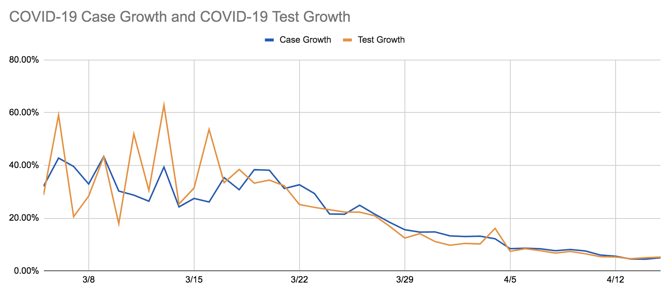
But there is another way to interpret the decline in new cases: The growth in the number of new tests completed per day has also plateaued. Since April 1, the country has tested roughly 145,000 people every day with no steady upward trajectory. The growth in the number of new cases per day, and the growth in the number of new tests per day, are very tightly correlated.

Graph comparing COVID-19 case growth and test growth

This tight correlation suggests that if the United States were testing more people, we would probably still be seeing an increase in the number of COVID-19 cases. And combined with the high test-positivity rate, it suggests that the reservoir of unknown, uncounted cases of COVID-19 across the country is still very large.

Each of those uncounted cases is a small tragedy and a microcosm of all the ways the U.S. testing infrastructure is still failing. When Sarah Pavis, a 36-year-old engineer in New York, woke up on Tuesday, she was out of breath and her heart was racing. An hour of deep breathing failed to calm her pulse. When her extremities started tingling, she called 911. It was her ninth day of COVID-19 symptoms.

New York City’s positivity rate is an astonishing 55 percent. More than 111,000 of the city’s residents have lab-confirmed cases of COVID-19, but Pavis is not among them. When the ambulance arrived at Pavis’s apartment, an EMS worker took her vitals, then explained there was little he could do to help. The city’s hospitals only admitted people with a blood-oxygen level of 94 percent or lower, he said. Pavis’s blood-oxygen reading was 96 percent. That 2 percent difference meant that her illness was not serious enough to merit hospitalization, not serious enough to be tested, not serious enough to be counted.


Whole Foods staff protest against conditions as coronavirus cases rise

https://www.theguardian.com/business/2020/apr/15/whole-food-protests-coronavirus-working-conditions-sickout

Coronavirus workplace conditions spur protests at Whole Foods, Amazon

Workers say too little is being done to enforce social distancing in stores, and some are not given masks or training on cleaning.

Whole Foods workers across the US are planning to hold another sickout protest on 1 May, as the number of confirmed cases of coronavirus infections at the supermarket chain continues to rise and workers charge the Amazon-owned company is doing too little to help them.

Workers complain too little is being done to enforce social distancing in stores; it is difficult, and sometimes impossible, to qualify for sick pay; and some are not given masks or training on cleaning. In the meantime, Whole Foods is reportedly recording record sales.

Dan Steinbrook, an employee at Whole Foods in Boston, said: “The bottom line is we don’t think Whole Foods or Amazon is doing nearly enough as they could be to protect both employees and customers at the store in terms of personal safety and public health.”

Steinbrook, who also participated in a sickout protest on 31 March organized by Whole Worker, a worker activism group said: “Grocery stores are one of the only places open to the public so they’ve become a significant public health concern in terms of stopping the spread of this disease. Any transmission we can stop at the grocery stores is extremely important for saving a lot of lives.”

Whole Foods workers have become increasingly concerned over the confirmed cases of coronavirus at Whole Foods stores. Employees have tested positive for coronavirus at Whole Foods locations across the country including West Orange, New JerseySudbury, MassachusettsBrookline, MassachusettsArlington, MassachusettsHingham, MassachusettsCambridge, MassachusettsSan Francisco, CaliforniaNew York City, New YorkFort Lauderdale, FloridaNew Orleans, Louisiana; and Allentown, Pennsylvania.

The Guardian spoke to several Whole Foods workers across the US about working conditions and the company’s policies. The workers requested to remain anonymous for fear of retaliation.

“I haven’t felt safe going into work because Whole Foods hasn’t really done anything to combat the amount of Amazon shoppers in the stores,” said a Whole Foods employee at Bowery Place in New York City, the center of the coronavirus pandemic in the US. “The store has been closing earlier, but they still want us to stay until 11pm to clean, and we aren’t trained to clean or given masks or anything.”

Whole Foods workers have noted some stores where a worker has tested positive for coronavirus have yet to be publicly reported in the media.

“Team members are being told there was a deep clean overnight and not to worry,” said a Whole Foods worker in West Bloomfield, Michigan. “I’m scared to work. I have three immune sensitive people living in my house and I don’t want to get them sick, but I can’t lose my only income.”

A worker at Whole Foods in Chapel Hill, North Carolina, said there have been two positive cases at their store. “It has been almost impossible to maintain basic social distancing practices. We’ve seen huge sales ever since the outbreak and it’s been all hands on deck. As of 1 April, there were no limits on the number of customers allowed in at a given time,” said the employee.

In Minnesota, a Whole Foods employee is currently on unpaid leave after experiencing coronavirus symptoms when their roommate was advised by their doctor to self-quarantine.

“When I talked to my HR department they told me I would need to take a two week leave as well, but unless I test positive for Covid-19, I do not qualify for the ‘guaranteed two weeks paid time off’ corporate is saying they are offering,” said the worker. “Everyone knows tests are limited and unavailable to most people unless they are showing severe symptoms, and as retail workers, many of us cannot afford to go to the doctor unless we’re in desperate need of medical attention.”

A Whole Foods employee in Massachusetts is also currently taking unpaid leave after experiencing coronavirus symptoms.

“I’m in a situation where I can’t get tested or afford a doctor. At first I was told I wouldn’t be eligible for sick pay without a positive test. Later I was told that I might qualify, that pay was being disbursed on a case by case basis. My case has been pending for over a week with no response and I ran out of paid time off,” said the worker.

“My parents lent me money, so I’ll be able to finish quarantine and still afford groceries. Money was tight before bills were due, and those fears kept me from reaching out to a doctor. My symptoms were mild, but I don’t know what I would have done if they got serious.”

A Whole Foods spokesperson told the Guardian: “The safety of our team members and customers is our top priority and we are diligently following all guidance from local health and food safety authorities. We’ve been working closely with our store Team Members, and are supporting the diagnosed Team Members, who are in quarantine.

“Out of an abundance of caution, each of these stores performed an additional deep cleaning and disinfection, on top of our current enhanced sanitation measures. As we prioritize the health and safety of our customers and Team Members, we will continue to do the following to help contain the spread of Covid-19.”


129 hospitals furloughing workers in response to COVID-19

https://www.beckershospitalreview.com/finance/49-hospitals-furloughing-workers-in-response-to-covid-19.html?utm_medium=email

City of San Antonio furloughs nearly 300 amid COVID-19 pandemic | WOAI

Many U.S. hospitals and health systems have suspended elective procedures to save capacity, supplies and staff to treat COVID-19 patients.

As a result of suspending these nonemergent procedures, several systems have lost or expect to lose a large chunk of their annual revenue, forcing them to make cost reduction a top priority. 

Below is a breakdown of the hospitals that have furloughed staff in an effort to remain financially stable amid the COVID-19 pandemic. 

April 16

1. Samaritan Medical Center in Watertown, N.Y., will furlough 10 percent of its 2,400 employee workforce due to a revenue loss stemming from the COVID-19 pandemic, according to NNY360. The medical center expects the furloughs to last about three months.

2. In an effort to ensure the long-term financial stability of the organization, DuBois, Pa.-based Penn Highlands Healthcare has furloughed or laid off 600 employees, according to The Progress News. About 60 percent of the 600 affected staff were furloughed. The health system has seen its revenue dip about 40 percent due to the suspension of elective procedures.

3. New Bedford, N.H.-based SolutionHealth, which includes Manchester, N.H.-based Elliot Hospital System and Nashua-based Southern New Hampshire Health, plans to furlough 650 staff members to offset a revenue hit from the COVID-19 pandemic, according to The Union Leader. 

4. Titus Regional Medical Center, a 108-bed facility in Mount Pleasant, Texas, has furloughed about 10 percent of its staff due to the COVID-19 pandemic, according to The Texas Tribune. It has about 800 employees. Titus said it expects the virus to cause a financial hit of $3.3 million, or about 14 days of cash.

5. Citing a financial hit from the COVID-19 pandemic, Chillicothe, Ohio-based Adena Health System has furloughed 500 staff members, according to WBNS, a CBS affiliate. The health system is projecting that it will have a deficit of more than $50 million through 2020 due to the suspension of elective procedures.

6. Akron, Ohio-based Summa Health is furloughing 360 employees in an effort to cut costs during the COVID-19 pandemic, according to The Beacon Journal. Summa Health has about 7,200 employees. The furloughs started this week. It is unclear when they will end.

7. Jupiter (Fla.) Medical Center has furloughed 50 workers in administrative and support positions due to the COVID-19 pandemic, according to The Palm Beach Post. The furloughs affect 2.7 percent of the hospital’s 1,883 employees and are expected to last through the peak of the pandemic.

8. Citing a patient volume and revenue loss from the COVID-19 pandemic, Paragould-based Arkansas Methodist Medical Center plans to furlough a portion of its staff starting April 20, according to local news station KAIT8. 

9. Dunn, N.C.-based Harnett Health has furloughed 80 staff members due to theCOVID-19 pandemic, according to My Daily Record. 

“We want to reassure our community that we are still here and able to provide care whenever they may need us,” Harnett Health President Cory Hess told the publication. “The restructuring is a direct result of having to temporarily shut down some of our services to reduce the spread of COVID-19.”

10. Citing a revenue dip due to the COVID-19 pandemic, Pocatello, Idaho-based Portneuf Medical Center will furlough and lay off a portion of its staff, according to the Idaho State Journal. It is unclear how many staff members were furloughed and laid off. The furloughs are expected to last 90 days, but some employees may be called back earlier.

“To balance the resources needed to care for our sickest patients against the economic impact of postponed visits and the decline in surgeries, we have made some difficult workforce decisions,” a spokesperson for Portneuf Medical Center told the publication.

11. San Francisco-based Dignity Health has furloughed a portion of its nonclinical staff, Laurie Harting, Dignity’s CEO for the Greater Sacramento region, told the Sacramento Business Journal. The number of affected employees was not disclosed.

12. While Sacramento-based Sutter Health has created a labor pool to redeploy and reassign employees, some who are unable to be reassigned have been furloughed, according to the Sacramento Business Journal. Sutter has offered these affected employees 80 hours of “disaster pay” to account for hours lost and is creating a relief fund for employees. It is unclear how many employees are receiving the disaster pay. The health system has not laid off employees.

April 15

1. Citing a decline in elective surgeries and other nonemergent procedures due to the COVID-19 pandemic, Dallas-based Tenet Healthcare has furloughed about 10 percent of its workforce of more than 113,000. Affected employees include those in administrative support roles, corporate office jobs and elective care. Earlier in April, Tenet said it planned to furlough 500 employees, but the health system said it had to raise the number of furloughs after the costly government-mandated suspension of elective procedures.

2. Citing the suspension of elective procedures, Detroit Medical Center is furloughing 480 employees who are not involved in treating COVID-19 patients or other critical patient care, according to Fox Detroit.

3. Lovelace Health System, based in Albuquerque, N.M., plans to furlough or cut hours of about 630 people, according to The Albuquerque Journal. The temporary workforce reduction affects about 15 percent of the health system’s 4,239 employees.

4. Citing a revenue drop of 60 percent due to the COVID-19 pandemic, Rutland City, Vt.-based Rutland Regional Health System has furloughed 150 employees, according to WCAX. The hospital has about 1,200 employees total.

5. Philadelphia-based Einstein Healthcare Network plans to move forward with furloughs due to a significant decline in physician practice and outpatient volume, according to WHYY. Health system officials said they project a $50 million to $60 million hit in 2020. Internal documents revealed that 70 percent of the health system’s expenses are staff related. Einstein Healthcare department heads were instructed to choose which employees to furlough this week.

6. Abbeville (S.C.) Area Medical Center has furloughed or cut hours of 75 employees for at least two months, according to the Index-Journal. Both clinical and nonclinical staff are affected.

“Like many hospital systems across the state and nation, the COVID-19 pandemic has created financial challenges for Abbeville Area Medical Center,” Dean Turner, Abbeville Area Medical Center’s CEO, told the publication. “This was a difficult decision but one that was necessary not only to ensure that our hospital can continue to serve patients, but also to ensure that our employees have jobs to come back to in the next six to eight weeks, if not sooner.”

7. Citing a financial toll from the COVID-19 pandemic, Roanoke, Va.-based Carilion Clinic plans to furlough a portion of its staff, CEO Nancy Agee announced in a video to employees. The number of affected employees has yet to be determined.

8. Jonesboro, Ark.-based St. Bernards Healthcare has furloughed 50 employees due to a significant decline in patient volume and revenue, according to Arkansas Business. The health system said that it is working to help furloughed staff “receive every benefit possible.”

9. In an effort to conserve cash and ensure the future financial stability of the organization, Sedalia, Mo.-based Bothwell Regional Health Center has furloughed 50 staff members, according to KSIS Radio. The COVID-19 pandemic has resulted in a 43 percent reduction in revenue, the hospital said.

10. Queensbury, N.Y.-based Hudson Headwaters Health Network has furloughed 50 employees due to the revenue hit from the COVID-19 pandemic, according to North Country Public Radio.

11. Decatur, Ill.-based HSHS St. Mary’s Hospital is asking employees to take voluntary furloughs due to a decline in patient volume from the COVID-19 pandemic, according to WCIA. 

12. Fayetteville, Ark.-based Washington Regional Medical Center is furloughing a portion of its staff to help offset revenue losses due to the COVID-19 pandemic, according to KNWA, a Fox affiliate. The number of furloughs has yet to be determined.

13. In an effort to offset some of the financial losses from the COVID-19 pandemic, Mount Clemens, Mich.-based McLaren Macomb Hospital plans to furlough up to 20 nurses, according to Detroit News. 

April 14

1. Kalispell (Mont.) Regional Healthcare will furlough 600 employees in an effort to help offset the financial hit from the COVID-19 pandemic, according to NBC Montana. The health system expects to incur a revenue loss of $16 million per month due to the suspension of elective procedures.

“The compounding effect of the loss of patient volumes, cancellation of elective surgeries, and the closure of entire service lines has had a tremendous financial impact on KRH,” Craig Lambrecht, MD, Kalispell Regional president and CEO, told the publication. “Cost cutting efforts have been underway but unfortunately those efforts alone cannot remedy the significance of these losses.”

2. UT Health East Texas in Tyler has furloughed or reduced hours of about 10 percent of its staff due to a decline in patient volume stemming from the COVID-19 pandemic, according to KLTV. The furloughs will last about 90 days, but some employees may be called back earlier. Employees will still have access to health insurance and paid time off benefits.

3. Manchester, N.H.-based Catholic Medical Center has furloughed 700 employees after canceling elective procedures to save staff and supplies for COVID-19 patients, according to The Union Leader. The hospital said it is losing about half of its typical monthly revenue. Furloughed workers can use paid time off.

4. Citing a revenue loss tied to the COVID-19 pandemic, Glens Falls (N.Y.) Hospital furloughed 337 workers, according to The Glens Falls Post-Star. Affected employees work in nonclinical roles.

5. Weymouth, Mass.-based South Shore Health has placed 219 employees on furlough in an effort to counter some of the financial strain caused by COVID-19, according to The Patriot Ledger. The health system has more than 5,600 employees. The health system said it is looking to reassign some of the workers to new roles.

6. Las Cruces, N.M.-based Memorial Medical Center has furloughed 125 employees, according to The Las Cruces Sun News. The furloughs affected nearly all departments and will last 60 days. The employees will earn partial pay and will still retain health benefits.

7. Minneapolis-based Allina Health said that employees in nonclinical and indirect patient care roles must take at least one mandatory furlough in a 30-day period, according to SW News Media. The mandatory unpaid furlough will be one week in duration. Employees can use paid time off to cover the mandatory furlough.

“Not unlike other health care systems in Minnesota and across the nation, these changes have created significant financial pressures for Allina Health,” the health system said in a news release.

8. Irving, Texas-based Christus Health implemented furloughs for a portion of its staff, according to KLTV. The health system said employees will retain their healthcare benefits and are allowed to take paid time off. The system didn’t disclose how many employees will be affected.

9. In an effort to help offset an expected revenue loss of $6 million per month, Derby, Conn.-based Griffin Hospital is furloughing 99 employees, according to The New Haven Register. The furloughed employees work in nonclinical roles.

10. Las Cruces, N.M.-based MountainView Regional Medical Center has placed 67 employees on furlough, according to The Las Cruces Sun News. The medical center has furloughed employees from departments where services have been suspended during the pandemic.

11. Nacogdoches (Texas) Memorial Hospital has furloughed a portion of its staff due to the COVID-19 pandemic, according to The Lufkin Daily News. The hospital said it has been stockpiling supplies for an anticipated surge in COVID-19 patients, which has “resulted in extraordinary expenses piling up at exactly the same time that we’ve intentionally driven volumes down by more than 50 percent.”

April 13

1. Citing a revenue drop due to the COVID-19 pandemic, Decatur (Ala.) Morgan Hospital is furloughing about 10 percent of its staff, 100 workers, according to The Decatur Daily. 

2. Springfield, Mo.-based CoxHealth has furloughed 283 employees due to the suspension of elective procedures, according to The Springfield News-Leader. The hospital said it is working to get some of the furloughed employees redeployed to other positions in the health system.

3. Canton, Ohio-based Aultman Health will furlough about 400 employees, according to The Canton Rep. The majority of furloughed employees work in nonclinical roles, low-volume service areas or can’t be redeployed to care settings.

4. Evangelical Community Hospital, based in Lewisburg, Pa., has placed 400 workers on a furlough, according to The Williamsport Sun-Gazette. The hospital employs about 1,900 workers.

“Furloughs were across the board,” Deanna Hollenbach, a Evangelical Community Hospital spokesperson, told The Sun-Gazette.

5. Danville, Ky.-based Ephraim McDowell Health plans to furlough 20 percent of its 1,700-employee workforce, according to The Advocate Messenger.  The hospital system said that it needed to “take immediate steps to ensure that we can sustain our operations after the COVID-19 crisis ends,” according to a statement obtained by the publication.

6. Starting April 13, Farmington, N.M.-based San Juan Regional Medical Center is furloughing a portion of its staff, according to The Farmington Daily Times. The furloughs will affect employees in elective care and in nonclinical roles.

7. Citing a revenue loss of 50 percent, Elmeria, N.Y.-based Arnot Health plans to furlough a portion of its staff to shore up finances, according to MyTwinTiers.com.  Affected employees will be notified by April 17.

“The subsequent reductions in patient revenue have made it impossible for Arnot Health to afford the cost of current staffing levels in all but the most essential areas at this time,” the hospital said in a news release.

8. Although Mayo Clinic previously said it would protect full pay and benefits through April 28, after that date the system now says it will furlough some staff and implement pay cuts to address significant reductions in revenues. The Rochester, Minn.-based system said it projects a $900 million shortfall, even with the furloughs and pay cuts.

9. Anderson, S.C.-based AnMed Health will begin implementing furloughs April 19, according to WWYF. The furloughs are expected to last about three months. There was no specific number of furloughs announced, but officials said both clinical and nonclinical employees will be affected.

10. Spartanburg (S.C.) Regional Healthcare System has furloughed some of its staff, according to WWYF. The health system has set up a COVID-19 fund to support affected staff.

11. La Crosse, Wis.-based Gundersen Health System has furloughed some of its staff, according to The La Crosse Tribune. Gundersen officials said that its locations have experienced a 40 percent to 80 percent decrease in business operations in the last few weeks due to the suspension of nonemergent procedures and clinic visits.

“These are temporary actions,” Gundersen CEO Scott Rathgaber, MD, told the publication. “We plan to bring staff back to fully serve the needs of our patients and communities when our procedures and appointments can safely return to normal operations.”

12. Grays Harbor Community Hospital, based in Aberdeen, Wash., has implemented furloughs after the system saw a 45 percent drop in outpatient procedures due to the COVID-19 pandemic, according to KXRO. The hospital said it was also incurring more costs to procure equipment for staff. The furloughs will begin April 13 and last 90 days.

13. Citing millions of dollars in lost revenue due to the COVID-19 pandemic, Bennington-based Southwestern Vermont Health Care is furloughing a portion of its workforce, according to The Bennington Banner. The health system expects to furlough about 100 of its 1,400 workers and said it will reassess the furloughs every two weeks.

14. Putnam, Conn.-based Day Kimball Healthcare has furloughed workers due to a drop in patient volume and revenue, according to NBC Connecticut.

April 10

1. Allentown, Pa.-based Lehigh Valley Health Network has furloughed about 900 employees who work at its physician practices, according to The Morning Call. The email obtained by the publication stated that furloughed workers can return to work after in-person patient visits return to normal levels.

2. Halifax Health, based in Daytona Beach, Fla, has placed 300 staff members on a mandatory four-month furlough, according to The Daytona Beach News Journal. The news comes just nine days after the system asked for volunteers to take furloughs. The health system is also mandating that nonclinical staff not included in the furlough take one day off per week.

3. Citing financial pressure from the COVID-19 pandemic, Escondido, Calif.-based Palomar Health has issued temporary layoffs for 221 employees, according to NBC San Diego. The furloughs will last 21 days and may be extended. Palomar Health said it is facing a significant revenue decline and incurred more costs to procure equipment.

4. Citing a 60 percent reduction in revenue in the last two weeks due to the pandemic, Marshall, Mich.-based Oaklawn Hospital has temporarily laid off 200 employees, according to local news station WWMT. The temporary layoffs affect about 17 percent of its 1,150 employees.

5. More than half of the employees at Gold Beach, Ore.-based Curry Health Network will be furloughed, laid off or have hours cut, according to Oregon Live. The hospital network said that 192 employees will be affected. At the beginning of March the network employed 340. The system said the state’s ban on elective procedures to free up capacity and supplies for COVID-19 patients cut into its revenue stream, according to the report.

6. Baptist Health, an eight-hospital system based in Louisville, Ky., has implemented temporary unpaid furloughs for employees in jobs that do not support caregivers or are not critical to treating COVID-19 patients. The health system did not disclose the number of furloughed employees.

“Our intent is to return to normal operations as soon as possible, and begin calling back employees. This is just a temporary measure,” said Baptist Health CEO Gerard Colman.

7. Lexington, Ky.-based UK HealthCare said it plans to place some employees on unpaid leave after April 25 if the pandemic continues to affect operations, according to WKYT.  Direct care providers will not be affected by the furloughs.

8. Batesville, Ark.-based White River Health System has furloughed some employees for 30 days due to a decrease in patient volume, according to local news station KARK. It is unclear how many employees were placed on furlough, but they are expected to be temporary.

9. Citing volume declines of more than 50 percent due to the COVID-19 pandemic, Georgetown, S.C.-based Tidelands Health has furloughed an undisclosed number of staff, according to WPDE, an ABC affiliate.

10. Gardener, Mass.-based Heywood Healthcare has furloughed an undisclosed number of staff in units and facilities that were closed in preparation for a surge of coronavirus patients, according to The Gardener News. The first furlough will last four weeks and will mainly affect staff that work in outpatient settings.

“We are actually seeing a $5 million drop in overall revenue for our organization, so we are going to really work on staffing, and we are going to implement a variety of things today, including furloughs — both full furloughs for staff and partial furloughs — continuing to use low activity days, some very limited layoffs, reducing scheduled hours, changing our on-call arrangements, restructuring job positions, reducing the contracted services we have, as we try to tackle and lower our expenses,” Win Brown, president and CEO of Heywood Healthcare, told the publication.

11. Brewer, Maine -based Northern Light Health is asking its staff to volunteer to take furloughs, according to CentralMaine.com. The health system said it has no plans to conduct involuntary furloughs.

April 9

1. Citing severe patient volume disruptions caused by the COVID-19 pandemic, Johnson City, Tenn.-based Ballad Health plans to furlough at least 1,300 workers, cut pay for some senior leaders and suspend retirement contributions. Ballad is projecting a cash flow drop of $150 million in the next 90 days due to the suspension of elective procedures.

2. Lewiston-based Central Maine Healthcare will furlough 330 employees to help offset the revenue loss caused by the COVID-19 pandemic, according to Bangor Daily News. The furloughs affect about 10 percent of its workforce.

“Furloughs like this are one way that we can adjust and manage the balance sheet appropriately. It also allows us to do that without having to sacrifice jobs permanently, without having to end the provision of care,” Kate Carlisle, director of public relations and community affairs for Central Maine Healthcare, told the publication.

3. Oswego (N.Y.) Health will furlough 25 percent of its workforce next week, according to Syracuse.com. Health system officials said that it has been losing about $180,000 per day since the beginning of March due to the coronavirus pandemic. Oswego Health said the furloughs should last about 10 to 12 weeks.

4. Citing a revenue and patient volume dip caused by the COVID-19 pandemic, Hopkinsville, Ky.-based Jenny Stuart Health has furloughed 248 staff members, according to Kentucky New Era. The health system has about 1,000 employees.

“This is an incredibly difficult time for our health system, and this is not a decision we made lightly. I regret the immediate personal impact on these employees and their families,” Jennie Stuart Health CEO Eric Lee told the publication.

5. Marshfield (Wis.) Clinic will furlough employees who are not involved in preparing for the anticipated surge in COVID-19 patients, according to local news station WEAU.  The furloughs are expected to be temporary, and staff can be recalled at any point in time to help manage the surge, according to the report.

6. Due to the suspension of elective procedures, Ashtabula (Ohio) County Medical Center is furloughing a portion of its workforce, according to the Star Beacon. To reduce the number of employees affected by the furlough, the hospital is training some employees to support different clinical departments in anticipation of a surge of COVID-19 patients.

7. University of Kansas Health System St. Francis Campus in Topeka is laying off 29 employees and furloughing 235, according to The Topeka Capital Journal. The furloughs and layoffs are an effort to offset the financial impact of the COVID-19 pandemic. The furloughs affect about 17 percent of the hospital’s staff.

8. Holyoke, Colo.-based Melissa Memorial Hospital is placing 19 employees on furlough for about three months, according to The Holyoke Enterprise. Furloughed employees are expected to return to work on July 26. The hospital said the decision was made because revenue was down due to the suspension of elective procedures.

9. Mad River Community Hospital, a 78-bed hospital in Arcata, Calif., is placing some employees on a full or partial furlough, according to Lost Coast Outpost. Hospital officials said the move is “essential” to ensure its doors remain open after the pandemic.

10. Citing challenges due to the COVID-19 pandemic, Oklahoma City-based Integris Health plans to furlough employees not involved in direct patient care, according to News 9. The furloughs are expected to be temporary. Affected employees will still receive health insurance benefits.

11. Abilene (Texas) Regional Medical Center has placed a small number of employees on furlough, according to KTXS, an ABC affiliate. Affected employees work in areas where services have been curtailed or suspended due to the COVID-19 pandemic.

April 8

1. MUSC Health, an eight-hospital system based in Charleston, S.C., said it would temporarily lay off 900 employees, or 5 percent of its workforce, to offset the financial hit caused by the COVID-19 pandemic. The temporary layoffs, which do not affect nonclinical workers, were effective April 7.

2. Nonclinical employees at Peoria, Ill.-based OSF HealthCare will be subject to mandatory paid time off or will be furloughed, the health system said April 7. The health system said the furloughs are necessary to help offset a revenue loss caused by the COVID-19 pandemic.

“It is important for the communities OSF has been called to serve for more than 142 years that we stabilize our financial position and protect our culture so we can continue to serve those communities, and our Mission Partners and their families in Illinois and Michigan,” said Mike Allen, CFO of OSF HealthCare. “Our priority remains equipping our frontlines with the resources they need to ensure the continuation of essential care, while protecting those providing that care.”

3. Citing a revenue and patient volume reduction caused by the COVID-19 pandemic, Holyoke, Mass.-based Valley Health System has furloughed 225 employees, according to Western Mass News. The furloughs affect about 11 percent of its workforce.

4. Odessa (Texas) Regional Medical Center has furloughed 60 employees to help offset a revenue loss due to the COVID-19 pandemic, CBS 7 reports. Affected employees will still receive insurance and are expected to be called back to work.

5. Medical Center Hospital in Odessa, Texas, has furloughed 30 staff members after the facility was ordered to suspend the lucrative elective procedures to save resources and staff to treat COVID-19 patients, according to CBS 7. The hospital has reassigned hospital workers to different areas, but Medical Center Hospital CEO Russell Tippin told the publication that it has been difficult.

“We’re in such a regulated industry that it’s hard,” Mr. Tippin told CBS 7. “You can’t take a pharmacist and put them in radiology. And you can’t take a radiologist and put them in pharmacy.”

6. Citing financial difficulties caused by the COVID-19 pandemic, Chillicothe, Ohio-based Adena Health System plans to furlough nonclinical workers in the coming weeks, according to a video from Adena CEO Jeff Graham.

7. In an effort to ease the financial damage caused by the COVID-19 pandemic, Amarillo, Texas-based BSA Hospital plans to furlough some of its employees for up to 90 days, according to ABC 7 Amarillo. 

8. Magnolia (Ark.) Regional Medical Center has furloughed an undisclosed number of nonclinical staff, including administrative and clerical workers, according to The Magnolia Banner News. The furloughs are expected to last at least two months. Affected staff will remain on the MRMC roster and maintain insurance, according to the report.

9. Caribou, Maine-based Cary Medical Center has furloughed a number of employees due to a drop in patient volume and revenue as a result of preparing for a COVID-19 patient surge, according to The Bangor Daily News. A majority of the furloughs affect support staff for physicians, according to the report.

10. In response to the COVID-19 pandemic, Hartford, Conn.-based Trinity Health of New England plans to furlough an undisclosed number of employees, according to The Hartford Courant. The majority of the furloughs will affect nonclinical workers.

“This will enable us to focus our resources on the functions directly related to essential COVID-19 patient care needs that we anticipate, while protecting people and helping prevent the spread of the disease,” Trinity Health of New England said in a statement to The Hartford Courant. 

April 7

1. Tulsa, Okla.-based HillCrest HealthCare System will furlough 600 employees for up to 90 days, according to local news station KRMG. The furloughs affect about 9 percent of staff and are a result of a decline in routine and elective procedures due to the COVID-19 pandemic.

2. Thomas Health System in South Charleston, W.Va., plans to furlough “less than 500” employees starting this week, according to the West Virginia Gazette Mail. In announcing the furloughs, the health system cited the suspension of nonemergent procedures due to the COVID-19 pandemic.

3. Citing a decrease in patient volume and revenue due to the pandemic, Cookeville (Tenn.) Regional Medical Center has furloughed 400 employees, according to Fox 17 News. 

“The pandemic created by COVID-19 has had a devastating impact not only in our community and state but across our entire country and the world that has required each of us to make sacrifices,” the hospital said in a statement to Fox 17 News. 

4. Cape Fear Valley Health, based in Fayetteville, N.C., plans to furlough an additional 350 employees, according to The Fayetteville Observer. The health system had already furloughed about 300 employees on March 27. The health system said since the first round of furloughs, its inpatient occupancy has dropped to 60 percent.

5. Citing a revenue and patient volume drop from the COVID-19 pandemic, Washington Court House, Ohio-based Fayette County Memorial Hospital has furloughed 71 of its 352 employees, according to radio station WKKJ. The furloughs are expected to last for 30 days.

6. M Health Fairview, a 10-hospital system in Minneapolis, is asking physicians, nurse practitioners and physician assistants in some clinics to volunteer to take a week of unpaid leave as a furlough, according to The Star Tribune.The system is taking volunteers for one-week physician furloughs through May 3. Those who volunteer will still receive benefits.

7. Mountain Home, Ark.-based Baxter Regional Medical Center plans to furlough an undisclosed number of employees to ease the financial hit from a decrease in volume and increased costs to prepare for the COVID-19 pandemic, according to local news station KTLO.  The furloughs are expected to be temporary. The hospital will reevaluate if additional measures are needed or if employees can return after four weeks.

8. Joplin, Mo.-based Freeman Health System plans to furlough an undisclosed number of employees after suspending elective procedures to prepare for the anticipated surge in COVID-19 patients, according to FourStatesHomepage.com

9. Lawrence (La.) General Hospital has placed 160 staff members on a four-week furlough, according to The Eagle Tribune. Most of the furloughs, which are expected to be temporary, affect nonclinical workers. Lawrence General has about 2,000 employees.

10. Froedtert Health has furloughed some workers, according to local news station Fox 6, which spoke to furloughed nurses from the Wauwatosa, Wis.-based system on the condition of anonymity.

April 6

1. Huntington, W.Va.-based Mountain Health Network furloughed 550 employees and cut the hours of 450, according to local news station WSAZ. The furloughs are a result of the financial and resource strain prompted by the COVID-19 pandemic.

2. LRGHealthcare, based in Laconia, N.H., plans to furlough 600 employees for up to four months to cope with the financial effects of the COVID-19 pandemic, according to the Laconia Daily Sun. Affected employees will keep their medical insurance and can receive unemployment compensation.

3. Citing a 35 percent reduction in revenue due to the COVID-19 pandemic, Columbia, Tenn.-based Maury Regional Health will furlough 340 employees this week, according to The Columbia Daily Herald. Maury Regional Health employs more than 3,000.

“We are experiencing unprecedented events as the COVID-19 pandemic evolves. After much deliberation, we were forced to make the difficult decision to furlough employees in the face of declining volumes and revenue. We plan to begin calling back employees as patient volumes normalize,” Maury Regional CEO Alan Watson told the Daily Herald.

4. Franklin, Tenn.-based Williamson Medical Center will furlough 200 employees due to a loss in revenue attributed to the COVID-19 pandemic and government mandates to postpone elective procedures, according to The Tenneseean. The furloughs, which began taking place April 1, are expected to be temporary.

5. Coos Bay, Ore.-based North Bend Medical Center has furloughed 130 employees to prepare for the novel coronavirus pandemic, according to TheWorldLink.com. The medical center is still providing insurance to the furloughed workers.

6. Citing a $16 million revenue loss in March due to the postponement of elective procedures, Sarasota (Fla.) Memorial Hospital will furlough an undisclosed number of employees, according to local news station WUSF. The hospital, which has 6,400 employees, expects to lose even more revenue in April and May due to the COVID-19 pandemic.

7. Dayton, Ohio-based Premier Health will furlough an undisclosed number of employees due to an anticipated financial hit from Ohio’s interim ban on nonessential surgeries, according to The Dayton Business Journal. The furloughs will affect employees that are not providing patient care.

8. Due to a loss in revenue and patient volume, Conway (S.C.) Medical Center plans to furlough about 100 employees who are not frontline care providers, according to WMBF. The hospital said the mandate on suspending elective procedures caused the revenue and volume drop.

April 3

1. Burlington, Mass.-based Wellforce, which includes four community hospitals, one academic medical center and a children’s hospital, has furloughed 719 workers, according to the Boston Business Journal. The affected employees will be furloughed for at least 90 days to help the system deal with the drastic volume decrease from suspending elective procedures. In addition, 1,236 employees will have their hours and pay reduced, according to the report.

2. Southbridge, Mass.-based Harrington Healthcare has furloughed 131 employees across its network this week, according to MassLive. About 20 of the 131 affected employees were “partially furloughed,” meaning their hours were significantly reduced, according to the report. Chris Canniff, the company’s vice president of administration and human resources, said the provider has seen a 50 percent decline in patient volume amid the COVID-19 pandemic. Furloughed employees will not be paid for four weeks.

3. Seattle-based Virginia Mason Medical Center said it has seen a 30 percent decline in revenue since the COVID-19 pandemic started and Gov. Jay Inslee ordered hospitals to suspend elective procedures. As a result, the system is furloughing an undisclosed number of employees, according to local station K5 News. Most of the affected employees are in nonclinical roles.

“We rely substantially on outpatient revenue to ensure our financial viability,” wrote medical center executives in an internal memo to Virginia Mason leaders obtained by K5 News. “This is an unprecedented time and it calls for drastic measures.”

4. Citing drastic revenue decreases and increased expenses, Columbus, Ohio-based Mount Carmel Health System will furlough nonclinical staff, according to ABC 6. The health system said fewer than 500 employees will be affected. The system employs more than 10,000. In addition to the furloughs, the health system is implementing pay cuts for executives and physicians, according to the report.

5. Atlantic City, N.J.-based AtlantiCare has furloughed some of its workers due to the COVID-19 pandemic, according to NJ.com. In addition, the system has asked staff members, including nurses and physicians, to voluntarily take a furlough or a reduction in their hours, according to Press of Atlantic City. The staffing changes began taking place March 30. The changes are considered temporary, and affected employees will keep their benefits.

6. Citing a drop in patient revenue due to government mandates to help the COVID-19 pandemic, Dayton, Ohio-based Kettering Health Network is placing some of its employees on furlough, according to the Dayton Business Journal. 

7. New Bedford, Mass.-based Southcoast Health will furlough some staff not actively involved in patient care efforts because the health system is absorbing a deep revenue hit, according to Southcoast Today. The health system will pay a portion of furloughed employees’ insurance premiums through June 30.

April 2

1. Livonia, Mich.-based Trinity Health plans to furlough 2,500 employees. The system made the decision to help offset the financial hit from COVID-19. Most of the affected employees are in nonclinical roles.

2. Boston Medical Center is furloughing 700 staff members, or 10 percent of its workforce, due to financial losses from the COVID-19 pandemic. Kate Walsh, CEO of Boston Medical Center, told The Globe that the hospital has lost about $5 million in revenue per week, and that the furloughs will help save the system about $1 million per week.

3. Citing a revenue hit from the COVID-19 pandemic, Cincinnati-based Bon Secours Mercy Health will furlough 700 employees and freeze wages of all nonclinical personnel. The furloughs are expected to begin next week and last 30 to 90 days, depending on how long the pandemic lasts, according to Bon Secours Mercy Health CEO John Starcher. Bon Secours Mercy Health estimates it will see an operating loss of at least $100 million per month while the pandemic lasts.

4. Citing a severe disruption in services due to the COVID-19 pandemic, Duluth, Minn.-based Essentia Health has placed about 500 nonclinical staff on administrative leave.

5. Hartford-based Connecticut Children’s Medical Center is furloughing 400 employees across its system due to the expected financial hit from COVID-19, according to The Hartford Courant. The system said its patient volume has been cut in half due to halting elective procedures. Furloughed employees are mainly nonclinical workers, and are expected to return to work in early June, or when elective procedures can resume.

6. Clay County Medical Center, a 25-bed hospital in Clay Center, Kan., has furloughed 25 percent of its staff in response to the COVID-19 pandemic, according to The Clay Center Dispatch. It has about 300 employees, according to its website.

7. Williamson Medical Center in Franklin, Tenn., will temporarily furlough 200 employees to sustain its financial resources during the COVID-19 pandemic.

8. Dallas-based Steward Health Care is informing employees to expect furloughs at its facilities across the U.S. as the system works to overcome the “seismic shock” of the COVID-19 pandemic. The health system said it has started a temporary furlough program for some employees of its hospitals in nine states. Most affected staff work in nonclinical jobs.

9. Huntsville (Ala.) Hospital System, faced with expenses and a loss of revenue due to the novel coronavirus, has implemented a cost reduction plan that includes furloughs, according to AL.com. Huntsville Hospital said April 9 that it had to furlough or cut hours for 2,000 employees.

10. Syracuse, N.Y.-based St. Joseph Health plans to furlough an undisclosed number of workers as it prepares to deal with an “unprecedented fiscal fallout” from the COVID-19 pandemic, Syracuse.com reports. St. Joseph Health will also cut pay for senior management.

11. Baptist Health in Little Rock, Ark., has started furloughing an undisclosed number of employees this week to address an expected revenue loss from the pandemic.

12. Little Rock-based Arkansas Heart Hospital has furloughed workers due to the interruption of normal hospital operations.

March 27 to April 1

1. Citing the financial hit from the COVID-19 pandemic, Greenville, S.C.-based Prisma Health said it will furlough an undisclosed number of clinical, corporate and administrative workers. On April 9, Prisma Health executives told legislators that it was forced to furlough or cut hours for 3,900 of its 30,000 person workforce, according to The State.

2. Chattanooga, Tenn.-based Erlanger Health System said it is implementing a cost-reduction plan that includes furloughs and pay reductions for leadership. The moves were prompted by the COVID-19 pandemic. Administrative employees also are affected by the furlough.

3. Appalachian Regional Healthcare, a 13-hospital system in Lexington, Ky., will furlough about 500 employees due to a sharp reduction in business and revenue.  In addition to the financial aspect, Appalachian Regional said its decision was to protect employees not involved in direct patient care from contracting the novel virus and ensure that the health system has enough supplies to treat the anticipated surge of COVID-19 patients.

4. Cleveland-based St. Vincent Charity Medical Center has furloughed about 70 employees amid the COVID-19 pandemic. Affected employees include nurses, surgical assistants, clerical and other support staff.

5. Morehead, Ky.-based St. Claire HealthCare announced it will furlough 300 employees who are not involved in direct patient care to ensure it can sustain clinical operations during and after the COVID-19 pandemic.

6. Astoria, Ore.-based Columbia Memorial Hospital has furloughed 90 of its 740 employees after the facility scaled back nonemergent procedures to concentrate on the coronavirus.

7. Citing the spreading and unforgiving demands of the COVID-19 pandemic, Canton, Ohio-based Mercy Medical Center has furloughed workers. The move came shortly after the state ordered hospitals to suspend elective surgeries and procedures to free up capacity and supplies to treat COVID-19 patients.The number of staff affected was not disclosed.

8. Meadville (Pa.) Medical Centehas furloughed more than 225 employees to ensure the hospital’s financial stability. The hospital said the furlough is expected to last through April 5, but warned an extension is possible if the pandemic continues to affect business operations and revenue.

9. To help the system survive the economic challenges linked to the COVID-19 pandemic, Rockford, Ill.-based Mercyhealth has furloughed an undisclosed number of employees who are not providing direct patient care.

10. In response to the COVID-19 pandemic, Lewisburg, Pa.-based Evangelical Community Hospital has furloughed a “significant” number of employees who are not involved in direct patient care.


More than 9,000 healthcare workers have contracted COVID-19 as of last week, CDC says

https://www.healthcarefinancenews.com/node/139992?mkt_tok=eyJpIjoiTWprMk5XVmlOVFV5T0RNMyIsInQiOiJ6dFdBNXNaYUVKdER0RXQzckFKMVpmanhyRjRBMjVSdHFrajR0UnBJSlkyWG50SzNtalp5a3FXXC9HUFl2ZndYcEZ2TVdyd1VvdGxLRWUrZkRCTXB6U3AxRTQzTXRtWTJoUDN3QytSbVwvV1IzZXg5QnpYdWp0SDhXV2tjQ25UTDNiIn0%3D

Healthcare Finance News

CDC warns the data may not reflect the true scope of the problem, as uneven reporting of confirmed cases likely underestimates the impact.

Healthcare workers who treat patients infected with the COVID-19 coronavirus are at risk of contracting the disease themselves due to frequent exposure and proximity to such patients.

New figures from the U.S. Centers for Disease Control and Prevention detail the extent to which this is true, finding that 9,282 healthcare workers across the country are confirmed to have been infected.

Of those confirmed cases, 27 have died, according to numbers culled from February 12 to April 9. About 55% of all healthcare personnel who were infected only had contact with COVID-19 patients within the healthcare setting.

The vast majority of confirmed positive healthcare workers – 90% – were not hospitalized. Up to 5% of those who were hospitalized ended up in intensive care, while 10 of the 27 deaths were among those workers 65 years old or older.

The CDC warned that the data may not reflect the true scope of the problem, as uneven reporting of confirmed cases across the country has resulted in figures that likely underestimate the number of healthcare workers infected.

WHAT’S THE IMPACT?

The number of coronavirus cases among healthcare workers is expected to rise. While this is due in part to more communities experiencing widespread transmission, the nature of working in the healthcare field understandably contributes to the risk: About 45% of workers who tested positive lived in households or communities in which the virus was present, meaning they risk exposure on two fronts, both inside a healthcare setting and outside of it.

Compounding the problem is that transmission can come from unrecognized sources, including those who are asymptomatic or presymptomatic. Because of that, contact tracing after occupational exposures will likely fail to identify many healthcare workers who are at risk for developing COVID-19.

As with the general population, the higher a healthcare workers’ age, the more likely they were to experience a severe outcome, although severe outcomes – including death – are possible at any age.

Preventative measures meant to staunch the spread among healthcare personnel include screening all workers for fever and respiratory symptoms at the beginning of their shifts, prioritizing such workers for testing, and discouraging working while sick by offering flexible and non-punitive medical leave policies.

The CDC said older healthcare personnel, or those with underlying health conditions, should consult with their healthcare provider and employee health program to better understand their risks. On hospitals’ part, they should consider the enhanced likelihood of severe outcomes among older personnel when mobilizing retired workers to increase surge capacity, especially in light of a shortage of personal protective equipment. One consideration would be preferential assignment of retired workers to lower-risk settings such as telehealth, administrative assignments or clinics for non-COVID-19 patients.

THE LARGER TREND

PPE shortages, insufficient tests, slow results and a dearth of ventilators are all factors that contribute to risk of infection among healthcare workers, and these challenges play off each other in a toxic cycle, an Office of the Inspector General report found last week.

Hospitals said their most significant challenges centered on testing and caring for patients with COVID-19 and keeping staff safe. Severe shortages of testing supplies and extended waits for test results limited hospitals’ ability to monitor the health of patients and staff, and widespread shortages of PPE are putting both groups at risk. Hospitals also said they were not always able to maintain adequate staffing levels or to offer staff adequate support.