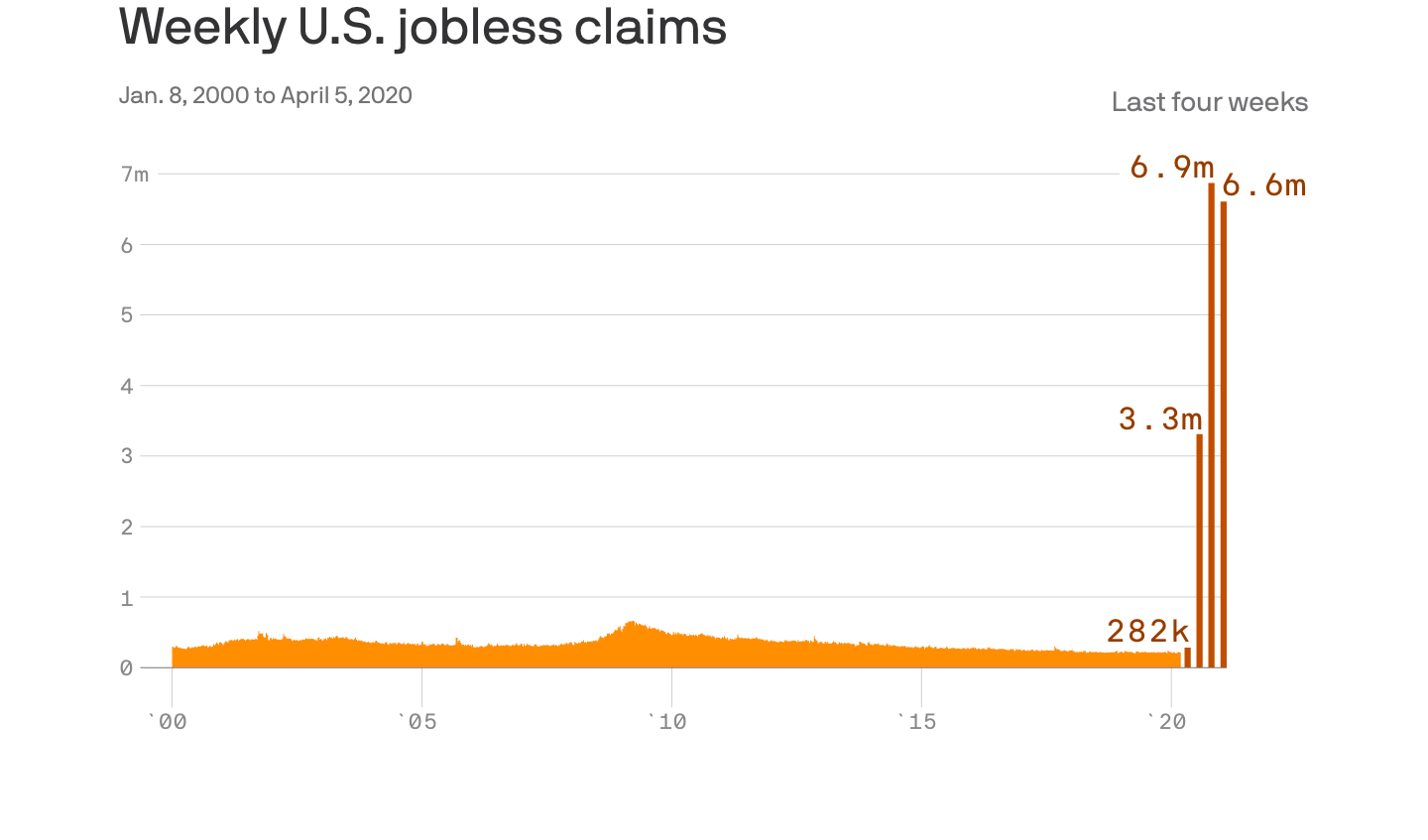
Another 6.6 million jobless claims filed last week amid coronavirus crisis

https://www.axios.com/coronavirus-unemployment-filings-6cb04d2d-9cc4-45b4-a473-9acbf4c99d43.html?stream=top&utm_source=alert&utm_medium=email&utm_campaign=alerts_all

Another 6.6 million jobless claims filed last week amid ...

Another 6.6 million Americans filed for unemployment last week, the Labor Department announced Thursday.

Why it matters: It adds to the staggering 10 million jobless claims in recent weeks — by far the sharpest spikes in American history — as the world economy has ground to a halt in an effort to contain the coronavirus outbreak.

  • The once-again colossal number of filings was worse than the 5 million that Wall Street had expected.
  • Last week’s unemployment claim numbers, which government data had pegged at 6.65 million, were revised upward to 6.87 million — the highest ever recorded.

The big picture: The data lags by a week, so while a large portion of the economic shutdown is now evident over the last three weeks, there may still be more huge numbers yet to come.

  • The $2.2 trillion coronavirus stimulus package opened the door to a surge of new unemployment filings, allowing the self-employed and independent contractors to claim benefits.


Pay Cuts, Furloughs, Redeployment for Doctors and Hospital Staff

https://www.medpagetoday.com/infectiousdisease/covid19/85827?xid=nl_mpt_investigative2020-04-08&eun=g885344d0r&utm_source=Sailthru&utm_medium=email&utm_campaign=InvestigativeMD_040820&utm_term=NL_Gen_Int_InvestigateMD_Active

Pay Cuts, Furloughs, Redeployment for Doctors and Hospital Staff ...

— Health systems see massive disruption from COVID-19

In Michigan, Trinity Health is furloughing 2,500 of its 24,000 employees. In Florida, Sarasota Memorial Health Care is taking “immediate steps to reduce costs, including temporary furloughs and reduced hours” for workers.

In less than 1 month, COVID-19 has made swift, deep cuts in hospital billings. Despite high volumes in the first 2 weeks, March revenue plunged by $16 million at Sarasota Memorial. Surgery cases fell by more than 50%, and volumes dropped by 45% at two emergency care centers and by 66% at seven urgent care centers.

Squeezed by plummeting income and climbing COVID-19 expenses, hospitals and health systems are bracing themselves for system-wide disruption by announcing temporary layoffs, reassignments, and pay cuts.

Many changes, like Trinity’s furloughs in Michigan, affect mainly non-clinical workers. Some alter compensation or duties for doctors, nurses, and other healthcare providers.

“In all parts of the country, physicians are being asked to sign agreements or acknowledgments for pay cuts ranging from 20% to 75%, depending on what their specialty is, where they are, and what the institutions are doing,” said Scott Weavil, JD, a California lawyer who counsels physicians nationwide about employment contracts.

“Many of these providers are not on the front lines of COVID, but they are still working,” Weavil noted. “Babies are being born. People are having accidents and visiting emergency departments. Urgent surgeries are happening. Physicians are at work or on call and ready to help if needed. And in most of these environments, there are patients who have tested positive for COVID-19,” he told MedPage Today.

“Ob/gyns aren’t doing a lot of elective procedures like hysterectomies, but they are delivering babies for COVID-positive patients, wearing donated cloth masks that may or may not be effective,” Weavil added.

In some cases, doctors have been sidelined and face the prospect of dwindling income as patient volumes fall. “We have 2,600 physicians and advanced-practice providers,” said Mark Briesacher, MD, senior vice president and chief physician executive of Intermountain Healthcare in Salt Lake City. “About 800 of them are on a patient volume-related type of contract, similar to what you would have in private practice.”

Because non-urgent and elective procedures are being delayed, some of these clinicians now see 30% to 50% fewer patients and could face big income drops, Briesacher told MedPage Today. “But we’ve put a floor in place,” he said: these providers will receive their usual pay until May 30, then 85% of that amount until normal patient volumes resume.

Redeployment can help practitioners make up lost income, Briesacher added. “A general surgeon often has critical care training,” he noted. “When this increase in patient care needs due to COVID-19 does come to Utah, we can deploy that surgeon to work in our ICUs with a critical care doctor, and if they’re working fulltime, they’ll get paid the same as they were before.”

Reassignment does not stop with doctors at Intermountain: hospital nurses can be deployed to screening desks, drive-through testing sites, or telehealth centers and will keep their current rate of pay, spokesperson Daron Crowley said.

“I recently reviewed a COVID-19 compensation plan of a health system in Florida that would give physicians their base or draw, or a midpoint between their 2019 base and their 2019 overall compensation,” noted Weavil, the attorney. “That seemed pretty good, but it came at a cost: the physicians had to agree to practice outside of their normal setting, as long as they were credentialed for the work.”

“At first blush, the credentialing requirement sounded like a protection; if you are a psychiatrist, you’d think ‘they’re not going to send me to the ICU,’ and normally, that’s correct,” Weavil continued.

But hospitals are adopting emergency credentialing provisions during COVID-19 and “doctors can be forced to practice pretty far afield of their specialty,” he said. In some ways, the situation resembles residency, he pointed out: “You have an attending physician who knows what she’s doing directing fish-out-of-water physicians who have been conscripted into service beyond their specialties.”

The list of hospital systems announcing major changes — including pay cuts for hospital executives, as Trinity Health in Michigan has done — grows each day. Boston Medical Center Health System has furloughed 700 employees; Cincinnati-based Bon Secours Mercy Health has announced it will do the same. Kentucky’s Appalachian Regional Healthcare will furlough about 500 staff members. South Carolina’s Prisma Health will lay off an undisclosed number of clinical, corporate, and administrative workers. Tenet Healthcare in Dallas has furloughed 500 fulltime positions.

Furloughing staff “was an extremely difficult decision, and one that we did not make lightly,” Sarasota Memorial CEO David Verinder wrote in a letter to employees.

“Staff have gone above and beyond to care for our patients throughout this crisis, even as they have been anxious about the health and well-being of themselves and their families,” he continued. “But as the health care safety net for the region, we must do all we can to continue fulfilling that critical role in the weeks ahead and for the long-term.”


The Most Appalling COVID-19 Lie

https://www.medpagetoday.com/infectiousdisease/covid19/85741?xid=nl_mpt_investigative2020-04-08&eun=g885344d0r&utm_source=Sailthru&utm_medium=email&utm_campaign=InvestigativeMD_040820&utm_term=NL_Gen_Int_InvestigateMD_Active

The Most Appalling COVID-19 Lie | MedPage Today

— Doctor breaks down the worst fallacy

Please forgive the basic nature of this video. I’ve enjoyed spending some time with my family finally after my quarantine expired. I wasn’t planning on making a video this weekend, but everybody’s in bed now and I felt that this was important.

I have done a few interviews recently and I’ve been asked the same question every time, which is what is the worst piece of misinformation you’ve heard about coronavirus. The first time I answered I said one of those conspiracy theories that we’ve all heard, but I quickly realized actually that isn’t the most damaging misconception about the current virus at all. The most harmful perception about COVID-19 is that it’s a disease that only affects the very old or the infirm.

The Intensive Care National Audit and Research Centre is a body that collects information from all the intensive care units in the U.K. and they’ve been publishing data about the COVID-19 patients here. I briefly mentioned one of their results in a previous video and I’ve been posting updates on Twitter. The most recent, which is about the first 775 patients admitted with COVID-19 to intensive care units in the U.K., came out a couple of days ago. I put it up on Twitter and it got quite a lot of attention, and so I felt it was useful to talk about that here as well.

The European Society of Intensive Care Medicine (ESICM) has published some preliminary results — I don’t have the full data set yet — for an even bigger group of patients — I think something like 1,800 patients. But from what I have seen, the results are very comparable.

The first headline is that the average age of patients admitted is 60 years old. Now, that doesn’t mean the average age of people getting coronavirus is 60. It’s just that out of the patients admitted to intensive care units with COVID-19 in the U.K., the average age — both mean and median — is around 60. The reason I say it like that is because admissions to ITU [intensive treatment unit] are prioritized for those that have the best chance of survival.

The right-hand column is quite useful here. It shows results for admissions to ITU over the last couple of years in the U.K. for patients with non-COVID viral pneumonia to act as a comparator. We can see immediately that in comparison to the usual viral pneumonia admissions, COVID admissions have a better baseline in that 91% are fully independent compared to 73% normally and fewer have pre-existing comorbidities or medical problems.

You can also see they are much more likely to be mechanically ventilated — i.e., intubated on a breathing machine, a ventilator — which is reflective of the profound hypoxia or low oxygen levels that we’re seeing in COVID-19 and the guidance that these patients deteriorate fast, and so doctors should intubate early.

An interesting pattern that’s emerged from every country’s cohorts is that men are more affected by this than women; 70% of severe infections requiring ITU are male, and perhaps most sobering is that out of all the patients admitted to ITU so far in the U.K., almost half have died — 48%. Comparing that with the usual admissions we see in ICU for viral pneumonia, like say influenza, only 22% of those died. If it needs to be repeated again, this is not “just like the flu.”

If you look at just 16- to 49-year-olds, although numbers are low at the moment, a quarter of them admitted to ITU have died. It remains true that 80% of people that get COVID-19 will have a self-limiting illness, the way I did, that does not require hospital admission. Your risk goes up with increasing age and the pre-existence of medical conditions.

However, overall one in five people that get this will have a severe infection, perhaps requiring hospital admission. Out of that, a quarter will require admission to intensive care. As these figures show, the average age for that subgroup is only 60, and half of those patients die.

Something that’s not captured in these figures is that death is just one marker. If you spend a week on a ventilator and 2 weeks in the hospital overall and then go home alive, that’s hardly what I’d call a mild infection. As I’ve said before, the main risk for most of us is not from the virus itself, but the effect that it’ll have on how healthcare functions in our respective countries.

On the subjects of healthcare, we’ve now seen three doctors here in the U.K., several in America, and 51 in Italy lose their lives directly because of COVID-19 — many or perhaps even most of whom were fit and well beforehand. To my sisters and brothers in healthcare, especially those going into battle like this without the appropriate armor — which is something that I just cannot believe is happening in developed countries, it shouldn’t be happening — I salute you.

That’s it. That’s the video. This isn’t aimed at any particular age group nor political affiliation. I find it remarkable I even have to say that second point because somehow this has become a partisan issue, which again I can’t understand.

Perhaps, if this does have an intended audience, it’s the middle-aged politicians who maybe also think that they’re too young for this disease and promote this appalling fallacy that COVID-19 is only killing patients who would have died sooner or later otherwise. Just stop f**king around.


COVID-19 Update: The N̶e̶w̶s̶ Data is Mostly Good

COVID-19 Update: The N̶e̶w̶s̶ Data is Mostly Good

First off, it’s time to call a spade a spade. When the Trump administration publicly projected 100,000 to 240,000 deaths in the U.S. last week, we couldn’t come up with a model that aligned with these numbers. Either they are/were seeing something in the data that we are not, or…they were managing expectations. This is an election year, after all. Even in the daily briefings since that forecast, the number of new cases reported have generally been lower than feared.

According to our forecasts, which were based on Italy and other countries leading virus-progressions (which were intentionally overestimated when compared to the probable U.S. trajectory), the U.S. would likely never plateau at rates above 50,000 new cases a day. The U.S. has 5.5 times as many people than Italy. Even if we overestimated that Italy was a model for the U.S. (which, as we projected, peaked two weeks ago at less than 7,000 cases a day), it was hard to model the U.S. peaking at more than 50,000 cases a day and likely that number will be closer to 40,000 or less. Italy maintained 85% of peak for nearly three weeks before declining. If we ascribe that to 40,000 new cases a day, the U.S. will likely add less than 750,000 new cases before meaningful decent. We believe we are already into that peak phase (currently with 400,000 cases). By our models, the U.S. will reach a total of approximately 1.5 million cases (or less), using the Italian infection model. With an above average fatality rate of 5% (we expect it will be lower), you would anticipate less than 75,000 deaths in the U.S., with the bulk of those coming in the next 4 weeks.

Importantly, Italy has one of the oldest populations in the developed world with an average age over 7 years older than the U.S. at 45.5 and a meaningful population in the most susceptible zone of the virus (above 70). Societally, they also live multi-generationally, which increases cross spread within families. Italy also failed to take protective measures until there was a considerable outbreak. They continued to allow flights in from China, their key textile trade partner, for over a week longer than the U.S., despite cases coming into Northern Italy directly through China. Further, Italy’s hospitals in the north were overrun with cases, which is not anticipated in most of the U.S. (see state by state data here). As such, we expect and hope that our estimates for U.S. data for the virus will prove to be higher than reality when the virus is eventually suppressed…at least this go around.

popitaly

With expectations that Italy’s progression may represent the worst pattern to date, we again look to Italy (and its close neighbors) to see if our indicators have continued on their paths of peak, plateau, and eventual decline. So far, with each new data point, we continue to be encouraged – with one troublesome outlier. Italy continues to report fewer and fewer new cases, as do their immediate neighbors to the north, Austria and Switzerland. In fact, Austria and Switzerland are already seeing the number of active cases in their countries decline.

germanydailyspain

daily fran

Most of the other European countries we are following are exhibiting similar patterns, although earlier in their progression. The outlier is France. France has posted up some alarming and quite possibly anomalistic numbers in the last several days. North Pier will investigate this data in more detail in our full weekly update. We hope that this will prove to be atypical and that we will see the virus’s trajectory in France moderate soon.

The U.S. stock market seems to have turned its attention to this new phase of virus-related data. For the time being, the fear of the abyss seems to have abated. Ultimately, the real test will come when we finally turn our attention to the economy, and what the post-virus world will look like. However, those days are far off. There will likely be bouts of fear and euphoria between now and then. Along the way, we will do our best to keep you informed.


Fauci: ‘Looks like’ US deaths will be lower than original projection

Fauci: ‘Looks like’ US deaths will be lower than original projection

Fauci: 'Looks like' US deaths will be lower than original ...

Dr. Anthony Fauci said Wednesday morning that he thinks the number of U.S. deaths from coronavirus will end up being less than the original projection of 100,000 to 200,000. 

Fauci, the government’s top infectious disease expert, attributed the drop to the success of social distancing measures that have directed people to stay home and closed many businesses.

“Although one of the original models projected 100- to 200,000 deaths, as we’re getting more data and seeing the positive effect of mitigation, those numbers are going to be downgraded,” Fauci said on Fox News. “I don’t know exactly what the numbers are going to be, but right now it looks like it’s going to be less than the original projection.”

By the end of March, the White House was projecting 100,000 to 240,000 deaths as America’s best-case scenario for the pandemic.

Centers for Disease Control and Prevention Director Robert Redfield made similar comments on Tuesday, saying he expected the number of deaths to be “much lower” than what was predicted by the models.

A closely watched University of Washington model is now projecting about 60,000 deaths in the U.S. 

Despite some hopeful signs, Fauci emphasized that now is not the time to ease up on social distancing measures, the best way to keep improving the outlook. 

“We’re going to start to see the beginning of a turnaround, so we need to keep pushing on the mitigation strategies because there’s no doubt that that’s having a positive impact,” he said.

“Now’s not the time to pull back at all,” he added. “It’s a time to intensify.”

President Trump has been eager to reopen the economy, and Fauci said planning for that is underway at the White House, where late Tuesday night there was a meeting on the subject in the Roosevelt Room.

“If in fact we are successful it makes sense to at least plan what a reentry into normality would look like,” Fauci said. “That doesn’t mean we’re going to do it right now, but it means we need to be prepared to ease into that. And there’s a lot of activity going on.”


$100B federal hospital aid won’t fully compensate lost revenue, Moody’s says

https://www.beckershospitalreview.com/finance/100b-federal-hospital-aid-won-t-fully-compensate-lost-revenue-moody-s-says.html?utm_medium=email

Moodys | HENRY KOTULA

The $2 trillion federal coronavirus aid package signed into law that includes $100 billion for nonprofit hospitals won’t completely cover the revenue hospitals will lose as a result of the pandemic, Moody’s Investors Service wrote in an April 3 note.

While the aid package includes several provisions like compensation for lost revenue, increased Medicare reimbursement and advances on future Medicare reimbursement, cash flow at nonprofit hospitals will still likely be materially lower for the next several months. Postponed services alone are likely to reduce hospital revenue by 25 percent to 40 percent a month on average, Moody’s said, a reduction that is affecting even hospitals that aren’t treating large COVID-19 case loads.

“The $100 billion aid package provides some relief to hospitals by supporting their operations and providing access to critical supplies,” Dan Steingart, vice president at Moody’s, said. “However, it is unlikely to fully compensate the sector for the two main financial challenges facing providers as a result of the coronavirus outbreak. The first is a material decline in revenue and cash flow as profitable elective surgeries, procedures and other services are postponed to preserve resources and avoid spreading the virus. The second is difficulty curbing expenses as surge preparation costs offset any expense reductions from postponed or canceled services.”

Moody’s maintained its negative outlook on nonprofit hospitals. 


Trump considering suspending funding to WHO

https://thehill.com/homenews/administration/491671-trump-considering-suspending-funding-to-who?utm_source=&utm_medium=email&utm_campaign=28856

WHO declares the outbreak of the new coronavirus is a pandemic ...

President Trump said Tuesday that he would consider placing a hold on funding for the World Health Organization (WHO), expressing grievances with its handling of the novel coronavirus.

“They missed the call. They could have called it months earlier. They would have known, and they should have known, and they probably did know,” Trump told reporters at a White House press briefing, suggesting the WHO failed to sufficiently warn the global community about the virus.

“We’re going to be looking into that very carefully, and we’re going to put a hold on money spent to the WHO,” Trump continued. “We’re going to put a very powerful hold on it, and we’re going to see. It’s a great thing if it works, but when they call every shot wrong, that’s not good.”

Pressed later by a reporter on whether it was a good idea to put a hold on funding during a global pandemic, the president clarified that he was considering suspending funding to the WHO.

“I’m not going to say I’m going to do it,” Trump said. “We will look at ending funding.”

The United States is the largest contributor to the WHO’s budget. The president’s fiscal 2021 budget request proposed slashing funding to the WHO, a body of the United Nations responsible for international public health, from $122 million to about $58 million.

The president said the WHO seemed to be “very biased towards China” and accused the organization of disagreeing with his travel restriction on flights coming in from China. He suggested the organization was blind to the extent of the outbreak in Wuhan, the capital of China’s Hubei province, where the virus originated.

The WHO said in early February that widespread travel bans that interfere with international travel and trade were not necessary to prevent the spread of COVID-19, days after the Trump administration announced it would restrict travel coming into the U.S. from China. It did not take particular issue with the president’s travel restriction.

“They actually criticized and disagreed with my travel ban at the time I did it, and they were wrong. They’ve been wrong about a lot of things. They had a lot of information early, and they didn’t — they seemed to be very China-centric. We have to look into it,” Trump told reporters.

When a reporter asked Anthony Fauci, head of the National Institute of Allergy and Infectious Diseases, to answer a question on the WHO, Trump interjected before he answered, saying Fauci “respects the WHO, and I think that’s good.”

“But they did give us some pretty bad play-calling,” Trump said.

The remarks, expanding on a critical tweet he sent earlier Tuesday, come amid growing criticism among conservatives of the WHO’s handling of the coronavirus outbreak. Some have accused the organization of leaving other nations unprepared for the virus.

Sen. Martha McSally (R-Ariz.) last week called on WHO Director-General Tedros Adhanom Ghebreyesus to resign, after reports emerged that the U.S. intelligence community had concluded China underreported its count of coronavirus cases. McSally accused the WHO of helping China conceal the extent of the outbreak.

Trump has faced criticism for at first downplaying the threat from the coronavirus, and his administration has been scrutinized for early delays in testing that hampered the overall response. Trump has often pointed to his early action restricting travel from China as a sign his administration was quick to confront the outbreak.

Ezekiel Emanuel, a special adviser to the director general of the WHO, was critical of Trump’s remarks on the coronavirus at the end of February, saying he found much of what Trump said at his first press briefing on the domestic virus outbreak to be “incoherent.”


Trump says IG report finding hospital shortages is ‘just wrong’

https://thehill.com/policy/healthcare/491454-trump-says-ig-report-finding-hospital-shortages-is-just-wrong?utm_source=&utm_medium=email&utm_campaign=28856

Hospital Experiences Responding to the COVID-19 Pandemic: Results ...

President Trump on Monday claimed that an inspector general report finding “severe” shortages of supplies at hospitals to fight the novel coronavirus is “just wrong.”

Trump did not provide evidence for why the conclusions of the 34-page report are wrong.

He implied that he is mistrustful of inspectors general more broadly. He recently fired the inspector general of the intelligence community, which has drawn outrage from Democrats.

“Did I hear the word inspector general?” Trump said in response to the reporter’s question about the findings.

“It’s just wrong,” Trump said of the report.

The inspector general report, released earlier Monday, was based on a survey of 323 randomly selected hospitals across the country.

It found “severe” shortages of tests and wait times as long as seven days for hospitals. It also found “widespread” shortfalls of protective equipment such as masks for health workers, something that doctors and nurses have also noted for weeks.

“The level of anxiety among staff is like nothing I’ve ever seen,” one hospital administrator said in the report.

Brett Giroir, an assistant secretary of Health and Human Services, noted that the report’s survey of hospitals was conducted March 23 to March 27. He said testing had improved since then and that it was “quite a long time ago.”

Trump asked who the inspector general of the Department of Health and Human Services is.

“Where did he come from, the inspector general?” Trump said, adding, “What’s his name?”

The office is currently led by Christi Grimm, the principal deputy inspector general.

According to her online biography, Grimm joined the inspector general’s office in 1999. 
Trump said the U.S. has now done more testing than any other country. “We are doing an incredible job on testing,” he said.
He also berated the reporter asking the question, saying testing has been a success.
“You should say, ‘Congratulations. Great job’ instead of being so horrid,” Trump said.
The American Hospital Association (AHA) on Monday said the inspector general report was accurate.

The report “accurately captures the crisis that hospitals and health systems, physicians and nurses on the front lines face of not having enough personal protective equipment (PPE), medical supplies and equipment in their fight against COVID-19,” the AHA said.

https://oig.hhs.gov/oei/reports/oei-06-20-00300.pdf?utm_source=&utm_medium=email&utm_campaign=28856


Navy chief resigns amid uproar over handling of aircraft carrier coronavirus crisis

https://thehill.com/policy/defense/491626-navy-chief-offers-to-resign-amid-uproar-over-handling-of-aircraft-carrier?rnd=1586292384?rnd=1586275342?userid=12325

Navy boss resigns amid uproar over firing of ship captain – WATE 6 ...

Acting Navy Secretary Thomas Modly resigned Tuesday after fanning the flames of a controversy over a coronavirus outbreak on board an aircraft carrier.

In a tweet, Defense Secretary Mark Esper said he accepted Modly’s resignation and that undersecretary of the Army James McPherson will take over as acting Navy secretary.

“This morning I accepted Secretary Modly’s resignation. He resigned of his own accord, putting the Navy and the sailors above self so that the USS Theodore Roosevelt, and the Navy as an institution, can move forward,” Esper said in a statement attached to the tweet.

The resignation comes a day after transcripts and audio of an inflammatory speech, in which Modly defended his decision to fire Capt. Brett Crozier as commander of the USS Theodore Roosevelt, leaked to the media.

Modly relieved Crozier of his command of the Roosevelt last week after a letter the captain wrote pleading for help with a coronavirus outbreak on the ship leaked in the media. Modly did not explicitly accuse Crozier of leaking the letter, but noted it appeared first in his hometown paper, the San Francisco Chronicle, and that he sent a copy to too many people to expect it not to leak.

In the speech aboard the Roosevelt, Modly said that if Crozier didn’t think the letter would leak, he was “too naive or too stupid to be a commanding officer of a ship like this.”

Alternatively, Modly said, if Crozier leaked the letter on purpose, that would be a “serious violation” of the Uniform Code of Military Justice.

He also called Crozier’s action a “betrayal” and warned sailors that there is “no situation” in which they should go to the media, alleging “the media has an agenda” that “depends on which side of the political aisle they sit.”

Modly at first said Monday afternoon he stands by “every word,” but by Monday night was apologizing.

“Let me be clear: I do not think Captain Brett Crozier is naive or stupid,” Modly said in a statement. “I apologize for any confusion this choice of words may have caused.”

At a White House press briefing, President Trump said he would not have asked Modly to resign.

“I had heard he did because he didn’t want to cause any disturbance for our country. He wouldn’t have had to resign. I would not have asked him. I don’t know him. I didn’t speak to him. But he did that I think just to end that problem. And I think in many ways that was a very unselfish thing to do.”

Trump said he was unsure what would happen to Crozier, leaving it up to Defense Secretary Mark Esper and the Naval chain of command. He called the letter a “mistake,” harping on its eventual leak to the media.

“The whole thing was very unfortunate. The captain should not have written a letter. He didn’t have to be Ernest Hemingway.”

The day before, as uproar over Modly’s speech and Crozier’s firing was growing, Trump had said he “may just get involved” with the situation.

Modly initially had Esper’s support in firing Crozier, but the fallout from his speech became too much to overcome as a growing chorus of lawmakers called for his removal from office, including House Armed Services Committee Chairman Adam Smith (D-Wash.) and Speaker Nancy Pelosi (D-Calif.).

“When I listened to the speech that acting Secretary Modly gave, it was almost like he was trying to do sort of a half-assed imitation of how Donald Trump would have given a speech,” Smith told reporters Tuesday in a response to a question from The Hill.

After the resignation, Smith said in statement that Modly “submitting his formal resignation to Secretary Esper was the right thing to do.”

Sen. Jack Reed (D-R.I.), the top Democrat on the Senate Armed Services, also said he agreed with Esper’s desicion to accept Modly’s resignation because Modly “mishandled the situation.”

“These actions were inappropriate for the leader of the U.S. Navy at any time, particularly in a crisis, and did a disservice to Captain Crozier, the sailors of the USS Theodore Roosevelt, and all Navy personnel,” Reed said in a statement. “The new leadership of the Navy must do better in leading and protecting sailors, Marines and their families in this unprecedented crisis.”

Senate Armed Services Committee Chairman Jim Inhofe (R-Okla.) said he supports Esper’s personnel decisions “especially as we deal with this pandemics,” but that “it’s disturbing to me that there’s been so much turmoil at the top of the Department of the Navy over the last year.”

In his statement on Tuesday, Esper said Modly’s “care for the sailors was genuine” and that he “wish[es] him all the best.”

Esper said he briefed Trump after his conversation with Modly and that the president supported his appointment of McPherson to replace Modly.

Esper said he also met with McPherson, Chief of Naval Operation Adm. Michael Gilday, Deputy Defense Secretary David Norquist and Joint Chiefs of Staff Chairman Gen. Mark Milley. He gave Gilday and McPherson guidance “on the way ahead.”

Esper also said he emphasized that his first priority in the coronavirus crisis is “protect our people, which means putting the health, safety and welfare of the USS Theodore Roosevelt’s crew first.”

“We must now put the needs of the Navy, including the crew of the USS Theodore Roosevelt, first, and we must all move forward together,” he said.

Crozier’s letter warned sailors could die if all but 10 percent of the 4,800-percent crew wasn’t evacuated from the ship.

“We are not at war. Sailors do not need to die,” Crozier wrote. “If we do not act now, we are failing to properly take care of our most trusted asset — our sailors.”

After he was fired, his crew gave him a hero’s sendoff, clapping and chanting his name as he walked off the ship.

As of Tuesday, the Navy reported 230 cases of coronavirus on the Roosevelt after 79 percent of the crew has been tested. The Navy said 1,999 sailors have been taken off the ship as it is docked in Guam, with 1,232 staying at hotels.

Over the weekend, Modly told The Washington Post he stepped in to fire Crozier in part because he wanted to get out in front of any action by the president. Modly’s predecessor, Richard Spencer, was ousted amid a dispute with Trump.

Spencer was fired amid the fallout from Trump’s decision to restore the rank of Navy Chief Petty Officer Eddie Gallagher, who was convicted in the military justice system of posing with the corpse of an ISIS fighter but acquitted of murder.

In addition to restoring Gallagher’s rank, Trump ordered the Navy to allow Gallagher to keep his status as a SEAL after news broke the Navy was reviewing his Trident pin.

Last month, Trump nominated U.S. Ambassador to Norway Kenneth Braithwaite to be Navy secretary after first saying he would immediately after Spencer’s departure in November.

But it’s unclear when the Senate will be able to hold a confirmation hearing for Braithwaite and approve his nomination as lawmakers remain largely out of Washington during the coronavirus pandemic.

“Once the Senate is back in session, I will make sure the Armed Services Committee considers the nomination of the next secretary of the Navy quickly, and I ask my fellow committee members to help me expedite this nomination as well,” Inhofe said in his statement. “Our Sailors, Marines and their families deserve to have stable, capable leadership at the helm during these challenging times.”


Wisconsin Election: Voters Find Long Lines and Closed Polling Sites

Wisconsin Election: Voters Find Long Lines and Closed Polling ...

The state is the first to hold a major election with in-person voting since stay-at-home orders were widely instituted because of the coronavirus.

Many voters say they never received the absentee ballots they requested.

  • Wisconsin is the first state to hold a major election with in-person voting despite stay-at-home orders for Americans protecting themselves from the coronavirus.

  • Polls will close at 9 p.m. Eastern time. Long lines have been seen in cities like Milwaukee, which has only five polling places open, and social distancing is a concern.

  • Wisconsin is holding its presidential primary between former Vice President Joseph R. Biden Jr. and Senator Bernie Sanders. Mr. Biden had a strong lead in a recent, widely respected poll.

  • The state’s elections commission has ordered municipal clerks not to release any results until April 13, in compliance with a federal court ruling.

  • Wisconsin Democrats wanted to extend absentee voting and even postpone the election altogether, but Republicans successfully blocked both in court. As a result, Democratic turnout is likely to be depressed because of the virus and the deadlines for absentee voting. A crucial seat on the State Supreme Court is on the ballot.

A morning of voting brings disruption and confusion.

MILWAUKEE — After a morning of voting across Wisconsin, in an election that has drawn derision from public health experts and inflamed partisan tensions, a picture is emerging of long lines, some flaring tempers and a dose of chaos and confusion in the state’s most heavily populated areas.

Voters in Milwaukee, the state’s Democratic base and most populous city, have experienced significant disruptions at polling places. Election workers in the city expected more than 50,000 voters on Tuesday, but the number of polling locations was drastically reduced, from more than 180 to just five. Some voters waited in line for more than two hours, spread out over blocks as they tried to practice social distancing to guard against the coronavirus.

In other parts of the state, especially in smaller communities that tend to be less Democratic, the in-person voting process was running relatively smoothly, with wait times more closely resembling a normal election.

Democratic officials in Wisconsin have lashed out at Republicans, saying they created an atmosphere that amounts to voter suppression with a key statewide Supreme Court race on the ballot. It remains to be seen how the disruptions could affect the Democratic presidential primary contest between Mr. Biden and Mr. Sanders.

Many voters say their absentee ballots never arrived.

Across Wisconsin, would-be voters complained that the absentee ballots they requested had never arrived in the mail, even though figures released by the state seemed to indicate the problem was not widespread.

Representative Gordon Hintz, the Democratic minority leader in the State Assembly, said there may have been a glitch in the system, perhaps because of overwhelmed elections offices. “It appears that people who requested their ballots between March the 20th and 24th, or maybe the 25th, have not received their ballots,” Mr. Hintz said.

Official state figures showed that of 1,282,762 ballots requested, 1,273,374 had been sent, a shortfall of about 9,000.

But Mr. Hintz estimated that hundreds, it not thousands, of voters in his Oshkosh district alone had not received the ballots they asked for, leaving them in a predicament over whether to vote in person and risk contracting or spreading the coronavirus.

One of them was Mr. Hintz himself, who had decided not to vote Tuesday because the ballot he requested on March 22 had not arrived. The Wisconsin Elections Commission’s website says it was mailed to him on March 24.

Roger Luhn, a psychiatrist in Milwaukee, said Tuesday that he was also among the voters who had not received an absentee ballot.

“According to the website, they mailed the ballot to me on March 23,” said Dr. Luhn, who is medical director of a psychiatric hospital. “Yesterday, I gave up. I called the election commission. They put you on extended hold.”

Dr. Luhn said he would not go to the polls on Tuesday out of concern for his family, his patients and his fellow staff members. “There is no good outcome for today’s election,” he said. “No matter what happens, not enough people will have had an opportunity to safely cast their ballots.”

Voters encounter long lines — and social distancing.

The effects of shuttering so many polling sites in Milwaukee were immediately apparent on Tuesday morning: Across the city, lines stretched for blocks even before 7 a.m. local time.

On the South Side of the city, the parking lot of Alexander Hamilton High School was already full as daylight broke. By 8 a.m., more than 300 voters waited in a line that snaked through the parking lot and down the street.

At other locations nearby that would have normally been open for voting, signs were posted directing voters to Hamilton High School. But many of the locations were in heavily immigrant neighborhoods, predominantly Spanish or Hmong, and the only signs posted were in English.

At Marshall High School, in the northern part of Milwaukee, the line stretched for more than three blocks, with voters keeping six feet of space between each other. Most wore masks or other facial coverings.

The northern part of the city, which is predominantly black, has been hit the hardest by the coronavirus. Yet hundreds of voters had already queued by early morning.

The lines weren’t limited to Milwaukee. In Waukesha, a suburb just outside of Milwaukee, only one polling location was open for a city of 70,000. A similarly long line wrapped around a parking lot, as cones denoting a safe distance between voters helped break up the line.

A woman sick with coronavirus is unable to vote.

Hannah Gleeson is a health care worker who lives in Milwaukee, is 17 weeks pregnant and recently tested positive for the coronavirus. She says she has voted in every election she has been eligible for — “I enjoy going in person. I like getting my sticker,” she said — but since contracting the virus she realized that going to a polling place would not be an option.

“I feel like especially right now, when there are so many things that can make you feel hopeless, voting is one of the only things that is still within your power,” Ms. Gleeson, 34, said.

So she requested an absentee ballot a week ago, well within the deadlines set by the state. But she never received one. When she saw that the U.S. Supreme Court had struck down an extension of the deadlines, she called the state elections commission.

“They kind of said, yeah, that really sucks, hopefully you’ll have better luck with the next election,” Ms. Gleeson said. She said that some friends in Milwaukee had also not received ballots: one who made a request on March 26, and another on March 9.

Now, Ms. Gleeson and her husband, who is not showing symptoms but is also isolating himself since Ms. Gleeson is sick, are not able to vote, or at least not able to do so without putting hundreds of people at risk. “I’ve always said that every vote matters, every vote counts, and it’s your one chance to have your voice heard,” she said. “And it’s now something that I really feel has been taken away from me, and my husband as well.”

A missing absentee ballot snaps a 30-year voting streak.

In the city of Oshkosh, where officials have implemented curbside voting, Brian Binder, 49, was one of many Wisconsin voters who reported not receiving the absentee ballots they applied for. Mr. Binder’s wife, who applied at the same time, received hers.

“There’s a large number of people who just did not get them,” said Mr. Binder, an employee of a food packaging company.

As a result of all the confusion and the coronavirus, Mr. Binder said he would not vote in this election, breaking a 30-year streak.

“I vote in every election, local primaries, since I was 18. I’m a person that takes it very seriously, your right and your responsibility to vote. However, given the situation with the virus I’m not sure I want to endanger myself or other people at the polls,” said Mr. Binder, who has been working from home for the past two weeks.

He also expressed frustration with the state’s deeply entrenched political division.

“I feel that this is something they shouldn’t play politics with,” said Mr. Binder, a lifelong Republican who said his support for the party had waned since President Trump’s election. “I don’t know why we couldn’t postpone to keep people safe. I don’t know what the goal was.”

Partisan brawling and a logistical tangle have led to chaos.

Like so much else in Wisconsin over the last decade, the state’s coronavirus response and opinions about moving the election broke along partisan lines.

Democrats, aiming to expand turnout especially in the state’s largest cities, Milwaukee and Madison, sought to expand mail voting and delay the election until June. Republicans, wary of affording new powers to a Democratic governor and content with suppressing turnout in urban centers where the coronavirus has struck hardest, refused to entertain proposals for relief.

“Thousands will wake up and have to choose between exercising their right to vote and staying healthy and safe,” Gov. Tony Evers said Monday after the state’s Supreme Court blocked his effort to postpone the election.

But Dean Knudson, a Republican former state legislator who is chairman of the Wisconsin Elections Commission, said late Monday that voters who wished to participate in Tuesday’s contest would have no recourse but to venture to the polls — even if they had requested but had not yet received an absentee ballot.

“If they haven’t got their ballot in the mail,” he said, “they are going to have to go to the polling place tomorrow.”

Other Republicans have played down the danger to public health of voting during a pandemic. One Republican county chair, Jim Miller of Sawyer County, said the process would be similar to people picking up food to eat during the state’s stay-at-home order.

“If you can go out and get fast food, you can go vote curbside,” Mr. Miller said. “It’s the same procedure.”

Why are Wisconsin Republicans so adamant about holding Tuesday’s elections?

It’s not just a presidential primary on the ballot in Wisconsin. Also at stake is the makeup of the Wisconsin Supreme Court — the very court that struck down Mr. Evers’s effort to delay Tuesday’s elections.

Statewide races in Wisconsin tend to be close, and Supreme Court elections, which come with 10-year terms, are often even closer.

Last year Brian Hagedorn, a conservative judge, defeated a liberal challenger by less than 6,000 votes out of 1.2 million cast. In 2011, another conservative, David T. Prosser Jr., won by 7,000 votes after officials in Waukesha County found 14,000 overlooked ballots the day after the election.

For now, conservatives hold five of seven seats on the officially nonpartisan court. The incumbent in Tuesday’s contest, Justice Daniel Kelly, was appointed to replace Justice Prosser by Gov. Scott Walker in 2016 and is seeking his first full term. He faces Jill Karofsky, a liberal circuit court judge.

President Trump has posted several messages on Twitter endorsing Justice Kelly in recent days.

If Justice Kelly wins, it will cement the conservative majority’s ability to block future Democratic efforts to change the state’s strict voting laws and litigate an expected stalemate over congressional and state legislative boundaries during post-2020 redistricting.

Liberals would need to flip just one of the conservatives’ votes if Judge Karofsky wins. Unless a justice retires or resigns, they would not have an opportunity to win a court majority until the 2023 elections.

Polls will close at 9 p.m. Eastern, but that’s unlikely to be the end of the elections.

Though voting may end on Tuesday night, there will most likely be a new round of lawsuits challenging both the results and the disenfranchisement of many voters. Many allied groups in Wisconsin were already gathering accounts of voters unable to get a ballot or vote in anticipation of litigation.

Adding to the uncertainty, the results themselves will most likely be delayed by almost a full week: The Wisconsin Elections Commission has directed local municipal and county clerks not to release results until next Monday afternoon, in compliance with a federal court ruling.

“Instead of having Iowa-style results where no one knows what to expect, if we stick to this we’re going to have a clean election tomorrow but we’re not going to report the results until the following week,” said Mr. Knudson, the elections commission chairman.