Payers win again, court rules Admininistration violated law in axing ACA cost-sharing payments

https://www.healthcaredive.com/news/payers-win-again-court-rules-trump-admin-violated-law-in-axing-aca-cost-sh/583565/?utm_source=Sailthru&utm_medium=email&utm_campaign=Issue:%202020-08-17%20Healthcare%20Dive%20%5Bissue:29123%5D&utm_term=Healthcare%20Dive

Payers win again, court rules Trump admin violated law in axing ...

Dive Brief:

  • A federal court ruled Friday that insurers are owed subsidies mandated by the Affordable Care Act to help them cover people with low incomes in the exchanges and the Trump administration violated the law when it halted the payments in 2017.
  • In a separate but related ruling, the same court found that payers that were able to raise premiums to offset the loss of those payments in 2018, however, should not receive the entire unpaid amount.
  • The judges with the U.S. Court of Appeals for the Federal District in their decision relied on a recent ruling in favor of insurers from the U.S. Supreme Court on a separate cost-sharing program in the ACA. “We see no sufficient basis for reaching a different conclusion,” they wrote.

Dive Insight:

The Affordable Care Act took into account that payers participating in the exchanges it created would be somewhat flying blind when setting premium rates for a new population. To safeguard them, multiple programs were established to help manage the inherent risk.

One of them was the risk corridors program, which was supposed to redistribute some of the profits insurers received in the exchanges to other companies seeing losses. But far more companies reported losses than profits, and the program quickly ran out of funds to pay out.

The Trump administration argued the ACA does not properly appropriate the funding anyway. 

The high court, however, ruled in April those insurers are owed about $12 billion from the program and that the language indeed creates what is called a money-mandating provision.

The decisions released Friday use that precedent for one of the other risk programs, which provided the subsidies for coverage of people with low-incomes, called cost-sharing reduction payments.

HHS abruptly stopped making the payments in October 2017, making the argument that the money had not been appropriated. But litigation of the issue goes back farther. Republicans in Congress sued HHS in 2014 making the same claim.

In 2018, with the payments still halted, payers increased their premium rates to help account for the lack of cost-sharing reduction payments, and thus received additional premium tax credits (a practice known as silver loading). The judges Friday said that although they agreed with a February 2019 decision from the U.S. Court of Federal Claims that the payers were owed the payments, they disagreed that insurers should be reimbursed in full despite the 2018 premium adjustments.

“The complexity of the process cannot obscure the underlying economic reality that the government is paying at least some of the increased costs that the insurers incurred as a result of the government’s failure to make cost-sharing reduction payments,” they wrote.

The judges remanded the case back to the Court of Federal Claims to determine the amount Maine Community Health Options is owed, and instructed them to take into account what amount of silver loading can be attributed to the loss of the payments.

Montana Co-op is owed $1.23 million for missed 2017 payments and Sanford Health Plan is owed $360,254.


Appeals court upholds nearly 30% payment cut to 340B hospitals

https://www.fiercehealthcare.com/hospitals/appeals-court-upholds-nearly-30-payment-cut-to-340b-hospitals?mkt_tok=eyJpIjoiWkRReFlqRmpaamRtWVdabSIsInQiOiJFTEp3SjQ3NG01NXcwRTg3Z0hCZkdTRlwvOURSeEVlblwvRlFUWlZcL09ONjZGNVEybzl3ekl3VFd2ZEgxSjY2NGQ0TkFIRFdtQ0ZDWUx0ak96NU15d09qMWcrdm9BMFUxOSszcVI0T21rak5raEN0aE5Kb0VUUGFcL254QnBjMjdCbzkifQ%3D%3D&mrkid=959610

In court filing, AHA says HHS should make 340B hospitals 'whole ...

A federal appeals court has ruled the Trump administration can install nearly 30% cuts to the 340B drug discount program.

The ruling Friday is the latest legal setback for hospitals that have been vociferously fighting cuts the Department of Health and Human Services (HHS) announced back in 2017.

340B requires pharmaceutical manufacturers to deliver discounts to safety net hospitals in exchange for participation in Medicaid. A hospital will pay typically between 20% and 50% below the average sales price for the covered drugs.

HHS sought to address a payment gap between 340B and Medicare Part B, which reimburses providers for drugs administered in a physician’s office such as chemotherapy. There was a 25% and 55% gap between the price for a 340B drug and on Medicare Part B.

So HHS administered a 28.5% cut in the 2018 hospital payment rule. The agency also included the cuts in the 2019 payment rule.

Three hospital groups sued to stop the cut, arguing that HHS exceeded its federal authority to adjust the rates to the program.

A lower court agreed with the hospitals and called for the agency to come up with a remedy for the cuts that already went into effect.

But HHS argued that when it sets 340B payment amounts, it has the authority to adjust the amounts to ensure they don’t reimburse hospitals at higher levels than the actual costs to acquire the drugs.

If the hospital acquisition cost data are not available, HHS could determine the amount of payment equal to the average drug price. HHS argued that hospital cost acquisition data was not available and so HHS needed to determine the payment rates based on the average drug price.

The court agreed with the agency’s interpretation.

“At a minimum, the statute does not clearly preclude HHS from adjusting the [340B] rate in a focused manner to address problems with reimbursement rates applicable only to certain types of hospitals,” the ruling said.

The court added that the $1.6 billion gleaned from the cuts would go to all providers as additional reimbursements for other services.

340B groups were disappointed with the decision.

“These cuts of nearly 30% have caused real and lasting pain to safety-net hospitals and the patients they serve,” said Maureen Testoni, president and CEO of advocacy group 340B Health, which represents more than 1,400 hospitals that participate in the program. “Keeping these cuts in place will only deepen the damage of forced cutbacks in patient services and cancellations of planned care expansions.”

This is the latest legal defeat for the hospital industry. A few weeks ago, the same appeals court ruled that HHS had the legal authority to institute cuts to off-campus clinics to bring Medicare payments in line with physician offices, reversing a lower court’s ruling.

The groups behind the lawsuit — American Hospital Association, American Association of Medical Colleges and America’s Essential Hospitals — slammed the decision as hurtful to hospitals fighting the COVID-19 pandemic. But the groups didn’t say if it would appeal the decision.

“Hospitals that rely on the savings from the 340B drug pricing program are also on the front-lines of the COVID-19 pandemic, and today’s decision will result in the continued loss of resources at the worst possible time,” the groups said in a statement Friday.


Hospitals lose legal challenge to 340B drug payment cut

https://www.healthcaredive.com/news/hospitals-lose-legal-challenge-to-340b-drug-payment-cut/582717/?utm_source=Sailthru&utm_medium=email&utm_campaign=Newsletter%20Weekly%20Roundup:%20Healthcare%20Dive:%20Daily%20Dive%2008-01-2020&utm_term=Healthcare%20Dive%20Weekender

340B Program: Important, but Weaknesses Cited - Pharmacy Practice News

Dive Brief:

  • A significant rate cut for some medications for 340B hospitals was based on a “reasonable interpretation of the Medicare statute” and can stand, the U.S. Court of Appeals for the District of Columbia ruled Friday.
  • The 2-1 ruling overturns a district court decision that HHS overstepped its bounds when it cut the reimbursement rate for a certain category of outpatient drugs by 28.5% for hospitals enrolled in the 340B drug discount program.
  • The American Hospital Association, which challenged the rate cut along with three individual hospitals, did not immediately respond to a request for comment. An advocacy group for 340B hospitals said in a statement it was disappointed in the ruling and that the rate change has “caused real and lasting pain to safety-net hospitals and the patients they serve.”

Dive Insight:

The decision is another major blow for hospitals, coming two weeks after the same court ruled HHS also acted within its authority when it reduced payments to off-campus hospital outpatient departments.

AHA said this week it is seeking to have that ruling overturned.

HHS made the cut to 340B hospital outpatient drug reimbursement in the 2018 Outpatient Prospective Payment System rule, arguing that those hospitals, which primarily serve low-income populations, get the drugs at a deep discount and thus could be incentivized to overuse them.

The cut was from 106% of the average sales price to 22.5% less than ASP. Hospitals immediately sued, but HHS retained the reduction in the 2019 OPPS. The department has said the change would save Medicare $1.6 billion in 2018.

Writing for the court, Chief Judge Sri Srinivasan said the department did indeed have the authority to make the reduction, “so as to avoid reimbursing those hospitals at much higher levels than their actual costs to acquire the drugs.”

He also called the cut “a fair, or even conservative, measure of the reduction needed to bring payments to those hospitals into parity with their costs to obtain the drugs.”

In a partially dissenting opinion, Circuit Judge Cornelia Pillard wrote that she believes the statute only allows HHS to make the change for a specific group of hospitals under a clause that requires the agency to use a certain data set it did not use.


Appeals court rules HHS has authority to implement site-neutral payments, dealing blow to hospitals

https://www.fiercehealthcare.com/hospitals/appeals-court-rules-hhs-has-authority-to-implement-site-neutral-payments-dealing-blow-to?mkt_tok=eyJpIjoiWXpGa016azRZekJqTTJZeSIsInQiOiJ6ajZGSWlYUGh1TTZqTFBDMEgwaXk3ZFZZSCtBVkdUWHNhemZ0SDJZWnhJVHlHVUpjRTdFVUlpbVBSdng4dTFXUEhhOGV2S3lRcElVVWNuZWpqakdEZE1DRmhleHRzdlY4RDRxYkxtZUNYNVI3Rmg5Kys5SVd1aGdseUR6Y1hxSCJ9&mrkid=959610

Appeals court rules HHS has authority to implement site-neutral ...

A federal appeals court ruled the Department of Health and Human Services has the authority to cut Medicare payments to off-campus clinics to bring them in line with independent physician practices, reversing a lower court’s decision.

The ruling from the U.S. Court of Appeals for the District of Columbia delivered Friday strikes a major blow to the hospital industry which has been fighting HHS over the controversial rule.

The American Hospital Association (AHA) led a lawsuit against HHS arguing it did not have the statutory authority to cut payments to the off-campus, provider-based departments. HHS made the cuts in its annual hospital payments rule and the hospitals argued they were unlawful because the cuts were not budget-neutral, a requirement of the payment rule.

But the appeals court agreed with HHS that it had the authority to make the change in the payment rule because of how the law is structured.


In blow to hospitals, judge rules for HHS in price transparency case

https://www.healthcaredive.com/news/in-blow-to-hospitals-judge-rules-for-hhs-in-price-transparency-case/580395/

UPDATE: June 24, 2020: The American Hospital Association said it will appeal Tuesday’s ruling  that upholds the Trump administration’s mandate to force hospitals to disclose negotiated rates with insurers. The hospital lobby said it was disappointed in the ruling and will seek expedited review. AHA said the mandate “imposes significant burdens on hospitals at a time when resources are stretched thin and need to be devoted to patient care.”

If AHA seeks to have the rule stayed pending an appellate ruling, the decision on such a request “is likely to be almost as significant as this ruling is, since absent a stay, the rule will likely go into effect before the appellate court rules,” James Burns, a law partner at Akerman, told Healthcare Dive.

Dive Brief:

  • A federal judge ruled against the American Hospital Association on Tuesday in its lawsuit attempting to block an HHS rule pushing for price transparency. The judge ruled in favor of the department, which requires hospitals to reveal private, negotiated rates with insurers beginning Jan. 1.
  • U.S. District Court Judge Carl Nichols, an appointee of President Donald Trump, was swayed neither by AHA’s argument that forcing hospitals to publicly disclose rates violates their First Amendment rights by forcing them to reveal proprietary information nor by the claim that it would chill negotiations between providers and payers. The judge characterized the First Amendment argument as “half-hearted.”
  • Nichols seem convinced that the requirement will empower patients, noting in Tuesday’s summary judgment in favor of the administration that “all of the information required to be published by the Final Rule can allow patients to make pricing comparisons between hospitals.”

Dive Insight:

The ruling is a blow for hospitals, which have been adamantly opposed to disclosing their privately negotiated rates since HHS first unveiled its proposal in July 2019. AHA did not immediately reply to a request for comment on whether it planned to appeal.

The legal debate hinges on the definition of “standard charges”, which is mentioned in the Affordable Care Act, though it was left largely undefined in the text. Trump issued an executive order last year that included negotiated rates as part of that definition.

Cynthia Fisher, founder of patienrightsadvocate.com, which filed an amicus brief in support of HHS, told Healthcare Dive on Tuesday the ruling could make shopping for health services more like buying groceries or retail.

“For the first time we will be able to know prices before we get care,” she said. “This court ruling rejects every claim to keep the secret hidden prices from consumers until after we get care.”


Hospitals tell court price transparency laws violate 1st Amendment

https://www.healthcaredive.com/news/AHA-HHS-price-transparency-oral-arguments/577613/

Dive Brief:

  • In the first round of oral arguments in their lawsuit against HHS over a rule requiring hospitals to reveal the secret rates they negotiate with insurers for services, hospital groups argued the requirement exceeds the government’s authority and violates the First Amendment by compelling hospitals to publicly post confidential and proprietary information​.
  • The American Hospital Association, along with other industry groups and health systems that brought the lawsuit, argued in the U.S. District Court for the District of Columbia on Thursday that medical bills aren’t considered commercial speech and don’t fall under the same regulations that traditional advertisements, flyers and other forms of commercial speech offering or promoting services do.
  • “There’s not another market that looks like the market for hospital services,” said U.S. Department of Justice Attorney Michael Baer, who was representing HHS. A majority of patients final bills’ include the negotiated rate, information that should be available to patients, acting as consumers, prior to receiving care, he said.

Dive Insight:

Thursday’s hearing was the first step in what’s likely to be a drawn out legal fight. Negotiated rates between hospitals and insurers have long been private, and hospitals want to keep it that way. 

When HHS passed the final price transparency rule last year, the hospital groups filed a lawsuit in December, warning that requiring disclosure of negotiated rates will confuse patients, overwhelm hospitals and thwart competition. The rule would go into effect Jan. 1, 2021.

According to the lawsuit, the rule creates undue burden on hospitals and health systems, which can have more than 100 contracts with insurers. There can even be multiple contracts with an individual carrier to account for the various product lines, including Medicare Advantage, HMO or PPO.

The rule would require various pricing information, including gross charges, payer-specific rates, minimum and maximum negotiated charges and the amount the hospital is willing to accept in cash from a patient.

Some payers and employer groups have also protested the new rule, calling it wrong-headed.

When the rule initially passed last year, HHS argued that patients already see this pricing data when they receive their explanation of benefits, pushing back against the idea that it’s proprietary business information. They said this information needs to come before a procedure, not after.​

HHS maintains that the rule is intended to give patients better access to payment information so they can make informed decisions as consumers. 

“Patients deserve to know how much it’s going to cost when they get hospital care,” Baer said. “They deserve to know before they open a medical bill or before they choose where they want to receive care.”


Administration Wants To Cut Back A Billion-Dollar Healthcare Program. Hospitals Say Now Is A Really Bad Time.

https://www.buzzfeednews.com/article/zoetillman/trump-medicare-cuts-hospitals-coronavirus-lawsuits?mkt_tok=eyJpIjoiTVRRd00yUmpZbUV3TVRVeiIsInQiOiJTZ0piR2wyRnBZOU5jR3N2TTNzd3Vrb040dHA5K0hVT0lQRm82YnFkVlNVVko4QlVRU0Z0SVVTQWxZUXJmWTZFTVBqaVh0N1JRWHFJTmg2dkNDb0hQTjBYYmxyUnphMEVGSmhwN0NJWUE3V0FFa2FIenJRZTJjWmliSWZKRVwvcU8ifQ%253D%253D

340B Drug Pricing Program: What Is it, How Does It Work?

The Trump administration has been fighting in court with public and nonprofit hospitals since 2017 over a plan to slash the reimbursement rates for drugs prescribed to Medicare patients.

In 2018, Park Ridge Health, a not-for-profit healthcare network in western North Carolina that serves a large population of lower-income patients, delayed plans to buy a new CT scanner for stroke patients.

The Trump administration had drastically scaled back a federal drug reimbursement program that benefitted public and not-for-profit hospitals. Park Ridge, now called AdventHealth Hendersonville, stood to lose $3.3 million per year, the hospital’s chief financial officer wrote in a court affidavit, and it wasn’t just the CT scanner on the line — that money went toward a variety of services for elderly and poor patients, including new cancer treatment facilities, women’s healthcare, and partnerships with nonprofits on issues like prescription drug abuse.

Park Ridge and other hospitals have been battling with the administration in court for three years over a plan to slash by nearly 30% the reimbursement rate that hospitals get for certain drugs prescribed to Medicare patients. The hospitals won the first round. The US Court of Appeals for the DC Circuit heard arguments in November and has yet to rule, and for now the cut is still in effect. In the meantime, the Centers for Medicare & Medicaid Services (CMS) is exploring another way to make the cut if they lose the case, over the objection of hospitals.

The litigation predates the coronavirus pandemic, but the stakes are higher as hospitals nationwide lose tens of billions of dollars weekly while nonessential services and elective surgeries are on hold because of the ongoing crisis.

“If [hospitals] lost that money now, it would make an already dire financial situation worse,” Lindsay Wiley, director of the Health Law and Policy Program at American University Washington College of Law, wrote in an email to BuzzFeed News.

Hospitals that serve a high proportion of lower-income patients can buy outpatient drugs at a discounted price through what’s known as the 340B program. Until 2017, these hospitals were reimbursed by the federal government for drugs prescribed to Medicare patients at a higher rate than the discounted price the hospitals paid.

The CMS announced in 2017 that it was slashing the reimbursement rate from 6% above the average price of the drugs to 22.5% below the average cost. The agency said the program gave hospitals an incentive to overprescribe drugs and cost patients more money, and shouldn’t provide a windfall to subsidize other services.

Hospitals that opposed the change argued that they had put money earned through the program — which can run in the millions of dollars for a hospital each year — into services for poor and underserved communities, as Congress intended.

The CMS estimated that cutting the reimbursement rate for the drugs would reduce the amount of money paid to hospitals by $1.6 billion in 2018 alone. Scaling back that funding would actually increase the rates paid by the government for other services for Medicare patients — the payment system has to be “budget neutral” — but Park Ridge and other hospitals that took the administration to court said they still expected net losses of millions of dollars.

Many hospitals that participate in the 340B program “are in the red to begin with,” said Maureen Testoni, president and CEO of 340B Health, a membership group for hospitals and health systems that participate.

“So on top of that, you add this pandemic and all the financial turmoil that this has caused,” Testoni said. The pandemic has highlighted “how critical [hospitals] are … and what an important role they play. And, financially, they’re not in a situation where they can play that role when they have this big financial reduction.”

While waiting for the DC Circuit to rule, the CMS is exploring ways to move forward with the rate cut even if it loses. Last month, the agency launched a survey to collect data from 340B hospitals that the CMS says would address the issues that led the lower court judge to rule against the government. Hospitals opposed the survey and asked the agency to at least delay it, saying they’d have to divert resources that are already stretched thin during the pandemic to respond.

“Now is not the time to distract hospitals’ attention from the vital job at hand to complete a CMS survey on drug acquisition costs. By launching the survey with no notice on April 24 and providing less than three weeks to respond, CMS is creating an unnecessary burden on hospitals at the worst possible moment,” Testoni wrote in a May 4 letter to the agency. The agency didn’t respond.

Representatives of hospitals involved in the lawsuits declined interview requests, citing the pending litigation. The American Hospital Association, a lead plaintiff, declined an interview request but sent a statement:

“The COVID-19 pandemic has created the greatest financial crisis in history for America’s hospitals and health systems, with our field losing over $50 billion each month. While it is too soon to have precise data on the full impact of this pandemic, the unlawful Medicare cuts that we are contesting in federal court have added significantly to the financial pressure all hospitals face,” the group said.

A spokesperson for the Department of Health and Human Services did not return a request for comment. In court, the Justice Department has argued that the district court judge lacked authority to review the rate cut at all, and that even if he could, the government had the power to bring the rate in line with what the available data showed hospitals were paying for the drugs.

“[O]vercompensation for some drugs or treatments means reduced payments for other drugs and treatments, and correcting overcompensation permits more equitable distribution of limited funds,” Justice Department lawyers argued in the government’s brief to the DC Circuit. “The result of bringing the Medicare payment amount for 340B drugs into alignment with average acquisition cost was therefore the redistribution of the anticipated $1.6 billion in savings, resulting in a 3.2% increase in the Medicare payment rates for non-drug items and services.”

Congress created the 340B program in 1992. Healthcare providers eligible for the program can buy outpatient drugs at discounted rates from pharmaceutical companies. When hospitals prescribe those drugs to patients covered by Medicare — the federal insurance program for people who are over the age of 65 or have disabilities — they submit claims to the government for reimbursement.

Starting in 2006, Congress gave the CMS two options to set the drug reimbursement rate. It could rely on what hospitals were actually paying to buy drugs if it had “statistically sound survey data” or, if that wasn’t available, the average sales price of the drugs. If the agency used the second, alternative option, Congress set a default rate: the average sales price plus 6%.

In the summer of 2017, the Trump administration announced a plan to change the rate. Under the new rule, the Medicare agency said it would pay the average sales price of drugs minus 22.5%. That rate would come closer to matching the discounted rate hospitals were paying through the 340B program, the agency said.

Hospitals don’t have to track or disclose how they use money saved through the program. Kelly Cleary, who spent three years as the chief legal officer for the CMS, said hospitals had provided examples of how they were using the funds to expand services into underserved areas and provide free or low-cost care.

“The money was going toward a purpose that was consistent with their mission,” said Cleary, who was involved in the CMS’s effort to change the rate and defend it in court. She returned to private practice last month as a partner at the law firm Akin Gump Strauss Hauer & Feld.

The chief financial officer for the Henry Ford Health System, which serves patients in Detroit and Jackson, Michigan, wrote in a court affidavit that even if the cut meant that reimbursement rates increased for other Medicare services, the hospital network still expected to lose around $8.5 million by the end of 2018 — money that had gone toward services for patients with low incomes, such as free and low-cost medications, a free community clinic, and mobile health units.

The margin between what the Henry Ford Health System paid for drugs through the 340B program and what it received back from Medicare helped hospitals in that network provide care for “underserved and indigent populations … that would otherwise be financially unsustainable,” the officer wrote.

In support of the rate cut, the CMS pointed to a 2015 report by the Government Accountability Office that showed hospitals participating in the program had an incentive to prescribe more drugs than hospitals that weren’t in the program, and that meant higher copayments for Medicare patients who were prescribed more drugs or higher-priced drugs. The agency concluded hospitals were receiving too much of a net financial benefit.

“While we recognize the intent of the 340B Program,” the agency wrote in a November 2017 notice in the Federal Register, “we believe it is inappropriate for Medicare to subsidize other activities.”

It’s a position that aligned the government with the pharmaceutical industry, which argued that some hospitals had abused the program. Drugmakers pointed out that even with a cut to the reimbursement rate, the healthcare providers would still get the benefit of discounted drugs. A representative of PhRMA, a membership group for the pharmaceutical industry, declined an interview request, but sent BuzzFeed News a copy of comments the group submitted in support of the cut.

“PhRMA is concerned that the 340B program continues to grow rapidly and without patient benefits, thus increasingly departing from its purpose and statutory boundaries,” the group wrote. “This growth in the 340B program creates market-distorting incentives that affect consumer prices for medicines, shift care to more expensive hospital settings, and accelerate provider market consolidation.”

Hospitals that supported the program, meanwhile, said the proposal punished providers who work with vulnerable patients, and they urged the CMS to focus its efforts instead on bringing down drug costs.

The agency disputed that the plan was punitive and said that “lowering the price of pharmaceuticals is a top priority” but was outside the scope of what it was considering at the time.


Hospitals and hospital associations began suing the administration shortly after the rule became final in November 2017. They argued that the CMS had come up with the new rate using a process that Congress hadn’t approved. The agency admitted that it didn’t have the “statistically sound” survey data on what hospitals were actually paying for the drugs — the first method Congress had laid out — so instead it used an estimate of average purchase costs compiled by the Medicare Payment Advisory Commission, an agency that advises Congress.

The problem with the government’s approach, the hospitals argued, was that Congress had said the CMS could either use survey data on purchase costs or the average sales price of the drugs, but not a hybrid of the two. Congress had given the CMS authority to “adjust” rates, but cutting the reimbursement rate by nearly 30% was more than just an adjustment, the hospitals said.

US District Judge Rudolph Contreras in Washington, DC, sided with the hospitals. In a December 2018 opinion, he wrote that the rate cut’s “magnitude and its wide applicability inexorably lead to the conclusion” that the agency had “fundamentally altered” what Congress had spelled out.

The judge stopped short of blocking the rule and ordering the government to reimburse hospitals for the difference between the previous rate and the CMS’s new, lower rate, however, writing that it was “likely to be highly disruptive.” He noted that the payment system had to stay budget neutral, which meant the money would need to come from another source, a “quagmire that may be impossible to navigate” given how much money the government paid out of Medicare each year. He asked for more briefing on what the agency should do to fix the problem, but that issue was put on hold as the administration took the case to the DC Circuit.

A three-judge DC Circuit panel heard arguments on Nov. 8 and has yet to release a decision. In the meantime, hospitals have continued to file lawsuits as their claims for reimbursement at the previous, higher rate are rejected; earlier this month, a hospital system in Jacksonville, Florida, which is part of the University of Florida, filed a new suit in federal court in Washington. And the CMS is going ahead with its survey over the objections from hospitals.

“The pandemic amplifies the significance of this policy, but the fact remains that there were winners and losers with the policy and it’s always going to be a zero-sum game,” Cleary said. “If the court rules against the agency and the agency is forced to walk back the policy, that stands to negatively impact thousands of hospitals.”

Wiley, of American University, told BuzzFeed News that even before the pandemic, the fight over the 340B program highlighted how hospitals and drugmakers were “actively throwing each other under the bus” in the broader debate about who was to blame for the high cost of prescription drugs and what the federal government should do about it.

“Which stakeholders voters perceive to be the heroes of the pandemic response could affect health reform and reimbursement politics for years to come,” she wrote.


AFL-CIO sues feds over coronavirus workplace safety

https://www.axios.com/afl-cio-sues-feds-over-coronavirus-workplace-safety-6de76122-2c75-4f84-92e5-21048c08b44b.html

AFL-CIO sues feds over coronavirus workplace safety - Axios

With states reopening for business and millions of people heading back to work, the nation’s largest labor organization is demanding the federal government do more to protect workers from contracting the coronavirus on the job.

What’s happening: The AFL-CIO, a collection of 55 unions representing 12.5 million workers, says it is suing the federal agency in charge of workplace safety to compel them to create a set of emergency temporary standards for infectious diseases.

Driving the news: The lawsuit against the U.S. Labor Department’s Occupational Safety and Health Administration (OSHA) is expected to be filed on Monday in the U.S. Court of Appeals in Washington, D.C.

  • Citing an urgent threat to “essential” workers and those being called back to work as government-imposed lockdowns are lifted, the AFL-CIO is asking the court to force OSHA to act within 30 days.
  • It wants a rule that would require each employer to evaluate its workplace for the risk of airborne disease transmission and to develop a comprehensive infection control plan that could include social distancing measures, masks and other personal protective equipment and employee training.

The agency has issued guidance, in collaboration with the Centers for Disease Control and Prevention, to protect workers in multiple industries — including dentist offices, nursing homes, manufacturing, meat processing, airlines and retail.

  • But the unions complain these are only recommendations, not requirements, and that mandatory rules should be imposed.
  • OSHA has been considering an infectious disease standard for more than a decade, they note, and has drafted a proposed standard.

U.S. Labor Secretary Eugene Scalia, in a letter to AFL-CIO President Richard Trumka, said employers are already taking steps to protect workers, and that OSHA’s industry-tailored guidelines provide more flexibility than a formal rule for all employers.

Yes, but: OSHA has received more than 3,800 safety complaints related to COVID-19 as of May 4, but it had already close to about 2,200 of them without issuing a single citation, according to the AFL-CIO.

What they’re saying: “It’s truly a sad day in America when working people must sue the organization tasked with protecting our health and safety,” Trumka said.

  • “But we’ve been left no choice. Millions are infected and nearly 90,000 have died, so it’s beyond urgent that action is taken to protect workers who risk our lives daily to respond to this public health emergency.
  • “If the Trump administration refuses to act, we must compel them to.”
  • OSHA could not immediately be reached for comment on the lawsuit.


Appeals court strikes down Trump approval of Medicaid work requirements

Appeals court strikes down Trump approval of Medicaid work requirements

Image result for Appeals court strikes down Trump approval of Medicaid work requirements

A federal appeals court on Friday struck down the Trump administration’s approval of Medicaid work requirements in Arkansas, the latest legal blow to one of President Trump‘s signature health initiatives. 

The U.S. Court of Appeals for the D.C. Circuit affirmed a lower court ruling that the approval of the work requirements was “arbitrary and capricious.

More than 18,000 people lost coverage in Arkansas due to the work requirements before they were halted by a lower court.

The court found that the Trump administration disregarded the statutory purpose of Medicaid — to provide health coverage — and did not adequately account for the coverage losses that would result from the work requirements. 

“Failure to consider whether the project will result in coverage loss is arbitrary and capricious,” Judge David Sentelle, an appointee of President Reagan, wrote in the opinion.

Requiring Medicaid recipients to work or else lose coverage is a top priority of Centers for Medicare and Medicaid Services Administrator Seema Verma. She argues that the policy helps lift people out of poverty by getting them jobs and out of Medicaid into employer-based insurance.

But Democrats and health care advocates have denounced the move, saying it imposes burdensome paperwork requirements on low-income people that cause them to lose coverage even if they are working.

The policy has also faced a string of legal losses, with courts ruling that Congress would need to act to authorize the work requirements. 

Arkansas was the only state where the requirements went into effect before being blocked by the courts. Several other states’ efforts were approved, but the initiatives have been halted as the issue works its way through the courts.

“The Court recognized the tragic harm that these work requirements have caused people in Arkansas doing their best to get ahead,” said Kevin De Liban, an attorney at Legal Aid of Arkansas, which helped challenge the requirements. “Now, more than two hundred thousand Arkansans on the program can rest easier knowing that they’ll have health care when they need it.”

Conservative changes to Medicaid have been a leading priority of the Trump administration, which also recently announced plans to let states block-grant their funding for the program. That move was also denounced by Democrats as inevitably leading to coverage losses and is also likely to be challenged in court.

Kentucky had originally also been part of the work requirement litigation, but a Democratic governor, Andy Beshear, was elected last year and ended the initiative.


Fifth Circuit Appeals Court Strikes Down the Affordable Care Act’s Individual Mandate

https://www.commonwealthfund.org/blog/2019/fifth-circuit-appeals-court-strikes-down-affordable-care-acts-individual-mandate

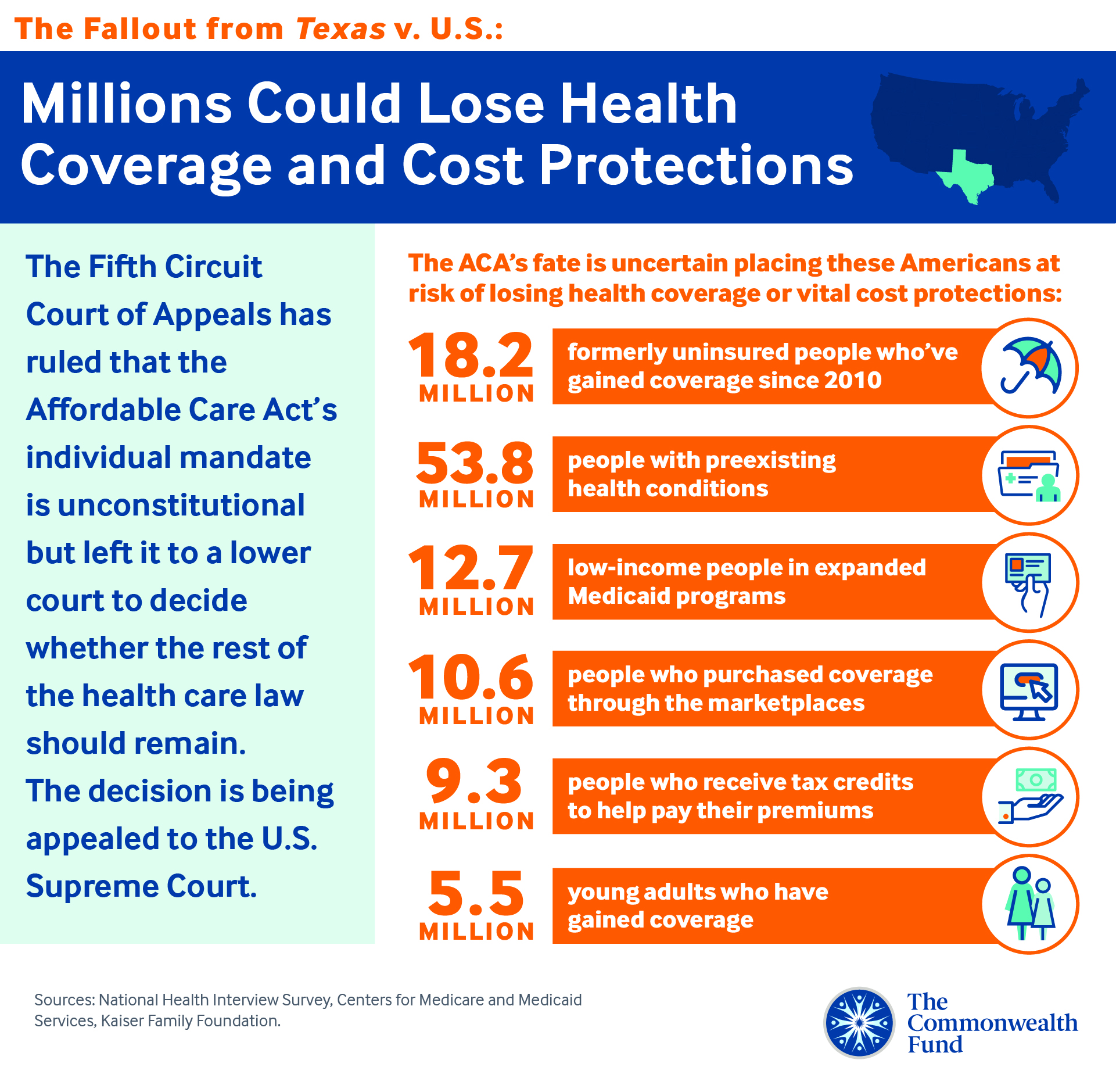
The Fallout from Texas v. U.S.:

Yesterday, a three-judge panel from the Fifth Circuit Court of Appeals struck down the Affordable Care Act (ACA)’s individual mandate. The judges agreed with a lower court decision issued in the case, Texas v. U.S., in December 2018 that the individual mandate is unconstitutional but, unlike the lower court, did not decide that the rest of the ACA is also unconstitutional. Instead, the judges remanded, or sent back, the decision to the same lower court judge to consider. California Attorney General Xavier Becerra, who is leading the 21 Democratic state attorneys general defending the law, along with the U.S. House of Representatives, immediately announced he would appeal the decision to the Supreme Court.

Whether the Supreme Court will decide to take the case now or wait for the decision of Judge O’Connor’s, of the lower court, is uncertain. If the Court decides to take the case now, they could expedite the briefing process and issue a decision in 2020. If it does not take the case now, a ruling will be delayed until after the 2020 presidential election.

No one knows how the Supreme Court will ultimately rule. But we do know that if the Court decides to strike down the ACA, the human toll will be immense and tragic. The law has granted unprecedented health security to millions:

  • 18.2 million formerly uninsured people have gained coverage since 2010
  • 53.8 million Americans with preexisting health conditions are now protected
  • 12.7 million low-income people are insured through expanded Medicaid
  • 10.6 million people have coverage through the ACA marketplaces, 9.3 million of whom receive tax credits to help them pay their premiums
  • 5.5 million young adults have gained coverage, many by staying on their parents’ plans
  • 45 million Medicare beneficiaries have much better drug coverage.

Such a decision will also trigger massive disruption throughout the U.S. health system. The health care industry represents nearly 20 percent of the nation’s economy; the ACA has touched every corner of it. The law restructured the individual and small-group health insurance markets, expanded and streamlined the Medicaid program, improved Medicare benefits, and reformed the way Medicare pays doctors, hospitals, and other providers. It was a catalyst for the movement toward value-based care and established a regulatory pathway for biosimilars — less expensive versions of biologic drugs. States have rewritten laws to incorporate the ACA’s provisions. Insurers, hospitals, physicians, and state and local governments have invested billions of dollars in adjusting to these changes.

The law’s popular preexisting health condition protections have made it possible for people with minor-to-serious health problems to apply for coverage in the same way healthier people have always done. These protections have given the estimated 53.8 million Americans with preexisting health conditions the peace of mind that they will never be denied health insurance because of their health.

More than 150 million people who get coverage through their employers now are eligible for free preventive care, and their children can stay on their policies to age 26.

The wide racial and income inequities in health insurance coverage that have been partly remedied by the ACA would return. Hospitals and providers, especially safety-net institutions, would struggle with mounting uncompensated care burdens and sicker and more costly patients who are not receiving the preventive care they need.

The ACA tore down financial barriers to health care for millions, many of whom were uninsured for most of their lives. It has demonstrably helped people get the health care they need in states across the country. Research indicates that Medicaid expansion has led to improved health status and lower mortality risk.

To date, neither the Trump administration, which has sided with the plaintiffs in the case, nor its Republican colleagues in Congress have offered a replacement plan in the event the law is struck down. The historic progress made by Americans, particularly those with middle and lower incomes and people of color, could unravel. Voters are already telling policymakers they are worried about their ability to afford health care. Yesterday’s decision and the uncertain path forward to the Supreme Court is certain to escalate those worries. With the nation entering the 2020 presidential election year, the Supreme Court may decide to take up the case this term.