Purdue Pharma pleads guilty to federal criminal charges related to nation’s opioid crisis

https://www.cnn.com/2020/11/24/us/purdue-pharma-oxycontin-guilty-plea/index.html?fbclid=IwAR2DM1jxDtKxFaCW1o-HJ45Tuh1-HOVw5DjNx_ncuhfajyjdkvP9wnMHUMg

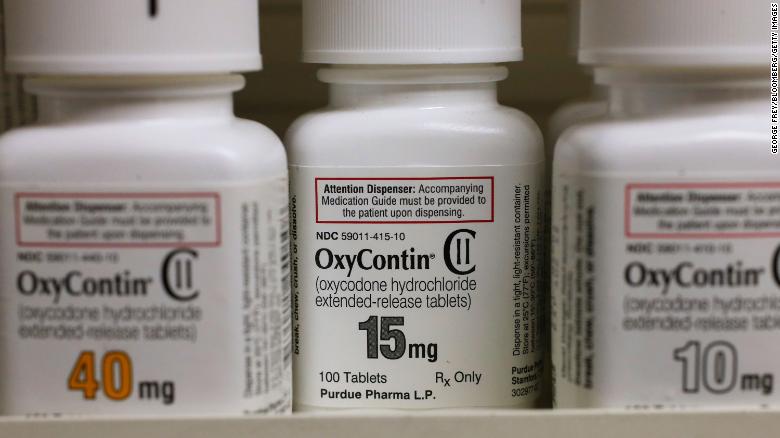
Purdue Pharma, the maker of OxyContin, pleaded guilty Tuesday to three federal criminal charges related to the company’s role in creating the nation’s opioid crisis. Purdue Pharma board chairman Steve Miller pleaded guilty on behalf of the company during a virtual federal court hearing in front of US District Judge Madeline Cox Arleo.

The counts include one of dual-object conspiracy to defraud the United States and to violate the Food, Drug, and Cosmetic Act, and two counts of conspiracy to violate the Federal Anti-Kickback Statute.

The plea deal announced in October includes the largest penalties ever levied against a pharmaceutical manufacturer, including a criminal fine of $3.544 billion and an additional $2 billion in criminal forfeiture, according to a Department of Justice press release.

The company, which declared bankruptcy last year, will be dissolved as a part of the plea agreement, and its assets will be used to create a new “public benefit company” controlled by a trust or similar entity designed for the benefit of the American public.

The Justice Department has said Purdue Pharma will function entirely in the public interest rather than to maximize profits. Its future earnings will go to paying the fines and penalties, which in turn will be used to combat the opioid crisis.

In pleading guilty to the criminal charges, the company is taking responsibility for past misconduct, Purdue Pharma said in a statement to CNN Tuesday.”Having our plea accepted in federal court, and taking responsibility for past misconduct, is an essential step to preserve billions of dollars of value for creditors and advance our goal of providing financial resources and lifesaving medicines to address the opioid crisis,” the statement said. “We continue to work tirelessly to build additional support for a proposed bankruptcy settlement, which would direct the overwhelming majority of the settlement funds to state, local and tribal governments for the purpose of abating the opioid crisis.”

According to the US Centers for Disease Control and Prevention, about 70,000 Americans died of drug overdoses in 2018, just one year of the opioid crisis, and about 70% of those deaths were caused by prescription or illicit opioids like OxyContin. In that year, an estimated 10.3 million Americans 12 and older misused opioids, including 9.9 million prescription pain reliever abusers and 808,000 heroin users, according to the US Department of Health and Human Services Substance Abuse and Mental Health Services Administration.

The Sackler family, and other current and former employees and owners of the company, still face the possibility that federal criminal charges will be filed against them. The court did not set a date for a sentencing hearing.

Appeals court sides with hospitals in latest challenge of DSH payment calculations

lady justice

A federal appeals court upheld a ruling that would allow hospitals to calculate their disproportionate share hospital (DSH) payments using Medicaid patients as well as patients eligible for treatment under experimental Medicaid “demonstration projects” approved by the Department of Health and Human Services (HHS).

The opinion, issued Friday, upheld the decision of a lower court that sided with 10 Florida hospitals seeking to include days of care funded by Florida’s Low Income Pool, an approved Medicaid demonstration project. Through the pool, the state and federal governments jointly reimbursed hospitals for care provided to uninsured and underinsured patients.

HHS argued against allowing the hospitals to include those patients in their Medicaid fraction on the ground that the patients were treated out of charity rather than as designated beneficiaries of a demonstration project.

“The district court found the Secretary’s arguments to the contrary unpersuasive. The Secretary argued the text of the regulation allows hospitals to include days of care provided under a demonstration project only if the project entitles specific patients to specific benefit packages,” the judges said (PDF). “As the court noted, however, this is not what the regulation says. Rather, a patient must have been ‘eligible for inpatient services,’ meaning the demonstration project enabled the patient to receive inpatient services, regardless whether the project gave the patient a right to these services or allowed the patient to enroll in an insurance plan that provided the services.”

DSH payments have traditionally been calculated using the costs incurred to treat Medicaid and uninsured patients. However, the Centers for Medicare & Medicaid’s 2017 rule says costs incurred treating other patients are applicable. For example, a dually eligible patient who’s admitted to the hospital will likely have their stay paid for by Medicare, the agency said, as Medicaid is treated as the “payer of last resort.” As such, those costs would be eligible to be subtracted from DSH payouts.

In backing the hospitals on the DSH dispute, the judges pointed to a similar case considered by the Fifth Circuit last year in which the agency sought to exclude from the Medicaid fraction days of care funded through an “uncompensated care pool” created by a demonstration project. That pool reimbursed hospitals in Mississippi for services provided to uninsured patients affected by Hurricane Katrina but did not entitle specific patients to specific services.

In that case, the Fifth Circuit held “plain regulatory text demands that such days be included—period.”

“We see no flaw in Judge Collyer’s analysis and therefore embrace the district court’s opinion as the law of this circuit,” the judges said.

Los Angeles hospital can force Anthem to cover ER visits, court rules

https://www.beckershospitalreview.com/legal-regulatory-issues/los-angeles-hospital-can-force-anthem-to-cover-er-visits-court-rules.html?utm_medium=email

Innovating in Emergency Medicine: CMS Launches ET3 — A New Treatment Model  for EMS | by StartUp Health | StartUp Health

A federal appellate court recently ruled that Anthem is required to pay Martin Luther King Jr. Community Hospital in Los Angeles for about 75 emergency room visits from covered patients, according to Bloomberg Law

The appeal centered on whether Anthem was required to cover services MLK Jr. Community Hospital rendered to employees of Budco Group, an Ohio company, when the hospital was assigned the patients’ benefit payments. Anthem is the administrator of Budco’s Employee Retirement Income Security Act plan, and the employees who received services at the hospital were beneficiaries of the plan. 

Between 2015 and 2017, Budco employees visited MLK Jr. Community Hospital’s emergency room at least 75 times and assigned their benefits under the company’s ERISA plan to the hospital as a condition of receiving care. Instead of paying MLK Jr. Community Hospital, which was out of Anthem’s network, the insurance company paid the beneficiaries, forcing the hospital to attempt to recover payment from the beneficiaries. The Budco employees deposited payment into their personal accounts and did not send any of the benefit payments to the hospital. 

The hospital sued Anthem and Budco in 2016, seeking benefit payments and declaratory relief. The district court granted summary judgment in favor of the hospitals, and Anthem and Budco appealed. 

On appeal, Anthem argued the case was blocked by a provision in its health plan that prevented patients from assigning their rights to third parties such as MLK Jr. Community Hospital, according to Bloomberg Law. The hospital argued that the “anti-assignment” provision did not bar assignments in this case. 

In an unpublished split decision filed Oct. 2, the U.S. Court of Appeals for the Ninth Circuit ruled in favor of the hospital, holding that the language cited by Anthem allowed assignments to healthcare providers, including those that were out of network. 

“The provision lists three entities other than the beneficiary that Anthem may pay directly. Providers are included among those entities,” the court stated. “In the same paragraph, and only two sentences later, the anti-assignment provision forbids beneficiaries from assigning benefits to ‘anyone else.’ This sentence restricting assignment must be read consistently with the entire paragraph, which concerns benefit payments to entities other than the beneficiary. Thus, we interpret the anti-assignment provision’s reference to ‘anyone else’ to permit assignments to those entities, including ‘providers.'”

Alternatively, the appellate court held that the anti-assignment provision is not part of the health plan documents. 

“The anti-assignment provision is plainly not a benefit, and therefore the district court correctly determined it should not be incorporated as a description of the plan’s benefits,” the appellate court held. 

In his dissenting opinion, Judge Daniel Collins said the anti-assignment provision is an express term of the documents that govern the Budco plan. He also disagreed with the majority’s alternative conclusion that the language of the anti-assignment provision did not bar the assignments that plan beneficiaries made to MLK Jr. Hospital. 

Blue Cross Blue Shield sues AllianzGI over investment strategies

https://www.pionline.com/courts/blue-cross-blue-shield-sues-allianzgi-over-investment-strategies

Blue Cross Blue Shield’s national employee benefits committee filed a lawsuit against Allianz Global Investors and its investment consultant Aon Investments USA, charging both with breaches of fiduciary responsibilities and breach of contract regarding more than $2 billion in losses in the insurer’s defined benefit plan trust.

The lawsuit, filed Wednesday in U.S. District Court in New York, alleges that AllianzGI took “reckless actions” in the management of three funds the manager had said offered downside protection against market declines and volatility, according to the court filing.

As of Jan. 31, the National Retirement Trust of the Blue Cross and Blue Shield Association had a total of $2.9 billion invested in the AllianzGI Structured Alpha Multi-Beta Series LLC I, AllianzGI Structured Alpha Emerging Markets Equity 350 LLC, and the AllianzGI Structured Alpha 1000 LLC, according to the filing.

The numerical values in the strategy names correspond to the amount of alpha in basis points above a corresponding index the strategy is expected to achieve.

After the funds experienced heavy losses in February and March, the investments were liquidated and redeemed, and the committee received about $540 million, according to the filing.

As of Dec. 31, 2018, the Blue Cross and Blue Shield Association National Retirement Trust had $4.6 billion in assets, according to its most recent Form 5500 filing.

The lawsuit, which includes claims breach of fiduciary duty and breach of contract against both AllianzGI and Aon, alleges that AllianzGI “caused the (benefits) committee to believe that structured alpha’s risk profile was consistent with Allianz’s stated investment strategy rather than the actual risk profile, either by making false or misleading representations about structured alpha or failing to disclose information necessary to correct prior representations that were inconsistent with how Allianz was actually managing the strategy.”

The suit alleges Aon breached its obligations by “failing to monitor and inform the committee of breakdowns in Allianz’s risk management protocols, learning only after the catastrophic events of March 2020 that Allianz had inadequate risk management in place.”

AllianzGI’s structured alpha strategies have historically been designed to be both long and short volatility, according to a September 2016 presentation: Taking range-bound spread positions, to sell options that were most likely to expire worthless (short volatility); hedged positions designed to protect against market crashes (long volatility); and directional spread positions designed to generate returns when equity indexes rise or fall more than usual during multiweek periods (long/short volatility).

The lawsuit alleges that “when equity markets declined, volatility spiked and the funds’ option positions were exposed to a heightened risk of loss in February and March 2020, those promised protections were absent.”

The lawsuit seeks relief including restoration of all losses, actual damages and accounting and disgorgement of fees and profits.

John Wallace, AllianzGI spokesman, said in an email: “While the losses sustained by the Structured Alpha portfolio during the market downturn in late February and March were disappointing, AllianzGI believes the allegations made by Blue Cross Blue Shield are legally and factually flawed. We will defend ourselves vigorously against these claims. Blue Cross Blue Shield was advised by a sophisticated investment consultant to evaluate the Structured Alpha strategy. These funds sought to deliver substantial returns of as much as 10% above, net of fees, the returns of the fund’s benchmark, an index like the S&P 500. As was fully disclosed to Blue Cross Blue Shield, the Structured Alpha strategy involved risks commensurate with those higher returns. Blue Cross Blue Shield and their consultant determined that the Structured Alpha Portfolio fit with their overall investment goals and risk tolerances.”

The $15.3 billion Arkansas Teacher Retirement System, Little Rock, filed its own lawsuit against Allianz Global Investors and subsidiaries in July, regarding its own losses in structured alpha strategies.

Robert Elfinger, Aon spokesman, said the company does not comment on pending litigation.

Sean W. Gallagher, Adam L. Hoeflich, Nicolas L. Martinez, Abby M. Mollen and Mark S. Ouweleen, partners at Bartlit Beck, attorney for the plaintiffs, could also not be immediately reached for comment.


Chicago hospital defeats allegations of ‘ghost payroll’ scheme

https://www.beckershospitalreview.com/finance/chicago-hospital-defeats-allegations-of-ghost-payroll-scheme.html?utm_medium=email

False Claims Act & Physicians - Basic Primer

An Illinois federal court has dismissed a whistleblower lawsuit alleging University of Chicago Medical Center, Medical Business Office and Trustmark Recovery Services violated the False Claims Act, according to Bloomberg Law

MBO and Trustmark provided medical billing and debt collection services for UCMC. The whistleblowers, Kenya Sibley, Jasmeka Collins and Jessica Lopez, alleged MBO and Trustmark engaged in a “ghost payroll” scheme that involved regularly falsifying UCMC invoices, listing employes who didn’t work on the hospital’s collections and time charges from people who were not employees.

The whistleblowers, former employees of MBO and Trademark, alleged the companies and UCMC knew about the “ghost payroll” scheme, and that the allegedly falsified invoices caused the hospital to report overstated wages to the federal government, triggering a larger Medicare reimbursement than it was entitled to.

The complaint further alleged that MBO and Trustmark engaged in a “bad debt” scheme. “MBO would regularly write-off Medicare bad debts for amounts a Medicare beneficiary owed without conducting a reasonable collection effort, when Medicare beneficiaries were still paying on the debts, or when Medicare beneficiaries did not actually owe a debt,” the amended complaint states.

After writing off the bad debt, MBO would allegedly send the bad debt to Trustmark or another collection agency for further collection efforts.

On Sept. 14, Judge Harry Leinenweber of the U.S. District Court for the Northern District of Illinois dismissed the amended complaint, saying the whistleblowers failed to adequately allege the defendants engaged in a scheme to inflate bad debts and falsify invoices in University of Chicago’s cost reports. 

The allegations of a “ghost payroll” scheme fail because the whistleblowers failed to allege that defendants certified compliance with any regulation, which is required when filing a false claims case, the judge said in the decision. The amended complaint also fails to establish sufficiently UCMC’s knowledge of the alleged scheme.

The judge also ruled that the amended complaint failed to adequately allege a “bad debt” scheme. Allegations related to MBO’s and Trustmark’s bad debt reports to clients cannot satisfy the requirements to show that companies or their clients submitted improper claims for bad debt reimbursements to the government, reads the decision.


Payers win again, court rules Admininistration violated law in axing ACA cost-sharing payments

https://www.healthcaredive.com/news/payers-win-again-court-rules-trump-admin-violated-law-in-axing-aca-cost-sh/583565/?utm_source=Sailthru&utm_medium=email&utm_campaign=Issue:%202020-08-17%20Healthcare%20Dive%20%5Bissue:29123%5D&utm_term=Healthcare%20Dive

Payers win again, court rules Trump admin violated law in axing ...

Dive Brief:

  • A federal court ruled Friday that insurers are owed subsidies mandated by the Affordable Care Act to help them cover people with low incomes in the exchanges and the Trump administration violated the law when it halted the payments in 2017.
  • In a separate but related ruling, the same court found that payers that were able to raise premiums to offset the loss of those payments in 2018, however, should not receive the entire unpaid amount.
  • The judges with the U.S. Court of Appeals for the Federal District in their decision relied on a recent ruling in favor of insurers from the U.S. Supreme Court on a separate cost-sharing program in the ACA. “We see no sufficient basis for reaching a different conclusion,” they wrote.

Dive Insight:

The Affordable Care Act took into account that payers participating in the exchanges it created would be somewhat flying blind when setting premium rates for a new population. To safeguard them, multiple programs were established to help manage the inherent risk.

One of them was the risk corridors program, which was supposed to redistribute some of the profits insurers received in the exchanges to other companies seeing losses. But far more companies reported losses than profits, and the program quickly ran out of funds to pay out.

The Trump administration argued the ACA does not properly appropriate the funding anyway. 

The high court, however, ruled in April those insurers are owed about $12 billion from the program and that the language indeed creates what is called a money-mandating provision.

The decisions released Friday use that precedent for one of the other risk programs, which provided the subsidies for coverage of people with low-incomes, called cost-sharing reduction payments.

HHS abruptly stopped making the payments in October 2017, making the argument that the money had not been appropriated. But litigation of the issue goes back farther. Republicans in Congress sued HHS in 2014 making the same claim.

In 2018, with the payments still halted, payers increased their premium rates to help account for the lack of cost-sharing reduction payments, and thus received additional premium tax credits (a practice known as silver loading). The judges Friday said that although they agreed with a February 2019 decision from the U.S. Court of Federal Claims that the payers were owed the payments, they disagreed that insurers should be reimbursed in full despite the 2018 premium adjustments.

“The complexity of the process cannot obscure the underlying economic reality that the government is paying at least some of the increased costs that the insurers incurred as a result of the government’s failure to make cost-sharing reduction payments,” they wrote.

The judges remanded the case back to the Court of Federal Claims to determine the amount Maine Community Health Options is owed, and instructed them to take into account what amount of silver loading can be attributed to the loss of the payments.

Montana Co-op is owed $1.23 million for missed 2017 payments and Sanford Health Plan is owed $360,254.


Appeals court rules HHS has authority to implement site-neutral payments, dealing blow to hospitals

https://www.fiercehealthcare.com/hospitals/appeals-court-rules-hhs-has-authority-to-implement-site-neutral-payments-dealing-blow-to?mkt_tok=eyJpIjoiWXpGa016azRZekJqTTJZeSIsInQiOiJ6ajZGSWlYUGh1TTZqTFBDMEgwaXk3ZFZZSCtBVkdUWHNhemZ0SDJZWnhJVHlHVUpjRTdFVUlpbVBSdng4dTFXUEhhOGV2S3lRcElVVWNuZWpqakdEZE1DRmhleHRzdlY4RDRxYkxtZUNYNVI3Rmg5Kys5SVd1aGdseUR6Y1hxSCJ9&mrkid=959610

Appeals court rules HHS has authority to implement site-neutral ...

A federal appeals court ruled the Department of Health and Human Services has the authority to cut Medicare payments to off-campus clinics to bring them in line with independent physician practices, reversing a lower court’s decision.

The ruling from the U.S. Court of Appeals for the District of Columbia delivered Friday strikes a major blow to the hospital industry which has been fighting HHS over the controversial rule.

The American Hospital Association (AHA) led a lawsuit against HHS arguing it did not have the statutory authority to cut payments to the off-campus, provider-based departments. HHS made the cuts in its annual hospital payments rule and the hospitals argued they were unlawful because the cuts were not budget-neutral, a requirement of the payment rule.

But the appeals court agreed with HHS that it had the authority to make the change in the payment rule because of how the law is structured.


FTC to block Philadelphia area health system merger in 1st big hospital challenge in 3 years

https://www.healthcaredive.com/news/ftc-to-block-philadelphia-area-health-system-merger-in-1st-big-hospital-cha/573165/

Dive Brief:

  • The Federal Trade Commission has moved to block the proposed merger between two nonprofit Pennsylvania health systems over anticompetitive concerns in its first challenge to hospital M&A in more than three years.
  • Jefferson Health and Albert Einstein Healthcare Network both provide inpatient general acute care and inpatient acute rehabilitation services in Philadelphia County and Montgomery County. A marriage between the two systems, which agreed to definitively merge in September 2018, would harm patients because the two systems would no longer compete for patients and for inclusion in payer networks, the FTC says.
  • Jefferson and Einstein defended the deal Thursday in a joint statement provided to Healthcare Dive, saying they remain “confident our merger will result in continued high-quality care for our consumers.”

Dive Insight:

FTC Commissioner Christine Wilson has pledged to be tougher on hospital deals in 2020, including reviewing previously closed deals to see if they’ve delivered on promised cost and quality metrics. The last time the FTC questioned a major hospital merger was in 2016, when it urged Virginia and Tennessee not to approve the union of large operators Mountain States Health Alliance and Wellmont. The push was unsuccessful, and the two coalesced into rural system Ballad Health.

The deal, first announced in March 2018, has stagnated over the past two years as it was scrutinized by regulators at the FTC and Pennsylvania Attorney General Josh Shapiro.

“This merger would eliminate the competitive pressure that has driven quality improvements and lowered rates,” Ian Conner, Director of the FTC’s Bureau of Competition, said in a statement. The rivalry between the two nonprofit players for market dominance has resulted in upgraded medical facilities and technological investments, but that progress could stall if Jefferson and Albert Einstein combined, FTC said.

Jefferson and Einstein boast a combined roughly $5.9 billion in annual revenue, along with 18 hospitals, more than 50 outpatient and urgent care centers and a handful of rehab and post-acute facilities. Jefferson, the bigger player, has 14 hospitals across South Jersey and Philadelphia, Montgomery and Bucks counties.

The regulators said they will soon file a formal complaint in the U.S. District Court for the Eastern District of Pennsylvania.

The complaint alleges that as a result of the merger, Jefferson and Einstein would control at least 60% of the inpatient general acute care services market in North Philadelphia, and 45% in Montgomery. That includes services like medical or surgical diagnostics and treatments requiring an overnight stay.

Jefferson and Einstein manage six of the eight inpatient rehab facilities for recovering from serious, acute conditions in the Philadelphia region, and would control at least 70% of that market if combined.

The hospitals said their marriage represents a “creative effort” to increase access at a time when safety net hospitals are struggling.

“We believe we have presented a strong and comprehensive case as to how the merger would benefit the patients we serve and advance our academic mission without reducing competition for healthcare services,” the systems, which have had an academic partnership for more than two decades, said.

Several studies have debunked theories that bigger is better in terms of quality of care when it comes to health systems.

FTC plans to seek a temporary restraining order and preliminary injunction to prevent Jefferson and Albert Einstein from consummating the merger pending an administrative trial scheduled to being in September this year.  


Appeals court strikes down Trump approval of Medicaid work requirements

Appeals court strikes down Trump approval of Medicaid work requirements

Image result for Appeals court strikes down Trump approval of Medicaid work requirements

A federal appeals court on Friday struck down the Trump administration’s approval of Medicaid work requirements in Arkansas, the latest legal blow to one of President Trump‘s signature health initiatives. 

The U.S. Court of Appeals for the D.C. Circuit affirmed a lower court ruling that the approval of the work requirements was “arbitrary and capricious.

More than 18,000 people lost coverage in Arkansas due to the work requirements before they were halted by a lower court.

The court found that the Trump administration disregarded the statutory purpose of Medicaid — to provide health coverage — and did not adequately account for the coverage losses that would result from the work requirements. 

“Failure to consider whether the project will result in coverage loss is arbitrary and capricious,” Judge David Sentelle, an appointee of President Reagan, wrote in the opinion.

Requiring Medicaid recipients to work or else lose coverage is a top priority of Centers for Medicare and Medicaid Services Administrator Seema Verma. She argues that the policy helps lift people out of poverty by getting them jobs and out of Medicaid into employer-based insurance.

But Democrats and health care advocates have denounced the move, saying it imposes burdensome paperwork requirements on low-income people that cause them to lose coverage even if they are working.

The policy has also faced a string of legal losses, with courts ruling that Congress would need to act to authorize the work requirements. 

Arkansas was the only state where the requirements went into effect before being blocked by the courts. Several other states’ efforts were approved, but the initiatives have been halted as the issue works its way through the courts.

“The Court recognized the tragic harm that these work requirements have caused people in Arkansas doing their best to get ahead,” said Kevin De Liban, an attorney at Legal Aid of Arkansas, which helped challenge the requirements. “Now, more than two hundred thousand Arkansans on the program can rest easier knowing that they’ll have health care when they need it.”

Conservative changes to Medicaid have been a leading priority of the Trump administration, which also recently announced plans to let states block-grant their funding for the program. That move was also denounced by Democrats as inevitably leading to coverage losses and is also likely to be challenged in court.

Kentucky had originally also been part of the work requirement litigation, but a Democratic governor, Andy Beshear, was elected last year and ended the initiative.


Fifth Circuit Appeals Court Strikes Down the Affordable Care Act’s Individual Mandate

https://www.commonwealthfund.org/blog/2019/fifth-circuit-appeals-court-strikes-down-affordable-care-acts-individual-mandate

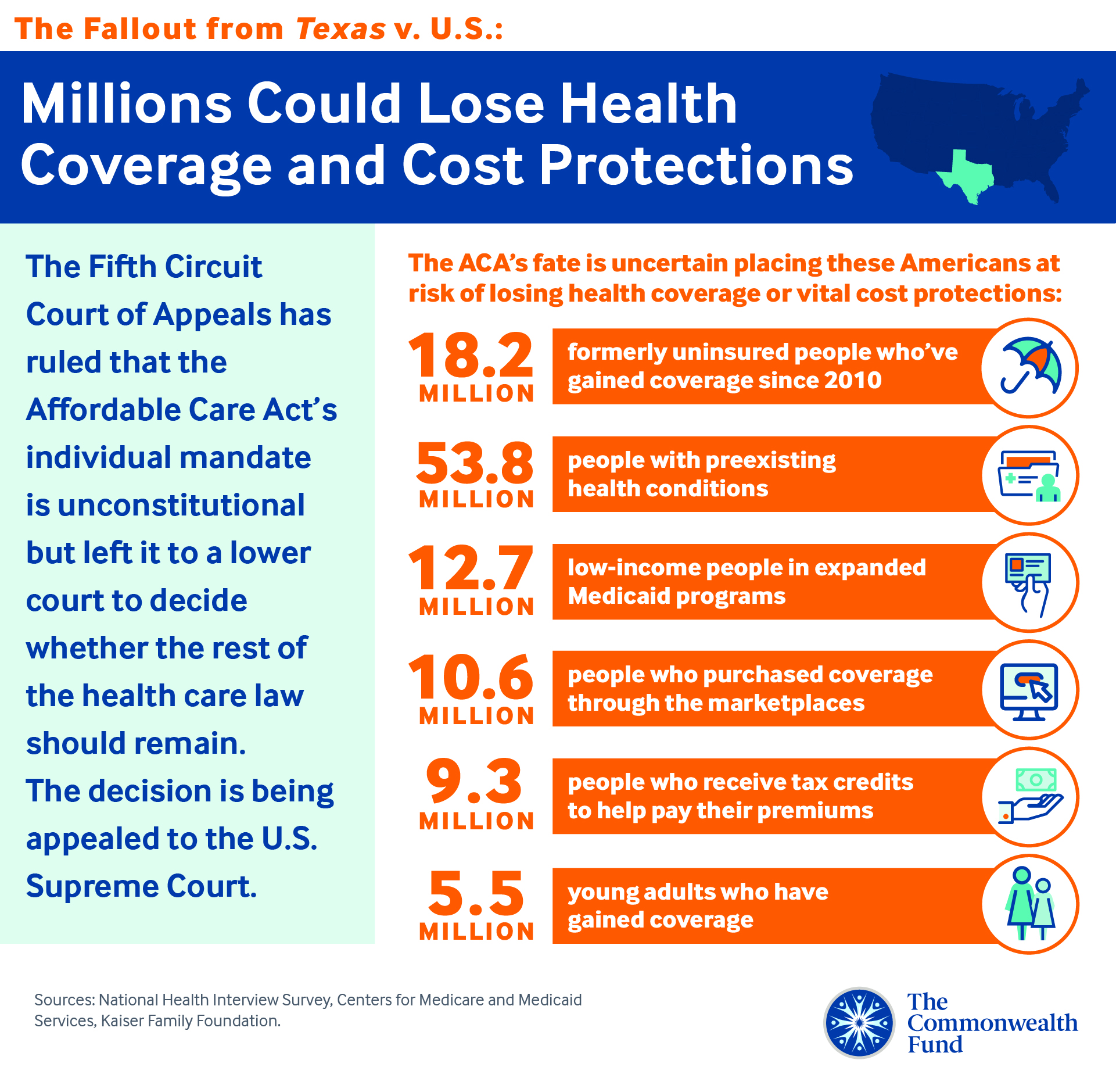
The Fallout from Texas v. U.S.:

Yesterday, a three-judge panel from the Fifth Circuit Court of Appeals struck down the Affordable Care Act (ACA)’s individual mandate. The judges agreed with a lower court decision issued in the case, Texas v. U.S., in December 2018 that the individual mandate is unconstitutional but, unlike the lower court, did not decide that the rest of the ACA is also unconstitutional. Instead, the judges remanded, or sent back, the decision to the same lower court judge to consider. California Attorney General Xavier Becerra, who is leading the 21 Democratic state attorneys general defending the law, along with the U.S. House of Representatives, immediately announced he would appeal the decision to the Supreme Court.

Whether the Supreme Court will decide to take the case now or wait for the decision of Judge O’Connor’s, of the lower court, is uncertain. If the Court decides to take the case now, they could expedite the briefing process and issue a decision in 2020. If it does not take the case now, a ruling will be delayed until after the 2020 presidential election.

No one knows how the Supreme Court will ultimately rule. But we do know that if the Court decides to strike down the ACA, the human toll will be immense and tragic. The law has granted unprecedented health security to millions:

  • 18.2 million formerly uninsured people have gained coverage since 2010
  • 53.8 million Americans with preexisting health conditions are now protected
  • 12.7 million low-income people are insured through expanded Medicaid
  • 10.6 million people have coverage through the ACA marketplaces, 9.3 million of whom receive tax credits to help them pay their premiums
  • 5.5 million young adults have gained coverage, many by staying on their parents’ plans
  • 45 million Medicare beneficiaries have much better drug coverage.

Such a decision will also trigger massive disruption throughout the U.S. health system. The health care industry represents nearly 20 percent of the nation’s economy; the ACA has touched every corner of it. The law restructured the individual and small-group health insurance markets, expanded and streamlined the Medicaid program, improved Medicare benefits, and reformed the way Medicare pays doctors, hospitals, and other providers. It was a catalyst for the movement toward value-based care and established a regulatory pathway for biosimilars — less expensive versions of biologic drugs. States have rewritten laws to incorporate the ACA’s provisions. Insurers, hospitals, physicians, and state and local governments have invested billions of dollars in adjusting to these changes.

The law’s popular preexisting health condition protections have made it possible for people with minor-to-serious health problems to apply for coverage in the same way healthier people have always done. These protections have given the estimated 53.8 million Americans with preexisting health conditions the peace of mind that they will never be denied health insurance because of their health.

More than 150 million people who get coverage through their employers now are eligible for free preventive care, and their children can stay on their policies to age 26.

The wide racial and income inequities in health insurance coverage that have been partly remedied by the ACA would return. Hospitals and providers, especially safety-net institutions, would struggle with mounting uncompensated care burdens and sicker and more costly patients who are not receiving the preventive care they need.

The ACA tore down financial barriers to health care for millions, many of whom were uninsured for most of their lives. It has demonstrably helped people get the health care they need in states across the country. Research indicates that Medicaid expansion has led to improved health status and lower mortality risk.

To date, neither the Trump administration, which has sided with the plaintiffs in the case, nor its Republican colleagues in Congress have offered a replacement plan in the event the law is struck down. The historic progress made by Americans, particularly those with middle and lower incomes and people of color, could unravel. Voters are already telling policymakers they are worried about their ability to afford health care. Yesterday’s decision and the uncertain path forward to the Supreme Court is certain to escalate those worries. With the nation entering the 2020 presidential election year, the Supreme Court may decide to take up the case this term.