Henry Ford Health to furlough 2,800 workers

https://www.beckershospitalreview.com/finance/henry-ford-health-to-furlough-2-800-workers.html?utm_medium=email

Henry Ford furloughing 2,800 employees due to COVD-19 financial ...

Financial damage from the COVID-19 pandemic is forcing Detroit-based Henry Ford Health System to furlough 2,800 workers, the health system announced April 22. 

The six-hospital system decided to furlough employees who are not directly involved in patient care after recording a $43 million loss in operating income in March due to the cancellation of elective procedures, temporary site closures, and expenses related to personal protective equipment and other supplies needed to care for COVID-19 patients. The health system expects more significant losses in April and May.

“I know that news concerning furloughs is painful — especially for an organization like ours, whose greatest strength has always been our people,” Henry Ford President and CEO Wright Lassiter III wrote in an email to employees. “We value each team member’s unique contribution and this decision does not change that. But, we must face these realities head on.”

In addition to the furloughs, the health system’s executives and senior leaders will begin contributing 10 percent to 25 percent of their salaries to funds created to support employees.

Henry Ford Health reported a net operating loss of $36.2 million for the first three months of this year, compared to operating income of $39.4 million in the same period of 2019. 


Mayo Clinic furloughs, cuts hours of 30,000 employees to help offset $3B in pandemic losses

https://www.beckershospitalreview.com/finance/mayo-clinic-furloughs-cuts-hours-of-30-000-employees-to-help-offset-3b-in-pandemic-losses.html?utm_medium=email

Information for Orlando Residents - Orlando - Mayo Clinic

Rochester, Minn.-based Mayo Clinic said it will furlough or cut the hours of about 30,000 staff members to help offset about $3 billion in losses incurred by the COVID-19 pandemic, according to The Post Bulletin.

Mayo Clinic announced that it would need to take several cost cutting measures, including furloughs, earlier in April. However, the system didn’t disclose the number of employees that would be affected.

The temporary reduction in workforce is one of the ways the system is working to offset a $3 billion loss from the pandemic. Even with the cost-cutting measures, Mayo anticipates a $900 million shortfall this year.

The furloughs or reduced hours affect about 42 percent of Mayo Clinic’s 70,000 employees across its campuses in Arizona, Florida and Minnesota. 

Affected employees will still receive healthcare benefits.

The furloughs will begin in May and be spread throughout the rest of the year, Mayo Clinic spokesperson Ginger Plumbo told the publication. The duration of the furlough will vary depending on the hospital unit, she added.

The furloughs will not affect physicians at the system, but physicians will receive a 10 percent wage reduction. In addition, senior managers will receive pay cuts of 15 percent and top executives will take a 20 percent reduction.

The furloughs, cut hours and wage reductions are expected to save $1.4 billion.

Mayo Clinic also has been taking other cost-cutting measures, including a hiring freeze and halting major construction projects.

Mayo Clinic is also tapping into its reserves to bring $900 million in cash to the system.


Beaumont-Summa merger on pause as COVID-19 batters hospitals

https://www.healthcaredive.com/news/beaumont-summa-merger-on-pause-as-covid-19-batters-hospitals/576535/

Dive Brief:

  • Michigan’s largest health system, Beaumont Health, is delaying its merger with Ohio-based Summa Health as the two continue to battle the coronavirus pandemic. “We didn’t plan this, but we are deferring that [the merger] until we have a little more clarity about the impact of this crisis,” Beaumont Health CEO John Fox said Wednesday.
  • Beaumont said it is temporarily laying off more than 2,400 employees, or nearly 7% of its workforce, as the pandemic has forced the system to halt inpatient and outpatient surgeries, cutting off an entire revenue stream. Among the job cuts, 450 positions have been permanently eliminated, while most of the other 2,400-plus positions involved administrative staff and others who are not directly caring for patients. Administrators have also said they’re taking pay cuts and Fox’s pay has been reduced by 70%.
  • The deal was recently approved by state and federal regulatory agencies, Summa Health told Healthcare Dive.

Dive Insight:

The deal is still on the table and the two are working on finalizing a path forward, Summa Health told Healthcare Dive.

“That said, the immediate priority is for both Summa and Beaumont to focus first and foremost on caring for our patients, employees, physicians and communities as we are impacted by the COVID-19 pandemic,” a spokesperson said.

The marriage between the two health systems is supposed to give Beaumont Health a foothold in Northeast Ohio, putting it in closer competition with Cleveland Clinic. In addition to its four hospitals, Summa also operates its own health plan, SummaCare, which provides coverage to 46,000 people.

Beaumont operates eight hospitals with 145 outpatient sites and has 38,000 employees.

Earlier this year, the two signed a definitive agreement and, together, Beaumont and Summa, are expected to create a $6.1 billion system in terms of total annual revenue with $4.7 billion from Beaumont and $1.4 billion from Summa.

However, the fallout from COVID-19 is likely to hamper those figures.

Beaumont reported a net loss of about $278 million during the first quarter of 2020, compared to about $408 million during the prior-year period. The system reported the virus only started affecting it in the last two weeks of March.


Operating margins plummet at US hospitals, Kaufman Hall says

https://www.healthcaredive.com/news/Kaufman-hospitals-operating-margin-decline/576491/

Third Quarter Investment Report: Moving Into Choppy Waters « CPEA ...

Dive Brief:

  • Operating margins at the nation’s hospitals have plummeted due to large-scale volume and revenue declines coupled with flat to rising expenses, according to a new report from Kaufman Hall.
  • Based on March data from more than 800 U.S. hospitals, average operating margins dropped 150% year over year, plunging non-profit hospitals, which historically operate on already thin margins, into troublesome territory.
  • The data paint a dire picture for U.S. hospitals. “These initial numbers only reflect the first two weeks of the COVID-19 response and likely indicate more negative results in the future,” Jim Blake, managing director at Kaufman Hall, said in a statement.

Dive Insight:

Hospitals depend heavily on elective surgeries for revenue, but had to cancel or postpone many of them starting last month in order to preserve coveted COVID-19 resources such as personal protective equipment, beds and staff.

Those measures have upended the financial health of the entire industry in a matter of just weeks, according to new data and analysis from Kaufman Hall.

“We anticipate April will be significantly worse, and at this point, no one knows how long hospitals will continue on their current path,” Blake said.

Despite the ongoing pandemic, patient volumes overall have plunged. During March, the median hospital occupancy rate was 53%, with operating room minutes down 20% year-over-year and emergency room visits down 15% year over year, according to the report.

At the same time, hospitals’ labor expenses were up 3% year over year, and non-labor expenses were up 1%. In order to rein in operating costs, some health systems have begun to furlough or lay off workers.

While non-profit systems are especially vulnerable given their razor-thin margins, major for-profit systems are also struggling financially.

HCA Healthcare, Community Health Systems and Tenet Healthcare have all pulled their 2020 guidance in response to the pandemic. In its first quarter report Tuesday, HCA attributed a steep decrease in volumes and 45% drop in profit to the pandemic.

And Jefferies analyst wrote in a note Tuesday they are reducing their volume and earnings expectations for those companies for this year and 2021 based on the pandemic. “Our belief is that high unemployment translates to reduced commercial insurance coverage and disposable income to fund co-pays/deductibles, which results in fewer physician visits and procedures,” they wrote.

Under these circumstances, the federal government has attempted to financially support struggling hospitals through ongoing coronavirus relief legislation.

First came accelerated Medicare payments based on reimbursement data, in the form of loans that providers will have to pay back.

Separately, the Coronavirus Aid, Relief, and Economic Security Act passed by Congress in March benchmarked $100 billion in funding to provide financial support to struggling hospitals.

$30 billion first round was announced April 8 and given to providers based on historic Medicare payments. A second round of CARES act funding for systems in hot spots is next, although the timing is unclear.

On Tuesday the Senate approved a separate $484 billion aid package, the Paycheck Protection Program and Health Care Enhancement Act, that would send an additional $75 billion in emergency funds to hospitals. It also allocates $25 billion to expand testing for the virus across the country.

The White House expressed support for the package. It still needs House approval, which could happen as soon as this week.

The latest package comes in response to depleted funding for the Small Business Administration’s Paycheck Protection Program. Upon replenishing those funds, smaller health systems may be eligible for forgivable PPP loans used to meet payroll and other operating costs, but only if they have 500 or fewer employees.


Envision hires restructuring advisers, considers bankruptcy filing

https://www.beckershospitalreview.com/finance/envision-hires-restructuring-advisers-considers-bankruptcy-filing.html?utm_medium=email

Envision Healthcare Said to Be Considering Bankruptcy, 2 Years ...

Envision Healthcare, a Nashville, Tenn.-based physician staffing company owned by private equity firm KKR, is struggling to manage its $7 billion debt load and recently hired lawyers and an investment bank to advise on its restructuring options, sources told Bloomberg.

The company is looking at restructuring options, including a potential Chapter 11 bankruptcy filing, as it faces financial pressure from the COVID-19 pandemic, according to Bloomberg. Envision has seen a significant decline in patient volume across its practices and specialties during the pandemic.  

No decision has been made on a course of action for Envision, and the company is still seeking to ease its debt burden by swapping $1.2 billion of unsecured notes for a new term loan. Creditors have until the end of the month to decide whether to participate in the deal.

The company is exploring its restructuring options after taking several steps to improve its financial position, including holding back pay for physicians, reducing salaries of senior leadership and furloughing nonclinical staff. The company said clinical pay will be reduced in services with low patient volumes, and performance-based bonuses and clinician profit-sharing will be delayed until the fall. Additionally, Envision temporarily suspended retirement contributions, merit increases and promotions for all employees.

About a week after Envision implemented many of the changes, U.S. Sen. Elizabeth Warren of Massachusetts and U.S. Rep. Katie Porter of California sent a letter to Envision and other healthcare staffing companies backed by private equity regarding pay and benefits.

The letter, which Ms. Porter posted on Twitter, said Envision is cutting its physicians’ pay and benefits, “all while our doctors face new financial strains of their own” amid the COVID-19 pandemic.

In response, Envision cited challenges healthcare organizations are facing.

“The nation’s healthcare system has experienced a drastic drop in patient volume since the beginning of the COVID-19 crisis,” wrote Envision, which has more than 40,000 team members, 27,000 of whom are physicians and clinicians. “Even as COVID-19 fills emergency departments in hot spots around the country, Envision’s overall emergency volume is actually down 45 percent.”

Hospital and physician groups are trying to secure funds from the Coronavirus Aid, Relief and Economic Security Act and get additional aid. Though the private equity industry is lobbying Washington to gain access to the funds, it remains unclear whether private equity-backed companies like Envision will receive the emergency government funds. 


Tower Health furloughs 1,000 workers amid dramatic revenue drop

https://www.beckershospitalreview.com/finance/tower-health-furloughs-1-000-workers-amid-dramatic-revenue-drop.html?utm_medium=email

Under financial pressure from the COVID-19 pandemic, Philadelphia-based Tower Health has furloughed at least 1,000 employees, according to The Philadelphia Inquirer

Tower Health implemented the furloughs, which affect roughly 7 percent of the system’s 14,000-person workforce, after suspending elective procedures and shutting down many of its outpatient clinics. The seven-hospital system said it has lost as much as half its revenue, according to the report. 

Tower Health received more than $23 million in grants made available under the Coronavirus Aid, Relief and Economic Security Act, but it’s still facing financial pressure.

“These funds, while helpful, do not come close to making up for the decline in revenue Tower Health has experienced in March and into April,” a spokesperson told The Philadelphia Inquirer.

Tower Health joins more than 150 other hospitals and health systems across the U.S. that have furloughed workers in recent months. 


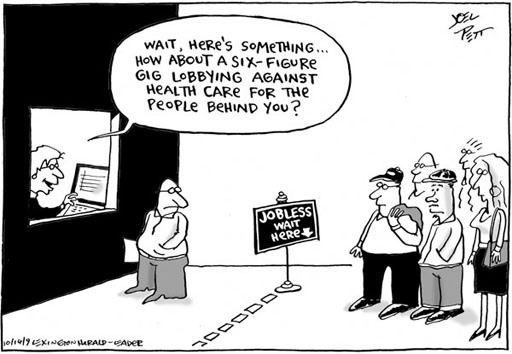
Cartoon – Job Opportunity

Political Cartoon: “Overheard In The Unemployment Line” by Joel ...

What is work sharing and how can it help the labor market?

https://www.brookings.edu/blog/up-front/2020/04/16/what-is-work-sharing-and-how-can-it-help-the-labor-market/?utm_campaign=Brookings%20Brief&utm_source=hs_email&utm_medium=email&utm_content=86505163

What is work sharing and how can it help the labor market?

When economic conditions worsen, as they did beginning in March 2020 because of the COVID-19 pandemic, employers often respond by laying off their employees. This can lead to very undesirable outcomes for society at large. Research shows that losing a job often causes decreased long-term earnings, health problems, and other adverse outcomes, the effects of which can last generations (Abraham and Houseman 2014). Layoffs create future costs for employers as well—once demand picks back up, firms will have to expend valuable resources on significant search, hiring, and training costs.

The U.S. unemployment insurance (UI) system can help. Its core function is to replace some of the earnings of workers who have lost their jobs, helping them to stay afloat during tough economic times. But the UI system can also support workers and employers as they reduce, rather than eliminate, employees’ work hours.

WHAT IS WORK SHARING?

A program called work sharing, or short-time compensation, encourages employers to temporarily reduce the hours of their employees rather than lay them off during an economic downturn. Work sharing allows employers to keep their skilled workforce and reestablish a full-time schedule when economic conditions improve. With this approach, employees continue to be paid for the hours they work, collecting pro-rated unemployment benefits that help cover the work hours they lose. For example, employers could reduce everyone’s hours by 20 percent and employees would qualify for 20 percent of the weekly unemployment benefit amount.

In a Hamilton Project proposal, economists Katharine Abraham and Susan Houseman described reforms that would facilitate the use of work sharing. The importance of these reforms for addressing the current economic downturn was discussed further in a recent webcast titled, “Unemployment Insurance during the COVID-19 Pandemic: Reducing the Impact of this Economic Downturn.”

WHAT IS THE RATIONALE FOR WORK SHARING? HOW MANY JOBS COULD IT SAVE?

Work sharing provides employers a way to respond to a decrease in demand by cutting back on hours rather than laying workers off. This approach maintains employer-employee connections, minimizing layoffs and supporting workers who have their hours reduced. Work sharing can be particularly helpful when the drop in demand is expected to be temporary, as many think likely for this pandemic-caused recession.

The value of preserving relationships between employers and employees is twofold. First, it can avoid huge spikes in permanent job losses that are financially ruinous for many families. Workers continue their employment, albeit with reduced hours, and avoid many of the damaging effects of losing a job (like loss of health insurance coverage). Second, both employers and workers will avoid costly search, hiring, and training once demand eventually picks back up.

Throughout the Great Recession, when only 17 states offered the option, use of work-sharing was very limited. Abraham and Houseman estimate that if work sharing had been available for the entire country during the Great Recession—and take-up rates had been similar to our European counterparts—work-sharing programs could have saved up to 1 million jobs, or 1 in 8 of the net jobs that were lost during the Great Recession.

HOW WIDESPREAD ARE WORK-SHARING PROGRAMS?

Today, 26 states, covering nearly 70 percent of the workforce, have operational work-sharing programs in place. But work sharing has been little used in the earliest days of this recession. As of the week ending in March 28, just 0.3 percent of the more than 8.2 million people claiming UI benefits received work-sharing benefits.

To expand coverage, Abraham and Houseman propose that Congress pass legislation that requires states to have a work-sharing program as a part of their UI system to participate in the federal–state UI system. Further, in order to encourage state take-up, they propose that the U.S. Department of Labor modify its funding formula to more accurately fund state administrative burdens associated with implementing and promoting work-sharing programs.

WHAT ELSE CAN BE DONE TO MAKE IT EASY FOR EMPLOYERS TO USE THE PROGRAM?

First, states could look for opportunities to expedite the process of starting up a work-sharing plan and paying benefits. Second, states could remove policies that tend to discourage the use of work sharing and push employers toward layoffs. For example, some states bar employers who have heavily used the UI system in the past from participating in work-sharing programs. Additionally, some states impose higher effective UI tax rates on employers who choose work-share programs than if they laid off their workers. Designed to prevent abuse of the UI system, these policies may discourage work sharing, especially during downturns. Abraham and Houseman recommend that Congress add a prohibition against the use of these policies to the existing criteria for state eligibility to participate in the federal–state UI system.

HOW CAN WORK-SHARING PROGRAMS BE FURTHER INCORPORATED INTO THE EXISTING UI SYSTEM?

Under current law, sharp increases in a state’s unemployment rate trigger extensions to the benefits available in that state; the federal government covers half the cost of those extensions. That same federal-state program could enhance the use of work sharing. Abraham and Houseman propose that the federal government cover half the cost of work-sharing programs when UI extended benefits are triggered in a state. As explained below, Congress has recently gone beyond this proposal, but only on a temporary basis.

HOW IS WORK SHARING ADDRESSED IN THE CORONAVIRUS AID, RELIEF, AND ECONOMIC SECURITY ACT (CARES ACT)?

The CARES Act, signed into law on March 25, 2020, encourages states and employers to use work-sharing programs. The federal government will reimburse 100 percent of the cost of short-time compensation benefits paid in states that have work-sharing programs in place. For those states that do not have a work-sharing program, the CARES act includes funds to pay for short-time benefits at a 50 percent federal coverage rate. Finally, the CARES Act allocates grant funding for states to promote and improve the implementation and administration of work-sharing programs.