In Thursday’s second and final Presidential debate, former Vice President Joe Biden warned that a “dark winter” lies ahead in the coronavirus pandemic, and with cases, hospitalizations, and deaths on the rise across the country, it now appears that we are headed into a “third wave” of infections that may prove worse than both the initial onset of COVID on the coasts and the summertime spike in the Sun Belt.
Yesterday more than 71,600 new cases were reported nationwide, nearing a late-July record. Thirteen states hit record-high hospitalizations this week, measured by weekly averages, most in the Midwest and Mountain West. Several Northeastern states, which had previously brought the spread of the virus under control, also experienced substantial increases in infections, leading schools in Boston to suspend all in-person instruction. Of particular concern is hospital capacity, which is already being strained in the more rural areas now being hit by COVID cases. With infection spikes more geographically widespread than in earlier waves, fewer medical workers are available to lend support to hospitals in other states, leading to concerns about hospital staffing as admissions rise.
As hospitalizations increase, so too will demand for therapeutics to help shorten the course and moderate the impact of COVID. This week, Gilead Sciences’ antiviral drug remdesivir, previously available under an Emergency Use Authorization (EUA) from the federal government, became the first drug to win full approval from the Food and Drug Administration (FDA) to treat patients hospitalized with COVID-19. The approval was based on clinical studies that showed that remdesivir can reduce recovery time, and also includes use for pediatric COVID patients under the age of 11.
Meanwhile, the FDA cleared AstraZeneca to resume US clinical trials of its coronavirus vaccine, which had been suspended for a month following an adverse patient event. It’s widely expected that one or more drug companies will submit their vaccine candidates for EUA sometime next month, although new polling data released this week indicates that the American public is growing more skeptical in their willingness to take an early vaccine against the virus, with only 58 percent of respondents saying they would get the shot when it first becomes available, down from 69 percent in August. (Only 43 percent of Black respondents say they would get the vaccine, compared to 59 percent of Whites—a racial divide that reveals deep distrust based on the history of inequities in the US healthcare system.)
In many respects, the coming month will surely prove to be a pandemic turning point, revealing the magnitude of the next wave of COVID, the direction of US public health policy, the prospects for reliable therapeutics, and the timing of a safe and effective vaccine. We’ll soon know whether we are, indeed, headed for a winter of darkness.
President Trump repeated baseless claims at the final presidential debate that the coronavirus “will go away” and that the U.S. is “rounding the turn,” while Joe Biden argued that any president that has allowed 220,000 Americans to die on his watch should not be re-elected.
Why it matters: The U.S. is now averaging about 59,000 new coronavirus infections a day, and added another 73,000 cases on Thursday, according to the Covid Tracking Project. The country recorded 1,038 deaths due to the virus Thursday, the highest since late September.
What they’re saying: “More and more people are getting better,” Trump said. We have a problem that’s a worldwide problem. This is a worldwide problem. But I’ve been congratulated by the heads of many countries on what we’ve been able to do … It will go away and as I say, we’re rounding the turn. We’re rounding the corner. It’s going away.”
Trump later disputed warnings by public health officials in his administration that the virus would see a resurgence in the winter, claiming: “We’re not going to have a dark winter at all. We’re opening up our country.”
Biden responded: “Anyone responsible for that many deaths should not remain as president of the United States of America.”
“What I would do is make sure we have everyone encouraged to wear a mask all the time. I would make sure we move in the direction of rapid testing, investing in rapid testing.”
“I would make sure that we set up national standards as to how to open up schools and open up businesses so they can be safe and give them the wherewithal, the financial resources, to be able to do that.”
The bottom line:Biden and Trump are living in two different pandemic realities, but Biden’s is the only one supported by health experts.
The White House is reportedly embracing a herd-immunity approach focused on “protecting the elderly and the vulnerable” but experts are calling the plan dangerous, “unethical”, and equivalent to “mass murder”.
“Current lockdown policies are producing devastating effects on short and long-term public health,” the declaration states, adding, “The most compassionate approach that balances the risks and benefits of reaching herd immunity, is to allow those who are at minimal risk of death to live their lives normally to build up immunity to the virus through natural infection, while better protecting those who are at highest risk. We call this Focused Protection.”
Essentially, herd immunity is when enough people are immune to a disease, like Covid-19, that the disease can’t be transmitted as easily and thus provides indirect protection.
It’s been rumoured that the government has been leaning towards this plan of action for some time now, although this is the first real admission.
In response to today’s news, experts around the world have been voicing their concerns.
And this isn’t the first time we’ve heard experts say herd immunity is not a good idea.
For example, the head of the World Health Organization said Monday that allowing the novel coronavirus to spread in an attempt to reach herd immunity was “simply unethical.”
Similarly, the National Institutes of Health (NIH) director Francis Collins also denounced herd immunity as a viable plan.
“What I worry about with this is it’s being presented as if it’s a major alternative view that’s held by large numbers of experts in the scientific community. That is not true. This is a fringe component of epidemiology. This is not mainstream science. It fits into the political views of certain parts of our confused political establishment,” he said in an interview.
Not to mention studies continue to show that Sweden’s attempts at herd immunity have failed and have resulted in a higher Covid-19 death toll than expected.
As more research comes out, scientists are starting to learn that Covid-19 immunity, even in those who were severely infected, can fade after a few weeks.
This is why we’ve seen cases of reinfection and why many experts are advising against a herd immunity plan.
To put that into context, that means around 197 million people would need to be infected in America. And assuming that the Covid-19 fatality rate is somewhere between 0.5% and 1%, based on numbers from the World Health Organization (WHO), more than 1 million people would die – at minimum.
William Haseltine, Chair and President of ACCESS Health International, told CNN “herd immunity is another word for mass murder. We are looking at two to six million Americans dead – not just this year but every year.”
“This is an unmitigated disaster for our country – to have people at the highest levels of our government countermanding our best public health officials. We know this epidemic can be put under control. Other countries have done it. We are doing the opposite.”
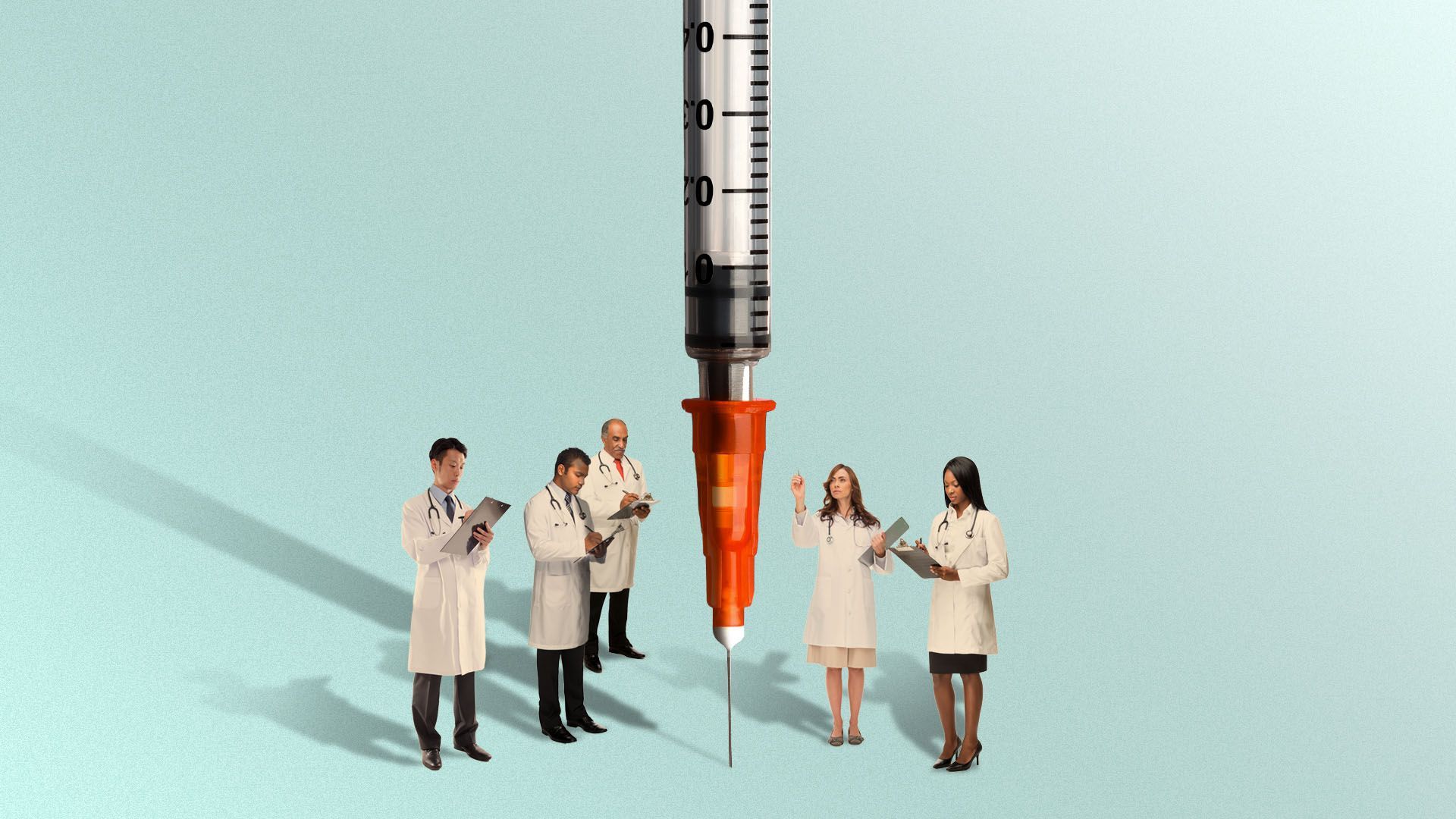
The first coronavirus vaccinewill likely get authorized within months, but that will only be the beginning of what’s likely to be a long, chaotic vaccination process, the New York Times’ Carl Zimmer reports.
The big picture: The first vaccines probably will offer only moderate protection against the virus, meaning we can’t ditch our masks even if we get one. And we probably won’t have a good way to choose between these vaccines once several of them are on the market.
Some vaccines that are in earlier stages of development today may struggle to cross the finish line, even if they work better than earlier vaccines.
And some vaccines may be pulled off of the market because they’re unsafe.
Between the lines:Some of this is inherent to the breakneck speed of the vaccination effort, but some of it is a result of how that effort was designed.
Earlier this year, some government scientists had wanted to test vaccine candidates against each other, instead of testing all of them against a placebo. But these kinds of trials are risky for drug companies, because they show the value of one vaccine against another.
That information could be useful for patients, but is a business risk for manufacturers.
“You have to have the total cooperation of the pharmaceutical companies to get involved in a master protocol,” top infectious disease expert Anthony Fauci told NYT. “That — I don’t know what the right word is — didn’t turn out to be feasible.”


:no_upscale()/cdn.vox-cdn.com/uploads/chorus_asset/file/21986301/2_US_Positive.png)




 HENRY KOTULA