Mayo Clinic halts scheduling of out-of-network Medicare Advantage patients

https://www.healthcarefinancenews.com/news/mayo-clinic-halts-scheduling-out-network-medicare-advantage-patients

The Mayo Clinic in Minnesota is no longer scheduling appointments for patients in most Medicare Advantage plans, and has been gradually notifying patients throughout the year, in a move that could have consequences for insurers operating plans in the area, according to a Mayo Clinic spokesperson.

Some insurers, such as UnitedHealthcare, have been negotiating with the Mayo Clinic to bring them in-network for Medicare Advantage, in some cases asking them to outline their requested terms, but Mayo to date has yet to send out proposals.

Mayo has long been out of network for most Medicare Advantage plans, but has historically treated out-of-network MA patients and accepted their benefits, according to Mayo Clinic spokesperson Karl Oestreich.

According to the Star Tribune, the change occurred because Mayo saw a significant increase in patients covered by “non-contract” MA insurers. That increase, officials said, threatens to crowd out patients covered by in-network insurers.

Non-contract MA plans are those in which insurance companies have not negotiated payment rates for services with Mayo.

UnitedHealthcare, which has been out of network, is negotiating to bring Mayo in-network for MA members, according to Dustin Clark, vice president for communications at UHC.

“We have asked Mayo Clinic to outline requested terms to join our network for Medicare Advantage and haven’t received a proposal,” he told Healthcare Finance News. “We are committed to reaching an agreement at an affordable cost for the people we serve. We stand at the ready to work with Mayo to end this disruption.”

For UHC, it’s especially important that MA patients who traditionally received care at Mayo can continue to do so in the future.

Although Mayo Clinic does not participate in our network for Medicare Advantage, many of our members have received treatment from its physicians as part of their out-of-network benefits,” said Clark. “We understand how difficult this situation is for some of our members, which is why we are working with Mayo to ensure our Medicare Advantage members who are currently undergoing treatment or have an established relationship with the clinic can continue to see their physician.”

Mayo Clinic spokesperson Karl Oestreich said that medical need is the primary criteria for obtaining an appointment.

“In situations where medical need does not apply and to ensure appointments remain available for our Mayo Clinic patients, we no longer schedule routine visits for those whose coverage does not include Mayo Clinic,” he said. “Continuity of care and relationships with existing local and regional patients won’t be compromised.”

The primary issue, said Oestreich, is capacity, not reimbursement. He said Mayo doesn’t have the capacity to serve an ever-increasing number of patients, and needs to remain a good steward with its contracted plans.

“There was not a policy change, but a shift in enforcement to ensure Mayo has access for our contracted plans (not just Medicare) and those who truly need Mayo’s medical expertise,” he said. “This long-standing policy applies to all payers, not just Medicare Advantage.”

“The impact is to non-contract Medicare Advantage plans,” said Oestrich. “Mayo does not have contracts with these plans. Mayo is open to entering new contracts, but also must keep in mind the impact on capacity to ensure that we can continue to see those patients (regardless of payer) who are in the greatest need of the care Mayo provides.

“We understand that affected patients may be disappointed and frustrated. Patients should always ask their brokers and insurers whether their plans specifically have in-network coverage at Mayo Clinic.”

THE LARGER TREND

UnitedHealthcare, which already has significant market control with its MA plans, said it will strengthen its foothold in the space by expanding its MA plans in 2022, adding a potential 3.1 million members and reaching 94% of Medicare-eligible consumers in the U.S.

While UnitedHealthcare has a massive foothold in the Medicare Advantage space, it underwent scrutiny from the federal government earlier this month, when the Centers for Medicare and Medicaid Services blocked four Medicare Advantage plans from enrolling new members in 2022 because they didn’t spend the minimum threshold on medical benefits. Three UnitedHealthcare plans and one Anthem plan failed to hit the required 85% mark three years in a row.

Medicare Advantage plans are required to spend a minimum of 85% of premium dollars on medical expenses. Failure to do so for three consecutive years triggers the sanctions.

For UHC, the penalties apply to its MA plans in Arkansas, New Mexico and the Midwest, which encompasses Missouri, Kansas, Nebraska and Iowa. UHC plans cover about 83,000 members, and the Anthem plan covers about 1,200 members. They cannot offer select plans to members until 2023, assuming they hit the 85% threshold next year – what’s called the medical loss ratio. If they fail to hit the threshold for five years in a row, the government will terminate the contracts.

UHC representatives told Bloomberg that it missed the 85% benchmark in certain markets in part because of patients deferring medical care due to the COVID-19 pandemic.

Prospect Medical Holdings goes on hospital divestiture spree

Scoop: Prospect Medical seeks multiple buyers - Axios

Los Angeles-based Prospect Medical Holdings has inked deals to sell its seven hospitals in Connecticut and Pennsylvania. 

The company announced Feb. 10 that it is selling three Connecticut hospitals with a combined 708 beds to Yale New Haven (Conn.) Health System. The deal is expected to close later this year. If the deal is finalized, the hospitals will transition from for-profit to nonprofit organizations.  

Prospect Medical Holdings announced Feb. 11 that it is selling Crozer Health, a four-hospital system based in Springfield, Pa., to Newark, Del.-based ChristianaCare. Under the deal, ChristianaCare would acquire Crozer’s hospitals, medical group, ambulatory centers and clinics. Crozer’s hospitals have more than 800 beds combinded. 

The deal with ChristianaCare was announced the same day Crozer got a new CEO. The health system appointed Kevin Spiegel, senior vice president of strategy and revenue development at Prospect, as its new CEO. He replaced Peter Adamo, who served in that role at Crozer for two years. Mr. Adamo’s last day at Crozer was Feb. 11, according to the Philadelphia Business Journal.

“The pandemic has demonstrated the vital importance of working together to meet the clinical needs of the communities we serve,” Mr. Spiegel said in a Feb. 11 news release. “We are excited by the potential to join these two great organizations so that we can continue to provide the high-quality, accessible care that our communities — Delaware County and beyond — rely on.”

The sale of the hospitals to ChristianaCare is expected to close in the second half of this year. If the deal is finalized, Crozer would become a nonprofit organization. 

Medicare is penalizing the same hospitals it highlights as having high quality

Understanding the Hospital-Acquired Condition (HAC) Reduction Program |  Interventional Radiology

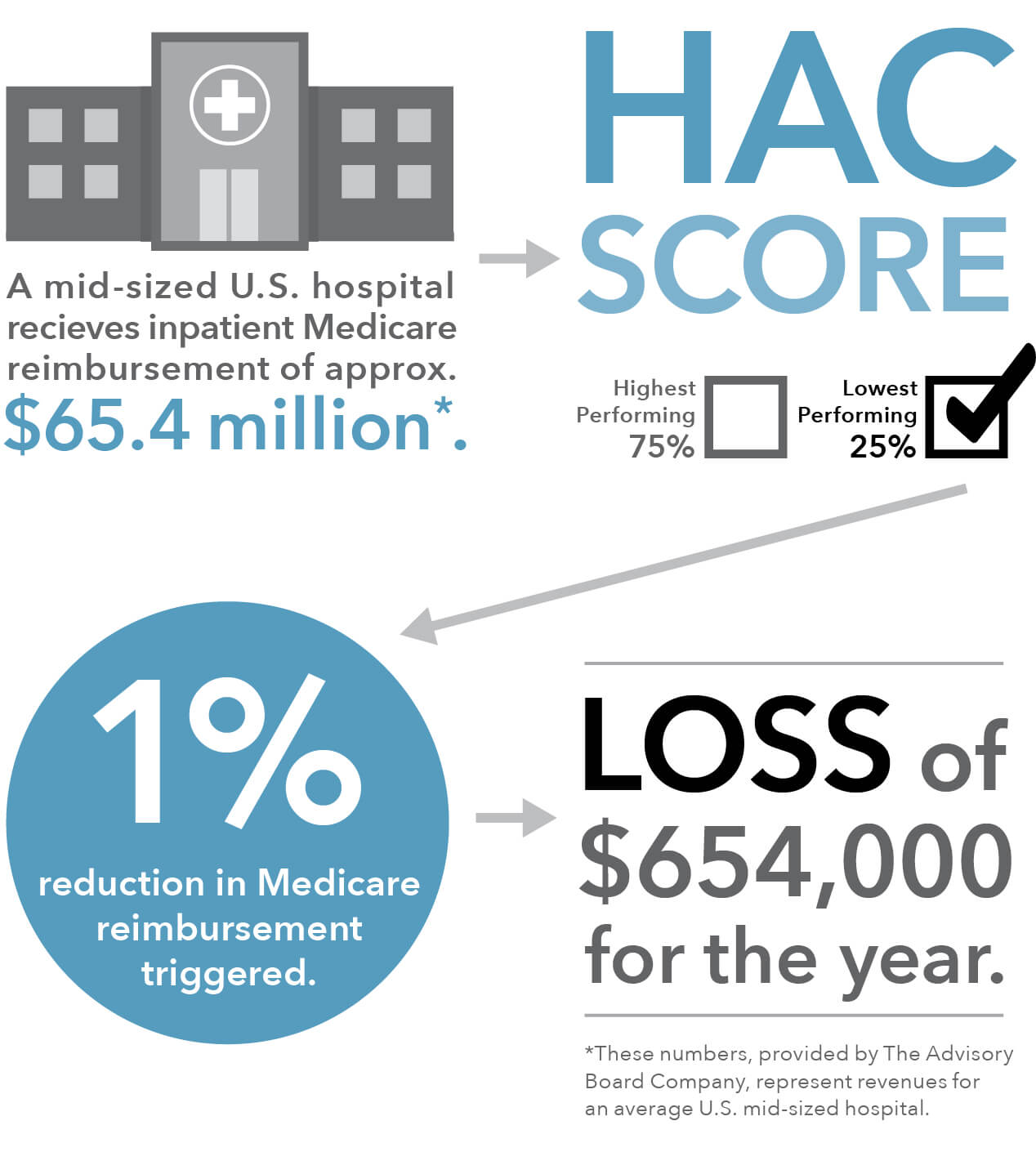
Of the 764 hospitals the Centers for Medicare and Medicaid Services (CMS) is penalizing this year with a one percent reduction in Medicare payments for scoring in the bottom quartile in the Hospital-Acquired Condition Reduction (HAC) Program, 38 also earned a five-star rating from CMS for overall quality of care.

This paradox is in part because Medicare’s star ratings compare a hospital’s safety and quality to a calculated average, whereas the HAC program requires Medicare to penalize the lowest-performing quartile of hospitals each year, even if they are showing improvement, or if the difference between low- and high-performing hospitals is miniscule.

The Gist: The promise of Medicare’s pay-for-performance incentive programs has not materialized, and is unlikely to be driving true clinical improvement. In addition to being confusing and tedious to comply with, the programs lack impact because penalties and rewards are too small to impact a hospital’s bottom line—the benefits don’t justify the costs of redesigning care processes or changing behavior. With years of evidence that many of these ACA-era quality programs aren’t producing the desired results, it’s time to find more effective ways of improving patient outcomes.

Nurses accuse PeaceHealth of retaliation after raising safety concerns

Responding to reports of retaliation against nurses - American Nurse

Nurses who worked at hospitals owned or operated by Vancouver, Wash.-based PeaceHealth are accusing the health system of retaliating against them when they raised concerns about patient and worker safety, NBC News reported Feb. 6.

Nurses spoke to the news division about their experiences, including Marian Weber, a travel nurse who was contracted to work at PeaceHealth Ketchikan (Alaska) Medical Center. She told NBC News that she raised concerns about critically ill COVID-19 patients who were placed in a unit with no central monitoring system and spoke up against the hospital’s suggestion of keeping a nurse in the room for 12 hours.

She said PeaceHealth terminated her contract in August 2021.

Ms. Weber filed a complaint with the National Labor Relations Board after her contract was terminated, and a hearing is scheduled for June 7, according to radio station KRBD. She seeks reimbursement for travel expenses, among other things.

In addition to Ms. Weber, Sarah Collins told NBC News that she lost her staff nursing job at PeaceHealth Southwest Medical Center in Vancouver after raising safety concerns, specifically regarding staffing and nurse-to-patient ratios.

According to the news division, Ms. Collins was put on a three-month leave in September after giving a local news interview. She told NBC News she was terminated for “operating outside her scope of practice” and “failing to follow policy.” She also has a complaint pending with the National Labor Relations Board.

Separately, NBC News reported, there is an ongoing lawsuit, filed in April 2020, claiming that PeaceHealth Southwest prevented workers from taking required meal and rest breaks allowed under law and that workers were discouraged from reporting missed breaks.

In a statement shared with Becker’s, PeaceHealth declined to comment on personnel issues or pending cases but said it emphasizes ensuring safety of employees and patients.

“We can wholeheartedly reinforce that the voices and opinions of our caregivers matter, and any concern brought forward is thoroughly reviewed,” the statement said. “We have hardwired safety into all our processes, including a longstanding ‘safe to share’ platform that empowers every caregiver — no matter their role — with the ability to confidentially raise opportunities to ensure safer care. This best-practice approach is part of our commitment to continuously improve and vision to ensure 100 percent safe care.”

“PeaceHealth medical centers’ overall quality and safety outcomes have been maintained in spite of the challenges presented by the pandemic, and our approach continues to ensure top-tier care in the communities we serve,” the health system added.

Read the NBC News report here. Read the KRBD report here

Hospitals see job gains after two months of losses

https://www.healthcarefinancenews.com/news/hospitals-see-job-gains-after-two-months-losses

Despite the gains, employment in healthcare is down by about 378,000 jobs (2.3%) from where it was in February 2020.

After a rough end to 2021 in terms of job losses, healthcare appears to be on the rebound – for now. The latest jobs report from the U.S. Bureau of Labor Statistics showed hospitals gaining jobs in January, though the industry is still below the levels seen before the COVID-19 pandemic.

In total, the healthcare sector saw a gain of 18,000 jobs last month. It lost 3,100 jobs in December; the prior month, November 2021, was the last time the sector saw job gains, when it posted a net gain of 2,100.

Hospitals made up for some, but not all, of the job losses seen during the tail end of 2021. They gained 3,400 jobs in January, after losing 5,100 jobs in December and 3,900 in November.

The last time hospitals gained jobs was in October, when 1,100 were added. Hospitals lost 8,100 jobs in September.

The biggest increase was in ambulatory healthcare services, which gained 14,700 jobs during the month. Physicians’ offices added 9,700 jobs. Nursing and residential-care facilities lost about 100 jobs in January.

Despite the gains, employment in healthcare is down by about 378,000 jobs (2.3%) from where it was in February 2020, at the dawn of the pandemic, according to BLS.

The broader U.S. economy added 467,000 jobs in January, after gaining 199,000 jobs in December, while the unemployment rate held fairly steady at about 4%.

WHAT’S THE IMPACT?

In a preview of the jobs report by economic research firm Glassdoor, researchers predicted that job losses in healthcare and leisure and hospitality would drag down overall payroll employment. Other coronavirus-sensitive sectors, such as retail and education, were also impacted, though seasonal factors helped mute job losses in those sectors.

Over the course of the pandemic, new COVID-19 cases have been somewhat predictive of job market data, but current record levels represent a situation without precedent, and there are few good comparisons, Glassdoor found. Since September 2020, each new 1,000 daily cases has been correlated with 4,000 fewer job gains, but the level of cases seen in January is unlike any other previous point in the pandemic, leading to uncertainty heading into the BLS jobs report.

The Bureau of Labor Statistics’ preliminary benchmark estimates forecast a modest downward revision in payroll employment of 166,000 for March 2021.

THE LARGER TREND

The Great Resignation hit the healthcare sector hard in November. BLS released job numbers in January showing that healthcare is among the top three industries cited in a 3% rise in the monthly “quits rate,” matching a high from September. The number of quits surged to 4.53 million for the month.

The numbers coincide with an already-strapped healthcare staffing market. Shortages and burnout among healthcare staff are a pervasive issue.

Multiple factors are contributing to labor pressures, including staff burnout stemming from the enduring pandemic and an overall shortage of qualified help, which has resulted in higher costs to hire temporary staff, as well as wage inflation.

Further, a Fitch Ratings report in November noted that lack of staff is forcing some in-patient behavioral health and senior housing operators to lower admission rates.

No Surprises Act implementation includes telehealth

https://www.healthcarefinancenews.com/news/no-surprises-act-implementation-includes-telehealth

Independent physician groups, which include telehealth docs, must now accept a rate that someone else has negotiated, expert says. 

The No Surprises Act has providers scrambling to understand the implications of a law that went into effect earlier this month.

Under the law, patients treated by an out-of-network physician can only be billed at the in-network rate. It protects patients from receiving surprise medical bills from the ER or air ambulance providers or for non-emergency services from out-of-network physicians at in-network facilities.

Patients can no longer receive balance bills – the difference between what the provider charges and what the insurer pays – or be charged a larger cost-sharing amount.

The congressional intent was to save patients sometimes thousands of dollars in unexpected, or surprise, medical bills. But applying the No Surprises Act to clinical care is being left to providers to sort out. 

A big question is the definition of an emergency and the benchmark used to determine when it ends, according to Kyle Faget, a partner at Foley who is co-chair of the firm’s Health Care and Life Sciences Practice Groups. She asked: Does the emergency end when the patient is stabilized, or should another standard apply? This includes emergency services for mental health and substance-use disorders.

Another question is around pre-planned services. Patients have to be notified who is providing the care and whether the physician is in-network. If the physician is out-of-network, patients must provide consent. But that can be tricky, for instance, if a patient scheduled for a planned C-section gets an out-of-network doctor who was not scheduled at the time the appointment was made.

At some hospitals, a new layer of administration is needed to comply with the law, Faget said.

Another area not well understood is how the law affects telehealth consults in the ER.

TELEHEALTH AND THE NO SURPRISES ACT

The law states that if treated by a telehealth clinician, the patient can only be billed the in-network rate, said Faget, who specializes in telehealth law.

Telehealth is often used in the ER, according to Faget. Most ER visits require a physician consultation, with hands-on medical care provided by a clinician other than the physician.

Pre-COVID-19, providers were in the embryonic stage of providing virtual emergency care, she said. The pandemic, and a shortage of physicians, spurred virtual care in the ER. 

These telehealth providers often work on a contracted basis. They are likely credentialed at the hospital but are not hospital employees, Faget said.

This means they are not credentialed with the insurer. Under the No Surprises Act, they are now subject to the in-network rates negotiated by the hospital. 

Telehealth ER physicians could negotiate their own contracts with insurers, but as a small group, they are not likely to get the higher rates they had prior to the implementation of the No Surprises Act.

“It’s an arduous contracting process, and small-group bargaining power is low,” Faget said. “The big hospital system has bargaining power. Those groups providing telehealth services won’t necessarily have agreements in place and, by definition, are out-of-network.”

Independent physician groups, which include telehealth docs, must now accept a rate that someone else has negotiated, Faget said. This fact can be more of an issue than the lower rate they’re now being paid, she said.

“I think telehealth will adapt,” Faget said. “I think it will become the way of doing business.”

WHY THIS MATTERS

The bottom line is that the No Surprises Act is doing what it promised to do – saving patients from getting a large bill not covered by insurance.

Surprise bills are a moral and ethical issue, Faget said. Patients, at their most vulnerable in the ER, are sent home only to get a $5,000 bill they never saw coming.

“It’s like kicking a person when they’re down,” Faget said.

However, in the larger healthcare ecosystem, ending surprise medical bills will ultimately result in cost-shifting, she said. 

“Think about the system globally: somebody is paying for something somewhere,” Faget said. “At the end of the day, somebody’s going to have to pay.”

THE LARGER TREND

Providers have told her that the No Surprises Act incentivizes insurance companies to lower their payments, Faget said.

The American Society of Anesthesiologists has accused BlueCross BlueShield of North Carolina of doing this. A letter sent by BCBS of North Carolina to anesthesiology and other physician practices this past November threatens to terminate physicians’ in-network status unless they agree to payment reductions ranging from 10% to over 30%, according to ASA. 

The ASA saw this as proof of its prognostication to Congress upon passage of the No Surprises Act: that insurers would use loopholes in the law to leverage their market power.

The AHA and AMA have sued the Department of Health and Human Services  over implementation of a dispute-resolution process in the law they say favors the insurer. The arbitrator must select the offer closest to the qualifying payment amount. Under the rule, this amount is set by the insurer, giving the payer an unfair advantage, according to the lawsuit. 

Understanding the implications of using agency nurses

The Great Nursing Resignation, and hospitals’ growing reliance on expensive agency labor (a.k.a. “travelers”) has grabbed headlines, for good reason. But lately we’ve heard a couple of anecdotes from health system leaders about the second-order impacts of the phenomenon that are worth considering as well.

First, as the ranks of agency nurses at hospitals have swelled, full-time employed nurses’ morale has plummeted—tenured nurses are having to orient their new temporary co-workers, then watch them earn up to three times as much money for the same work.

At the same time, willingness to work overtime among employed nurses has dropped. That’s not just because of burnout—it turns out that the nurses who were most likely to take overtime shifts are also more likely to have chosen to leave full-time employment to become travelers, where they are even more richly rewarded for working extra shifts. So, the “productivity” of the remaining corps of staff nurses has dropped, even as caseloads have increased.

One other implication we’ve heard about recently: the economic impact of “observation” cases, where patients are held in a staffed bed but not admitted—already a bad bargain for hospitals—has gotten worse. That’s because the cost of deploying staff to care for those patients has gone up, due to wage inflation and use of travelers. It’s hard to overstate the level of staffing crisis at most hospitals today, and the rapid growth in reliance on temporary staff will have consequences lasting well beyond the current surge.

How “Goliaths” that adapt can retain industry dominance

5 Steps for Defeating Digital Goliaths - Adthena

A thought-provoking piece in this week’s Harvard Business Review about the underrated advantages longstanding industry giants have over disruptors got us thinking about health system strategy. The authors highlighted several companies that have enjoyed sustained success over a century or more, including agricultural behemoth Deere and Company, and shipping giant company A.P. Møller-Maersk, which wielded “strategic incumbency” to successfully innovate and pursue new strategies, leveraging scale, trusted customer relationships, and long-term planning capabilities—attributes that new market entrants often lack when looking to disrupt established consumer channels. 

The Gist: In a market where healthcare unicorns constantly garner headlines, the article offers a counterintuitive perspective about the value of incumbency.

Health system leaders might look to the experience of Maersk, which moved from a supply-driven focus (pushing its products to customers), to a demand-driven strategy (navigating customers through logistical pain points), using technology to maximize its vast asset portfolio.

Likewise, health systems have an abundant “supply” of care delivery assets, and now need to build the connective tissue to make the care experience across those point solutions seamless for patients.