


The FDA ended Monday its emergency use authorizations for two controversial drugs, hydroxychloroquine and chloroquine, as a potential coronavirus treatment.
Why it matters: Despite gaining President Trump’s adamant support and use, the drugs have failed in several clinical trials and have been found to possibly cause serious heart problems.
What they’re saying: The FDA said it believes the drugs “are unlikely to be effective in treating COVID-19” under the emergency use authorization.
Read the letter and memo regarding the revocation:


Despite a raft of data suggesting that wearing face masks (in conjunction with hand washing and social distancing) is effective in preventing person-to-person transmission of the coronavirus, the practice is still a partisan political issue in some places even as new cases continue to rise.
A new review published in The Lancet looked at 172 observational studies and found that masks are effective in many settings in preventing the spread of the coronavirus (though the results cannot be treated with absolute certainty since they were not obtained through randomized trials, the Washington Post notes).
Another recent study found that wearing a mask was the most effective way to reduce the transmission of the virus.
90% of Americans now say they’re wearing a mask in compliance with the CDC’s recommendations, up from 78% in April, according to a new poll conducted by NORC at the University of Chicago for the Data Foundation.
But despite the conclusive research and what seems to be a public consensus, masks remain a divisive subject.
As new coronavirus cases surge in Arizona, where cases have jumped 300% since the beginning of May, for instance, Governor Doug Ducey has not made it mandatory to wear masks in public, and in Orange County, California, officials on Friday rescinded a mask mandate after public backlash, even as cases rise; when cases peaked in April, on the other hand, New York made wearing a mask mandatory when people could not socially distance from others, and other states passed similar restrictions.
Part of the politicization of masks may have to do with resistance to heavy-handed government mandates, which in this case could cause people who are already skeptical of wearing face coverings to dig in their heels.
Lindsay Wiley, an American University Washington College of Law professor specializing in public health law and ethics, told NPR last month that stringent mask requirements “can actually cause people who are skeptical of wearing masks to double down.” And in turn, that “reinforce[s] what they perceive to be a positive association with refusing to wear a mask … that they love freedom, that they’re smart and skeptical of public health recommendations.”
Masks have also become a heavily politicized issue in recent weeks: Senate Majority Leader Mitch McConnell (R-Ky.) last month voiced his support of mask wearing in public, for instance, in contrast to President Trump and other GOP leaders who have portrayed masks as a sign of weakness. Trump infamously refused to wear a face mask as he toured a Ford facility in Michigan last month. When asked about the mask, he said that he wore one in private but “didn’t want to give the press the pleasure of seeing it.” House Speaker Nancy Pelosi has voiced her support for the practice: “real men wear masks,” she said earlier this month.
A video posted to Twitter on Friday showed a street in New York City’s East Village that was packed with people ignoring social distancing guidelines, most of whom were not wearing masks, drew widespread criticism. “When there’s a new spike people will blame the (masked) protests, but it’s really gonna be maskless crap like this,” one Twitter user wrote.
New York Governor Andrew Cuomo even weighed in on the scene. “Don’t make me come down there,” he tweeted.
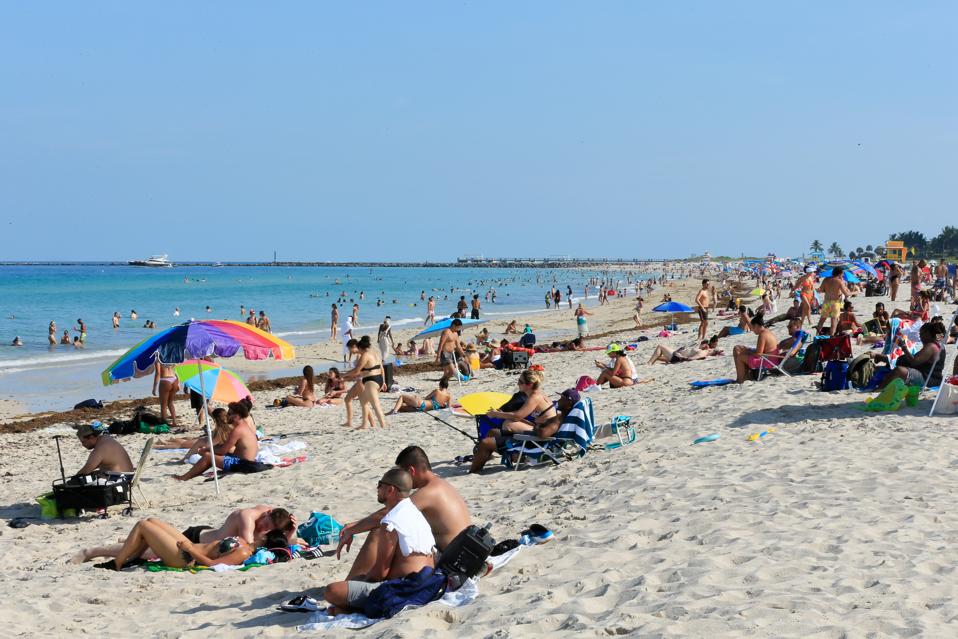
Some states are seeing a dramatic surge in new coronavirus infections even as reopening measures continue across the country, raising tough questions about whether those reopening efforts were premature and how officials will balance maintaining public safety with preventing more economic damage.
Texas and Florida—two of the first states to reopen—both hit new daily highs last week.
California also hit a record daily high last week, though one official attributed the spike to increased testing (Florida’s governor has also attributed his state’s spike to more testing).
Arkansas, Alabama, North Carolina, South Carolina, Utah and Alaska have also seen surging case numbers over the last week.
On Friday, the CDC released new forecasts that singled out six states—Arizona, Arkansas, Hawaii, North Carolina, Utah and Vermont—where the coronavirus death toll is likely to rise over the next month.
Some states and cities have walked back reopening measures in response to surging cases: Oregon’s governor put the reopening process on pause on Friday after the state saw its highest level of new cases since the start of the pandemic; Utah’s governor issued a similar order, as did the mayor of Nashville, Tennessee.
According to data compiled by Johns Hopkins, more than 2 million Americans have contracted Covid-19, the disease caused by the coronavirus, since the beginning of the pandemic, and more than 114,000 have died.
Even though news of states hitting record levels of coronavirus cases day after day might make it seem like the U.S. is headed for a second wave of the virus, the country is still situated very firmly within the “first wave.” New infections peaked around 36,000 cases a day in April, according to New York Times data, and over the last month the number of new daily cases has held relatively steady around 20,000. Cases in former hot spots like New York and New Jersey have fallen dramatically while cases in many areas of the South and West continue to rise. For a true “second wave” of the virus to be possible, the virus would need to subside and then reappear.
“We really never quite finished the first wave,” Dr. Ashish Jha, a professor of global health at Harvard University, told NPR. “And it doesn’t look like we are going to anytime soon.”

Dr. Anthony Fauci told a British newspaper Sunday that something resembling normal life in the U.S. would likely return in “a year or so,” with the coronavirus pandemic expected to require social distancing and other mitigation efforts through the fall and winter, although political divisiveness, reopening efforts and the George Floyd protests could add more layers of difficulty to the country’s recovery.
“I would hope to get to some degree of real normality within a year or so. But I don’t think it’s this winter or fall,” Fauci, director of the National Institute of Allergy and Infectious Diseases, told The Telegraph Sunday.
Fauci also told the newspaper that the travel ban from the U.K., the European Union, China and Brazil will likely stay in place for “months,” based on “what’s going on with the infection rate.”
Within the U.S., Florida, California and Texas hit all-time daily highs in reported Covid-19 cases, while the Centers for Disease Control predicted six states (Arizona, Arkansas, Hawaii, North Carolina, Utah and Vermont) will see higher death tolls over the next month.
U.S., where states that aren’t making them mandatory, like California, are seeing cases spike while New York, where the protective gear is required, has the country’s lowest spread rate.
“We’re seeing several states, as they try to reopen and get back to normal, starting to see early indications [that] infections are higher than previously,” Fauci said.
Over 2 million. That’s how many confirmed coronavirus cases are in the U.S., which leads the world both in the number of infections and casualties from the disease, according to data from Johns Hopkins University.
Despite Fauci’s immediate conservative outlook on when life can return to normal, he’s hopeful that multiple Covid-19 vaccines could be found by the end of 2020. “We have potential vaccines making significant progress. We have maybe four or five,” he told The Telegraph. Although “you can never guarantee success with a vaccine,” Fauci added, from “everything we have seen from early results, it’s conceivable we get two or three vaccines that are successful.”
The U.S. is not facing a second wave of coronavirus. “We really never quite finished the first wave,” according to Dr. Ashish Jha, a global health professor at Harvard. In an NPR interview, Jha said the first wave is unlikely to be finished “anytime soon.”
The World Health Organization designated the coronavirus outbreak as a pandemic on March 11, 2020. As of Sunday, the pandemic is approaching its fifth month, and few countries have had success in beating back their outbreaks. New Zealand has essentially returned to normal life after eliminating coronavirus, while countries like the U.S., the U.K. and Brazil, among others, continue to see new cases and report deaths.
Within the U.S., efforts to reduce cases and deaths, like mask wearing, have become partisan political issues. Desires both from elected officials and some citizens to reopen economies have also impacted the pandemic, as states that reopened earlier, like Florida, are seeing numbers of cases spike. Concerns that recent protests sparked by George Floyd’s killing will also further spread the coronavirus are present, but have not yet been proven, as symptoms can take up to 14 days to develop.

“We would like to warn everyone not to drop their guard even for a second in epidemic prevention control; we must be prepared for a prolonged fight with the virus,” Xu Hejian, a spokesman for the Beijing municipal government, said at a news conference Saturday.
“We have to stay alert to the risks of imported cases and to the fact that epidemic control in our city is complicated and serious and will be here for a long time,” he said.
/cloudfront-us-east-1.images.arcpublishing.com/dmn/HOLPLLCNCZGCVOECUBIPHZKKQE.jpg)
Coronavirus cases and hospitalizations are reaching alarming levels in some states.
What they’re saying: “Arizona is the new national hotspot for COVID-19 with more than 4,400 new cases in just the last 72 hours. Per capita, Arizona’s infection rate is now more than three times higher than New York state. It’s spreading like wildfire,” Rep. Greg Stanton tweeted last night.
The big picture: Several states have seen record numbers of new cases over the last few days, including Alabama, Alaska, Arizona, Arkansas, California, Florida, North Carolina, Oklahoma and South Carolina, Reuters reports.
The bottom line: There’s never been any reason to think that states with mild outbreaks in April weren’t at risk of having a crisis in June, especially states that haven’t taken lockdowns or social distancing as seriously.
https://www.insider.com/expert-us-is-in-an-unsure-moment-with-coronavirus-2020-6
Dr. Michael Osterholm, the director of the Center for Infectious Disease Research and Prevention, said Sunday that the US is in an “unsure moment” as states reopen and new cases emerge.
“We have to be humble and say we’re in an unsure moment,” Osterholm said on “Fox News Sunday,” adding that states across the country are in varied stages of the pandemic as 22 have recorded an increase in coronavirus cases, eight in plateaus, and 21 with decreasing cases.
Osterholm was speaking as states have been reopening businesses for weeks, Americans flocked to warm weather, and widespread protests drew people to the streets in cities across the country. The first few weeks of June have seen sharp rises in new cases and hospitalizations.
The US hit a grim milestone two weeks into June as it marked more than 2 million infected and 115,000 dead from the virus. Centers for Disease Control and Prevention predicted on June 12 that the US coronavirus death toll could increase to 130,000 by July 4.
“About 5% of the US population has been infected to date with the virus, this virus is not going to rest until it gets to about 60% or 70%,” Osterholm said. “When I say rest, I mean just slow down, so one way or another we’re going to see a lot of additional cases.”
The expert told host Chris Wallace that the increase cannot only be attributed to increasingly available testing, and it’s too early to tell if protests have been a source of widespread infections, but early data suggests not.
“These next weeks, the two weeks are going to be the telling time, we just don’t know,” he said. “We’re not driving this tiger, we’re riding it.”
“My biggest concern is if cases start to disappear across the country, suggesting we are in a trough” that would lead to a second wave of the virus, Osterholm said.
Dr. Anthony Fauci has recently downplayed concerns that the recent rise in cases of the novel coronavirus in the US doesn’t a “second spike” of infections, and a seasonal resurgence was “not inevitable.”
Though Fauci told CNN on June 12 that indicators like hospitalizations could still spell concern for officials, increased testing and CDC capabilities could counter a possible resurgence in cases.
Public Health Officials Face Wave Of Threats, Pressure Amid Coronavirus Response
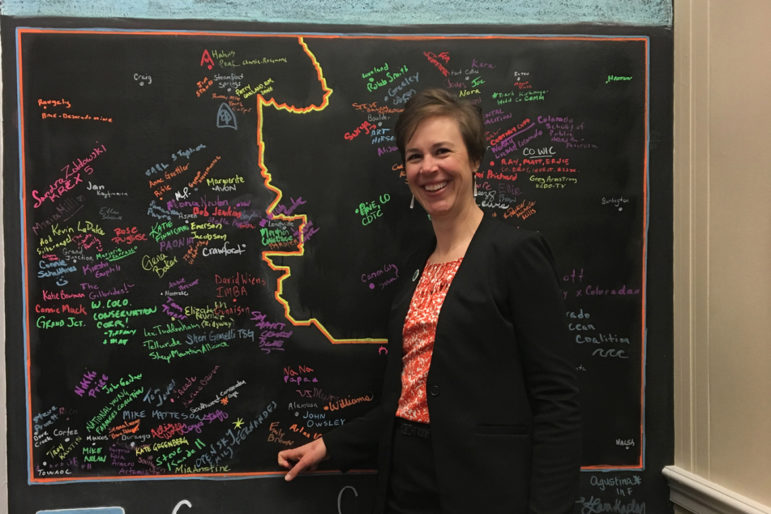
Emily Brown was director of the Rio Grande County Public Health Department in Colorado until May 22, when the county commissioners fired her after battling with her over coronavirus restrictions. “They finally were tired of me not going along the line they wanted me to go along,” she says.
Emily Brown was stretched thin.
As the director of the Rio Grande County Public Health Department in rural Colorado, she was working 12- and 14-hour days, struggling to respond to the pandemic with only five full-time employees for more than 11,000 residents. Case counts were rising.
She was already at odds with county commissioners, who were pushing to loosen public health restrictions in late May, against her advice. She had previously clashed with them over data releases and had haggled over a variance regarding reopening businesses.
But she reasoned that standing up for public health principles was worth it, even if she risked losing the job that allowed her to live close to her hometown and help her parents with their farm.
Then came the Facebook post: a photo of her and other health officials with comments about their weight and references to “armed citizens” and “bodies swinging from trees.”
The commissioners had asked her to meet with them the next day. She intended to ask them for more support. Instead, she was fired.
“They finally were tired of me not going along the line they wanted me to go along,” she said.
In the battle against COVID-19, public health workers spread across states, cities and small towns make up an invisible army on the front lines. But that army, which has suffered neglect for decades, is under assault when it’s needed most.
Officials who usually work behind the scenes managing everything from immunizations to water quality inspections have found themselves center stage. Elected officials and members of the public who are frustrated with the lockdowns and safety restrictions have at times turned public health workers into politicized punching bags, battering them with countless angry calls and even physical threats.
On Thursday, Ohio’s state health director, who had armed protesters come to her house, resigned. The health officer for Orange County, California, quit Monday after weeks of criticism and personal threats from residents and other public officials over an order requiring face coverings in public.
As the pressure and scrutiny rise, many more health officials have chosen to leave or been pushed out of their jobs. A review by KHN and The Associated Press finds at least 27 state and local health leaders have resigned, retired or been fired since April across 13 states.
In California, senior health officials from seven counties, including the Orange County officer, have resigned or retired since March 15. Dr. Charity Dean, the second in command at the state Department of Public Health, submitted her resignation June 4.
These officials have left their posts due to a mix of backlash and stressful, nonstop working conditions, all while dealing with chronic staffing and funding shortages.
Some health officials have not been up to the job during the biggest health crisis in a century. Others previously had plans to leave or cited their own health issues.
But Lori Tremmel Freeman, CEO of the National Association of County and City Health Officials, said the majority of what she calls an “alarming” exodus resulted from increasing pressure as states reopen. Three of those 27 were members of her board and well known in the public health community — Rio Grande County’s Brown; Detroit’s senior public health adviser, Dr. Kanzoni Asabigi; and the head of North Carolina’s Gaston County Department of Health and Human Services, Chris Dobbins.
Asabigi’s sudden retirement, considering his stature in the public health community, shocked Freeman. She also was upset to hear about the departure of Dobbins, who was chosen as health director of the year for North Carolina in 2017. Asabigi and Dobbins did not reply to requests for comment.
“They just don’t leave like that,” Freeman said.
Public health officials are “really getting tired of the ongoing pressures and the blame game,” Freeman said. She warned that more departures could be expected in the coming days and weeks as political pressure trickles down from the federal to the state to the local level.
From the beginning of the coronavirus pandemic, federal public health officials have complained of being sidelined or politicized. The Centers for Disease Control and Prevention has been marginalized; a government whistleblower said he faced retaliation because he opposed a White House directive to allow widespread access to the malaria drug hydroxychloroquine as a COVID-19 treatment.
In Hawaii, U.S. Rep. Tulsi Gabbard called on the governor to fire his top public health officials, saying she believed they were too slow on testing, contact tracing and travel restrictions. In Wisconsin, several Republican lawmakers have repeatedly demanded that the state’s health services secretary resign, and the state’s conservative Supreme Court ruled 4-3 that she had exceeded her authority by extending a stay-at-home order.
With the increased public scrutiny, security details — like those seen on a federal level for Dr. Anthony Fauci, the top infectious disease expert — have been assigned to state health leaders, including Georgia’s Dr. Kathleen Toomey after she was threatened. Ohio’s Dr. Amy Acton, who also had a security detail assigned after armed protesters showed up at her home, resigned Thursday.
In Orange County, in late May, nearly a hundred people attended a county supervisors meeting, waiting hours to speak against an order requiring face coverings. One person suggested that the order might make it necessary to invoke Second Amendment rights to bear arms, while another read aloud the home address of the order’s author — the county’s chief health officer, Dr. Nichole Quick — as well as the name of her boyfriend.
Quick, attending by phone, left the meeting. In a statement, the sheriff’s office later said Quick had expressed concern for her safety following “several threatening statements both in public comment and online.” She was given personal protection by the sheriff.
But Monday, after yet another public meeting that included criticism from members of the board of supervisors, Quick resigned. She could not be reached for comment. Earlier, the county’s deputy director of public health services, David Souleles, retired abruptly.
An official in another California county also has been given a security detail, said Kat DeBurgh, the executive director of the Health Officers Association of California, declining to name the county or official because the threats have not been made public.
DeBurgh is worried about the impact these events will have on recruiting people into public health leadership.
“It’s disheartening to see people who disagree with the order go from attacking the order to attacking the officer to questioning their motivation, expertise and patriotism,” said DeBurgh. “That’s not something that should ever happen.”
Many local health leaders, accustomed to relative anonymity as they work to protect the public’s health, have been shocked by the growing threats, said Theresa Anselmo, the executive director of the Colorado Association of Local Public Health Officials.
After polling local health directors across the state at a meeting last month, Anselmo found about 80% said they or their personal property had been threatened since the pandemic began. About 80% also said they’d encountered threats to pull funding from their department or other forms of political pressure.
To Anselmo, the ugly politics and threats are a result of the politicization of the pandemic from the start. So far in Colorado, six top local health officials have retired, resigned or been fired. A handful of state and local health department staff members have left as well, she said.
“It’s just appalling that in this country that spends as much as we do on health care that we’re facing these really difficult ethical dilemmas: Do I stay in my job and risk threats, or do I leave because it’s not worth it?” Anselmo asked.
Some of the online abuse has been going on for years, said Bill Snook, a spokesperson for the health department in Kansas City, Missouri. He has seen instances in which people took a health inspector’s name and made a meme out of it, or said a health worker should be strung up or killed. He said opponents of vaccinations, known as anti-vaxxers, have called staffers “baby killers.”
The pandemic, though, has brought such behavior to another level.
In Ohio, the Delaware General Health District has had two lockdowns since the pandemic began — one after an angry individual came to the health department. Fortunately, the doors were locked, said Dustin Kent, program manager for the department’s residential services unit.
Angry calls over contact tracing continue to pour in, Kent said.
In Colorado, the Tri-County Health Department, which serves Adams, Arapahoe and Douglas counties near Denver, has also been getting hundreds of calls and emails from frustrated citizens, deputy director Jennifer Ludwig said.
Some have been angry their businesses could not open and blamed the health department for depriving them of their livelihood. Others were furious with neighbors who were not wearing masks outside. It’s a constant wave of “confusion and angst and anxiety and anger,” she said.
Then in April and May, rocks were thrown at one of their office’s windows — three separate times. The office was tagged with obscene graffiti. The department also received an email calling members of the department “tyrants,” adding “you’re about to start a hot-shooting … civil war.” Health department workers decamped to another office.
Although the police determined there was no imminent threat, Ludwig stressed how proud she was of her staff, who weathered the pressure while working round-the-clock.
“It does wear on you, but at the same time we know what we need to do to keep moving to keep our community safe,” she said. “Despite the complaints, the grievances, the threats, the vandalism — the staff have really excelled and stood up.”
The threats didn’t end there, however: Someone asked on the health department’s Facebook page how many people would like to know the home addresses of the Tri-County Health Department leadership. “You want to make this a war??? No problem,” the poster wrote.
Back in Colorado’s Rio Grande County, some members of the community have rallied in support of Brown with public comments and a letter to the editor of a local paper. Meanwhile, COVID-19 case counts have jumped from 14 to 49 as of Wednesday.
Brown is grappling with what she should do next: dive back into another strenuous public health job in a pandemic, or take a moment to recoup?
When she told her 6-year-old son she no longer had a job, he responded: “Good — now you can spend more time with us.”
 HENRY KOTULA