Jobless claims plunge to 199K, lowest level since 1969

Jobless claims plunge to 199K, lowest level since 1969

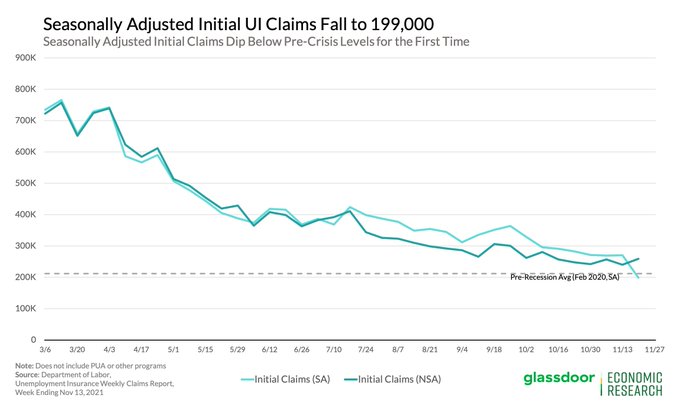
For the 1st time during the pandemic, initial UI claims have dipped below pre-crisis levels, falling to 199,000 (vs the Feb 2020 avg: 211,700). Layoffs are hitting new lows amid ongoing labor shortages as employers look to hold onto hard-to-find workers.
New weekly claims for jobless aid plunged to the lowest level in more than 50 years last week, according to data released Wednesday by the Labor Department.

In the week ending Nov. 20, there were 199,000 initial applications for unemployment insurance, according to the seasonally adjusted figures, a decline of 71,000 from the previous week. Claims fell to the lowest level since November 1969 and are now well below the pre-pandemic trough of 225,000 applications received the week of March 14, 2020.

The steep drop in unemployment applications comes after several strong months of job growth and rising consumer spending heading into the holiday shopping season. While high inflation has stressed many household budgets, U.S. job growth, economic production, stock values and corporate profits have all steamed ahead.

“Getting new claims below the 200,000 level for the first time since the pandemic began is truly significant, portraying further improvement,” said Mark Hamrick, chief economic analyst at Bankrate.com.

“The strains associated with higher prices, shortages of supplies and available job candidates are weighed against low levels of layoffs, wage gains and a falling unemployment rate,” he continued. “Growth will likely be above par for the foreseeable future, but within the context of historically high inflation which should relax its grip on the economy to some degree in the year ahead.”

The U.S. added 531,000 jobs in October and job growth in the previous months was revised substantially higher after a string of what first appeared to be meager gains. While businesses have struggled to hire enough workers to meet surging consumer demand, the decline in jobless claims appears to be a sign of an improving labor market.

“Layoffs are hitting new lows amid ongoing labor shortages as employers look to hold onto hard-to-find workers,” said Daniel Zhao, senior economist at Glassdoor, in a Wednesday thread on Twitter.

Even so, Zhao said the sharp decline below pre-pandemic levels may have been due to a lower than expected seasonal impact on hiring.

“As you can see from the above chart, this is in part due to the seasonal adjustment expecting a much larger jump in non-seasonally adjusted claims, so this dip below pre-crisis levels may be short-lived,” he explained.

UPMC workers to strike Nov. 18

Workers at Pittsburgh-based UPMC plan to strike over wages and benefits, the Post-Gazette reported Nov. 5. 

Service Employees International Union Healthcare Pennsylvania, which does not represent the workers but is supporting them, told Becker’s Hospital Review the strike would involve workers at UPMC hospitals in Pittsburgh, including transporters, dietary workers, housekeepers, nurses, patient care techs, medical assistants, pharmacy techs, surgical techs, valets, therapists, health unit coordinators and administrative assistants. Workers plan to strike for one day on Nov. 18.

The workers are demanding a $20 per hour minimum wage, affordable high-quality healthcare, elimination of all medical debt and respect for union rights, according to a union news release.

Their strike notice came after UPMC announced Nov. 2 that the health system is giving 92,000 staff members a bonus of $500 to thank them for their work during the pandemic. UPMC will issue the bonuses on Nov. 26. The health system also announced improvements to employee compensation and benefit programs, including raising the entry level wage to $15.75 in January, according to the Post-Gazette

“There was no ‘thank you pay’ until we started organizing to strike,” Juilia Centofanti, pharmacy tech at UPMC Children’s Hospital of Pittsburgh, said in a news release.

Ms. Centofanti added that employees are “owed this [$20 per hour wage] and so much more,” and said she “will continue organizing with my co-workers for the pay, safer staffing and union rights we deserve.”

In announcing the bonuses, Leslie Davis, president and CEO of UPMC, told workers, “Over the past 20 months, you have risen in truly exceptional ways to meet challenges we could have never anticipated. With your critical support, UPMC continues to care for so many.”

A UPMC spokesperson declined to comment to Becker’s on Nov. 5.

UPMC is a $23 billion healthcare provider and insurer. SEIU Healthcare Pennsylvania has been trying to organize about 3,500 hourly workers at UPMC Presbyterian and Shadyside hospitals for nearly a decade, but has not yet held a unionization vote, according to the Post-Gazette.

Read the full report here.

U.S. economy adds 531,000 jobs in huge hiring rebound

U.S. economy adds 531,000 jobs in huge hiring rebound

The job market added a stunning 531,000 jobs last month. The unemployment rate ticked down to 4.6% — a new pandemic-era low.

Why it matters: America’s job market recovery has been on track all along.

Between the lines: Revisions to prior months are often overlooked. Not this month: Upgrades to both August and September were so enormous — fully 366,000 jobs higher than originally reported — that they have definitively reversed the narrative that there was a Delta-induced hiring slump in late summer.

By the numbers: America has now recovered 80% of the jobs lost at the depth of the recession in 2020.

The big picture: Leisure and hospitality added 164,000 jobs last month — but jobs growth was widespread. The disappointment — again — came in public sector education. State and local education shed a combined 65,000 jobs.

  • Wages are still rising: Average hourly earnings rose another 11 cents an hour in October, to $30.96. That’s enough to keep up with inflation.

What to watch: Millions of workers remain on the sidelines — and there wasn’t much improvement in pulling them back into the workforce.

The bottom line: “The Fall hiccup is now at best a Fall deep breath,” tweeted University of Michigan economist Justin Wolfers.

Providence looks to rapidly fill 17,000 jobs

Providence looks to rapidly fill 17,000 jobs

Providence is investing $220 million to fill open positions and give bonuses to current employees, the Renton, Wash.-based system announced Sept. 3. 

The health system is giving a $1,000 bonus to every caregiver who has been with the organization for at least 90 days. The bonuses, which will be given to workers up to and including the director level, will be paid in two installments in September and December. 

Providence is also making investments to rapidly fill 17,000 job openings. The system said it is offering sign-on bonuses to front-line workers with the goal of filling positions quickly and alleviating the stress and burnout many clinicians are experiencing. Current employees are eligible for referral bonuses of between $1,000 and $7,500. 

“Our caregivers are the core of who we are, and we have been committed to supporting their health and well-being throughout the pandemic,” Providence President and CEO Rod Hochman, MD, said in a news release. “Now, as we enter month 21 of our COVID-19 response, it’s even more imperative to continue to care for and bolster those who make our mission possible.” 

Delta variant wallops job market

https://click1.email.thehill.com/ViewMessage.do;jsessionid=F9613966312B9A8532D428B13E03C0A9

Today’s Big Deal: A dismal August jobs report.

Economy adds just 235K jobs in August as delta hammers growth

That’s it for today. Thanks for reading and check out The Hill’s Finance page for the latest news and coverage. We’ll see you Friday.

The U.S. added 235,000 jobs in August and the unemployment rate fell to 5.2 percent as the economy appeared to falter under surging coronavirus cases, according to data released Friday by the Labor Department.

  • Economists had expected employment growth to slow slightly in August to a gain of roughly 750,000 jobs, according to consensus forecasts, amid falling consumer confidence and disruptive school closures. 
  • Declines in restaurant reservations, air travel and other key drivers of the recovery also raised red flags about the August jobs haul.

“Today’s report has the delta variant written all over it. It is clear that the recent surge in COVID-19 cases is a strong headwind to the labor market,” wrote Nick Bunker, economic research director at Indeed. I break it down here.

Delta homes in on pandemic-sensitive industries: The August jobs report showed setbacks in sectors of the economy hit hardest by the pandemic and crucial to the comeback from its economic blow.

  • The leisure and hospitality sector did not add any net jobs in August as a 42,000-job decline in restaurants and bars wiped out a 36,000-job gain in arts and entertainment. 
  • Employment in retail, another hard-hit sector, also fell by 29,000 thanks to steep losses at grocery stores and building material and garden supply stores. 

“The industry breakdown in employment growth shows clear signs that the increased COVID-19 spread is behind this relatively weak number,” Bunker wrote. “Yet, the labor market is still recovering.”

Signs of resilience: While job growth slowed significantly in August, the first full month since the delta surge picked up in mid-July, the labor market still showed signs of holding strong.

  • Labor force participation stayed even at 61.7 percent in August and the employment to population ratio — a broader gauge of job market strength — ticked up 0.1 percentage points to 58.5 percent. 
  • The number of Americans who have been jobless for 27 weeks or longer, known as the “long-term unemployed,” also dropped from 3.4 million to roughly 3.2 million. Those who suffer long-term unemployment often struggle to return to work and are hired at lower rates than those without long periods of joblessness.

Stronger days…behind? Upward revisions to June and July’s blockbuster jobs gains were another positive sign for the economy. June’s job haul was revised up from 938,000 to 962,000, and July’s was revised up from 943,000 to 1,053,000 — the first seven-digit job gain since August 2020.  

“The underlying momentum is still there. We just have to see if we can keep up the pace until this surge is behind us,” Bunker said.

Unemployment claims jumped to 419,000 last week, a sudden increase reflecting an unsettled labor market

Unemployment claims jumped last week, as the delta variant of the coronavirus sparked rising caseloads around the country and renewed fears about the potential for more restrictions and business closures.

The number of new claims grew to 419,000 from 368,000, the third time in six weeks that they had ticked up, according to data from the Department of Labor.

Economists said the uptick was concerning but cautioned that it was too early to tell whether it was a one week aberration or telegraphed a more concerning turn for the labor market.

“The unexpected bump in claims could be noise in the system, but it’s also not hard to see how the rise of the covid-19 delta variant could add thousands of layoffs to numbers that already are double what they were pre-Covid,” said Robert Frick, corporate economist at Navy Federal Credit Union.

Overall, unemployment numbers have been falling gradually from the peaks at other stages of the pandemic, but they are still well above pre-pandemic averages.

The jobless numbers have provided a jarring catalogue about the economic devastation wrought by the pandemic — spiking to records as the pandemic unfolded in March 2020, and remaining at historic high levels throughout most of 2020.

The coronavirus surge last fall helped precipitate a rise in claims that saw the labor market, as seen in the monthly jobs report, slide backward too.

But until recently, the last few months been marked by strong jobs growth and a sense of optimism as vaccinations picked up, giving economists hope that the country was back on track to recovering the nearly 7 million jobs it is still down from before the pandemic.

Now, the delta variant is driving an alarming increase in covid-19 cases around the country, according to public health officials: the number of new cases increased more than 40 percent in the last week, sending jitters through the stock market, and is raising questions about whether state and local health authorities will reinstitute restrictions to slow the virus’ spread.

A new mandate in Los Angeles county to wear masks indoors has sparked protests and anger from local officials, as other counties where cases are increasing mull similar actions.

Frick said that the report showed the potential for unemployment claims to start trending upward after months of steady declines.

“There’s definitely a correlation, however loose, that the rise in covid does cause a rise in claims,” he said. “My fear is that the rise in the delta variant could cause claims to go back up…Certainly one week doesn’t show that. But I wouldn’t be surprised if we start to see claims rise.”

Texas for example, where cases have grown 54 percent in the last week, lead the way with an increase of 10,000 new claims.

However, there are also lots of signs that the economy continues to rebound despite rising caseloads.

The more than 2.2 million people that the Transportation Security Administration said it screened at airports on Sunday was the most since late February 2020 — and nearly three times the amount it was on the same day last year.

Restaurant dining has largely rebounded in recent months, at times surpassing the levels from before the pandemic — on Saturday the number of diners was 1 percent higher than the same day in 2019, according to data from Open Table.

Last week, some 12.5 million claims were filed for unemployment insurance overall, according to the most recent numbers — down from 32.9 million filed at the same point last year.

Nevada, Rhode Island and California topped the list of states with the highest number of people on unemployment, the Labor Department said.

Economic concerns in recent months have been more focused on the ways that workers are still held back from filling some of the more than 9 million job openings in the country, than unemployment, with high hopes that school re-openings in the fall will help many parents get back into the labor force.

Pay cut forces Health Partners to lay off 560 workers

When layoffs become inevitable: The painful story

Health Partners, one of the largest home healthcare providers in Michigan, laid off 560 employees at the beginning of July, including nurses, nursing assistants, therapists and direct care workers, according to Crain’s Detroit Business

The layoffs occurred July 1 and happened as the Bingham Farms-based company is winding down business. The job losses are attributed to a 2019 state law capping Health Partners’ payment rates at 55 percent of what it bills insurance companies to care for injured motorists, said Chad Livengood, a senior editor at Crain’s Detroit Business

Health Partners owner John G. Prosser II, who has been in the home health business for decades, said the company couldn’t absorb the losses from the new fee schedule, which cuts payments by 45 percent, according to Crain’s

Other home healthcare companies in Michigan haven’t met the same fate as Health Partners because they rely more heavily on Medicaid, workers’ compensation insurance or private payers, according to the report. 

Read more here

Show Me the Money

DevOps for Defense

How much transparency is too much?

That’s the question business leaders are facing after Colorado lawmakers passed a bill requiring companies to post salary ranges for open or remote work positions in the state. California, Connecticut, Maryland, and Washington already have laws on the books mandating companies provide pay ranges to candidates who specifically ask for them or during an offer. The Colorado law takes it one step further by making companies proactively disclose the minimum and maximum salary as part of the job posting.

Though Colorado is the first state to make salary ranges available to any applicant, it won’t be the last, says Benjamin Frost, a solutions architect in Korn Ferry’s Products business. The wind is clearly blowing in the direction of this becoming commonplace,” he says. Investors and employees want more transparency from companies, particularly around diversity, equity, and inclusion. Moreover, supporters argue providing salary ranges up front can help companies better match candidates to positions, making the hiring process more efficient.

But some companies, already under increasing wage pressure brought on by the hiring boom, apparently don’t see it that way: some recent job listings have specifically excluded candidates who live in Colorado from certain open positions. Frost says the move is less about Colorado’s talent pool and more about losing negotiating power with talent overall. “Excluding Colorado workers seems like a decent price to pay for not needing to disclose salary ranges at the moment,” he says. By contrast, he says, if and when a state like New York or California takes the step toward proactive disclosure, it will be a much bigger deal: “It is about talent pools and where companies can and can’t afford to close off access.”

Human resources leaders also argue that proactively providing pay ranges will actually make the recruiting process less, rather than more, efficient. For one, designating a salary range is tricky business. “You don’t want to limit the talent you get to look at,” says Andy De Marco, Korn Ferry’s vice president of human resources for the Americas. At the time, the range can be so broad that it could become arbitrary. A span of $100,000, for instance, expands the candidate pool and skills spectrum so much that it could slow down recruiting and, by extension, operations.

Excluding applicants from Colorado for now might give companies more time to clean up their pay practices, says Tom McMullen, a Korn Ferry senior client partner and a leader in the firm’s Total Rewards practice. He notes that posting pay ranges could expose internal inequities leaders aren’t yet prepared to deal with. For instance, suppose a company posts a range of $80,000 to $100,000 for a role, but an existing employee is still earning the minimum number after five years with the firm. “How upset will that employee be after seeing this posted range?” asks McMullen.

To be sure, optics are a huge part of the disclosure calculus for leaders. McMullen says companies are running out of time to institute fairer pay practices on their own before regulators push them to do so. “Employees will give their leaders credit for making these changes proactively,” he says.