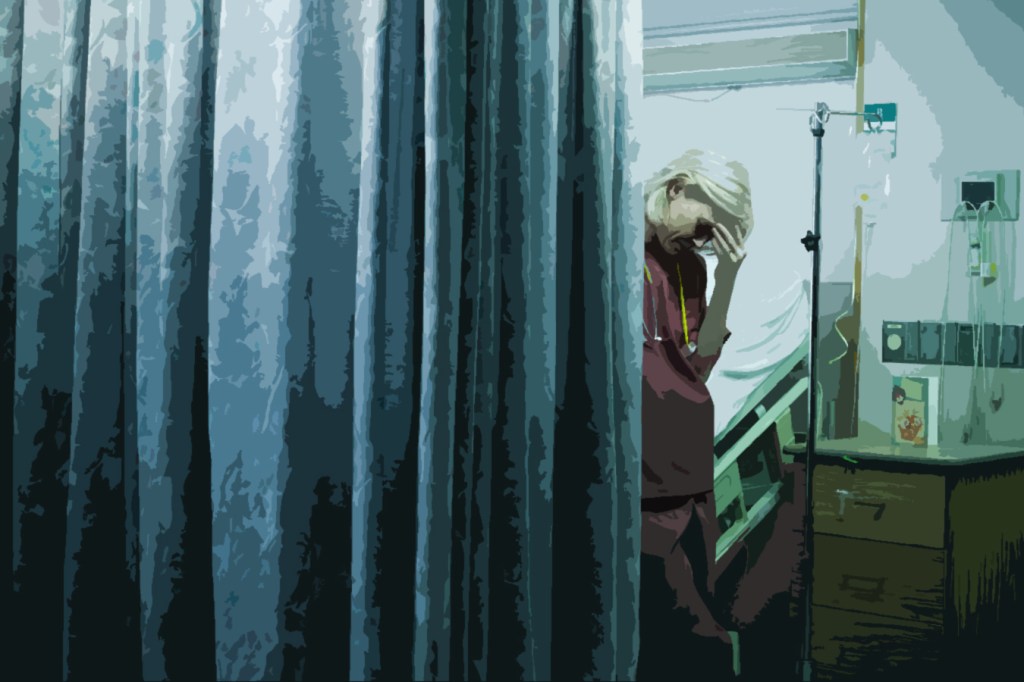
In front of White House, nurses read names of colleagues killed by coronavirus

https://www.washingtonpost.com/local/nurses-read-names-of-colleagues-who-died-of-the-coronavirus-in-front-of-the-white-house/2020/04/21/fc93184c-83e6-11ea-878a-86477a724bdb_story.html?fbclid=IwAR3uHwtfPR-JqZaeFCfIrwmVEzDRSN574QocAt932Pa2pyUt6oL9KC3Kka8&fbclid=IwAR2VQF-oNTrPWkrGFODp9d_WMPOzIUW-imvhPWPGZlU2SN32I6W7trHrjEA&fbclid=IwAR2vXZ6AGvzXd9kZp1naBhLYA8Z2MzWVpYi2zbfXUNM9ybmRZ6FhW1hASEU&utm_campaign=wp_main&utm_medium=social&utm_source=facebook

Coronavirus deaths: Nurses read names at White House of colleagues ...

Registered nurses gathered Tuesday in front of the White House to read the names of health-care workers who have died fighting the coronavirus pandemic.

Wearing masks and standing six feet apart, the nurses held up photographs of the deceased as Melody Jones, a member of the National Nurses United union, addressed the news media in an otherwise empty Lafayette Square.

The names came from all over the country — New York and Alabama, Puerto Rico and Nevada, California and Michigan, Florida and Maryland, New Jersey and the District.

A man in blue scrubs stood behind Jones as she read, holding a metallic gold sign painted with the message: “20 seconds won’t scrub ‘hero’ blood off your hands.”

“Let us remember and honor the ultimate sacrifice these nurses paid,” Jones said. “We commit ourselves to fight like hell for the living.”

The protest stood in stark contrast to demonstrations in recent days in some parts of the country in which protesters have demanded the reopening of nonessential businesses. Nurses have been spotted at those gatherings, too, standing arms crossed, in opposition to demonstrators, many of whom are unmasked and milling in crowds.

More than 9,000 health-care workers in the United States have tested positive for the novel coronavirus, according to figures from the Centers for Disease Control and Prevention. Those numbers are believed to be an undercount of infections due to a lack of tests in many areas.

The nurses said Tuesday that they wanted to bring their demands for more personal protective equipment directly to President Trump’s doorstep.

Health-care providers in hospitals, clinics, nursing homes, assisted-living facilities and rehabilitation centers have for weeks asked lawmakers and government agencies for more protective equipment to shield themselves and their vulnerable patients from the spread of covid-19.

National Nurses United last month petitioned the Occupational Safety and Health Administration to institute an emergency safety standard that would provide nurses with more protective gear, including N95 respirator masks, face shields, gowns, gloves and shoe coverings.

Health-care workers, governors and other officials have for weeks demanded that Trump enforce the Defense Production Act to order mass production of those materials. Many have also petitioned Congress to mandate Trump use his authority to help boost the production of such gear.

Last week, a protest in the shadow of the Capitol displayed the faces of health-care workers demanding better protection on 1,000 signs. The sign represented protesters that organizers said would not have been safe if gathered together on the Capitol lawn.


Trump Administration Tells Employers Not To Worry About Recording COVID-19 Cases

https://www.yahoo.com/huffpost/osha-labor-department-coronavirus-cases-at-work-155001164.html

Know your rights: Michigan workers have new website for ...

The Trump administration announced Friday afternoon that employers outside of the health care industry generally won’t be required to record coronavirus cases among their workers, a decision that left some workplace safety advocates incredulous.

COVID-19, the disease caused by the coronavirus, is classified as a recordable illness, meaning employers would have to notify the Occupational Safety and Health Administration when an employee gets sick from an exposure at work. But the nation’s top workplace safety agency now says the majority of U.S. employers won’t have to try to determine whether employees’ infections happened in the workplace unless it’s obvious.

“OSHA is kidding, right?” tweeted David Michaels, who helmed OSHA throughout the presidency of Barack Obama.

It is not a joke. OSHA, which is part of the Labor Department, released an enforcement memo Friday spelling out the recording rules.

Employers in health care, emergency response and corrections would have to inform the agency when they become aware of a COVID-19 case that probably resulted from work. But other entities would not have to do so unless there was “objective evidence” that the transmission was work-related, or there was evidence “reasonably available to the employer” ― for example, if a whole slew of people who work right next to each other got sick.

The rationale: Those employers outside of health care “may have difficulty making determinations about whether workers who contracted COVID-19 did so due to exposures at work,” the memo stated.

But if employers don’t have to try to figure out whether a transmission happened in the workplace, it could leave both them and the government in the dark about emerging hotspots in places like retail stores or meatpacking plants.

“So all you infected bus drivers, grocery store clerks, poultry processors ― you didn’t get it at work,” tweeted Jordan Barab, a former OSHA official now with the House Committee on Education and Labor.

The announcement is part of an ongoing fight between the Trump administration and occupational safety experts who say OSHA is failing to fulfill its obligations under the president. Employer record keeping has been a key issue in that spat. Early in his presidency, Donald Trump loosened the recording requirements employers must follow, a move critics said would make it easier for companies to fudge their data and hide their injuries.

Safety advocates say recording injuries and illnesses like COVID-19 helps officials discover growing hazards and shape sound public policy to address them. The Labor Department, under Trump and Labor Secretary Eugene Scalia, has portrayed those kinds of employer obligations as burdensome red tape.

In its memo on COVID-19 recording, OSHA said that by not enforcing the requirement on most employers, the agency would “help employers focus their response efforts on implementing good hygiene practices in their workplaces, and otherwise mitigating COVID-19’s effects, rather than on making difficult [work-related] decisions in circumstances where there is community transmission.”

The Labor Department and OSHA in particular have drawn a lot of heat for their response to the coronavirus pandemic. Labor unions have been asking Scalia to issue an emergency standard for infectious disease, which would would give health care facilities clear, enforceable standards to protect their workers during the pandemic. 

Scalia hasn’t done that. Instead, OSHA has created a new poster for employers with tips on preventing infections, and tweaked the rules around respirators to help employers deal with a shortage.

A Labor Department spokesperson defended the agency’s work responding to the outbreak, saying in an email to HuffPost Friday that it had taken “swift and direct action to protect America’s workers.”


Already Taxed Health Care Workers Not ‘Immune’ From Layoffs And Less Pay

https://khn.org/news/already-taxed-health-care-workers-not-immune-from-layoffs-and-less-pay/

Already Taxed Health Care Workers Not 'Immune' From Layoffs And ...

Just three weeks ago, Dr. Kathryn Davis worried about the coronavirus, but not about how it might affect her group of five OB-GYNs who practice at a suburban hospital outside Boston.

“In medicine we think we’re relatively immune from the economy,” Davis said. “People are always going to get sick; people are always going to need doctors.”

Then, two weeks ago, she watched her practice revenue drop 50% almost overnight after Massachusetts officials told doctors and hospitals to stop performing elective tests and procedures. For Davis, that meant no more non-urgent gynecological visits and screenings.

Late last week, as Davis and her partners absorbed the stunning turn of events, they devised a stopgap plan. The 35 nurses, medical assistants and secretaries they employ would have two options: move from full-time to part-time status or start collecting unemployment. Doctors in the practice would take a substantial pay cut. Davis said she’s hearing from colleagues who may have to permanently close their offices if the focus on crisis-level care continues for months.

“It’s shocking,” she said. “Everyone has been blindsided.”

Atrius Health, the largest independent physician group in Massachusetts, said patient volume is down 75% since mid-March. It is temporarily closing offices, placing many nonclinical employees on furlough and withholding pay for those who remain. The average withholding is 20%, and the company pledges that pay withheld will be returned. The lowest-paid workers, those earning up to $55,000, are exempt.

“What we’re trying to do is piece together a solution to get through the crisis and keep employed as many people as we can,” said Dr. Steven Strongwater, Atrius Health’s CEO.

Atrius cares for 745,000 patients in clinics that often include primary care, specialists, radiology and a pharmacy under one roof.

Strongwater said physician groups must be included when the federal government distributes $100 billion to hospitals from the $2 trillion stimulus package.

It’s not clear if that money will stop the tide of layoffs and lost pay at hospitals as well as in doctor’s offices. A Harvard Medical School physician group will suspend retirement contributions starting April 1.

Beth Israel Lahey Health, the second-largest hospital network in Massachusetts, announced executive pay cuts Monday.

“The suspension of elective procedures and decline in visits to our primary care practices and urgent care centers have resulted in financial challenges,” wrote CEO Dr. Kevin Tabb in an email to employees. Tabb said he would take a 50% salary cut. Other executives and hospital presidents in the system will forgo 20% of their salaries for the next three months.

“Although executive leadership compensation is being reduced, we will never compromise on doing the things that are essential to protect your safety and the safety of our patients,” Tabb told staff.

Dallas-based Steward Health Care has told hospital employees in Massachusetts and eight other states where it operates to expect furloughs focused on nonclinical staff. In a statement, Steward Health Care said it prepared for the pandemic but is experiencing a “seismic financial shock.”

“Elective surgeries are the cornerstone of our hospital system’s operating model — and the negative impact due to the cancellations of these procedures cannot be overstated. In addition, patients are understandably cautious and choosing to defer any nonemergency treatments or routine visits until this crisis has passed.”

Dr. Kaarkuzhali Babu Krishnamurthy, an assistant professor of neurology at Harvard Medical School who studies medical ethics, said employers need to think more carefully about the ethics of asking doctors and nurses to live on less when many are working longer hours and putting the health of their families at risk.

“At a time when health care systems are calling on doctors and nurses to do more, this is not the time to be making it more difficult to do that,” said Krishnamurthy.

There’s talk of redeploying laid-off health care workers to new COVID-19 units opening in shuttered hospitals or to patient overflow sites. Tim Foley, executive vice president for the largest health care union in Massachusetts, 1199SEIU, is promoting the development of a staff registry.

“It is more important, now more than ever, to explore all options to maintain the level of urgent care needed across the state and we look forward to working with all stakeholders to do just that,” Foley said in an email.


As coronavirus spreads, so do reports of companies mistreating workers

https://www.washingtonpost.com/business/2020/03/31/worker-retaliation-mistreatment-coronavirus/?fbclid=IwAR1uQPecWtRM3G__toecrlhfYhszBQkDoYFkxsUrMYY_UZtKaTHpq3cblH4&utm_campaign=wp_main&utm_medium=social&utm_source=facebook

Workers complain of mistreatment as they try to cope with the ...

From nurses to retail salespeople, workers are walking off the job and facing retribution for speaking out.

She could wear her protective mask while seeing her patients. Many were, after all, elderly, with respiratory problems, susceptible to getting severely sick from the novel coronavirus. And so Laura Moreno, a nurse in Oklahoma City, wanted to protect them — as well as herself and her 12-year-old daughter, who has asthma and a thyroid condition.

She could not, however, wear her mask in the hallways, or the cafeteria or any of the hospital’s common areas, because her supervisors told her it would scare patients. “I was told if I wanted to wear a mask, I would not be working there,” she said. “So I said I’m not willing to put my life at risk, and my contract was terminated.”

Since the viral pandemic started ravaging the country in recent weeks, workers, unions and attorneys are seeing a dramatic rise in cases they say illustrate a wave of bad employer behavior, forcing workers into conditions they fear are unsafe, withholding protective equipment, and retaliating against those who speak up or walk out.

Moreno’s case was one of many that her attorney, Rachel Bussett, and her colleagues at the National Employment Lawyers Association have been inundated with as workers grow increasingly fearful of retribution from, as Bussett said, “employers who value the economy over people.”

A handful of workers at a McDonald’s outside San Francisco walked off the job to protest the lack of safety measures. So did about 50 workers at a Perdue chicken plant in Georgia, as well as workers at Instacart and Amazon, while the companies said they were taking steps to ensure their employees’ safety and well-being. (Amazon’s chief executive, Jeff Bezos, owns The Washington Post.)

Meanwhile, employees at several major retailers have circulated petitions urging the companies to close their stores and protect workers. And some workers have said they were fired outright for speaking their minds and pushing companies to look after them.

The complaints come as the virus’s toll mounts and health officials warned that extreme measures, such as lockdowns, would continue. On Sunday, health officials said social distancing guidelines would remain in place through April, and President Trump said the nation “will be well on its way to recovery” by June 1, not Easter, as he had said previously.

“This is a situation we’ve never had to deal with before,” said Heidi Burakiewicz, a D.C. attorney and a member of the employment lawyers association. “We’re doing everything we can to help these employees — not just about protecting jobs. But people’s lives are at stake, and people should never have to be faced with questions about whether they need to risk exposing themselves and their families or losing their jobs.”

The designations for “essential” businesses can vary by state but generally include supermarkets, pharmacies, hardware stores, auto repair shops and the defense industry.

Workers at a number of large retailers — such as craft stores, video-gaming shops and office supply chains — have questioned their employers’ decision to stay open despite stay-at-home orders across the country.

“It is unnecessary and unsafe to be open during a PANDEMIC,” Staples employees wrote in a petition. “We are not an essential store and corporate is fighting and begging to stay open, claiming Staples is essential and putting employees and their families at risk. Staples should temporarily close stores and pay their employees for the time being.”

Staples spokeswoman Meghan McCarrick said the company is “an essential provider of business and educational materials and products, household goods and cleaning supplies.” She said that an intensive care unit at a Baltimore hospital recently purchased ink and toner for a printer at Staples, while a hospital in Virginia bought webcams to set up remote telemedicine offices.

Last week, the Federal Bureau of Prisons turned away employees who said they had taken pain medications such as Advil, Tylenol or Motrin within four hours of reporting for work. That meant guards with balky hips or bad backs were forced to take sick leave, even if they had no fever or other symptoms of the virus, union officials said.

“You have unqualified people asking questions that are medically related,” said Sandy Parr, a union official. “They’re sending people home just because they took Motrin, which is decreasing the staff available to work — and that increases the danger.”

After guard workers complained and The Post inquired about the measure, the Bureau of Prisons said last week that it was discontinuing the practice.

Across the country, some health-care facilities are hoarding masks, goggles and gloves — forcing some workers to bring in their own, use the same equipment again and again, or go without.

“It’s in cabinets locked away, collecting dust while people need it now,” said Rebecca Reindel, the safety and health director of the AFL-CIO, who said the union has raised the issue “in every avenue we can.”

Moreno’s concern wasn’t the availability of the equipment — only her ability to use it. A contract nurse at Select Specialty Hospital, she felt she needed to wear a mask at all times, especially given that the patients she was treating were particularly susceptible to the worst effects of the virus. The hospital’s website says it provides “specialized care for patients with acute or chronic respiratory disorders. Our primary focus is to wean medically complex patients from mechanical ventilation and restore independent breathing.”

The state is under a “safer at home” order, which directs people over 65 and those with underlying medical conditions to stay home and limits gatherings to no more than 10 people, among other restrictions.

On Wednesday, however, Moreno was told her contract was being terminated because the hospital did not want her wearing a mask in common areas of the hospital, she said. But by the next afternoon, after The Post had contacted the hospital, she said hospital officials “had completely changed their tune” and decided to allow nurses to wear masks throughout the hospital and not just in patient rooms.

On Friday, she went back to work. In an email, a hospital spokeswoman said, “The nurse is still engaged with us and her upcoming scheduled shifts have been confirmed.”

The policy change “feels wonderful,” Moreno said, “because I know I will be protected and my friends and co-workers will be protected.”

Kevin Readel, another nurse in Oklahoma City, said he was fired for a similar reason — but in his case it was for insisting on wearing a mask while with patients.

He said he was told “point blank that I can’t wear a mask” because it “could cause fear and anxiety amongst the other nurses and the patients.”

He filed a suit against the Oklahoma Heart Hospital South for wrongful termination, claiming that “the hospital was more concerned about the perception of due diligence than actually performing due diligence.”

A spokesman for the hospital said he could not comment on pending litigation but said the hospital’s “entire focus is on making sure we protect the safety of our patients and health care professionals in preparation for an expected surge in COVID-19 patients. As part of our preparation, we are strictly complying with the guidelines on the personal protective equipment set forth by the World Health Organization and the Centers for Disease Control.”

Lauri Mazurkiewicz, a nurse who lives outside Chicago, grew nervous when she was repeatedly exposed to patients diagnosed with covid-19, the disease caused by the coronavirus. “This is so contagious. It’s spreading so fast. I need an N95 mask,” she said, referring to a specialty mask worn by many health-care workers.

She happened to have an N95 and began wearing it during her rounds at Northwestern Memorial Hospital, she said, but was told the hospital was prohibiting the use of N95 masks and using regular surgical masks instead.

She sent an email warning her colleagues that those masks were less effective. She was fired shortly afterward — the result, she alleged in a lawsuit against the hospital, of her attempts to “disclose public corruption and/or wrongdoing.”

A spokesman for the hospital declined to comment on the specifics of her complaint in the lawsuit, but said it is “committed to the safety of our employees who are on the frontlines of this global health care crisis.” He added that it follows “CDC guidance regarding the use of personal protective equipment for our health care providers.”

In a statement Monday, the American College of Emergency Physicians said it was “shocked and outraged by the growing reports of employers retaliating against frontline health workers who are trying to ensure they and their colleagues are protected while caring for patients in this pandemic. … Not only does this type of retribution remove healthy physicians from the frontlines, it encourages others to work in unsafe conditions, increasing their likelihood of getting sick.”

In the retail sector, employees at Michaels crafts stores said they were told the company’s shops would remain open because they serve “people who are bored at home” and double as UPS drop-off sites, according to an employee at a Phoenix store who is awaiting results for a coronavirus test.

The worker, who spoke on the condition of anonymity, has been home with a low-grade fever, cough and chest pain but says store managers have not been supportive.

“Every time I call in sick, there’s just an incredibly disappointed sound on the other end,” she said. “This is not an essential business — nobody in the history of mankind has ever dropped dead from boredom. They need to close their doors.”

Anjanette Coplin, a spokeswoman for Michaels, said its stores provide necessary products and services for parents and small-business owners. “We want to support and remain a lifeline for the teachers, parents and small businesses who rely on Michaels and our products to enable creative learning,” she said. Michaels is offering curbside pickup and has temporarily closed locations in certain states, including California, New York and Pennsylvania.

JoAnn craft stores, GameStop, Office Depot and Guitar Center have also come under fire for keeping stores open. A spokesman for Office Depot said the company is not requiring retail employees to come to work if they are not comfortable. Guitar Center, which furloughed 9,000 workers on Monday, said it is following state and local rules regarding store closures. JoAnn and GameStop did not respond to requests for comment.

In Plain City, Ohio, workers at a TenPoint Complete call center who administer automotive surveys by phone have been instructed to report to work even after the state issued a stay-at-home order, according to one employee who spoke on the condition of anonymity because she feared reprisal.

Her work, she said, consists of calling customers to ask about their experience at the body shop.

“This is not an essential job,” she said.

TenPoint Complete did not respond to a request for comment.

Even as other department stores, such as Nordstrom and Kohl’s, have temporarily shut their doors and kept paying their workers, Dillard’s has kept locations operating where government authorities allow it, making it one of the few remaining mall-based stores to remain open despite the pandemic, employees say.

That has sparked concern from employees, social media outrage by community members and a petition drive urging it to close that alleges, “Unlike other retailers who care about the safety and well-being of their employees and the guests they serve everyday, Dillard’s is choosing to run a blind eye in order to keep money funneling into their greedy pockets.”

Some employees who work for the company expressed fear about the stores remaining open, saying that they have been offered no assurances of pay if their stores close and that they had to pay more for their health insurance as their hours were cut.

One full-time Dillard’s employee based in Colorado, who requested anonymity to preserve her job, said that before her store closed in the middle of last week, she tried to use the vacation time she has accumulated to take off two weeks, but was told she couldn’t because the store was short-staffed. Her store has since closed because of local restrictions for nonessential businesses, and she said they were not being paid during the closure, other than for earned vacation leave. They have received little clear information about whether they would get their jobs back when the stores reopened, she said.

An employee in her 60s based in southwest Florida said she has not yet accumulated any paid time off, so if she were to get sick, she would have no paid leave. “They say you’re more than welcome to stay home, but that’s, of course, without pay,” at least for her.

She said the company has done little to directly encourage social distancing from customers making purchases. “They’re just telling us to relay to customers — politely — to stand back,” she said, but not putting up signage or tape to mark where customers should stand. “They are providing us at each register with a little small bottle of hand sanitizer. Mine has about a quarter of it left.”

In an email, Julie Johnson Guymon, a company spokeswoman, said “direct communication” with associates began Monday. In an earlier statement, she said Dillard’s is “fully cooperating with any government directives in our markets and promptly closing under those guidelines. Importantly, we are strictly following CDC guidelines for the safety of our associates and the customers who choose to visit us where open. No associate who is uncomfortable working is required to do so. We believe continuing to operate using current safety standards is the best thing we can do long term for our associates and for the economy.”


An explosion of coronavirus cases cripples a federal prison in Louisiana

https://www.washingtonpost.com/national/an-explosion-of-coronavirus-cases-cripples-a-federal-prison-in-louisiana/2020/03/29/75a465c0-71d5-11ea-85cb-8670579b863d_story.html?fbclid=IwAR2rjY1fk7FF2H1vhUxaeZ4c8F3_Vi1HUJhCUkhP-bjFdc_tbuHV8KrKN80&utm_campaign=wp_main&utm_medium=social&utm_source=facebook

Federal prison in Louisiana crippled by coronavirus cases as ...

A federal prison in Louisiana has, within days, exploded with coronavirus cases, leading to the death of one inmate on Saturday, the admission of a guard into a hospital intensive care unit, and positive test results for another 30 inmates and staff.

Patrick Jones, 49, was the first inmate in the Federal Bureau of Prisons diagnosed with the novel coronavirus, which causes covid-19, and the first to die.

At least 60 inmates at the Oakdale prison are in quarantine and an unknown number of staff are self-quarantining at home, said Corey Trammel, a union representative for correctional officers at the 1,700-inmate facility about 110 miles northwest of Baton Rouge.

“It’s been simultaneous, just people getting sick back to back to back to back,” Trammel said. “We don’t know how to protect ourselves. Staff are working 36-hour shifts — there’s no way we can keep going on like this.”

The prison bureau is not releasing the names of other infected inmates or staff, citing medical and privacy concerns. Jones complained of a “persistent cough” on March 19, the prison bureau said, and was transported to a hospital where he was diagnosed and placed on a ventilator.

The prison bureau also said Jones had “long-term, preexisting medical conditions” that increased his risk of developing the disease. Jones was convicted in 2017 of possession with intent to distribute crack cocaine within 1,000 feet of a junior college. He was serving a 27-year sentence.

Louisiana ranks 10th highest among states for reported coronavirus cases, with more than 3,300 people who have tested positive and another 137 who have died, government reports show. A week before the Oakdale prison had its first positive case, Gov. John Bel Edwards (D) issued a stay-at-home order and closed all public schools.

Trammel said the prison bureau has been slow to respond to the crisis across the country. The bureau last week banned family and friends from visiting inmates, but the officers’ union had lobbied the federal prison system to take this action for weeks to keep the disease from infiltrating the prison walls.

The Bureau of Prisons updates confirmed coronavirus cases most afternoons on its website, but there has been a lag between cases reported by the officers’ union and prison officials. As of Sunday afternoon, the prison system had only confirmed 14 inmates and 13 staff have tested positive.

At Oakdale, Trammel said staff also asked prison officials — weeks before the first coronavirus case — to shut down a prison labor program within the facility, where more than 100 prisoners make inmate clothing. The program, Trammel said, was not shut down until after the first inmate tested positive.

The Bureau of Prisons — which operates 122 prisons with more than 175,000 inmates — did not immediately respond Sunday to a request for comment. Oakdale Warden Rod Myers could also not be reached for comment.

Trammel said he asked the prison bureau on Saturday to send specialized medical teams to the facility to help with staffing shortages. He’s also asking for hazard pay, which would increase their salaries by 25 percent as they respond to the crisis. And he’s asking for more robust protective gear, including masks with respirators and perhaps face shields.

“We are bringing inmates to the hospitals and are staying right beside them around the clock,” Trammel said. “All we have is these itty bitty masks — a piece of towel over our faces — and nurses are coming into the room for a few minutes and they are all suited up.”

He also said he believes all Oakdale prison staff have now been exposed to the virus. Days ago, he interacted with an inmate who had a fever and still doesn’t know if the prisoner has received a test.

“We should all be in quarantine,” Trammel said. “We should not be going in to spread this monster of a virus.”

Prison reform advocates, who have been pushing for the early release of elderly and severely ill inmates due to covid-19, said the death of a federal inmate illustrates why government officials need to be doing a better job of protecting people like Jones.

“The conditions and reality of incarceration make prisons and jails tinderboxes for the spread of disease,” said Udi Ofer, director of the American Civil Liberties Union’s Justice Division. “A prison sentence should not become a death sentence. Our leaders must immediately take steps to release those identified by the CDC as most vulnerable to covid-19. With every hour of inaction that passes, the greater the human tragedy.”


Grocery workers are keeping Americans alive during the COVID-19 pandemic. Here’s what they need.

https://www.brookings.edu/blog/the-avenue/2020/03/25/grocery-workers-are-keeping-americans-alive-during-the-covid-19-pandemic-heres-what-they-need/?utm_campaign=Brookings%20Brief&utm_source=hs_email&utm_medium=email&utm_content=85335188

Grocery workers are keeping Americans alive during the COVID-19 ...

As worried Americans pack supermarket aisles in anticipation of quarantines and shelter-in-place orders, grocery workers like Courtney Meadows are working at a frantic pace to keep Americans fed and alive, and risking their own health in the process.

Meadows, a cashier at Kroger in Beckley, W.Va., said her store is the busiest she has seen it in 10 years on the job. “I have worked through snow scares, a blizzard, two derechos, holidays, anything that can impact a grocery store,” she told me. “This is the absolute worst I have seen it. It is a sea of people everywhere.”

Over the last week, I traveled to supermarkets across the Washington, D.C. region and interviewed workers from Virginia, Maryland, West Virginia and the District to hear—in their words—how COVID-19 is impacting them. These crowded stores I visited had few visible safeguards or protections for workers.

“We aren’t staying six feet away from the customers,” said Michelle Lee, a Safeway cashier in Alexandria, Va. “When we ring them up, they are like two feet away from us. We check out 200 customers a day. A doctor can wear a mask and protective gear. We don’t have all of that.”

Amber Stevens, a cashier at Shoppers in Prince George’s County, Md., expressed concern over social distancing as well. “I do still have a job to go to, but it isn’t helping me with social distancing because I am hands-on with customers,” she told me. “That is the scary part. Dealing with money, having to be so close to people.”

More than their own health, the grocery store employees I interviewed expressed the most concern about the safety of those around them: their loved ones at home, their elderly customers, their colleagues with underlying health conditions, and their neighbors in crowded apartment buildings. Several workers welled up with emotion as they described how hard it is to be unable to care for older relatives during the pandemic.

“All of that worry plus the stress of double the number of customers we normally have,” said Lisa Harris, a cashier at Kroger in Richmond, Va. “This isn’t just for one day. It is for weeks.”

As grocery workers put their lives on the line—often for low wages and few benefits—it is imperative that employers, policymakers, and even customers act with urgency to protect, support, and compensate them.

EMPLOYERS MUST KEEP GROCERY WORKERS HEALTHY

Employers need to implement immediate steps to reduce grocery workers’ exposure to COVID-19. First, employers should expand access to personal protective equipment (PPE) such as masks and gloves and end any restrictions on workers wearing them. While supplies of protective masks and gloves are extremely limited across the country, employers and policymakers should prioritize PPE for grocery workers as they become available. Employers should provide adequate cleaning supplies and hand sanitizer, regular opportunities for workers to wash their hands, and frequent equipment cleaning.

Second, stores should shorten hours and limit the number of customers at any given time. While several stores—including Trader Joe’sWalmart, and Safeway—have limited store hours and introduced “senior only” hours, most stores are not following the CDC’s guidance of limiting gatherings to 50 people. Even tighter restrictions may be needed to keep workers safe as the virus spreads; for instance, some stores in China are checking customers’ temperatures before they enter the store.

Third, grocery stores should implement additional measures to protect workers and enforce safe spacing of customers. Albertsons, which owns Safeway and 19 other grocery chains, was the first major company to announce they will install plexiglass “sneeze-guard” barriers at checkouts in its 2,200 stores over the next two weeks. Walmart and Kroger have made similar commitments, and other grocery stores should follow.

Even in the absence of specific CDC guidelines for grocery workers, employers should act boldly and creatively to modify stores to keep workers safe, continuously adapt to evolving best practices, and respond to safety priorities identified by unions like the United Food and Commercial Workers International Union (UFCW), which represents over 1.2 million workers.

INCREASE COMPENSATION AND OFFER HAZARD PAY

The coronavirus pandemic has put a harsh spotlight on the low wages that grocery workers earn for their life-saving work. At Kroger, the country’s second-largest grocery chain with 453,000 workers, the average hourly wage of cashiers is just $9.94 per hour, according to estimates on Indeed.com.

Lisa Harris, a Kroger cashier, described the financial hardships she and her low-wage colleagues face: “I have coworkers who stand all day serving people, and then have to go pay for their own groceries with food stamps. I am very lucky that my boyfriend works in pizza because that is our survival food. If we can’t afford to buy food, he brings home a pizza.”

Even in “normal” times, grocery workers—like other service and low-wage workers—deserve better wages. In these extreme times, adequately compensating them is even more imperative. As grocery sales soar and their stock prices rise, employers should provide additional compensation and hazard pay to their workers on the front line.

“I think that some pay increase would be wonderful,” Kroger cashier Courtney Meadows told me. “I don’t think they understand the toll that comes through in our lives. They don’t see it. They don’t see the panic on people’s faces.”

In response to the pandemic, the two largest grocery employers, Kroger and Walmart, have offered workers one-time bonuses of $300. Responding to pressure from the UFCW, Safeway and Shoppers are now offering an additional $2 per hour of hazard pay, while Whole Foods and Target are also raising pay $2 per hour.

These pay increases are an important start, but they don’t go far enough. The raises should be permanent, and enough to provide a family-sustaining wage to workers.

ENSURE ACCESS TO HEALTH INSURANCE AND EXTEND PAID SICK LEAVE

Now more than ever, paid sick leave and health insurance are critical for grocery workers. Well before the COVID-19 pandemic, hundreds of thousands of grocery workers didn’t receive paid sick leave from their employers. Responding to public outrage and pressure from employees and unions, most large employers now have updated their sick leave policy to respond to COVID-19. However, their policies don’t go far enough: They are temporary, focus narrowly on COVID-19, and are insufficient to meet the needs of workers.

Companies including Safeway, Kroger, and Walmart are now offering 14 days paid sick leave for workers with a confirmed COVID-19 diagnosis. But COVID-19 tests are in extremely short supply and many workers with suspected cases will be unable to get tested. Employers should modify paid leave policies to allow flexibility for ill workers to access the benefits even without a confirmed test, at least until testing is more widely available.

Policies should cover paid leave for grocery workers to care for their immediate family members or people they live with if they become ill. Employers should also compensate workers for any coronavirus-related medical bills that are not covered by their health insurance.

Employers should provide extra support to grocery workers who are especially high-risk, such as older workers and the immunocompromised. The most vulnerable workers may need to simply stay home during the pandemic and not work for weeks or months. Employers should do their part to ensure those workers have extended paid leave or other forms of adequate compensation and benefits, including health insurance.

CUSTOMERS CAN HELP KEEP GROCERY WORKERS SAFE

A major concern for the workers I interviewed was the actions of individual customers that could jeopardize their health. Many workers noted that customers continue to come to their store even when they are sick.

“Some customers will come through the line and cough or sneeze in their hand,” said Safeway cashier Michelle Lee. “If you are sick, you should stay home or cough in their elbow.”

Customers should do their part by keeping a safe distance from workers at checkout and throughout the store, practicing proper hygiene when coughing or sneezing, and staying home when ill.

RIGHT NOW, GROCERY WORKERS ARE EMERGENCY PERSONNEL

On March 15, Minnesota Governor Tim Walz made grocery store employees and food distribution personnel eligible for free child care by designating them as emergency workers. Four days later, Vermont’s Department of Public Safety added grocery workers to its list of essential personnel, giving them free child care at school-based centers set up by the state.

Other states should follow the lead of Minnesota and Vermont and designate grocery workers as emergency personnel, granting them the same protections and benefits as first responders and health workers.

If we had an opportunity to get free child care, people like me could go in,” Matt Milzman, a 29-year-old Safeway cashier in Washington, D.C. and father of two small children, told me. “They need all the people they can. I am low risk and healthy. I would much rather me work than someone who is older with a million health problems.”

Grocery workers are among the true heroes of the pandemic, providing basic necessities to keep Americans alive, but also human comfort for their customers during an anxious time.

“I choose to be happy and positive,” cashier Courtney Meadows told me. “If you can talk and make someone laugh, that might be the only positive thing in their life that day. That is what I choose to do.”

We owe them not only our gratitude, but the protection, support, and compensation they deserve.


Trading high deductibles for narrow networks

https://mailchi.mp/f3434dd2ba5d/the-weekly-gist-december-20-2019?e=d1e747d2d8

Related image

For many employers, narrowing provider networks has been a bridge too far, despite unrelenting healthcare cost growth.

A recent Los Angeles Times profile of a Boston union that was able not only to lower costs but also nearly eliminate employee cost-sharing may make doubters reconsider. Unite Here Local 26, which represents 9,000 hotel workers and their families, implemented a narrow network health plan in 2013, when two-thirds of its members agreed to forego care at certain marquee academic hospitals, which charged two to three times more than others in the Boston area.

Today the union actually pays less in medical costs per member than it did six years ago, and premiums are ten percent lower than the national average, despite Boston being one of the highest-cost healthcare markets in the country. Employees pay no deductibles, and generic medications cost them only $1. Savings have translated into raises for many employees, with some low-income workers seeing a pay jump of up to 39 percent across six years.

As we’ve discussed in the past, employers are reaching a limit on how high they can push deductibles, especially in a tight labor market. Some are beginning to experiment with various network options that lower health care costs—but many have been reticent to change benefit design in any way that could be perceived as narrowing choice.

Local 26’s experience shows that well-designed narrow networks, implemented with employee education and buy-in, can provide cost relief for both businesses and individuals that can be sustained over time.


What to expect as Kaiser’s 4,000 behavioral health workers launch 5-day strike statewide

https://www.sacbee.com/news/local/health-and-medicine/article238378533.html

Image result for What to expect as Kaiser’s 4,000 behavioral health workers launch 5-day strike statewide

Kaiser Permanente’s behavioral health clinicians will be picketing Monday outside the health care giant’s Sacramento Medical Center on Morse Avenue, joining in a weeklong labor strike that will affect services at more than 100 facilities around California.

Roughly 4,000 psychologists, psychiatric nurses and other behavioral health workers — members of the National Union of Healthcare Workers — say they want the company to shorten wait times for return appointments and reduce therapist caseloads.

“I know of nowhere else but in the Kaiser system that there is literally no definition of a caseload or maximum number of patients for which one is responsible,” said Susan Whitney, a Kaiser therapist in Kern County. “There are about 35 therapists and social workers that serve Kaiser’s Kern County population of 109,000 members, only one mental health worker for every 3,000 members. In contrast, Kaiser primary care physicians have a panel, or caseload, of 1,500 patients, and also have staff such as nurses and medical assistants that support them.”

Kaiser executive Michelle J. Gaskill-Hames said that proposals made to the union would keep Kaiser therapists among the highest paid in California, with excellent benefits, as well as offering them more time in their schedules for patient appointments and to take care of administrative tasks. Rather than strike, she said, the company has asked the union’s leadership continue to work with a mediator and Kaiser Permanente.

“Like every other health care provider, we are seeing a significant demand for mental health care in the face of a national shortage of qualified professionals,” said Gaskill-Hames, Kaiser’s senior vice president for Northern California hospital and health plan operations. “Despite this shortage, we have hired nearly 500 new therapists in California this year alone.”

The clinicians had initially planned the strike for mid-November but postponed it out of respect for the family of the late Kaiser CEO Bernard Tyson, who died unexpectedly last month.

WHAT UNION MEMBERS HAD TO SAY

The strike is to compel Kaiser to make mental health care as much of a priority as physical health care, Whitney said. Treating mental health issues also improves physical health, she said, as numerous studies have shown.

Since Kaiser was fined several years ago for lengthy waits for first appointments, the company has worked under state supervision to improve its performance in this area, Whitney said, but as it has improved in that metric, return appointments have become more difficult to schedule.

Vicki Hoskins, a therapist in Orange County, said that if a patient completed an intake appointment today and wanted to return to see her, that patient would have to wait until March. There is a backlog of vacant positions in some offices, she said, so new hires are often filling those rather than adding to the workforce.

WHAT KAISER LEADERS HAD TO SAY

Kaiser has been jointly working with an external mediator to help reach a collective bargaining agreement with the union, Gaskill-Hames said.

She said the mediator recently delivered a proposed compromise to both sides, but the union has rejected it and announced plans to strike instead of working through the mediated process.

This is union’s sixth noticed strike within a single year, and the repeated call for short strikes is disruptive to patient access, operational care and service, said Gaskill-Hames, who described the union’s action as irresponsible.

A strike puts patients in the middle of bargaining, which is not fair to them, especially during the holidays when rates of depression can spike, she said.

HOW WILL THE STRIKE AFFECT PATIENTS?

Kaiser Permanente will try to minimize patient disruption, Gaskill-Hames said, but the company may be forced to reschedule appointments and devote resources from elsewhere in the organization to address the continuity of care.

WHEN AND WHERE WILL PICKETS BE PROTESTING?

In the Sacramento area, pickets will be out from 6 a.m. to 2 p.m. at Kaiser’s Sacramento Medical Center, 2025 Morse Ave., on Monday; at the Roseville Medical Center, 1600 Eureka Road, on Wednesday; and at the South Sacramento Medical Center, 6600 Bruceville Road, on Friday. On Thursday, they will rally at the State Capitol at 10th and L streets at 10:30 a.m. and at the Department of Managed Health Care, 990 Ninth St., at 11:30 a.m. Elsewhere in the Central Valley, pickets will be at Fresno Medical Center, 7300 N. Fresno St., Monday through Friday.


UNION RESCHEDULES KAISER PERMANENTE STRIKE POSTPONED AFTER CEO’S DEATH

https://www.healthleadersmedia.com/strategy/union-reschedules-kaiser-permanente-strike-postponed-after-ceos-death?spMailingID=16676008&spUserID=MTg2ODM1MDE3NTU1S0&spJobID=1780330838&spReportId=MTc4MDMzMDgzOAS2

The health system’s senior vice president of national labor relations said the conflict is resolvable, ‘and there is no reason to strike.’

A five-day strike that was postponed last month after the sudden death of Kaiser Permanente Chairman and CEO Bernard J. Tyson is back on the calendar.

Thousands of psychologists, therapists, psychiatric nurses, and other healthcare professionals plan to strike December 16–20 at more than 100 Kaiser Permanente facilities across California, the National Union of Healthcare Workers (NUHW) said Wednesday.

“Mental health has been underserved and overlooked by the Kaiser system for too long,” said Ken Rogers, PsyD, MEd, a Kaiser Permanente clinical psychologist who serves as a vice president on the NUHW executive board, in a statement released by the union.

“We’re ready to work with Kaiser to create a new model for mental health care that doesn’t force patients to wait two months for appointments and leave clinicians with unsustainable caseloads,” Rogers said. “But Kaiser needs to show that it’s committed to fixing its system and treating patients and caregivers fairly.”

The union accuses Kaiser Permanente of refusing to negotiate unless mental health clinicians agree to “significantly poorer retirement and health benefits” than those received by its more than 120,000 other California employees.

Dennis Dabney, senior vice president of national labor relations and the Office of Labor Management Partnership at the Kaiser Foundation Health Plan and Hospitals, said the parties have been working together with an external mediator in pursuit of a collective bargaining agreement. The union rejected a compromise solution proposed last week by the mediator, Dabney said.

“The only issues actively in negotiation in Northern California are related to wage increases and the amount of administrative time that therapists have beyond patient time,” Dabney said. “We believe these issues are resolvable and there is no reason to strike.”

The mediator’s recommendation includes about 3% in annual wage increases for therapists in Northern California for four years, plus a $2,600 retroactive bonus, Dabney said

“In Southern California, the primary contract concern relates to wage increases and retirement benefits,” Dabney said.

The mediator’s recommendation includes about 3% in annual wage increases for therapists in Southern California for four years, plus a $2,600 retroactive bonus, even though the organization’s therapists in Southern California “are paid nearly 35% above market,” Dabney said.

“Rather than calling for a strike, NUHW’s leadership should continue to engage with the mediator and Kaiser Permanente to resolve these issues,” Dabney said.


University of Chicago Medical Center closes level 1 trauma center ahead of strike

https://www.beckershospitalreview.com/human-resources/university-of-chicago-medical-center-closes-level-1-trauma-center-ahead-of-strike.html

Related image

University of Chicago Medical Center has closed its level 1 trauma center for adult and pediatric patients as it prepares for about 2,200 nurses to go on strike next week, medical center leaders announced.

Medical center leaders said UCMC closed its pediatric level 1 trauma program Nov. 18 and its adult trauma program Nov. 20. Its adult and pediatric emergency rooms continue to take walk-in patients.

Nurses are scheduled to strike Nov. 26, two days before Thanksgiving. The nurses also walked off the job Sept. 20 in a strike organized by National Nurses Organizing Committee/National Nurses United. They were allowed to return to work Sept. 25, after the medical center said it fulfilled its contract with temporary nurses to replace the striking ones for five days.

In preparation for the strike, UCMC announced earlier this week that it is moving about 50 babies and 20 children in its neonatal and pediatric intensive care units to other facilities.

UCMC President Sharon O’Keefe is also recruiting about 900 replacement nurses.

However, “it’s exceptionally difficult to hire people who are willing to leave their families during Thanksgiving,” she said in a news release. “At the same time, other hospitals in the city are already at or near capacity, which means they will not be able accept transfers of current inpatients if that need arises when nurses walk out. The combination of the two led us to take the step of temporarily closing our trauma program ahead of the strike.”

UCMC said the hospital was required to offer replacement nurses five days of work “to best recruit qualified and experienced replacement nurses.” Therefore, the nurses on strike will not be able to return to work until 7 a.m. Dec. 1.

Negotiations between UCMC and National Nurses Organizing Committee/National Nurses United began earlier this year. Medical center leaders say incentive pay — and whether the hospital should end the pay for newly hired nurses — is a sticking point in negotiations, according to the Chicago Tribune. The union has continued to express concerns about staffing levels.

The nurses said they plan to strike unless an agreement is reached.