These are the 5 traits that set extraordinary people apart, says former FBI agent—‘but you need the entire set’

What makes someone extraordinary? As a retired FBI agent with more than 40 years of studying human behavior and performance, no question has captivated me more.

Extraordinary people have a wisdom and way of being that inspires and commands respect. They energize you with their wisdom and empathy. You want them to be your friend, neighbor, co-worker, manager, mentor or community leader.

The 5 traits of extraordinary people

Surprisingly, the qualities that make these people stand out aren’t related to their level of education, income or talents (say, in athletics or art or business).

As it turns out, based on thousands of observations, there are five traits that set exceptional individuals apart from everyone else — but you must have the entire set, and not just one or a few.

I call them “The Five Domains of Exceptional People”:

1. Self-mastery

Self-mastery brings out your best in whatever you do through dedication, curiosity and adaptability.

Usain Bolt, the fastest human to ever live, didn’t achieve that status merely through athletic ability. He achieved it through self-mastery: He learned, sacrificed, worked hard and remained diligently focused. Michael Jordan, the greatest basketball player of all time, did the same.

But another side to self-mastery is knowing our emotions, strengths and, more importantly, our weaknesses. By understanding ourselves, we know things like when others should take the lead, when today is not our day or when we need to confront our demons.

Start attaining self-mastery by asking:

  • What areas need attention?
  • What knowledge, training or skills will help me pursue my goals?
  • What can I do now to initiate change?
  • How can I better myself through books, mentors, organizations, video tutorials or online classes?

2. Observation

We’re taught to look, but not to observe. We look to see if we can cross the street safely or what supermarket line is moving the fastest. It’s a passive experience that’s useful, but may not provide complete information.

Observing, on the other hand, is active; it requires effort, but the results are more enlightening. It’s about using all our senses to decode the world in real time for a more informed understanding of our environment and of others.

By working as an FBI agent and as an ethologist, I’ve developed my sensitivity for reading the needs, wants, desires, concerns and preferences of others — all crucial information for understanding and communicating with people.

The most observational people have a skill set that many lack. They instantly know:

  • What they are seeking and whether there may be multiple explanations.
  • How context and/or culture factors in.
  • How they can validate their observations and conclusions.
  • How to prioritize, separating the inconsequential from the essential.

3. Communication

We communicate constantly. Do it right and people will adore you. Do it wrong and you create doubt, indifference, even anger.

Exceptional communication skills elevate the quality of your relationships. It’s not about communicating perfectly, but rather effectively — and that builds trust. Here’s how:

  • Address emotions first. We cannot think or communicate clearly until emotions are dealt with. This is where reading body language is helpful.
  • Build rapport through caring and kindness. It can be verbal or nonverbal: a wave or an outstretched hand to acknowledge or welcome. Mirroring your companion’s gestures goes far.
  • Be prompt. Answering emails and calls promptly shows that you value others. Bad news shouldn’t be delayed, nor should gratitude and affirmation.
  • Listen to validate. Listen not only for what is said, but also in what order and how often certain words are mentioned. Repetition of a topic, for example, can shed light on unresolved or underlying problems.

4. Action

Our actions are the nonverbals that show who we are, what’s important to us and how we feel about others.

You can’t fully master this trait without the previous three: Self-mastery prepares us for possible actions to take based on what’s happening; observation allows us to understand the situation in context so we can act appropriately; communication allows us to give and receive the information and support to act.

Exceptional individuals weigh four major factors when making decisions:

  • Do my actions build trust?
  • Do my actions add value?
  • Do my actions positively influence or inspire?
  • Do my actions benefit others?

5. Psychological Comfort

Psychological comfort is a state where our biological and emotional needs and preferences are met.

It forms the bedrock of our mental and physical health, driving everything from our relationship choices to the brands we buy. We thrive when we have psychological comfort, and it’s especially essential in difficult times.

Since we’re primed to receive psychological comfort, it doesn’t take a grand gesture — it just takes the right one. It could be a calm voice, a kind word, an acknowledgment, a thank you note, a welcoming smile or suggesting a break.

Psychological comfort is where self-mastery, observation, communication and action join forces, helping you recognize and provide what best reduces unwanted emotions like stress, fear or apprehension.

It’s simple: In the 21st century, whoever provides the most psychological comfort wins.

More hospitals poised to require COVID-19 vaccines

It’s “a trickle that will become a torrent,” Ashish Jha, dean at Brown University’s School of Public Health, tweeted.

More hospitals are likely to require employees receive a COVID-19 vaccine, experts said, to further protect the sick and vulnerable patients who rely on them for care.

A Houston-area hospital captured headlines after taking a firm stance on requiring vaccines that prevent severe illness of the coronavirus, which has killed more than 600,000 in the U.S. and ravaged the economy.

Houston Methodist employees who refused the vaccine were either terminated or resigned. A judge earlier this month sided with the hospital and tossed out an employee lawsuit that was seeking to block the mandated inoculation. The ruling may give other hospitals the green light to require the jab, and as more facilities put a similar policy in place, others are likely to follow, experts said.

It’s “a trickle that will become a torrent,” Ashish Jha, professor and dean at Brown University’s School of Public Health, posted Thursday on Twitter.

3 large health systems in Massachusetts to require all workers to be vaccinated.

Given the critical need to protect vulnerable patients, its critical all hospitals do this.

Leading systems will do it soon.

Laggards will get there eventually.

Joining the growing tide of vaccine mandates are a variety of systems and hospitals, including Mass General Brigham in Boston, BJC Healthcare in St. Louis and Inova Health System in Virginia.

Some of the nation’s largest health systems have yet to mandate the shot, including Kaiser Permanente and CommonSpirit Health.

“Vaccination will only be required for Kaiser Permanente employees if a state or county where we operate mandates the vaccine for health care workers,” the company said in an email.

The American Hospital Association continues to hear that a growing number of its members are requiring the vaccine, with some exemptions. However, many member hospitals are waiting until the FDA grants full approval, a time when more safety and efficacy data will be made available.

“Getting vaccinated is especially critical for health care professionals because they work with patients with underlying health conditions whose immune systems may be compromised,” AHA, which has not taken on stance on the requirement, said in a statement.

The mandates raise ethical questions, some say, pointing to the profession’s promise to “do no harm.”

Arthur Caplan, head of medical ethics at New York University School of Medicine, said the codes of ethics that doctors and nurses says to put patients first, do no harm and protect the vulnerable.

“Of course they should be vaccinated,” he said. “If they don’t want to get vaccinated, I think they’re in the wrong profession.”

The Equal Employment Opportunity Commission said employment law does not prohibit employers from requiring the jab, essentially giving the green light to employers to put incentives and requirements in place for their workers. The EEOC is the federal agency tasked with ensuring that workplaces do not discriminate.

Some states are going against the tide and signing legislation that bars vaccine mandates, including Florida. The city of San Francisco will require hospital employees and workers in high-risk settings to get the vaccine. San Francisco, like other employers and universities, will require all city workers get inoculated.

The differing policy stances across the country creates additional hurdles for corporations with a large footprint.

The Worst-Case COVID-19 Predictions Turned Out To Be Wrong. So Did the Best-Case Predictions.

http://www.reason.com/2021/06/22/

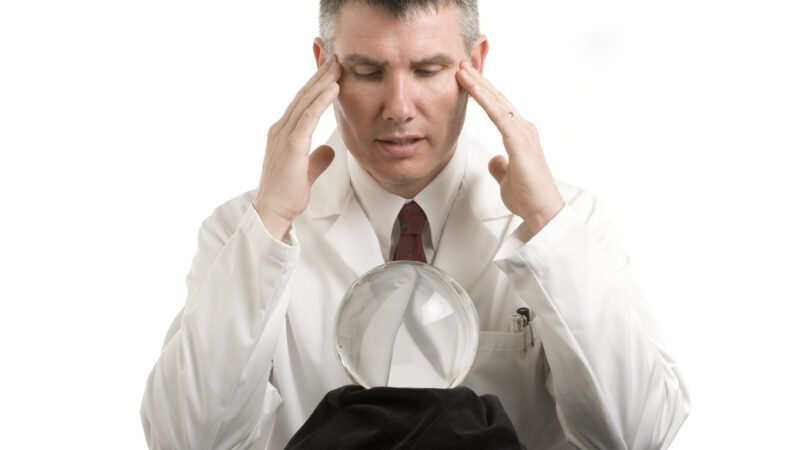
CrystalBallDoctorDreamstime

An argument for humility in the face of pandemic forecasting unknown unknowns.

“Are we battling an unprecedented pandemic or panicking at a computer generated mirage?” I asked at the beginning of the COVID-19 pandemic on March 18, 2020. Back then the Imperial College London epidemiological model’s baseline scenario projected that with no changes in individual behaviors and no public health interventions, more than 80 percent of Americans would eventually be infected with novel coronavirus and about 2.2 million would die of the disease. This implies that 0.8 percent of those infected would die of the disease. This is about 8-times worse than the mortality rate from seasonal flu outbreaks.

Spooked by these dire projections, President Donald Trump issued on March 16 his Coronavirus Guidelines for America that urged Americans to “listen to and follow the directions of STATE AND LOCAL AUTHORITIES.” Among other things, Trump’s guidelines pressed people to “work or engage in schooling FROM HOME whenever possible” and “AVOID SOCIAL GATHERINGS in groups of more than 10 people.” The guidelines exhorted Americans to “AVOID DISCRETIONARY TRAVEL, shopping trips and social visits,” and that “in states with evidence of community transmission, bars, restaurants, food courts, gyms, and other indoor and outdoor venues where people congregate should be closed.”

Let’s take a moment to recognize just how blindly through the early stages of the pandemic we—definitely including our public health officials—were all flying at the time. The guidelines advised people to frequently wash their hands, disinfect surfaces, and avoid touching their faces. Basically, these were the sort of precautions typically recommended for influenza outbreaks. On July 9, 2020, an open letter from 239 researchers begged the World Health Organization and other public health authorities to recognize that COVID-19 was chiefly spread by airborne transmission rather than via droplets deposited on surfaces. The U.S. Centers for Disease Control and Prevention (CDC) didn’t update its guidance on COVID-19 airborne transmission until May 2021. And it turns out that touching surfaces is not a major mode of transmission for COVID-19.

The president’s guidelines also advised, “IF YOU FEEL SICK, stay home. Do not go to work.” This sensible advice, however, missed the fact that a huge proportion of COVID-19 viral transmission occurred from people without symptoms. That is, people who feel fine can still be infected and, unsuspectingly, pass along their virus to others. For example, one January 2021 study estimated that “59% of all transmission came from asymptomatic transmission, comprising 35% from presymptomatic individuals and 24% from individuals who never develop symptoms.”

The Imperial College London’s alarming projections did not go uncontested. A group of researchers led by Stanford University medical professor Jay Bhattacharya believed that COVID-19 infections were much more widespread than the reported cases indicated. If the Imperial College London’s hypothesis were true, Bhattacharya and his fellow researchers argued, that would mean that the mortality rate and projected deaths from the coronavirus would be much lower, making the pandemic much less menacing.

The researchers’ strategy was to blood test people in Santa Clara and Los Angeles Counties in California to see how many had already developed antibodies in response to coronavirus infections. Using those data, they then extrapolated what proportion of county residents had already been exposed to and recovered from the virus.

Bhattacharya and his colleagues preliminarily estimated that between 48,000 and 81,000 people had already been infected in Santa Clara County by early April, which would mean that COVID-19 infections were “50-85-fold more than the number of confirmed cases.” Based on these data the researchers calculated that toward the end of April “a hundred deaths out of 48,000-81,000 infections corresponds to an infection fatality rate of 0.12-0.2%.” As I optimistically reported at the time, that would imply that COVID-19’s lethality was not much different than for seasonal influenza.

Bhattacharya and his colleagues conducted a similar antibody survey in Los Angeles County. That study similarly asserted that COVID-19 infections were much more widespread than reported cases. The study estimated 2.8 to 5.6 percent of the residents of Los Angeles County had been infected by early April. That translates to approximately 221,000 to 442,000 adults in the county who have had the infection. “That estimate is 28 to 55 times higher than the 7,994 confirmed cases of COVID-19 reported to the county by the time of the study in early April,” noted the accompanying press release. “The number of COVID-related deaths in the county has now surpassed 600.” These estimates would imply a relatively low infection fatality rate of between 0.14 and 0.27 percent. 

Unfortunately, from the vantage of 14 months, those hopeful results have not been borne out. Santa Clara County public health officials report that there have been 119,712 diagnosed cases of COVID-19 so far. If infections were really being underreported by 50-fold, that would suggest that roughly 6 million Santa Clara residents would by now have been infected by the coronavirus. The population of the county is just under 2 million. Alternatively, extrapolating a 50-fold undercount would imply that when 40,000 diagnosed cases were reported on July 11, 2020, all 2 million people living in Santa Clara County had been infected by that date.

Los Angeles County reports 1,247,742 diagnosed COVID-19 cases cumulatively. Again, if infections were really being underreported 28-fold, that would imply that roughly 35 million Angelenos out of a population of just over 10 million would have been infected with the virus by now. Again turning the 28-fold estimate on its head, that would imply that all 10 million Angelenos would have been infected when 360,000 cases had been diagnosed on November 21, 2020.

COVID-19 cases are, of course, being undercounted. Data scientist Youyang Gu has been consistently more accurate than many of the other researchers parsing COVID-19 pandemic trends. Gu estimates that over the course of the pandemic, U.S. COVID-19 infections have roughly been 4-fold greater than diagnosed cases. Applying that factor to the number of reported COVID-19 cases would yield an estimate of 480,000 and 5,000,000 total infections in Santa Clara and Los Angeles respectively. If those are ballpark accurate, that would mean that the COVID-19 infection fatality rate in Santa Clara is 0.46 percent and is 0.49 percent in Los Angeles. Again, applying a 4-fold multiplier to take account of undercounted infections, those are both just about where the U.S. infection fatality rate of 0.45 percent is now.

The upshot is that, so far, we have ended up about half-way between the best case and worst case scenarios sketched out at the beginning of the pandemic.