Fauci vs. Rogan: White House works to stomp out misinformation

Fauci vs. Rogan: White House works to stomp out misinformation

Fauci vs. Rogan: White House works to stomp out misinformation | TheHill

The Biden administration is working to stamp out misinformation that might dissuade people from getting coronavirus shots, a crucial task as the nation shifts into the next, more difficult phase of its vaccination campaign.

The White House announced Friday that 100 million Americans are now fully vaccinated against COVID-19, but the nationwide rollout is plateauing as fewer people sign up for shots. 

Administration officials and health experts know the difficulty ahead in getting vaccines into as many people as possible, and are trying to eliminate the barriers to doing so.

Authorities need to dispel the legitimate concerns that make people hesitant, while also stopping waves of misinformation.

This past week, top infectious diseases expert Anthony Fauci corrected Joe Rogan, a popular podcast host who himself later acknowledged his lack of medical knowledge, after Rogan said young healthy people don’t need to be vaccinated.

“You’re talking about yourself in a vacuum,” Fauci said of the podcast host. “You’re worried about yourself getting infected and the likelihood that you’re not going to get any symptoms. But you can get infected, and will get infected, if you put yourself at risk.”

White House communications director Kate Bedingfield also joined in the criticism.

“Did Joe Rogan become a medical doctor while we weren’t looking? I’m not sure that taking scientific and medical advice from Joe Rogan is perhaps the most productive way for people to get their information,” she told CNN.

Rogan’s comments were trending on Twitter for two days before he attempted to walk them back.

“I’m not a doctor, I’m a f—ing moron, and I’m a cage fighting commentator … I’m not a respected source of information, even for me,” he said.

Public health experts said Rogan’s comments were irresponsible, and potentially dangerous because they could perpetuate hesitancy.

“You have a responsibility as an adult, you have a responsibility as a community leader, your responsibility as a communicator to get it right,” said Georges Benjamin, executive director of the American Public Health Association. 

While Rogan is not a political figure, he has one of the most popular podcasts in the world, and an enormous platform. 

Rogan hosts the most popular podcast on Spotify. Rogan said in 2019 that his podcast was being downloaded 190 million times per month.

People are not getting all their information from Rogan, but when his comments clash with what public health experts say, that is problematic.

“It’s not so much that Joe Rogan’s a comedian, he’s very popular with people sort of leaning on the conservative side, especially young people. And that’s the group that we have to reach, especially young men,” said Peter Hotez, a leading coronavirus vaccinologist and dean of Baylor University’s National School of Tropical Medicine.

Hotez, who has appeared on Rogan’s show in the past, said he thinks the host was just misinformed. Hotez said he has reached out, and wants to help Rogan have a more productive discussion about why it’s so important for everyone to be vaccinated against the coronavirus.

Polls show vaccine hesitancy is declining, but the holdouts are not monolithic, and experts believe trusted messengers will be needed. 

“I just think they have to speak the facts. You speak the facts, and anytime you discover the facts that are incorrect, you try to correct them,” said Benjamin. “And … I don’t think you demonize the individual, nor do I think you try to pin motive to it, because you don’t know what the motive is.”

Some people are most worried about side effects, some are concerned about the safety of the vaccines and some people don’t think COVID-19 is a problem at all. There are also likely some people who will never be convinced, and try to sow confusion and distrust. 

Biden administration officials are aware of the harmful impact of misinformation, but know they are walking a fine line between people who legitimately want more information and those who just want chaos.

“We know that people have questions for multiple reasons. Sometimes because there’s misinformation that they’ve encountered, sometimes because they’ve had a bad experience with the healthcare system and they’re wondering who to trust, and some people have just heard lots of different news as we continue to get updates on the vaccine, and they want to hear from someone they trust,” Surgeon General Vivek Murthy said during a White House briefing. 

For the White House, using medical experts like Fauci to correct obvious misinformation is part of the strategy to boost vaccine confidence.

“Our approach is to provide, and flood the zone with accurate information,” White House press secretary Jen Psaki said Friday. “Obviously that includes combating misinformation when it comes across.”

The administration has also invested $3 billion to support local health department programs and community-based organizations intended to increase vaccine access, acceptance and uptake. 

Still, experts said different messengers are needed, especially when trying to reach conservatives who may now view Fauci as a polarizing political figure.

“There needs to be a better organized effort by the administration to really understand how to reach groups that are identified in polls as saying they won’t get vaccinated,” Hotez said. “We need to figure out how to do the right kind of outreach with the conservative groups, and we’ve got to do something about” the damage caused by members of the conservative media.

In a recent CBS-YouGov poll, 30 percent of Republicans said they would not get the vaccine and another 19 percent said they only “maybe” would do so. 

The underlying mistrust comes after a year in which Trump and his allies played down the severity of a virus that has killed more than half a million Americans already. 

A national poll and focus group conducted by GOP pollster Frank Luntz showed Republicans who voted for President Trump will be far more influenced by their doctors and family members than any politician. 

To that end, a group of Republican lawmakers who are also physicians released a video urging people to get the COVID-19 vaccine.

The video, led by Sen. Roger Marshall (R-Kan.), features some of the lawmakers wearing white coats with stethoscopes around their necks speaking into the camera.

Taking a deeper look at vaccine hesitancy

https://mailchi.mp/097beec6499c/the-weekly-gist-april-30-2021?e=d1e747d2d8

The American public’s attitude toward COVID-19 vaccination has evolved rapidly since the end of last year. The share of adults who report they have either already been vaccinated or intend to get the vaccine as soon as possible continues to rise (currently about 62 percent), while the share who say they will “wait and see” continues to shrink (now 17 percent). Importantly, however, the share who say they will either “definitely not” get vaccinated or only do so “if required” (currently 20 percent) has remained stubbornly consistent since December.

As the US reaches a vaccine tipping point, with more COVID vaccines available than people willing to be vaccinated, it will be important to understand this vaccine-hesitant population more clearly. A recent consumer segmentation analysis found that this group falls into four major behavioral profiles, shown on the right side of the graphic above. 

The next phase of vaccine rollout must specifically address the key concerns of individuals in each of these different segments. For example, the “watchful” group, the easiest to persuade, will likely respond to a more transparent vaccination process and the amplification of positive vaccination testimonials. On the other hand, “system distrusters,” generally comprised of younger, lower-income minorities, would benefit most from hearing community leaders discuss vaccine safety. Unfortunately, the largest segment of vaccine-hesitant Americans, the “misinformation believers”, will also be the most difficult to turn. These individuals are more likely to hold rigid, politically driven beliefs.

While countering misinformation by leveraging trusted influencers may help convince some, this group may be the hardest to persuadealthough their participation will be crucial to hitting any goal of “herd immunity” by this fall.

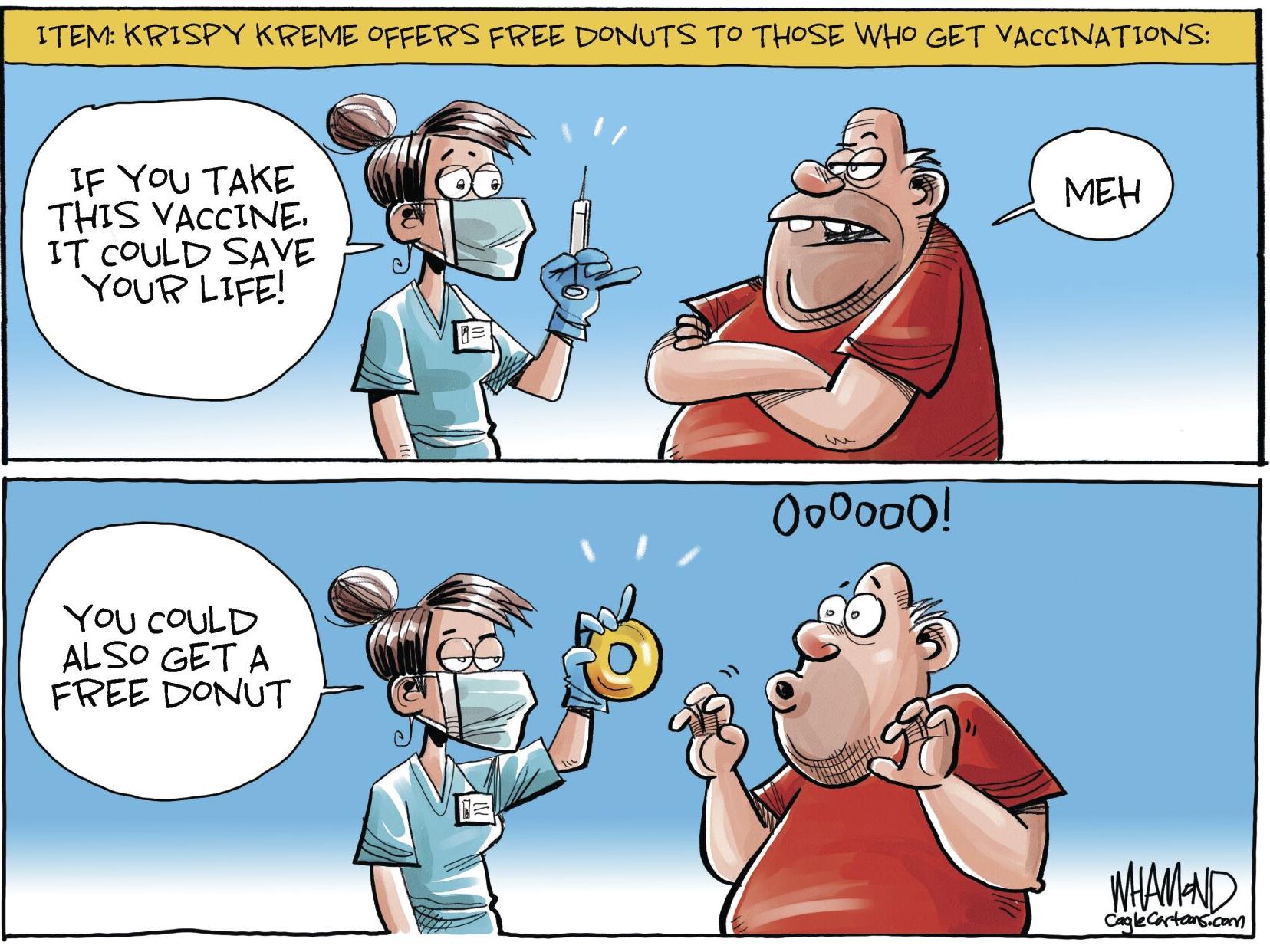
Cartoon – Krispy Kreme to the Rescue

Jim Henson & Joshua Blank: Vaccine hesitancy in Texas more than a  Republican issue | Columnists | wacotrib.com

The partisan divide in coronavirus vaccinations is widening

One hesitates to elevate obviously bad arguments, even to point out how bad they are. This is a conundrum that comes up a lot these days, as members of the media measure the utility of reporting on bad faith, disingenuous or simply bizarre claims.

If someone were to insist, for example, that they were not going to get the coronavirus vaccine solely to spite the political left, should that claim be elevated? Can we simply point out how deranged it is to refuse a vaccine that will almost certainly end an international pandemic simply because people with whom you disagree think that maybe this is a good route to end that pandemic? If someone were to write such a thing at some attention-thirsty website, we certainly wouldn’t want to link to it, leaving our own readers having to figure out where it might be found should they choose to do so.

In this case, it’s worth elevating this argument (which, to be clear, is actually floating out there) to point out one of the myriad ways in which the effort to vaccinate as many adults as possible has become interlaced with partisan politics. As the weeks pass and demand for the vaccine has tapered off, the gap between Democratic and Republican interest in being vaccinated seems to be widening — meaning that the end to the pandemic is likely to move that much further into the future.

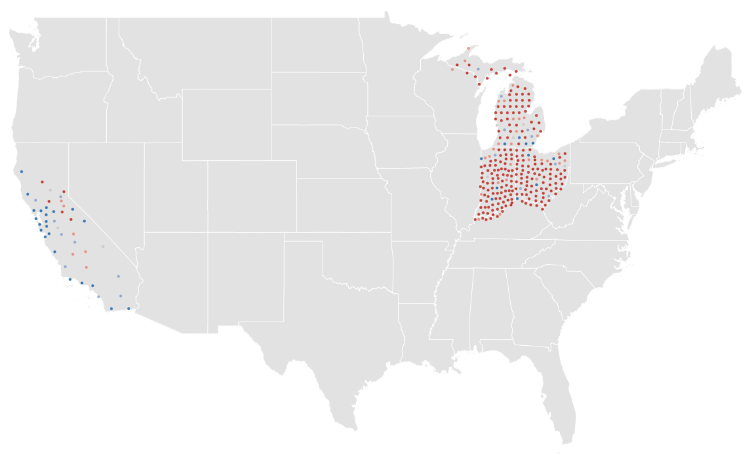
Consider, for example, the rate of completed vaccinations by county, according to data compiled by CovidActNow. You can see a slight correlation between how a county voted in 2020 — the horizontal axis — and the density of completed vaccinations, shown on the vertical. There’s a greater density of completed vaccinations on the left side of the graph than on the right.

If we shift to the percentage of the population that’s received even one dose of the vaccine, the effect is much more obvious.

This is a relatively recent development. At the beginning of the month, the density of the population that had received only one dose resulted in a graph that looked much like the current density of completed doses.

If we animate those two graphs, the effect is obvious. In the past few weeks, the density of first doses has increased much faster in more-Democratic counties.

If we group the results of the 2020 presidential contest into 20-point buckets, the pattern is again obvious.

It’s not a new observation that Republicans are less willing to get the vaccine; we’ve reported on it repeatedly. What’s relatively new is how that hesitance is showing up in the actual vaccination data.

A Post-ABC News poll released on Monday showed that this response to the vaccine holds even when considering age groups. We’ve known for a while that older Americans, who are more at risk from the virus, have been more likely to seek the vaccine. But even among seniors, Republicans are significantly more hesitant to receive the vaccine than are Democrats.

This is a particularly dangerous example of partisanship. People 65 or older have made up 14 percent of coronavirus infections, according to federal data, but 81 percent of deaths. That’s among those for whom ages are known, a subset (though a large majority) of overall cases. While about 1.8 percent of that overall group has died, the figure for those aged 65 and over is above 10 percent.

As vaccines have been rolled out across the country, you can see how more-heavily-blue counties have a higher density of vaccinations in many states.

This is not a universal truth, of course. Some heavily Republican counties have above-average vaccination rates. (About 40 percent of counties that preferred former president Donald Trump last year are above the average in the CovidActNow data. The rate among Democratic counties is closer to 80 percent.) But it is the case that there is a correlation between how a county voted and how many of its residents have been vaccinated. It is also the case that the gap between red and blue counties is widening.

Given all of that, it probably makes sense to point out that an argument against vaccines based on nothing more than “lol libs will hate this” is an embarrassing argument to make.

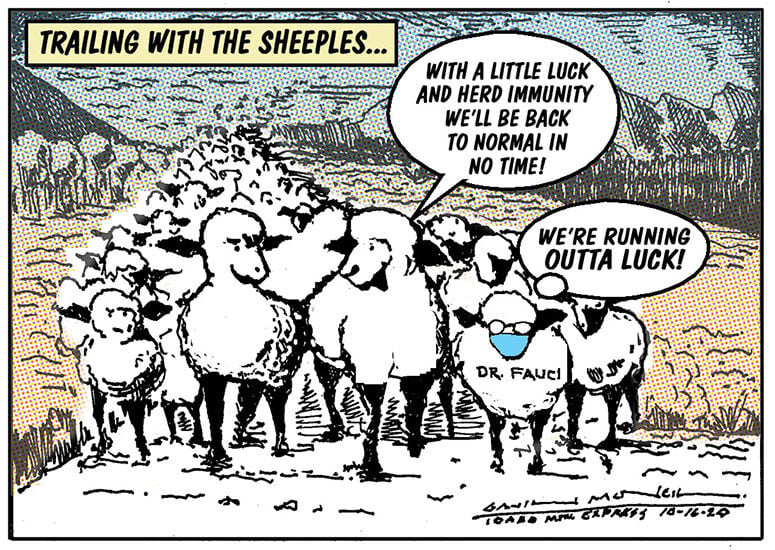
Cartoon – Trailing with the Sheeples

Herd Immunity | Cartoon | mtexpress.com

Cartoon – Vaccination from Making Decisions based on Politics

Marshall Ramsey: Vaccination | Mississippi Today

A quarter of the country won’t get the coronavirus vaccine

We’re a year into the coronavirus pandemic, so the math that undergirds its risks should by now be familiar. We all should know, for example, that the ability of the virus to spread depends on it being able to find a host, someone who is not protected against infection. If you have a group of 10 people, one of whom is infected and nine of whom are immune to the virus, it’s not going to be able to spread anywhere.

That calculus is well known, but there is still some uncertainty at play. To achieve herd immunity — the state where the population of immune people is dense enough to stamp out new infections — how many people need to be protected against the virus? And how good is natural immunity, resistance to infection built through exposure to the virus and contracting covid-19, the disease it causes?

The safe way to increase the number of immune people, thereby probably protecting everyone by limiting the ability of the virus to spread, is through vaccination. More vaccinated people means fewer new infections and fewer infections needed to get close to herd immunity. The closer we get to herd immunity, the safer people are who can’t get vaccinated, such as young children (at least for now).

The challenge the world faces is that the rollout of vaccines has been slow, relatively speaking. The coronavirus vaccines were developed at a lightning pace, but many parts of the world are still waiting for supplies sufficient to broadly immunize their populations. In the United States, the challenge is different: About a quarter of adult Americans say they aren’t planning on getting vaccinated against the virus, according to Economist-YouGov polling released last week.

That’s problematic in part because it means we’re less likely to get to herd immunity without millions more Americans becoming infected. Again, it’s not clear how effective natural immunity will be over the long term as new variants of the virus emerge. So we might continue to see tens of thousands of new infections each day, keeping the population at risk broadly by delaying herd immunity and continuing to add to the pandemic’s death toll in this country.

But we also see from the Economist-YouGov poll the same thing we saw in Gallup polling earlier this month: The people who are least interested in being vaccinated are also the people who are least likely to be concerned about the virus and to take other steps aimed at preventing it from spreading.

In the Economist-YouGov poll, nearly three-quarters of those who say they don’t plan on being vaccinated when they’re eligible also say they’re not too or not at all worried about the virus.

That makes some perverse sense: If you don’t see the virus as a risk, you won’t see the need to get vaccinated. Unfortunately, it also means you’re going to be less likely to do things like wear a mask in public.

Or you might be more likely to view as unnecessary precautions such as avoiding close-quarter contact with friends and family or traveling out of state.

About a quarter of adults hold the view that they won’t be vaccinated when eligible. That’s equivalent to about 64 million Americans.

Who are they? As prior polls have shown, they’re disproportionately political conservatives. At the outset of the pandemic, there was concern that vaccine skepticism would heavily be centered in non-White populations. At the moment, though, the rate of skepticism among those who say they voted for Donald Trump in 2020 and among Republicans is substantially higher than skepticism overall.

That shows up in another way in the Economist poll. Respondents were asked whose medical advice they trusted. Among those who say they don’t plan to get the vaccine, half say they trust Trump’s advice a lot or somewhat — far more than the advice of the Centers for Disease Control and Prevention or the country’s top infectious-disease expert Anthony S. Fauci.

If we look only at Republican skeptics, the difference is much larger: Half of Republican skeptics say they have a lot of trust in Trump’s medical advice.

The irony, of course, is that Trump sees the vaccine as his positive legacy on the pandemic. He’s eager to seize credit for vaccine development and has — sporadically — advocated for Americans to get the vaccine. (He got it himself while still president, without advertising that fact.) It’s his supporters, though, who are most hostile to the idea.

Trump bears most of the responsibility for that, too. Over the course of 2020, worried about reelection, he undercut containment efforts and downplayed the danger of the virus. He undermined experts such as Fauci largely out of concern that continuing to limit economic activity would erode his main argument for his reelection. Over and over, he insisted that the virus was going away without the vaccine, that it was not terribly dangerous and that America should just go about its business as usual — and his supporters heard that message.

They’re still listening to it, as the Economist poll shows. One result may be that the United States doesn’t reach herd immunity through vaccinations and, instead, some large chunk of those tens of millions of skeptics end up being exposed to the virus. Some of them will die. Some may risk repeat infections from new variants against which a vaccine offers better protection. Some of those unable to get vaccinated may also become sick from the virus because we haven’t achieved herd immunity, suffering long-term complications from covid-19.

Trump wants his legacy to be the rollout of the vaccine. His legacy will also probably include fostering skepticism about the vaccine that limits its utility in containing the pandemic.

Vaccine skepticism and disregard for containment efforts go hand in hand

It seems pretty clear the path the United States is on. Within a few months, everyone who wants to be vaccinated against the coronavirus will be, save for those below the minimum age for which vaccines are available. For everyone else, the pandemic Wild West will continue, with the country hopefully somewhere near the level of immunity that will keep the virus from spreading wildly but with large parts of the population — again, including kids — susceptible to infection.

That really gets at one of the two outstanding questions: How many Americans won’t get the vaccine? If the figure is fairly low, the ability of the virus to spread will be far lower. If it’s high, we have a problem. And that’s the other outstanding question: How big of a problem will the virus be, moving forward?

We know that even as vaccines are being rolled out, cases are slowly climbing. While the number of new infections recorded each day is well off the highs seen in the winter, we’re still averaging more cases on a daily basis than we saw even a month into the third wave that began in September. A lot of people are still getting sick, and, even with most elderly Americans now protected with vaccine, a lot more people will probably die.

Data released by Gallup this week shows that both of the questions posed above share a common component. It is, as you probably suspected, those who are least willing to get vaccinated who are also least likely to take steps to contain the virus.

Gallup asked Americans about their vaccination status, finding that about a fifth had been fully vaccinated and an additional 13 percent partially vaccinated. More than a quarter of respondents, though, said they didn’t plan to get vaccinated. It was those in that latter group who were least likely to say that they were completely or mostly isolating in an effort to prevent the virus spreading.

It was also those skeptics who were least likely to say that, in the past seven days, they had avoided crowds, group gatherings or travel. If you’re not inclined to get vaccinated, it is at least consistent that you would be similarly disinclined to take other steps aimed at limiting the spread of the virus.

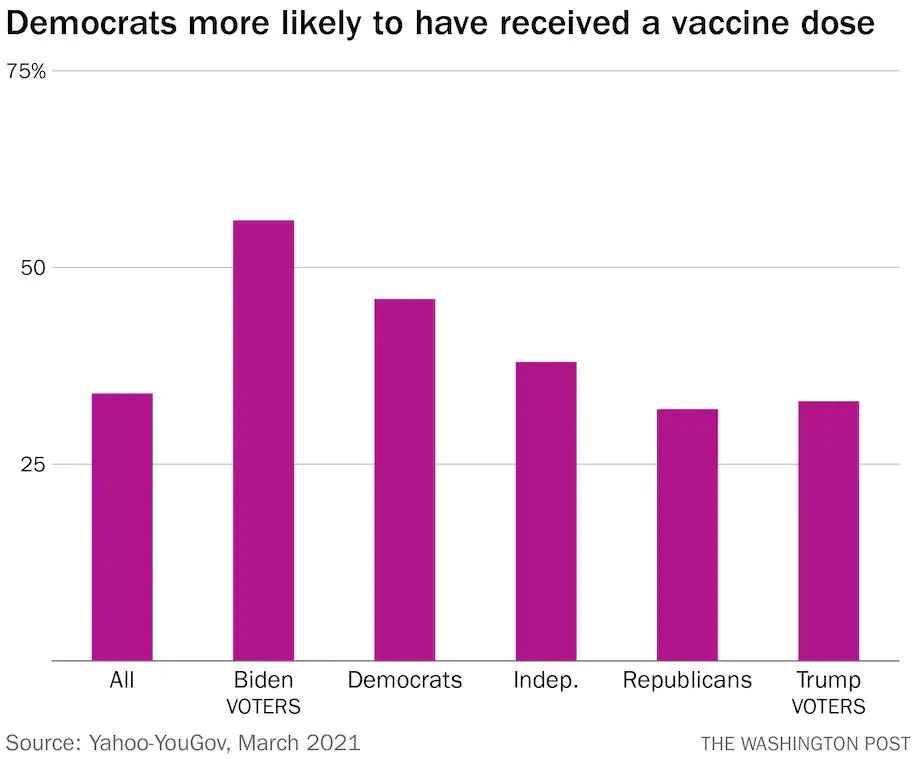
Gallup didn’t break out those groups by party, but it’s clear that few of them are Democrats. Data from YouGov, compiled on behalf of Yahoo News, shows that Democrats (and those who voted for Joe Biden in particular) are more likely to say that they have already received a vaccine dose.

Among those who hadn’t yet received a dose, Democrats were far more likely to indicate that they planned to do so as soon as possible. Among Republicans, half of those who haven’t been vaccinated say that they don’t have any plans to do so at all.

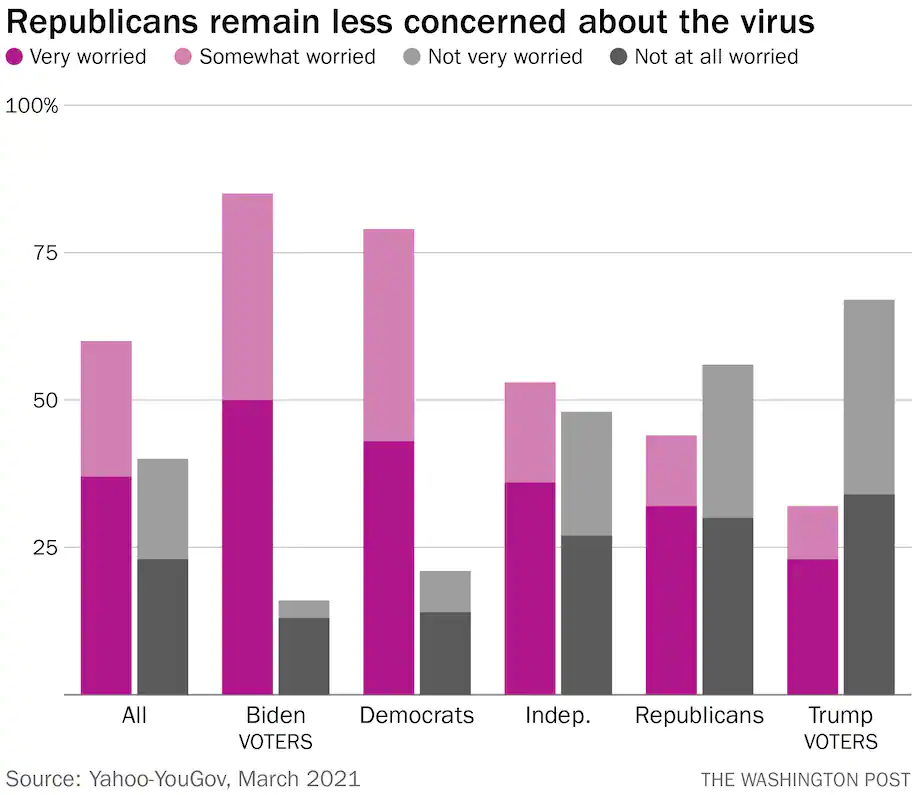
One reason is that Republicans are simply less worried about the virus. More than half say that they’re not very worried about it or not worried at all. Among those who voted for Donald Trump, the figure is over two-thirds. By contrast, more than three-quarters of Democrats say that they are at least somewhat worried about the virus.

In the YouGov polling, 60 percent of Republicans say that the worst of the pandemic is behind us. They’re also much more likely to say that restrictions aimed at preventing the spread of the virus — mask mandates, limits on indoor dining — should be lifted immediately.

As we mentioned Thursday, there are two ways to achieve herd immunity. One is fast and safe: widespread vaccinations. The other — people contracting the virus — is slow and dangerous. The path the United States is on will take us to a place where much of the country has opted for the first option and the rest, the latter.

So the question again becomes: How many people will die, both over the short term and the long term, as a result of those choices?

Two lawmakers test positive for coronavirus, one after receiving both doses of vaccine

Politics - The Washington Post

Two members of Congress from Massachusetts have tested positive for the coronavirus, one after receiving both doses of the vaccine, a reminder that people can still be vulnerable to infection after being vaccinated, particularly in the two weeks after receiving the second dose.

Rep. Stephen F. Lynch (D-Mass.) tested positive for the virus on Friday afternoon after a staff member in his Boston office tested positive earlier in the week, his spokeswoman Molly Rose Tarpey said.

Lynch received a second dose of the Pfizer-BioNTech vaccine before the inauguration of President Biden on Jan. 20, but his office declined to specify the date it was administered. Lynch had tested negative for the virus before attending the inaugural ceremonies, Tarpey said.

“While Mr. Lynch remains asymptomatic and feels fine, he will self-quarantine and will vote by proxy in Congress during the coming week,” she said.

Tarpey added that Lynch “has followed CDC guidelines and continues to do so since he received the vaccine.”

Another Democrat from Massachusetts, Rep. Lori Trahan, announced Thursday that she had tested positive for the virus and was asymptomatic. Trahan, whose staff members have been working remotely, also said she planned to vote by proxy next week.

“I encourage everyone to continue taking this virus seriously and to follow the science and data-driven guidance to wear a mask, maintain a safe social distance from others, avoid large gatherings and stay home whenever possible,” Trahan said.

Trahan received her first shot of one of the vaccines last week, spokeswoman Francis Grubar told The Washington Post.

Occasional cases of people testing positive after receiving one or both doses are not unexpected, medical experts say. Clinical trial data published by Pfizer show that the vaccine is about 52 percent effective at preventing illness after the first shot, compared to 95 percent effectiveness seven days after the second dose.

A small number of patients can still become mildly sick even after they are fully vaccinated. But only one of the roughly 20,000 people who received both doses in the clinical trial developed severe covid-19, suggesting the vaccine is powerful protection against the most dangerous cases of the disease.

Members of Congress began getting vaccinated as early as Dec. 18, but Lynch at the time said he was “waiting for the vaccine to be first offered to health care personnel, first responders and vulnerable seniors” in his district, the Boston Herald reported. It is unclear when Lynch ultimately received his first dose of the vaccine; he would have received the second dose of the Pfizer-BioNTech vaccine about three to four weeks after the first.

Public health experts have emphasized that it usually takes one week after the second dose of the Pfizer-BioNTech vaccine to reach 95 percent efficacy and two weeks after the second dose of the Moderna vaccine to reach 94 percent efficacy.

“There’s no vaccine that I know that protects you the same day you get it,” Onyema Ogbuagu, the principal investigator for Pfizer’s vaccine trial at Yale University, told The Post’s Allyson Chiu. “On a population level, 95% efficacy still translates to 5/100, or 50/1,000, or 500/10,000 vaccinated persons still being vulnerable to symptomatic disease and maybe even more having asymptomatic carriage.”

At least 23.2 million people in the United States have received one or both doses of the vaccine. The Centers for Disease Control and Prevention recommends that vaccinated people continue to wear masks, socially distance, avoid poorly ventilated spaces and wash their hands frequently to prevent the spread of the virus.

“We also don’t yet know whether getting a covid-19 vaccine will prevent you from spreading the virus that causes covid-19 to other people, even if you don’t get sick yourself,” CDC guidelines state. “While experts learn more about the protection that covid-19 vaccines provide under real-life conditions, it will be important for everyone to continue using all the tools available to help stop this pandemic.”

Mask-wearing in particular has become politicized, including in the hallways of Congress. After the Jan. 6 siege at the Capitol, several Democrats said they feared they had been exposed to the virus after sheltering with Republican lawmakers who refused to wear masks. In the following, at least three lawmakers tested positive for the virus.

On Friday, Rep. Cori Bush (D-Mo.) accused Rep. Marjorie Taylor Greene (R-Ga.) of berating her in the hallways after she told Greene to put on a mask. The incident, coupled with other hostile rhetoric and Greene’s refusal to abide by rules and protocols put in place because of the pandemic, prompted Bush to decide to move her office away from Greene’s for safety reasons, the Missouri lawmaker said.