The spotlight is on health insurance companies. Patients are telling their stories of denied claims, bankruptcy and delayed care.

https://www.yahoo.com/lifestyle/spotlight-health-insurance-companies-patients-014648180.html

After UnitedHealthcare CEO Brian Thompson, left, was killed and Anthem released a controversial anesthesia policy, people shared their stories of insurance woes. (UnitedHealth Group via AP, Getty)

After UnitedHealthcare CEO Brian Thompson, left, was killed and Anthem released a controversial anesthesia policy, people shared their stories of insurance woes. (UnitedHealth Group via AP, Getty)

On Wednesday, Brian Thompson, the chief executive of UnitedHealthcare, was fatally shot in midtown Manhattan in what police are calling a “pre-meditated, preplanned, targeted attack.” Days before, Anthem Blue Cross Blue Shield said in a note to providers that it would limit anesthesia coverage in some states if a surgery or procedure exceeded a set time limit (the policy, set to go into effect in February, was swiftly reversed following an uproar).

The U.S. health care insurance system relies on private insurance, which covers 200 million Americans, and government-run programs.

Americans receive coverage through their employers, government programs like Medicaid or Medicare or by purchasing it themselves — often at a high cost. Even when an individual is covered by insurance, medical coverage can be expensive, with co-pays, deductibles and premiums adding up. Going to an out-of-network provider for care (which can be done unintentionally, for example if you are taken by ambulance to a hospital) can lead to exorbitant bills.

And then there’s the fact that, according to data from state and federal regulators, insurers reject about one in seven claims for treatment.

And most people don’t push back — a study found that only 0.1% of denied claims under the Affordable Care Act, a law designed to make health insurance more affordable and prevent coverage denials for pre-existing conditions, are formally appealed. This leaves many people paying out of pocket for care they thought was covered — or skipping treatment altogether.

For many, the cost of life-saving care is too high, and medical debt is the No. 1 cause of bankruptcy in America.

That is to say nothing of the emotional labor of navigating the complex system. With Thompson’s killing and the Anthem policy, there’s been widespread response with a similar through line: a pervasive contempt for the state of health insurance in the United States. The most illustrative reactions, though are the personal ones, the tales of denied claims, battles with insurance agents, delayed care, filing for bankruptcy and more.

‘We sat in the hospital for three days’

Jessica Alfano, a content creator who goes by @monetizationmom, shared her story on TikTok about battling an insurance company while her one-year-old child was in the hospital with a brain tumor. When her daughter needed to have emergency surgery at a different hospital was outside their home state, UnitedHealthcare allegedly refused to approve the transfer via ambulance to New York City. She also couldn’t drive her daughter to the hospital as the insurance company told them they would not cover her at the next hospital if they left the hospital by their own will and did not arrive by ambulance. “I vividly remember being on the phone with UnitedHealthcare for days and days — nine months pregnant about to give birth alone — while my other baby was sitting in a hospital room,” she said.

https://www.tiktok.com/embed/v2/7444723783765740830?lang=en-US&referrer=https%3A%2F%2Fwww.yahoo.com%2Flifestyle%2Fspotlight-health-insurance-companies-patients-014648180.html&embedFrom=oembed

‘Excruciating pain’

While pregnant, Allie, who posts on TikTok as @theseaowl44, went to the hospital in “excruciating pain,” she said in a video. After initially being sent home by a doctor who said she was having pain from a urinary tract infection and the baby sitting on her bladder, she returned to the hospital to learn she was suffering from appendicitis. She was sent to a bigger hospital in St. Louis, where she had emergency surgery. Her son survived the surgery but died the next day after she delivered him.

https://3489f1614246e47166ad8768064e31d6.safeframe.googlesyndication.com/safeframe/1-0-40/html/container.html

About 45 minutes later, Allie suffered a pulmonary embolism and had to have an emergency dilation and curettage (D&C) to remove the placenta, nearly dying in the process. It was after all of this that she learned she had been sent to a hospital that was out of network. “We ended up with a bill from the hospital that was more than what we paid for the home that we live in, and it was going to take probably, I don’t know, 20 to 30 years to pay off this hospital bill,” Allie said. “We opted to have to file bankruptcy, but not before I exhausted every appeal with [insurance company] Cigna — I wrote letters, I spilled my heart out, I talked on the phone, I explained our situation and our story, thinking surely someone would understand this was not my fault.

On the third and final appeal, because they only allow you three, Cigna’s appeal physician told me, point blank, it was my fault that when I was dying from a ruptured appendix in the ER, that I didn’t check and make sure that the hospital I was being sent to by ambulance was in my insurance network.”

https://www.tiktok.com/embed/v2/7445019152714173726?lang=en-US&referrer=https%3A%2F%2Fwww.yahoo.com%2Flifestyle%2Fspotlight-health-insurance-companies-patients-014648180.html&embedFrom=oembed

Hundreds of similar stories are being told, but the comments section on these videos paints a picture in itself. “I wear leg braces and walk with crutches as a paraplegic and they tried to deny my new leg braces and only approve me a wheelchair. They wanted to take my ability to WALK away,” commented TikToker @ChickWithSticks.

“Perfectly healthy pregnancy, until it wasn’t,” TikToker Meagan Pitts shared. “NICU stay was covered by my insurance, the neonatologist group contracted by the NICU: Denied. I’m sorry, what?”

Another wrote that her son was born with a congenital heart defect and needed open heart surgery. “My husband changed jobs & we switched to UHC,” she wrote. “They DENIED my son’s cath lab intervention!”

‘The most stressful time of my life’

One Redditor, @Sweet_Nature_7015, wrote that they struggled with UnitedHealthcare when they and their husband were in a “terrible car accident” that was the other driver’s fault. Since United Healthcare only covered two days in the hospital, the Redditor wrote that the case manager tried to find a way to “kick him out of the hospital” — but since their husband was in a coma, he was unable to be discharged safely. “The stress of being told — your health insurance isn’t covering this anymore, we have to discharge your husband — while he’s in a freaking coma and on a ventilator, etc, rediculous [sic],” they wrote. “I have to sign some papers to give up all of my husband’s benefits via his job – which included his life insurance that he had paid into, so we lost that. This allowed him to be covered by Medicaid. I can’t even put into words how much stress UHC caused on top of my husband (and my) health issues in the most stressful time of my life.”

The kicker, they wrote, was that years later the couple was awarded a court settlement from the other driver in the accident — and “UHC rolled up to the court and took the entire settlement money as their payment for those two days in the hospital they had paid for.”

‘I’m one of the lucky ones’

On the same thread, Redditor @sebastorio wrote that they went to the emergency room for an eye injury, which their doctor said could have resulted in a loss of sight. “UHC denied my claim, and I paid $1,400 out of pocket,” they said. “I’m one of the lucky ones. Can’t imagine how people would feel if that happened for critical or life-saving care.”

‘Constant stream of hostile collection calls’

Redditor @colonelcatsup opened up about their experience with insurance while having a baby, writing that they went into premature labor while insured under one company but that at midnight, their insurance switched to United Healthcare. “I gave birth in the morning. My daughter was two months early and was in the NICU for weeks so the bill was over $80,000 and United refused to pay it, saying it wasn’t their responsibility,” they wrote. “In addition to dealing with a premature baby, I had a constant stream of hostile collection calls and mail from the hospital for 18 months. My credit took a hit.”

Eventually, their employer hired an attorney to fight UHC, and the insurance company eventually paid. “I will never forgive them for the added stress hanging over me for the first year and a half of my child’s life,” they wrote.

‘Debt or death’

On Substack, on which she posted an excerpt from her Instagram, author Bess Kalb also recounted her experience with health insurance coverage when she was bleeding during her pregnancy and was asked by an EMT what insurance she had before deciding whether they would go to the nearest hospital. When her husband said to take Kalb to the hospital, despite not knowing the insurance implications, their bill was more than $10,000.https://www.instagram.com/p/DDNphXCp3Qu/embed/captioned/?cr=1&v=12

“The private insurance industry forces millions of Americans to choose between debt or death,” Kalb wrote. “Often, ghoulishly, the outcome is both. If I were worried about an ambulance out of coverage, I would have waited at home or waited in traffic for an hour to cross Los Angeles to get to my doctor’s office and sat in the waiting room bleeding out and perhaps would not be here to write this, and neither would my son.”


Trump picks HHS and CMS nominees

https://www.kaufmanhall.com/insights/blog/gist-weekly-november-22-2024

Last week, President-elect Donald Trump announced that Robert F. Kennedy, Jr. would be his nominee for Secretary of Health and Human Services (HHS). He followed this up on Tuesday with his selection of Dr. Mehmet Oz as his nominee for the Centers for Medicare and Medicaid Services (CMS) Administrator. If confirmed, the two men would replace Xavier Becerra and Chiquita Brooks-LaSure, respectively.

Kennedy, who ended his independent presidential campaign and endorsed Trump in August, has become known for his heterodox views on public health, including vaccine skepticism and opposition to water fluoridization.

Dr. Oz, first famous as a TV personality and more recently a Republican candidate for Pennsylvania Senator, is a strong proponent of Medicare Advantage, having co-authored an op-ed advocating for “Medicare Advantage for All” in 2020.

The Gist: 

These nominees, especially Kennedy, hold a number of personal beliefs at odds with the public health consensus. 

They are both likely to be confirmed, however, as the last cabinet nominee to be rejected by the Senate was John Tower in 1989. (This does not include nominees who have chosen to withdraw themselves from consideration, as former Representative Matt Gaetz has just done.)

Should they be confirmed, they will be responsible for implementing not their own but President Trump’s agenda, the specific priorities of which also remain relatively undefined. 

However, possible consensus points between Trump and his nominees include public health cuts and deregulationgreater scrutiny of pharmaceutical companies, and a favoring of Medicare Advantage over traditional Medicare.

    New Senate Report on Prior Authorization in Medicare Advantage Begs a Question: Can Big Insurance Ever Be Regulated Adequately to Ensure Patient Care?

    Last week, the Senate Permanent Subcommittee on Investigations, led by Sen. Richard Blumenthal (D-Connecticut), released a Majority Staff Report on rampant prior authorization (PA) abuses in Medicare Advantage (MA).

    The report offers unique insight into recent trends in the use of prior authorization by Medicare Advantage plans and the strategy and motives behind insurance corporations’ use of it. 

    While the findings won’t surprise those who’ve been following health policy trends, it is immensely concerning that between 2019 and 2022, the prior authorization denial rate for post-acute care in UnitedHealth’s Medicare Advantage plans doubled.

    The denial rate for long-term acute care hospitals in Humana’s Medicare Advantage plans increased by 54% from 2020 to 2022. During this time, UnitedHealth, CVS/Aetna, and Humana increased their use of artificial intelligence (AI) for prior authorization reviews, often resulting in increasing denial numbers and decreasing (or absent) review time by human beings.

    The report recommends that the Centers for Medicare and Medicaid Services (CMS) collect additional data, conduct audits of prior authorization processes, and expand regulations on the use of technology in PA reviews. While these recommendations would be positive steps, the report’s findings call into question whether Big Insurance can ever be trusted or regulated enough to prevent abuse of patients through prior authorization and other mechanisms. 

    This report provides an in-depth look at insurers’ motivations. Sadly, those motivations are not to “make sure a service or prescription is a clinically appropriate option,” as UnitedHealth claims, but to decrease the amount spent on medical care to increase the corporations’ profits.

    The report noted that CVS, which owns Aetna, saved $660 million in 2018 by denying Medicare Advantage patients’ claims for treatment at inpatient facilities. Around the same time, CVS found in its testing of a model to “maximize approvals,” which would be a good thing for patients, that the model jeopardized profits because it would lead to more care being covered. In 2022, CVS “deprioritized” a plan to increase auto-approvals because of the lost “savings” from denying patient care. 

    The report found that the motivation to increase profits, without regard for patient care, was not unique to CVS/Aetna.

    UnitedHealth’s naviHealth subsidiary provided this directive to its employees: “IMPORTANT: Do NOT guide providers or give providers answers to the questions” when speaking to a patient’s doctor about a prior authorization request. Instead of working collaboratively with doctors to get patients the care they need, UnitedHealth told its workers not to bother. In a training session offered to Humana employees involved in prior authorization reviews, the company explained that reviewers should deny a request for post-acute care even if a patient needed more intensive treatment. Humana told reviewers that the lack of an in-network lower-level care facility for patients to go to was not a reason to approve post-acute care and that usually the situations can be “sorted out,” presumably by the patient with no help from the insurer.

    All three companies (UnitedHealth, Humana and CVS/Aetna), which dominate the Medicare Advantage program,  demonstrated a striking lack of motivation to protect and enhance patient care, instead showing a primary motivation to increase profits and margins. 

    The subcommittee’s report also noted that UnitedHealth, CVS/Aerna, and Humana are increasingly using AI to make care decisions and cutting humans, especially doctors, out of the process. The researchers found that in 2022, UnitedHealth looked into how using AI and machine learning could aid in predicting which denials of post-acute care requests were most likely to be overturned.  One would hope this effort would be to decrease the number of wrongfully denied prior authorization requests and increase patient access to care.

    However, the report includes a quote from a recap of a meeting on the project asking “what we could do in the clinical review process to change the outcome of the appeal,” meaning that UnitedHealth was interested in preventing the overturning of denials, not getting the decision right in the first place. The report also found evidence that naviHealth used artificial intelligence to help determine the coverage decisions for a patient’s post-acute care claim before any human post-acute care providers evaluated a case. The report’s authors found that denials for post-acute care facilities rose rapidly once naviHealth began managing these requests for UnitedHealth’s MA plans. 

    These are just some of the findings in the 54-page report on Big Insurance’s use of prior authorization to deny Medicare Advantage patient requests for post-acute care.

    The report’s findings demonstrate the abuse of prior authorization by the insurers, the motivation to increase profit and decrease patient care, and the use of AI to increase denials. Further, the findings underscore that prior authorization is a tool used by Big Insurance primarily to maximize profits. The report puts forward recommendations to cut down on abusive denials, which would have some positive impact.

    More importantly, I believe the report provides more evidence that it is becoming exceedingly less likely that private and for-profit insurance companies can be regulated and act in a way that promotes patient health over profits.

    Private Health Insurance Spends Big on Political Contributions and Lobbying

    With the election looming and the beginning of annual open enrollment periods for health insurance plans, it is vital to pull back the curtain on the influx of money from Big Insurance corporations to political campaigns and lobbying. 

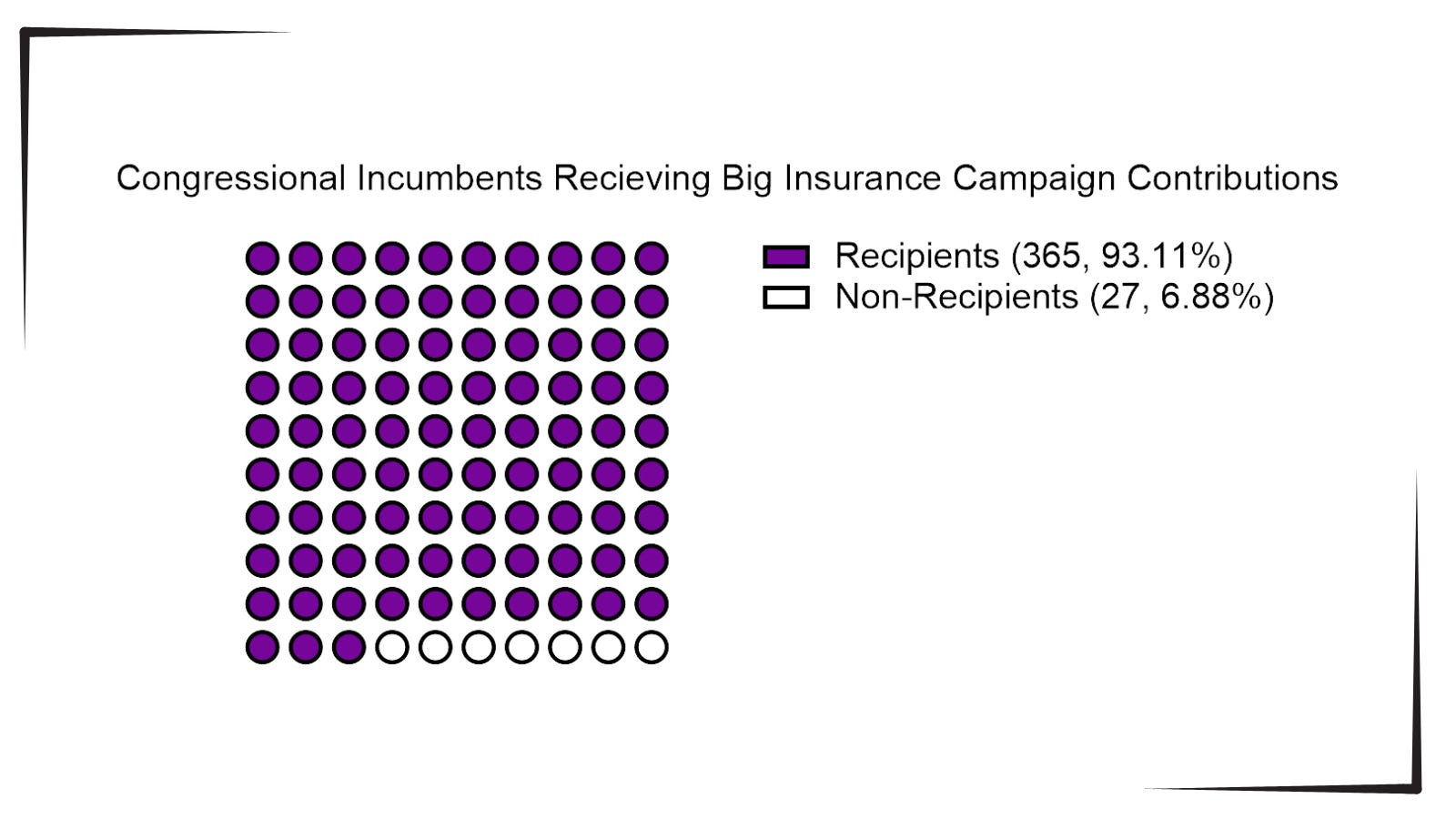
    Data available from OpenSecrets.com thus far in 2024 shows that 93% of Congressional incumbents running in 2024 received contributions from Big Insurance, including 100% of Senate incumbents. These insurance corporations run the ten largest Medicare Advantage plans in the country and are known to deny needed health care and defraud the government, but face little to no consequences.

    Insurance corporations included in this analysis are UnitedHealth Group, Humana, CVS/Aetna, Kaiser Permanente, Elevance Health, Centene Corp, Cigna, Blue Cross Blue Shield Association (which represents many MA plans, including two of the largest: BCBSMichigan and Highmark), and SCAN.

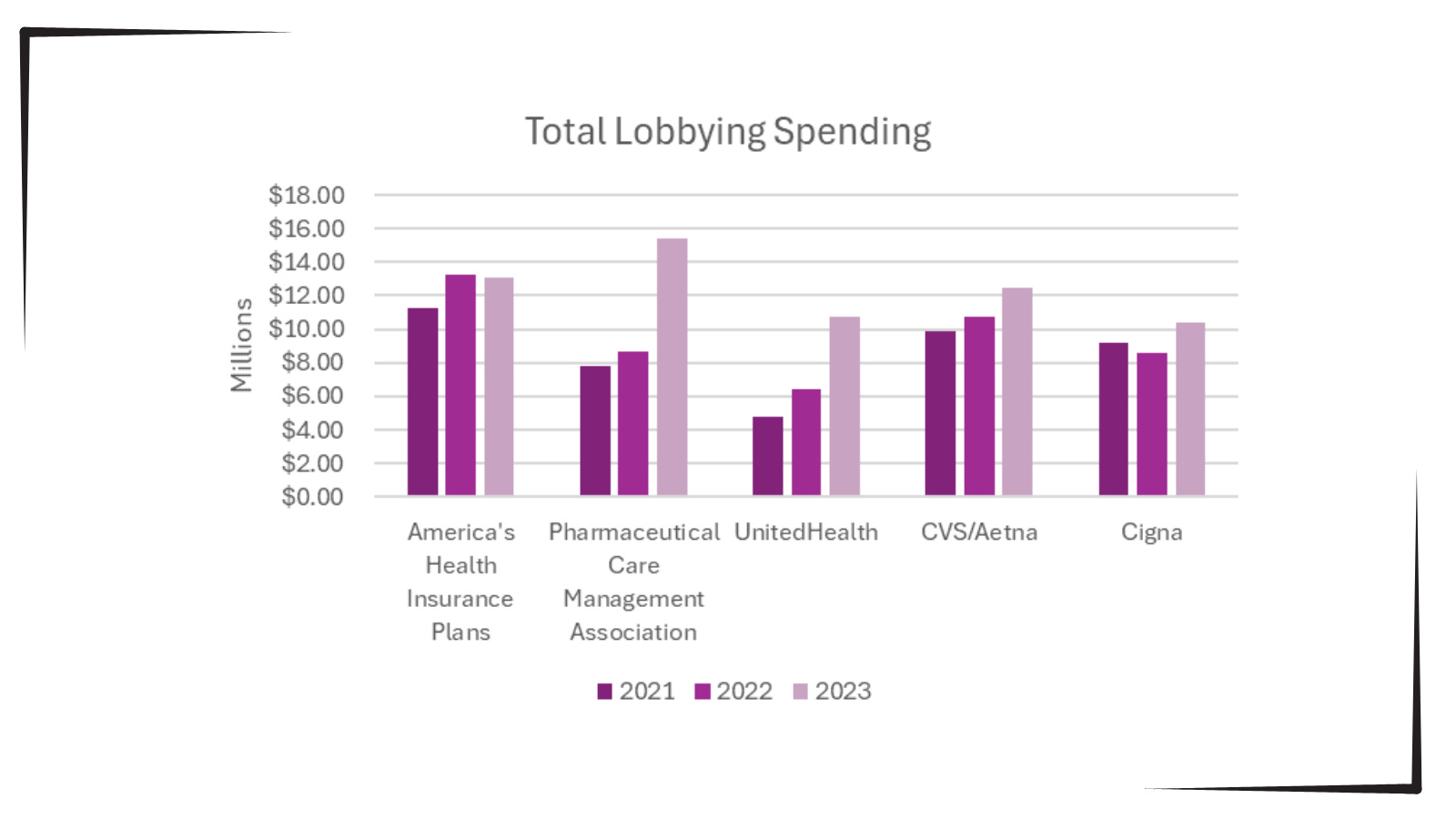
    Additionally, as bipartisan scrutiny of pharmacy benefit managers (PBMs) and Medicare Advantage plans has intensified, spending by Big Insurance on lobbying has increased.

    Total lobbying spending by America’s Health Insurance Plans; Pharmaceutical Care Management Association; UnitedHealth; CVS/Aetna; and Cigna for the years 2021, 2022 and 2023.

    This open enrollment season, people struggling to choose a health insurance plan that they can afford and that provides the care they need may ask themselves, “Why is our health care system like this?” The immense amounts of money Big Insurance spends to blanket members of Congress with contributions and lobbying hold the answer. 

    Additional analysis following the election will allow evaluation of just how much Big Insurance spends on politics to help protect industry profits and will give health reform advocates an idea of how to overcome this influence to pass policies for patients, not profits.

    UnitedHealth Group Has Made $24.5 Billion in Profits This Year (So Far) But Still Takes Beating on Wall Street

    UnitedHealth Group has taken a beating on Wall Street this week after admitting that its Medicare Advantage plans had to pay out more in medical claims in the third quarter of this year than investors had expected. As I’ve noted many times, Wall Street can’t stand it and gets very spiteful when Big Insurance uses more of our premium dollars paying for patients’ care because that means there’s less money left over to enrich shareholders. 

    At the end of trading at the New York Stock Exchange Tuesday, UnitedHealth’s share price was down 8.11% — almost $50 a share — falling like a rock from $605.40 to $556.29 as soon as the market opened. It had reached a 52-week high just the day before but fell off a cliff Tuesday morning. This despite the fact that the company still made $8.7 billion in operating profits during the third quarter.

    What investors didn’t like at all was the fact that UnitedHealthcare’s medical loss ratio (MLR) climbed to 85.2% from 82.3% for the same period last year.

    By other measures, the company did just fine, especially when you look at how much money it made during the first nine months of this year: a whopping $24.5 billion in profits.

    Enrollment in both the company’s commercial and Medicare Advantage plans increased, but it posted a significant decline in the number of people enrolled in the Medicaid plans its administers for several states. That’s because of the Medicaid “unwinding” that has been going on since the official end of the pandemic.  

    And here is another couple of numbers of note from the third quarter:

    UnitedHealth’s Optum division, which encompasses its massive pharmacy benefit manager, Optum Rx, made more money for the parent company than the health plan division: $4.5 billion in profits vs. $4.2 billion for UnitedHealthcare.

    PBMs have become even more of a cash cow for Big Insurance than Medicare Advantage, which despite the higher MLRs of late is still a reliable money-gushing ATM for the industry. 

    Corporate Takeover Has Not Been Good for Healthcare

    Four decades ago, Paul Starr noted in his landmark history of U.S. healthcare, “The Social Transformation of American Medicine,” that the industry had taken a decisive turn toward corporate ownership. “Medical care in America now appears to be in the early stages of a major transformation in its institutional structure,” he wrote. “Corporations have begun to integrate a hitherto decentralized hospital system, enter a variety of other health care businesses, and consolidate ownership and control in what may eventually become an industry dominated by huge healthcare conglomerates.”

    Forty years later, Starr’s prediction has come true. The vast majority of hospitals (other than critical access facilities) are now part of health systems, and some of those belong to giant for-profit or not-for-profit corporations. Nearly 80% of physicians are now employed by hospitals or private companies, including health insurers like United Healthcare. Most community pharmacies have been displaced by enormous chains like CVS, Walgreens and Walmart. Nursing home chains have taken over two-thirds of skilled nursing facilities. A handful of huge firms dominate health insurance, and a dozen drug manufacturers produce and set the prices of the most common prescription medicines.

    Private equity (PE) investors focus like a laser beam on generating profits. There can be an amoral quality to PE investing, seeking returns whether or not they create value for customers in the marketplace.

    Steward Healthcare, a large hospital chain initially created with PE investment has become, whether fair or not, a poster child for what can go wrong with private investment in healthcare. Steward went bankrupt after aggressively expanding into new markets beyond Massachusetts with funding generated from sales-leaseback arrangements with Real Estate Investment Trusts (REITs).

    But many of the PE firms that now own over 200 acute care hospitals take a similar approach. According to a recent study of PE-owned hospitals, two years after they were purchased, 61% of them had reduced capital assets, compared to 15.5% of control hospitals. Assets decreased by a mean of 15% for acquired hospitals and increased by 9.2% for controls during that period.

    Corporate Goals Vs. Value-Based Care
    The consolidation of the industry by large corporate entities has received a fair amount of media attention. What has been less noticed is the incompatibility between corporate goals and value-based care. One reason for this is that many big healthcare systems pretend to be interested in population health management. For example, they may operate accountable care organizations (ACOs) that seek to improve the quality of care and reduce costs through better prevention and care coordination. They may also try to reduce readmissions, which helps them avoid Medicare penalties.

    Don’t be fooled. There are exceptions — including the few integrated systems like Kaiser and Geisinger that take financial responsibility for care — but most healthcare systems have no intention of turning their business model upside down by using population health management to decrease admissions and empty their beds. When for-profit chains deliver reports to stock analysts, or not-for-profits seek to sell bonds, the metric they most often use to show their financial health is their occupancy rate, not their success in value-based care.

    Meanwhile, the healthcare behemoths are continuing to grow larger. While the Department of Justice has ramped up its antitrust activity under the Biden Administration and has discouraged some mergers, this has had relatively little impact on healthcare consolidation. Academic medical centers are acquiring more community hospitals as referral sources, and some large systems like Risant Health, a nonprofit entity created by Kaiser Permanente, are doing interstate deals that help them escape the oversight of state laws.

    Physicians have been largely a football in the matches between giant healthcare systems and equally massive insurers. Many independent practices have been forced to sell out to hospitals because Medicare pays hospital outpatient departments more than independent practices for the same services. (That this remains the case nearly 10 years after Congress passed its first “site-neutral” payment law is a testament to the power of regulatory capture.) While there are some sizable independent groups and physician-led ACOs, it is difficult for doctors to determine their own destinies today. And, because of how their corporate overlords affect the practice of medicine, many employed physicians are unhappy with their working conditions and its impact on patients. We’re even starting to see the beginnings of unionization in some systems.

    Saving Primary Care
    A variety of reforms have been tried to shore up primary care, the cornerstone of value-based care. For example, some primary-care-driven ACOs with value-based contracts generate significant savings that they have shared with their doctors. But the percentage of all payments made in these kinds of arrangements is still fairly small. The risk-taking portion of the healthcare business will not grow substantially as long as hospitals and specialists continue to make good money doing the same old fee-for-service thing.

    Insurers have also taken the lead in some efforts to fortify primary care. United, which employs about 10% of the nation’s physicians, has been training them to practice evidence-based medicine and reduce waste. Elevance Health recently struck a deal with PE firm Clayton, Dubilier & Rice to create a new primary care model in Elevance’s Millenium Physician Group and Carelon Health. This “whole-person health” model will emphasize the patient-doctor relationship, along with care coordination, referral management and health coaching within “value-based care” financial arrangements.

    This is all to the good. But health insurers don’t make their profits by encouraging primary care doctors to take better care of patients. They use provider networks, prior authorization, high deductibles and other tools to limit access and the cost of services. In Medicare Advantage, carriers like United and Humana have used diagnostic coding to inflate their Medicare payments by an estimated $88 billion just this year. Efforts to infuse value-based care into healthcare delivery have not been a major priority for insurance companies.

    Drug Company Profits
    Whole books have been written about how the pharmaceutical industry has ripped off the American consumer. Following notorious, out-of-whack price increases over the years for drugs like insulin, Humira and Truvada, in 2022 net prices jumped 6.2% for Darzalex, 6% for Prolia, 7.2% for Xgeva, 6% for Perjeta, and 8.9% for Adcetris, among others. These price hikes, which were unsupported by new clinical evidence of the drugs’ effectiveness, netted from $63 million to $248 million in additional revenue for their manufacturers. Drug companies can get away with it because nothing in U.S. law prevents them from raising prices for patented medications by however much they want to. How they price their drugs can also have a strong impact on health costs as a whole, especially when a lot of people take a particular medication. Current examples include Wegovy, Ozempic and the other high-priced GLP-1 weight-loss drugs, which eventually could cost the health system as much as $1 trillion a year — five times as much as could be saved in lower costs for other conditions — if prescribed to all obese Americans.

    The kicker is that we spend nearly three times as much per person on prescription medicines as other leading countries do, because their governments bargain with pharmaceutical companies and ours doesn’t. Yet the drug makers complain that any limitations on their U.S. profits will make it impossible for them to develop more lifesaving medicines.

    Overall, it’s clear that the corporatization of our healthcare system is not good for our health. In Portugal, for example, health spending per capita is one-fifth that of the U.S., yet life expectancy there is six years longer, on average, than in our country. The difference is largely rooted in the fact that Portugal has a national health service that guarantees access to healthcare, regardless of ability to pay. In other words, health takes precedence over profits in Portugal.

    If we really want good healthcare at an affordable cost — the definition of value-based care — we have to move away from our profit-driven, corporatized healthcare model. As long as corporations are allowed to profit from healthcare, they will maximize those profits, regardless of the impact on consumers. It doesn’t matter how much we talk about value-based care or reforms that merely nip at corporate profits. Until Americans demand the same kind of healthcare that every Portuguese has, and insist that our government rein in the corporate owners of healthcare entities, we will get poorer healthcare and die sooner than citizens of other advanced countries.
    Outcomes Matter. Customers Count. Value Rules.

    As a Nightmare Brews on Wall Street for CVS, Executives Scramble to Quell Investors

    wrote Monday about how the additional Medicare claims CVS/Aetna paid during the first three months of this year prompted a massive selloff of the company’s shares, sending the stock price to a 15-year low.

    During CVS’s May 1 call with investors, CEO Karen Lynch and CFO Thomas Cowhey assured them the company had already begun taking action to avoid paying more for care in the future than Wall Street found acceptable.

    Among the solutions they mentioned: 

    Ratcheting up the process called prior authorization that results in delays and denials of coverage requests from physicians and hospitals; kicking doctors and hospitals out of its provider networks; hiking premiums; slashing benefits; and abandoning neighborhoods where the company can’t make as much money as investors demand.

    On Tuesday at the Bank of America Securities Healthcare Conference, Cowhey doubled down on that commitment to shareholders and provided a little more color about what those actions would look like and how many human beings would be affected. As Modern Healthcare reported:

    Headed into next year, Aetna may adjust benefits, tighten its prior authorization policies, reassess its provider networks and exit markets, CVS Chief Financial Officer Tom Cowhey told investors. It will also reevaluate vision, dental, flexible spending cards, fitness and transportation benefits, he said. Aetna is also working with its employer Medicare Advantage customers on how to appropriately price their business, he said. 

    Could we lose up to 10% of our existing Medicare members next year? That’s entirely possible, and that’s OK because we need to get this business back on track,” Cowhey said.

    Insurers use the word “members” to refer to people enrolled in their health plans. You can apply for “membership” and pay your dues (premiums), but insurers ultimately decide whether you can stay in their clubs. If they think you’re making too many trips to the club’s buffet or selecting the most expensive items, your membership can–and will–be revoked.

    That mention of “employer Medicare Advantage customers” stood out to me and should be of concern to people like New York Mayor Eric Adams, who was sold on the promise that the city could save millions by forcing municipal retirees out of traditional Medicare and into an Aetna Medicare Advantage plan. A significant percentage of Aetna’s Medicare Advantage “membership” includes people who retired from employers that cut a deal with Aetna and other insurers to provide retirees with access to care. Despite ongoing protests from thousands of city retirees, Adams has pressed ahead with the forced migration of retirees to Aetna’s club. He and the city’s taxpayers will find out soon that Aetna will insist on renegotiating the deal.

    Back to that 10%. Aetna now has about 4.2 million Medicare Advantage “members,” but it has decided that around 420,000 of those human beings must be cut loose. Keep in mind that those humans are not among the most Internet-savvy and knowledgeable of the bewildering world of health insurance. Many of them have physical and mental impairments. They will be cast to the other wolves in the Medicare Advantage business.

    Welcome to a world in which Wall Street increasingly calls the shots and decides which health insurance clubs you can apply to and whether those clubs will allow you to get the tests, treatments and medications you need to see another sunrise.

    As Modern Healthcare noted, Aetna is not alone in tightening the screws on its Medicare Advantage members and setting many of them adrift. Humana, which has also greatly disappointed Wall Street because of higher-than-expected health care “utilization,” told investors it would be taking the same actions as Aetna.

    But Aetna in particular has a history of ruthlessly cutting ties with humans who become a drain on profits. As I wrote in Deadly Spin in 2010:

    Aetna was so aggressive in getting rid of accounts it no longer wanted after a string of acquisitions in the 1990s that it shed 8 million (yes, 8 million) enrollees over the course of a few years. The Wall Street Journal reported in 2004 that Aetna had spent more than $20 million to install new technology that enabled it “to identify and dump unprofitable corporate accounts.” Aetna’s investors rewarded the company by running up the stock price. 

    I added this later in the book:

    One of my responsibilities at Cigna was to handle the communication of financial updates to the media, so I knew just how important it was for insurers not to disappoint investors with a rising MLR [medical loss ratio, the ratio of paid claims to revenues]. Even very profitable insurers can see sharp declines in their stock prices after admitting that they had failed to trim medical expenses as much as investors expected. Aetna’s stock price once fell more than 20% in a single day after executives disclosed that the company had spent slightly more on medical claims during the most recent quarter than in a previous period. The “sell alarm” was sounded when the company’s first quarter MLR increased to 79.4% from 77.9% the previous year.

    I could always tell how busy my day was going to be when Cigna announced earnings by looking at the MLR numbers. If shareholders were disappointed, the stock price would almost certainly drop, and my phone would ring constantly with financial reporters wanting to know what went wrong.

    May 1 was a deja-vu-all-over-again day for Aetna. You can be certain the company’s flacks had a terrible day–but not as terrible as the day coming soon for Aetna’s members when they try to use their membership cards.

    Speaking of Lynch, one of the people commenting on the piece I wrote Monday suggested I might have been a bit too tough on Lynch, who I know and liked as a human being when we both worked at Cigna. The commenter wrote that:

    After finishing Karen S. Lynch’s book, “Taking Up Space,” I came to the conclusion that she indeed has a very strong conscience and sense of responsibility, not totally to shareholders, but more importantly to the insured people under Aetna and the customers of CVS.”

    I don’t doubt Karen Lynch is a good person, and I know she is someone whose rise to become arguably the business world’s most powerful woman was anything but easy, as the magazine for alumni of Boston College, her alma mater, noted in a profile of her last year. Quoting from a speech she delivered to CVS employees a few years earlier, Daniel McGinn wrote

    Lynch began with a story to illustrate why she was so passionate about health care. She described how she’d grown up on Cape Cod as the third of four children. Her parents’ relationship broke up when she was very young and her father disappeared, leaving her mom, Irene, a nurse who struggled with depression, as a single parent. In 1975, when Lynch was 12, Irene took her own life, leaving the four children effectively orphaned. 

    During her speech, several thousand employees listened in stunned silence as Lynch explained how her mom’s life might have turned out differently if she’d had access to better medical treatment, or if there’d been less stigma and shame about getting help for depression. She then talked about how an insurance company like Aetna could play a role in reducing that stigma, increasing access to care, and helping people live with mental illness. 

    I’m sure when she goes home at night these days, Lynch worries about what will happen to those 420,000 other humans who will soon be scrambling to get the care they need or to find another club that will take them. Their lives most definitely will turn out differently to appease the rich people who control her and the rest of us.

    But she is stuck in a job whose real bosses–investors and Wall Street financial analysts–care far more about the MLR, earnings per share and profit margins than the fate of human beings less fortunate than they are.

    Foundational Steps Vital on the Road to Universal Health Care

    “Incrementalism.” The word is perceived as the enemy of hope for universal health care in the United States.

    Those who advocate for single-payer, expanded Medicare for all tend to be on the left side of the political spectrum, and we have advanced the movement while pushing back on incremental change. But the profit-taking health industry giants in what’s been called the medical-industrial complex are pursuing their own incremental agenda, designed to sustain the outrageously expensive and unfair status quo.

    In recent years, as the financial sector of the U.S. economy has joined that unholy alliance, scholars have begun writing about the “financialization” of health care.

    It has morphed into the medical-financial-industrial complex (MFIC) so vast and deeply entrenched in our economy that a single piece of legislation to achieve our goal–even with growing support in Congress–remains far short of enough votes to enact.

    If we are to see the day when all Americans can access care without significant financial barriers, policy changes that move us closer to that goal must be pursued as aggressively as we fight against the changes that push universal health care into the distant future. Labeling all positive steps toward universal health care as unacceptable “incrementalism” could have the effect of aiding and abetting the MFIC and increase the chances of a worst-case scenario: Medicare Advantage for all, a goal of the giants in the private insurance business. But words matter. Instead of “incremental,” let’s call the essential positive steps forward as “foundational” and not undermine them.

    The pandemic crisis exposed the weaknesses of our health system. When millions of emergencies in the form of COVID-19 infections overtook the system, most providers were ill-prepared and understaffed. More than 1.1 million U.S. citizens died of COVID-19-related illness, according to the Centers for Disease Control. 

    For years, the MFIC had been advancing its agenda, even as the U.S. was losing ground in life expectancy and major measures of health outcomes. While health care profits soared in the years leading up to and during the pandemic, those of us in the single-payer movement demanded improved, expanded Medicare for all.  And we were right to do so. Progress came through almost every effort. The number of advocates grew, and more newly elected leaders supported a single-payer plan. Bernie Sanders’ 2016 presidential bid proved that millions of Americans were fed up with having to delay or avoid care altogether because it simply cost too much or because insurance companies refused to cover needed tests, treatments and medications.

    But as the demand for systemic overhaul grew, the health care industry was making strategic political contributions and finding ways to gain even more control of health policy and the political process itself. 

    Over the years, many in the universal health care movement have opposed foundational change for strategic reasons. Some movement leaders believed that backing small changes or tweaks to the current system at best deflected from our ultimate goal. And when the Patient Protection and Affordable Care Act was passed, many on the left viewed it as a Band-Aid if not an outright gift to the MFIC. While many physicians in our movement knew that the law’s Medicaid expansion and the provisions making it illegal for insurers to refuse coverage to people with preexisting conditions would save many thousands of lives, they worried that the ACA would further empower big insurance companies. Both positions were valid.

    After the passage of the ACA, more of us had insurance cards in our wallets and access to needed care for the first time, although high premiums and out-of-pocket costs have become insurmountable barriers for many. Meanwhile, industry profits soared. 

    The industry expanded its turf. Hospitals grew larger, stand-alone urgent care clinics, often owned by corporate conglomerates, opened on street corners in cities across the country, private insurance rolls grew, disease management schemes proliferated, and hospital and drug prices continued the march upward. The money flowing into the campaign coffers of political candidates made industry-favored incremental changes an easier lift.

    The MFIC now enjoys a hold on nearly one-fifth of our GDP. Almost one of every five dollars flowing through our economy does so because of that ever-expanding, profit-focused complex.  

    To change this “system” would require an overhaul of the whole economy. Single-payer advocates must consider that herculean task as they continue their work. We must understand that the true system of universal health care we envision would also disrupt the financial industry – banks, collection agencies, investors – an often-forgotten but extraordinarily powerful segment of the corporate-run complex.  

    Even if the research and data show that improved, expanded Medicare for all would save money and lives (and they do show that), that is not motivating for the finance folks, who fear that without unfettered control of health care, they might profit less. Eliminating medical bills and debt would be marvelous for patients but not for a large segment of the financial community, including bankruptcy attorneys.

    Following the money in U.S. health care means understanding how deep and far the tentacles of profit reach, and how embedded they are now.

    We know the MFIC positioned itself to continue growing profits and building more capacity. The industry made steady, incremental progress toward that goal. There is no illusion that better overall health for Americans is the mission of the stockholders who drive this industry. No matter what the marketers tell us, patients are not their priority. If too many of us get healthier, we might not use as much care and generate as much money for the owners and providers. Private insurers want enough premiums and government perks to keep flowing their way to keep the C-Suite and Wall Street happy.

    More than health insurers

    Health insurers are far from the only rapidly expanding component of the MFIC. A recent documentary, “American Hospitals: Healing a Broken System,” for example, explores a segment of the U.S. health industry that is often overlooked by policymakers and the media. Though they were unprepared for the national health crisis, hospitals endured the pandemic in this country largely because the dedicated doctors, nurses and ancillary staff risked their own lives to keep caring for COVID-19 patients while everything from masks, gowns and gloves to thermometers and respirators were in short supply. But make no mistake, many hospitals were still making money through the pandemic. In fact, some boosted their already high profits, and private insurance companies had practically found profit-making nirvana. Patients put off everything from colonoscopies to knee replacements, physical therapy to MRIs. Procedures not done meant claims not submitted, while monthly insurance premiums kept right on coming and right on increasing. 

    The pandemic was a time of turmoil for most businesses and families, yet the MFIC took its share of profits. It was pure gold for many hospitals until staffing pressures and supply issues grew more dire, COVID patients were still in need of care, and more general patient care needs started to reemerge.

    We might be forgiven for thinking there wasn’t much regulating or legislating done around health care during the pandemic years. We’d be wrong. There was a flurry of legislation at the state level as some states took on the abuses of the private insurance industry and hospital billing practices. 

    And the movement to improve and expand traditional Medicare to cover all of us stayed active, though somewhat muted. The bills before Congress that expanded access to Medicaid during the pandemic through a continuous enrollment provision offered access to care for millions of people. Yet as that COVID-era expansion ended, many of those patients were left without coverage or access to care. This might have been a chance to raise the issue loudly, but the social justice movement did not sufficiently activate national support for maintaining continuous enrollment in Medicaid. Is that the kind of foundational change worth fighting for? I would argue it most certainly is.

    As those previously covered by Medicaid enter this “unwinding” phase, many will be unable to secure equivalent or adequate health insurance coverage. The money folks began to worry as coverage waned. After all, sick people will show up needing care and they will not be able to pay for it. As of this writing, patient advocacy groups are largely on the sidelines.

     But Allina Health took action. The hospital chain announced it would no longer treat patients with medical debt. After days of negative press, the company did an about-face. 

    Throughout the country, even as the pandemic loomed, the universal, single-payer movement focused on explaining to candidates and elected officials why improving and expanding Medicare to cover all of us not only is a moral imperative but also makes economic sense. In many ways, the movement has been tremendously effective: More than 130 city and county governing bodies have passed resolutions in support of Medicare for all, including in Seattle, Denver, Cincinnati, Washington, D.C., Tampa, Sacramento, Los Angeles, St. Louis, Atlanta, Duluth, Baltimore, and Cook County (Chicago). 

    The Medicare for All Act, sponsored by Rep Pramila Jayapal (D-Wash.) and Sanders (I-Vt.) has 113 co-sponsors in the House and 14 in the Senate. Another bill allowing states to establish their own universal health care programs has been introduced in the House and will be introduced soon in the Senate.

    Moving us closer

    The late Dr. Quentin Young was a young Barack Obama’s doctor in Chicago. Young spoke to his president-in-the-making patient about universal health care and Obama, then a state legislator, famously answered that he would support a single-payer plan if we were starting from scratch. Many in the Medicare–for-all movement dismissed that statement as accepting corporate control of health care. 

    But Young would steadfastly advocate for single-payer health care for years to come and as one of the founding forces behind Physicians for a National Health Program. Once Dr. Young was asked if the movement should support incremental changes. He answered, “If a measure makes it easier and moves us closer to achieving health care for all of us, we should support that wholeheartedly. And if a measure makes it harder to get to single-payer, we need to oppose it and work to defeat that measure.”  Many people liked that response. Others were not persuaded.

    But in recent years, PHNP has become a national leader in a broad-based effort to halt the privatization of Medicare through so-called Medicare Advantage plans and other means. A case can be made that those are incremental/foundational but essential steps to achieving the ultimate goal.

    We must fight incrementally sometimes, for instance when traditional Medicare is threatened with further privatization. Bit by painful bit, a program that has served this nation so well for more than 50 years will be carved up and given over to the private insurance industry unless the foundational steps taken by the industry are met with resistance and facts at every turn. We can achieve our goal by playing the short game as well as the long game. Foundational change can be and has been powerful. It just has to be focused on the health and well-being of every person.