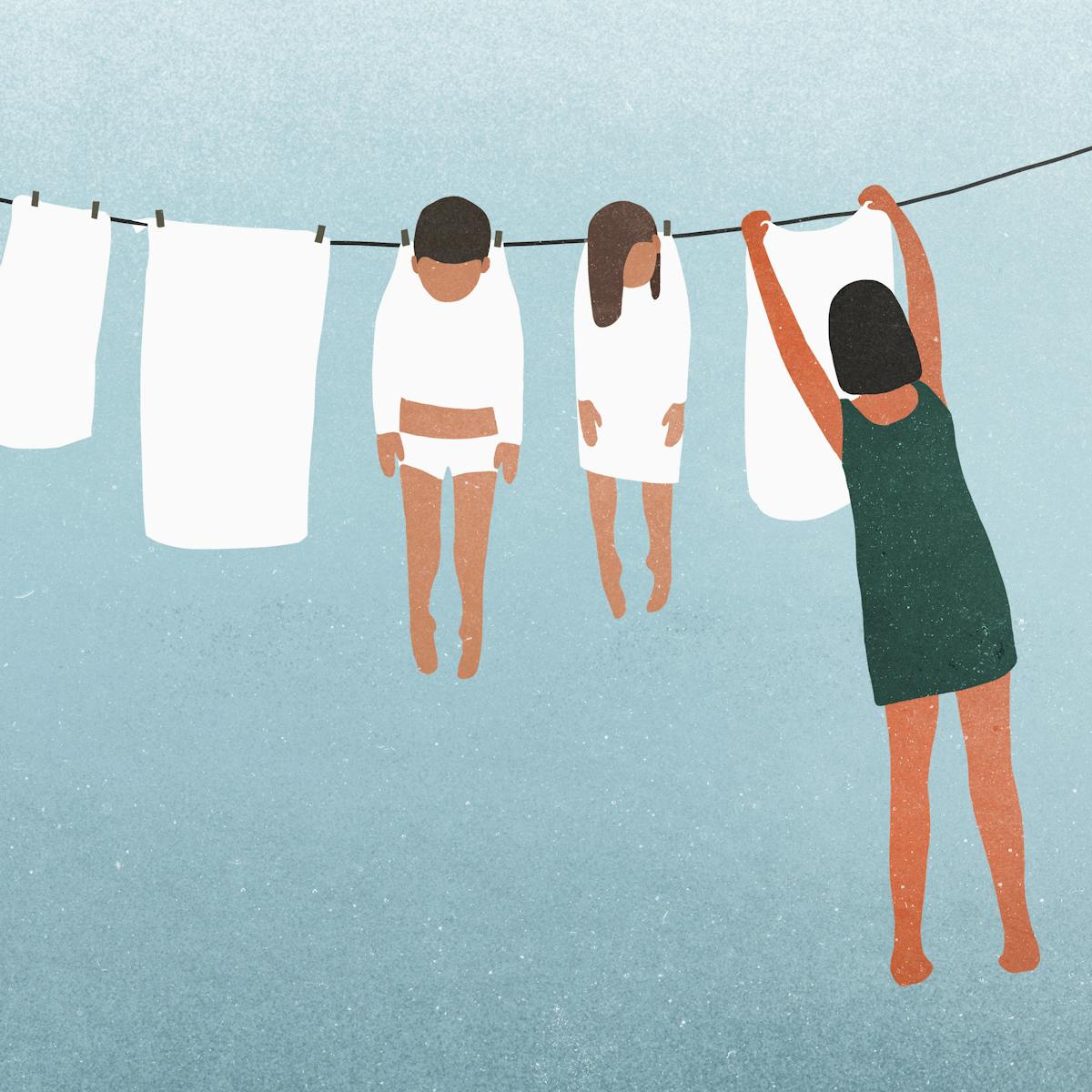
Without child care, work and family are impossible

https://theconversation.com/without-child-care-work-and-family-are-impossible-137340?utm_medium=email&utm_campaign=Latest%20from%20The%20Conversation%20for%20May%2022%202020%20-%201630015658&utm_content=Latest%20from%20The%20Conversation%20for%20May%2022%202020%20-%201630015658+Version+A+CID_f23e0e73a678178a59d0287ef452fe33&utm_source=campaign_monitor_us&utm_term=Without%20child%20care%20work%20and%20family%20are%20impossible

Without child care, work and family are impossible

I have a Ph.D. from Harvard and a 20-month-old child.

Without child care, life revolves around the toddler.

I am a political science professor and researcher, but lacking child care, I count myself lucky to work a few hours each day.

I am increasingly aware there is no such thing as the so-called work/family conflict. This is not only a personal observation. Scholars have found that good jobs – full-time, with benefits – and family, without help, are simply incompatible.

The concept is also wrong. If three-quarters of American women become mothers, and also most women do paid work, then doing both is, well, life; it’s not some existential, context-free choice.

Work and family are both full-time pursuits. If the problem is framed as a choice between them, the battle is lost, since family will usually win. Telecommuting and “workplace flexibility” are important but do not make up for a lack of time and space to think and work.

Those who need care, especially little children, are needy and adorable, and mothers are evolutionarily disposed to focus on them.

(Whoops, excuse me, the toddler is trying to kill herself again … OK, child saved, with minimal screaming on both of our parts. Now what was I thinking? Did I reorder all our prescriptions? Hold on, I’ll be back.)

The national shift to home-based work and schooling has had challenging consequences for parents, especially mothers. Sometimes these effects are lovely, like giving us more time with family, but if your goal is getting work done, good luck to you.

Can you type with a toddler in your lap? Getty/Tom Werner

Not alone

Working at home these days without child care is incredibly difficult unless I can escape to another room and close a door. This inevitably triggers screaming, but oh well.

She’s worse than a cat; she climbs on me, presses things on the computer, sucks its edges and screams for attention, in addition to the normal baby bodily functions that comprise a disproportionate section of my thinking – when did she last poop? Is that a rash?

It’s not just me.

Submissions from women to academic journals have plummeted since COVID-19 hit.

One geography professor tweeted, “It’s hard enough to keep my head barely above the water with the kids at home and interruptions every 2 min … I can’t imagine writing a paper now.”

Another scholar said the data on diminished submissions from women made her cry because it wasn’t just her.

It turns out that someone has to supervise – and sometimes force – children’s learning, even if online, and this takes actual work. With parks, museums, sports, pools and movie theaters closed, and with kids mostly unable to hang out with friends, someone also has to do the physical and emotional labor of keeping children busy, engaged and upbeat. This too is work.

Then there is the simple fact that family members are eating, working and playing in houses most of the time, which means more cooking, more cleaning, more grocery shopping and, yes, more toilet paper.

(OMG the baby took a two-hour nap. I got to exercise and even shower. No time for leg-shaving but I’m still a new woman. Now what was I thinking…)

Because it is not just time, you see. Sometimes the child is playing quietly, and theoretically I could sit down and bang out a research article, but my brain is fuzzy as hell.

I used to wonder what cows thought, standing there chewing their cud in a field. Now I know. They are thinking nothing. Especially with the nursing, I have great sympathy with cows lately.

Before the baby, and before COVID-19, I had great plans for composing scholarly articles in my head during all that nursing downtime. But I forgot that hormones can change your brain and behavior.

Submissions by women to academic journals have plummeted since COVID-19 hit. Getty/ KT images

Hormones play a role

Feminist theory and research finds that much of what people think of as “biological sex” – female or male – is socially constructed, as in, strongly based on culturally contingent assumptions about women and men as groups. I firmly believe, and teach, this as evidence-based truth.

Hormones, though, have undeniable physical and mental effects. If they are turning your body into a milk-production and child-protection facility, there can be some side effects on brain function. Many of these changes (increased empathy and vigilance) are useful evolutionarily, and the physical alterations appear to be short-lived. But there can also be negative effects on memory and focus. If your brain is your job, as mine is, this can cause some serious work disruption.

Pat Schroeder had two young children when first elected to Congress as a Democrat from Colorado in the 1970s. When asked how she could do both jobs, she famously replied, “I have a brain and a uterus, and I use them both.”

I try to live up to Schroeder’s standard, but lately I’ve found I have to qualify it; I tell myself she meant sequentially, not simultaneously.

Sequential is fine, as long as I have time and space to switch gears – I’m a first-time mom at 40 and the gears sometimes stick or stall out – and the peace of mind to focus beyond the child and the never-ending housework. We don’t call this “women’s work” anymore, and men do more than they used to, but it’s essential work and still mostly done by women.

There’s another way

With luck and science, COVID-19 will recede soon, and we can trickle back to offices, for which I have a newfound respect.

Will the U.S. take something positive from this crisis by learning an enduring lesson about the power of child care?

Americans tend to think of having children as an expensive, private choice. The alternative is to think of it as a public good.

Other countries offer far more generous parental leave and low-cost, high-quality daycare, knowing that “work versus family” is a false formulation. The U.S. is losing serious talent and promoting gender inequality by continuing to misunderstand the problem.

There are many potential options when child care is made a priority in a society.

Government subsidies for child care centers would help low-income workers have access to good care. The U.S. almost managed this in 1971, when Congress passed, on a bipartisan vote, a bill to establish child care centers across the country, funded in part by the federal government. President Richard Nixon vetoed the bill.

Universal pre-K starting at age 3, as in New York City, is another option to advance the interests of working parents and children.

And because working parents are drowning in high child-care costs, the government could offer subsidies and tax relief for curriculum-based care – which encourages child development and learning as well as safety – for those early years. I make a pretty good salary, but still, an extra US$1,000 a month or more to ensure my child is safe and well cared for while I work is painful.

It’s not a work-family conflict; it is a lack of high-quality, low-cost child care. Framing the problem otherwise damages the ability to enact good solutions.

It also makes a lot of good, hardworking parents feel enduring guilt over a problem that isn’t theirs alone to solve.


Guns in Michigan Capitol: Defense of liberty or intimidation?

https://www.csmonitor.com/USA/Politics/2020/0504/Guns-in-Michigan-Capitol-Defense-of-liberty-or-intimidation

Guns in coronavirus protests: Defense of liberty or intimidation ...

WHY WE WROTE THIS

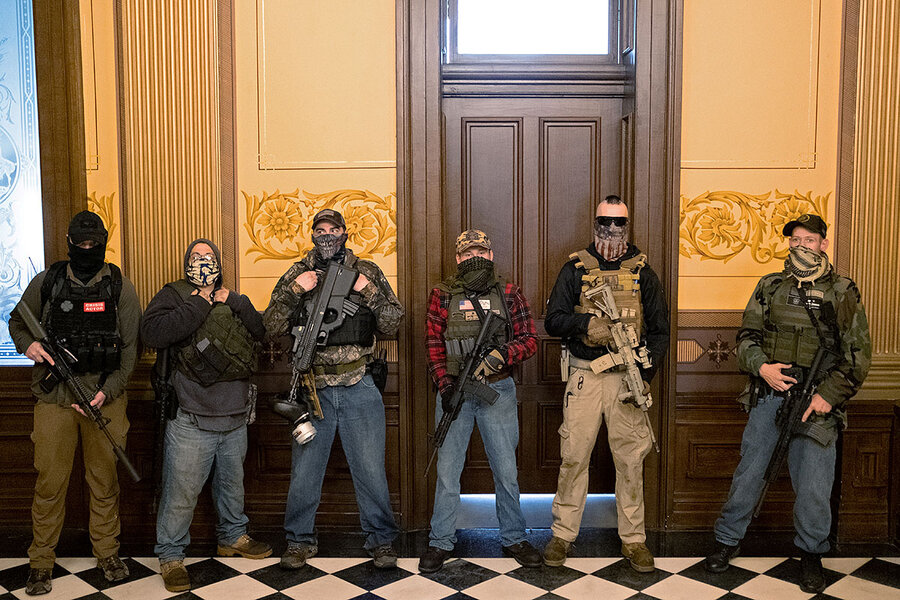
Bringing assault weapons to the Michigan Legislature for a protest against coronavirus restrictions? To one group, it’s why the Second Amendment exists. To many others, it’s unfathomable.

It was a first for Michigan state Sen. Sylvia Santana. Before heading to the statehouse in Lansing last Thursday, she slipped into a bulletproof vest.

Ms. Santana’s husband, a sheriff’s deputy, warned her about potential trouble at a rally to protest the decision to extend a coronavirus lockdown.

A group of armed white men entered the Capitol and shouted at lawmakers. To Ms. Santana, some were dressed like they were “going to war.” Several Confederate flags, a swastika, and a misogynistic sign aimed at Gov. Gretchen Whitmer could be seen outside.

“I thought that was very scary,” says Ms. Santana, an African American who represents parts of Detroit and all of neighboring Dearborn. “We’re there to do a job, and it’s not to dodge bullets as we try to do our jobs in a bipartisan fashion to make sure we’re keeping all Michiganders safe.”

Four days on from the protest, her concern lingers. The pandemic has intensified many societal fault lines – from health care inequities to political polarization – and gun control is no exception. Feeling that state officials are overreaching, a tiny minority of protesters are flexing their Second Amendment rights in Michigan and beyond.

But at a time of crisis, their crusade against the perceived tyranny of government is seen by many as tyrannical in its own right – recklessly using their liberties to intimidate others.

The core question is: Where should the line be drawn? For protesters, guns in statehouses is one of the purest expressions of the power the Second Amendment invests in citizens. But no constitutional right is absolute.

“Where do people who see no problem with guns downtown or near a hospital or in the legislature, where do they draw the line?” Sanford Levinson, co-author of “Fault Lines in the Constitution.” “That’s an interesting question both politically and legally, because courts are really receptive to line drawing. I don’t think you’d find any judge who says, ‘Yeah, I welcome guns in my courtroom.’”

In that way, the struggle over whether to allow firearms in legislatures “is part of the culture war,” he adds.

Are hard-line tactics effective?

Today, 21 state capitols allow guns in some form, according to a Wall Street Journal report. But only a few, including Michigan, allow citizens to openly carry under the rotunda. Many Republican-led states balk at open carry in the people’s hall for personal safety reasons, and courts have upheld bans in places like legislatures and polling places, holding that guns can chill other people’s rights.

Elements of race have long played a role. The modern gun control movement is linked to the signing of the Mulford Act in 1967, which banned open carry in California. The bill gained momentum after two dozen Black Panthers legally brought firearms to the state capitol to protest against it. The National Rifle Association backed the bill.

Incidents like the one in Michigan, however, could do more to damage gun rights than advance them. “It’s really now an open question to what extent hard-line pro-gun policies are politically advantageous,” says Mr. Levinson, also a visiting professor at Harvard Law School in Cambridge, Massachusetts.

Ms. Santana was certainly not persuaded. “I, as a state lawmaker, want to hear your concerns and your position on the issue. But I don’t feel that bringing assault weapons to the capitol and using symbols of hatred will make me understand your issue better.”

The scenes in Michigan, which has been hit hard by COVID-19, only make it harder to have already difficult conversations, others say. Part of self-defense is respecting the preferences other people have for their own security, which might mean leaving guns at home when overtones of intimidation are possible.

“When your eyes look at these pictures of groups of people … in a public building that is supposed to be a center of democratic exchange and debate, and you see a group of people carrying military weapons, that is not a vision of democracy,” says Hannah Friedman, a staff attorney at Giffords Law Center to Prevent Gun Violence in San Francisco. “That’s a vision of intimidation by a minority of people.”

Such concerns were heightened further this weekend, when employees at businesses in Stillwater, Oklahoma, faced a threat of violence with a gun while trying to force customers to wear masks, as mandated by the local government.

“I think we were heard”

But Ashley Phibbs has a different view.

Ms. Phibbs, a project manager and mother who helped organize the Michigan rally, acknowledged with regret that many in attendance didn’t abide by social distancing rules. She also confirmed the display of hate symbols. But she insisted those were agitators and not part of her group, Michigan United for Liberty, which has sprung up to oppose what members see as repressive COVID-19 restrictions.

“I know how it can seem to people who aren’t active in rallies and who are looking at it from the outside in, and I try to be very understanding of that,” says Ms. Phibbs. “But … I don’t think that anyone was there to really make anyone fearful. I didn’t see anything that would have really caused fear, aside from loud noises from the people yelling. But a lot of people are also sometimes afraid of guns in general.”

In the end, she says, “I think we were heard. I think overall [the rally] was positive.”

Knowing your audience

Other gun-rights advocates saw problems with the optics.

As he watched news from Michigan Thursday, Caleb Q. Dyer saw some familiar faces. The New Hampshire barista and former state legislator had been a keynote speaker at a Michigan Libertarian Party event last year.

But he worried that his friends in Michigan were sending “mixed messages” by failing to abide by public health rules.

In fact, he usually brings witty protest gear – such as a sign that says “arm the homeless” – to disarm fear. It’s a fine line, he says, between free speech and armed intimidation.

“People aren’t ready to have the discussion that a lot of these gun-carrying protesters want to have, which is that none of these laws are even remotely effective or just,” says Mr. Dyer. “But they’re not going to have that discussion if they cannot carry themselves in such a way that the opposition won’t think … that they’re murderous and violent.”


Home of the Brave

Image may contain: 8 peopleImage may contain: 8 people

Coronavirus and Healthcare Reform

Coronavirus and Healthcare Reform

2020.03.07 coronavirus_structure

At this writing, the number of COVID-19 cases worldwide has reached 100,000 with 3,500 deaths.  These numbers will be higher by tomorrow.

What does this have to do with U.S. healthcare reform? A lot.

Two current background articles drive home the point that a well-functioning public health system is critical for responding to a pandemic like 2019 coronavirus disease (COVID-19), especially in its early phases. And it means that the healthcare system – including a robust public health infrastructure — should be about health, not just about profit and greed.

Let’s Put This in Context:  Is COVID-19 “Just Another Flu”?

WHO reports that annual cases of influenza A and B worldwide range from 3 to 5 million, causing 290,000 to 650,000 respiratory deaths.  That’s a lot more than COVID-19, at least so far. So what’s the big deal?

The big deal is that, This Is Not a Competition, not an either-or between influenza virus and coronavirus. Otherwise this would be like asking, Would you rather be killed by an airplane crash, by tobacco-related cancer, or by pollution-related pneumonia? The answer is, of course, none of the above.

What these types of deaths and illness have in common is being in part preventable by known public health measures, with different interventions needed for each one. Likewise, influenza A and B deaths are in part preventable. Prevention relies on the elaborate and sophisticated worldwide influenza vaccine program. It includes monitoring influenza strains alternating between Northern and Southern hemispheres, annual adjustment of vaccine components, production, distribution, and public messaging.

But unlike influenza, currently COVID-19 is not preventable, since vaccine development and testing will take a year or more.  And WHO is modeling that COVID-19 is at best only partially containable by general non-pharmaceutical measures. For example, one worst-case model of the pandemic estimates that two-thirds of the world’s population could be infected, once it runs its course.  This has epidemiologists scrambling to calculate the actual transmissibility and actual mortality rates so as to refine predictions more accurately and to help plans for mitigating its spread.

So, no, COVID-19 is not “just another flu,” as the President implied in a March 4 off-the-cuff interview. COVID-19 is to be sure, a “flu-like illness,” but it has unique (as yet not fully characterized) epidemiologic characteristics, and it requires a completely different public health strategy, at least in the short- and medium-term. The President is reckless to minimize either disease – both diseases are widespread and lethal — especially since proper public messaging is a key to rallying a coherent response by individuals, communities, and nations.

How Bad Could It Be? Comparison to 1918 Spanish Flu

Could the COVID-19 pandemic wreak the same devastation as the 1918 Spanish flu? Spanish flu eventually infected 500 million people worldwide, effectively 25 percent of the total global population. And it killed up to 100 million of them. “It left its mark on world history,” according to University of Melbourne professor James McCaw, a disease expert who mathematically modelled the biology and transmission of the disease, and who was quoted today by the Australian Broadcasting Company (ABC).

What SARS-CoV2 (severe acute respiratory syndrome-corona virus strain 2), the agent that causes COVID-19 disease, has in common with the H1N1/Spain agent  is novelty, transmissibility, and lethality. Novelty means that it is antigenically new, so that no one in the world is already immune or even partially cross-immune. Transmissibility means it’s easily spread by aerosol (coughing) or surface contact (hand to nose). Lethality means its significant death rate.

On the one hand, Dr. McCaw hopes that public health measures against COVID-19 will be more effective than in 1918. For one, experts and the general public now know about viruses. In 1918, virology was in its infancy.

“We’re not going to see that sort of level of mortality, that mortality was driven by the social context of the outbreak,” predicts Dr. Kirsty Short, a University of Queensland virologist, also quoted by the ABC. “We had a viral outbreak, at the same time as the end of a world war.”

In addition, modern medicine means much better care is available now than it was then. “We’ve already got a lot of scientists working on novel therapies and novel vaccines to try to protect the general population,” Dr Short says.

Professor McCaw points to an apparent initial success in Wuhan Province. “What’s happened in China gives very clear evidence that we can get what’s called the ‘reproduction number’ under one. So at the moment in China, on average, each person infected with coronavirus is passing that infection on to fewer than one other person. If people hadn’t changed their behaviour, we would have expected somewhere around the millions of cases in China by now instead of the comparatively small number of around 100,000.” So, he says, it looks like the transmissibility of coronavirus can be significantly modified through social distancing and good hygiene.

On the other hand, best-case calculations from these Australian epidemiologists appear to discount other factors that could actually worsen the pandemic in 2020 compared with 1918 – rapid international travel and higher concentration of people in urban centers.

Both Dr. Short and Professor McCaw admit that in the early days of a pandemic accurate predictions remain difficult to make.

Nevertheless, they both make clear that in battling the coronavirus, the national and international public health systems – and the public’s trust in them – will be key.

Public Health Approach Is the Key

The importance of public health actions is underscored by a second report today by two experts from the Center for Strategic and International Studies, a Washington think tank.

Samuel Brannen and Kathleen Hicks write in Politico.com,

Last October, we convened a group of experts to work through what would happen if a global pandemic suddenly hit the world’s population. The disease at the heart of our scenario was a novel and highly transmissible coronavirus. For our fictional pandemic, we assembled about 20 experts in global health, the biosciences, national security, emergency response and economics at our Washington, D.C., headquarters. The session was designed to stress-test U.S. approaches to global health challenges that could affect national security. As specialists in national security strategic planning, we’ve advised U.S. Cabinet officials, members of Congress, CEOs and other leaders on how to plan for crises before they strike, using realistic but fictional scenarios like this one.

Here are their conclusions:

  • Early and preventative actions are critical. They praise bipartisan Congressional support, including $50 million allocated to the CDC Infectious Diseases Rapid Response Reserve Fund, the passage of the 2019 Pandemic and All-Hazards Preparedness and Advancing Innovation Act, and the continuation of the Global Health Security Agenda.
  • Communication is vital—but a decline in trust makes it harder. A critical ingredient for addressing pandemics is public order and obedience to protocols, rationing, and other measures that might be needed. Today, public trust in institutions and leaders is fragile, with routine evidence of intentional disinformation by foreign actors and elected officials alike. Misstatements about science are particularly damaging to the credibility of scientists and health officials seeking to guide response to the pandemic. Amid the hyperpartisanship of the current U.S. political environment in a presidential election year, politicization of the coronavirus outbreak could undermine public health efforts.
  • International cooperation is also key. A virus knows no borders, as we have already seen with the real-world outbreak, and here a concerning change is heightened mistrust among countries. In the midst of trade tensions, fraying of international relationships, increased meddling by one country in the internal politics of another, and growing military tensions in hot spots around the globe, organizations such as the World Health Organization are increasingly caught in the middle, unable to play their intended neutral function.
  • The private sector will be vital to managing the outbreak. There’s a good reason the President gathered pharmaceutical executives on Monday, March 2. The U.S. federal government is rightly at the center of the response to this likely pandemic, but it is the private sector that holds the bulk of the technological innovation to producing treatments and cures. One bit of good news on this front: There is already in place a highly effective public-private partnership structure in the Coalition for Epidemic Preparedness Innovations, which is making important contributions in the current race for a vaccine.
  • The principal conclusion of our scenario was that leaders simply don’t take health seriously enough as a U.S. national security issue. Congress holds few hearings on the topic, especially in the defense committees, and the White House last year eliminated a top National Security Council position focused on the issue.

Healthcare Reform:  We’re All in This Together

The impending epidemic of coronavirus in the U.S. also brings up important practical questions in the whole healthcare system, as reported in, for example, the New York Times and Kaiser Family Foundation.

Who will have access to testing?  Who will pay? Will copays designed to keep patients with trivial illnesses from overutilizing the health system now backfire by delaying their testing and care?  These kinds of questions are not at issue in countries with universal access.

However, even those countries will struggle to cope with the pandemic. For example, the United Kingdom faces a shortage of intensive care unit beds after a decade of downsizing its bed capacity.

This drives home the point that public health infrastructure is necessary but not sufficient for managing a pandemic. Namely, the U.K.’s bed shortage shows that public health is but one component of the broader task of maintaining a nation’s strategic risk preparedness. Calculating the surge capacity of inpatient beds for an unexpected pandemic emergency should not be left just to hospital administrators. This is also why the President should restore both bio-preparedness positions dropped by him in 2018 from the National Security Council and the Homeland Security Department.

Conclusion:  Right, Privilege or, Rather, Social Contract?

Is healthcare a right or a privilege? The coronavirus tells us, Neither. Instead, this virus reminds us that healthcare is better framed as part of the social contract, the fundamental duty of governments to their citizens to defend them from clear threats, both currently present and foreseeable, not only military, but also economic, cyber, and in this case biological. Can Americans and their leaders put aside petty polemical bickering over healthcare reform and recognize the healthcare system for what it is, part of the backbone of a healthy, resilient nation?


Is Gun Violence a Public Health Issue?

https://mailchi.mp/burroughshealthcare/february-8-1687741?e=7d3f834d2f

Image result for gun violence research

The United States population is 327 million and there are 393 million guns in this country. The issue of guns and gun control remains one of the nation’s most divisive.

As the Los Angeles Times explains in a recent editorial, “to truly address gun violence, we need to view it through a public health lens — one that reframes the issue as a preventable disease that can be cured with the help of all community members.”

The American Public Health Association (APHA) shared recently that the U.S. has the dubious distinction of “outpacing” any other country with a gun violence burden. Highly publicized statistics vary from source to source, but they do bear repeating, beginning with the fact that:

  • 82 percent of all firearm deaths in nearly two dozen populous, high-income countries—

including Australia, France, Italy, Spain and the United Kingdom — occur in the U.S.

  • 91 percent of children ages 0-14 killed by firearms in this group of nations were from the U.S.

The Gun Violence Archive stays up to date on this year’s sobering victim numbers, already standing at:

Total incidents:         36,390
Deaths:                       9,578
Injuries:                       19,102
Mass shooting:               268

Ways but No Will

Having dedicated himself to the science of gun violence, health policy professor David Hemenway, Ph.D., of the Harvard T. H. Chan School of Public Health says we’re all watching too much media where “guns are the solution to so many problems. The good guy with the gun is the big hero.”

In real life, guns are not solutions to problems. The myth is imposed early and continues to be perpetuated. Children are exposed to 90 percent of movies, 68 percent of video games and 60 percent of shows that include violence, Common Sense Media said six years ago. Current numbers are surely much higher.

Dr. Hemenway also balks at the old “we’ll be able to protect ourselves when that intruder comes into our space” argument. It takes lots of training, repetition and practicing, over and over, to do the right thing right, he says, and most don’t have time or resources to get that — right.

Although the United States is an international mega-power, it as much to learn, Dr. Hemenway says, noting that “every other country has shown us the way to vastly reduce our problems.” That means if other countries can get control of gun reasonability — as New Zealand did in a hurry following its first mass shooting — we can, too.

Repeated surveys of Americans say they favor universal background checks. As recent history has shown, whether or not that will come to fruition still remains unanswered.

Prevent Rather Than Repair

The idea of “community” as it relates to “public” means motivating responsible gun owners, says Dr. Hemenway, citing his colleague Cathy Barber, M.P.A., at T.H. Chan’s Means Matter campaign. She collaborates on a number of pertinent issues with gun owners, advocates and trainers, as well as gun shop owners.

Dr. Hemenway’s must-do list includes licensing of gun owners and all that entails, including strong background checks, and only allowing firearm sales to a licensed owner. He also recommends a federal agency to oversee the massive gun issue — a heretofore novel and yet seemingly sound idea.

The medical community has taken its stand on the public health effects of gun violence after frequently describing for the rest of us in riveting detail what it’s like to treat victims of shootings. Formally, members have established the nonprofit American Foundation for Firearm Injury Reduction in medicine (AFFIRM), with more than 40,000 healthcare colleagues.

The group seeks to inform medical protocols for their peers on the frontlines of gun violence, and to engage other first responders and stakeholders, as well as to educate and inform the public. They say they’d rather prevent than repair, and they worry about a culture of indifference and acceptance — of normalization that leads to divisiveness in this nation.

Meeting of the Minds Needed

It’s tough to solve a problem if stakeholders can’t come together to share ideas and solutions, the kind of proactive collaboration that provided results and conclusions around seat belts and smoking.

So why doesn’t the federal government jump headlong into gun violence research, specifically the Centers for Disease Control and Prevention (CDC) and the National Institutes of Health (NIH)? The Dickey Amendment came to fruition in the early 1990s when gun violence did become a public health issue.

The National Rifle Association (NRA) said then that the CDC was biased against guns, and attracted Congressional support that basically eliminated any funding “to advocate or promote gun control”: That meant no studies related to firearms, and in 2011, the amendment reached to the NIH. After the Sandy Hook school shooting, President Obama told the CDC that the Dickey Amendment shouldn’t completely ignore funding for gun violence research, but Congress stopped it nonetheless. Currently, the amendment isn’t really in effect but there’s still no funding.

To that end, early this year, Rep. Carolyn Maloney (D-NY) introduced H.R. 674 and Sen. Edward Markey (D-MA) introduced S.184, the Gun Violence Prevention Research Act of 2019, which was referred to the Subcommittee on Health, where it’s been languishing. It would provide CDC funding to study gun violence for the next five fiscal years.

Random Attacks Are Few
 
If the United States is unable to tackle more research into gun violence, that hasn’t stopped smaller, independent studies, like one from the state of Utah. It published a report in 2018 with the T.H. Chan School, looking at suicide and firearm injury. It was supported by both parties, and by gun rights champions.

The results showed that 87 percent of those who died by suicide could have passed a background check and that Utahns with mental health or drinking issues weren’t properly storing or locking up guns. The most surprising fact: Those random attacks that people are warned about as reasons to carry guns occurred only three or four times a year.

So with all we know and all that’s yet to be known if more scientific research is conducted, the following have been suggested as remedies to the gun violence epidemic. The solutions run the gamut from more basic to creative:

  • Universal background checks
  • An assault weapons ban, along with a ban on high-capacity magazines
  • Mandatory license needed to buy a gun
  • Mandatory gun registration
  • Mandatory training for owners
  • Waiting periods for firearm purchase
  • More taxes on gun manufacturers
  • Safe and secure gun storage
  • No sales to anyone on a terrorist watch list
  • No sales to anyone convicted of a felony
  • Red-flag law: Families can ask a judge to temporarily prohibit an individual from possessing a firearm if those parties believe that individual might commit violence.

Also mentioned as possible solutions:

  • The federal government could buy the domestic handgun manufacturing industry.
  • It could ban the import of all handguns.
  • It could offer cash buybacks for all handguns in circulation.
  • A person buying a gun would have to enlist for military reserve service.

Scientific American sees it this way, opining that we just don’t know enough about gun violence perpetrators and we should.

Did they get firearms legally, or how did they get them?

Are our current laws being used to disarm dangerous people?

What do we do about the proliferation of underground gun markets?

How can we better evaluate violence prevention policies and programs, as in “Do they work?”
 
As the editorial board notes, research doesn’t infringe on Second Amendment rights, but it does support those other, unalienable rights we are all due, thanks to the Declaration of Independence. Don’t forget “Life, Liberty and the pursuit of Happiness.”

Report: Climate changes costing U.S. billions in health spending

https://www.fiercehealthcare.com/hospitals-health-systems/report-climate-changes-costing-u-s-billions-health-spending?mkt_tok=eyJpIjoiT1dJNE5tUTFZV0k1TVdRNCIsInQiOiJMakFtS1IzZmxaRDlQNUtjdFdMUHVYUFdBd1wvXC9EZFR3ekhHU3ZsYVNib2t3bTlEb0Z2bklLZndEZXFOTjZ1RVZ0bURYMXI5dGFNcW92SXFYV25HTVh4d01tNEY4YkVCUnBMamhpbllXSytVTW5ybGJ1OTh0UjJmVDRmSWJ6c1wveCJ9&mrkid=959610

From deaths and injuries caused by extreme heat and stronger storms to longer growing seasons linked to an increased risk of mosquito- and tick-borne illnesses and wildfires, the healthcare impacts of climate change are costing the U.S. billions, a new analysis found.

Case in point: An analysis of a single year—2012—by researchers at the Natural Resource Defense Council and the University of California, San Francisco (UCSF) estimated a total of 10 climate-sensitive events in the U.S. that ultimately cost $10 billion. 

That estimate stems from costs associated with 917 deaths, 20,568 hospitalizations and 17,857 emergency room visits, researchers said in the study published in the journal GeoHealth.

Among the costs connected to “climate-sensitive events” in 2012, researchers pointed to:

  • $252 million in Wisconsin: A heatwave led to several record temperatures were broken over the span of a week in July 2012. Researchers analyzed costs from an estimated 27 deaths, 155 hospitalizations and 1,620 emergency room visits that summer.
  • $1.6 billion in Colorado and $2.3 billion in Washington: Longer fire seasons in the western U.S. have resulted from higher temperatures and changes in seasonal rainfall patterns. Researchers examined costs from direct wildfire deaths and impacts attributed to wildfire smoke in 2012. There were 174 deaths, 256 hospitalizations and 1,432 emergency room visits in Colorado and 245 deaths, 371 hospitalizations and 1,897 emergency room visits in Washington.
  • $3.1 billion in New Jersey and New York: Hurricane Sandy caused severe flooding and power outages for more than 20 million customers. Sea level rise is believed to have amplified the storm surge. Researchers estimate there were 273 hurricane-related deaths, 6,602 hospitalizations and 4,673 emergency room visits.

Researchers said mortality costs were estimated using a mortality risk valuation implemented by the U.S. Environmental Protection Agency in regulatory impact analyses, with each life lost valued at $9.1 million in 2018 dollars. They also factored direct morbidity costs for each event using hospital admissions and emergency department visits from the federal Healthcare Cost and Utilization Project data well as costs associated with outpatient visits, home health care costs and prescribed drugs from the federal Medical Expenditure Panel Survey.

They acknowledged several limitations of the study. For instance, they said, “despite record-setting weather conditions across the U.S. in 2012, our analysis was restricted to case studies for which there was adequate documentation of health impacts,” they said.

They only included mental health impacts from Hurricane Sandy despite evidence that other events like wildfires can also adversely impact mental health. They also said extreme heat and Lyme disease are routinely underreported health effects that could result in conservative estimates.

“As such, the $10 billion total we calculated is likely a conservative estimate of health-related costs for these studies,” researchers said in this study.

Still, these costs are not just theoretical, but tangible costs that should be factored into the policy conversation, said Wendy Max, co-director of the Institute for Health & Aging at UCSF.

“We wanted to look at who bears this cost and we found two-thirds of the cost are borne by the Medicaid and Medicare programs,” Max said. “In an era of concern about healthcare costs, this is an important message: Climate change is adding to the public healthcare cost burden. That’s a message we’re hoping will resonate with policymakers.”


Drug companies seek removal of judge in landmark opioid case

https://www.washingtonpost.com/health/drug-companies-seek-removal-of-judge-in-landmark-opioid-case/2019/09/14/1609f69a-d6f6-11e9-9343-40db57cf6abd_story.html?wpisrc=nl_most&wpmm=1

Drug companies facing more than 2,000 lawsuits over their alleged roles in the opioid epidemic demanded Saturday that the federal judge overseeing the case step aside, questioning his impartiality because he has consistently urged both sides to settle the case.

The request comes after a series of rulings against the companies by U.S. District Judge Dan Aaron Polster in the landmark trial slated to begin Oct. 21.

“Defendants do not bring this motion lightly,” the lawyers wrote in a filing Saturday morning on behalf of some of the nation’s biggest drug distributors and retailers but no drug manufacturers. “Taken as a whole and viewed objectively, the record clearly demonstrates that recusal is necessary.”

The lawyers contended Polster has overstepped his authority and created the appearance of bias. They cited his statements since the beginning of the case encouraging settlement so that money for badly needed drug treatment and other services could go quickly to communities hard hit by the opioid epidemic.

With just two counties “seeking $8 billion in cash for so-called ‘abatement,’ the Court has determined that it, not a jury, has the discretion to decide how much money defendants may pay to government agencies for medical treatment and other addiction-related services and initiatives,” the drug companies wrote.

Polster could not be reached for comment. A telephone call to his assistant Saturday went unanswered.

Lawyers for the more than 2,000 cities, towns, counties and tribal communities suing the drug industry called the attempt to remove Polster a desperate move. The lead plaintiffs’ lawyers said in a statement they “remain confident the judiciary will swiftly respond to yet another attempt by the opioid defendants to delay the trial.”

The plaintiffs have demanded the drug companies, including manufacturers, distributors and retailers, pay billions of dollars for the damage they allegedly caused. Since 1999, more than 200,000 people have died of overdoses of prescription narcotics, and another 200,000 have died from overdoses of heroin and illegal fentanyl, according to government data.

Two Ohio counties, Cuyahoga and Summit, are scheduled to begin trial next month as test cases to determine how other plaintiffs and defendants may fare before a jury.

As of now, they would face off against drug distributors McKesson Corp., Cardinal Health, AmerisourceBergen and Henry Schein; manufacturers Johnson & Johnson and Teva Pharmaceuticals; and retail drugstore chain Walgreens.

Two law professors called the defendants’ motion unusual and saw little chance it would succeed.

The law that authorizes large, consolidated cases like this one — known as “multidistrict litigation” — explicitly recognizes that judges would use the opportunity to encourage settlements, said Carl Tobias, a professor at Richmond University School of Law.

“Judges overseeing MDLs are supposed to encourage settlement and most MDLs end with settlements” for the majority of plaintiffs, Tobias wrote in an email.

Alexandra Lahav, a professor at the University of Connecticut School of Law, agreed.

“It is a highly unusual motion and not one that I think can win,” she wrote in an email. “I am not sure what the strategy is behind bringing it, and filing on Saturday, other than public relations.”

She added, however, “I don’t think there is anything wrong with filing a non-frivolous motion to bring attention to an issue and start a conversation. Given the courts’ historic emphasis on settlement, I just don’t see how that conversation goes anywhere.”

This past week, Purdue Pharma, the company most widely blamed for its role in the crisis, announced a tentative settlement with all the municipalities and about half the state attorneys general who have separately sued members of the drug industry in state courts. If finalized, that agreement would remove Purdue from the first trial.

Ohio Attorney General Dave Yost (R), whose state backs the Purdue settlement, also has asked to halt the trial, saying the municipalities should allow states to take the lead in the litigation.

In the lead-up to the trial, Polster denied a series of motions filed by the companies seeking to throw out, or limit, the case against them. Those included a defense motion to dismiss arguments that the drug companies conspired with each other to protect their companies from enforcement actions by the Drug Enforcement Administration.

Polster also rejected a motion to dismiss the plaintiffs’ legal theory that the companies created a “public nuisance” by inundating communities across the nation with enormous amounts of pain pills. And he denied a defense motion to dismiss a strategy to pursue the case under the Racketeer Influenced and Corrupt Organizations Act, originally created to prosecute the Mafia.

This past week, Polster agreed to an unusual plan that would include 30,000 jurisdictions across the United States in any settlement, if they agreed to it. It is aimed at preventing more lawsuits and ensuring that communities everywhere get some money from any settlement.

In their motion, the drug distributors and retail chains said the crucial test is whether a reasonable person would conclude that Polster appeared biased against the defendants.

They cited Polster’s statements inside and outside court “evidencing a personal objective to do something meaningful to abate the opioid crisis, with the funding to be provided through defendants’ settlements,” as well as “numerous improper comments to the media and in public forums about the litigation.”

And they noted Polster’s “apparent prejudgment of the merits and outcome of the litigation and singular focus on, and substantial involvement in, settlement discussions.”

They also protested his decision to limit defendants to 12.5 hours apiece to present their cases during the upcoming trial.

Last month, an appellate court admonished some of the defendants for a legal attack on Polster over an unrelated question. The panel of appellate judges said their claim that Polster’s “assurances are not entitled to our respect because [he] has been deceptive or duplicitous … is a very serious allegation and we find no merit to it.”


Trends In Public Opinion On US Gun Laws: Majorities Of Gun Owners And Non–Gun Owners Support A Range Of Measures

Trends In Public Opinion On US Gun Laws: Majorities Of Gun Owners And Non–Gun Owners Support A Range Of Measures
By Colleen Barry, Elizabeth Stone, Cassandra Crifasi, Jon Vernick, Daniel Webster, and Emma McGinty

This new study, being released ahead of print, used data from the National Survey of Gun Policy from the years 2013, 2015, 2017, and 2019. The surveys were administered by the Johns Hopkins Center for Gun Policy and Research, which sampled adult gun owners and non–gun owners alike. The findings show that large majorities of both owners and nonowners strongly support a range of measures to strengthen US gun laws. Read More >>

This study will also appear in the October issue of Health Affairs, a theme issue with studies focusing on violence and health.

HA 38/10 Ahead of Print, Barry

https://www.healthaffairs.org/doi/abs/10.1377/hlthaff.2019.00576?utm_source=Newsletter&utm_medium=email&utm_content=Trends+In+Public+Opinion+On+US+Gun+Laws%3B++Opioid+Addiction%3B+Expanding+International+Reference+Pricing&utm_campaign=HAT+9-9-19


In Wednesday’s second Democratic debate, 7 of 10 candidates support Medicare for All

https://www.healthcarefinancenews.com/node/139034?mkt_tok=eyJpIjoiWW1OaFpUazJaV1l4TldFeiIsInQiOiJPSUpCQjRXc1E1MTZUUTJIaWFHTWtPWEFTVzRYa0RWTUJ6dFc4ZHNSWlN3aWlKSjlmN3NsajZ0b01PSGkzdHUrQWg1UzR2VUM5QWlSbXdLcG5qUFBIWlVPV1wvWnlKTHlUZ3lNU3JCWG9oM1JLY3hjc3hSRXl3RnBEanlPbUpSZnkifQ%3D%3D

Democratic candidates take the stage during first debate in June.

Expanding coverage, lowering healthcare costs, central to Democratic agenda.

Tonight, Joe Biden, Kamala Harris, Cory Booker, Andrew Yang, Julián Castro, Tulsi Gabbard, Michael Bennet, Jay Inslee, Kirsten Gillibrand, Bill de Blasio take the stage for round two of the Democratic presidential debates.

Seven support Medicare for All. The others – Biden, Bennett and Inslee have come out in favor of a public option. Here, in no particular order, is a look at where each candidate stands on healthcare coverage.

Joe Biden

As vice president to President Barack Obama, former Senator Joe Biden carries into this election the legacy of the Affordable Care Act. As president, Biden said he would protect the ACA and prevent further Republican attempts to dismantle it.

Unlike many of his Democratic rivals, Biden does not support full Medicare for All. Instead of getting rid of private insurance, Biden said he would build on the ACA through the Biden Plan to create a public health insurance option. As in Medicare, costs would be reduced through negotiating for lower prices from hospitals and other providers.

He also has a plan to increase the value of the ACA tax credits by eliminating the 400% income cap on tax credit eligibility and lowering the limit on the cost of coverage from 9.86% of income to 8.5%. This means that no one would spend more than 8.5% of their income on health insurance. Additionally,  Biden would base the size of tax credits on the cost of the higher-tiered gold plan, rather than silver plan.

Biden also supports premium-free access to the public option for individuals in the 14 states that have not expanded Medicaid under the ACA. States that have already expanded Medicaid would have the choice of moving the expansion population to the premium-free public option, as long as the states continue to pay their current share of the cost of covering those individuals.

Biden also promises to stop surprise billing, tackle market concentration, repeal the exception allowing drug companies to avoid negotiating with Medicare over drug prices and limiting the launch price for drugs that face no competition, among other actions.

In his words: “When we passed the Affordable Care Act, I told President Obama it was a big deal – or something to that effect.”

Kamala Harris

California Senator Kamala Harris often refers to her mother’s diagnosis of colon cancer and her Medicare coverage for treatment as an example of why all Americans should have Medicare for All.

Harris is looking to eliminate premiums and out-of-pocket costs through government insurance that guarantees comprehensive care including dental and vision and coverage. Harris gives no estimate of the cost of universal healthcare, but says taking profit out of America’s healthcare system would save money.

Her Medicare for All plan, which is similar to Senator Bernie Sanders – would cover all medically necessary services, including emergency room visits, doctor visits, vision, dental, hearing aids, mental health and substance use disorder treatment, telehealth and comprehensive reproductive care services. It would allow the Secretary of Health and Human Services to negotiate for lower prescription drug prices.

As former Attorney General of California who won a $320 million settlment from insurers, Harris said she wants to take on Big Pharma and private insurers to lower the cost of prescription drugs.

She also has strong views on prosecuting opioid makers and for preserving women’s right to healthcare and protecting Planned Parenthood from the financial cuts and policies of the Trump Administration.

She would institute an audit of prescription drug costs to ensure pharmaceutical companies are not charging more than other comparable countries, a comprehensive maternal child health program to reduce deaths among women and infants of color, and rural healthcare reforms, such as increasing residency slots for rural areas with workforce shortages and loan forgiveness for rural healthcare professionals.

In her words on the ACA: “As someone who fought tooth and nail as Attorney General and as Senator to prevent repeal, that’s exactly what I will continue to do.”

Cory Booker

Senator Cory Anthony Booker, first African-American Senator from New Jersey, and former mayor of Newark, is also a Medicare for All proponent.

He also wants to implement universal paid family and medical leave.

He supports lowering costs for prescription drugs by allowing Medicare to negotiate prices and by importing drugs from Canada and other countries, the latter a policy announced today by Health and Human Services Secretary Alex Azar.

He would also invest in ending the maternal mortality rate and work to reduce racial disparities in maternal mortality rates.

One of his big issues is expanding eligibility for long-term services and support for low and middle-income Americans needing care at home. He wants long-term care workers to be paid a minimum of $15 an hour.To limit the impact of the program on state budgets, the new costs associated with the expansion of Medicaid long-term care services and workforce standards would be financed entirely by the federal government in, effectively, a 100% match. The cost would be financed by making the tax code more progressive by reforming the capital gains, estate, and income taxes.

In his words: “Healthcare is a human right.”

Kirsten Gillebrand

Kirsten Gillebrand, U.S. Senator from New York, originally ran for a House seat in that state on a platform that supported the expansion of Medicare, a view she still holds, and in 2017 expressed support for Senator Bernie Sanders’ Medicare for All bill.

In May, Gillebrand reiterated her support, saying the best way to achieve a single-payer system is to let people buy-in over a transition period of about four to five years. She favors allowing a public option to create competition with insurance companies. Medicare needs to be fixed first so that reimbursement rates better reflect costs, she said.

In 2011 she helped pass the James Zadroga 9/11 Health and Compensation Act, which provides treatment to the first responders of the Sept. 11, 2001 terrorist attacks. The law provides health monitoring and services for 9/11-related health issues among those exposed to the debris and tainted air of the attack’s aftermath.

In her words: “Under the healthcare system we have now, too many insurance companies continue to value their profits more than they value the people they are supposed to be helping.”

Bill de Blasio

New York Mayor Bill de Blasio believes everyone, including undocumented immigrants, has a right to receive healthcare, and has repeatedly voiced his support for a national single-payer health plan.

He and rival Elizabeth Warren raised their hands during the first debate when asked if they supported Medicare for All.

One of his accomplishments as mayor was signing a bill into law that established a paid sick leave and safe leave plan for the city.

First unveiled in January, the program NYC Care, guarantees healthcare for the roughly 600,000 New Yorkers who aren’t currently insured, which de Blasio touted as the “most comprehensive health system in the nation.” He has indicated that NYC Care could become a model nationwide.

The plan encompasses primary and specialty care, pediatric and maternity care and mental health services. The idea is that NYC Care works on what de Blasio said was a “sliding scale,” in which people can essentially pay what they can for care. While the city already has a public option for healthcare, de Blasio said NYC Care will pay for direct comprehensive care for people who can’t afford insurance or who aren’t covered by Medicaid.

The program costs $100 million per year for the city — an investment the mayor expects will yield returns.

In his words: “If we don’t help people get their healthcare, we’re going to pay plenty on the back end when people get really sick,” he said recently on MSNBC’s “Morning Joe” broadcast.

Jay Inslee

Washington Governor Jay Inslee has planted a flag as “the climate change candidate” and in many ways he’s all in on that single issue, reasoning that things like healthcare policy “become relatively moot if the entire ecosystem collapses on which human life depends.”

That said, he has a strong case to make on healthcare by virtue of having just recently put his state’s money where his fellow candidates’ mouths are: in May he signed the country’s first public option into law in Washington.

Expect him to bring up that accomplishment — in which the state will contract with private insurers to create a public option that pays at Medicare plus 60 percent — in any conversation about healthcare, as he did in the first debate.

In his words: “We hope this will be a smashing success. We hope that it will give a shot of courage to other governors to move forward toward universal access. We were willing to take the leap and we’re gonna learn as we go along, I’m sure, and there will be some modifications. But we had to get started.”

Michael Bennet

Colorado Senator Michael Bennet supports a public option he calls Medicare-X. But where his plan stands apart from others is a strong focus on the rural-urban divide on access to care. He intends to create a healthcare policy that will ensure that all regions of the country are covered by available health plans, addressing what he calls a failure of the ACA exchanges.

His plan is unusually detailed and includes lowering prescription drug prices, closing existing gaps in care, and, yes, promoting telemedicine and other technology that can bolster rural healthcare. He also has provisions for combatting substance abuse, improving maternal and mental health, and bringing more support to senior caregivers.

In his words: “As president, I would build on the Affordable Care Act to cover everyone, rather than doing away with our current system. My Medicare-X plan gives every family the choice to buy an affordable public option or keep the plan they have today. It starts in rural areas, where there is very little competition and requires the federal government to negotiate drug prices. I have fought for this approach for almost a decade, because it is the most effective and fastest way to cover everyone and drive down costs.”

Julián Castro

The former U.S. Secretary of Housing and Urban Development and San Antonio Mayor favors a Medicare for All, single-payer system.

To pay for the system, Castro has said he would raise taxes on corporations and on the wealthiest Americans — the “0.05, 0.5 or 1%,” he said.

While he favors a single-payer system, Castro said he would allow private insurance, saying that anyone who wants their own private insurance plan should be able to have one.

In his words: Castro said at an event in Iowa that, “The U.S. should be the healthiest nation in the world.”

Andrew Yang

Entrepreneur Andrew Yang of New York is founder of Venture for America, a two-year fellowship program for recent grads who want to work at a startup and create jobs in American cities.

He supports Medicare for All and has called the Affordable Care Act a step in the right direction that didn’t go far enough because access to medicine isn’t guaranteed and the incentives for healthcare providers don’t align with providing quality, efficient care.

Doctors are incentivized to act as factory workers, he has said, churning through patients and prescribing redundant tests, rather than doing what they’d prefer–spending extra time with each patient to ensure overall health.

Medicare for All will increase access to preventive care, bringing overall healthcare costs down. Cost can also be controlled directly by setting prices provided for medical services.

He cites the Cleveland Clinic, where doctors are paid a flat salary instead of by a price-for-service model. Redundant tests are at a minimum, and physician turnover is much lower than at comparable hospitals, he said.

And the Southcentral Foundation which uses a holistic approach to treat native Alaskans with mental and physical problems by referring patients to psychologists during routine physicals.

Also, the current system of employer-sponsored insurance prevents employees from having economic mobility.

In his words: “New technologies – robots, software, artificial intelligence – have already destroyed more than 4 million U.S. jobs, and in the next 5-10 years, they will eliminate millions more.”

Tulsi Gabbard

Rep. Tulsi Gabbard of Hawaii is a military veteran who supports Medicare for All as a cosponsor of H.R.676, the Expanded & Improved Medicare for All Act.

But she is currently getting press for her lawsuit against Google claiming alleged election interference.

Following the first Democratic primary debate on June 26, many people searched her name, but “without any explanation, Google suspended Tulsi’s Google Ads account,” her office said in a statement, according to The Verge.

Tulsi claims the tech giant suspended her campaign’s Google Ads account just after that first debate.

Congress must act to prevent the tech giant from exerting too much influence, she claimed Monday on “Tucker Carlson Tonight.”
In her words: “This is really about the unchecked power these big tech monopolies have over our public discourse and how this is a real threat to our freedom of speech and to our fair elections.”