U.S. with 1/3 of Confirmed Coronavirus Cases with Less Than 2% of Population Tested

https://coronavirus.jhu.edu/map.html

Coronavirus outbreak affecting some Durham high school students ...

By the numbers: The coronavirus has infected over 2.9 million people and killed over 200,000, Johns Hopkins data shows. More than 829,000 people have recovered from COVID-19. The U.S. has reported the most cases in the world (more than 940,000 from 5.1 million tests), followed by Spain (over 223,000).


“I’ll take my chances with breast cancer”

https://mailchi.mp/0d4b1a52108c/the-weekly-gist-april-24-2020?e=d1e747d2d8

Local Health Officials Prepared for Coronavirus - Social Security ...

It’s entirely understandable that consumers would be reticent to visit in-person care settings right now. Given that doctors’ offices and urgent care facilities are where sick people congregate, a patient might well assume their chances of contracting COVID-19 would be higher there than in almost any other public space. But a story we heard this week from a health system chief strategy officer (CSO) reveals just how frightened patients may be to return.

Last week the system began to reach out to patients who had positive screening mammograms in February, before elective procedures and tests were cancelled, and who now needed to return for more detailed diagnostic images. A full 75 percent of these patients were unwilling to schedule a diagnostic mammogram within the next month, with one patient even saying, “I’ll take my chances with breast cancer over COVID!”.

Women with a concerning mammogram finding are typically among the most motivated patients in seeking follow-up care. If a majority of them are unwilling to pursue in-person follow-up, the same will likely be true of scores of patients with other possible cancers, heart disease, and other serious conditions. As fear delays needed care, patients are likely to end up much sicker, with more advanced disease, when they do return. With rigorous attention to symptom and temperature screening, visiting a doctor’s office should be less risky than going to the grocery store—but providers will have to publicly communicate the steps they are taking to keep patients safe before many will be willing to come in the door.


Tentative steps toward recovering from a deadly pandemic

https://mailchi.mp/0d4b1a52108c/the-weekly-gist-april-24-2020?e=d1e747d2d8

Baby Steps – Selah Someonetotalkto's Blog

The death toll from the novel coronavirus continued to mount this week, with more than 50,000 deaths reported in the US, and over 900,000 confirmed cases nationwide. Globally, the disease has infected more than 2.7M people and killed nearly 200,000. On Tuesday, public health officials in California announced that two people who died in Santa Clara County in early February were victims of COVID-19, making them the earliest known fatalities in the US, and altering experts’ understanding of how long the disease has been spreading in the country. New modeling from researchers at Northeastern University this week suggested that the virus may have been spreading widely in several cities by early February, but went undetected because of restrictions on testing.

National attention has remained focused on the subject of testing, as states and localities scramble to secure enough testing supplies and equipment to allow them to understand community spread and identify new cases. President Trump signed an emergency $484B relief bill on Friday that will provide $25B to ramp up testing, give additional aid to businesses forced to shutter, and send hospitals $75B in additional emergency funding.

The new money for hospitals is in addition to $100B already approved by Congress for a “provider relief fund” as part of the CARES Act. Having already distributed $30B of the initial grant money to hospitals, the Department of Health and Human Services (HHS) was expected to pay out an additional $20B today, this time according to a formula based on the net patient revenue of each hospital, rather than the earlier approach based on Medicare billings. The shift is expected to address concerns among children’s hospitals, safety-net providers, and others who were disadvantaged by the Medicare-based approach. It is unclear how the newly approved $75B of additional funding will be allocated.

Meanwhile, states began to plan for the reopening of their economies, with most governors taking a measured approach in coordination with neighboring states. A handful of states moved to loosen stay-at-home restrictions in advance of meeting the Trump administration’s “gating” criteria, including Florida, which reopened some beaches for recreational use, Oklahoma, and Georgia, which controversially allowed gyms, bowling alleys, hair and nail salons, and tattoo parlors to reopen on Friday.

Many states began to put in place plans to restart elective surgeries, which had been curtailed by a patchwork of differing state and local directives. The Centers for Medicare and Medicaid Services (CMS) released guidelines this week to help local officials decide when and how to restart surgeries. Whether for healthcare services or other types of economic activity, states will (and should) be guided by the ability to conduct widespread testing, robust contact tracing, and isolation of those infected with the virus. Ensuring that ability will likely make the next phase of the pandemic a protracted and frustrating “dance” of fits and starts, likely to last into the summer months and beyond.


Cartoon – At last a Sport We can Watch

KAL's cartoon | The world this week | The Economist

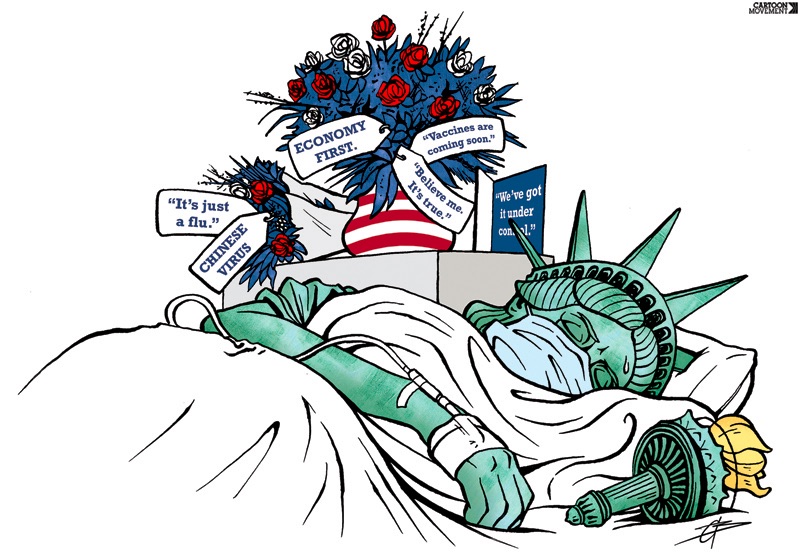
Cartoon – State of the Union

iroon.com: Cartoons


Cartoon – Coronavirus Prevention Today

College Signals Concern over Coronavirus Outbreak Cooks Adresses ...

70% Of Americans Want Officials To Prioritize Public Health Over Restarting Economy

https://www.forbes.com/sites/arielshapiro/2020/04/23/70-of-americans-want-officials-to-prioritize-public-health-over-restarting-economy-trump-kemp/?utm_source=newsletter&utm_medium=email&utm_campaign=news&utm_campaign=news&cdlcid=#74a9d5ce68d3

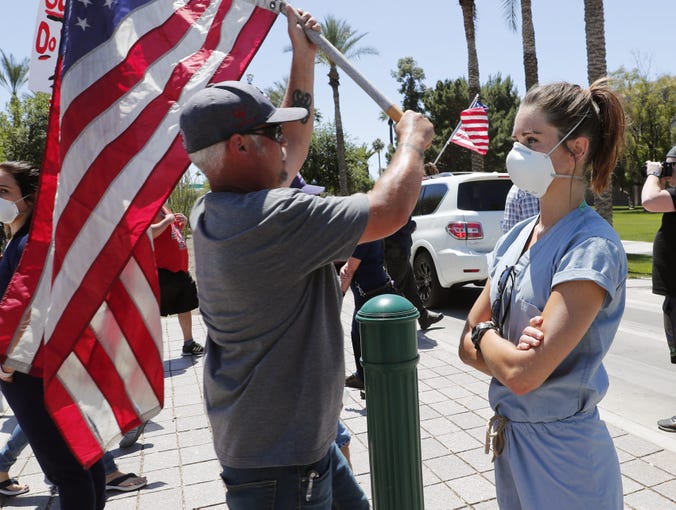
The ICU nurse who stood masked and silent at the rally to open Arizona

A wide majority of Americans are not ready to resume public life, according to a poll released Thursday by CBS News and YouGov, as governors in Georgia, Tennessee and South Carolina plan to allow stay-at-home orders to expire next week.

KEY FACTS

Only 30% of people surveyed said the government’s priority should be restarting the economy; 70% said the focus should be on slowing the virus through social distancing measures.

The polling shows a partisan divide—while 91% of Democrats and 69% of Independents favor focusing on public health, 52% of Republicans say the economy should take precedence.

29% of those polled said they would feel comfortable eating at a restaurant; Georgia Governor Brian Kemp will allow certain businesses, including restaurants, to open on April 27, 2020.

A minority of respondents said they would be comfortable going to work right now (44%) and even fewer said they would attend a large entertainment or sports event (13%), but the social isolation is taking its toll—54% said they would be willing to visit their friends.

KEY BACKGROUND

Protests against stay-at-home orders have cropped up around the country in states like California and Michigan, initially with President Donald Trump’s support. Although the movement is vocal, its support is limited. Less than a quarter of the poll’s respondents said they support the protests, and only 7% think that Trump should encourage them. The president is starting to change his tune, criticizing Georgia Governor Kemp’s plan to reopen businesses at the White House briefing on Wednesday.

WHAT TO WATCH FOR

Florida Governor Ron DeSantis said he is coordinating with neighboring governors on how to proceed, but has not yet announced whether he will extend the state’s stay-at-home order or let it expire. Florida has had more than 28,000 cases of COVID-19, more than any other southern state. A Quinnipiac poll released Wednesday shows that Florida residents’ opinions on reopening the economy reflect those of the country: Only 22% said that the state should loosen social distancing rules at the end of the month. As a first step, DeSantis allowed localities to reopen their beaches last week, and some, notably those in Jacksonville, were crowded.


Governor Cuomo, Bloomberg Announce Unprecedented New York COVID-19 Coronavirus Contact Tracing Program

https://www.forbes.com/sites/brucelee/2020/04/23/governor-cuomo-bloomberg-announce-unprecedented-new-york-covid-19-coronavirus-contact-tracing-program/?utm_source=newsletter&utm_medium=email&utm_campaign=career&cid=5d2c97df953109375e4d8b68#129e09243cd1
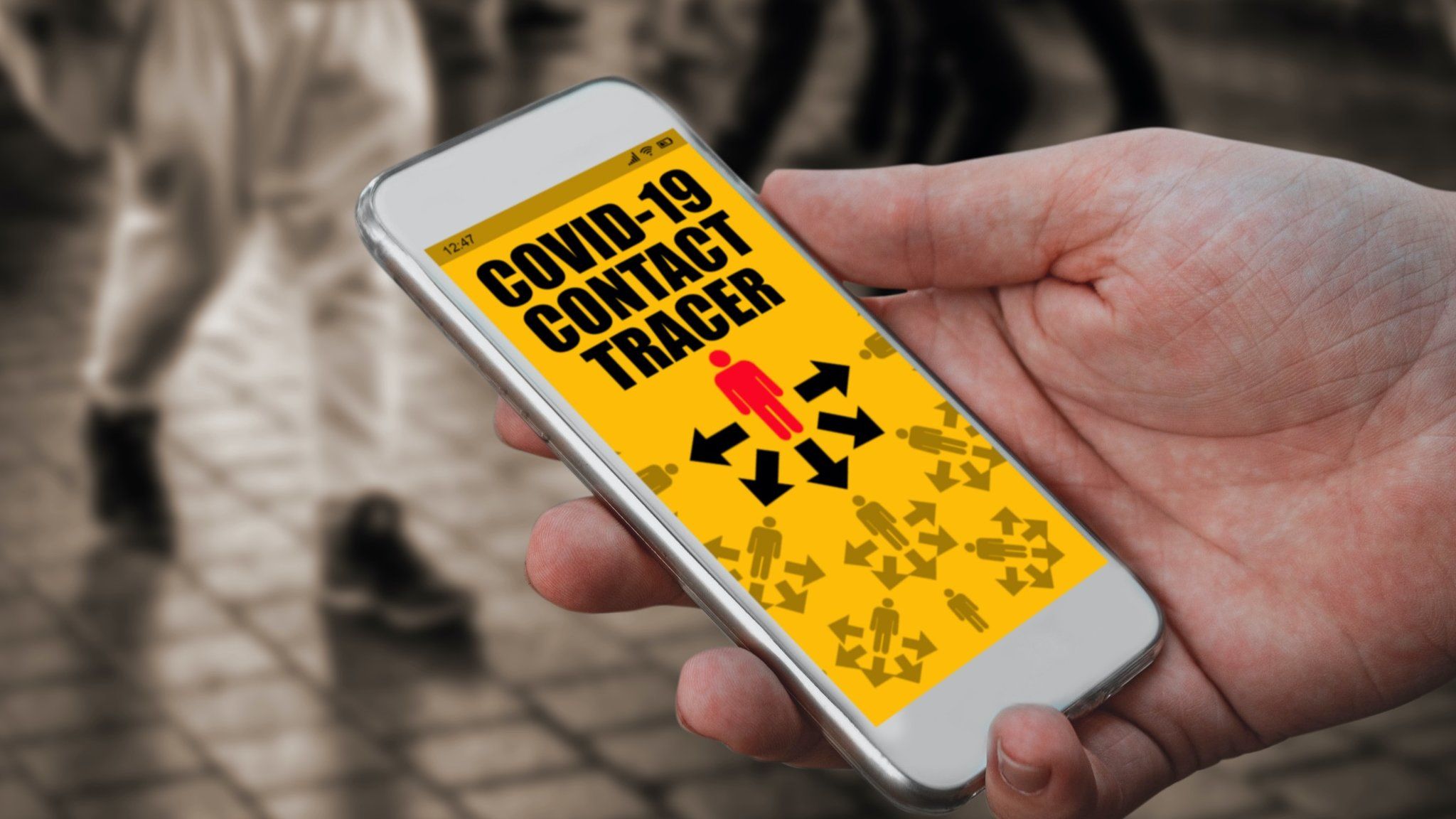
Coronavirus: Why are there doubts over contact-tracing apps? - BBC ...

New York is not going to let the COVID-19 coronavirus spread without a trace. Make that multiple traces. In fact, make that many, many, many traces.

New York State Governor Andrew Cuomo and former New York City Mayor Mike Bloomberg announced the launch of a massive contact tracing program in an effort to better contain the severe acute respiratory syndrome coronavirus 2 (SARS-CoV-2). How massive? How about larger-than-any-contact-tracing-effort-that’s-been-attempted-before-in-the-U.S. massive?

It is a sign of the times that Cuomo had to include a slide that said: “But we can’t be stupid.” After all, there are other people out there pushing to re-open businesses without at the same time providing a specific plan on how exactly to stop the virus when social distancing measures are relaxed.

Bloomberg Philanthropies, which was founded by Bloomberg, will contribute $10.5 million as well as technical support and assistance to the program. The Johns Hopkins Bloomberg School of Public Health will develop an online training program and certification process for those doing the contact tracing. Vital Strategies, via its Resolve to Save Lives initiative, will advise and assist the New York State Health Department staff in developing protocols and processes to help the whole contact tracing process.

Speaking of vital strategies, “test-trace-isolate” is quite a vital strategy to try to contain the COVID-19 coronavirus so that social distancing measures can be relaxed and things can re-open, at least to some degree. Contact tracing is the “trace” part of that strategy. I’ve described previously for Forbes how to do contact tracing. When you’ve identified a person (an index case) infected with the SARS-Cov2 via testing, contact tracing is determining and locating every person that index case may have had contact with that was close enough to transmit the virus. This way you can isolate or quarantine all of those contacts as quickly as possible so that they can’t spread the virus any further. Essentially testing, tracing, and isolating or quarantining aims to contain the virus, to box it in, to give it no people to spread to, to surround it by nothing but toilet paper, fluffy pillows, Netflix videos, and whatever else people have in their houses and apartments.

Without a vaccine or specific treatment versus the SARS-Cov2, the virus could have spread much more widely without social distancing measures in place, because supplements, gargling salt water, Medieval chants or whatever bogus prevention measures have been offered weren’t going to stop the virus. Premature re-opening could send all of those efforts down the metaphorical toilet bowl. “While we start our work to re-open our economy we must ensure we are doing it in a way that does no harm and does not undo all of the work and sacrifice it has taken to get here,” said Cuomo in statement. “One of the most critical pieces of getting to a new normal is to ramp up testing, but states have a second big task – to put together an army of people to trace each person who tested positive, find out who they contacted and then isolate those people.”

Think about it. If you re-open places and relax social distancing measures, it could take only a small number of people spreading the virus to then cause another surge in COVID-19 cases. Therefore, a good contact tracing program needs to be in place to catch potentially infectious people quickly. Implementing large scale and coordinated contact tracing programs has been one way that Germany, Singapore and South Korea have been able to better control the COVID-19 coronavirus and its impact than the U.S. and U.K. have.

“We’re all eager to begin loosening restrictions on our daily lives and our economy,” said Bloomberg in a statement. “But in order to do that as safely as possible, we first have to put in place systems to identify people who may have been exposed to the virus and support them as they isolate.”

Putting appropriate systems in place before making a decision? Hear that sound? It’s the sound of science walking back into the ongoing “re-open America” conversation and saying, “what the heck have you been doing to the house while I’ve been away.” Deciding to re-open anything without first putting proper systems in place to monitor and contain the virus would be like going to a dinner party when you aren’t wearing any clothes. It would leave you quite exposed and basically put your butt on the line.

Although the program is launching immediately, it will take some time to recruit and train hundreds or perhaps thousands of tracers. Potential recruits will come from a variety of places such as the State Department of Health, various state agencies, the State University of New York (SUNY), and the City University of New York (CUNY). Henning indicated that the timeline for getting things in place will be in the order of “a number of weeks.”

This program will coordinate with contact tracing efforts in New Jersey and Connecticut. After all, this virus doesn’t respect borders or need an E-ZPass to spread to neighboring states. As Henning noted, “New York state has already been talking extensively with New Jersey and other states.”

If you live outside this tri-state area, try to pay attention to what’s going on here. After all, contact tracing will have to occur in other parts of the country as well. Otherwise, the virus can keep circulating in different parts of the country, which means that it could at any time readily spread to the rest of the U.S. After all, the virus is like a very bad house guest. It doesn’t respect boundaries. And it is unlikely to just disappear without a trace.


The High Stakes of Low Scientific Standards

https://www.axios.com/coronavirus-pandemic-science-problems-e6e619b8-c1a8-4e06-97d9-c328d4d0400e.html

The Lucky Seven States Already Pursuing Gambling Legislation In 2018

In the midst of this pandemic, science is suffering from low standards for some research, a new study argues.

The big picture: Science — which is slow, methodical and redundant — isn’t necessarily made for the immediacy and acute public interest brought on by a health crisis.

  • Scientists rely on peer review and back and forth exchange that leads to a more polished final study. But a health crisis like the current pandemic, or the Ebola outbreak, creates a sense of urgency that can be antithetical to the scientific process.

What’s happening: A new study out today in the journal Science warns many of the clinical trials and studies first published about treatments and other issues involving the current pandemic were designed poorly or had other issues that affected their outcomes.

  • Studies that have yet to go through peer-review — like a recent, flawed study of the use of hydroxychloroquine to treat coronavirus — have found their way into news stories thanks to pre-print services, leading to problematic reporting and real-time peer review through Twitter.
  • More than 18 clinical trials testing hydroxychloroquine to treat the novel coronavirus have enrolled more than 75,000 patients in North America.
  • “This massive commitment concentrates resources on nearly identical clinical hypotheses, creates competition for recruitment, and neglects opportunities to test other clinical hypotheses,” the study says.
  • Early, flawed work has potentially increased the risk that later results may have gotten false positives and more media attention than they deserved, the new study says.

Yes, but: While the pandemic is exacerbating these problems with misinformation and lax research standards, it isn’t the cause of them.

  • “Some of the problems that we’re seeing right now are actually not that exceptional compared to the problems that we have under normal conditions as well, just that maybe they’re a little bit more amplified and have a little more visibility,” Jonathan Kimmelman, director of the Biomedical Ethics Unit at McGill University and one of the authors of the new paper, told Axios.
  • These kinds of issues cropped up during previous health crises, and while the authors of the new study argue that some of those problems around information sharing and standards of research have improved, there’s still a long way to go.

What’s next: Many of these issues around varying standards of research and communication could be remedied through better communication among researchers and the agencies funding their work.

  • Instead of having a number of fragmented studies competing for resources and looking for effective treatments, the researchers say it would make more sense to bring them under one umbrella, allowing them to coordinate.
  • “You could reduce variation, and you might get answers more quickly,” Alex John London, the director of the Center for Ethics and Policy at Carnegie Mellon and one of the authors of the new study, told Axios.
  • The authors are also calling on clinicians to resist performing their own small studies, instead opting to join up with larger trials.
  • They also say agencies need to help build those larger studies and avoid making statements to the public about unvalidated treatments that may or may not work, instead opting to elevate larger studies in their various stages to the public.