Anticipating a post-pandemic “Renaissance Era”

https://mailchi.mp/da2dd0911f99/the-weekly-gist-july-17-2020?e=d1e747d2d8

The primary measures we’re using to control the spread of COVID-19—masks, social distancing, isolation—have changed little from those used to mitigate the Spanish Flu in 1918, or even the bubonic plague in the Middle Ages. (In fact, the word “quarantine” comes from the Italian quaranta giorni, the forty-day period of time that arriving ships were required to anchor off the Venetian coast to prevent the spread of the Black Death.)

We were intrigued by a recent piece in the New Yorker that looks at another impact of the plague that ravaged the world in the 14th and 15th centuries: the Black Death likely ushered in an era of unprecedented social change and knowledge advancement. Devastated economies recovered to become stronger than before, with greater equality. With half of the population wiped out, workers’ wages rose, leading to the rise of a new class of artisans and innovators. With a shortage of adult men to fill jobs, women found meaningful employment in many trades.

Science and medicine moved from a spiritual and astrological orientation to a more knowledge-based approach. The “quarantine enforcers” birthed a public health infrastructure. And so the Renaissance was born. But the author also points out that great upheavals, whether caused by disease, depression or war, lead to radical social adjustments—which can be a good thing or a bad thing.

Our current pandemic offers glimpses of both possibilities. Will distrust of science, government ineptitude, and political divisiveness become further entrenched? Or will society emerge stronger, with advances in technology and medicine, a stronger economy and a renewed social system that addresses deep-rooted inequality—our own post-pandemic Renaissance? It’s up to us.


U.S. blows past coronavirus record with more than 70,000 new cases in one day

https://www.washingtonpost.com/nation/2020/07/17/coronavirus-live-updates-us/?utm_campaign=wp_post_most&utm_medium=email&utm_source=newsletter&wpisrc=nl_most

FirstFT: Today's top stories | Financial Times

There was a time in the United States when 40,000 coronavirus cases in a day seemed like an alarming milestone. That was less than three weeks ago.

Now, the number of new infections reported each day is reaching dizzying new heights. On Thursday, the daily U.S. caseload topped 70,000 for the first time, according to data tracked by The Washington Post.

Record numbers of covid-19 fatalities were reported in Florida, Texas and South Carolina on Thursday, and officials throughout the Sun Belt are worried that hospitals could soon reach a breaking point.

Here are some significant developments:

  • Masks are now mandatory in more than half of U.S. states — with the governors of Arkansas and Colorado the latest to issue face-covering orders. Major retailers phased in new mask policies, and Maryland Gov. Larry Hogan (R), chairman of the National Governors Association, said that masks should be mandated in states across the country.
  • Larry Fink, the chief executive of investment firm BlackRock, said that if states moving forward with reopening plans required masks, the economy would recover much sooner.
  • Atlanta Mayor Keisha Lance Bottoms (D) blasted Georgia’s Republican governor, Brian Kemp (R), for suing to stop block her city’s mask ordinance, accusing him of “putting politics over people.”
  • An unpublished report from the White House Coronavirus Task Force suggests that nearly 20 hard-hit states should enact tougher public health measures.
  • Real-time coronavirus tracking data temporarily disappeared from the Centers for Disease Control and Prevention’s website, sparking an outcry.
  • President Trump faces rising disapproval and widespread distrust on coronavirusaccording to a new Post-ABC poll.
  • India on Friday surpassed 1 million confirmed coronavirus cases, becoming the third country to cross that threshold, behind the United States and Brazil..


Florida And Texas Both Set Coronavirus Death Records Thursday

https://www.forbes.com/sites/nicholasreimann/2020/07/16/florida-and-texas-both-set-coronavirus-death-records-thursday/?utm_source=newsletter&utm_medium=email&utm_campaign=dailydozen&cdlcid=5d2c97df953109375e4d8b68#226e63bb720a

Florida coronavirus: State marks Covid-19 case record as July ...

TOPLINE

Coronavirus deaths are again on the rise in the U.S., with all three of the nation’s largest states setting new highs for daily death tolls Thursday following weeks of record increases in new cases and hospitalizations, even as President Donald Trump and other conservatives have touted death statistics as a sign the U.S. is handling the pandemic well.

KEY FACTS

California, Texas and Florida all reported new record daily highs for deaths Thursday.

California reported 149 deaths, while Florida reported 120 and Texas set a new record for the third-straight day, with 105.

Deaths are rising rapidly in Texas, with the 105 deaths breaking Wednesday’s record of 98, which shattered the record of 60 that was set on Tuesday.

Coronavirus deaths in the U.S. declined from early May through mid-June, but have picked up recently, and are now pacing at just under 1,000 per day.

The rise is being driven by record new death tolls in the nation’s largest states—the same states that have in large part contributed to the U.S.’s record rise in new cases recently.

Experts have said that deaths lag behind increases in cases and hospitalizations, with former FDA Commissioner Scott Gottlieb saying in an interview Sunday that “the total number of deaths is going to start going up again.”

KEY BACKGROUND

Coronavirus deaths reached a peak nationally in April through early May with over 2,000 a day on many days, largely driven by the severe outbreak in New York. Now the pandemic has eased in the Northeast while states in the South and West are the new national epicenters for coronavirus.

CHIEF CRITICS

Trump and Republican politicians had used the decline in deaths and a decrease in mortality rates to argue that the U.S. response to coronavirus has worked. However, there has also been a massive increase in testing, meaning that many less severe cases are now being identified.

BIG NUMBER

4.3%. According to Johns Hopkins University, that’s what the current mortality rate is among confirmed coronavirus cases in the U.S., a number that’s continually dropped as testing has increased. However, health experts like Dr. Anthony Fauci said early on in the pandemic that they believe the actual mortality rate is around 1%, which is still at least 10 times the lethality of the seasonal flu. And Gottlieb noted that even if the reported death rate continues to drop, if there is an increase in infections, the amount of deaths will ultimately rise, as well.

CRITICAL QUOTE

“It’s a false narrative to take comfort in a lower rate of death,” Fauci said on Tuesday, adding “There’s so many other things that are very dangerous and bad about this virus, don’t get yourself into false complacency.”


What happens if Covid-19 symptoms don’t go away? Doctors are trying to figure it out.

https://www.vox.com/2020/7/14/21324201/covid-19-long-term-effects-symptoms-treatment

Covid-19 long-term effects: People with persistent symptoms ...

People with long-term Covid-19 complications are meanwhile struggling to get care.

In late March, when Covid-19 was first surging, Jake Suett, a doctor of anesthesiology and intensive care medicine with the National Health Service in Norfolk, England, had seen plenty of patients with the disease — and intubated a few of them.

Then one day, he started to feel unwell, tired, with a sore throat. He pushed through it, continuing to work for five days until he developed a dry cough and fever. “Eventually, I got to the point where I was gasping for air literally doing nothing, lying on my bed.”

At the hospital, his chest X-rays and oxygen levels were normal — except he was gasping for air. After he was sent home, he continued to experience trouble breathing and developed severe cardiac-type chest pain.

Because of a shortage of Covid-19 tests, Suett wasn’t immediately tested; when he was able to get a test, 24 days after he got sick, it came back negative. PCR tests, which are most commonly used, can only detect acute infections, and because of testing shortages, not everyone has been able to get a test when they need one.

It’s now been 14 weeks since Suett’s presumed infection and he still has symptoms, including trouble concentrating, known as brain fog. (One recent study in Spain found that a majority of 841 hospitalized Covid-19 patients had neurological symptoms, including headaches and seizures.) “I don’t know what my future holds anymore,” Suett says.

Some doctors have dismissed some of his ongoing symptoms. One doctor suggested his intense breathing difficulties might be related to anxiety. “I found that really surprising,” Suett says. “As a doctor, I wanted to tell people, ‘Maybe we’re missing something here.’” He’s concerned not just for himself, but that many Covid-19 survivors with long-term symptoms aren’t being acknowledged or treated.

Suett says that even if the proportion of people who don’t eventually fully recover is small, there’s still a significant population who will need long-term care — and they’re having trouble getting it. “It’s a huge, unreported problem, and it’s crazy no one is shouting this from rooftops.”

In the US, a number of specialized centers are popping up at hospitals to help treat — and study — ongoing Covid-19 symptoms. The most successful draw on existing post-ICU protocols and a wide range of experts, from pulmonologists to psychiatrists. Yet even as care improves, patients are also running into familiar challenges in finding treatment: accessing and being able to pay for it.

What’s causing these long-term symptoms?

Scientists are still learning about the many ways the virus that causes Covid-19 impacts the body — both during initial infection and as symptoms persist.

One of the researchers studying them is Michael Peluso, a clinical fellow in infectious diseases at the University of California San Francisco, who is currently enrolling Covid-19 patients in San Francisco in a two-year study to study the disease’s long-term effects. The goal is to better understand what symptoms people are developing, how long they last, and eventually, the mechanisms that cause them. This could help scientists answer questions like how antibodies and immune cells called T-cells respond to the virus, and how different individuals might have different immune responses, leading to longer or shorter recovery times.

At the beginning of the Covid-19 pandemic, “the assumption was that people would get better, and then it was over,” Peluso says. “But we know from lots of other viral infections that there is almost always a subset of people who experience longer-term consequences.” He explains these can be due to damage to the body during the initial illness, the result of lingering viral infection, or because of complex immunological responses that occur after the initial disease.

“People sick enough to be hospitalized are likely to experience prolonged recovery, but with Covid-19, we’re seeing tremendous variability,” he says. It’s not necessarily just the sickest patients who experience long-term symptoms, but often people who weren’t even initially hospitalized.

That’s why long-term studies of large numbers of Covid-19 patients are so important, Peluso says. Once researchers can find what might be causing long-term symptoms, they can start targeting treatments to help people feel better. “I hope that a few months from now, we’ll have a sense if there is a biological target for managing some of these long-term symptoms.”

Lekshmi Santhosh, a physician lead and founder of the new post-Covid OPTIMAL Clinic at UCSF, says many of her patients are reporting the same kinds of problems. “The majority of patients have either persistent shortness of breath and/or fatigue for weeks to months,” she says.

Additionally, Timothy Henrich, a virologist and viral immunologist at UCSF who is also a principal investigator in the study, says that getting better at managing the initial illness may also help. “More effective acute treatments may also help reduce severity and duration of post-infectious symptoms.”

In the meantime, doctors can already help patients by treating some of their lingering symptoms. But the first step, Peluso explains, is not dismissing them. “It is important that patients know — and that doctors send the message — that they can help manage these symptoms, even if they are incompletely understood,” he says. “It sounds like many people may not be being told that.”

Long-term symptoms, long-term consequences

Even though we have a lot to learn about the specific damage Covid-19 can cause, doctors already know quite a bit about recovery from other viruses: namely, how complex and challenging a task long-term recovery from any serious infection can be for many patients.

Generally, it’s common for patients who have been hospitalized, intubated, or ventilated — as is common with severe Covid-19 — to have a long recovery. Being bed-bound can cause muscle weakness, known as deconditioning, which can result in prolonged shortness of breath. After a severe illness, many people also experience anxiety, depression, and PTSD.

A stay in the ICU not uncommonly leads to delirium, a serious mental disorder sometimes resulting in confused thinking, hallucinations, and reduced awareness of surroundings. But Covid-19 has created a “delirium factory,” says Santhosh at UCSF. This is because the illness has meant long hospital stays, interactions only with staff in full PPE, and the absence of family or other visitors.

Theodore Iwashyna, an ICU physician-scientist at the University of Michigan and VA Ann Arbor, is involved with the CAIRO Network, a group of 40 post-intensive care clinics on four continents. In general, after patients are discharged from ICUs, he says, “about half of people have some substantial new disability, and half will never get back to work. Maybe a third of people will have some degree of cognitive impairment. And a third have emotional problems.” And it’s common for them to have difficulty getting care for their ongoing symptoms after being discharged.

In working with Covid-19 patients, says Santhosh, she tells patients, “We believe you … and we are going to work on the mind and body together.”

Yet it’s currently impossible to predict who will have long-lasting symptoms from Covid-19. “People who are older and frailer with more comorbidities are more likely to have longer physical recovery. However, I’ve seen a lot of young people be really, really sick,” Santhosh says. “They will have a long tail of recovery too.”

Who can access care?

At the new OPTIMAL Clinic at UCSF, doctors are seeing patients who were hospitalized for Covid-19 at the UCSF health system, as well as taking referrals of other patients with persistent pulmonary symptoms. For ongoing cough and chest tightness, the clinic is providing inhalers, as well as pulmonary rehabilitation, including gradual aerobic exercise with oxygen monitoring. They’re also connecting patients with mental health resources.

“Normalizing those symptoms, as well as plugging people into mental health care, is really critical,” says Santhosh, who is also the physician lead and founder of the clinic. “I want people to know this is real. It’s not ‘in their heads.’”

Neeta Thakur, a pulmonary specialist at Zuckerberg San Francisco General Hospital and Trauma Center who has been providing care for Covid-19 patients in the ICU, just opened a similar outpatient clinic for post-Covid care. Thakur has also arranged a multidisciplinary approach, including occupational and physical therapy, as well as expedited referrals to neurology colleagues for rehabilitation for the muscles and nerves that can often be compressed when patients are prone for long periods in the ICU. But she’s most concerned by the cognitive impairments she’s seeing, especially as she’s dealing with a lot of younger patients.

These California centers join new post-Covid-19 clinics in major cities across the country, including Mount Sinai in New York and National Jewish Health Hospital in Denver. As more and more hospitals begin to focus on post-Covid care, Iwashyna suggests patients try to seek treatment where they were hospitalized, if possible, because of the difficulty in transferring sufficient medical records.

Santosh recommends that patients with persistent symptoms call their closest hospital, or nearest academic medical center’s pulmonary division, and ask if they can participate in any clinical trials. Many of the new clinics are enrolling patients in studies to try to better understand the long-term consequences of the disease. Fortunately, treatment associated with research is often free, and sometimes also offers financial incentives to participants.

But otherwise, one of the biggest challenges in post-Covid-19 treatment is — like so much of American health care — being able to pay for it.

Outside of clinical trials, cost can be a barrier to treatment. It can be tricky to get insurance to cover long-term care, Iwashyna notes. After being discharged from an ICU, he says, “Recovery depends on [patients’] social support, and how broke they are afterward.” Many struggle to cover the costs of treatment. “Our patient population is all underinsured,” says Thakur, noting that her hospital works with patients to try to help cover costs.

Lasting health impacts can also affect a person’s ability to go back to work. In Iwashyna’s experience, many patients quickly run through their guaranteed 12 weeks of leave under the Family Medical and Leave Act, which isn’t required to be paid. Eve Leckie, a 39-year-old ICU nurse in New Hampshire, came down with Covid-19 on March 15. Since then, Leckie has experienced symptom relapses and still can’t even get a drink of water without help.

“I’m typing this to you from my bed, because I’m too short of breath today to get out,” they say. “This could disable me for the rest of my life, and I have no idea how much that would cost, or at what point I will lose my insurance, since it’s dependent on my employment, and I’m incapable of working.” Leckie was the sole wage earner for their five children, and was facing eviction when their partner “essentially rescued us,” allowing them to move in.

These long-term burdens are not being felt equally. At Thakur’s hospital in San Francisco, “The population [admitted] here is younger and Latinx, a disparity which reflects who gets exposed,” she says. She worries that during the pandemic, “social and structural determinants of health will just widen disparities across the board.” People of color have been disproportionately affected by the virus, in part because they are less likely to be able to work from home.

Black people are also more likely to be hospitalized if they get Covid-19, both because of higher rates of preexisting conditions — which are the result of structural inequality — and because of lack of access to health care.

“If you are more likely to be exposed because of your job, and likely to seek care later because of fear of cost, or needing to work, you’re more likely to have severe disease,” Thakur says. “As a result, you’re more likely to have long-term consequences. Depending on what that looks like, your ability to work and economic opportunities will be hindered. It’s a very striking example of how social determinants of health can really impact someone over their lifetime.”

If policies don’t support people with persistent symptoms in getting the care they need, ongoing Covid-19 challenges will deepen what’s already a clear crisis of inequality.

Iwashyna explains that a lot of extended treatment for Covid-19 patients is “going to be about interactions with health care systems that are not well-designed. The correctable problems often involve helping people navigate a horribly fragmented health care system.

“We can fix that, but we’re not going to fix that tomorrow. These patients need help now.”


The U.S. is way behind on coronavirus contact tracing. Here’s how we can catch up.

The U.S. is way behind on coronavirus contact tracing. Here’s how we can catch up.

The US is amassing an army of contact tracers to contain the covid ...

Get this: Vietnam, a country of 97 million people, has reported zero deaths from only 372 cases of coronavirus.

Theories abound about how they pulled it off. But public health experts chalk it up to swift action by the Vietnamese government, including contact tracing, mass testing, lockdowns, and compulsory wearing of masks.

Here, masks have become a political landmine. And despite President Trump claiming, “We have the greatest testing program anywhere in the world,” some states with surging infections have testing shortages—like Arizona.

But what about contact tracing, the process of calling potentially exposed people and persuading them to quarantine?

“I don’t think we’re doing very well,” said Dr. Anthony Fauci, director of the National Institute of Allergy and Infectious Diseases, when asked in June about contact tracing nationwide. Most states haven’t even made public how fast or well they’re implementing the process, if at all.

Florida, the nation’s current No. 1 hotspot for the virus, is often failing to trace positive cases. This, despite the state spending over $27 million on a contract with Maximus, a company notorious for underbidding, understaffing, and performing poorly on government services contracts in multiple states.

Yet, there are bright spots elsewhere. California allocated 5 percent of staff across 90 state government departments to contact trace. North Carolina’s Wake County trained 110 librarians. In Massachusetts, counties have used state pandemic funds to hire more nurses.

There are three reasons why state and local governments should reassign public employees or hire new staff outright as the country—finally—ramps up contact tracing.

One, outsourcing what should be a public job to for-profit companies like Maximus reduces transparencylimits democratic decision-makinglowers service quality, and increases inequality, all while rarely saving public dollars. Public control is particularly important when it comes to contact tracing, which involves personal health data.

Two, this is a chance to begin to reverse decades of cuts to public health budgets, which have made the worst public health crisis in a century even worse. Almost a quarter of the local public health workforce has been let go since 2008. Federal spending on nondefense discretionary programs like public health is now at a historic low.

The Trump administration, as expected, is headed in the wrong direction. On Tuesday, it stripped the Centers for Disease Control and Prevention (CDC) of control over coronavirus data. State and local governments must do all they can to right the ship.

And three, contact tracing is an opportunity to chip away at systemic racism. Since World War II, public sector employment has helped equalize American society by offering workers of color stable, well-paid employment. The median wage earned by Black employees is significantly higher in the public sector than in private industries.

Privatizing public work like contact tracing contributes to racial and gender income disparities. Workers at federal call centers operated by Maximus, for example, are predominately women and people of color paid poverty wages as low as $10.80 an hour with unaffordable health care.

If #BlackLivesMatter—as many governors and mayors across the country have proclaimed in recent weeks—then contact tracing should be treated as what it is: a public good.

To catch up to other countries like Vietnam, the U.S. needs to get contact tracing right—and that means doing it with public workers.


Over 224,000 COVID-19 deaths forecast in U.S. by November 1, says University of Washington’s IHME

https://www.reuters.com/article/us-health-coronavirus-usa-forecast/over-224000-covid-19-deaths-forecast-in-u-s-by-november-1-says-university-of-washingtons-ihme-idUSKCN24G1S9?fbclid=IwAR19qY7KM_P4bPIMnlP7ax1fB2xXu8Pf4GOxZoar-p2aey6elaVI_SXW4-Y

Over 224,000 COVID-19 deaths forecast in US by November 1, says ...

A newly revised University of Washington model projects the U.S. death toll from COVID-19 will climb to just above 224,000 by Nov. 1, up 16,000 from a prior forecast, due to rising infections and hospitalizations in many states.

But the latest forecast from the university’s Institute for Health Metrics and Evaluation (IHME), released late on Tuesday, also predicts the death toll could be reduced by 40,000 if nearly all Americans wore masks in public.

“Use of masks is up, but not as high as it should be. If 95% of Americans wore masks each time they left their homes, infection rates would drop, hospitalizations would drop, and forecast deaths would drop,” the IHME said in a statement.

The IHME’s new forecast came after Alabama, Florida and North Carolina on Tuesday reported record daily increases in deaths from COVID-19, marking grim new milestones of a second wave of infections surging across much of the U.S.

The new IHME forecast – 224,089 U.S. lives lost by Nov. 1 – was revised upward from the 208,254 deaths projected on July 7.

At least 136,052 Americans have died from COVID-19, the illness caused by the novel coronavirus, while reported U.S. infections have surpassed 3.4 million, according to a tally by Reuters.

The IHME’s projections have been cited in the past by the White House and are watched closely by public health officials.


Administration’s war on the public health experts

https://www.axios.com/trump-public-health-experts-cdc-fauci-e1509d14-0cf1-4b1c-b107-7753bf95395d.html

Trump's war on the public health experts - Axios

A pandemic would normally be a time when public health expertise and data are in urgent demand — yet President Trump and his administration have been going all out to undermine them.

Why it matters: There’s a new example almost every day of this administration trying to marginalize the experts and data that most administrations lean on and defer to in the middle of a global crisis.

Here’s how it has been happening just in the past few weeks:

  • The administration has repeatedly undermined the Centers for Disease Control and Prevention. Most recently, Trump has criticized the CDC’s school reopening guidelines, Education Secretary Betsy DeVos declared that “kids need to be in school,” and the administration has reportedly ordered hospitals to bypass the CDC in reporting coronavirus patient information.
  • It has repeatedly undermined Anthony Fauci. Trump distanced himself on Wednesday from an op-ed attack by White House trade adviser Peter Navarro, but longtime Trump aide Dan Scavino also called the infectious diseases specialist “Dr. Faucet” in a Facebook post accusing him of leaking his disagreements. And the White House gave a opposition research-style list of the times Fauci “has been wrong” to the Washington Post and other media outlets.
  • Trump himself undermined public health experts generally with his retweet of former game show host Chuck Woolery’s “everyone is lying” tweet — which blamed “The CDC, Media, Democrats, our Doctors, not all but most, that we are told to trust.”
  • Trump has made numerous statements suggesting, over and over again, that we wouldn’t have as many COVID cases if we just tested less. (From his Tuesday press conference at the White House: “If we did half the testing we would have half the cases.”)

The impact: The result is that the CDC — which is supposed to be the go-to agency in a public health crisis — is distracted by constant public critiques from the highest levels. And Fauci, “America’s Doctor,” is the subject of yet another round of stories about whether Trump is freezing him out.

  • “The way to make Americans safer is to build on, not bypass, our public health system,” Tom Frieden, a former CDC director under Barack Obama, said in a statement to Axios about the efforts to sideline the agency.
  • “Unfortunately, as with mask-up recommendations and schools reopening guidance, the administration has chosen to sideline and undermine our nation’s premier disease fighting agency in the middle of the worst pandemic in 100 years,” Frieden said.
  • And Fauci, in an interview with The Atlantic, said of the efforts to discredit him: “Ultimately, it hurts the president to do that … It doesn’t do anything but reflect poorly on them.”

The other side: The White House insists there’s no problem. “President Trump has always acted on the science and valued the input of public health experts throughout this crisis,” said White House deputy press secretary Sarah Matthews.

  • Trump campaign communications director Tim Murtaugh closed ranks with the experts as well. “President Trump has said repeatedly that he has a strong relationship with Dr. Fauci, and Dr. Fauci has always said that the President listens to his advice,” he said.
  • And Department of Health and Human Services spokesman Michael Caputo declared that “the scientists and doctors speak openly, they are listened to closely, and their advice and counsel helps guide the response.”
  • “Frankly, when it comes to this tempest in a teapot over Dr. Fauci, I blame the media and their unending search for a ‘Resistance’ hero, for turning half a century of a brilliant scientist’s hard work into a clickbait headline that helps reporters undermine the president’s coronavirus response,” Caputo said.

Between the lines: Murtaugh deflected several times when asked whether there was a deliberate strategy to marginalize the CDC and the experts: “The President and the White House have consistently advised Americans to follow CDC guidelines. The President also believes we can open schools safely on time and that we must do so.”

  • However, one administration official said there were parts of the CDC school reopening guidelines that were impractical, and noted that kids can also suffer long-term harm by staying out of school too long.

Our thought bubble, by Axios White House reporter Alayna Treene: The responses make it clear that the White House and the Trump campaign don’t want to advance the narrative that they’re deliberately battling with America’s health experts, or that there’s any kind of strategy behind it.

The bottom line: When the history of this pandemic is written, it will show that the public health experts who were trying to fight it also had to deal with political fights that made their jobs harder.


Public’s disconnect from COVID-19 reality worries experts

Public’s disconnect from COVID-19 reality worries experts

Public's disconnect from COVID-19 reality worries experts | TheHill

The United States is being ravaged by a deadly pandemic that is growing exponentially, overwhelming health care systems and costing thousands of lives, to say nothing of an economic recession that threatens to plague the nation for years to come.

But the American public seems to be over the pandemic, eager to get kids back in schools, ready to hit the bar scene and hungry for Major League Baseball to play its abbreviated season.


The startling divergence between the brutal reality of the SARS-CoV-2 virus and the fantasy land of a forthcoming return to normalcy has public health experts depressed and anxious about what is to come. The worst is not behind us, they say, by any stretch of the imagination.


“It’s an absolute disconnect between our perceived reality and our actual reality,” said Craig Spencer, a New York City emergency room doctor who directs global health in emergency medicine at New York Presbyterian/Columbia University Medical Center. “To look at the COVID case count and the surge in cases and to think that we can have these discussions as we have uncontrolled spread, to think we can have some national strategy for reopening schools when we don’t even have one for reopening the country, it’s just crazy.”

The number of dead from the virus in the United States alone, almost 136,000, is roughly equal to the populations of Charleston, S.C., or Gainesville, Fla. If everyone in America who had been infected lived in the same city, that city would be the third-largest in the country, behind only New York and Los Angeles. More people in the United States have tested positive for the coronavirus than live in the state of Utah. By the weekend, there are likely to be more confirmed coronavirus cases than there are residents of Connecticut.

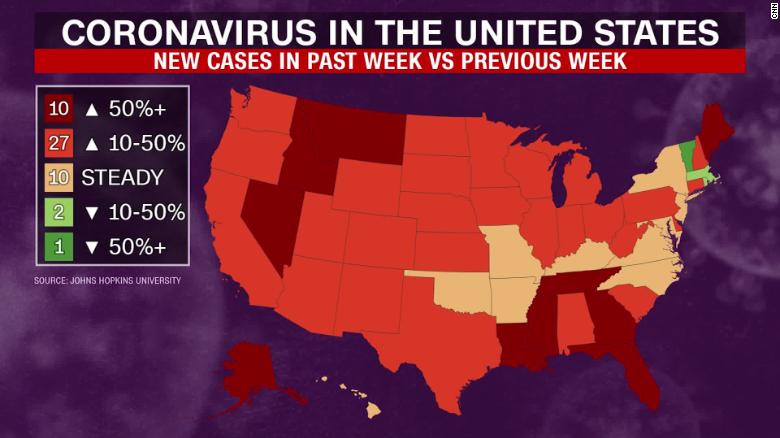
There are signs that the outbreak is getting worse, not better. The 10 days with the highest number of new coronavirus infections in the United States have come in the past 11 days.

Case counts, hospitalizations and even deaths are on the rise across the nation, not only in Southern states that were slow to embrace lockdowns in March and April.

California, the first state to completely lock down, has reported more than 54,000 new cases over both of the last two weeks. Nevada, about one-thirteenth the size of California, reported 5,200 new cases last week. States where early lockdowns helped limit the initial peak like Pennsylvania, Illinois and Ohio are all seeing case counts grow and hospital beds fill up.

Only two states — Maine and New Jersey — have seen their case counts decline for two consecutive weeks.


“We are nearing the point where pretty much most of the gains we had achieved have been lost,” said Christine Petersen, an epidemiologist at the University of Iowa. “All of us are hoping we magically get our acts together and we can look like Europe in two months. But all the data shows we are not doing that right now.”

It is in that dismal context that schools are preparing some sort of return to learning, whether in person or remote. President Trump and Education Secretary Betsy DeVos have threatened schools that do not fully reopen.

But even though the coronavirus appears to have less severe consequences among children, sending them back to schools en masse does not carry zero risk. Children have died from the virus, and the more who are exposed mean more opportunities for the virus to kill again, even before considering the millions of teachers who may be vulnerable or the parents and grandparents asymptomatic children might be exposed to.

Already, school districts in Los Angeles and San Diego have delayed reopening plans as case counts rise.

“We do know that kids can get sick and they can even die. It’s definitely a much lower number,” Petersen said. “Even if they aren’t as infectious, if there are millions of them gathering in schools not having great hygiene, it’s a multiplier effect.”


The painful lockdowns that were supposed to reduce viral transmissions bought time to bolster testing and hospital capacity, to speed production of the equipment needed to test patients and protect front-line health care workers.

But that hasn’t happened; laboratories in the United States have tested as many as 823,000 people in a day, a record number but far shy of the millions a day necessary to wrestle the virus under control. Arizona and Los Angeles have canceled testing appointments for lack of supplies. Hospitals are reporting new shortages of protective gear and N95 masks.

The Trump administration used the Defense Production Act to order meat processing plants to stay open; it has only awarded contracts sufficient to produce 300 million N95 masks by the end of the year, far short of what health experts believe will be necessary to protect health care workers.


“A failure of national leadership has led us to a place where we are back where we were before, no national testing strategy, no national strategy for supply,” said Kelli Drenner, who teaches public health at the University of Houston. “States are still on their own to scramble for reagents and swabs and PPE and all of that, still competing against each other and against nations for those resources.”

There are troubling signs that the promise of a vaccine may not be the cure-all for which many had hoped. Early studies suggest that the immune system only retains coronavirus antibodies for a few months, or perhaps a year, raising the prospect that people could become reinfected even after they recover. A growing, if still fringe, movement of anti-vaccination activists may refuse a vaccine altogether, putting others at risk.

“A vaccine is not going to solve this. People die of vaccine-preventable diseases every day. All the failures with testing and diagnostics and all the inequities and access to care with those are going to be the same things that are going to be magnified with a vaccine,” said Nita Bharti, a biologist at Penn State’s Center for Infectious Disease Dynamics.


More than a dozen states hit hardest by the latest wave of disease have paused or reversed their reopening processes. But only 24 states and the District of Columbia have ordered residents to wear masks in public, and compliance varies widely by both geography and political affiliation.

“This is the critical time. If we are going to try to reverse this, we have to get back to the mental space and the resolute action we had in March. I’m not sure we have the energy and the wherewithal to do it,” Petersen said.


Without a dramatic recommitment to conquering the virus, health officials warn, the new normal in which the country exists will be one of serious and widespread illness, and a steady drumbeat of death.

“None of this was inevitable. None of this should be acceptable. There are ways we can do better,” Spencer said. “This will continue to be our reality for as long as we don’t take it seriously.”

But after months of repeating the same warnings — wear a mask, stay socially distant, stay home if possible, avoid places where people congregate in tight quarters — some health experts worry their message has been lost amid a sea of doubt, skepticism and mixed signals.

“It’s like a learned helplessness when we’re not helpless,” Drenner said. “There are some pretty effective strategies, but we don’t seem to have the political will to do it.”


Coronavirus cases soar by more than 1 million over 5 days

https://www.cnn.com/2020/07/14/world/million-coronavirus-cases-five-days-intl/index.html

Coronavirus cases soar by more than 1 million over 5 days - WRCBtv ...

Coronavirus cases soared by more than a million globally in just five days as the numbers continue to accelerate from week to week, according to figures from Johns Hopkins University.

Reported cases increased by 1,046,200 from July 6 through July 10, up from a 994,400 increase over the five days from July 5 through July 9.
The total global case number surpassed 13 million on Monday, growing by 1,061,600 between July 8 and July 13.
While some countries that were hit early in the outbreak have managed to contain the virus, the number of cases globally has been accelerating fairly steadily.
There have now been more than half a million deaths from the virus worldwide, according to JHU data.
The World Health Organization’s director-general on Monday warned there would be “no return to the old normal for the foreseeable future.”
Tedros Adhanom Ghebreyesus told a media briefing in Geneva that there were no shortcuts out of this pandemic, and that while we may hope for an effective vaccine, there must be a focus on using the tools that are available now to suppress transmission and save lives.
“We need to reach a sustainable situation where we do have adequate control of this virus without shutting down our lives entirely, or lurching from lockdown to lockdown,” Tedros said.
He told reporters there was a “roadmap to a situation where we can control the disease and get on with our lives” that would require three things: a focus on reducing mortality and suppressing transmission; an “empowered, engaged community” that takes individual measures to protect the whole community; and strong government leadership and communication.
Two countries accounted for half of all new cases added worldwide on Sunday, he told the briefing.
“Yesterday, 230,000 cases of Covid-19 were reported to WHO. Almost 80% of those cases were reported from just 10 countries, and 50% come from just two countries,” he said.
Tedros did not name the countries, but WHO data indicated that he was referring to the United States and Brazil. According to the JHU tally of cases, the US, India and Brazil accounted for more than 112,000 new cases on Sunday.
The US has the world’s highest confirmed numbers, with at least 3.4 million recorded cases and at least 135,615 deaths. Brazil has almost 2 million confirmed cases and India is closing in on one million.
“Let me be blunt: Too many countries are headed in the wrong direction,” Tedros said.
“If governments do not clearly communicate with their citizens and roll out a comprehensive strategy focused on suppressing transmission and saving lives; if populations do not follow the basic principles of physical distancing, hand washing, wearing masks, there is only one way this is going to go. It’s going to get worse and worse and worse.”
“But it does not have to be this way,” he added. “It’s never too late to bring the virus under control, even if there has been explosive transmission.”


Fauci has been an example of conscience and courage.

https://www.washingtonpost.com/opinions/fauci-has-been-an-example-of-conscience-and-courage-trump-has-been-nothing-but-weak/2020/07/13/7c9a7578-c52b-11ea-8ffe-372be8d82298_story.html?fbclid=IwAR0n0o67FMhhUjxqU11cfrd4daMkW0ZWZtIg–I1P3ioLPA7ka7Ew0XT_EA&utm_campaign=wp_main&utm_medium=social&utm_source=facebook

Opinion | Fauci has been an example of conscience and courage ...

When historians try to identify the most shameful documents from the Trump administration, a few are likely to stand out. For unconstitutional bigotry, it is hard to beat the initial executive order banning travel to the United States from Muslim countries. For cruelty and smallness, there is the “zero tolerance” directive to federal prosecutors that led to family separations at the border. For naked corruption, there is the transcript of the quid-pro-quo conversation between President Trump and the president of Ukraine.

But for rash, foolish irresponsibility, I’d nominate the opposition research paper recently circulated by the White House in an attempt to discredit the National Institute of Allergy and Infectious Diseases’ Anthony S. Fauci. As reported by The Post, the document recounted a number of instances — on community transmission, asymptomatic transmission and mask wearing in particular — where Fauci’s views have shifted over time. As far as I know, this official record is unique: A White House attack on the government’s leading infectious-disease specialist during a raging pandemic. It indicates an administration so far gone in rage, bitterness and paranoia that it can no longer be trusted to preserve American lives.

From a purely political standpoint, it is understandable that the administration would want to divert attention from its covid-19 record. Trump’s policy of reopening at any cost is exacting a mounting cost. Five months into the greatest health crisis of modern U.S. history, there are still serious problems with supply chains for protective equipment. There are still long wait times for testing results in many places. The contact tracing process in many communities remains (as one health expert described it to me) “a joke.” More than 132,000 Americans have died.

Rather than addressing these failures, Trump has chosen to sabotage a public official who admits their existence. Rather than confronting these problems, Trump wants to ensure his whole administration lies about them in unison. The president has surveyed America’s massive spike in new infections and thinks the most urgent matter is . . . message discipline.

It is true that a number of Fauci’s views on the novel coronavirus have evolved (though some of the administration’s charges against him are distorted). But attacking a scientist for making such shifts is to willfully misunderstand the role of science in the fight against disease. We do not trust public health officials during an emerging pandemic because they have fully formed scientific views from the beginning. We trust them because 1) they are making judgments based on the best available information and 2) they have no other motive than the health of the public. If, say, health officials were initially mistaken about the possibility of asymptomatic transmission, it is not failure when they change their views according to better data. It is the nature of the scientific method and the definition of their duty.

In the inch-deep world of politics, amending your view based on new information is a flip-flop. In epidemiology, it is known as, well, epidemiology.

Meanwhile, the president is failing according to both requirements of public trust. Trump is not making judgments based on the best available information. And he clearly has political goals that compete with (and often override) his commitment to public health. The president is hoping against hope that the public will forget about the virus until November, or at least about the federal role in fighting it. To apply a veneer of normalcy, he is holding public events that endanger his staff and his audience and is planning a Republican convention that will double as a petri dish.

It now seems likely that the most decisive moment of the American pandemic took place in mid-April when new cases began to stabilize around 25,000 a day. Even four or six more weeks of firm presidential leadership — urging the tough, sacrificial application of stay-at-home orders — might have reduced the burden of disease to more sustainable levels, as happened in Western Europe. And this would have relieved stress on systems of testing, tracing and treatment.

But Trump’s nerve failed him. Instead of holding firm, he began siding with populist demands for immediate opening, pressuring governors to take precipitous steps and encouraging skepticism about basic public health information and measures. This may well have been the defining moment of the Trump presidency. And he was weak, weak, weak.

It is typical for Trump to shift blame. But in this case, the president has selected his fall guy poorly. Fauci has been an example of conscience and courage in an administration that values neither. When Trump encourages a contrast to his own selfishness and cravenness, he only damages himself.