America’s nightmarish year is finally ending

America's nightmare year of COVID is finally ending

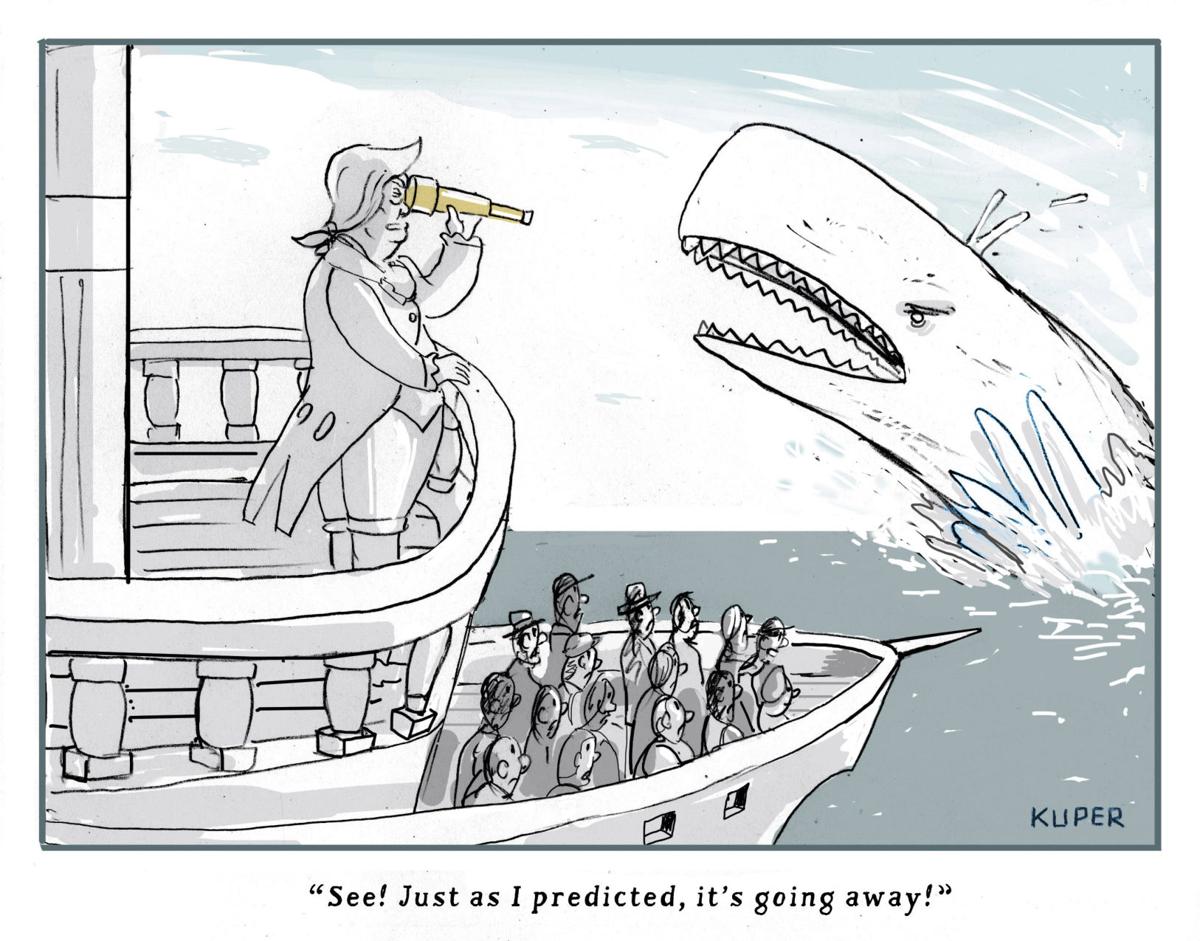
One year after the World Health Organization declared COVID-19 a pandemic, the end of that pandemic is within reach.

The big picture: The death and suffering caused by the coronavirus have been much worse than many people expected a year ago — but the vaccines have been much better.

Flashback“Bottom line, it’s going to get worse,” Anthony Fauci told a congressional panel on March 11, 2020, the day the WHO formally declared COVID-19 to be a global pandemic.

  • A year ago today, the U.S. had confirmed 1,000 coronavirus infections. Now we’re approaching 30 million.
  • In the earliest days of the pandemic, Americans were terrified by the White House’s projections — informed by well-respected modeling — that 100,000 to 240,000 Americans could die from the virus. That actual number now sits at just under 530,000.
  • Many models at the time thought the virus would peak last May. It was nowhere close to its height by then. The deadliest month of the pandemic was January.

Yes, but: Last March, even the sunniest optimists didn’t expect the U.S. to have a vaccine by now.

  • They certainly didn’t anticipate that over 300 million shots would already be in arms worldwide, and they didn’t think the eventual vaccines, whenever they arrived, would be anywhere near as effective as these shots turned out to be.

Where it stands: President Biden has said every American adult who wants a vaccine will be able to get one by the end of May, and the country is on track to meet that target.

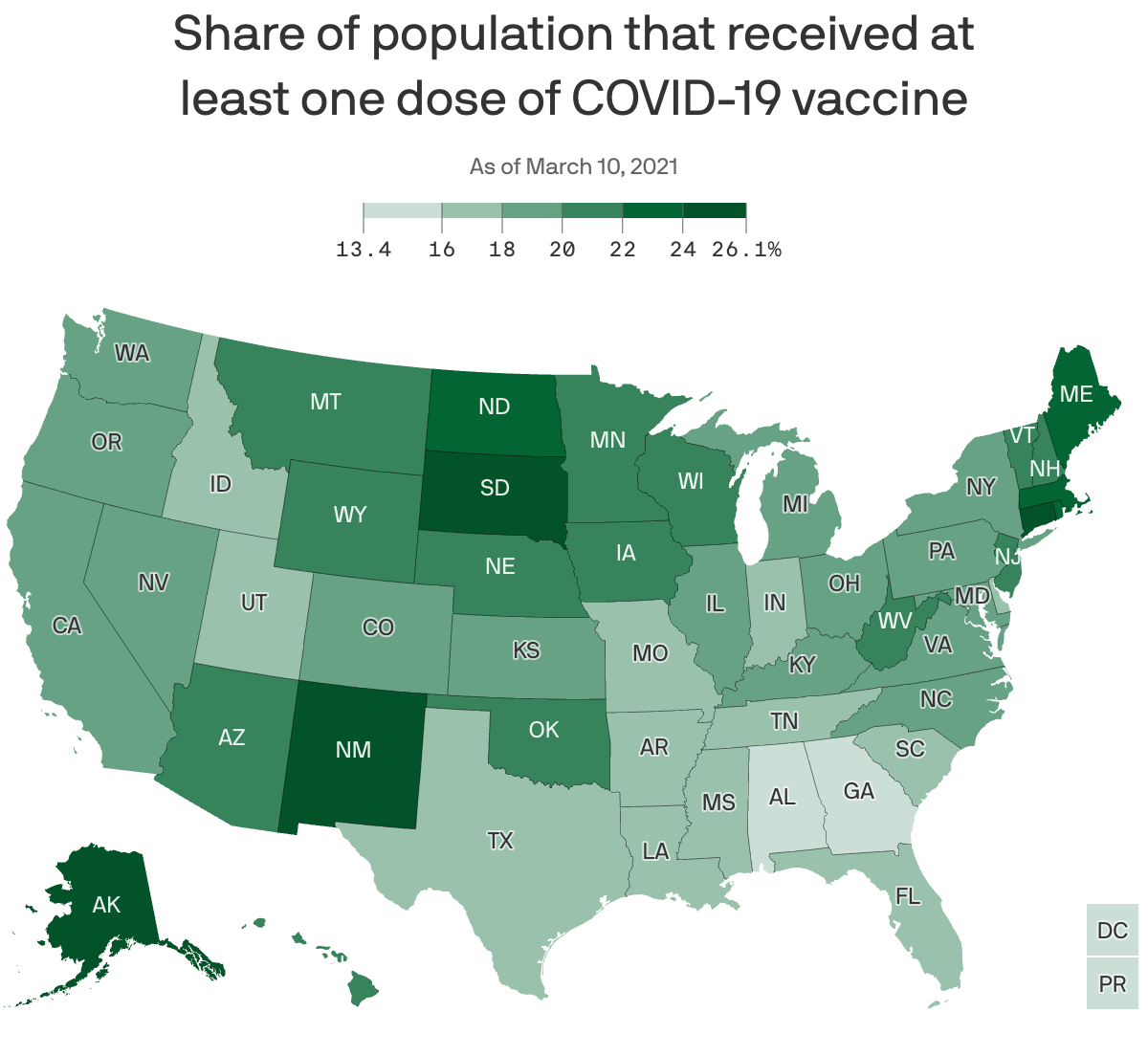
  • The U.S. is administering over 2 million shots per day, on average. Roughly 25% of the adult population has gotten at least one shot.
  • The federal government has purchased more doses than this country will be able to use: 300 million from Pfizer, 300 million from Moderna and 200 million from Johnson & Johnson.
  • The Pfizer and Moderna orders alone would be more than enough to fully vaccinate every American adult. (The vaccines aren’t yet authorized for use in children.)

Yes, millions of Americans are still anxiously awaiting their first shot — and navigating signup websites that are often frustrating and awful.

  • But the supply of available vaccines is expected to surge this month, and the companies say the bulk of those doses should be available by the end of May.
  • Cases, hospitalizations and deaths are all falling sharply at the same time vaccinations are ramping up.

The bottom line: Measured in death, loss, isolation and financial ruin, one year has felt like an eternity. Measured as the time between the declaration of a pandemic and vaccinating 60 million Americans, one year is an instant.

  • The virus hasn’t been defeated, and may never fully go away. Getting back to “normal” will be a moving target. Nothing’s over yet. But the end of the worst of it — the long, brutal nightmare of death and suffering — is getting close.
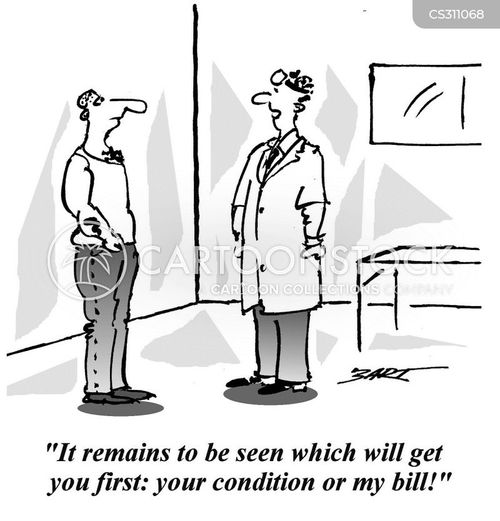
Cartoon – State of the Union (Underinsured)

Image result for cartoon underinsured health

Economy shrank 3.5 percent in 2020

https://thehill.com/policy/finance/536247-economy-shrank-35-percent-in-2020

How fish and shrimps could be recruited as underwater spies | | News For  Tomorrow

The U.S. economy shrank 3.5 percent in 2020 as the coronavirus pandemic shuttered businesses, schools and events, marking the first annual contraction since the Great Recession, according to data released by the Commerce Department on Thursday.

U.S. gross domestic product (GDP) suffered its largest annual decline since 1946 due to the coronavirus pandemic, according to the Commerce Department release. The outbreak of COVID-19 caused the steepest economic collapse since the Great Depression, wiping out more than 20 million jobs and years of economic growth within two months.

U.S. GDP increased by an annualized rate of 4 percent in the final three months of 2020, according to the data released Thursday, following an annualized gain of 33.4 percent in the third quarter and a 31.4 percent annualized decline in the second quarter. But the economic rebound staged in the second half of 2020 has been dampened by the continued rapid spread of COVID-19 throughout the country.

The U.S. economy came into 2020 remarkably strong. Unemployment reached a 50-year low of 3.5 percent in the previous year, inflation remained low and the U.S. had just set a record for the longest economic expansion in its modern history. While the U.S. was likely to face some headwinds from slowing economies overseas, the stunning emergence of the coronavirus pandemic shattered the strong labor market and forced thousands of businesses to shutter.

Consumer spending — which makes up nearly two-thirds of the U.S. economy — fell 2.6 percent in 2020, driven mainly by a 3.4 percent decline in spending on services. Spending on goods rose 0.8 percent, however, as purchases shifted from gatherings to products that could be used during lockdowns.

Economists expect the U.S. economy to bounce back quickly in the second half of 2021, assuming enough Americans are vaccinated to prevent large coronavirus outbreaks. Both economists and health experts insist that a full return to normal is not possible until the pandemic is defeated. 

Roughly 9 million jobs lost during the onset of the pandemic have yet to be recovered, and those without work have struggled to get by with swaths of the economy still largely shut down by the virus. The federal government approved more than $4 trillion to fund pandemic response and economic rescue in 2020, though Democratic lawmakers and many economists say more is still needed.

President Biden and congressional Democrats are pushing to pass another $1.9 trillion COVID-19 bill meant to ramp up vaccine distribution and offer more economic relief to those in the greatest need.

Republican lawmakers have not ruled out passing another relief bill, but most object to the size and scope of Biden’s proposal after approving a $900 billion measure in December.

Treasury Secretary Janet Yellen and Federal Reserve Chairman Jerome Powell have both warned lawmakers that the risks of holding back on necessary fiscal relief are far greater than adding more to the national debt or risking an increase in inflation.

“I’m much more worried about falling short of a complete recovery and losing peoples’ careers and lives and the damage that will do to productive capacity than about the possibility of higher inflation,” Powell said Wednesday.

Cartoon – History Repeating Itself (Covid-19)

Editorial Cartoon: COVID-19 returns | Opinion | dailyastorian.com

Cartoon – Coronavirus Death Toll

Coronavirus cartoons: Trump's ratings jump amid big job losses

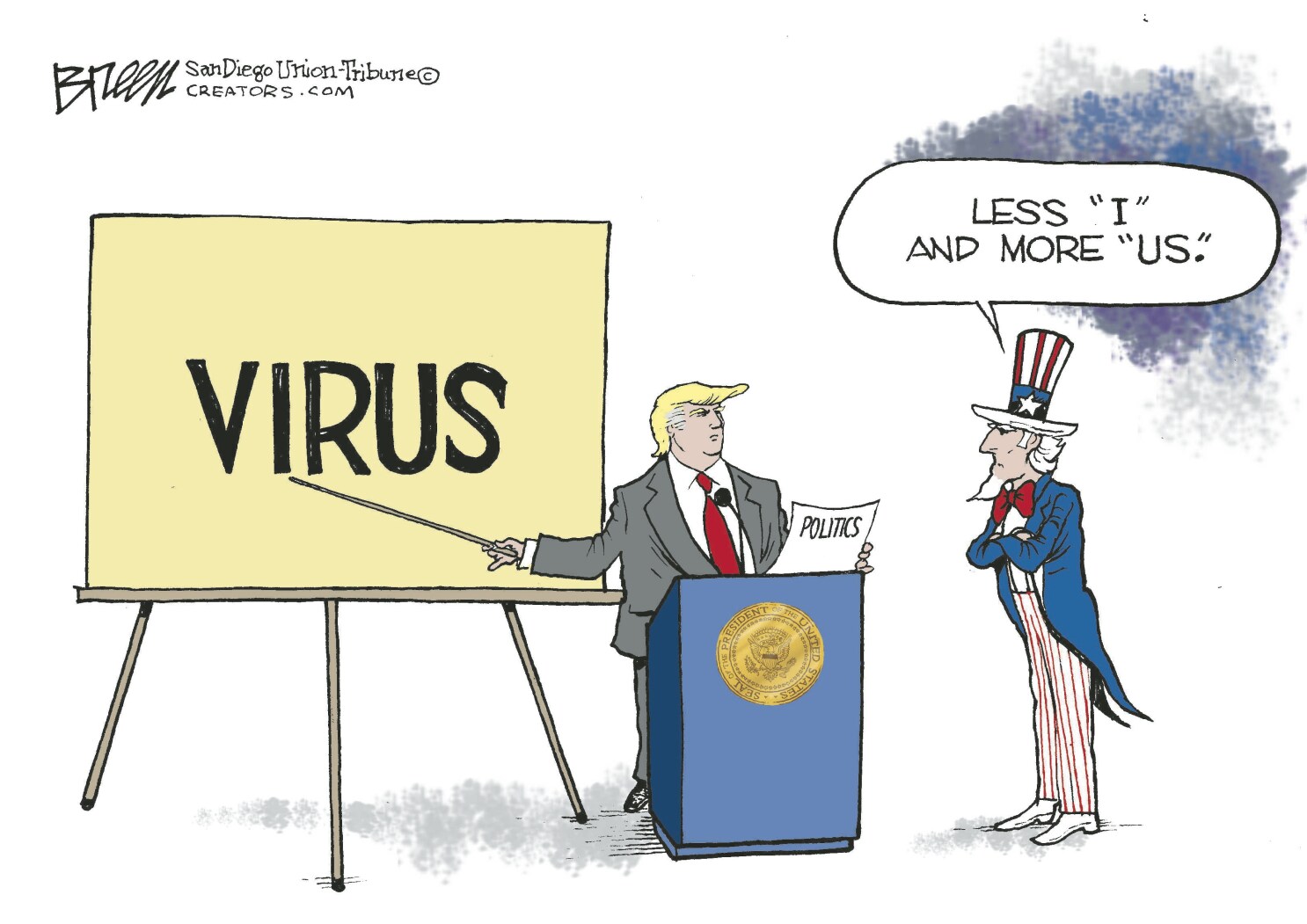
Cartoon – Less “I” and more “US.”

Trump's coronavirus press conference less than inspiring - The San Diego  Union-Tribune

Cartoon – State of the Union on Covid Denial

Editorial cartoons for Jan. 3, 2021: Good riddance, 2020 - syracuse.com

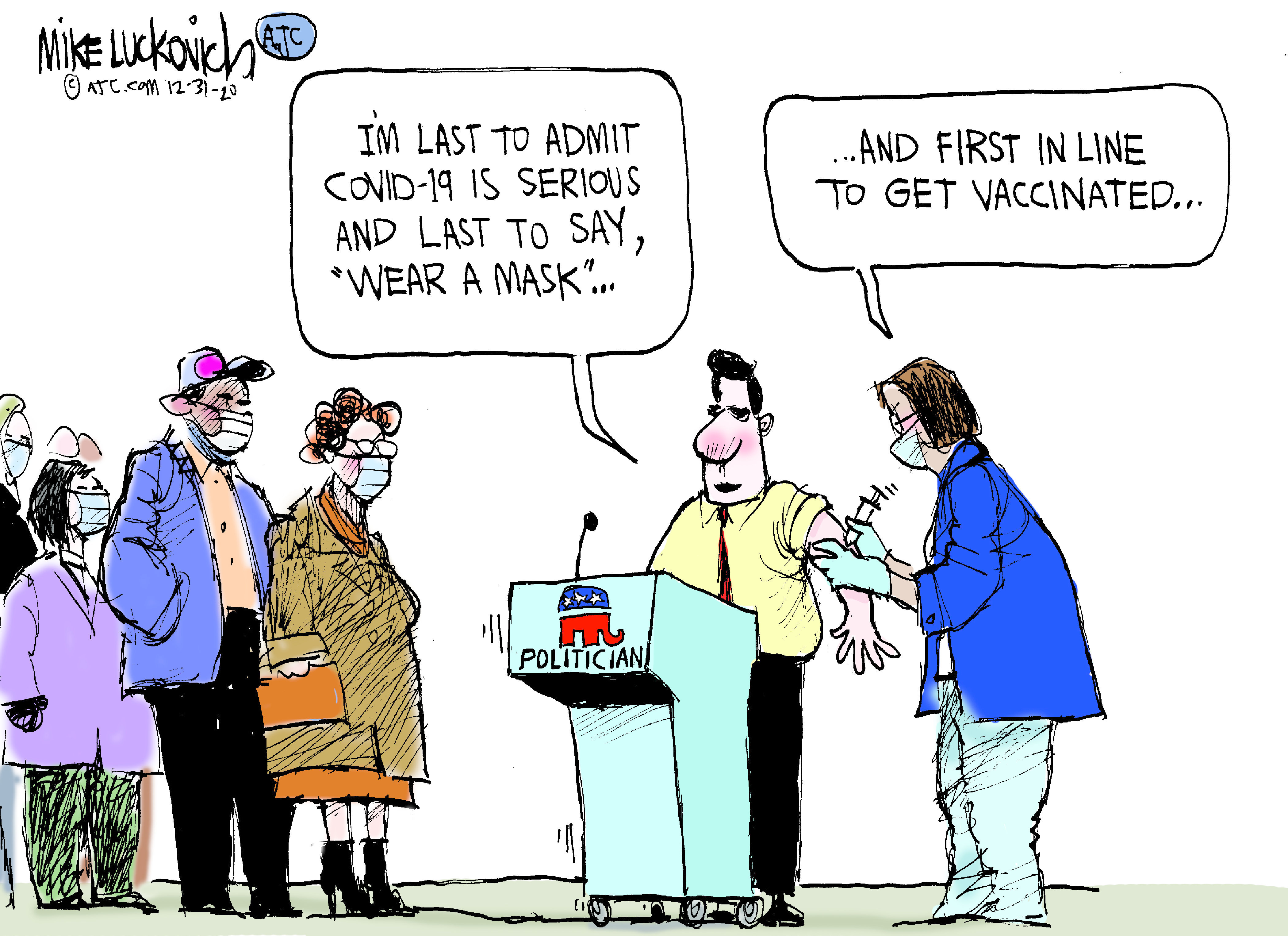
Cartoon – State of the Union on Vaccines