U.S. Supreme Court sides with insurers in battle over risk corridor payments

https://www.fiercehealthcare.com/payer/scotus-sides-insurers-battle-over-risk-corridor-payments?mkt_tok=eyJpIjoiWXpNMlpXUTVaakpoTmpJMSIsInQiOiJzU3ViK3ZwV0oyMUxOS3N5T0tXY3h1anlUSW5ndTJ0MDlEMkE1S3BGRDg1Mlc1eDdpY3hGaHRCV0U1eUpFbWxhR3ZoSVlRdlU5M1NCek5FamxZZ0NLMEhxQ25teFwvNVwvSFEzYnlETEpuMnlZM0FJYThWeEhTcUFodElZUEcwS1RlIn0%3D&mrkid=959610

Supreme Court seems to side with insurers in ACA risk corridor ...

The Supreme Court sided with insurers in a years-long battle over billions in payments promised under the Affordable Care Act.

The nation’s highest court ruled (PDF) 8-1 on Monday that the ACA’s risk corridor program created an obligation for the federal government to pay health plans promised funds.

The insurers suing for damages sought $12 billion in unpaid funds from the program.

The ACA established the risk corridors to encourage health plans to participate in the exchanges. If an insurer earned massive profits through the individual market, the government would claim some of those funds and pay it out to insurers that are performing poorly.

The government did collect those funds, but did not pay out money to struggling insurers. The risk corridor program closed in 2016 after three years.

The justices argued that the government was compelled to make the payments.

“The plain terms of the risk corridors provision created an obligation neither contingent on nor limited by the availability of appropriations or other funds,” the court argued.

Justice Samuel Alito was the lone dissent in the case.

The justices also disputed the government’s argument that Congress implied a repeal of the risk corridors through appropriations riders. The justices said that any riders did not actually change the payment methodology or suggest the payments were not required.

The court also argued that the health plans had standing to sue under the Tucker Act.

“Petitioners clear each hurdle: The risk corridors statute is fairly interpreted as mandating compensation for damages, and neither exception to the Tucker Act applies,” the court said.

In his dissent, Alito blasts the opinion as a bailout for health plans.

America’s Health Insurance Plans CEO Matt Eyles praised the ruling in a statement.

“The federal government made a clear commitment in the interest of building stable markets and making coverage more affordable for individuals and small employers,” Eyles said. “Health insurance providers kept their commitments while incurring substantial losses.”

Today’s decision, as the Supreme Court observes, reflects ‘a principle as old as the Nation itself: The Government should honor its obligations,’” he added. “We appreciate that today’s Supreme Court 8-1 decision ensures that the federal government honors the obligations it made for services the private sector already delivered.”


Pandemic spurs court fights over mail-in voting

https://thehill.com/regulation/court-battles/492135-pandemic-spurs-court-fights-over-mail-in-voting?userid=12325

Pandemic spurs court fights over mail-in voting | TheHill

Election officials are scrambling ahead of the November vote to ramp up alternative methods like mail-in voting as the coronavirus pandemic raises concerns about the safety of in-person voting.

That dash to expand polling options could bring a new wave of court fights around the 2020 election, legal experts say. As states move to bolster balloting options — or face challenges to such plans — both sides in the debate are likely to take those decisions to court.

And when Election Day arrives, questions over the handling of mail-in ballots could lead to more court fights.

“We do not want the election resolved in the courts and so I hope it does not come to that,” said Richard Pildes, a law professor at New York University.

Legal experts say the nightmare scenario would be a situation resembling the Supreme Court’s decision on Bush v. Gore, which was seen as an ideological one that undermined both the legitimacy of the court and the 2000 presidential election results among critics of the decision.

“We know that the current partisan divide over the legitimacy of the U.S. Supreme Court can be timed to the release of the Bush v. Gore decision,” said Charles Stewart, a political science professor and election expert at MIT. “So, we have to be worried both about the legitimacy of the result and the legitimacy of the courts.”

States are hoping to avoid the situation Wisconsin faced this week where widespread in-person voting took place, despite last-minute efforts to avoid that outcome amid a virus that had infected some 2,500 and killed nearly 80 in the state by the Tuesday vote.

“There’s nonstop work being done by election officials to plan for November,” Stewart said.

The hope is that the pandemic will have abated enough to allow for in-person voting, which could be done more safely if early voting is expanded to reduce crowding on Voting Day. But given the fears over inciting a second wave of infections, that may not be advisable by the fall.

All states allow at least some mail-in balloting for select voters. While some states have relatively expansive mail voting systems, others have few provisions.

The fight over expanding voting options has already sparked legal battles. Texas is one of the states that has cases pending in court over efforts to expand mail-in balloting.

Under the current state election rules in Texas, only voters with a “qualifying reason” — advanced age, disability, incarceration or planned travel — can mail in ballots, despite public health guidance to avoid public gatherings. But a lawsuit filed by Texas Democrats ahead of the July primary runoff seeks to have that criteria expanded by including social distancing as a qualifying disability.

Progress toward developing a voting failsafe by November is likely to be uneven among the states given that not all are beginning from the same starting point, and because the push has increasingly become riven by partisan politics.

States that have a head start will be better off, though, experts said.

“States that already have a well-developed vote-by-mail program may well have the capacity to supersize it, and states that don’t may well have the capacity to provide some incremental vote-by-mail capacity,” said Justin Levitt, a professor at Loyola Law School.

“But it will be a herculean task for a state without much vote-by-mail capacity to get to almost everyone voting by mail by November. That takes expertise and systems, equipment and personnel, and the capacity to print a lot more ballots. And it is not easy to get any of those quickly.”

Lorraine Minnite, a political science professor at Rutgers University-Camden, put it even more starkly.

“A large-scale change in procedure hastily administered will likely not run smoothly even under the best of conditions,” she said.

Experts warn that expanded mail-in voting could lead to more voter errors and omissions, create more opportunities for fraud or coercion, and pose special challenges for those who move frequently or lack a permanent address. 

Edward Foley, a law professor at Ohio State University, said that if states are too slow to mail out ballots, litigation could arise from those issues.

“The most likely problem to trigger litigation would be if voters request absentee ballots on time, but election officials because they are overwhelmed with the high volume of absentee ballot requests fail to send the ballots to voters in time for voters to return them by the legally specified deadline,” Foley said.

“This, then, creates a problem of wrongful disenfranchisement of eligible voters, through no fault of the voters but because of the government’s own problems, and requires a court to come up with an appropriate remedy,” he added.

Rick Hasen, a professor of law and political science at the University of California Irvine, said that more courts may be drawn into a battle similar to the one playing out in Texas over whether voting by mail should require a valid excuse.

“There are a number of issues courts may address related to the vote by mail and the coronavirus,” he said. “Do states have to expand ballot deadlines to deal with a flood of absentee ballots? Do voters have a right to be told their absentee ballots have been rejected and given the opportunity to ‘cure’ a problem for rejecting a ballot like a purported signature mismatch?”

According to Levitt, one common thread among states is the urgent need for money to ramp up mail-in operations.

“The single most important piece is funding,” he said. “There are a lot of logistics between here and there, including space and machinery and people to process mail ballots, and that takes money.”  

The more than $2 trillion coronavirus stimulus package included $400 million for states to expand early voting, election by mail and for other election matters.

“The recent funding from Congress is an extremely welcome start, but only barely a start,” he added. “There needs to be much more, and quickly: it does little good to get more funding for this in October.”


Political hackery at its worst: Supreme Court gives Wisconsin a green light to disenfranchise voters during the pandemic

https://www.yahoo.com/news/political-hackery-worst-supreme-court-021006989.html

Opinion: Hackery at its worst: Supreme Court conservatives just ...

The Los Angeles Times warned in an editorial last month that the COVID-19 pandemic threatened not only the health of individuals but the democratic process. The Supreme Court exacerbated that infection Monday when the justices blocked a lower court’s decision to extend the period in which Wisconsin voters could mail in absentee ballots.

Tuesday is election day in that state, and the Democratic presidential primary is only one of many contests on the ballot. As the COVID-19 crisis deepened, it became obvious that some voters would face a choice between exercising the franchise and protecting their health by staying home. But first the Wisconsin Supreme Court and then the U.S. Supreme Court failed to rise to the occasion.

On Monday the state Supreme Court rebuffed an attempt by Wisconsin’s Democratic governor to suspend in-person voting on Tuesday and expand voting by mail. Then late Monday the U.S. Supreme Court, with Democratic and Republican appointees on opposite sides, stayed an order by a lower federal court requiring Wisconsin to count mail-in ballots if they arrived by April 13 even if they were mailed after election day.

In an unsigned opinion, the court’s conservative justices providing a textbook example of exalting form over substance. The majority complained that the extended deadline for absentee ballots “fundamentally alters the nature of the election.” It cited the precedent of a 2006 decision in which the court overturned an injunction preventing Arizona’s use of a photo ID requirement — a ruling from a calmer time. Precedent loses its force in unprecedented circumstances.

This ruling is outrageously oblivious to the emergency posed by the pandemic. In the 2006 case the court emphasized that a state “indisputably has a compelling interest in preserving the integrity of its election process.” But given the pandemic and the disruptions it creates for the election process, the lower court’s order promoted exactly that objective.

As Justice Ruth Bader Ginsburg noted in a dissent signed by three other Democratic appointees, the court’s order means that absentee voters must postmark their ballots by Tuesday, even if they didn’t receive their ballots by that date because of a backlog. The result, she warned, could be “massive disenfranchisement.”

As disturbing as the result of the court’s ruling is the fact that it pitted conservative justices appointed by Republican presidents against liberal justices appointed by Democratic presidents, seeming to validate the perception that the justices are “politicians in robes.” So much for Chief Justice John G. Roberts Jr.’s campaign to portray the court as being aloof from partisan politics.


Wisconsin Votes Tomorrow. In Person.

Wisconsin Votes Tomorrow. In Individual. - Hindi2News

The state’s Supreme Court ruled against the governor’s last-minute effort to delay the election.

The Summer Olympics are delayed. March Madness was canceled. Even the pope celebrated Palm Sunday Mass before a nearly empty St. Peter’s Basilica.

But in Wisconsin, there could still be an election tomorrow.

Yes, you read that correctly: A state that has been under a stay-at-home order for nearly two weeks is about to hold an in-person election amid the coronavirus pandemic.

Just over an hour ago — and with just hours to go before the polls are scheduled to open — the Wisconsin Supreme Court ruled against a last-minute effort by Gov. Tony Evers to postpone the election until June 9, siding with a Republican-controlled State Legislature that has resisted making nearly any changes to voting during the worldwide crisis.

The last-minute fighting over whether it is safe for people to vote tomorrow injects even more chaos into an election already rife with legal challenges and public safety concerns.

It’s a situation that could foreshadow the kind of politically toxic battles over voting that the country may face this fall, if the virus lingers into the November election. (Wisconsin has more than 2,000 reported coronavirus cases and at least 80 deaths.)

Mr. Evers, a Democrat, had previously said that he lacked the legal authority to move the election, but today he argued that a postponement was necessary to protect voters and slow the spread of the virus.

Within minutes of his order, Republican legislative leaders called his move unconstitutional, instructing clerks to move forward with the election and challenging the order in the State Supreme Court, which has a conservative majority.

Already, 15 other states and one territory had either pushed back their presidential primaries or switched to voting by mail with extended deadlines.

Dysfunctional politics kept Wisconsin from doing the same. On Saturday, state lawmakers rejected Mr. Evers’s proposals for holding an all-mail election and extending voting to May, gaveling out a special legislative session within seconds. That prompted Mr. Evers and his team to reassess what authority he might have to postpone the election with an executive order.

Even with voters’ very lives at stake, Wisconsin’s politicians were unable to come to an agreement — a fight that mirrors the dynamics of battles over voting access already underway at the national level.

As Democrats push for billions of dollars in federal funds to bolster voting by mail and other absentee options, Republicans say those kinds of options would increase the risk of electoral fraud. Some, including President Trump, also argue it would harm the electoral prospects of Republican candidates.

“The things they had in there were crazy,” Mr. Trump said of the Democratic proposal. “They had things — levels of voting that, if you ever agreed to it, you’d never have a Republican elected in this country again.”

While Wisconsin Republicans have not made that argument explicitly, they do have a competitive State Supreme Court election on the ballot on Tuesday (along with the presidential primary and thousands of local offices).

Wisconsin, one of the most gerrymandered states in the country, has a long history of electoral shenanigans. Two years ago, the Republicans in charge tried to move Tuesday’s State Supreme Court election to a different date to help their candidate.

Even if in-person voting does happen tomorrow, the legitimacy of the election will most likely be thrown into question. Turnout is expected to be dismal, given the warnings about contracting the virus and confusion over the actual elections.

Already, more than 100 municipalities have said they lack enough staff members to run even one polling place. Milwaukee typically has about 180 sites; this election the city will have five open. The head of the state elections commission has raised the possibility that some voters may have to head to a different town because no one will be staffing the polls in their hometowns.

The poll workers who remain are overwhelmingly older. Some have serious health conditions. Many have been waiting to receive protective equipment.

In Wisconsin, it seems, maintaining democracy means risking your health — to both toxic politics and a deadly virus.


Trump rejects Obamacare special enrollment period amid pandemic

https://www.politico.com/news/2020/03/31/trump-obamacare-coronavirus-157788?fbclid=IwAR1nbCE7Uwvo2CNi6d6W5NG9zEIQulyh-noy1RXdk_0RJstMM0C5VYJ8mO4

Trump rejects opening ObamaCare special enrollment period amid ...

Before the coronavirus outbreak, nearly 30 million Americans were uninsured and as many as 44 million were under-insured, paying for bare-bones plans with soaring deductibles and copays. Today, millions more Americans will begin losing their employer-based health insurance because they’ve lost their jobs during this pandemic.

Meanwhile, the Trump administration is still actively trying to repeal the entirety of the Affordable Care Act in court, which would cause an additional 20 million people to lose insurance *in the middle of a pandemic*.

And today, Trump refused to reopen ACA enrollment to those millions of uninsured Americans for a special enrollment window, leaving them without any affordable options to get covered. People are going to die because they can’t afford to seek treatment or end up saddled with thousands of dollars of medical debt if they do. Remember this the next time someone tries to tell you Medicare for All is too radical.

What do you think?

The Trump administration has decided against reopening Obamacare enrollment to uninsured Americans during the coronavirus pandemic, defying calls from health insurers and Democrats to create a special sign-up window amid the health crisis.

President Donald Trump and administration officials recently said they were considering relaunching HealthCare.gov, the federal enrollment site, and insurers said they privately received assurances from health officials overseeing the law’s marketplace. However, a White House official on Tuesday evening told POLITICO the administration will not reopen the site for a special enrollment period, and that the administration is “exploring other options.”

The annual enrollment period for HealthCare.gov closed months ago, and a special enrollment period for the coronavirus could have extended the opportunity for millions of uninsured Americans to newly seek out coverage. Still, the law already allows a special enrollment for people who have lost their workplace health plans, so the health care law may still serve as a safety net after a record surge in unemployment stemming from the pandemic.

Numerous Democratic-leaning states that run their own insurance markets have already reopened enrollment in recent weeks as the coronavirus threat grew. The Trump administration oversees enrollment for about two-thirds of states.

Insurers said they had expected Trump to announce a special enrollment period last Friday based on conversations they had with officials at the Centers for Medicare and Medicaid Services, which runs HealthCare.gov enrollment. It wasn’t immediately clear why the Trump administration decided against the special enrollment period. CMS deferred comment to the White House.

Trump confirmed last week he was seriously considering a special enrollment period, but he also doubled down on his support of a lawsuit by Republican states that could destroy the entire Affordable Care Act, along with coverage for the 20 million people insured through the law.

People losing their workplace coverage have some insurance options outside of the law’s marketplaces. They can extend their employer plan for up to 18 months through COBRA, but that’s an especially pricey option. Medicaid is also an option for low-income adults in about two-thirds of states that have adopted Obamacare’s expansion of the program.

Short-term health insurance alternatives promoted by Trump, which allow enrollment year-round, is also an option for many who entered the crisis without coverage. Those plans offer skimpier coverage and typically exclude insurance protections for preexisting conditions, and some blue states like California and have banned them or severely restricted them. The quality of the plans vary significantly and, depending on the contract, insurers can change coverage terms on the fly and leave patients with exorbitant medical bills.

Major insurers selling Obamacare plans were initially reluctant to reopen the law’s marketplaces, fearing they would be crushed by a wave of costs from Covid-19, the disease caused by the novel coronavirus. But the main insurance lobby, America’s Health Insurance Plans, endorsed the special enrollment period roughly two weeks ago while also urging lawmakers to expand premium subsidies to make coverage more affordable for middle-income people.

Congress in last week’s $2 trillion stimulus passed on that request, as well as insurers’ petition for an open-ended government fund to help stem financial losses from an unexpected wave in coronavirus hospitalizations.

Democrats pushing for the special enrollment period are also grappling with the high costs facing many people with insurance despite new pledges from plans to waive cost-sharing. Obamacare plans and a growing number of those offered by employers impose hefty cost-sharing and high deductibles that could still burden infected Americans with thousands of dollar in medical bills.

House Energy and Commerce Chairman Frank Pallone (D-N.J.) on a press call Monday contended that “we also need to have free treatment” after Congress eliminated out-of-pocket costs for coronavirus tests.

“We did the testing, which is now free, and everybody, regardless of their insurance, gets it,” Pallone said. “But that has to be for the treatment as well.”


Two candidates remain: Mr. Medicare for All and Mr. Public Option

https://mailchi.mp/9e118141a707/the-weekly-gist-march-6-2020?e=d1e747d2d8

Image result for Medicare for All and Public Option

The past week in Presidential politics has been momentous—but not clarifying—for determining both the eventual Democratic nominee and the healthcare platform of the party. Between the first ballots cast in South Carolina and the last votes counted in California, the field of viable candidates for the nomination has been winnowed to two: Vermont Sen. Bernie Sanders and former Vice President Joe Biden. The coming weeks will feature a knock-down, drag-out fight for delegates in the run-up to what is likely to be a contested convention in Milwaukee in mid-July, pitting Biden’s “establishment” wing of the party against Sanders’ “progressive” wing.

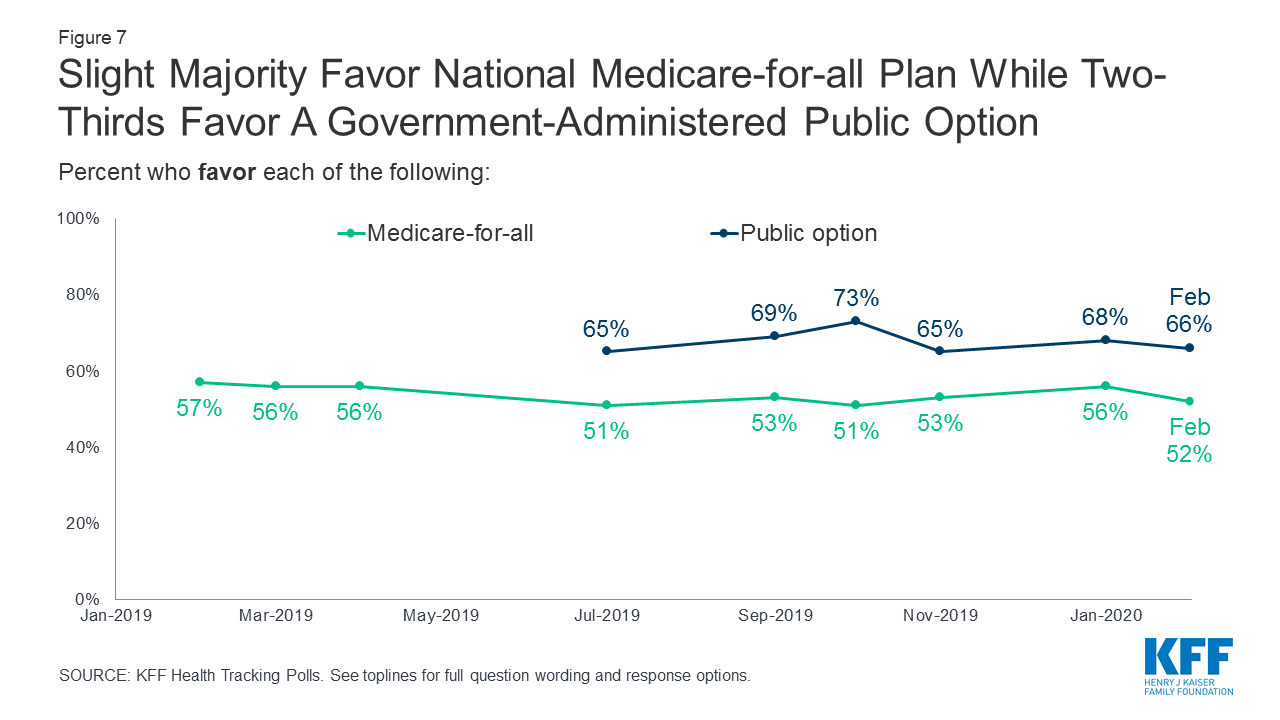
On the healthcare front, that means a continued debate between defenders of the Affordable Care Act (ACA), who want to extend coverage, as Biden does, using a government-run “public option” plan, and supporters of single-payer, “Medicare for All” (M4A) coveragewhich Sanders advocates. That’s the same argument Democrats have been having since the campaign started, and while healthcare remains the top issue of concern for primary voters, polls indicate that both plans are popular with the electorate.

We continue to believe that the public option plan is a far more likely outcome than M4A, but only if the Democrats win control of the Senate—a prospect which appears more possible given billionaire Mike Bloomberg’s post-Super Tuesday endorsement of Biden, and plans to devote his substantial campaign resources to support Democratic candidates across the ballot. Some of that money will surely be spent in Montana, where Gov. Steve Bullock is poised to announce plans to run against incumbent Sen. Steve Daines (R-MT), in a critical race that could be the most expensive Senate contest in history.

And for an indication of how the politics of a public option would play out, look no further than Colorado, where the Democratic legislature moved forward with its version of the plan this week, over the objections of the hospital and insurance lobbies.

Finally, looming over the general election campaign will be the pivotal Texas vs. California case, which the Supreme Court agreed to take up in this fall’s term. That case will ensure that healthcare will remain the centerpiece of American political debates regardless of who leads the Democratic ticket. Buckle up.


Supreme Court Will Hear First Major Abortion Case Since Two Trump Appointees Joined

https://www.wsj.com/articles/supreme-court-will-hear-first-major-abortion-case-since-two-trump-appointees-joined-11583192925?mod=hp_lista_pos2

Image result for Supreme Court Will Hear First Major Abortion Case Since Two Trump Appointees Joined

Case will test new conservative makeup’s approach to precedent.

The Supreme Court hears its first major abortion case Wednesday since two Trump nominees joined the bench, potentially signalling whether—and how much——reproductive rights may change under a bolstered conservative majority.

“There’s a lot on the line in this case, and more than most people realize,” said Mary Ziegler, a law professor at Florida State University and author of the forthcoming book “Abortion and the Law in America.”

Most prominently, the case involves the Supreme Court’s approach to precedent, since it largely is a replay of an issue the court decided in 2016, when by a 5-3 vote it struck down a Texas law requiring that abortion providers obtain admitting privileges at a nearby hospital.

The case also tests the strategy for antiabortion forces, who have been divided over the best way to roll back court precedents recognizing women’s constitutional right to end pregnancy. While some advocates seek to reverse outright Roe v. Wade, the 1973 decision recognizing abortion rights, others believe a more prudent approach is to carve away at the precedent through increasingly restrictive regulations that would spare the Supreme Court the controversy of directly overruling a landmark case.

The law in question, known as the Louisiana Unsafe Abortion Protection Act, isn’t based on a state policy to protect potential life, an interest that the Supreme Court has recognized as valid justification for some abortion restrictions.

Instead, it is based on the argument that abortion itself can be harmful to women, and that restricting access to the procedure therefore is beneficial to women. For that reason, the state’s brief contends that abortion providers shouldn’t be permitted to challenge the law on behalf of their patients, arguing that “a serious conflict of interest” exists between them and Louisiana’s women.

In striking down the Texas law in 2016, the court found the admitting-privilege requirement provided no health benefits to women while forcing many of the state’s abortion clinics to close.

The opinion, by Justice Stephen Breyer, cited evidence that admitting privileges do little to ensure continuity of care, as the state maintained, because when abortion has complications, they generally arise not at the clinic but days after the procedure, when the patient would visit her regular physician or local hospital. The court also observed that hospital admitting privileges aren’t a general credential but are granted for other purposes, such a doctor’s ability to bring in patients for treatment.

Statistically, however, only a tiny number of women require hospitalization after abortion, the court said. “In a word, doctors would be unable to maintain admitting privileges or obtain those privileges for the future, because the fact that abortions are so safe meant that providers were unlikely to have any patients to admit,” Justice Breyer wrote.

But that decision, Whole Woman’s Health v. Hellerstedt, hinged on since-retired Justice Anthony Kennedy, a maverick conservative who joined more liberal justices in the majority. With the late Justice Antonin Scalia’s seat vacant, three conservatives dissented, contending that the majority skirted procedural rules to throw out the Texas law.

President Trump, who appointed Justice Brett Kavanaugh to the vacancy, had as a candidate predicted his Supreme Court picks would vote to overrule Roe v. Wade.

In September 2018, three months after Justice Kennedy’s retirement, the Fifth U.S. Circuit Court of Appeals, in New Orleans, upheld a Louisiana admitting-privileges law that critics argue is identical to the Texas measure struck down two years earlier. The appellate court found the Louisiana Unsafe Abortion Protection Act wouldn’t burden abortion rights in Louisiana to the degree the Texas law did in its state.

An abortion clinic in Shreveport, La., June Medical Services LLC, and three doctors who perform the procedure appealed to the Supreme Court.

That puts the spotlight particularly on Justice Kavanaugh, whose remarks and writings, which have praised the dissent in Roe and supported a Trump administration policy to prevent an underage illegal immigrant from obtaining an abortion, have given hope to abortion opponents.

However, the focus may equally fall on Chief Justice John Roberts, who typically has voted against abortion-rights positions in Supreme Court cases—but he also has stressed an institutional interest in distinguishing the courts from political bodies, where outcomes on legislation can swing wildly based on the latest election results. For that reason, he may be hesitant to overrule even a decision he opposed simply because Justice Kennedy’s retirement presents an opportunity.

In February 2019, he joined the court’s liberal wing to block implementation of the Louisiana law while the appeal proceeded; four other conservatives dissented, although Justice Kavanaugh appended a statement suggesting he was taking a middle ground. He said he wasn’t persuaded that the Louisiana doctors had fully explored opportunities to obtain hospital-admitting privileges.

Should a frontal assault on recent precedent alienate the chief justice or another conservative justice, it probably would end prospects for similar admitting-privilege laws.

But the door could remain open for other abortion restrictions that aren’t covered by existing precedent, particularly if the court signals a readiness to pare back the ability of abortion providers to challenge regulations, or suggests it is more inclined to defer to legislative judgments regarding the safety of abortions rather than evidence, such as scientific research or the views of the medical profession, presented at trial court.


The Supreme Court isn’t done with the ACA case yet. Here are the next steps.

https://www.healthcaredive.com/news/the-supreme-court-isnt-done-with-the-aca-case-yet-here-are-the-next-steps/570816/

The U.S. Supreme Court is scheduled to review the legal challenge to the Affordable Care Act on Feb. 21 to potentially weigh whether to take the case. However, legal expert Katie Keith from Georgetown University cautioned Healthcare Dive it’s common for the court to reschedule or relist cases for a later conference date.

Tuesday’s one-sentence order from the U.S. Supreme Court denying a request to fast-track the challenge to the Affordable Care Act is not the final word from the high court.

The justices will now decide whether to take up the legal case threatening to overturn the landmark law during their next term, which begins in October.

Essentially, the order returns the case to the typical review process as a group of blue states, led by California’s Democratic Attorney General Xavier Becerra, try to convince the Supreme Court it should hear the case at some point instead of letting it wind its way back through the lower courts.

“The court did not say we’re not reviewing this case at all,” MaryBeth Musumeci, an associate director at Kaiser Family Foundation and graduate of Harvard Law School, told Healthcare Dive.

The blue states sought to expedite the case, which would have resulted in a ruling before the presidential election in November. Some Democrats hoped that would pressure Republicans to come up with a replacement had the law been tossed, or more publicly defend efforts that would kill popular provisions like protections for pre-existing conditions.

The court refused to accelerate its review despite requests from hospitals, insurers, advocacy groups including AARP and a group of bipartisan economic scholars.

“It’s disappointing but it’s not altogether unsurprising. They typically don’t like to grant expedited review,” Katie Keith, a lawyer and health policy expert at Georgetown University​, told Healthcare Dive.

Other legal experts warned against reading too much into Tuesday’s order and what it may mean for the case going forward.

“Expediting was always unlikely. It’s a big ask for little purpose here. I wouldn’t read anything else into it,” Jonathan Adler, a law professor at Case Western Reserve University, told Healthcare Dive​.

Careful observers of the case should expect the justices to vote on whether to take it up by June at the latest, Keith said.

In the meantime, Tuesday’s order sets off another wave of briefs. First, the red states will try to convince the court of its position on whether the legal challenge should be heard in October. Expect that motion in the first few days of February, experts told Healthcare Dive.

Robert Henneke, the lawyer representing the individual plaintiffs, told Healthcare Dive his team will argue that the case is still premature for Supreme Court review. “The opinion from the Fifth Circuit was not a complete opinion,” Henneke said.

The appeals court in part affirmed a lower court’s decision, ruling that the individual mandate is unconstitutional because it can no longer be considered a tax. However, it sent the key question of whether the rest of the ACA can stand without the mandate back to the lower court for further analysis.

Becerra has argued that the lower court’s decision is wrong and, without a definitive ruling from the Supreme Court, the challenge only fuels doubt about the future of the ACA — credited with significantly reducing the ranks of the uninsured.

“The health and wellbeing of millions of our loved ones who rely on the ACA for healthcare is too important. We will do everything in our power to keep fighting for them,” Becerra said in a tweet following the order.

Nevertheless, Tuesday’s result likely thrusts the issue of the ACA back in the spotlight for another presidential campaign cycle.

Much of the healthcare debate among Democrats vying to take on President Donald Trump has revolved around a “Medicare for All” idea. One question now is, will Democrats shift to talk about rescuing the ACA, a law in place but remains in jeopardy?

The problem is the outcome is still uncertain, Stephanie Kennan, senior vice president of federal public affairs at McGuireWoods Consulting, told Healthcare Dive. However, it does give Democrats the opportunity to talk about what’s popular in the bill, noting protections for those with pre-existing conditions.

“It certainly gives them a springboard for them to talk about the things they could do to fix it,” Kennan said.

Despite Tuesday’s outcome, there will still be some Democratic contenders who will campaign for Medicare for All, Bill Jordan, chair of Alston and Bird’s healthcare litigation group, told Healthcare Dive. But this ruling gives Democrats another tool against Republicans, he said.

“As time has gone on, the Affordable Care Act has become more popular, not less popular,” Jordan said.

But he cautioned that anything can happen in the next election, which could entirely alter the political landscape and influence whether the case makes it back up to the Supreme Court if the justices pass this time.


Supreme Court denies blue states’ effort to expedite ObamaCare challenge

Supreme Court denies blue states’ effort to expedite ObamaCare challenge

Supreme Court denies blue states' effort to expedite ObamaCare challenge

The Supreme Court on Tuesday rejected an effort by Democrats to expedite a challenge to a lower court’s ruling striking down a key tenet of ObamaCare, narrowing the possibility that the court takes up the contentious case this year.

The House of Representatives and a group of blue states had asked the court to fast-track their appeal after the 5th Circuit Court of Appeals ruled that the Affordable Care Act’s individual mandate is unconstitutional.

“Under the current state of affairs, there is considerable doubt over whether millions of individuals will continue to be able to afford vitally important care,” the House wrote in a court filing earlier this month.

“Millions of individuals will live with the insecurity of not knowing that they have access to affordable health care, and will be forced to make important life decisions without knowing how those decisions will affect their continued access to such care.”

“If the Court does not hear the case this Term, that uncertainty will likely persist through next year’s open enrollment period,” the House wrote.

Tuesday’s order makes it unlikely that the high court will rule on the health care law before the November presidential election, where health insurance policy is sure to play a prominent role.

The 5th Circuit’s ruling delivered a victory for the coalition of conservative state attorneys general challenging the Obama administration’s signature achievement.

The Trump administration has declined to defend the Affordable Care Act in court, and the president has cheered on legal efforts to dismantle it.

“This decision will not alter the current healthcare system,” President Trump said in a statement last month. “My Administration continues to work to provide access to high-quality healthcare at a price you can afford, while strongly protecting those with pre-existing conditions. The radical healthcare changes being proposed by the far left would strip Americans of their current coverage. I will not let this happen.”

It’s still unclear whether the Supreme Court will decide to hear the challenge to the 5th Circuit ruling. Now that the justices have chosen to adhere to a normal briefing schedule, that decision will likely not come until March at the earliest.