The Four Questions Healthcare Boards must Answer

In 63 days, Americans will know the composition of the 119th Congress and the new occupants of the White House and 11 Governor’s mansions. We’ll learn results of referenda in 10 states about abortion rights (AZ, CO, FL, MD, MO, MT, NE, NV, NY, SD) and see how insurance coverage for infertility (IVF therapy) fares as Californians vote on SB 729. But what we will not learn is the future of the U.S. health system at a critical time of uncertainty.

In 6 years, every baby boomer will be 65 years of age or older. In the next 20 years, the senior population will be 22% of the population–up from 18% today. That’s over 83 million who’ll hit the health system vis a vis Medicare while it is still digesting the tsunami of obesity, a scarcity of workers and unprecedented discontent:

  • The majority of voters is dissatisfied with the status quo. 69% think the system is fundamentally flawed and in need of major change vs. 7% who think otherwise. 60% believe it puts its profits above patient care vs. 13% who disagree.
  • Employers are fed up: Facing projected cost increases of 9% for employee coverage in 2025, they now reject industry claims of austerity when earnings reports and executive compensation indicate otherwise. They’re poised to push back harder than ever.
  • Congress is increasingly antagonistic: A bipartisan coalition in Congress is pushing populist reforms unwelcome by many industry insiders i.e. price transparency for hospitals, price controls for prescription drugs, limits on private equity ownership, constraint on hospital, insurer and physician consolidation, restrictions on tax exemptions of NFP hospitals, site neutral payment policies and many more.

Fanning these flames, media characterizations of targeted healthcare companies as price gouging villains led by highly-paid CEOs is mounting: last week, it was Acadia Health’s turn courtesy of the New York Times’ investigators.

Navigating uncertainty is tough for industries like healthcare where demand s growing, technologies are disrupting how and where services are provided and by whom, and pricing and affordability are hot button issues.  And it’s too big to hide: at $5.049 trillion, it represents 17.6% of the U.S. GDP today increasing to 19.7% by 2032. Growing concern about national debt puts healthcare in the crosshairs of policymaker attention:

Per the Committee for a Responsible Federal Budget: “In the latest Congressional Budget Office (CBO) baseline, nominal spending is projected to grow from $6.8 trillion in Fiscal Year (FY) 2024 to $10.3 trillion in 2034. About 87% of this increase is due to three parts of the federal budget: Social Security, federal health care programs, and interest payments on the debt.”

In response, Boards in many healthcare organizations are hearing about the imperative for “transformational change” to embrace artificial intelligence, whole person health, digitization and more. They’re also learning about ways to cut their operating costs and squeeze out operating margins. Bold, long-term strategy is talked about, but most default to less risky, short-term strategies compatible with current operating plans and their leaders’ compensation packages. Thus, “transformational change” takes a back seat to survival or pragmatism for most.

For Boards of U.S. healthcare organizations, the imperative for transformational change is urgent: the future of the U.S. system is not a repeat of its past. But most Boards fail to analyze the future and construct future-state scenarios systematically. Lessons from other industries are instructive.

  • Transformational change in mission critical industries occurs over a span of 20-25 years. It starts with discontent with the status quo, then technologies and data that affirm plausible alternatives and private capital that fund scalable alternatives. It’s not overnight.
  • Transformational change is not paralyzed by regulatory hurdles. Transformers seek forgiveness, not permission while working to change the regulatory landscape. Advocacy is a critical function in transformer organizations.
  • Transformation is welcomed by consumers. Recognition of improved value by end-users—individual consumers—is what institutionalizes transformational success. Transformed industries define success in terms of the specific, transparent and understandable results of their work.

Per McKinsey, only one in 8 organizations is successful in fully implementing transformational change completely but the reward is significant: transformers outperform their competition three-to-one on measures of growth and effectiveness.

I am heading to Colorado Springs this weekend for the Governance Institute. There, I will offer Board leaders four basic questions.

  • Is the future of the U.S. health system a repeat of the past or something else?
  • How will its structure, roles and responsibilities change?
  • How will affordability, quality, innovation and value be defined and validated?
  • How will it be funded?

Answers to these require thoughtful discussion. They require independent judgement. They require insight from organizations outside healthcare whose experiences are instructive. They require fresh thinking.

Until and unless healthcare leaders recognize the imperative for transformational change, the system will calcify its victim-mindset and each sector will fend for itself with diminishing results. No sector—hospitals, insurers, drug companies, physicians—has all the answers and every sector faces enormous headwinds. Perhaps it’s time for a cross-sector coalition to step up with transformational change as the goal and the public’s well-being the moral compass.

PS: Last week, I caught up with Drs. Steve and Pat Gabbe in Columbus, Ohio. Having served alongside them at Vanderbilt and now as an observer of their work at Ohio State, I am reminded of the goodness and integrity of those in healthcare who devote their lives to meaningful, worthwhile work. Steve “burns with a clear blue flame” as a clinician, mentor and educator. Pat is the curator of a program, Moms2B, that seeks to alleviate Black-White disparities in infant mortality and maternal child health in Ohio. They’re great people who see purpose in their calling; they’re what make this industry worth fixing!

General Catalyst to buy Summa Health

https://mailchi.mp/cd8b8b492027/the-weekly-gist-january-26-2024?e=d1e747d2d8

Last week, venture capital firm General Catalyst announced its plan to acquire Summa Health, an Akron, OH-based integrated delivery system with three hospitals, a large medical group, a health plan, and an annual revenue of around $2B. The terms of the deal were not disclosed, though General Catalyst previously indicated it aimed to spend $1-3B to acquire a health system.

Pending regulatory approval, Summa will convert to a for-profit entity and become a fully owned subsidiary of General Catalyst’s recently launched Health Assurance Transformation Corporation (HATCo).

HATCo, under the leadership of former Intermountain Health CEO Marc Harrison, was founded with the intention of acquiring a health system to serve as a blueprint for General Catalyst’s vision of healthcare transformation.

The Gist: While there’s a dearth of evidence for what kind of health system makes a good venture capital investment, Summa’s concentrated footprint of integrated delivery assets, robust Medicare Advantage plan, and position in an aging, yet competitive, market certainly seem attractive given HATCo’s stated goals. 

If it closes, the partnership will provide Summa with an influx of capital and General Catalyst with a “proving ground” for both its vision of healthcare transformation and its portfolio of technology solutions. But while it’s one thing to get Summa’s board to sign on, General Catalyst will now have to reckon with other important stakeholders. 

Summa’s physicians will be the gatekeepers of change at the local level, and their buy-in will be required for any continued push toward value-based care or successful product roll-out. 

And, behind the scenes, General Catalyst will have to convince its investors that this longer-term play to rethink care delivery will offer financial returns worth the wait.

“Culture Eats Strategy for Breakfast” But Probably Not Right Now

https://www.kaufmanhall.com/insights/thoughts-ken-kaufman/current-management-issues-healthcare-c-suite?mkt_tok=NjU0LUNOWS0yMjQAAAGN5bowgtV1D72jA8pbxTCk4NjIzNuu9fxXT5eRT0vb8A3oKGzQB_5C2mtXCgYRufhJVxSpI0VqOQ6lwqJvDhs6pzxAVL1Xsoxc5EfcQUJr7Bhu

2022 and 2023 have been particularly difficult operating years for hospital providers. The financial challenges stand out but as we concluded in the August 7, 2023, blog, strategic planning and vision issues may be more compelling over the long term.

We previously identified two strategic issues that need to be reckoned with:

  1. Strategic Relevance. Has everything changed organizationally post-Covid or does it just feel that way? If your strategy still seems dynamic and relevant, how do you capitalize on that? If your strategy feels entirely lost, how do you recapture organizational excitement and enthusiasm?
  2. Vision. How important is organizational vision right now? You know the old saying, “a camel is a horse designed by a committee.” And many vision statements wind up looking more like that camel than like that desired horse. But be that as it may: Covid has been so disruptive to the organizational momentum of hospitals that finding a relevant and executable vision should be top of mind right now.

Given circumstances, one obvious conclusion is that any strategic exercise undertaken in the current moment needs to be well accomplished. Executive teams, clinicians, and Boards are simply too distracted or too tired to spend time on planning processes that are not well thought out and highly directed. This immediate observation next demands a discussion that outlines post-Covid strategic principles, definitions, and the creation of a vision that relates immediately to actionable strategy. It would be an understatement to note that for hospitals there is no “strategic time” to waste.

Start the post-Covid planning process with four very clear strategic definitions:

  1. Vision: A time-bounded view of the future destination of your business.
  2. Strategic Workstreams: The ways you devise to achieve the strategic vision.
  3. Goals: Goals are the lag outcomes that you seek to achieve for your customers.
  4. Metrics: Metrics measure the progress toward the goals.

Working from these definitions then allows you to move toward an organizationally appropriate vision and an actionable strategy that efficiently supports that vision as follows:

  1. The vision should drive growth. Many hospital organizations have stopped growing organically. No growth is harmful financially, clinically, intellectually, and creatively.
  2. The vision should differentiate the business from that of competitors. Everybody and everything competes with hospitals these days: other hospitals, pharmacy companies, insurers, private equity. It has no end.
  3. The vision should endeavor to solve a basic customer problem or problems. The problem list is pretty apparent. The list of helpful solutions has been harder to come by.
  4. The vision should be either incremental or transformational. In all candor, most hospitals’ post-Covid vision is going to be incremental. It takes considerable financial and capital capacity to move toward a transformational vision. That kind of capacity is available at only a small minority of hospitals nationwide.
  5. Recognize that a transformational vision will require active management of culture and stakeholders. If you pivot to a transformational vision, you are likely to upset certain stakeholders and your existing culture may need to also adjust to the transformation.
  6. Be prepared to modify or improve upon the vision, workstreams, and/or goals as you get ongoing feedback during the planning and execution process. Under any circumstances you need to be open to learning all along the way. For this to happen, your organization needs to be a listening organization and a learning organization. Not all hospitals and health systems are.

Does all this sound hard? It should sound hard because it is hard. Leading the hospital back to financial stability while finding a relevant post-Covid vison that proves to be competitive and, at the same time, energizes your team to find renewed purpose in your hospital’s work; that is unforgivably hard.

As Piet Hein, the Danish mathematician, profoundly said, “Problems worthy of attack prove their worth by fighting back.” And fighting back is the hospital job of the moment.

Note: “Culture eats strategy for breakfast” is a quote attributed to management consultant and writer Peter Drucker.

Health systems bulk up C-suites ahead of transformation

https://www.beckershospitalreview.com/hospital-management-administration/health-systems-bulk-up-c-suites-ahead-of-transformation.html

Faced with tighter margins and continued rising costs, many health system C-suites are restructuring. At least 17 health systems have reorganized executive teams and some eliminated C-suite roles.

 The chief operating officer role in particular has been on the chopping block for health systems but not everyone is slimming down.

Some are bulking up amid organizational transformation with an eye on the future.

In June, Sutter Health in Sacramento, Calif., named Todd Smith, MD, its inaugural senior vice president and chief physician executive, responsible for supporting the health system through clinical transformation. Dr. Smith will focus on service line standards, reducing variation and strengthening the system’s relationship with medical group and community physicians.

Sutter isn’t the only system adding clinical leaders to the C-suite. Mass General Brigham in Somerville, Mass., named Erica Shenoy, MD, PhD, its first chief of infection control in June. Her expanded role is accountable for leading the integration of infection control at the system and developing and implementing infection control standards, policies and measurements. She was also appointed to the National Infection Control Advisory Committee to guide HHS earlier this year.

Meritus Health in Hagerstown, Md., added physician leadership to its executive team. Adrian Park, MD, became the system’s first chief surgical officer with responsibility for building a surgical program with advanced technology and minimally invasive procedures to the system. He is known for surgical innovation in laparoscopic techniques, and holds more than 20 patents.

MaineHealth in Portland recently added Chris Thompson, MD, to the C-suite as the system’s first chief medical transformation officer. He is responsible for chief medical officer duties as well as innovating in care delivery.

Richmond, Va.-based VCU Health and OU Health in Oklahoma City named their first chief nursing executives as well earlier this year.

Health systems are also adding strategic experts with expertise in patient experience, transformation and data analytics.

Atlanta-based Emory Healthcare created a new role for Amaka Eneanya, MD, to serve as chief transformation officer, accountable for enhancing patient and clinician experiences. She took on the role in July and is tasked with developing systemwide strategies to boost patient experience, improve access to care, increase community engagement and enrich clinician experience. Dr. Eneanya works with the system’s diversity, equity and inclusion office to prioritize strategies for health equity, diversity and inclusion in care delivery as well.

“Amaka is a forward-thinking leader who is well versed in transformational strategy and operational structure and will help us move Emory Healthcare to the next level,” said Joon S. Lee, MD, CEO of Emory Healthcare. “We look forward to working with her in our continued pursuit to transform and strengthen patient access and the patient experience.”

Last year, Centura Health in Centennial, Colo., also added a chief transformation officer, Scott Lichtenberger, MD, as a new position to balance short-term improvements and long-term value. He is responsible for ensuring the system delivers results quickly.

Finally, Cleveland Clinic has elevated another IT leader into the C-suite in recent weeks. Albert Marinez was named the system’s first chief analytics officer, set to begin his new role Aug. 28. He previously served as chief analytics officer of Intermountain Health in Salt Lake City, and will be responsible for overseeing data strategies for better patient care and lower costs at Cleveland Clinic. He will also have accountability for boosting the system’s growth alongside chief digital officer Rohit Chandra, PhD.

Value-vased care battle: Kaiser-Geisinger vs. Amazon, CVS, Walmart

https://www.linkedin.com/pulse/value-vased-care-battle-kaiser-geisinger-vs-amazon-cvs-pearl-m-d-/

For decades, research studies and news stories have concluded the American system is ineffective,

too expensive and falling further behind its international peers in important measures of performance: life expectancy, chronic-disease management and incidence of medical error.

As patients and healthcare professionals search for viable alternatives to the status quo, a recent mega-merger is raising new questions about the future of medicine.

In April,  Kaiser Permanente acquired Geisinger Health under the banner of newly formed Risant Health. With more than 185 years of combined care-delivery experience, Kaiser and Geisinger have long been held up as role models of the value-based care movement.

Eyeing the development, many speculated whether this deal will (a) ignite widespread healthcare transformation or (b) prove to be a desperate attempt at relevance (Kaiser) or survival (Geisinger).

Whether incumbents like Kaiser Permanente and Geisinger can lead a national healthcare transformation or are displaced by new entrants will depend largely on whether they can deliver value-based care on a national scale.

In Search Of Healthcare’s Holy Grail

Value-based care—the simultaneous provision of high quality, convenient and affordable medical care—has long been the aim of leading health systems like Kaiser, Geisinger, Mayo Clinic, Cleveland Clinic and dozens more.

But results to-date have often failed to match the vision.

The need for value-based care is urgent. That’s because U.S. health and economic problems are expected to get worse, not better, over the next decade. According to federal governmental actuaries, healthcare expenditures will rise from $4.2 trillion today to $7.2 trillion by 2031. At that time, these costs are predicted to consume an estimated 19.6% of the U.S. Gross Domestic Product.

Put simply: The U.S. will nearly double the cost of medical care without dramatically improving the health of the nation.

For decades, health policy experts have pointed out the inefficiencies in medical care delivery. Research has estimated that inappropriate tests and ineffective procedures account for more than 30% of all money spent on American medical care.

This combination of troubling economics and untapped opportunity explain why value-based care has become medicine’s holy grail. What’s uncertain is whether the transformation in healthcare delivery and financing will be led from inside or outside the healthcare system.

Where The Health-System Hopes Hang

For years, Kaiser Permanente has led the nation in clinical quality and patient outcomes based on independent, third-party research via the National Committee for Quality Assurance (NCQA) and Medicare Star ratings. Similarly, Geisinger was praised by President Obama for delivering high-quality care at a cost well below the national average.

And yet, these organizations, and many other highly regarded national and regional health systems, are extremely vulnerable to disruption, especially when their strategy and operational decisions fail to align.

Kaiser, for its part, has struggled with growth while Geisinger’s care-delivery strategy has proven unsuccessful in recent years. Failed expansion efforts forced KP to exit multiple U.S. markets, including New York, North Carolina, Kansas and Texas. More recently, several of its existing regions have failed to grow market share and weakened financially.

Meanwhile, Geisinger has fallen on hard times after decades of market domination. As Bob Herman reported in STAT News: “Failed acquisitions, antitrust scrutiny, leadership changes, growing competition from local players, and a pandemic that temporarily upended how patients got care have forced Geisinger to abandon its independence. The system is coming off a year in which it lost $240 million from its patient care and insurance operations.”

Putting the pieces together, I believe the Kaiser-Geisinger deal represents an industry undergoing massive change as health systems face intensifying pressure from insurers and a growing threat from retailers like Amazon, CVS and Walmart. This upcoming battle over the future of value-based care represents a classic conflict between incumbents and new entrants.

Can The World’s Largest Companies Disrupt U.S. Healthcare?

Retail giants, including Amazon, Walmart and CVS, are among the nation’s 10 largest companies based on annual revenue.

They have a broad geographic presence and strong relationships with almost all self-funded businesses. Nearly all have acquired the necessary healthcare pieces—including clinicians, home-health services, pharmacies, insurance arms and electronic medical record systems—to replace the current medical system.

And yet, while these companies expand into medical care and financing, their core businesses are struggling, resulting in announced store closures and layoffs. As newcomers to the healthcare market, they have been forced to pay premium dollars to acquire parts of the delivery system. All have a steep learning curve ahead of them.

The Challenge Of Healthcare Transformation

American medicine is a conglomerate of monopolies (insurers, hospitals, drug companies and private-equity-owned medical practices). Each works to maximize its own revenue and profit. All are unwilling to innovate in ways that benefit patients when doing so comes at the sacrifice of financial performance.

One problem stands at the center of America’s soaring healthcare costs: the way doctors, hospitals and drug companies are paid.

The dominant payment methodology in the United States, fee-for-service, rewards healthcare providers for charging higher prices and increasing the number (and complexity) of services offered—even when they provide no added value.

The message to doctors and hospitals is clear: The more you do, and the greater market control you have, the higher your income and profit. This is the antithesis of value-based care.

The alternative to fee-for-service payments, capitation, involves paying a single, up-front sum to the providers of care (doctors and hospitals) to cover the total annual cost for a population of patients. This model, unlike fee-for-service, rewards effectiveness and efficiency. Capitation creates incentives to prevent disease, reduce complications from chronic illness, and diminish the inefficiencies and redundancies present in care delivery. Capitated health systems that can prevent heart attacks, strokes and cancer better than others are more successful financially as a result. 

However, it’s harder than it sounds to translate what’s best for patients into everyday decisions and actions. It’s one thing to accept a capitated payment with the intent to implement value-based care. It’s another to put in place the complex operational improvements needed for success. Here are the roadblocks that Kaiser-Geisinger will face, followed by those the retail giants will encounter.

3 Challenges For Kaiser-Geisinger:

  1. Involving Clinical Experts. Kaiser Permanente is a two-part organization and when the insurance half (Kaiser) decided to acquire Geisinger, it did so without input or involvement from the half of the organization responsible for care-delivery (Permanente). This spells trouble for Geisinger, which must navigate a complex turnaround without the operational expertise or processes from Permanente that, in the past, helped Kaiser Permanente grow market share and lead the nation in clinical quality.
  2. Going All In. To meet the healthcare needs of most its patients, Geisinger relies on community doctors who are paid on a fee-for-service basis. Generally, the fee-for-service model is predicated on the assumption that higher quality and greater convenience require higher prices and increased costs. With Geisinger’s distributed model, it’ll be very difficult to deliver consistent, value-based care.
  3. Inspired Leadership. Major improvements in care delivery require skilled leadership with the authority to drive clinical change. In Kaiser Permanente, that comes through the medical group and its physician CEO. In Geisinger’s hybrid model, independent doctors have no direct oversight or central accountability structure. Although Risant Health could be an engine for value-based medical care, it’s more likely to serve the role of a “holding company,” capable of recommending operational improvements but incapable of driving meaningful change.

3 Challenges For The Retail Giants:

  • More Medical Offerings. Amazon, Walmart and CVS are successfully acquiring primary care (and associated telehealth) services. But competing with leading health systems will require a more wholistic, system-based approach to keep medical care affordable. This won’t be easy. To avoid ineffective, expensive specialty and hospital services, they will need to hire their own specialists to consult with their primary care doctors. And they will have to establish centers of excellence to provide heart surgery, cancer treatment, orthopedic care and more with industry-leading outcomes. But to meet the day-to-day and emergent needs of patients, they also will have to establish contracts with specialists and hospitals in every community they serve.  
  • Capitalizing On Capitation. Already, the retail giants have acquired organizations well-versed in delivering patient care through Medicare Advantage, a capitated alternative to traditional (fee-for-service) Medicare plans. It’s a good start. But the retailers must do more than dip a toe in value-based care models. They must find ways to gain sufficient experience with capitation and translate that success into value-based contracts with self-funded businesses, which insure tens of millions of patients.
  • Defining Leadership. Without an effective and proven clinical leadership structure, the retail giants will be no more effective than their mainstream competitors when it comes to implementing improvements and shifting the culture of medicine to one that is customer- and service-focused.

Be they incumbents or new entrants, every contender will hit a wall if they cling to today’s failing care delivery model. The secret ingredient, which most lack and all will need to embrace in the future, is system-ness.

For all of the hype surrounding value-based care, fragmentation and fee-for-service are far more common in American healthcare today than integration and capitation.

Part two of this article will focus on how these different organizations—one set inside and one set outside of medicine—can make the leap forward with system-ness. And, in the end, you’ll see who is most likely to emerge victorious.

America’s Hospitals Need a Makeover

A couple of months ago, I got a call from a CEO of a regional health system—a long-time client and one of the smartest and most committed executives I know. This health system lost tens of millions of dollars in fiscal year 2022 and the CEO told me that he had come to the conclusion that he could not solve a problem of this magnitude with the usual and traditional solutions. Pushing the pre-Covid managerial buttons was just not getting the job done.

This organization is fiercely independent. It has been very successful in almost every respect for many years. It has had an effective and stable board and management team over the past 30 to 40 years.

But when the CEO looked at the current situation—economic, social, financial, operational, clinical—he saw that everything has changed and he knew that his healthcare organization needed to change as well. The system would not be able to return to profitability just by doing the same things it would have done five years or 10 years ago. Instead of looking at a small number of factors and making incremental improvements, he wanted to look across the total enterprise all at once. And to look at all aspects of the enterprise with an eye toward organizational renovation.

I said, “So, you want a makeover.”

The CEO is right. In an environment unlike anything any of us have experienced, and in an industry of complex interdependencies, the only way to get back to financial equilibrium is to take a comprehensive, holistic view of our organizations and environments, and to be open to an outcome in which we do things very differently.

In other words, a makeover.

Consider just a few areas that the hospital makeover could and should address:

There’s the REVENUE SIDE: Getting paid for what you are doing and the severity of the patient you are treating—which requires a focus on clinical documentation improvement and core revenue cycle delivery—and looking for any material revenue diversification opportunities.

There is the relationship with payers: Involving a mix of growth, disruption, and optimization strategies to increase payments, grow share of wallet, or develop new revenue streams.

There’s the EXPENSE SIDE: Optimizing workforce performance, focusing on care management and patient throughput, rethinking the shared services infrastructure, and realizing opportunities for savings in administrative services, purchased services, and the supply chain. While these have been historic areas of focus, organizations must move from an episodic to a constant, ongoing approach.

There’s the BALANCE SHEET: Establishing a parallel balance sheet strategy that will create the bridge across the operational makeover by reconfiguring invested assets and capital structure, repositioning the real estate portfolio, and optimizing liquidity management and treasury operations.

There is NETWORK REDESIGN: Ensuring that the services offered across the network are delivered efficiently and that each market and asset is optimized; reducing redundancy, increasing quality, and improving financial performance.

There is a whole concept around PORTFOLIO OPTIMIZATION: Developing a deep understanding of how the various components of your business perform, and how to optimize, scale back, or partner to drive further value and operational performance.

Incrementalism is a long-held business approach in healthcare, and for good reason. Any prominent change has the potential to affect the health of communities and those changes must be considered carefully to ensure that any outcome of those changes is a positive one. Any ill-considered action could have unintended consequences for any of a hospital’s many constituencies.

But today, incrementalism is both unrealistic and insufficient.

Just for starters, healthcare executive teams must recognize that back-office expenses are having a significant and negative impact on the ability of hospitals to make a sufficient operating margin. And also, healthcare executive teams must further realize that the old concept of “all things to all people” is literally bringing parts of the hospital industry toward bankruptcy.

As I described in a previous blog post, healthcare comprises some of the most wicked problems in our society—problems that are complex, that have no clear solution, and for which a solution intended to fix one aspect of a problem may well make other aspects worse.

The very nature of wicked problems argues for the kind of comprehensive approach that the CEO of this organization is taking—not tackling one issue at a time in linear fashion but making a sophisticated assessment of multiple solutions and studying their potential interdependencies, interactions, and intertwined effects.

My colleague Eric Jordahl has noted that “reverting to a 2019 world is not going to happen, which means that restructuring is the only option. . . . Where we are is not sustainable and waiting for a reversion is a rapidly decaying option.”

The very nature of the socioeconomic environment makes doing nothing or taking an incremental approach untenable. It is clearly beyond time for the hospital industry makeover.

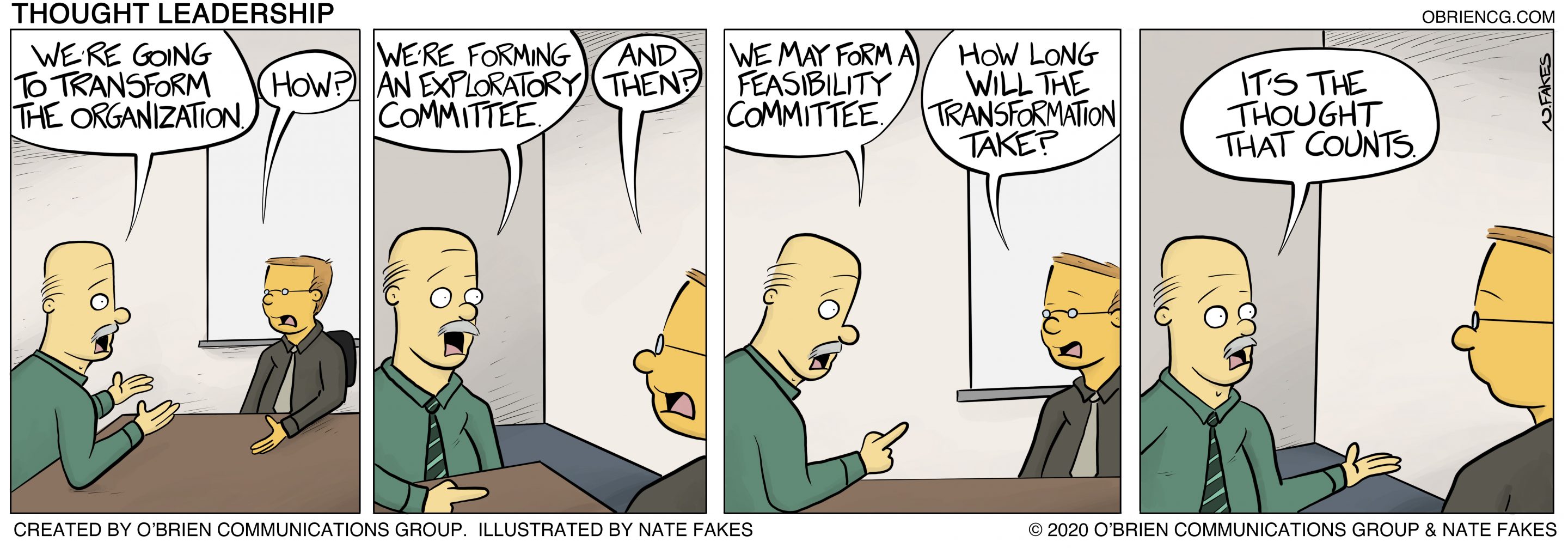
Cartoon – It’s the thought that counts

Thought Leadership - A comic by O'Brien Communications Group

The evolution of the CFO

https://www.mckinsey.com/business-functions/strategy-and-corporate-finance/our-insights/the-evolution-of-the-cfo?cid=other-eml-alt-mip-mck&hlkid=566473ff51dc4a379e17847ee5acfc84&hctky=9502524&hdpid=7cd18d63-2307-4455-b5bd-e821124db867

Image result for The evolution of the CFO

CFOs are playing an increasingly pivotal role in driving change in their companies. How should they balance their traditional responsibilities with the new CFO mandate?
In this episode of the Inside the Strategy Roompodcast, McKinsey partner Ankur Agrawal and consultant Priyanka Prakash speak with communications director Sean Brown about how to manage the competing demands of the CFO role in the digital age.

Podcast transcript

Sean Brown: If you wanted evidence that the only constant in life is change, then look no further than the evolution of the CFO role. In addition to traditional CFO responsibilities, results from a recent McKinsey survey suggest that the number of functions reporting to CFOs is on the rise. Also increasing is the share of CFOs saying they oversee their companies’ digital activities and resolve issues outside the finance function. How can CFOs harness their increasing responsibilities and traditional finance expertise to drive the C-suite agenda and lead substantive change for their companies?

Joining us today to answer that question are Ankur Agrawal and Priyanka Prakash. Ankur is a partner in our New York office and one of the leaders of the Healthcare Systems & Services Practice. Priyanka is a consultant also based in New York. She is a chartered accountant by training and drives our research on the evolving role of finance and the CFO. Ankur, Priyanka, thank you so much for joining us today.

Let’s start with you, Ankur. Tell us about your article, which is based on a recent survey. What did you learn?

Ankur Agrawal: We look at the CFO role every two years as part of our ongoing research because the CFO is such a pivotal role in driving change at companies. We surveyed 400 respondents in April 2018, and we subsequently selected a few respondents for interviews to get some qualitative input as well. Within the 400 respondents, 212 of those were CFOs, and then the remainder were C-level executives and finance executives who were not CFOs. We had a healthy mix of CFOs and finance executives versus nonfinance executives. The reason was we wanted to compare and contrast what CFOs are saying versus what the business leaders are saying to get a full 360-degree view of CFOs.

The insights out of this survey were many. First and foremost, the pace of change in the CFO role itself is shockingly fast. If we compare the results from two years ago, the gamut of roles that reported into the CFO role has dramatically increased. On average, approximately six discrete roles are reporting to the CFO today. Those roles range from procurement to investor relations, which, in some companies, tend to be very finance specific. Two years ago, that average was around four. You can see the pace of change.

The second interesting insight out of this survey when compared to the last survey is the cross-functional nature of the role, which is driving transformations and playing a more proactive role in influencing change in the company. The soft side of the CFO leadership comes out really strongly, and CFOs are becoming more like generalist C-suite leaders. They should be. They, obviously, are playing that role, but it is becoming very clear that that’s what the business leaders expect them to do.

And then two more insights that are not counterintuitive, per se, but the pace of change is remarkable. One is this need to lead on driving long-term performance versus short-term performance. The last couple of years have been very active times for activist investors. There are lots of very public activist campaigns. We clearly see in the data that CFOs are expected to drive long-term performance and be the stewards of the resources of the company. That data is very clear.

And then, lastly, the pace of change of technology and how it’s influencing the CFO role: more than half of the CFO functions or finance functions are at the forefront of digitization, whether it is automation, analytics, robotic processes, or data visualization. More than half have touched these technologies, which is remarkable. And then many more are considering the technological evolution of the function.

Sean Brown: In your survey, did you touch on planning for the long term versus the short term?

Ankur Agrawal: Our survey suggests, and lot of the business leaders suggest, that there is an imperative for the CFO to be the steward of the long term. And there is this crying need for the finance function to lead the charge to take the long-term view in the enterprise. What does that mean? I think it’s hard to do—very, very hard to do—because the board, the investors, everybody’s looking for the short-term performance. But it puts even more responsibility on the finance function in defining and telling the story of how value is being created in the enterprise over the long term. And those CFOs and finance executives who are able to tell that story and have proof points along the way, I think those are the more successful finance functions. And that was clearly what our survey highlighted.

What it also means is the finance functions have to focus and put in place KPIs [key performance indicators] and metrics that talk about the long-term value creation. And it is a theme that has been picked up, in the recent past, by the activists who have really taken some companies to task on not only falling short on short-term expectations but also not having a clear view and road map for long-term value creation. It is one of the imperatives for the CFO of the future: to be the value architect for the long term. It’s one of the very important aspects of how CFOs will be measured in the future.

Sean Brown: I noticed in your survey that you did ask CFOs and their nonfinance peers where they thought CFOs created the most value. What did you learn from that?

Priyanka Prakash: This has an interesting link with the entire topic of transformation. We saw that four in ten CFOs say that they created the most value through strategic leadership, as well as leading the charge on talent, including setting incentives that are linked with the company’s strategy. However, we see that nonfinance respondents still believe that CFOs created the most value by spending time on traditional finance activities. This offers an interesting sort of split. One of the things that this indicates is there’s a huge opportunity for CFOs to lead the charge on transformation to ensure that they’re not just leading traditional finance activities but also being change agents and leading transformations across the organization.

Ankur Agrawal: The CFOs of the future have to flex different muscles. They have been very good in really driving performance. Maybe there’s an opportunity to even step up the way that performance is measured in the context of transformation, which tends to be very messy. But, clearly, CFOs are expected to be the change agents, which means that they have to be motivational. They have to be inspirational. They have to lead by example. They have to be cross-functional. They have to drive the talent agenda. It’s a very different muscle, and the CFOs have had less of an opportunity to really leverage that muscle in the past. I think that charismatic leadership from the CFO will be the requirement of the future.

Sean Brown: You also address the CFO’s role regarding talent. Tell us a bit more about that.

Ankur Agrawal: Another really important message out of the survey is seeing the finance function and the CFO as a talent factory. And what that means is really working hand in hand with the CEO and CHRO [chief HR officer] over this trifecta of roles. Because the CFO knows where to invest the money and where the resources need to be allocated to really drive disproportionate value, hopefully for the long run. The CHRO is the arbiter of talent and the whole performance ethic regarding talent in the company. And the CEO is the navigator and the visionary for the company. The three of them coming together can be a very powerful way to drive talent—both within the function and outside the function.

And the finance-function leaders expect CFOs to play a really important role in talent management in the future and in creating the workforce of the future. And this workforce—in the finance function, mind you—will be very different. There’s already lots of talk about a need for data analytics, which is infused in the finance function and even broader outside the organization of finance function. The CFOs need to foster that talent and leverage the trifecta to attract, retain, and drive talent going forward.

Sean Brown: Do you have any examples of successful talent-development initiatives for the finance function? And can you share any other examples of where CFOs, in particular, have taken a more active role in talent and talent development?

Ankur Agrawal: An excellent question. On talent development within the finance function, a few types of actions—and these are not new actions—done very purposefully can have significant outsize outcome. One is job rotations: How do you make sure that 20 to 30 percent of your finance function is moving out of the traditional finance role, going out in the business, learning new skills? And that becomes a way where you cultivate and nurture new skills within the finance function. You do it very purposefully, without the fear that you will lose that person. If you lose that person, that’s fine as well. That is one tried-and-tested approach. And some companies have made that a part of the talent-management system.

The second is special projects. And again, it sounds simple, but it’s hard to execute. This is making this a part of every finance-function executive’s role, whether it’s a pricing project or a large capex [capital-expenditure] and IT project implementation. Things like that. Getting the finance function outside of their comfort zone: I think that’s certainly a must-have.

And the third would be there is value in exposing finance-function executives to new skills and creating a curriculum, which is very deliberate. I think technology’s changing so rapidly. So exposing the finance function to newer technologies, newer ways of working, and collaboration tools: those are the things I would highlight as ways to nurture finance talent.

Priyanka Prakash: Just to add onto that. A lot of the folks whom I talked to say that, very often, finance folks spend a large chunk of their time trying to work on ad hoc requests that they get from the other parts of the business. A big opportunity here is in how the finance function ensures that the rest of the nonfinance part has some basic understanding of finance to make them more self-sufficient, to ensure that they are not coming to the finance function with every single question. What this does is it ensures that the rest of the organization has the finance skills to ensure that they’re making the right decisions, using financial tools.

And secondly, it also significantly frees up the way that the finance organization itself spends its time. If they spend a few hours less working on these ad hoc requests, they can invest their time in thinking about strategy, in thinking about how the finance function can improve the decision making. I think that’s a huge sort of benefit that organizations have seen just by upscaling their nonfinance workforce to equip them with the financial skills to ensure that the finance team is spending time on its most high-value activity.

Sean Brown: Is this emphasis on talent focused only on the finance function? What I am hearing from your response is that it’s not just building up the talent within the finance function but embedding finance talent and capabilities throughout the organization. Is that right?

Priyanka Prakash: Absolutely. Because if you take an example of someone who’s in a factory who wants to have an investment request for something that they want to do at a plant, they will have to know the basic knowledge of finance to evaluate whether this is an investment that they need or not. Because at the end of the day, any decision would be incomplete without a financial guideline on how to do it. I think that the merging of your other functions with a strong background and rooting in finance can improve the quality of decisions that not just the finance function but other teams and other functions also make in the organization.

Sean Brown: Priyanka, your survey touches a bit on the topic of digital. What did you learn there?

Priyanka Prakash: Sure. This is one of those things that everybody wants to do, but the question that I’ve seen most of my clients struggle with in the initial phases is, “Yes, I have the intent from the top. There is intent from the finance and other teams on how to become more digital, but how do you actually start that process?”

There are four distinct kinds of technologies or tools that finance teams, specifically, could use in enabling their digital journey and transformation. CFOs have way too much on their plates right now. What this essentially means is that they need to invest time and a lot of their thinking into some of these newer, more strategic areas while ensuring that they keep the lights on in the traditional finance activities. The biggest tool that will enable them to keep the lights on as well as add value in this new expanded role is to take advantage of automation, as well as some of the newer digital technologies that we see.

There are basically four types of digital stages that we see as finance functions start to evolve. One is using automation, which is typically the first step. For example, “How do I move from an Excel-based system to an Alteryx one? How do I move from a manual transactional system to something that’s more automated, where my finance teams don’t have to invest time, but it happens in the background with accuracy?” That’s step one.

The second thing that we see as a result of this is you have a lot of data-visualization tools that are being used. This is very helpful, especially when you think about the role of FP&A [financial planning and analysis]. “How does my FP&A team ensure that the company makes better decisions? How do I use a visualization software to get different views of my data to ensure that I’m making the right decisions?”

The third one is, “How do I use analytics within finance? How do I use analytics to draw insights from the data that I might have missed otherwise?” This could be something in forecasting. This could be something in planning. But this could also be something that’s used when you compare your budget or your forecast. Your analytics could really help draw out drivers of why there’s a variance.

And fourthly is, “How do I then integrate this advanced-analytics philosophy across the rest of the company?” What this means is, “How do I integrate my finance and traditional ERP [enterprise-resource-planning] systems with the pricing system, with the operations, and supply-chain-management system? How do I integrate my finance systems with my CRM [customer relationship management]?” Again, the focus is on ensuring that the whole database is not this large, clunky system but an agile system that ensures you draw out some insights.

Sean Brown: Some have suggested the CFO is ideally suited to be the chief digital officer. Have you seen any good examples of this?

Ankur Agrawal: There were examples even before the digital technologies took over. In some companies, the technology functions used to report to CFOs. There are cases where CFOs have formally or even informally taken over the mandate of a chief digital officer. You don’t necessarily need to have a formal reporting role to be a digital leader in the company. CFOs, of course, have an important role in vetting expenses and vetting the investments the companies are making. That said, CFOs have this cross-functional visibility of the entire business, which makes them very well suited to being the digital officers. In some cases, CFOs have stepped up and played that more formal role. I would expect, in the future, they will certainly have an informal role. In select cases, they will continue to have a formal digital-officer role.

Sean Brown: It sounds like, from the results of the survey, the CFO has a much larger role to play. Where does someone begin on this journey?

Priyanka Prakash: Going back to the first point that we discussed on how CFOs should help their companies have a more long-term view, we see that this transformation is specifically here to move to more digital technologies. It’s not going to be easy, and it’s not going to be short. Yes, you will see quick wins. But it is going to be a slightly lengthy—and oftentimes, a little bit of a messy—process, especially in the initial stages. How do we ensure that there is enough leadership energy around this? Because once you have that leadership energy, and once you take the long-term view to a digital transformation, the results that you see will pay for themselves handsomely.

Again, linking this back with the long-term view, this is not going to be a short three-month or six-month process. It’s going to be an ongoing evolution. And the nature of the digital technologies also evolve as the business evolves. But how do you ensure that your finance and FP&A teams have the information and the analytics that they need to evolve and be agile along with the business and to ensure that the business responds to changes ahead of the market? How do we ensure that digital ensures that your company is proactively, and not reactively, reacting to changes in the external market and changes in disruption?

Sean Brown: Priyanka, any final thoughts you’d like to share?

Priyanka Prakash: All that I’ll say is that this is a very, very exciting time for the role of the CFO. A lot of things are changing. But you can’t evolve unless you have your fundamentals right. This is a very exciting time, where CFOs can have the freedom to envision, create, and chart their own legacy and then move to a leadership and influencer role and truly be a change agent in addition to doing their traditional finance functions, such as resource allocation, your planning, and all of the other functions as well. But I definitely do think that these are very exciting times for finance organizations. There are lots of changes, and the evolutionary curve is moving upward very quickly.

Sean Brown: Ankur, Priyanka, thanks for joining us today.


The new CFO mandate: Prioritize, transform, repeat

https://www.mckinsey.com/business-functions/strategy-and-corporate-finance/our-insights/the-new-cfo-mandate-prioritize-transform-repeat

Image result for CFO Expanding Role

Amid a raft of new duties for CFOs, our survey suggests that finance leaders are well positioned to lead the C-suite agenda by championing transformations, digitization, and capability building.
If you wanted to validate the old adage that the only constant in life is change, the results from our newest McKinsey Global Survey suggest you need not look any further than the CFO role.1 In the two years since our previous survey on the topic, CFOs say the number of functions reporting to them has risen from about four to more than six. What’s more, the share of CFOs saying they oversee their companies’ digital activities has doubled during that time. And many finance leaders say they are being asked to resolve issues in areas that are relatively new to them while continuing to mind traditional responsibilities, such as risk management, that remain business priorities.

Responses indicate that the opportunity for CFOs to establish the finance function as both a leading change agent and a source of competitive advantage has never been greater. Yet they also show a clear perception gap that must be bridged if CFOs are to break down silos and foster the collaboration necessary to succeed in a broader role. While CFOs believe they are beginning to create financial value through nontraditional tasks, they also say that a plurality of their time is still devoted to traditional tasks versus newer initiatives. Meanwhile, leaders outside the finance function believe their CFOs are still primarily focused on and create the most value through traditional finance tasks.

How can CFOs parlay their increasing responsibility and traditional finance expertise to resolve these differing points of view and lead substantive change for their companies? The survey results point to three ways that CFOs are uniquely positioned to do so: actively heading up transformations, leading the charge toward digitization, and building the talent and capabilities required to sustain complex transformations within and outside the finance function.

Changing responsibilities, unchanged perceptions

The latest survey results confirm that the CFO’s role is broader and more complex than it was even two years ago. The number of functional areas reporting to CFOs has increased from 4.5 in 2016 to an average of 6.2 today. The most notable increases since the previous survey are changes in the CFO’s responsibilities for board engagement and for digitization (that is, the enablement of business-process automation, cloud computing, data visualization, and advanced analytics). The share of CFOs saying they are responsible for board-engagement activities has increased from 24 percent in 2016 to 42 percent today; for digital activities, the share has doubled.

The most commonly cited activity that reports to the CFO this year is risk management, as it was in 2016. In addition, more than half of respondents say their companies’ CFOs oversee internal-audit processes and corporate strategy. Yet CFOs report that they have spent most of their time—about 60 percent of it, in the past year—on traditional and specialty finance roles, which was also true in the 2016 survey.

Also unchanged are the diverging views, between CFOs and their peers, about where finance leaders create the most value for their companies. Four in ten CFOs say that in the past year, they have created the most value through strategic leadership and performance management—for example, setting incentives linked to the company’s strategy. By contrast, all other respondents tend to believe their CFOs have created the most value by spending time on traditional finance activities (for example, accounting and controlling) and on cost and productivity management across the organization.

Finance leaders also disagree with nonfinance respondents about the CFO’s involvement in strategy decisions. CFOs are more likely than their peers to say they have been involved in a range of strategy-related activities—for instance, setting overall corporate strategy, pricing a company’s products and services, or collaborating with others to devise strategies for digitization, analytics, and talent-management initiatives.

Guiding and sustaining change

Our latest survey, along with previous McKinsey research,2 confirms that large-scale organizational change is ubiquitous: 91 percent of respondents say their organizations have undergone at least one transformation in the past three years.3 The results also suggest that CFOs are already playing an active role in transformations. The CFO is the second-most-common leader, after the CEO, identified as initiating a transformation. Furthermore, 44 percent of CFO respondents say that the leaders of a transformation, whether it takes place within finance or across the organization, report directly to them—and more than half of all respondents say the CFO has been actively involved in developing transformation strategy.

Respondents agree that, during transformations, the CFO’s most common responsibilities are measuring the performance of change initiatives, overseeing margin and cash-flow improvements, and establishing key performance indicators and a performance baseline before the transformation begins. These are the same three activities that respondents identify as being the most valuable actions that CFOs could take in future transformations.

Beyond these three activities, though, respondents are split on the finance chief’s most critical responsibilities in a change effort. CFOs are more likely than peers to say they play a strategic role in transformations: nearly half say they are responsible for setting high-level goals, while only one-third of non-CFOs say their CFOs were involved in objective setting. Additionally, finance leaders are nearly twice as likely as others are to say that CFOs helped design a transformation’s road map.

Other results confirm that finance chiefs have substantial room to grow as change leaders—not only within the finance function but also across their companies. For instance, the responses indicate that half of the transformations initiated by CFOs in recent years were within the finance function, while fewer than one-quarter of respondents say their companies’ CFOs kicked off enterprise-wide transformations.

Leading the charge toward digitization and automation

The results indicate that digitization and strategy making are increasingly important responsibilities for the CFO and that most finance chiefs are involved in informing and guiding the development of corporate strategy. All of this suggests that CFOs are well positioned to lead the way—within their finance functions and even at the organization level—toward greater digitization and automation of processes.

Currently, though, few finance organizations are taking advantage of digitization and automation. Two-thirds of finance respondents say 25 percent or less of their functions’ work has been digitized or automated in the past year, and the adoption of technology tools is low overall.

The survey asked about four digital technologies for the finance function: advanced analytics for finance operations,5 advanced analytics for overall business operations,6 data visualization (used, for instance, to generate user-friendly dynamic dashboards and graphics tailored to internal customer needs), and automation and robotics (for example, to enable planning and budgeting platforms in cloud-based solutions). Yet only one-third of finance respondents say they are using advanced analytics for finance tasks, and just 14 percent report the use of robotics and artificial-intelligence tools, such as robotic process automation (RPA).7 This may be because of what respondents describe as considerable challenges of implementing new technologies. When asked about the biggest obstacles to digitizing or automating finance work, finance respondents most often cite a lack of understanding about where the opportunities are, followed by a lack of financial resources to implement changes and a need for a clear vision for using new technologies; only 3 percent say they face no challenges.

At the finance organizations that have digitized more than one-quarter of their work, respondents report notable gains from the effort. Of these respondents, 70 percent say their organizations have realized modest or substantial returns on investment—much higher than the 38 percent of their peers whose finance functions have digitized less than one-quarter of the work.

Unlocking the power of talent

The survey results also suggest that CFOs have important roles to play in their companies’ talent strategy and capability building. Since the previous survey, the share of respondents saying CFOs spend most of their time on finance capabilities (that is, building the finance talent pipeline and developing financial literacy throughout the organization) has doubled. Respondents are also much more likely than in 2016 to cite capability building as one of the CFO’s most value-adding activities.

Still, relative to their other responsibilities, talent and capabilities don’t rank especially high—and there are opportunities for CFOs to do much more at the company level. Just 16 percent of all respondents (and only 22 percent of CFOs themselves) describe their finance leaders’ role as developing top talent across the company, as opposed to developing talent within business units or helping with talent-related decision making. And only one-quarter of respondents say CFOs have been responsible for capability building during a recent transformation.

But among the highest-performing finance functions, the CFO has a much greater impact. Respondents who rate their finance organization as somewhat or very effective are nearly twice as likely as all others to say their CFOs develop top talent organization-wide (20 percent, compared with 11 percent). Among those reporting a very effective finance function, 38 percent say so.

Looking ahead

It’s clear from the numbers that CFOs face increased workloads and expectations, but they also face increased opportunities. In our experience, a focus on several core principles can help CFOs take advantage of these opportunities and strike the right balance:

  • Make a fundamental shift in how to spend time. To be more effective in their new, ever-expanding roles, CFOs must carefully consider where to spend their time and energy. They should explore new technologies, methodologies, and management approaches that can help them decide how and where to make necessary trade-offs. It’s not enough for them to become only marginally more effective in traditional areas of finance; they must ensure that the finance organization is contributing more and more to the company’s most value-adding activities. It’s especially important, therefore, that CFOs are proactive in looking for ways to enhance processes and operations rather than waiting for turnaround situations or for their IT or marketing colleagues to take the lead.
  • Embrace digital technologies. The results indicate that the CFO’s responsibilities for digital are quickly increasing. We also know from experience that finance organizations are increasingly becoming critical owners of company data—sometimes referred to as the “single source of truth” for their organizations—and, therefore, important enablers of organizational transformations. Finance leaders thus need to take better advantage and ownership of digital technology and the benefits it can bring to their functions and their overall organizations. But they cannot do so in a vacuum. Making even incremental improvements in efficiency using digital technologies (business intelligence and data-visualization tools, among many others) requires organizational will, a significant investment of time and resources, and collaboration with fellow business leaders. So, to start, CFOs should prioritize quick wins while developing long-term plans for how digitization can transform their organizations. They may need to prioritize value-adding activities explicitly and delegate or automate other tasks. But they should always actively promote the successes of the finance organization, with help from senior leadership.
  • Put talent front and center. Since the previous survey, CFOs have already begun to expand their roles and increase their value through capability building and talent development. But the share of CFOs who spend meaningful, valuable time on building capabilities remains small, and the opportunity for further impact is significant. Finance leaders can do more, for instance, by coaching nonfinance managers on finance topics to help foster a culture of transparency, self-sufficiency, and value creation.