In their latest article scrutinizing the MA program, New York Times reporters Reed Abelson and Margot Sanger-Katz highlight MA marketing practices brought to light in a recent report from the Senate Finance Committee. Complaints to the Centers for Medicare and Medicaid Services (CMS) about MA marketing more than doubled from 2020 to 2021, as agents and brokers took advantage of oversight rules relaxed during the Trump administration. Some of the most egregious alleged abuses include agents switching seniors into new plans without their consent and exploiting individuals with cognitive impairments.
The Gist: Media interest is finally catching up to the building legislative and regulatory pressure on Medicare Advantage. While earlier reporting has highlighted how plans can inflate payments from Medicare, this new story shows how the process of selecting a plan can be fraught for the seniors enrolled.
Plan design is confusing even for industry insiders, so it is no surprise that seniors might find themselves ‘choosing’ plans that omit key providers, or even drug coverage they already rely on, particularly after being badgered or misled by agents and brokers.
Many of the regulatory fixes highlighted in the report can be implemented directly by CMS, but insurers, who remember the managed care backlash of the 90s, shouldn’t wait to tighten the reins on questionable marketing practices, lest they risk losing public support for one of their most lucrative business lines.
In its Q3 earnings call, Oscar Health CEO Mario Schlosser revealed that the “insurtech” has pulled out of the MA market in Texas and New York, leaving it with only one Florida-based plan. Oscar entered the MA business with high hopes in 2020, but counted fewer than 5K MA members in Q3 2022.
Although its Affordable Care Act exchange enrollment has nearly doubled since last year, now covering more than 1M lives, Oscar is still struggling with high medical loss ratios, which have kept it from turning a profit. The company’s stock price is at an all-time low, having declined over 90 percent from its peak, shortly after its 2021 IPO.
The Gist: Like Bright HealthCare before them, Oscar pulling out of MA is another sign that the chance of meaningful disruption from “insurtechs” has nearly vanished. While still privately held, Oscar achieved fame in the early 2010s through catchy marketing that targeted a young, tech-savvy client base, and its move into MA before the pandemic signaled broader ambitions.
Oscar’s travails illustrate just how hard it is to start an insurance company from scratch, even with an intriguing and comprehensive technology platform. The company proved unable to overcome its lack of market power in negotiations with providers, and faced difficulty managing a small, unstable risk pool.
Now that more traditional insurers are improving their mobile tech interfaces and telehealth offerings, the differentiated value Oscar offers to its members has clearly diminished.
Last week, over 1,200 resident physicians and interns at Montefiore Medical Center, one of the largest employers in New York City, with four hospitals in the Bronx, held an organizing vote and requested voluntary recognition of their bargaining unit. The residents organized under the Committee of Interns and Residents, a unit of the Service Employees International Union that claims 22K members and has established unions at five hospitals this year. Roughly seven percent of practicing doctors were unionized as of 2019; that number has grown in the wake of pandemic-induced burnout and industry consolidation. Montefiore Medical Center declined to voluntarily recognize the union and has requested that the union re-form via a secret ballot election.
The Gist: Health system executives may see the possibility of resident unions as another headache amid the ongoing labor crisis, but the drivers of the crisis—burnout, workplace safety concerns, work-life balance, and real-wage erosion—are responsible for the growing appeal of unions for physicians. Fueled by economy-wide stressors, unionization has been growing in nontraditional labor sectors, including among baristas and tech workers, and medical residents may be the next to join that wave.
Health systems worried about resident unionization should address residents’ concerns about working conditions proactively, which may involve reevaluating wages in light of residents’ significant contributions to operational and financial success.
While the final balance of the House and Senate are still unknown after Tuesday’s midterm elections, both chambers are expected to be narrowly divided.
Ballot initiatives on reproductive health produced more unambiguous results, with three states—California, Michigan, and Vermont—amending their constitutions to affirm reproductive rights, and two states—Kentucky and Montana—voting down proposals that would have imposed greater legal barriers to abortion access. South Dakota became the seventh, and likely final, state to expand Medicaid via ballot initiative, making an additional 28K South Dakotans eligible for coverage, and reducing the number of states that have yet to expand Medicaid to 11.
The Gist: Democrats beat expectations, bucking historical trends in which midterm voters swing strongly against the President’s party. But healthcare did not feature prominently in voters’ choices, with this being the first election in over a decade where the state of the Affordable Care Act and protecting individuals’ access to care and coverage was not a significant choice driver.
The fallout from the Supreme Court’s decision in June to overturn Roe v. Wade had a clear impact on voter turnout, with abortion tying inflation for voters’ top concern in exit polls. At the state level, South Dakota voters approved Medicaid expansion, where over 40 percent of the state’s uninsured adults could now gain access to coverage—another clear sign that voters, regardless of party affiliation, are behind the ACA’s expanded vision for the safety net program.
Moving forward, a closely divided Congress is unlikely to take on significant healthcare legislation, regardless of who ultimately holds the House and Senate.
The nation’s largest payers have filed their third-quarter earnings reports, revealing which grew their profits the most year over year.
1. UnitedHealth Group: $5.3 billion The company’s third quarter earnings increased over 28 percent year over year. Total net earnings in 2022 are $15.7 billion, an increase of 16.2 percent from $13.5 billion in 2021.
2. Cigna: $2.8 billion The company’s third quarter earnings increased over 70 percent year over year. Total net earnings in 2022 are $5.5 billion, an increase of over 29 percent from $4.2 billion in 2021.
3. Elevance Health: $1.6 billion The company’s third quarter earnings increased over 7 percent year over year. Total net earnings in 2022 are $5.06 billion, an increase of nearly 2 percent from $5 billion in 2021.
4. Humana: $1.2 billion The company’s third quarter earnings decreased over 21 percent year over year. Total net earnings in 2022 are $2.8 billion, a decrease of over 4 percent from $2.9 billion in 2021.
5. Centene: $738 million The company’s third quarter earnings increased over 26 percent year over year. Total net earnings in 2022 are $1.4 billion, an increase of over 89 percent from $748 million in 2021.
6. CVS Health: $3.4 billion losses The company’s third quarter losses are attributable to an opioid legal settlement. Total net earnings in 2022 are $1.9 billion, a decrease of over 71 percent from $6.6 billion in 2021.
Here are 10 health systems with strong operational metrics and solid financial positions, according to reports from Fitch Ratings and Moody’s Investors Service.
1. Advocate Aurora Health has an “AA” rating and a stable outlook with Fitch. The health system, dually headquartered in Milwaukee and Downers Grove, Ill., has a strong financial profile and a leading market position over a broad service area in Illinois and Wisconsin, Fitch said. The health system’s fundamental operating platform is strong, the credit rating agency said.
2. Allina Health System has an “AA-” rating and a stable outlook with Fitch. The Minneapolis-based system is the inpatient market share leader in a highly competitive market and has a strong relation with payers in the market, Fitch said. Alliana’s financial profile is strong, the ratings agency said.
3. Banner Health has an “AA-” rating and stable outlook with Fitch. The Phoenix-based health system’s core hospital delivery system and growth of its insurance division combine to make it a successful, highly integrated delivery system, Fitch said. The credit rating agency said it expects Banner to maintain operating EBITDA margins of about 8 percent on an annual basis, reflecting the growing revenues from the system’s insurance division and large employed physician base.
4. Bon Secours Mercy Health has an “AA-” rating and stable outlook with Fitch. The Cincinnati-based health system has a broad geographic footprint as one of the five largest Catholic health systems in the U.S., a good payer mix and a leading or near-leading market share in eight of its eleven markets in the U.S., Fitch said.
5. Bryan Health has an “AA-” rating and stable outlook with Fitch. The Lincoln, Neb.-based health system has a leading and growing market position, very strong cash flow and a strong financial position, Fitch said. The credit rating agency said Bryan Health has been resilient through the COVID-19 pandemic and is well-positioned to accommodate additional strategic investments.
6. Deaconess Health System has an “AA” rating and stable outlook with Fitch. The Evansville, Ind.-based system has a leading market position in its primary service area and a favorable payer mix, Fitch said. The ratings agency said it expects Deaconess’ operating EBITDA margins to improve and stabilize around 10 percent by 2023, reflecting strong volumes and focus on operating efficiencies.
7. Gundersen Health System has an “AA-” rating and stable outlook with Fitch. The La Crosse, Wis.-based health system has strong balance sheet metrics, a leading market position and an expanding operating platform in its service area, Fitch said. The credit rating agency expects the health system to return to strong operating performance as it emerges from disruption related to the COVID-19 pandemic.
8. Hackensack Meridian Health has an “AA-” rating and stable outlook with Fitch. The Edison, N.J.-based health system has shown consistent year-over-year increases in market share and has a solid liquidity position, Fitch said.
9. Intermountain Healthcare has an “Aa1” rating and stable outlook with Moody’s. The Salt Lake City-based health system has exceptional credit quality, which will continue to benefit from its leading market position in Utah, Moody’s said. The credit rating agency said the health system’s merger with Broomfield, Colo.-based SCL Health will also give Intermountain greater geographic reach.
10. Yale New Haven (Conn.) Health has an “AA-” rating and stable outlook with Fitch. The health system’s turnaround efforts, brand recognition and market presence will help it return to strong operating results, Fitch said.
Allentown, Pa.-based Lehigh Valley Health Network, which operates 13 hospitals and numerous care sites in Eastern Pennsylvania, will largely stop accepting Aetna insurance in 2023, Morning Call reported Nov. 10.
The move will be effective from March 13, LVHN said in a letter to employees. It comes after years of Aetna refusing to pay for care or delaying care for patients, the health group claimed.
LVHN, which has contracted with Aetna for 20 years, has been in dispute with the insurance company before, the report said. Back in 2000, the hospital group threatened to cut ties with Aetna over a dispute over care reimbursements.
Some Aetna coverage will remain for emergency care or for serious treatments such as cancer care, according to the letter.
LVHN declined to comment to Morning Call, and Aetna could not be reached, the report said.
More details on the story, which comes at a time when people are enrolling in new healthcare plans, can be found here.
The Consumer Price Index cooled more than expected in October: it rose 7.7% from a year earlier, down from 8.2% the prior month, the Labor Department said on Thursday.
Why it matters: Inflation still remains painfully high, but a bigger-than-expected easing in price pressures for items like used cars and apparel helped pull the overall index down.
By the numbers: On a monthly basis, CPI rose 0.4%, the same pace as September.
Core CPI, a closely watched gauge that strips out volatile food and energy costs, eased in October. On a monthly basis, it rose 0.3% — up 6.3% from a year ago.
In September, those figures were 0.6% and 6.6%, respectively.
Catch up quick: Soaring costs have eroded many Americans’ wage gains, souring their view on the economy that has otherwise held up.
Supply chain problems have led to shortages of vehicles and other consumer goods, which pushed up prices. Russia’s invasion of Ukraine has created a volatile backdrop for energy costs.
Those supply chain pressures have eased and consumers have dialed back demand for goods, pushing prices down. But costs for services have raced ahead.
Where it stands: The Fed has raced to try to get inflation under control, raising interest rates at a historic clip.
In recent months, inflation data has surprised to the upside. That’s kept officials on an aggressive path to slow the economy down, with the hope inflation will follow suit. Those moves have risked throwing the economy into a recession.
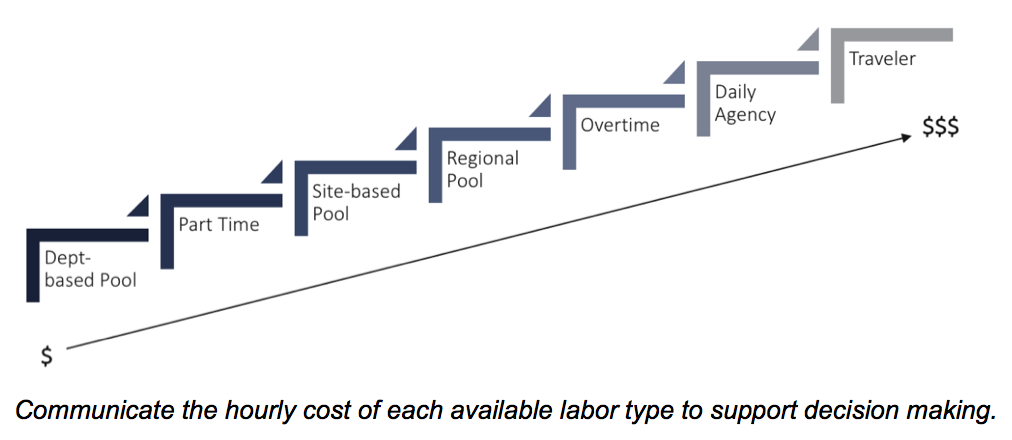
Many hospitals and health systems aim to recruit and retain permanent staff to replace contract labor positions, which have seen wages skyrocket because of staff shortages during the COVID-19 pandemic.
Hospitals across the country have relied on contract labor and temporary staffing agencies to support their clinical teams when many burned-out providers are exiting healthcare. An October survey conducted by Bain & Company found that 25 percent of physicians, advanced practice providers and nurses are considering changing careers. Eight-nine percent of the providers thinking about leaving the profession cited burnout as the driving force.
Staffing shortages are driving labor costs to an unsustainable level for hospitals operating on razor-thin margins and reducing temporary staffing costs is top of the agenda for many financial executives looking to reduce expenses in the coming quarters.
Here are 22 numbers that demonstrate the cost of contact labor for hospitals, according to reports from Kaufman Hall, Definitive Healthcare, Vaya Workforce and big hospital operators:
1. The demand for contract labor increased500 percent in fall 2021 compared with 2019, according to healthcare staffing services company Vaya Workforce. While demand has since decreased, it is still nearly triple pre-pandemic levels and is projected to remain as high as 20 percent above the 2019 baseline.
2. In 2020, the average amount hospitals spent on contract labor was $4.6 million, more than double the average expense of $2.2 million in 2011, according to a report from Definitive Healthcare, a data and analytics company.
3. Rochester, Minn.-based Mayo Clinic Hospital, Saint Mary’s Campus spent $286.8 million on contract labor in 2020, the most of any hospital in the country that year, according to Definitive Healthcare’s analysis of about 3,100 U.S. hospitals
4. From 2019 to 2022, the hourly wage rate for contract nurses increased106 percent, according to Kaufman Hall. Contract nurses are earning an average of $132an hour in 2022 versus $64an hour in 2019. At the height of the pandemic, some travel nurses earned up to $300 an hour, with rates as high as these placing immense pressure on hospital balance sheets.
5. The rise in contract labor from 2019 through March of 2022 led to a 37 percent increase in labor expenses per patient, equating to between $4,009 and $5,494 per adjusted discharge.
6. Hospitals with 25 beds or fewer spent about $460,000 on contract labor in 2020 compared to hospitals with more than 250 beds that spent almost $11 million on average, according to Definitive Healthcare.
7. Hospitals in the western U.S. have the highest contract labor expenses, with an average of $9.6 million reported in 2020. Large cities, high cost of living and high salary rates in the region contribute to this high average.
8. Labor costs were one of the core reasons Franklin, Tenn.-based Community Health Systems reported a net loss of $42 million in the third quarter, but CFO Kevin Hammons said he expects to see a 40 percent to 50 percent reduction in contract labor costs next year compared with 2022.
9. Nashville, Tenn.-based HCA Healthcare reported a 19 percent decrease in contract labor costs in the third quarter compared to the second quarter, allowing the system to absorb much of the market-based wage adjustment costs for its employee workforce, CFO Bill Rutherford said during an Oct. 21 earnings call.
10. According to Kaufman Hall’s “2022 State of Healthcare Performance Improvement” report, published Oct. 18, 46 percent of hospital and health system leaders identify labor costs as the greatest opportunity for cost reductions. This was significantly up from the 17 percent of respondents who noted labor costs as their greatest opportunity to cut costs last year.
11. There are some hopeful signs that the use of contract labor has stabilized and is steadily falling, according to Kaufman Hall: 44 percent of hospitals in its survey reported that their utilization of contract labor is declining while 29 percent said that it is holding steady.








 HENRY KOTULA