![Chapter 1 - Private Equity as an Economic Driver: An Historical Perspective - Introduction to Private Equity [Book]](https://www.oreilly.com/library/view/introduction-to-private/9780470711880/dema_9780470711880_oeb_004_r1.gif)
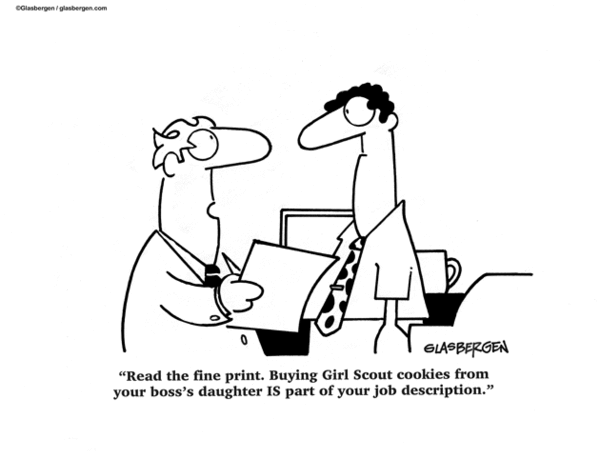
Cartoon – Branding Opportunity



Workers at three Tenet Healthcare hospitals in Southern California will hold a rally May 6 to highlight their concerns about staffing, wages and benefits during the COVID-19 pandemic, according to the union that represents them.
The rally comes as the National Union of Healthcare Workers is in negotiations with Dallas-based Tenet for more than 600 direct Tenet employees at Fountain Valley Regional, including respiratory therapists, nursing assistants and X-ray technicians. The union is also in negotiations with the Compass Group, a food and support services provider, for about 225 housekeepers and food service workers at Tenet California hospitals in Fountain Valley, Los Alamitos and Lakewood, who are subcontracted by Tenet and employees of Compass.
Union spokesperson Matt Artz told Becker’s workers contend Tenet has remained profitable during the pandemic, but it did not implement appropriate safety measures. He said Tenet also rejected proposals to better staff certain units, and it has rejected the union’s proposal to stop subcontracting out the housekeepers and food service workers who have struggled to afford healthcare.
The union said Tenet, a major for-profit hospital operator, has the financial means to address these issues. The company reported a $97 million profit in the first quarter of 2021. Tenet stock also recently hit a new 52-week high, according to an April 29 report from Zacks Equity Research.
“These profits are not helping workers or patients,” Christina Rodriguez, a respiratory therapist at Fountain Valley (Calif.) Regional Hospital, said in a May 5 news release. “They’re being made at the expense of patient care and the people who have put their health on the line to help patients during this pandemic. At the height of the surge, I would go home crying that we didn’t have enough staff to help patients struggling to survive.”
Tenet contends the issue is not about Tenet but rather about negotiations between Compass and the union. Tenet said it is focused on staff and patients.
“This matter is not about us. It’s about a negotiation strictly between the NUHW and the Compass Group, which is a vendor that provides a range of food, laundry and other support services to hospitals,” Tenet told Becker’s. “At all times, our main concern is the safety of our staff, the integrity of our facilities and the best possible outcomes for our patients, and we remain hopeful that the NUHW and Compass will reach a positive outcome at the conclusion of their respective negotiations.”
But the union said Tenet can decide whether to bring the subcontracted housekeepers and food service workers in-house, which would benefit them in terms of wages and health benefits.
Meanwhile, Compass said it will continue to negotiate in good faith, with union members.
“Our hardworking team members are at the heart of what we do, and their determination to provide best-in-class care and service is inspiring,” a Compass spokesperson told Becker’s. “We take pride in paying competitive wages and providing affordable benefits and continue to uphold our agreement with the NUHW. We have a long history of listening to our employees, working productively with unions, and will continue to meet and negotiate — always in good faith.”
Respiratory therapists, housekeepers, nursing assistants, medical technicians, dietary workers and others represented by the union said they plan to rally from 11 a.m. to noon May 6 outside Fountain Valley Regional.
The rally, scheduled after Tenet’s shareholders meeting, includes workers from Los Alamitos (Calif.) Medical Center and Lakewood (Calif.) Regional Medical Center. Union workers whose jobs are subcontracted to Compass will speak during the rally, the union said.

The Kansas Heart Hospital in Wichita filed a lawsuit against two former executives, claiming they stole money from the facility and improperly used CARES Act funds, according to ABC affiliate KAKE and court documents.
The lawsuit, filed April 29 in the U.S. District Court in Kansas, accuses the hospital’s former COO Joyce Heismeyer and former CFO Steve Smith of stealing funds between 2015 and 2020. During that time, Kansas Heart Hospital lost more than $31 million, according to the lawsuit.
Ms. Heismeyer and Mr. Smith abruptly stepped down from their roles in fall 2020. The hospital claims the former executives set up large severance payments for themselves before their departures, which prompted an internal investigation.
In its complaint, Kansas Heart Hospital alleges that Ms. Heismeyer and Mr. Smith conspired with the hospital’s former president, Gregory Duick, MD, to divert more than $6 million in hospital funds for undisclosed bonuses and benefits during the five-year period. Additionally, the hospital claims all three sent millions in hospital dollars to an investment account that Dr. Duick owned.
Kansas Heart Hospital also claims the three caused it to lose out on $4.4 million in CARES Act payments. The funds were returned to avoid a federal audit, the lawsuit alleges, but the former executives said the funds were returned because the hospital hadn’t treated any COVID-19 patients.
Dr. Duick also retired from his role in fall 2020. He is named in the lawsuit but is not a defendant, and did not immediately return KAKE‘s request for comment.
In a statement to KAKE, an attorney for Ms. Heismeyer and Mr. Smith said, “Joyce and Steve vehemently deny the allegations and will aggressively defend themselves and expect to clear their names in court.” Additionally, the statement said, “We are disappointed by the Kansas Heart Hospital’s plan to sue and tarnish the reputations of two long time employees.”

From 2003 to 2017, private equity firms focused their acquisition crosshairs on larger hospitals with higher operating margins and greater patient charge-to-cost ratios, according to a new review of healthcare investments published in Health Affairs.
These private equity (PE)-owned hospitals also saw greater increases to their operating margins and charge-to-cost ratios over the course of the 15-year study period than their non-PE-owned counterparts.
Combined with a decrease in all-personnel staffing ratios, the study’s researchers said these data make a case for further investigation into how PE investment may be influencing operational decisions to boost profits and secure favorable exits.
“[Short-term acute care] hospitals’ large size, stable cashflow environment and prevalence of valuable fixed assets (that is, properties) make them highly desirable targets for acquisition,” researchers wrote in Health Affairs. “Broadly speaking, PE acquisition of hospitals invites questions about the alignment of the financial incentives necessary to achieve high-quality clinical outcomes.”
To inform that discussion, the researchers reviewed PE deal data collected by Pitchbook, CB Insights and Zephyr. They also collected information on hospital characteristics and financials from the Centers for Medicare and Medicaid Services’ (CMS) Healthcare Provider Cost Reporting Information System database and the American Hospital Association’s Annual Survey.
Their efforts yielded 42 PE acquisitions involving 282 different hospitals during the 15-year time period. These deals were most frequent among hospitals in Mid-Atlantic and Southern states.
Of note, 161 of the acquired hospitals were tied to a single deal: Bain Capital, Kohlberg Kravis & Roberts and Merrill Lynch Global Private Equity’s roughly $33 billion (more than $21 billion cash, $11.7 billion debt) acquisition of HCA Healthcare in 2007.
The study outlined differences between the PE-acquired hospitals and others that were not acquired before any of the deals (in 2003) and after (in 2017).
Nearly three-quarters of hospitals acquired by PE were for-profit in 2003, versus about a quarter of those that were not acquired, the researchers wrote. By 2017, those respective proportions had increased to 92.3% and 25.3%.
Acquired hospitals were significantly larger in terms of beds and total discharges both in 2003 and in 2017. In fact, while acquired hospitals increased in size during the 15-year window, other hospitals decreased in beds and discharges by 2017.
Nurse staffing ratios were similar on both ends of the study period for both categories of hospitals. However, all-staff ratios were lower among the soon-to-be-acquired hospitals in 2003 and saw a slight decrease over the years, whereas hospitals that had not been acquired instead recorded an increase over time.
In terms of financials, the researchers reviewed measures including net patient revenue per discharge, total operating expenses per discharge and the percentage of discharges paid out by Medicaid. Differences among these three areas were not significant with the exception of a larger 15-year increase in total operating expenses per discharge among non-PE hospitals.
The primary financial differences between the PE and non-PE hospitals were instead found among the organizations’ percent operating margins and charge-to-cost ratio, the researcher wrote.
In 2003, both measures were higher among the soon-to-be acquired hospitals. By 2017, the percent operating margin and charge-to-cost ratio increased 66.5% and 105% among the PE-acquired hospitals, respectively, versus changes of -3.8% and 54.2% for the non-PE hospitals.
These and the study’s other findings outline the playbook an investor could follow to identify a profitable hospital and increase its margins, the researchers wrote.
“Post-acquisition, these hospitals appeared to continue to boost profits by restraining growth in cost per patient, in part by limiting staffing growth,” they wrote.
The trends affirm findings published in a 2020 JAMA Internal Medicine study, which similarly tied PE acquisition to moderate income and charge-to-cost ratio increases over the same time period, the researchers wrote.
The data also contrast “the prevailing narrative” that PE investors target distressed businesses to extract value for a quick turnaround sale, they wrote. Outside of a few outlier acquisitions, the researchers said that PE’s goal for short-term acute care hospitals appears to be the opposite—operations refinement and further profit improvements among potential top performers.
Still, the differing structure of PE investments warrants questions as to whether these groups are promoting high-quality outcomes alongside their high margins, Anaeze Offodile II, M.D., an assistant professor at the University of Texas MD Anderson Cancer Center and the study’s lead author, said during an accompanying Health Affairs podcast.
In contrast to the public market, PE investments often lean on leveraged buyouts that are higher risk and higher reward, he said. Partners are targeting a three-to-seven-year exit window for their investments and often need to hit 20% to 30% annualized returns.
More investigation is needed to determine whether these economic incentives come in tandem with better care or are instead hindering patient outcomes, he said.
“The question becomes ‘Are there unintended consequences or tradeoffs invited due to pursuit of profitability?’” Offodile said during the podcast. “I think someone could make the same argument that if there is a value enhancement strategy by PE firms, then it behooves them to actually raise the level of care delivery up because that enhances the value and engineers a better sale.
“In seeing that sort of exploratory result and how it challenged the prevailing narrative, we’re glad that we took this sort of [setting the] stage approach, and I look [forward] to seeing what we find—which we’re doing now—with respect to quality, spending, access domains,” he said.
Granddaughter Says Life Is Too Hard. That’s When Grandma Pulls Out A Carrot, Egg & Coffee

As the story begins, a woman goes to visit her grandmother. She is stressed and frustrated by the way that her life has been going— in a way that many can relate. No sooner is one problem dealt with than another one rises in its place.
The woman tells her grandmother that she’s reaching the end of her rope and doesn’t know how she can go on.
Without a word, the grandmother goes to her kitchen, fills three pots with water, and puts the pots on the stove to boil. Once the water is bubbling away, the grandmother puts a few carrots in one pot, several eggs in the second pot, and ground coffee beans in the third.
After about twenty minutes or so, the grandmother turns off the heat and puts the contents of each pot in a bowl.
She then asks her granddaughter what she sees.
The answer seems obvious. “Carrots, eggs, and coffee,” the granddaughter replies.
The grandmother then tells her granddaughter to feel the softened, boiled carrots, to crack the hard-boiled egg and look at it, and to take a sip of the coffee.
Having done so, the granddaughter asks what it all means. The story continues:
“Her grandmother explained that each of these objects had faced the same adversity — boiling water — but each reacted differently.
“The carrot went in strong, hard and unrelenting. However, after being subjected to the boiling water, it softened and became weak. The egg had been fragile. Its thin outer shell had protected its liquid interior. But, after sitting through the boiling water, its inside became hardened.
“The ground coffee beans were unique, however. After they were in the boiling water, they had changed the water.”
The question for the granddaughter — and for the reader as well — is which one represents how you respond to adversity. Are you the egg? The carrots? Or the coffee?
“Think of this: Which am I? Am I the carrot that seems strong, but with pain and adversity? Do I wilt and become soft and lose my strength?
“Am I the egg that starts with a malleable heart, but changes with the heat? Did I have a fluid spirit, but after a death, a breakup, a financial hardship or some other trial, have I become hardened and stiff? Does my shell look the same, but on the inside am I bitter and tough with a stiff spirit and a hardened heart?
“Or am I like the coffee bean? The bean actually changes the hot water, the very circumstance that brings the pain. When the water gets hot, it releases the fragrance and flavor of your life. If you are like the bean, when things are at their worst, you get better and change the situation around you. When the hours are the darkest and trials are their greatest, do you elevate to another level?”
Of course, the question is posed not just as a way to examine how you respond to adversity now, but in order to learn how to adapt in the future.
We are not permanently carrots or eggs or coffee. Perhaps you have responded as an egg before. Perhaps you’re currently feeling a bit carrot-y. But that doesn’t mean that you can’t make a change.