Anthony Fauci’s security is stepped up as doctor and face of U.S. coronavirus response receives threats

https://www.washingtonpost.com/politics/anthony-faucis-security-is-stepped-up-as-doctor-and-face-of-us-coronavirus-response-receives-threats/2020/04/01/ff861a16-744d-11ea-85cb-8670579b863d_story.html?utm_campaign=wp_news_alert_revere&utm_medium=email&utm_source=alert&wpisrc=al_news__alert-hse–alert-national&wpmk=1

Nation's top coronavirus expert Dr. Anthony Fauci forced to beef ...

Anthony S. Fauci, the nation’s top infectious-diseases expert and the face of the U.S. response to the novel coronavirus pandemic, is facing growing threats to his personal safety, prompting the government to step up his security, according to people familiar with the matter.

The concerns include threats as well as unwelcome communications from fervent admirers, according to people with knowledge of deliberations inside the Department of Health and Human Services and the Department of Justice.

Fauci, 79, is the most outspoken member of the administration in favor of sweeping public health guidelines and is among the few officials willing to correct President Trump’s misstatements. Along with Deborah Birx, the coordinator for the White House’s task force, Fauci has encouraged the president to extend the timeline for social-distancing guidelines, presenting him with grim models about the possible toll of the pandemic.

“Now is the time, whenever you’re having an effect, not to take your foot off the accelerator and on the brake, but to just press it down on the accelerator,” he said Tuesday as the White House’s task force made some of those models public, warning of 100,000 to 240,000 deaths in the United States.

The exact nature of the threats against him was not clear. Greater exposure has led to more praise for the doctor but also more criticism.

Fauci has become a public target for some right-wing commentators and bloggers, who exercise influence over parts of the president’s base. As they press for the president to ease restrictions to reinvigorate economic activity, some of these figures have assailed Fauci and questioned his expertise.

Last month, an article depicting him as an agent of the “deep state” gained nearly 25,000 interactions on Facebook — meaning likes, comments and shares — as it was posted to large pro-Trump groups with titles such as “Trump Strong” and “Tampa Bay Trump Club.”

Alex Azar, the HHS secretary, recently grew concerned about Fauci’s safety as his profile rose and he endured more vitriolic criticism online, according to people familiar with the situation. In recent weeks, admirers have also approached Fauci, asking to him sign baseballs, along with other acts of adulation. It was determined that Fauci should have a security detail. Azar also has a security detail because he is in the presidential line of succession.

Asked Wednesday whether he was receiving security protection, Fauci told reporters, “I would have to refer you to HHS [inspector general] on that. I wouldn’t comment.”

The president interjected, saying, “He doesn’t need security. Everybody loves him.”

HHS asked the U.S. Marshals Service to deputize a group of agents in the office of the HHS inspector general to provide protective services for the doctor, according to an official with knowledge of the request.

The U.S. Marshals Service conveyed the request to the deputy attorney general, who has authority over deputations for the purpose of providing protective services, with the recommendation that it be approved, according to the official, who spoke on the condition of anonymity to reveal sensitive plans that the person was not authorized to discuss.

A Justice Department official signed paperwork Tuesday authorizing HHS to provide its own security detail to Fauci, according to an administration official.

An HHS spokesperson declined to discuss details of the doctor’s security but said: “Dr. Fauci is an integral part of the U.S. Government’s response against covid-19. Among other efforts, he is leading the development of a covid-19 vaccine and he regularly appears at White House press briefings and media interviews.”

At the briefings, Fauci, who has advised presidents of both parties as director of the National Institute of Allergy and Infectious Diseases, has spoken authoritatively about the spread of the coronavirus and the sacrifices involved in mitigating its effects.

He has at times corrected the president, in particular when prompted by reporters. After Trump said a covid-19 vaccine would be available in a couple of months, Fauci said it would in fact be available in about a year to a year and a half, at best.

His role has turned him into a hero for some. When he was absent from a briefing last month, followers who had grown accustomed to his frank assessments of the outbreak were alarmed that he might have been sidelined for his forthrightness. Many took to Twitter to ask, “Where is Dr. Fauci?” causing the question to trend on the platform.

He gained viral attention two days later when he placed his hand in front of his face in a gesture of apparent disbelief as Trump referred to the State Department as the “deep state department” from the White House briefing room.

Fauci has also given several interviews in which he has tempered praise for the president with doubts about his pronouncements, including about the viability of anti-malarial drugs as a treatment for the novel coronavirus. Most notably, he told the journal Science that he attempts to guide Trump’s statements but “can’t jump in front of the microphone and push him down.”

These moves have inspired fandom. But they have also drawn scorn from some of the president’s most vocal supporters, even as both men have sought to tamp down the appearance of tension.

“The president was right, and frankly Fauci was wrong,” Lou Dobbs said last week on his show on the Fox Business Network, referring to the use of experimental medicine.

Right-wing news and opinion sites have gone further, launching baseless smears against the doctor that have gained significant traction within pro-Trump communities online.

Outlets such as the Gateway Pundit and American Thinker seized on a 2013 email — released by WikiLeaks as part of a cache of communications hacked by Russian operatives — in which Fauci praised Hillary Clinton’s “stamina and capability” during her testimony as secretary of state before the congressional committee investigating the attacks in Benghazi, Libya.

The headline in the American Thinker referred to Fauci as a “Deep-State ­Hillary Clinton-loving stooge.” The author, Peter Barry Chowka, didn’t respond to requests for comment. When asked about the relevance of Fauci’s emails to his role in advising the White House’s coronavirus response, Jim Hoft, the editor of the Gateway Pundit, said, “I don’t have a problem with more information being shared about the doctor.”

The outlet has continued to criticize Fauci in recent days, saying that by offering new predictions about the possible death toll, Fauci and others were “going to destroy the U.S. economy based on total guesses and hysterical predictions.”

Several senior administration officials said that Trump respects Fauci and that the two generally have a good working relationship. Trump heeded the guidance of Fauci and Birx this week when he announced his administration would extend social-distancing guidelines for another 30 days. Last week, many health officials and experts grew worried when Trump said he hoped to reopen the country by Easter, even as coronavirus cases in the United States continue to rapidly climb.

The immunologist, who graduated first in his class from Cornell’s medical school, has been the director of the National Institute of Allergy and Infectious Diseases since 1984. Between 1983 and 2002, he was the 13th-most-cited scientist among the 2.5 million to 3 million authors worldwide and across all disciplines publishing in scientific journals, according to the Institute for Scientific Information.


Jobless claims spike to another weekly record amid coronavirus crisis

https://www.axios.com/jobless-claims-unemployment-coronavirus-e54561c2-ed25-4f1e-8e32-7fbec81a9a24.html?stream=top&utm_source=alert&utm_medium=email&utm_campaign=alerts_all

Jobless claims spike to 6.6 million, another weekly record amid ...

6.6 million people filed for unemployment last week, a staggering number that eclipses the record set just days ago amid the coronavirus pandemic, according to government data released Thursday.

Why it matters: Efforts to contain the outbreak are continuing to create a jobs crisis, causing the sharpest spikes in unemployment filings in American history.

  • The colossal number of unemployment filings is worse than most Wall Street banks were expecting.

The big picture: Nearly 10 million Americans have filed for unemployment claims in recent weeks, as businesses around the country shut down in response to the pandemic.

  • But the data lags by a week, so it’s almost certain labor departments around the country are still processing claims and people are still applying.


At the population level, the coronavirus is almost literally everywhere

https://www.washingtonpost.com/business/2020/04/01/population-level-coronavirus-is-almost-literally-everywhere/?fbclid=IwAR3yWJR5JNinRfMPebVblOi74KdH3klfAKwdf4x_-c6Wf2X0Zt1AyCjkugM&utm_campaign=wp_main&utm_medium=social&utm_source=facebook

At the population level, the coronavirus is almost literally ...

95 percent of Americans live in a county that has reported at least one case.

More than 6 in 10 Americans live in counties where people have died of the disease caused by the coronavirus, and about 95 percent live in places reporting at least one case, according to a Washington Post analysis of data compiled by Johns Hopkins University.

At the population level, in other words, the virus is almost literally everywhere, turning the epidemic into a crisis directly affecting the lives of nearly every single person in the United States.

Image without a caption

The first coronavirus case in the United States was confirmed on Jan. 20 in a man in Snohomish County, Wash., who had recently visited the epicenter of the global pandemic in Wuhan, China. In just over two months, the virus has spread to more than 2,000 counties representing at least 95 percent of the U.S. population, according to tracking data maintained by Johns Hopkins.

March 13 marks an inflection point in the virus’s spread. That day, it was reported in counties representing more than half the population. Coincidentally, it was a day after Americans woke up to news of travel restrictions on Europe, the cancellation of March Madness and Tom Hanks’s covid-19 diagnosis in Australia.

The virus continued its rapid spread to new segments of the population until about March 21, when confirmed cases reached counties representing 80 percent of Americans. Since then the rate of county-level exposure has slowed somewhat, if only because the virus is running out of new population centers to infect.

As of March 30, nearly every county in the United States with a population of 100,000 or more is reporting at least one coronavirus infection.

These numbers come with caveats. The virus is almost certainly already present in a number counties where no cases have yet been confirmed via testing. Many people who become infected show no or only mild signs of infection, so they may not seek testing. In many regions of the country, there still aren’t enough tests for every potential patient.

Image without a caption

Nevertheless, it’s instructive to see where the virus has not yet been reported. The map above, in which counties with no confirmed cases are in orange, is essentially an inverse population map. The orange counties are some of the least populated in the United States, including the wide belt of sparsely populated counties in the central plains.

These counties represent well over half the country’s land area, but only about 5 percent of its population. Their lack of cases illustrates an obvious but easy to forget point: The virus has a harder time spreading in places with fewer people. Density is one of cities’ great strengths, but during a pandemic it becomes a weakness, allowing an infection to spread rapidly among a tightly packed population.

It’s worth pointing out that while rural counties may be remote, they are not necessarily isolated. People living in these places often routinely travel to cities and towns to shop, receive health care and visit friends and family. Rural areas pride themselves on self-sufficiency, but they are nevertheless connected to the rest of the country via travel and trade.

Some rural areas, particularly vacation and second home destinations, are growing concerned at the prospect of city-dwellers fleeing to the country to ride out the pandemic, potentially bringing the virus with them. Many rural counties lack hospitals, making health care access a challenge even in normal times.

If city transplants cause a coronavirus outbreak disproportionate to the availability of hospital beds in a rural area, the results could be catastrophic.


Trump rejects Obamacare special enrollment period amid pandemic

https://www.politico.com/news/2020/03/31/trump-obamacare-coronavirus-157788?fbclid=IwAR1nbCE7Uwvo2CNi6d6W5NG9zEIQulyh-noy1RXdk_0RJstMM0C5VYJ8mO4

Trump rejects opening ObamaCare special enrollment period amid ...

Before the coronavirus outbreak, nearly 30 million Americans were uninsured and as many as 44 million were under-insured, paying for bare-bones plans with soaring deductibles and copays. Today, millions more Americans will begin losing their employer-based health insurance because they’ve lost their jobs during this pandemic.

Meanwhile, the Trump administration is still actively trying to repeal the entirety of the Affordable Care Act in court, which would cause an additional 20 million people to lose insurance *in the middle of a pandemic*.

And today, Trump refused to reopen ACA enrollment to those millions of uninsured Americans for a special enrollment window, leaving them without any affordable options to get covered. People are going to die because they can’t afford to seek treatment or end up saddled with thousands of dollars of medical debt if they do. Remember this the next time someone tries to tell you Medicare for All is too radical.

What do you think?

The Trump administration has decided against reopening Obamacare enrollment to uninsured Americans during the coronavirus pandemic, defying calls from health insurers and Democrats to create a special sign-up window amid the health crisis.

President Donald Trump and administration officials recently said they were considering relaunching HealthCare.gov, the federal enrollment site, and insurers said they privately received assurances from health officials overseeing the law’s marketplace. However, a White House official on Tuesday evening told POLITICO the administration will not reopen the site for a special enrollment period, and that the administration is “exploring other options.”

The annual enrollment period for HealthCare.gov closed months ago, and a special enrollment period for the coronavirus could have extended the opportunity for millions of uninsured Americans to newly seek out coverage. Still, the law already allows a special enrollment for people who have lost their workplace health plans, so the health care law may still serve as a safety net after a record surge in unemployment stemming from the pandemic.

Numerous Democratic-leaning states that run their own insurance markets have already reopened enrollment in recent weeks as the coronavirus threat grew. The Trump administration oversees enrollment for about two-thirds of states.

Insurers said they had expected Trump to announce a special enrollment period last Friday based on conversations they had with officials at the Centers for Medicare and Medicaid Services, which runs HealthCare.gov enrollment. It wasn’t immediately clear why the Trump administration decided against the special enrollment period. CMS deferred comment to the White House.

Trump confirmed last week he was seriously considering a special enrollment period, but he also doubled down on his support of a lawsuit by Republican states that could destroy the entire Affordable Care Act, along with coverage for the 20 million people insured through the law.

People losing their workplace coverage have some insurance options outside of the law’s marketplaces. They can extend their employer plan for up to 18 months through COBRA, but that’s an especially pricey option. Medicaid is also an option for low-income adults in about two-thirds of states that have adopted Obamacare’s expansion of the program.

Short-term health insurance alternatives promoted by Trump, which allow enrollment year-round, is also an option for many who entered the crisis without coverage. Those plans offer skimpier coverage and typically exclude insurance protections for preexisting conditions, and some blue states like California and have banned them or severely restricted them. The quality of the plans vary significantly and, depending on the contract, insurers can change coverage terms on the fly and leave patients with exorbitant medical bills.

Major insurers selling Obamacare plans were initially reluctant to reopen the law’s marketplaces, fearing they would be crushed by a wave of costs from Covid-19, the disease caused by the novel coronavirus. But the main insurance lobby, America’s Health Insurance Plans, endorsed the special enrollment period roughly two weeks ago while also urging lawmakers to expand premium subsidies to make coverage more affordable for middle-income people.

Congress in last week’s $2 trillion stimulus passed on that request, as well as insurers’ petition for an open-ended government fund to help stem financial losses from an unexpected wave in coronavirus hospitalizations.

Democrats pushing for the special enrollment period are also grappling with the high costs facing many people with insurance despite new pledges from plans to waive cost-sharing. Obamacare plans and a growing number of those offered by employers impose hefty cost-sharing and high deductibles that could still burden infected Americans with thousands of dollar in medical bills.

House Energy and Commerce Chairman Frank Pallone (D-N.J.) on a press call Monday contended that “we also need to have free treatment” after Congress eliminated out-of-pocket costs for coronavirus tests.

“We did the testing, which is now free, and everybody, regardless of their insurance, gets it,” Pallone said. “But that has to be for the treatment as well.”


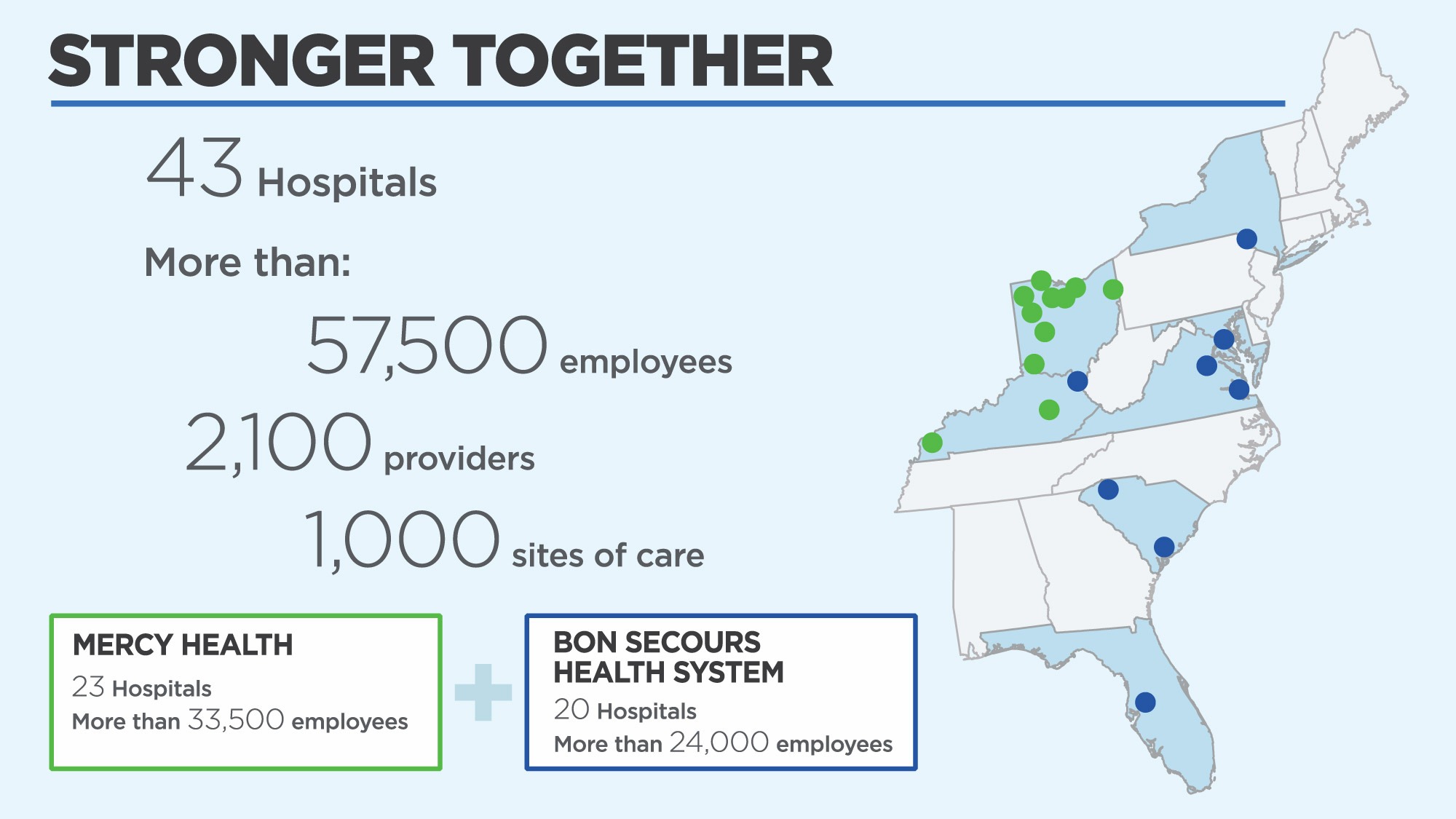
Bon Secours Mercy Health to furlough 700, estimates $100M monthly operating loss

https://www.beckershospitalreview.com/finance/bon-secours-mercy-health-to-furlough-700-estimates-100m-monthly-revenue-loss.html?utm_medium=email

Bon Secours Mercy Health Sells $1.2B Majority Stake in Ensemble ...

Citing a revenue hit from the COVID-19 pandemic, Cincinnati-based Bon Secours Mercy Health will furlough 700 employees and freeze wages of all nonclinical personnel, according to The Cincinnati Business Journal. 

The furloughs will affect workers in the system’s shared services business office, which includes entry-level workers and those who are senior vice presidents. No caregiver, pharmacy or supply chain jobs will be affected.

The furloughs are expected to begin next week and last 30 to 90 days, depending on how long the pandemic lasts, according to Bon Secours Mercy Health CEO John Starcher.

The cost-cutting measures are a result of an anticipated decline in revenue due to government-imposed bans on elective procedures. Bon Secours Mercy Health estimates it will see an operating loss of at least $100 million per month while the pandemic lasts.

In addition to the furloughs and wage freeze, the health system is freezing hiring for all noncritical care positions.

“We don’t shy away from making the difficult decisions, and this certainly is one of those, because we always have a mind’s eye on what the long-term ramifications and implications are,” Mr. Starcher told the Business Journal. “We’re laser-focused on making sure this ministry is as successful and vibrant for the next 150 years as it’s been for the last 150.”


$40M sale of 2 California hospitals includes commitment to COVID-19 patient care

https://www.beckershospitalreview.com/hospital-transactions-and-valuation/40m-sale-of-2-california-hospitals-includes-commitment-to-covid-19-patient-care.html?utm_medium=email

Verity Health gets $610 million offer for four hospitals

Verity Health Gets $610M Offer to Buy St. Vincent, St. Francis and ...

El Segundo, Calif.-based Verity Health has agreed to sell two California hospitals to AHMC Healthcare and is seeking an expedited review of the transaction, according to Bloomberg Law.

Verity, which entered Chapter 11 bankruptcy in 2018, filed a motion with the bankruptcy court March 29, seeking approval for the sale. Under the proposed transaction, Verity would sell Seton Medical Center in Daly City, Calif., and Seton Coastside in Moss Beach, Calif., to AHMC for $40 million. The agreement also includes a commitment by AHMC to continue to support the state’s efforts to address the COVID-19 pandemic.

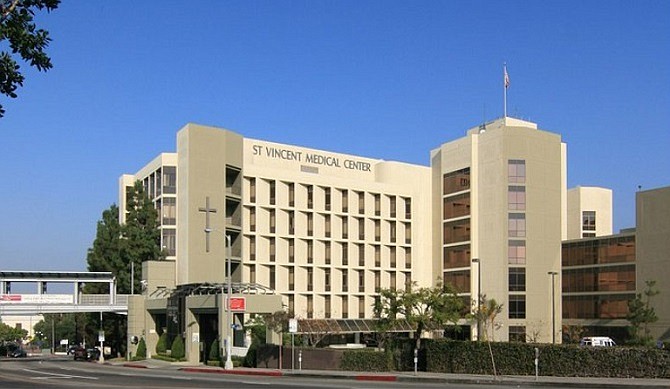
The proposed deal comes after California Gov. Gavin Newson announced March 21 that the state will use $30 million in emergency funding to lease Seton Medical Center and St. Vincent Medical Center in Los Angeles, which Verity closed in January. The state is leasing the hospitals for three months to expand capacity for COVID-19 patients.