More Evidence Points to Role of Blood Type in COVID-19

Additional evidence continued to suggest blood type may not only play a role in COVID-19 susceptibility, but also severity of infection, according to two retrospective studies.

In Denmark, blood type O was associated with reduced risk of developing COVID-19 (RR 0.87, 95% CI 0.83-0.91), based on the proportion of those with type O blood who tested positive for SARS-CoV-2 compared with a reference population, reported Torben Barington, MD, of Odense University Hospital, and colleagues.

However, there was no increased risk for COVID-19 hospitalization or death associated with blood type, the authors wrote in Blood Advances.

Limitations to the data include that ABO blood group information was only available for 62% of individuals, and that the sex of the testing population was skewed, with women accounting for 71% who tested negative and 67% who tested positive.

They pointed to the recent research that blood type plays a role in infection, noting the lower than expected prevalence of blood group O individuals among COVID-19 patients. Researchers also observed how blood groups are “increasingly recognized to influence susceptibility to certain viruses,” among them SARS-CoV-1 and norovirus, adding that individuals with A, B, and AB blood types may be at “increased risk for thrombosis and cardiovascular diseases,” which are important comorbidities among patients hospitalized with COVID-19.

ABO and RhD blood group information was available for 473,654 individuals who were tested for SARS-CoV-2 from February 27 to July 30, as well as for 2,204,742 individuals not tested for SARS-CoV-2 as a reference.

Of the individuals tested, 7,422 tested positive for SARS-CoV-2. About a third of both those who tested positive and negative were men, and those with positive tests were slightly older (52 vs 50, respectively).

Among individuals testing positive for SARS-CoV-2, about 38% (95% CI 37.5-39.5%) belonged to blood group O versus about 42% of those in the reference population. There were significantly more group A and AB individuals in the positive testing group versus the reference population, though the difference was non-significant for group B. When group O individuals were removed, there was no difference between the remaining groups.

Blood Type Linked to COVID-19 Severity?

Meanwhile, a second, smaller study in Blood Advances did report a connection between blood type and COVID-19 severity.

Blood types A or AB in COVID-19 patients were associated with increased risk for mechanical ventilation, continuous renal replacement therapy, and prolonged ICU admission versus patients with blood type O or B, according to Mypinder Sekhon, MD, of the University of British Columbia in Vancouver, and colleagues. Inflammatory cytokines did not differ between groups, however.

These authors also cited research that found that blood groups were linked to virus susceptibility, but that the relationship between SARS-CoV-2 infection severity and blood groups remains “unresolved.” However, COVID-19 appears to be a multisystem disease with renal and hepatic manifestations.

“If ABO blood groups play a role in determining disease severity, these differences would be expected to manifest within multiple organ systems and hold relevance for multiple resource-intensive treatments, such as mechanical ventilation and continuous renal replacement therapy,” Sekhon and colleagues wrote.

They collected data from six metropolitan Vancouver hospitals from Feb. 21 to April 28, identifying 95 COVID-19 patients admitted to an ICU with known ABO blood type.

Among these patients, 57 were group O or B, while 38 were group A or AB. A significantly higher proportion of A/AB patients required mechanical ventilation versus O/B patients (84% vs 61%, respectively, P=0.02). Similar figures were seen for patients requiring continuous renal replacement therapy (32% vs 9%, P=0.04). Median ICU stay length was also longer for A or AB patients compared with O or B patients (13.5 days vs 9 days, P=0.03).

There was no difference in probability of ICU discharge, and eight patients died in the O/B group versus nine patients in the A/AB group. Not surprisingly, biomarkers of renal and hepatic dysfunction were higher in the A/AB group, as well.

“The unique part of our study is our focus on the severity effect of blood type on COVID-19. We observed this lung and kidney damage, and in future studies, we will want to tease out the effect of blood group and COVID-19 on other vital organs,” Sekhon said in a statement.

About 25% of patients were missing data on blood group, and the nature of the study makes it impossible to infer causality, the authors acknowledged. Ethnic ancestry and outcomes in patients with COVID-19 could be an unaddressed confounder. Additionally, anti-A antibody titers may affect COVID-19 severity, and these were not measured.


This terrible year taught me something about hope

The first month of the pandemic was also supposed to be the month I got pregnant, but my clinic closed and plans changed. Doctors and nurses needed personal protective equipment to tend to patients with covid-19, not women with recurrent miscarriages.

When the clinic reopened several months later, it turned out my husband and I had only been delaying yet another loss: In late August, he obeyed the medical center’s strict coronavirus protocols by waiting anxiously in the car while I trudged inside, masked and hand-sanitized, to receive a miscarriage diagnosis alone. I searched the ultrasound screen for the rhythmic beat of a heart, and then accepted that whatever had once been there was now gone.

But that was 2020 for you, consistent only in its utter crappiness. For every inspiring video of neighbors applauding a shift change at the hospital, another video of a bone-tired nurse begging viewers to believe covid was real, it wasn’t a hoax, wear a mask.

For every protest organized by activists who understood racism is also a long-term crisis, an appearance by the Proud Boys; for every GoFundMe successfully raising money for a beloved teacher’s hospital bills, a bitter acknowledgment that online panhandling is our country’s version of a safety net.

Millions of citizens stood in line for hours to vote for the next president and then endured weeks of legal petitions arguing that their votes should be negated. The basis for these legal actions were conspiracy theories too wild to be believed, except that millions of other citizens believed them.

And that was 2020 for you, too: accepting the increasingly obvious reality that the country was in peril, built on iffy foundations that now buckled under pressure. My loved ones who worked as waiters or bartenders or physical therapists were choosing between health and paychecks, and even from the lucky safety of my work-from-home job, each day began to feel like watching America itself arrive at a hospital in bad shape, praying that doctors or clergy could find something they were able to save.

Is there a heartbeat?

You want the answer to be yes, but even so, it was hard to imagine how we would come back from this.

What kind of delusional person would even try to get pregnant in this world? In my case it would never be a happy accident; it would always be a herculean effort. And so it seemed I should have some answers.

How do you explain to a future child: Sorry, we can’t fix climate change; we can’t even get people to agree that we should wear masks in grocery stores? How do you explain the frustration of seeing brokenness, and then the wearying choice of trying to fix it instead of abandoning it? How do you say, Love it anyway. You’re inheriting an absolute mess, but love it anyway?

I found myself asking a lot of things like this in 2020, but really they were all variations of the same question: What does it mean to have hope?

But in the middle of this, scientists worked quietly in labs all over the world. They applied the scientific method with extraordinary discipline and speed. A vaccine was developed. Tens of thousands of volunteers rolled up their sleeves and said, Try it out on me.

It was approved, and a nurse from Long Island was the first American televised receiving it. Her name was Sandra Lindsay, an immigrant from Jamaica who had come to the United States 30 years ago and who had spent the last year overseeing critical care teams in back-to-back shifts. She said she had agreed to go first to show communities of color, long abused, brushed-off or condescended to by the medical system, that the vaccine was safe.

Here was hope. And more than that, here was hope from a woman who had more reason than most to be embittered: an exhausted health-care worker who knew too well America’s hideous racial past and present, who nonetheless also knew there was only one way out of the tunnel. Here she was, rolling up her own sleeve, and there were the lines of hospital employees ready to go after her, and there were the truck drivers ferrying shipments of syringes.

I can’t have been the only person to watch the video of those early inoculations, feeling elated and tired, and to then burst into tears. I can’t have been the only person to realize that even as 2020 revealed brokenness, it also contained such astounding undercurrents of good.

The scientific method works whether you accept it or not. Doctors try to save you whether you respected public-health guidelines or not. Voter turnout was astronomical because individual citizens realized they were all, every one of them, necessary pieces in a puzzle, even if they couldn’t see what the final picture was supposed to look like.

The way to believe in America is to believe those things are passed down, too.

Sometime in October, a couple of months after my last miscarriage — when the country was riding up on eight months of lonely and stoic birthdays, graduations, deaths and weddings — I went into the bathroom and saw a faint second line on a First Response pregnancy test. It was far from my first rodeo, so I knew better than to get excited. I mentioned it to my husband with studied nonchalance, I told him that I’d test again in a few days but that we should assume the worst would happen.

Two weeks after that, I had a doctor’s appointment, and then another a week later, each time assuming the worst, but each time scheduling another appointment anyway, until eventually I was further along than I’d ever gotten before — by one day, then three days, then thirty.

I am not a superstitious person. I don’t believe that good things always come to those who deserve them. I believe that stories regularly have sad endings and that it’s often nobody’s fault when they do, and that we should tell more stories with sad endings so that people who experience them know that they’re not alone.

But 2020 has taught me that I am, for better or worse, someone who wants to hope for things. To believe in the people who developed vaccines. In the people who administered them. In Sandra Lindsay. In the people who delivered groceries, who sewed masks, who have long cursed America’s imperfect systems and long fought to change them, who still donate $10 to a sick teacher’s GoFundMe.

At my most recent appointment, the doctor’s office was backed up in a holiday logjam. I sat in the exam room for nearly three hours while my husband again waited anxiously in the car. I texted him sporadic updates and tried to put hope in a process that so far had not seemed to warrant my hope.

It all felt precarious. The current reality always feels precarious.

And yet there we all are together, searching for signs of life, hoping that whatever we emerge to can be better than what we had before, and that whatever we build will become our new legacy. The sonographer finally arrived and turned on the machine.

There was a heartbeat. There was a heartbeat.

Wisconsin health-care worker ‘intentionally’ spoiled more than 500 coronavirus vaccine doses, hospital says

A hospital employee outside Milwaukee deliberately spoiled more than 500 doses of coronavirus vaccine by removing 57 vials from a pharmacy refrigerator, hospital officials announced Wednesday, as local police said they were investigating the incident with the help of federal authorities.

Initiating an internal review on Monday, hospital officials said they were initially “led to believe” the incident was caused by “inadvertent human error.” The vials were removed Friday and most were discarded Saturday, with only a few still safe to administer, according to an earlier statement from the health system. Each vial has enough for 10 vaccinations but can sit at room temperature for only 12 hours.

Two days later, the employee acknowledged having “intentionally removed the vaccine from refrigeration,” the hospital, Aurora Medical Center in Grafton, Wis., said in a statement late Wednesday.

The employee, who has not been identified, was fired, the hospital said. Its statement did not address the worker’s motives but said “appropriate authorities” were promptly notified.

Wednesday night, police in Grafton, a village of about 12,000 that lies 20 miles north of Milwaukee, said they were investigating along with the FBI and the Food and Drug Administration. In a statement, the local police department said it had learned of the incident from security services at Aurora Health Care’s corporate office in Milwaukee. The system serves eastern Wisconsin and northern Illinois, and includes 15 hospitals and more than 150 clinics.

Leonard Peace, an FBI spokesman in Milwaukee, would not comment on the Bureau’s involvement but said of the episode, “We’re aware of it.” The FDA did not immediately respond to a request for comment.

The tampering will delay inoculation for hundreds of people, Aurora Health officials said, in a state where 3,170 new cases were reported and 40 people died Wednesday of covid-19, the disease caused by the coronavirus, according to The Washington Post’s coronavirus tracker.

“We are more than disappointed that this individual’s actions will result in a delay of more than 500 people receiving the vaccine,” the health system said in a statement.

The Wisconsin incident comes as states continue to grapple with a bumpy rollout of the first doses of the Moderna and Pfizer-BioNTech vaccines, which were approved less than a month ago and prioritized for health-care workers and residents and staff of long-term care facilities. So far, distribution has lagged well behind federal projections, raising doubts about whether the outgoing administration will meet its already revised goal of 20 million vaccines distributed by the end of the year.

As of Wednesday, the Centers for Disease Control and Prevention said 12.4 million doses of the vaccine had been distributed across the United States, but only 2.6 million of those had been administered. (This means that just 1 in 125 Americans has received the first dose of the vaccine.) Trump administration officials have said these numbers lag behind the actual pace of vaccination, which they also vowed would accelerate starting next week.

The Moderna and Pfier-BioNTech vaccines, the first two regimens to gain regulatory approval for emergency use, are two-shot protocols with intricate logistical requirements. Moderna’s vaccine doesn’t require subarctic temperatures, as does the Pfizer product, but it does need to be kept cold. It can be stored at freezer temperatures for six months, the company says, and kept at regular refrigerated conditions for 30 days. It can be maintained at room temperature for only 12 hours, though, and can’t be refrozen once thawed.

Complex storage requirements are among the reasons state officials are imploring providers to administer vaccine quickly once it is received.

In its original statement, Aurora Health said it had successfully vaccinated about 17,000 people over the previous 12 days. Its initial review, it said, had found that the 57 vials were simply not returned to the refrigerator after “temporarily being removed to access other items.”

The hospital apologized, saying, “We are clearly disappointed and regret this happened.”

It is not clear what motive the employee may have had to spoil the vaccine doses. The hospital said it would release more details about its investigation Thursday.

The Times Square ball drop’s raucous past and lonely present

The annual New Year’s eve ball drop celebration in Times Square actually began with dynamite.

It was 1904. Adolph Ochs, the owner of the New York Times, had just finished construction of a towering new headquarters on 42nd Street.

Ochs was very proud of this new building. He even published a 48-page special supplement to celebrate a structure that, as the paper put it, “reaches higher toward the clouds than anything within twelve miles.”

To celebrate the new building and the calendar flipping to 1905, the paper invited New Yorkers to celebrate at the new tower with fireworks and a performance by Francesco Fanciulli’s band. Throngs have gathered in Times Square ever since, except for two years during World War II — and this year, because of the coronavirus pandemic.

“There are absolutely no spectators allowed in Times Square,” Police Chief Terence A. Monahan warned Wednesday at a news conference.

In 1904, massive crowds began to gather as the sun set, lured by the Times promise that “Bombs will burst 1,000 feet in the air, and not a feature of the exhibition will be hidden to Greater New York or the surrounding country.”

“Broadway seemed the thoroughfare to which all faces were turned,” the Times reported the next day. “And when the time approached when another year should be inscribed upon the century book the crush was so great that progress was well nigh impossible in any direction.”

It was very loud.

“Every known device for making noise was pressed into service,” the Times said. “There were horns of all shapes and sizes — horns which wailed with an almost human note and horns which carried an ear-shattering volume of sound. One of the favorite kinds of horns was fashioned in the semblance of a champagne bottle and gave forth a series of notes which sounded the scale from top to bottom.”

As the clock struck midnight, “another bomb and another” shot up from the tower.

“No more beautiful picture was ever limned in fire on the curtain of midnight,” the Times reported. “As the first bomb ascended in a graceful arc, and burst 1,000 feet in the air, the city knew that 1904 had passed, and from factory, locomotive, and steamship whistles welcomed its successor.”

The launching of dynamite from the Times Building to celebrate the New Year continued until 1907, when the city, perhaps concluding that firing explosives over thousands of people and scores of other rising skyscrapers was unsafe, refused to issue a permit.

In search of another way to celebrate, Ochs hired Artkraft Strauss, the preeminent Times Square signmaker, to build him a giant time ball — a precisely calibrated device invented in the early 19th century to tell time in city centers and on naval ships.

Ochs would use his time ball — “a 700-pound wood-and-iron ball, five feet in diameter and illuminated by 100 25-watt bulbs,” according to the Times — to countdown the final minute of the year. Over the year, the ball has changed, but the tradition has not.

“Today, the drop is initiated by a laser-cooled atomic clock in Colorado, the primary time standard for the United States,” according to the New Yorker. “It continues to be our most spectacular display of public time-keeping.”

But this year there will be no throngs of cold revelers in Times Square. There will be no noise, no ticker tape, no couples kissing to ring in the new year. But still, one year will pass into the next — 2020, to 2021.

And maybe next year things will be different.

Maybe Times Square will sound and feel and be alive again like it was that December evening in 1904, when, as the Times recorded, “the spirit of the occasion was one of good fellowship” and the sky “took on all colors of the rainbow.”

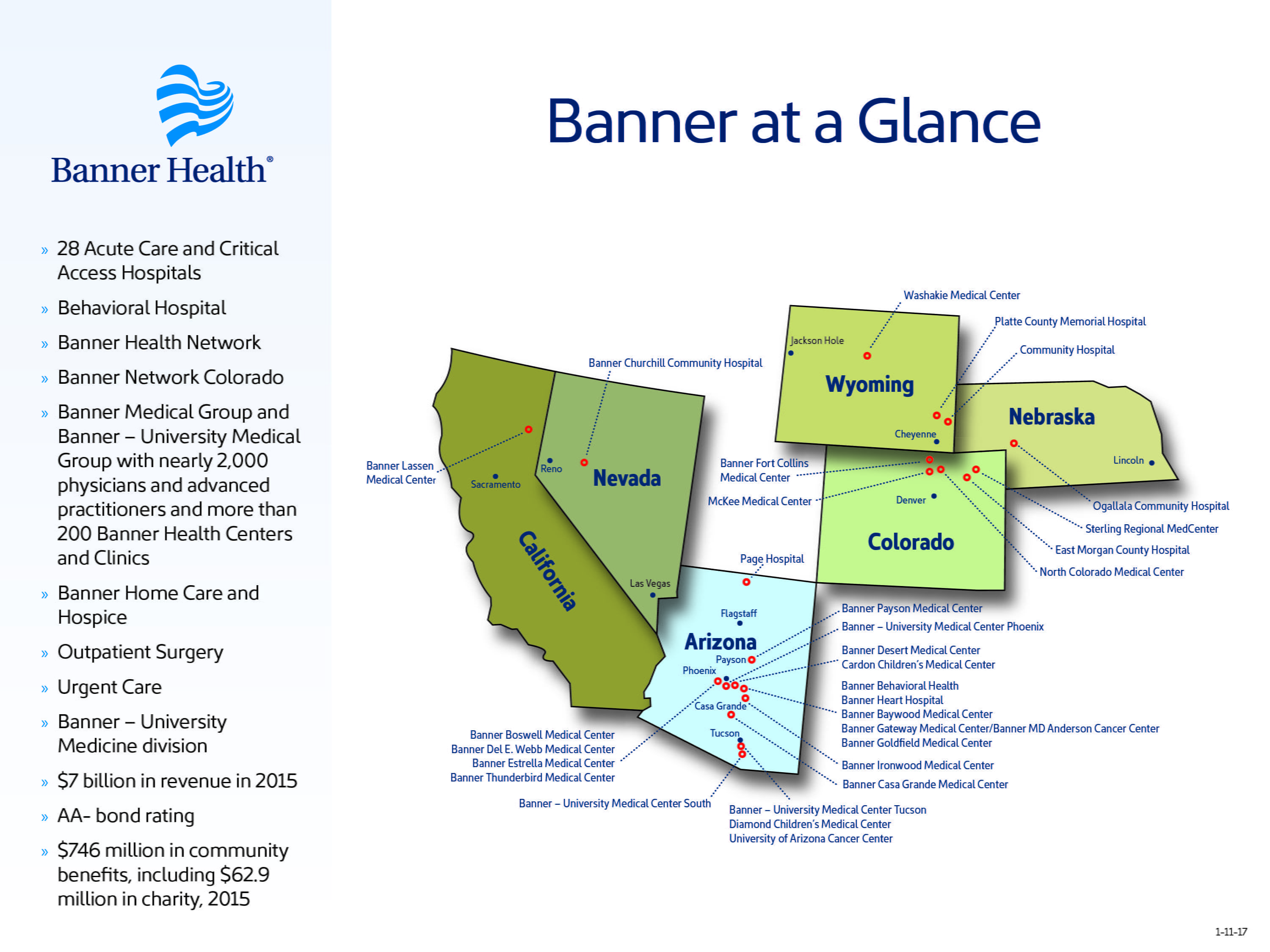
Banner Health halts elective surgeries

History

Banner Health will pause elective surgeries Jan. 1, the Phoenix-based system announced Dec. 30. 

The health system is suspending nonurgent elective surgeries that can reasonably be postponed for 30 to 60 days without a negative impact on the patient’s health, according to TV station CBS 5

Banner’s hospitals are facing a surge of COVID-19 patients. As of Dec. 29, the system was at 104 percent licensed bed capacity, Banner Chief Clinical Officer Marjorie Bessel, MD, said Dec. 30, according to TV station ABC 15. Some Banner hospitals have exceeded 120 percent licensed bed capacity.

Because of a backlog of patients, some Banner hospitals are diverting incoming ambulance transports. 

“This diversion activity is an early indication that triage may soon be necessary if volumes continue to increase like they did this past week,” Dr. Bessel said, according to CBS 5. “What triage would look like, would be that we might, if we got to that point, be unable to care for everybody.”

California reports first case of new coronavirus variant

https://www.axios.com/california-covid-coronavirus-variant-1081cbb4-5d2c-42f2-8785-b35e567296c9.html

California reported its first case of a new variant of the coronavirus that may be more transmissible, AP reports.

The big picture: California is the second state to document a confirmed case of the variant — which originated in the United Kingdom — after Colorado reported the first case in the United States on Tuesday.

  • California Gov. Gavin Newsom announced the infection during an online conversation with Anthony Fauci, head of the National Institute of Allergy and Infectious Diseases, according to AP.
  • The governor said the case was located in Southern California, but he did not provide any other details about the person who was infected.
  • “I don’t think Californians should think that this is odd. It’s to be expected,” Fauci said Wednesday, per AP.

Of note: There is thus far no evidence that the new variant is more deadly — only that it appears more transmissible. There is also no evidence that COVID-19 vaccines will be less effective against the new variant.

  • A non-peer reviewed study by the Centre for Mathematical Modelling of Infectious Diseases at the London School of Hygiene and Tropical Medicine found that the variant is 56% more transmissible than other strains.
  • The British government previously warned that a new variant could be up to 70% more transmissible.

Go deeper: What you need to know about the coronavirus mutation

America hopes 2021 will be less terrible

https://www.axios.com/axios-surveymonkey-poll-2021-hopes-7de84661-c2dd-43df-9509-3dda4a35a9f5.html

Axios-SurveyMonkey poll: America hopes 2021 will be less terrible - Axios

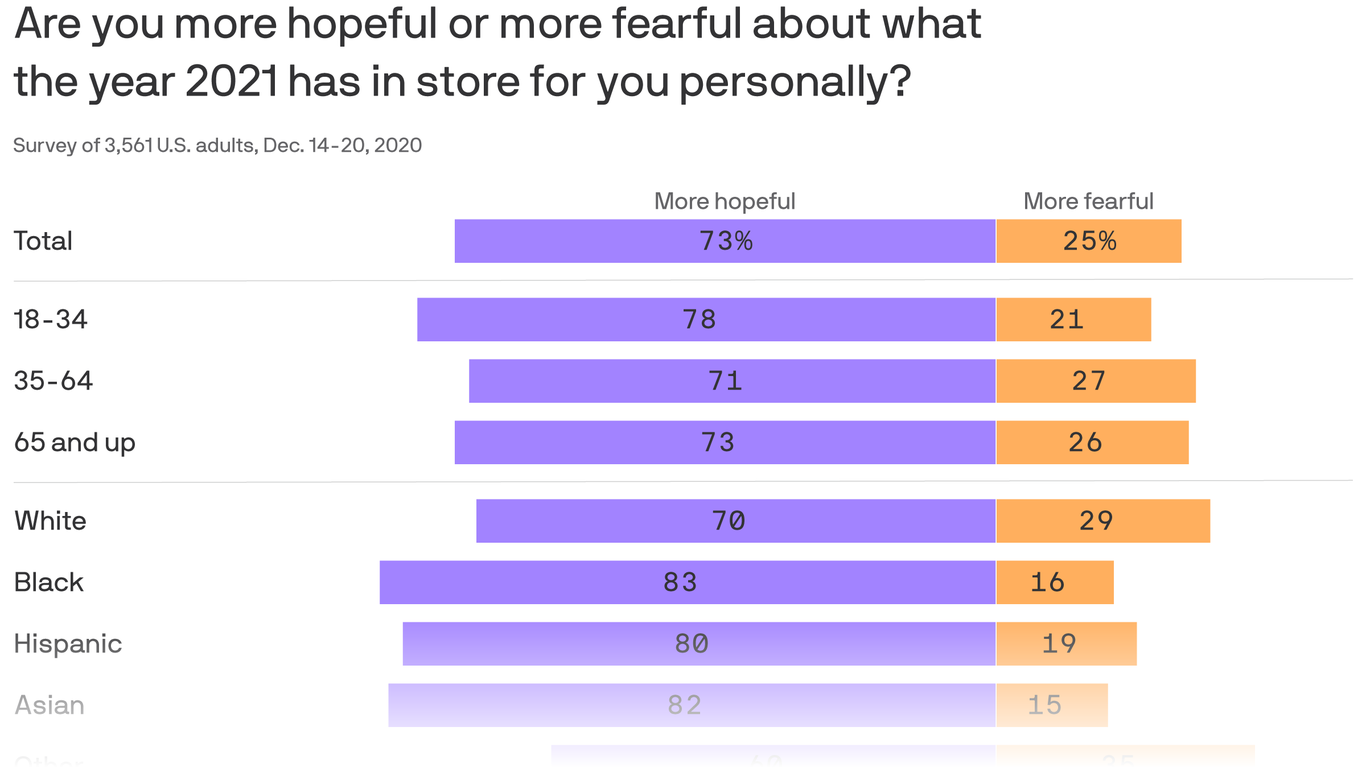
More than six out of 10 Americans are hopeful about what 2021 has in store for the world, according to a new Axios/SurveyMonkey poll.

The big picture: After a year dominated by the pandemic and a seemingly endless presidential election, Americans are overwhelmingly hopeful that things will get better with the pandemic — and more narrowly hopeful about Joe Biden’s presidency.

By the numbers: 63% of poll respondents said they’re more hopeful than fearful about what 2021 holds in store for the world, while 36% said they’re more fearful.

  • That’s a jump in optimism compared to the same poll heading into 2019, when just 51% said they were hopeful and 48% said they were fearful.
  • The only group that wasn’t optimistic about 2021 was Republicans: 41% said they were more hopeful, while 58% said they were more fearful.

Between the lines: Americans were even more optimistic about the year ahead for them personally — mostly driven by the hopes of young adults, people of color and Democrats.

The coronavirus was the one issue that united most people in optimism. Overall, 76% were more hopeful than fearful about the pandemic next year — a view that held across most age groups, racial and ethnic groups, and parties.

  • 82% of Democrats, 72% of Republicans, and 73% of independents said they were more hopeful than fearful.

The Biden presidency was more divisive. Overall, 56% were more hopeful about his presidency, while 42% were more fearful.

  • Not surprisingly, Republicans are the most pessimistic: 82% said they’re more fearful than hopeful about his presidency.
  • By contrast, 59% of independents said they’re more hopeful about it — and 92% of Democrats said the same.

And while Republicans are ready for President Trump to take on a big leadership role in the Republican Party after his presidency ends, that’s not true of everyone else.

  • 75% of Republicans said they’re more concerned that Trump will play too small a role in the future of the GOP rather than too big a role — while 51% of all respondents said they’re more concerned that he’ll play too big a role.
  • And more than half of Republicans (52%) said they believe Trump will have a major role in the Republican Party, while 30% said they think he’ll have a minor role.
  • By contrast, just 34% of all respondents expect him to play a major role, while 32% think he’ll have a minor role and 31% think he’ll have no role at all.