Explainer: What to Know About Monkeypox

Explainer: What to Know About Monkeypox

The COVID-19 pandemic is still fresh in the minds of the people around the world, so it comes as no surprise that recent outbreaks of another virus are grabbing headlines.

Monkeypox outbreaks have now been reported in multiple countries, and it has scientists paying close attention. For everyone else, numerous questions come to the surface:

  • How serious is this virus?
  • How contagious is it?
  • Could monkeypox develop into a new pandemic?

Below, we answer these questions and more.

What is Monkeypox?

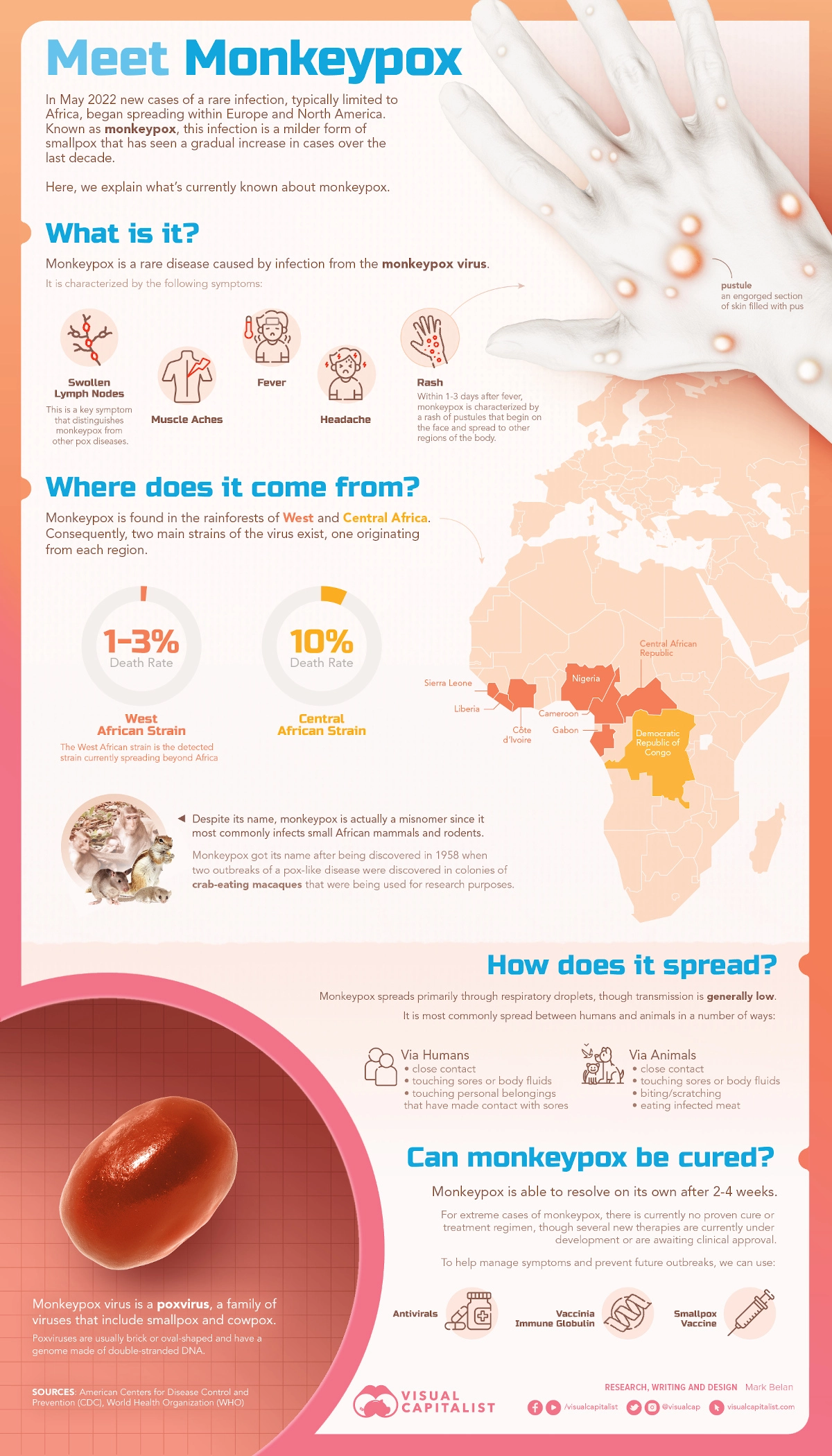
Monkeypox is a virus in the Orthopoxvirus genus which also includes the variola virus (which causes smallpox) and the cowpox virus. The primary symptoms include fever, swollen lymph nodes, and a distinctive bumpy rash.

There are two major strains of the virus that pose very different risks:

  • Congo Basin strain: 1 in 10 people infected with this strain have died
  • West African strain: Approximately 1 in 100 people infected with this strain died

At the moment, health authorities in the UK have indicated they’re seeing the milder strain in patients there.

Where did Monkeypox Originate From?

The virus was originally discovered in the Democratic Republic of Congo in monkeys kept for research purposes (hence the name). Eventually, the virus made the jump to humans more than a decade after its discovery in 1958.

It is widely assumed that vaccination against another similar virus, smallpox, helped keep monkeypox outbreaks from occurring in human populations. Ironically, the successful eradication of smallpox, and eventual winding down of that vaccine program, has opened the door to a new viral threat. There is now a growing population of people who no longer have immunity against the virus.

Now that travel restrictions are lifting in many parts of the world, viruses are now able to hop between nations again. As of the publishing of this article, a handful of cases have now been reported in the U.S., Canada, the UK, and a number of European countries.

On the upside, contact tracing has helped authorities piece together the transmission of the virus. While cases are rare in Europe and North America, it is considered endemic in parts of West Africa. For example, the World Health Organization reports that Nigeria has experienced over 550 reported monkeypox cases from 2017 to today. The current UK outbreak originated from an individual who returned from a trip to Nigeria.

Could Monkeypox become a new pandemic?

Monkeypox, which primarily spreads through animal-to-human interaction, is not known to spread easily between humans. Most individuals infected with monkeypox pass the virus to between zero and one person, so outbreaks typically fizzle out. For this reason, the fact that outbreaks are occurring in several countries simultaneously is concerning for health authorities and organizations that monitor viral transmission. Experts are entertaining the possibility that the virus’ rate of transmission has increased.

Images of people covered in monkeypox lesions are shocking, and people are understandably concerned by this virus, but the good news is that members of the general public have little to fear at this stage.

I think the risk to the general public at this point, from the information we have, is very, very low.
–TOM INGLESBY, DIRECTOR, JOHNS HOPKINS CENTER FOR HEALTH SECURITY
A deadly virus was just identified in Ghana: What to know about Marburg

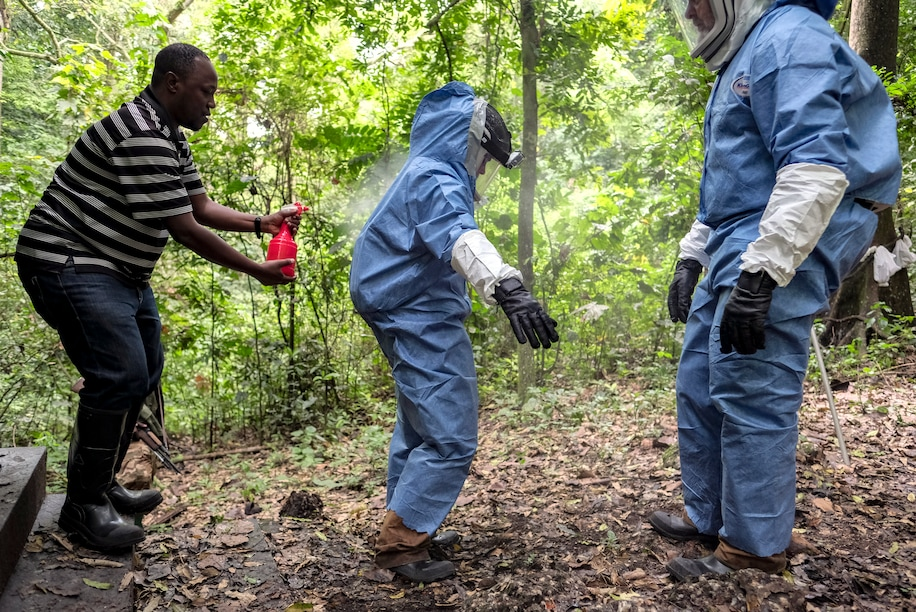
Epidemiologist Luke Nyakarahuka sprays disinfectant on scientists Jonathan Towner and Brian Amman in Queen Elizabeth National Park, Uganda, in 2018. The scientists were researching how bats transmit the Marburg virus to humans.

After the coronavirus pandemic and the rise of monkeypox cases, news of another virus can trigger nerves globally. The highly infectious Marburg virus has been reported in the West African country of Ghana this week, according to the World Health Organization.

Two unrelated people died after testing positive for Marburg in the southern Ashanti region of the country, the WHO said Sunday, confirming lab results from Ghana’s health service. The highly infectious disease is similar to Ebola and has no vaccine.

Health officials in the country say they are working to isolate close contacts and mitigate the spread of the virus, and the WHO is marshaling resources and sending specialists to the country.

“Health authorities have responded swiftly, getting a head start preparing for a possible outbreak. This is good because without immediate and decisive action, Marburg can easily get out of hand,” said the WHO’s regional director for Africa, Matshidiso Moeti.

Fatality rates from the disease can reach nearly 90 percent, according to the WHO.

Here’s what we know about the virus:

What is the Marburg virus?

Marburg is a rare but highly infectious viral hemorrhagic fever and is in the same family as Ebola, a better-known virus that has plagued West Africa for years.

The Marburg virus is a “genetically unique zoonotic … RNA virus of the filovirus family,” according to the Centers for Disease Control and Prevention. “The six species of Ebola virus are the only other known members of the filovirus family.”

Fatality rates range from 24 percent to 88 percent, according to the WHO, depending on the virus strain and quality of case management.

Marburg has probably been transmitted to people from African fruit bats as a result of prolonged exposure from people working in mines and caves that have Rousettus bat colonies. It is not an airborne disease.

Once someone is infected, the virus can spread easily between humans through direct contact with the bodily fluids of infected people such as blood, saliva or urine, as well as on surfaces and materials. Relatives and health workers remain most vulnerable alongside patients, and bodies can remain contagious at burial.

The first cases of the virus were identified in Europe in 1967. Two large outbreaks in Marburg and Frankfurt in Germany, and in Belgrade, Serbia, led to the initial recognition of the disease. At least seven deaths were reported in that outbreak, with the first people infected having been exposed to Ugandan imported African green monkeys or their tissue while conducting lab research, the CDC said.

Where has Marburg been detected?

The Ghana cases are only the second time Marburg has been detected in West Africa. The first reported case in the region was in Guinea last year. The virus can spread quickly. More than 90 contacts, including health workers and community members, are being monitored in Ghana. The WHO said it has also reached out to neighboring high-risk countries to put them on alert.

Cases of Marburg have previously been reported elsewhere in Africa, including in Uganda, the Democratic Republic of Congo, Kenya, South Africa and Zimbabwe. The largest outbreak killed more than 200 people in Angola in 2005.

The virus is not known to be native to other continents, such as North America, and the CDC says cases outside Africa are “infrequent.” In 2008, however, a Dutch woman died of Marburg disease after visiting Uganda. An American tourist also contracted the disease after a Uganda trip in 2008 but recovered. Both travelers had visited a well-known cave inhabited by fruit bats in a national park.

What are the symptoms?

The illness begins “abruptly,” according to the WHO, with a high fever, severe headache and malaise. Muscle aches and cramping pains are also common features.

In Ghana, the two unrelated individuals who died experienced symptoms such as diarrhea, fever, nausea and vomiting. One case was a 26-year-old man who checked into a hospital on June 26 and died a day later. The second was a 51-year-old man who went to a hospital on June 28 and died the same day, the WHO said.

In fatal cases, death usually occurs between eight and nine days after onset of the disease and is preceded by severe blood loss and hemorrhaging, and multi-organ dysfunction.

The CDC has also noted that around day five, a non-itchy rash on the chest, back or stomach may occur. Clinical diagnosis of Marburg “can be difficult,” it says, with many of the symptoms similar to other infectious diseases such as malaria or typhoid fever.

Can Marburg be treated?

There are no vaccines or antiviral treatments approved to treat the Marburg virus.

However, supportive care can improve survival rates such as rehydration with oral or intravenous fluids, maintaining oxygen levels, using drug therapies and treating specific symptoms as they arise. Some health experts say drugs similar to those used for Ebola could be effective.

Some “experimental treatments” for Marburg have been tested in animals but have never been tried in humans, the CDC said.

Virus samples collected from patients to study are an “extreme biohazard risk,” the WHO says, and laboratory testing should be conducted under “maximum biological containment conditions.”

Anything else to know?

The WHO said this week it is supporting a “joint national investigative team” in Ghana and deploying its own experts to the country. It is also sending personal protective equipment, bolstering disease surveillance and tracing contacts in response to the handful of cases.

More details are likely to be shared at a WHO Africa online briefing scheduled for Thursday.

“It is a worry that the geographical range of this viral infection appears to have spread. This is a very serious infection with a high mortality rate,” international public health expert and professor Jimmy Whitworth of the London School of Hygiene and Tropical Medicine told The Washington Post on Monday.

“It is important to try to understand how the virus got into the human population to cause this outbreak and to stop any further cases. At present, the risk of spread of the outbreak outside of Ashanti region of Ghana is very low,” he added.

BA.5 spurs new calls to fund next-generation COVID-19 vaccines

The rise of the BA.5 variant is spurring new calls for funding for an Operation Warp Speed 2.0 to accelerate development of next-generation COVID-19 vaccines that can better target new variants. 

The BA.5 subvariant of omicron that now makes up the majority of U.S. COVID-19 cases is sparking concern because it has a greater ability to evade the protection of current vaccines than past strains of the virus did.

Pfizer and Moderna are working on updated vaccines that target BA.5 that could be ready this fall, but experts say that by the time they are ready, a new variant very well could have taken hold.  

As alternatives to vaccine makers chasing each variant, experts point to research on “pan-coronavirus” vaccines that are “variant-proof,” targeting multiple variants, as well as nasal vaccines that could drastically cut down on transmission of the virus.

There is ongoing research on these next-generation vaccines, but unlike in 2020, when the federal government’s Operation Warp Speed helped speed the development of the original vaccine, there is less funding and assistance this time around.  

COVID-19 funding that could help develop and manufacture new vaccines more quickly has been stalled in Congress for months.

“There’s no Operation Warp Speed,” said Eric Topol, professor of molecular medicine at Scripps Research. “So it’s moving very slowly. But at least it’s moving.” 

Leana Wen, a public health professor at George Washington University, wrote in a Washington Post op-ed this week that the U.S. needs “urgent investment” in next-generation vaccines and “we need an ‘Operation Warp Speed Part 2.’” 

Pfizer and Moderna are working on updated vaccines that target BA.5 that could be ready this fall, but experts say that by the time they are ready, a new variant very well could have taken hold.  

As alternatives to vaccine makers chasing each variant, experts point to research on “pan-coronavirus” vaccines that are “variant-proof,” targeting multiple variants, as well as nasal vaccines that could drastically cut down on transmission of the virus.

There is ongoing research on these next-generation vaccines, but unlike in 2020, when the federal government’s Operation Warp Speed helped speed the development of the original vaccine, there is less funding and assistance this time around.  

COVID-19 funding that could help develop and manufacture new vaccines more quickly has been stalled in Congress for months.

“There’s no Operation Warp Speed,” said Eric Topol, professor of molecular medicine at Scripps Research. “So it’s moving very slowly. But at least it’s moving.” 

Leana Wen, a public health professor at George Washington University, wrote in a Washington Post op-ed this week that the U.S. needs “urgent investment” in next-generation vaccines and “we need an ‘Operation Warp Speed Part 2.’” 

Administration health officials pointed to funding when asked about next-generation vaccines at a press briefing on Tuesday.

“We need resources to continue that effort and to accelerate that effort,” said Anthony Fauci, the government’s top infectious disease expert. “So although we’re doing a lot and the field looks promising, in order to continue it, we really do need to have a continual flow of resources to do that.” 

But COVID-19 funding has been stuck in Congress for months. Republicans have long said they do not see any urgency in approving the money. Democrats, while generally calling for the funding, have been caught up in their own internal divisions, like when a group of House Democrats objected to a way to pay for the new funding in March.

“Of course more funding would accelerate some parts of the development,” Karin Bok, acting deputy director of the National Institutes of Health’s (NIH) Vaccine Research Center, said in an interview.  

She also cautioned that development of next-generation vaccines like nasal vaccines would take longer than the original vaccines, because less groundwork has been laid over the preceding years.  

Experts stress that even for BA.5, the current vaccines still provide important protection against severe disease and hospitalization, and are urging people to get their booster shots now. But there is potential for further improvement in the vaccines as well.

Aside from funding, another obstacle is obtaining copies of the existing COVID-19 vaccines for use in research, said Pamela Bjorkman, a California Institute of Technology professor working on a next-generation vaccine. 

“I would say we’ve wasted at least six months,” with various procedural hurdles on that front, she said. “It’s just ridiculous.” 

For example, she said at one point when her team was able to get access to the AstraZeneca COVID-19 vaccine, it then took two or three months to get an import permit to send it from the United Kingdom.

“This is a hot topic,” Bok, of the NIH, said of access to existing vaccine doses for researchers. “The government is working very hard on an agreement with the companies to provide it to us and to all the investigators…that are funded by NIH.” 

Asked about providing vaccine doses for researchers and any talks with the administration on that front, a Moderna spokesperson said: “We do provide vaccine in certain investigator-initiated studies where physicians and scientists propose research they have designed and want to conduct with our support,” pointing to a South African study as an example.  

More broadly, the White House says it is working on accelerating next-generation vaccine research and will have more announcements soon.  

“Let me be very clear: We clearly need a true next-generation vaccine,” White House COVID-19 response coordinator Ashish Jha told reporters on Tuesday. 

“You’ll hear more from us in the days and weeks ahead,” he added. “This is something that we have been working quite assiduously on.” 

COVID is not done with us, part six (…seven? eight?)

https://mailchi.mp/30feb0b31ba0/the-weekly-gist-july-15-2022?e=d1e747d2d8

The rise of ubiquitous self-testing and the paucity of accurate, timely data from the CDC on COVID numbers has left us feeling our way in the dark in terms of the current state of the pandemic. Clearly there’s a new surge underway, driven by the BA.5 variant. What we can report from our experiences on the road over the past few weeks is that the wave is significant. 

We’re hearing from our health system members that inpatient COVID volumes and COVID-related ED visits are significantly up again—often double or more what they were just two months agoalthough still well below levels of past surges. Length of stay for COVID inpatients is shorter, with fewer ICU visits than during the Delta surge—about the same intensity, proportionally, as during Omicron.

But COVID-related staffing shortages are once again having a real impact on hospitals’ ability to deliver care—clinical and non-clinical staff callouts are at high levels again, as during Omicron.

One piece of good news: masking is back in vogue among many health system executive teams, likely in response to a number of “superspreader” events: gatherings of hospital staff over the past few weeks that resulted in clusters of cases. One system described an all-hands session for anesthesiologists that resulted in more than a dozen cases across the next week—forcing the hospital to cancel procedures. 

We’re worried that this BA.5 surge is just getting started, and with booster uptake stagnating and masking all but nonexistent in the general population, the late summer and early autumn situation could be significantly worse.

Be careful out there.

Current state of President Biden’s healthcare policy agenda

https://mailchi.mp/30feb0b31ba0/the-weekly-gist-july-15-2022?e=d1e747d2d8

With a closely divided Congress, President Biden has leaned heavily on regulatory actions to advance his healthcare priorities. With the midterm elections fast approaching, the graphic above assesses the impact of those actions, and outlines which legislative components Democrats may still try to pass before November.

From the start, the administration has signaled the importance of promoting competition in healthcare markets, and has devoted more scrutiny to hospital mergers—while leaving most attempts at vertical integration unchallenged. Through Medicaid waivers, it has worked to expand insurance coverage, rolling back Trump-era work requirements, expanding postpartum coverage, and encouraging states to experiment with public option plans on the Affordable Care Act (ACA) exchanges.

The Centers for Medicare and Medicaid Services (CMS) has continued the steady march toward value programs, revising the Direct Contracting model to factor in health equity. Despite these incremental moves, Medicare Advantage (MA) remains the focus of long-term efforts to control Medicare spending, and MA programs have seen payments boosts year-over-year.

Meanwhile, the fate of President Biden’s signature healthcare campaign promises remains in the hands of an intransigent Congress. Senate Democrats are currently trying to negotiate a deal on a bill allowing Medicare drug negotiations and extending ACA subsidies, an important provision to protect millions from receiving premium hike notices just weeks before Election Day.  

Acknowledging the losses that come with a new strategy

https://mailchi.mp/30feb0b31ba0/the-weekly-gist-july-15-2022?e=d1e747d2d8

Embarking on a new strategy requires myriad organizational changes—which will inevitably come with losses. Some parts of the business, people, roles, processes, and traditions will inevitably be deemphasized, or even eliminated from the organization. A recent article in the Harvard Business Review identifies how leaders launching new strategies typically spend a significant amount of time trying to plan for the unpredictable future, while overlooking one of the most predictable parts of any change in strategy: what will be lost when something else is gained.

The Gist: It is critical to identify, acknowledge, and plan for these losses in adopting any new strategy, as the unexpressed fear of loss is a key driver of organizational inertia and resistance to change.

With health systems deep in strategy development for the post-COVID marketleaders must take into account the wide range of challenges their organizations will face when it comes to reconfiguring investment, growth, competencies, and people, in addition to focusing on new areas of opportunity revealed by the pandemic. 

Failing to confront these tradeoffs head-on may sacrifice any strategic gains resulting from new initiatives.

“Superbug” infections and deaths rose in 2020

https://mailchi.mp/30feb0b31ba0/the-weekly-gist-july-15-2022?e=d1e747d2d8

While the world’s attention was focused on fighting COVID-19, antibiotic-resistant infections were spreading. A Centers for Disease Control and Prevention (CDC) report finds that hospital-acquired infections and deaths from antimicrobial-resistant pathogens increased 15 percent in 2020, compared to 2019. COVID overwhelmed healthcare settings, shifting the focus of infection control resources, resulting in sicker patients with longer catheter and ventilator use, which increased infection risks. Plus, clinicians initially unsure of how to treat the new disease prescribed COVID patients antibiotics at unusually high rates, setting the stage for growing drug resistance.

The Gist: This uptick reverses years of progress made on reducing the number of superbug infections in hospitals. Prior to the pandemic, hospitals were becoming markedly safer places, with fewer hospital-acquired infections, adverse drug reactions, and poor procedural outcomes. 

As health systems exit COVID crisis mode, hospitals must renew their focus on these longstanding goals of the infection control agenda.

Expanded national mental health crisis hotline launches July 16

https://mailchi.mp/30feb0b31ba0/the-weekly-gist-july-15-2022?e=d1e747d2d8

Individuals in crisis can dial 988 to speak with mental health professionals, receive immediate medical assistance, or be directed to treatment. Established by a 2020 law, the hotline is an expanded version of the previous National Suicide Prevention Lifeline, intended to provide Americans with a single mental health emergency access point, akin to 911.

The Gist: While 988 has the potential to help more Americans, as well as reduce some burden on overstressed first responders and hospital emergency rooms, media outlets are reporting concerns from national, state, and local partners that they lack adequate staffing and funding to handle the expected level of demand. 

The nation is long overdue for creating accessible, coordinated mental health crisis care, and this is a step in the right direction. But with one in six calls to the current hotline system now going unanswered, the rollout needs to be coupled with funding for local infrastructure needs.

Biden Administration says that all hospitals must provide abortion care in emergencies

https://mailchi.mp/30feb0b31ba0/the-weekly-gist-july-15-2022?e=d1e747d2d8

This week, federal health officials sent hospitals clarification that the federal Emergency Medical Treatment and Labor Act (EMTALA) protects the provision of abortion care during medical emergencies, regardless of state laws. The guidance also offers EMTALA as a possible legal defense for providers against state enforcement of antiabortion laws. Texas Attorney General Ken Paxton has already sued the Department of Health and Human Services (HHS) to set aside the guidance, claiming the agency is exceeding its authority.   

The Gist: This latest federal action follows President Biden’s recent executive order directing federal agencies to protect access to reproductive care, and HHS’s warning that pharmacists refusing to dispense medications used to induce abortions could be violating federal civil rights laws. The Federal Trade Commission and Justice Department have also announced that they will enforce data privacy rules and pursue legal action against states that look to restrict patients from traveling to obtain abortion care. 

These quick federal actions, while limited, are an attempt provide clarity for providers trying to deliver lifesaving care in a timely manner, without running afoul of state laws. Some Democrats, however, argue that they don’t go far enough, and are pushing for the President to declare a public health emergency on abortion, though it’s not clear that would provide much patient benefit.

Meanwhile, reports from Texas and other states with restrictive abortion laws reveal physicians are already delaying care for ectopic pregnancies and other life-threatening conditions, setting up all-but-certain legal action when patients experience adverse outcomes.