Some red state hospitals pitch Medicaid expansion to solve rural health woes

https://www.axios.com/2022/12/08/red-state-hospitals-medicaid-expansion-rural-health-woes

Hospitals in some non-Medicaid expansion states are pitching expansion as a way to help solve the rural health crisis. But the industry is hardly speaking with one voice.

Driving the news: Facilities with fewer commercially insured patients that treat a large number of uninsured people see expansion as a potential lifeline in tough economic times.

Yes, but: Republican lawmakers in the holdout states continue to oppose enlarging their Medicaid rolls, citing higher state costs of covering a bigger population.

  • And hospital associations in North Carolina and Florida have opposed expansion plans, either out of concern about alienating key lawmakers or because the plans could bring other changes that disrupt dollars flowing to their members.

State of play: South Dakota voters approved a Medicaid expansion ballot measure this fall, leaving 11 non-expansion states.

  • Democratic governors in North Carolina and Kansas think they may be wearing down Republican opposition, Politico reports, but still face uphill battles when the new legislative sessions begin.

Zoom in: Medicaid expansion can bring dollars into a state’s health care system, even if the program pays only a fraction of the actual cost of care.

  • Numerous studies show that Medicaid expansion can have a positive financial impact on hospitals’ operating and profit margins, particularly smaller rural facilities, Robin Rudowitz, vice president at the Kaiser Family Foundation, told Axios.
  • The program could provide a reprieve for hospitals that were kept afloat in part by federal pandemic aid that’s now drying up.
  • “We have hospitals with 12 days cash on hand. We’ve lost a nursing home this year. We have seen decreased services. We’ve lost OB services in a few places, and we’ve seen over the years the decrease in mental health,” Wyoming Hospital Association vice president Josh Hannes told state lawmakers last month, per Politico.
  • Expanding Medicaid in other states has also led to a significant decline in uncompensated care costs, as well as improved states’ health outcomes, including overall mortality.

Yes, but: Medicaid expansion is not necessarily a silver bullet that will rescue every struggling facility.

  • Some state hospital associations are seeking other types of relief, from cuts in hospital bed taxes or higher reimbursements for existing Medicaid beneficiaries.

Of note: Rural, small hospitals have the most to gain from Medicaid expansion, because they serve a smaller patient populations with a larger pool of uninsured people.

  • Congress sweetened the deal for non-expansion states in the American Rescue Plan Act, with a 5% increase in the federal Medicaid Assistance Percentage for the state’s current Medicaid recipients, which lasts for two years.
  • In Texas, whose uninsured rate is the highest in the nation, hospital leaders think Medicaid expansion could help cover many in the working class whose jobs do not offer health plans.
  • “If you could get those folks coverage at a Medicaid rate it would obviously help the financial situations of (rural) hospitals, and if you could get them to a medical home you could deal with more acute medical conditions going forward,” John Hawkins, president of the Texas Hospital Association, told reporters last week.

The bottom line: While rural hospitals all over are facing headwinds, those in non-expansion states are bearing the brunt of the pain. And while there is a potential lever for those states, it doesn’t appear likely their elected officials are willing to pull it.

18M Are at Risk of Losing Medicaid Coverage at the End of Covid Emergency

Of these 18 million people, 3.8 million people will become completely uninsured, according to the Urban Institute’s report. The estimate is higher than HHS’ August prediction of 15 million people losing coverage after the public health emergency.

If the Covid-19 public health emergency expires in April, about 18 million people could lose Medicaid coverage, a new report concludes.

The Urban Institute, which published the report, found that of these 18 million people, 3.8 million people will become completely uninsured. About 3.2 million children will likely move from Medicaid to separate Children’s Health Insurance Programs. Additionally, about 9.5 million people will receive employer-sponsored insurance. Lastly, more than 1 million people will enroll in a plan through the nongroup market.

The Urban Institute’s estimates, published Monday, is higher than the U.S. Department of Health & Human Services’ (HHS) prediction of 15 million people losing coverage after the public health emergency ends. HHS’ report was published in August and stated that 17.4% of Medicaid and Children’s Health Insurance Program enrollees would leave the program. The Urban Institute’s report did not provide a percentage.

To conduct the study, researchers from the Urban Institute relied on the most recent administrative data on Medicaid enrollment, as well as recent household survey data on health coverage. It used a simulation model to estimate how many Americans will lose Medicaid insurance.

In 2020, Congress passed the Families First Coronavirus Response Act due to the Covid-19 pandemic. It barred states from disenrolling people during the public health emergency, and in return, states received a temporary increase in the federal Medicaid match rates. From February 2020 to June 2022, Medicaid enrollment increased by 18 million people, an unprecedented number, according to the Urban Institute.

Currently, the public health emergency is set to end in January. But since the government has to provide a 60-day notice before the expiration —and did not do so in November — it is expected to be extended to April.

Because many of the affected enrollees who will lose Medicaid coverage will be eligible for coverage through federal or state Marketplaces, the Urban Institute recommends coordination between the Marketplaces and state Medicaid agencies

Researchers called on the government to take action so Americans are prepared for the end of the public health emergency.

“State Medicaid officials and policymakers must continue to ensure that individuals currently enrolled in Medicaid are aware of the approaching end of the public health emergency, and that they have a plan to maintain or find new health coverage through their employer, the federal healthcare Marketplace, or Medicaid,” the Urban Institute said.

Malls are dying. These 2 health systems want to bring them back to life.

Instead of building new facilities, more and more health systems are now expanding their operations outside of traditional care settings by repurposing vacant retail spaces in malls, aiming to provide patients more convenient and accessible care, Lauren Berryman writes for Modern Healthcare.

The rise of ‘medical malls’

In recent years, shopping malls have struggled to stay in business and many big-city health systems have taken over available retail spaces in vacant malls.

These “medical malls” are established inside of converted shopping malls as either full medical centers or a combination of leased spaces offering outpatient health care services alongside leased retail spaces. The facilities offer convenience for patients and providers and cost significantly less than expanding an existing facility.

“Most of these hospitals are in areas where there’s just no room to grow. And if you do, it’s so expensive,” said Andrew McDonald, a former hospital administrator who leads health care consulting at LBMC. “These buildings are old. They’re antiquated. They’re very expensive to maintain.”

According to McDonald, malls are a good fit—especially for large health systems—because they allow providers to move everything short of the ED and ICU and keep them clustered. Typically, physicians’ offices are scattered across a hospital district, but in a mall setting, almost everything is under the same roof.

“It just creates a whole lot more efficient flow for the patient going through the health care system with whatever infirmity they may have,” he added.

How 2 health systems made the ‘mall-to-medicine’ transition

Currently, there are 32 enclosed malls in the United States that house health care services in some part of their footprint, according to a database created by Georgia Tech urban design professor Ellen Dunham-Jones.

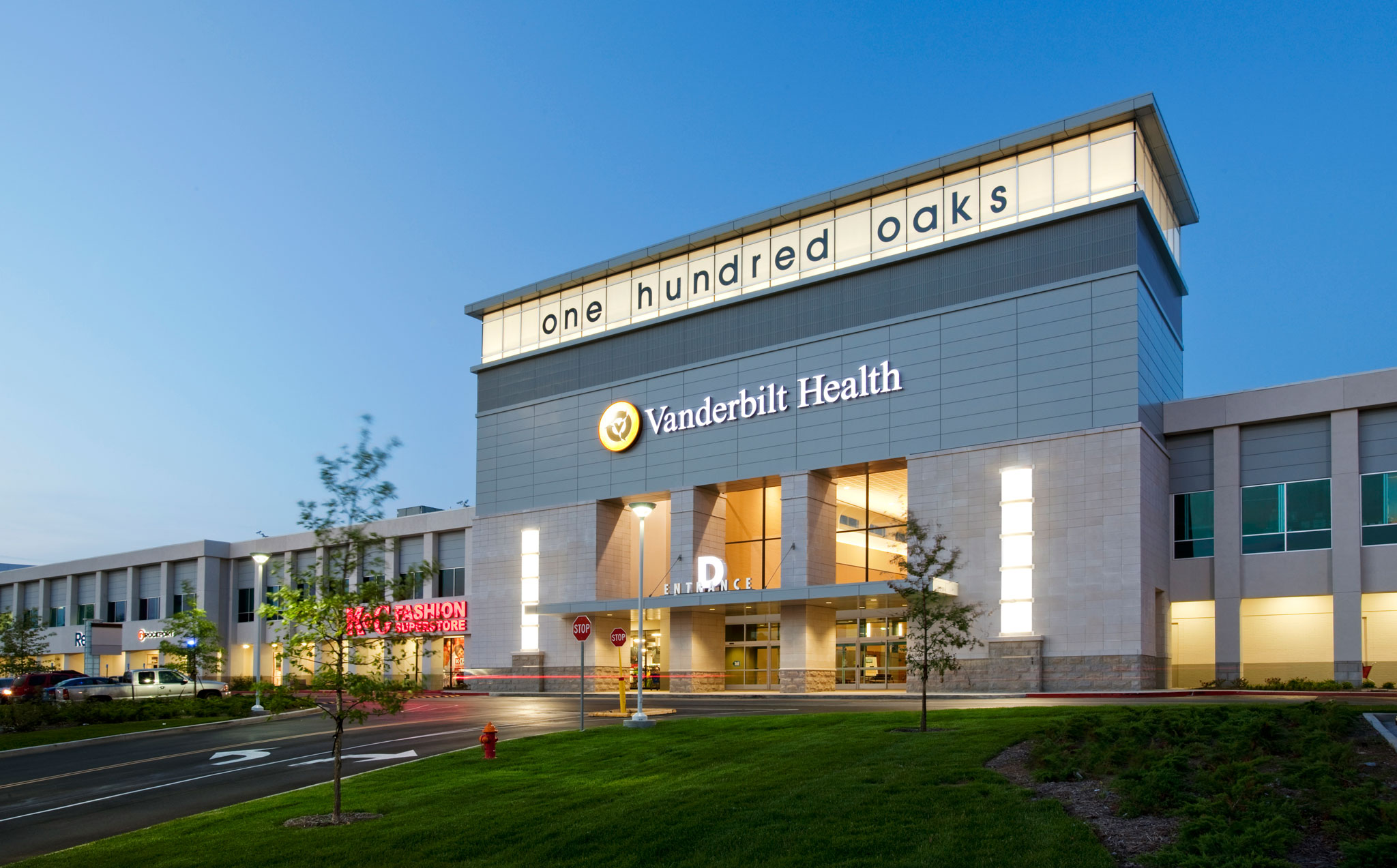
One health system that has taken advantage of available retail space is Vanderbilt University Medical Center (VUMC). Since 2009, VUMC has transformed 450,000 square feet of empty mall space, which formerly housed Reebok and JCPenney stores, into a women’s clinic, dermatology clinic, comprehensive spine clinic, and other specialty sites.

The health system also has several offsite clinics that work with the medical mall and offer telehealth options and free shuttle rides to and from the Monroe Carell Jr. Children’s Hospital and Vanderbilt Medical Center East.

In March, VUMC signed a letter of intent to negotiate a lease for 600,000 square feet in another mall just outside of Nashville and plans to add several new medical facilities there.

“I think that speaks to the success we experienced with our first foray,” said Janice Smith, an RN and VP of adult ambulatory operations at VUMC.

Another health system that has embarked on the “mall-to-medicine” transition is Medical University of South Carolina (MUSC) Health. According to hospital leaders, moving into the mall space makes sense because of its multiple entry points, ample parking, and interstate access.

“There were a lot of big wins for us, and it checked a lot of boxes from a care delivery standpoint,” said Tom Crawford, MUSC Health’s COO.

Originally, MUSC Health planned to break ground on a new piece of land, but then they decided to open new clinics inside of a former mall JCPenney in 2019. “It offered the bones that could be easily flipped into a healthcare facility,” Crawford said.

The facility, which is called the West Ashley Medical Pavilion, now houses an ambulatory surgery center, diagnostic imaging center, and infusion center. MUSC Health has also reached a deal with the mall’s owners to have first right of refusal to adjacent stores if it wants to continue expanding.

This proximity to a shopping mall has proven beneficial for visitors and family members who are waiting for patients. “Because that facility is hooked into the mall, it’s considered the same property,” said Ginger Davis, from Trademark Properties, a real estate company that handles leasing and development planning for Citadel Mall where the West Ashley Medical Pavilion is located. “Instead of having a waiting room full of people, they can go to Target.”

Medical malls have also helped their surrounding communities by generating new foot traffic and business that was not there before. “There’s been this resurgence in that area, and it’s wonderful that any organization can offer that back to the city,” Smith said.

Optum expecting $214B in revenue in 2023

UnitedHealth Group expects Optum to see a long-term double-digit revenue growth rate and bring in a range between $212 billion to $214 billion in 2023 revenues.

The Minnetonka, Minn.-based healthcare giant shared Nov. 29 it projects growth margins of over 20 percent for technology products and low- to mid-single-digit growth for pharmacy care services. 

2023 projections:

Optum Health
Revenues: $91 billion to $92 billion
Earnings: $7.4 billion to $7.6 billion

Optum Insight
Revenues: $18.6 billion to $19.3 billion
Earnings: $4.4 billion to $4.5 billion

OptumRx
Revenues: $105.5 billion to $106.5 billion
Earnings: $4.8 billion to $4.9 billion


UnitedHealth Group expects 2023 revenues of $357 billion to $360 billion, net earnings of $23.15 to $23.65 per share, and adjusted net earnings of $24.40 to $24.90 per share. Cash flows from operations are expected to be $27 billion to $28 billion.

UnitedHealthcare expects 2023 revenues to range from $274 billion to $276 billion. By the end of this year, the payer’s revenues are expected to hit $249.2 billion, up from $222.9 billion in 2021.

JPMorgan wants to bring back 60-minute doctor’s appointments

The demise of Haven — a coalition of three big employers aiming to lower the cost of healthcare for their workers — was met with a surprising reaction from Jamie Dimon, CEO of JPMorgan Chase: “We want to do this again.” 

A Dec. 6 report from Bloomberg details some of the aftermath of Haven’s end and also the origins of Morgan Health, the bank’s second go at lowering healthcare costs that was rolled out in spring 2021. While still in its early stages, one tenet of its strategy is a return to basics, including appointments between clinicians and patients that take at least 30 minutes if not an hour.  

Haven was the healthcare partnership formed in 2018 by Amazon, JPMorgan Chase and Berkshire Hathaway with an aim to lower healthcare costs for their 1.2 million workers. It disbanded in 2021. As its end neared, Mr. Dimon set out to learn what had gone wrong. 

When he asked the question of Bill Wulf, MD, CEO of Central Ohio Primary Care, the internist told the businessman the initiative had moved too slowly. A virtual care program drew in only 150 people in Ohio, for example, before it was scrapped. 

Shortly after the debrief with Dr. Wulf, Mr. Dimon assigned a lieutenant to restart the work on lowering employer healthcare costs, this time focusing on JPMorgan Chase alone. That leader was Peter Scher, vice chairman with the bank, who had his doubts at first. “There are a lot of things we could be spending our time on,” he told Bloomberg. “I was perfectly prepared to go back to Jamie and the operating committee and say, ‘Listen, it was a good try.'” 

Mr. Scher stuck with it and brought on Dan Mendelson, founder and former CEO of healthcare advisory group Avalere Health, to lay the groundwork for JPMorgan’s second healthcare attempt. Mr. Mendelson, who had been a skeptic of Haven, spent three months crafting a strategy and playbook that recognized where Haven had fallen short and avoided repeated mistakes. He signed on to lead the group, dubbed Morgan Health. 

The group has made more headlines since its launch than its predecessor Haven, which premiered with much bravado but went nearly a year without releasing any news except for its name and a new website. In fall 2022, Morgan Health opened three advanced primary care centers in Ohio for a total of five and formed a healthcare venture capital team targeting early- to later-stage healthcare companies with innovations in areas like genetic medicine, autoimmune diseases, cardiometabolic diseases and rare disorders. It also hired Cheryl Pegus, MD, Walmart’s executive vice president of health and wellness, as a managing director.

Morgan Health’s strategy is marked by what appears to be common sense and a return to basics, including the placement of clinics in office building atriums — “a full-service practice where employees can develop long-term relationships with primary-care providers, wellness coaches, mental health providers and care coordinators.” 

All appointments are booked for at least 30 minutes with many going an hour, according to Bloomberg. Patients generally see the same practitioner for each visit to build long-term relationships. Clinicians’ payments are tied to goals like avoiding emergency room visits, providing cancer screenings and keeping high blood pressure in check. If it plays out as designed, JPMorgan says the investment in prevention and primary care will curb high-cost services and hospital stays, ultimately leading to meaningful savings.

The goal is to “​​identify high-risk patients and then bubble-wrap them,” Dr. Wulf told Ohio business leaders in an October meeting, Bloomberg reports. “How do we keep you out of the hospital?”

JPMorgan has opened five clinics in the area of Columbus, Ohio, which will also be open to other employers who want to sign on. The clinics and primary care centers are managed and staffed by Vera Whole Health and Central Ohio Primary Care. JPMorgan is seeking “like-minded” medical groups in markets like New York, Chicago and Dallas where it has hubs of workers, Bloomberg reports. 

Walgreens’ VillageMD inks $9B deal to buy Summit Health, marking largest physician deal of the year

https://www.fiercehealthcare.com/providers/walgreens-villagemd-inks-9b-deal-buy-summit-health-expand-healthcare-footprint

VillageMD, which is majority owned by Walgreens Boots Alliance, plans to shell out nearly $9 billion to pick up medical practice Summit Health, the parent company of urgent care clinic chain CityMD.

The deal, announced Monday morning, is valued at $8.9 billion and includes investments from Walgreens Boots Alliance and Cigna Corp’s healthcare unit Evernorth, which will also become a minority owner in VillageMD. Bloomberg first reported on a potential deal back in late October.

The deal will expand Walgreen’s reach into primary, specialty and urgent care. The transaction creates one of the largest independent provider groups in the U.S., the organizations said. Combined, VillageMD and Summit Health will operate more than 680 provider locations in 26 markets. The two companies will have 20,000 employees.

Walgreens said Monday it will invest $3.5 billion through an even mix of debt and equity to support the acquisition, which is expected to close in the first quarter of 2023. The company will remain the largest and consolidating shareholder of VillageMD with about 53% stake.

Walgreens also raised its fiscal year 2025 sales goal for its U.S. healthcare business to between $14.5 billion and $16 billion from $11 billion to $12 billion previously. That business segment is now expected to achieve positive adjusted EBITDA by the end of fiscal year 2023. 

Last year, Walgreens invested $5.2 billion in VillageMD and said it planned to open at least 600 Village Medical at Walgreens primary-care practices across the country by 2025 and 1,000 by 2027.

The deal comes amid a frenzy of M&A activity in the past two years. Major retailers like CVS, Walgreens and Amazon are ramping up their focus on providing medical services to gain bigger footholds in the healthcare market.

Drugstore rival CVS Health won the bidding war for home health and technology services company Signify Health and plans to shell out $8 billion to acquire the company. Amazon also plans to buy primary care provider One Medical for $3.9 billion.

The M&A move signals that Walgreens wants to become a “dominant entity in the overall healthcare services ecosystem,” according to David Larsen, healthcare IT and digital health analyst at financial services firm BTIG.

“Walgreens Boots Alliance is graduating up from being a drug retail store to owning the life-cycle of members’ health,” he wrote in an analyst’s note. “We view this transaction as being a statement by the market that primary care continues to be one of the key drivers of healthcare long-term.”

The deal also will put additional pressure on CVS Health to break into the primary care business “sooner rather than later,” Larsen wrote. 

“I think at the most strategic level, I think there continues to be recognition that an integrated, coordinated, connected model of care is one that will ultimately deliver the best results. You see this through Optum’s acquisition of Kelsey-Seybold Clinic and VillageMD’s acquisition of Summit Health,” Tim Barry, CEO and chair of VillageMD, said in an interview with Fierce Healthcare.

“If we’re going to ultimately stem the rising tide of this fee-for-service healthcare system, we need a better solution, and that solution needs to have doctors working with other doctors in a coordinated way and trying to solve the unique problems that these patients have and making sure that the right doctors are accessing the patient at the right time, and doing it all underneath the umbrella of a risk-based contract,” Barry said.

He added, “We think that this is going to continue to be where healthcare goes. And, we have to do it in a way that is integrated and value-oriented. Any organization focused on doing that, and doing that at size and scale, is going to continue, I think, to be the successful winners of our healthcare system.”

In 2019, Summit Medical Group, a physician-owned and governed multispecialty group, merged with CityMD, a leading urgent care company in New York City. The combined organization, Summit Health, has more than 370 locations in New Jersey, New York, Connecticut, Pennsylvania and Oregon.

VillageMD provides value-based primary care for patients at traditional free-standing practices, Village Medical at Walgreens practices, at home and via virtual visits. VillageMD and Village Medical have grown to 22 markets and are responsible for more than 1.6 million patients, according to the company.

Barry said the combination of VillageMD and Summit Health-CityMD will enable the organizations to scale up value-based care and build out integrated primary and specialty care services.

“If you look at the long history of Summit Health, it’s an organization that has done some very innovative things. The way that they deliver multispecialty care, it is truly integrated, it’s truly connected and they are known as the preeminent brand in their marketplace. They also have CityMD, which is one of the more unique and differentiated urgent care models out there in the market. They really are a best-of-breed organization,” he said.

“When I look at what we’ve been able to do at VillageMD, we built this incredible model of value-based primary care delivery. The idea of bringing these two organizations together to bring those best-of-breed capabilities under one umbrella was just so compelling. We will soon be able to offer a more comprehensive, integrated and connected model by also offering other specialty services to our patients, but all still done through a value or risk-based reimbursement structure.”

Barry is bullish on the combined capabilities of the two companies in the primary and specialty care markets. 

“We’ll be delivering a consistent value-based model of integrated, multispecialty care in a way that delivers the best clinical results on the planet,” he said.

Jeff Alter, CEO of Summit Health-CityMD, said in a statement that the deal adds Summit Health’s expertise and geographic coverage to VillageMD’s proven value-based primary care approach.

The acquisition also expands Walgreens’ reach into providing medical care directly to patients. “This transaction accelerates growth opportunities through a strong market footprint and wide network of providers and patients across primary, specialty and urgent care,” Roz Brewer, CEO of Walgreens Boots Alliance, said in a statement.

With Cigna’s investment, the combined company will be able to tap into Evernorth’s health services capabilities to potentially lower healthcare costs, Barry said. Evernorth encompasses Cigna’s health services businesses including pharmacy benefit manager Express Scripts  

“In order to be a risk-based provider or a value-based provider, you have to have contracts with a payer that allows you to work in this value or risk-based construct. We learned over the years that Cigna has been a really good partner to us on that journey,” Barry said. 

“There are companies that [Cigna] has purchased over the years that have different specializations and capabilities that we believe ultimately will allow us to deliver better care to our patients,” he noted. “Evernorth has some capabilities tied to behavioral health, and they have some capabilities tied to the management of specialty pharmaceutical spend, which everyone knows those costs continue to be soaring. We both liked the idea of supporting an organization like ours that’s going to continue to grow and continues to be focused on risk and value.”

With the investment in VillageMD and Summit Health, Cigna gets a leg up in the primary care space as it looks to build out its Evernorth division.

“Our collaboration with VillageMD accelerates our efforts to improve the way care is accessed and delivered,” said Eric Palmer, CEO of Evernorth, in a statement. “Harnessing the breadth of Evernorth’s health services capabilities and connecting them with physicians who provide care in a value-based model like VillageMD, helps more people to get the right care at the right time—driving better health and value.” 

More large employers and unions turn to Medicare Advantage to offer retiree health benefits

https://www.fiercehealthcare.com/payers/kff-more-large-employers-and-unions-turn-medicare-advantage-offer-retiree-health-benefits

More and more employer and union-sponsored retiree health plans are offering Medicare-eligible coverage through Medicare Advantage (MA), a new analysis finds. 

The analysis from the Kaiser Family Foundation, released Thursday, comes as MA is expected to surpass traditional Medicare in total enrollment for 2023 and more insurers enter the lucrative market. Employers and unions are turning to MA in a bid to control retiree healthcare costs. 

“For some large employers, the shift to Medicare Advantage appears to be a strategy to maintain benefits for their retirees, without terminating coverage or adopting other changes that more directly shift costs onto retirees,” the analysis said. “However, the shift to Medicare Advantage has implications for retirees that extend beyond supplemental benefits.”

Kaiser relied on data from its 2022 employer health benefits survey of large private and nonfederal public employers. It showed that half of the large employers with 200 or more workers are offering health benefits to retirees through an MA contract, nearly double the 26% doing the same in 2017. Another 44% that offer MA coverage to retirees don’t give them another choice in coverage. 

Among the companies with 2,000 or more employers, 60% offered benefits through an MA plan. The top reason such companies turn to MA is to combat higher costs, with 42% citing it as a reason compared with 14% for flexibility for enrollees. 

Unlike traditional Medicare, MA relies on provider networks and cost management tools to cut down on costs. Kaiser warned that this shift toward MA has some unintended consequences for retirees. 

“This approach has potential to restrict retirees’ access to doctors and hospitals, depending on the plan’s provider network, and subject retirees to cost management tools, such as prior authorization, that may limit access to Medicare-covered services,” the analysis said. 

Kaiser cited a recent move by New York City to move its city worker retirees to an MA plan, a decision that is on hold after the insurers Elevance Health and Empire Blue Cross Blue Shield dropped out, according to a published report on The City news site. 

The MA market has grown in popularity among seniors in recent years. The program has also received heightened scrutiny surrounding overpayments to plans based on inaccurate risk scores and aggressive marketing tactics by agents and brokers.

Will health systems see the usual end-of-year spike in elective care? 

https://mailchi.mp/0622acf09daa/the-weekly-gist-december-2-2022?e=d1e747d2d8

2022 has disproven the old trope that “healthcare is recession-proof”. With the average family deductible nearing $4,000, a significant portion of healthcare services are exposed to consumer concerns about affordability. Reflecting the impact of the recession, health systems nationwide have reported sluggish volumes, particularly for elective cases, in the second half of the year.

One COO recently shared, “We’re 15 percent off where we expected to be on elective cases…We didn’t see the usual pick-up in early fall, after summer vacation. I’m not sure if it’s related to the economy, or whether demand changed during COVID, but this decline has eroded any possibility of a positive margin for the quarter.” The recession hit just as providers mostly finished working through the backlog of cases delayed by COVID in 2020 and 2021. 

To determine whether demand declines are related to the current economic environment, or signal real shifts in care patterns, health systems are looking closely to see if the usual end-of-year swell of demand for elective care materializes, as patients max out their deductibles. But even if the demand is there, some systems are worried about being able to accommodate it: “We’ve been so short-staffed for nurses and surgical techs, we’ve had to intermittently take some ORs and units offline…If we get a big December spike in elective care, I’m not sure we’ll have the staff to accommodate it.” Facing the triple threat of sky-high costs, sluggish demand, and a worsening payer environment, the ability to accommodate this demand will be critical to securing margins as providers move into 2023. 

Many insured Americans still struggle to afford care 

https://mailchi.mp/0622acf09daa/the-weekly-gist-december-2-2022?e=d1e747d2d8

Driven by the steady progress of Medicaid expansion and pandemic-era policies to ensure access to health insurance coverage, the US uninsured rate hit an all-time low of 8 percent in early 2022. Since the Affordable Care Act passed in 2010, the US uninsured rate has been cut in half, with the largest gains coming from Medicaid expansion. 

However, using data from Commonwealth Fund, the graphic below illustrates how this noteworthy achievement is undermined by widespread underinsurancedefined as coverage that fails to protect enrollees from significant healthcare cost burdens. A recent survey of working-age adults found that eleven percent of Americans experienced a coverage gap during the year, and nearly a quarter had continuous insurance, but with inadequate coverage. 

High deductibles are a key driver of underinsurance, with average deductibles for employer-sponsored plans around $2,000 for individuals and $4,000 for families. 

Roughly half of Americans are unable to afford a $1,000 unexpected medical bill. Americans’ healthcare affordability challenges will surely worsen once the federal COVID public health emergency ends, because between 5M and 14M Medicaid recipients could lose coverage once the federal government ends the program that has guaranteed continuous Medicaid eligibility. 

The process of eligibility redeterminations is sure to be messy—while some Medicaid recipients will be able to turn to other coverage options, the ranks of uninsured and underinsured are likely to swell.

More health systems are charging patients to message their physicians

https://mailchi.mp/0622acf09daa/the-weekly-gist-december-2-2022?e=d1e747d2d8

 A growing number of health systems have begun to bill for certain electronic communications with patients via portals like MyChart. The systems instituting these practices, including Cleveland Clinic and Chicago-based Northwestern Medicine, have justified the billing based on the time demands placed on their providers to answer messages involving additional efforts, including extensive patient chart review. Northwestern shared that fewer than one percent of MyChart messages incurred fees, which are typically covered by insurance, and require patient consent before billing. 

The Gist: In a time of significant margin pressure, we understand the instinct to seek additional revenue by collecting whatever reimbursement is available. However, in the ongoing transition to technology-enabled hybrid care, this practice has the potential to confuse, or even drive away, patients, who finally began to embrace virtual provider communication during the pandemic. 

Viewing portal messaging as a “digital front door” for patients, rather than a revenue-generating service in and of itself, may prove more fruitful in the long run.