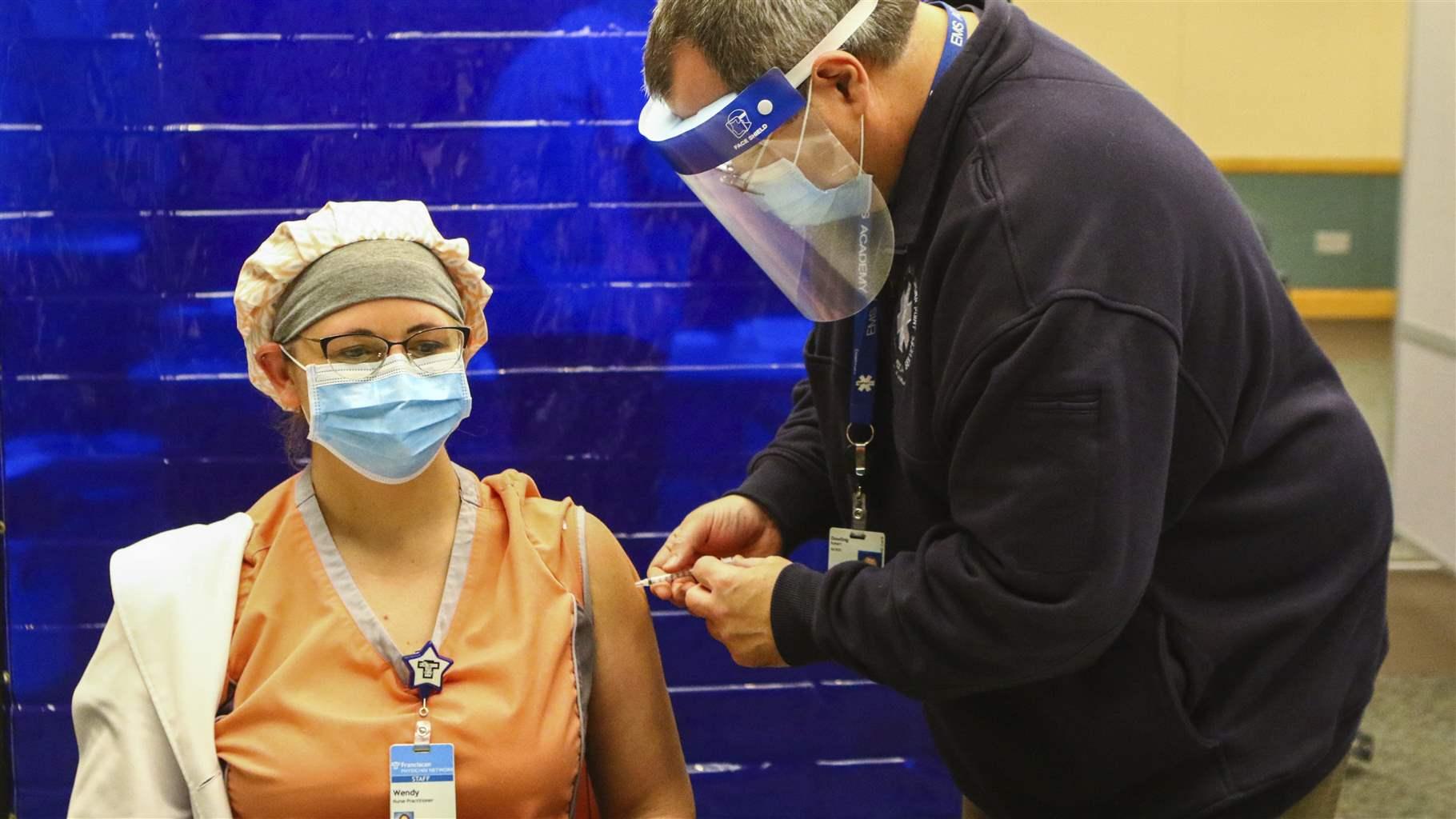
Here’s our personal bellwether for how the Delta variant is impacting health systems:we’ve had three different, in-person leadership retreats cancel across the course of the past week, due to COVID concerns. Three very different parts of the country, on both coasts and in the heartland.
Case counts are up, hospitalizations are up, and clinical leaders are (rightly) becoming more skittish about large, in-person meetings. As many have noted, this latest wave of infections is unevenly distributed across the country, primarily affecting the unvaccinated but also putting vaccinated people at risk of transmitting the virus or becoming ill.
As frequent business travelers who thrive on meeting face-to-face with our members, we had just begun to get comfortable being back out “on the road”—but now that’s changing, too. The recent cancellations are a good reminder that we’re still in a fluid situation in this pandemic, and that being flexible and adaptable will continue to be critical for the foreseeable future. (Thank goodness we’re not in the conference business—that’s got to be a nightmare right now.)
Just as we always check the weather forecast for places we’re traveling to, we’ve started checking the number of cases per 100,000 and the test positivity rate as well—over 10 per 100,000, or over 5 percent, and we’ll think twice about visiting.
And our masks have gone back on. We’ll hope to see you out there soon, but in the meantime—stay safe and get vaccinated!
We’ve been hearing a growing number of stories from patients about difficulties scheduling appointments for specialist consults.
A friend’s 8-year-old son experienced a new-onset seizure and was told that the earliest she could schedule a new patient appointment with a pediatric neurologist at the local children’s hospital was the end of November. Concerned about a five-month wait time after the scary episode, she asked what she should do in the meantime: “They told me if I want him to be seen sooner, bring him to the ED at the hospital if it happens again.”
A colleague shared his frustration after his PCP advised him to see a gastroenterologist. Calling six practices on the recommended referral list, the earliest appointment he could find was nine weeks out; the scheduler at one practice noted that with everyone now scheduling colonoscopies and other procedures postponed during the pandemic, they are busier than they’ve been in years. Recent conversations with medical group leaders confirm a specialist access crunch.
Patients who delayed care last year are reemerging, and ones who were seen by telemedicine now want to come in person. “We are booked solid in almost every specialty, with wait times double what they were before COVID,” one medical group president shared. The spike in demand is compounded by staffing challenges: “I pray every day that another one of our nurses doesn’t quit, because it will take us months to replace them.”
Doctors and hospitals are now seeing a rise in acuity—cancers diagnosed at a more advanced stage, chronic disease patients presenting with more severe complications—due to care delayed by the pandemic. If patients can’t schedule needed appointments and procedures, this spike in severity could be prolonged, or even made worse.
For medical groups who can find ways to open additional access, it’s also an opportunity to capture new business and engender greater patient loyalty.
The number of independent physician practices continued to decline nationwide as health systems, payers, and investors accelerated their physician acquisition and employment strategies during the pandemic.
The graphic above highlights recent analysis from consulting firm Avalere Health and the nonprofit Physicians Advocacy Institute, finding that nearly half of physician practices are now owned by hospital or corporate entities, meaning insurers, disruptors, or other investor-owned companies.
This increase has been driven mainly by a surge in the number of corporate-owned practices, which has grown over 50 percent across the last two years. (Researchers said they were unable to accurately break down corporate employers more specifically, and that the study likelyundercounts the number of practices owned by private equity firms, given the lack of transparency in that segment.)
It’s no surprise that we’re seeing an uptick in physician employment, as about a quarter of physicians surveyed a year ago claimed COVID was making them more likely to sell or partner with other entities, and last year saw independent physicians’ average salary falling below that of hospital-employed physicians.
We expect the move away from private practice will continue throughout this year and beyond, as physicians seek financial stability and access to capital for necessary investments to remain competitive.
On Thursday, the Missouri Supreme Court unanimously reversed a lower court ruling that held that the state’s $1.9B Medicaid expansion, approved by voters in a 2020 ballot initiative, was unconstitutional.
The ruling clears the way for the state’s Department of Social Services to begin implementation of the expansion, which is expected to cover 275,000 low-income Missouri residents. Under the Affordable Care Act (ACA), the federal government will pay 90 percent of the cost to cover the newly eligible Medicaid beneficiaries, along with an additional bump in federal funding for Missouri’s Medicaid program, thanks to a provision in the American Rescue Plan Act passed earlier this year.
Missouri voters approved the expansion by a 53-47 margin last year, but the ballot initiative was held to be unconstitutional because it did not include a source of funding for the portion of coverage costs to be paid for by the state (and the state legislature refused to allocate money for the expansion, despite currently running a surplus). Five other states have turned to ballot initiatives to expand Medicaid under the ACA, seeking to work around state legislatures that have resisted the change. In all, a dozen states, mostly in the Southeast, have chosen not to expand their Medicaid programs, even despite the additional incentives Congress voted into law this year.
Democrats on Capitol Hill are considering legislative alternatives to provide new coverage to low-income residents in those states, as part of the $3.5T reconciliation package currently being negotiated. Numerous studies have shown the positive impact of expanding Medicaid on health and financial well-being, but state-level politics have proven to be a challenge, especially in deep-red states. Meanwhile, tax dollars continue to flow from those states to fund Medicaid expansion elsewhere—now, including Missouri.
Two major policy developments emerged from this week’s release by the Centers for Medicare & Medicaid Services (CMS) of the FY22 proposed rule governing payment for hospital outpatient services and ambulatory surgical centers.
First, CMS proposes todramatically increase the financial penalties assessed to hospitals that fail to adequately reveal prices for their services, a requirement first put in place by the Trump administration. According to a report by the consumer group Patient Rights Advocate, only 5.6 percent of a random sample of 500 hospitals were in full compliance with the transparency requirement six months after the regulation came into effect, with many instead choosing to pay the $300 per hospital per day penalty associated with noncompliance. The new CMS regulation proposes to scale the assessed penalties in accordance with hospital size, with larger hospitals liable for up to $2M in annual penalties, a substantial increase from the earlier $109,500 maximum annual fine. In a press release, the agency said it “takes seriously concerns it has heard from consumers that hospitals are not making clear, accessible pricing information available online, as they have been required to do since January 1, 2021.” In a statement, the AHA stated that it was “deeply concerned” about the proposal, “particularly in light of substantial uncertainty in the interpretation of the rules.” The penalty hike is a clear signal that the Biden administration plans to put teeth behind its new push for more competition in healthcare, which was a major focus of the President’s recent executive order. We’d expect to see most hospitals and health systems quickly move to comply with the transparency rule, given the size of potential penalties.
More heartening to hospitals was CMS’ proposal to roll back changes the Trump administration made, aimed at shifting certain surgical procedures into lower cost, ambulatory settings. The agency proposed halting the elimination of the Inpatient Only (IPO) list, which specifies surgeries CMS will only pay for if they are performed in an inpatient hospital. Citing patient safety concerns, CMS noted that the phased elimination of the IPO list, which began this year, was undertaken without evaluating whether individual procedures could be safely moved to an outpatient setting. Nearly 300 musculoskeletal procedures have already been eliminated from the list, and will now be added back to the list for 2022, keeping the rest of the list intact while CMS undertakes a formal process to review each procedure. Longer term, we’d anticipate that CMS will look to continue the elimination of inpatient-only restrictions on surgeries, as well as pursuing other policies (such as site-neutral payment) that level the playing field between hospitals and lower-cost outpatient providers.
For now, hospitals will enjoy a little more breathing room to plan for the financial consequences of that inevitable shift.
With the Delta variant now accounting for more than 83 percent of all new COVID cases in the US, daily new case counts more than quadrupling across the month of July, and hospitalizations—particularly in states with low vaccination rates—beginning to climb significantly, we appear to have entered a new and uncertain phase of the pandemic, now being dubbed a “pandemic of the unvaccinated”.
Welcome news, then, that this week the American Hospital Association (AHA) publicly encouraged its members to put in place vaccine mandates for their employees. While several large health systems have taken the lead in implementing vaccine mandates, including Trinity Health, the Livonia, MI-based Catholic system that operates hospitals across 22 states, Phoenix, AZ-based Banner Health, Houston Methodist in Texas, and the academic giant NewYork-Presbyterian, others have been more reticent to compel employees to get vaccinated, citing concerns over employee privacy and the potential for workforce backlash.
The New York Timesreports that a quarter of all hospital employees remain unvaccinated nationwide, with many facilities reporting that more than half of their healthcare workers have not gotten the COVID vaccine. In our discussions with health system executives, one consideration frequently cited is the desire for full Food and Drug Administration (FDA) approval of the new vaccines before mandates are put in place.
In a CNN town hall meeting this week, President Biden suggested that approval could come as soon as the end of August, although other reports point to likely approval much later, potentially not until January of next year. Facing a new variant of the virus that is much more transmissible and possibly more virulent than earlier strains, hospitals—and their patients—can’t afford to wait that long.
For safety’s sake, hospitals should quickly put in place vaccine mandates, with appropriate exceptions.






/types-of-doctors-1736311_final-e807c88a56fc45569caa2afde85f71ac.jpg)