How will Covid-19 affect employers’ healthcare costs? It depends, says PwC report

How will Covid-19 affect employers’ healthcare costs? It depends, says PwC report

How will Covid-19 affect employers' healthcare costs? It depends ...

A report by PricewaterhouseCoopers said employer spending on healthcare could increase anywhere from 4% to 10% next year. The report highlighted three potential scenarios depending on what happens with the Covid-19 pandemic.

As the Covid-19 pandemic and resulting economic slowdown strain company budgets, employers are trying to calculate how much they will spend on healthcare next year. Soon, they will be picking health plans for 2021, and the pandemic will certainly go into that calculus.

A new report by PricewaterhouseCoopers attempts to forecast healthcare costs for next year. But there are still lots of unknowns. According to the report, the medical cost trend could increase between 4% and 10% in 2021.

Researchers with PwC’s Health Research Institute interviewed health plan actuaries from 12 national and regional payers over the past three months. The consensus? They were still unsure about the pandemic’s effect on spending now and what it will mean for 2021.

PwC considered three potential scenarios:

  • If healthcare spending remains down in 2021, PwC expects a 4% medical cost trend
  • If spending continues to grow at the same rate that it has from 2014 to 2019, PwC forecasts a 6% medical cost trend
  • If spending increases significantly next year in part due to pent-up demand from delayed care during the pandemic, PwC forecasts a 10% medical cost trend.

Employers are already considering measures to reduce their costs next year. For instance, a growing number are looking at narrow-network plans as a way of negotiating down prices.

“As the pandemic continues and the economic pressures increase, the shift towards narrow network will likely continue and accelerate,” PwC Health Research Institute Leader Ben Isgur wrote in an email.

In particular, large companies with more than 5,000 employees are more likely to consider this strategy, with 25% offering narrow-network plans, according to a 2019 survey by PwC.

Walmart is a recent example. The company began offering “curated physician networks” in Arkansas, Florida and Texas in 2020. In March, the company indicated it would expand on its network strategies.

More companies are also expanding their telehealth services, in part a direct result of the pandemic. While this may not save them money in the short-term — most insurers are currently reimbursing the same for telehealth visits as in-office visits — in the long term, it is expected to reduce costs.

“Employers understand the benefits of telehealth including lower costs, easier access, less time away from work and a good consumer experience,” Isgur wrote. “89 percent of employers surveyed by PwC in spring 2019 offered telemedicine either through their medical vendor or a carve-out vendor, up from 56 percent in 2016. Over the past few months, we have seen telehealth accelerate even faster.”

A couple of ongoing factors could increase spending next year. Employers are adding mental health services to their health plans, and have seen increased demand for those services, especially in light of the pandemic. According to a recent survey by the Health Research Institute, 12% of individuals on employer plans said they had sought mental health services, and another 18% planned to do so.

Specialty drug spending is also expected to drive up costs, as the majority of pharmaceuticals planned for release next year are specialty drugs. This is not a new trend; of companies’ total drug spending, specialty drugs grew from 21% of the total in 2010 to 58% in 2017.

Many patients have delayed care as a result of the pandemic. Even as medical offices begin to offer in-person visits again, volumes are still down. It’s still too early to tell whether that will lead to a surge in spending next year due to postponed — but needed — procedures.

According to PwC, 22% of patients with employer-sponsored insurance have delayed care since March.

“We could see the population risk increase for 2021 if members with chronic conditions are not able to manage their health as effectively in 2020 due to Covid-19,” Amy Yao, senior vice president and chief actuary at Blue Shield of California, told PwC’s Health Research Institute.



500 Delta Airline Staff Test Positive for Coronavirus, 10 Dead

https://www.newsweek.com/500-delta-airline-staff-test-positive-coronavirus-10-dead-1513016

Coronavirus Travel: What Happens to Planes Grounded by Covid-19 ...

Hundreds of staff at Delta Air Lines have tested positive for the novel coronavirus. Ten workers have died after contracting the virus, the company confirmed.

According to a transcript of the company’s latest shareholders meeting held on a phone conference June 18, Delta’s Chief Executive Officer Ed Bastian said: “We have had approximately 500 employees that have tested positive for COVID-19. The vast majority have recovered, thankfully. Unfortunately, we have lost 10 employees to the disease.”

Speaking to Newsweek, a spokesperson for Delta noted the latest tally of infected employees is “inclusive of all positive cases reported to us since March out of our 90,000 employees worldwide.

“Since initial reporting in March, Delta has seen a significant reduction in positive employee COVID-19 tests and is currently tracking at a rate five times lower than the national average.”

Bastian said: “We have recently announced that we are going to be testing all of our employees. In fact, we started this week in Minneapolis for both the blood serology, as to whether they have already been exposed to the disease and have antibodies, as well as the active test to see if they, indeed, are carrying the virus. And that test is being led by Mayo Clinic.”

“And we are also working very closely with Quest Diagnostics in that we will have all 90,000 of our employees available to be tested. And from getting a good baseline, we will be able to provide better protection for our people and then, eventually, certainly, our customers as we go forward,” Bastian confirmed on the call.

It is unknown whether the infected staff members are cabin crew or ground-level workers and which flights they may have been operating. The majority of Delta’s employees are reported to be flight attendants, pilots and airport agents, while less than 10,000 are administrative staff, most of whom are working from home, according to Bastian.

“Given that we are a frontline customer service business, the majority of our employees need to be at work to conduct business,” Bastian said.

On Monday, Delta announced it will resume flights between the U.S. and China. The carrier will operate a service between Seattle and China’s Shanghai Pudong International Airport via South Korea’s Incheon International Airport twice a week from June 25.

From July, the airline will operate weekly flights from Seattle and Detroit to Shanghai, also via Incheon International Airport. Delta is the first U.S. airline to resume services between the U.S. and China since the temporary suspension of flights in February following the outbreak.

Earlier this month, Delta announced it will be suspending flights to 11 U.S. airports from July 8 while “customer volume is significantly reduced,” the carrier confirmed in a statement.

These airports make up five percent of the airline’s domestic operations. “All of these airports will continue to receive service from at least one other carrier after Delta suspends its operations,” the statement added.

The 11 airport locations include Aspen in Colorado (ASE), Bangor in Maine (BGR), Erie, PA (ERI), Flint in Michigan (FNT), Fort Smith in Arkansas (FSM), Lincoln in Nebraska (LNK), New Bern/Morehead/Beaufort in North Carolina (EWN), Peoria in Illinois (PIA), Santa Barbara, California (SBA), Scranton/Wilkes-Barre, Pennsylvania (AVP) and Williston in North Dakota (XWA).

“Delta has announced an 85 percent reduction in our second-quarter schedule, which includes reductions of 80 percent in U.S. domestic capacity and 90 percent internationally,” including service to Canada’s Ottawa International Airport in the province of Ontario which was suspended indefinitely from June 21, the statement confirmed.

Last month, Delta also announced the temporary suspension of operations at airports in locations with “more than one Delta-served airport to allow more frontline employees to minimize COVID-19 exposure risk while customer traffic is low.”

“Delta will continue providing essential service to impacted communities via neighboring airports,” the statement said.

The 10 airports where operations were temporarily suspended include Chicago Midway International Airport (MDW) in Illinois, Oakland International Airport (OAK), Hollywood Burbank Airport (BUR) and Long Beach Airport (LGB) in California, T. F. Green International Airport (PVD) in Rhode Island, Westchester County Airport (HPN) and Stewart International Airport (SWF) in New York, Akron-Canton Airport (CAK) in Ohio, Manchester-Boston Regional Airport (MHT) in New Hampshire and Newport News/Williamsburg International Airport (PHF) in Virginia.

Services at Canada’s Saskatoon International Airport were also temporarily suspended last month.

Delta extended its waiving of change fees and the flexibility to travel through September 30, 2022, to customers with canceled flights through September 2020.

“Eligible customers include those who have upcoming travel already booked between now and September 30 as of April 17, 2020,” and those with “canceled travel on flights between March 2020 and September 2020,” the airline said.

From May 4, Delta has required all passengers to wear a face mask or other appropriate face covering on its flights. Other safety measures introduced include sanitizing all aircraft with electrostatic spraying before departure and disinfecting all high-touch points throughout the aircraft interior.

Aircraft are also equipped with “state-of-the-art air circulation systems with HEPA [high efficiency particulate absorbing] filters that extract more than 99.99 percent of particles, including viruses,” the company said in a statement Monday.

Last week, American Airlines flight crew asked a passenger to disembark a plane after the man refused to wear a mask on board a flight.

In the same week, a survey by the International Air Transport Association (IATA) found that 45 percent of travelers said they would fly within two months after the novel coronavirus is no longer seen as a threat, down from 60 percent in April.

The novel coronavirus, first reported in Wuhan, China, has infected more than 9.2 million people across the globe, including over 2.3 million in the U.S. More than 477,800 have died following infection, while over 4.6 million have reportedly recovered from infection, as of Wednesday, according to the latest figures from Johns Hopkins University.


Houston ICUs at 97 Percent Capacity as Texas Coronavirus Cases Break Records

https://www.newsweek.com/houston-icus-90-percent-capacity-texas-coronavirus-cases-break-records-1513077

Coronavirus Briefing: What Happened Today - The New York Times

Almost all intensive care unit beds at Houston hospitals were occupied on Wednesday as Texas reported a record number of statewide patient admissions related to the novel coronavirus.

During a City Council meeting Wednesday morning, Houston Mayor Sylvester Turner said 97 percent of the city’s ICU beds were filled. A report from the Texas Medical Center (TMC) said 27 percent of those beds were occupied by COVID-19 patients.

According to data published earlier this week by the TMC, a network of health care and research institutions based in Houston, 90 percent of the city’s ICU beds were filled as of Monday. Virus patients accounted for more than one-quarter of those occupancies.

The TMC’s latest report incorporated ICU admission numbers from seven affiliate hospitals in the Houston area: CHI St. Luke’s Health, Harris Health System, Houston Methodist, MD Anderson Cancer Center, Memorial Hermann, Texas Children’s Hospital and University of Texas Medical Branch. The hospitals can collectively admit 1,330 ICU patients at regular capacity, when 70 to 80 percent of total beds are typically occupied, according to the TMC.

The TMC’s Monday report noted that an additional 373 beds could become available under its “sustainable surge” plan, a procedure that would indefinitely increase ICU capacities as needed during the pandemic. Another 504 beds could be added to Houston ICUs under an emergency “unsustainable surge” plan, which the TMC would implement to address a “significant, temporary” influx of patients, according to its report.

Houston’s heightened ICU admissions were reported as cases and hospitalizations related to the coronavirus are spiking throughout Texas. Ongoing data released by the Texas Department of State Health Services show that of all the state’s regions, the Houston area is one of the hardest hit in terms of virus incidence and hospital admissions. The latest DSHS data estimated that 179 ICU beds were available at medical facilities located in the Greater Houston area as of Tuesday afternoon.

The number of patients hospitalized with the virus peaked in Texas on Tuesday, as the DSHS confirmed more than 4,000 current admissions. The state has set new records for hospitalizations related to COVID-19 every day since June 12, when 2,166 patients were reported.

On Monday, the Houston Health Department said hospitalizations due to the virus had increased 177 percent throughout the surrounding county since May 31. It also noted a 64 percent increase in ICU patients who had tested positive for the virus.

Texas also saw its highest daily increase in virus cases on Wednesday, with 5,489 new diagnoses confirmed. The latest single-day record surpassed its previous high of 4,430 new cases reported last Saturday. Cumulative diagnosis data reflected in graphics published by the DSHS show a sharp upturn in cases reported statewide since the start of June, when about 64,800 total cases were confirmed. As of Tuesday afternoon, the number had risen to more than 120,300. The DSHS estimated that roughly 47,400 of those cases remain active.

Businesses in Texas started to reopen at the beginning of May. Although Texas Governor Greg Abbott has not required residents to wear face masks in the state’s public spaces during the reopening process, he did encourage people to do so earlier this week in response to increasing case counts and hospitalizations.

“Wearing a mask will help us to keep Texas open. Not taking action to slow the spread will cause COVID to spread even worse, risking people’s lives and ultimately leading to the closure of more businesses,” he said during a news conference on Monday.


Coronavirus live updates: New York activates quarantine for travelers from hotspots as Florida shatters daily record

https://www.cnbc.com/2020/06/24/coronavirus-live-updates.html?utm_source=&utm_medium=email&utm_campaign=30961

Chart of daily new coronavirus cases in the United States through June 23, 2020.

The coronavirus continues to surge in states around the country, mostly in the South and West. Testifying before members of Congress on Tuesday, White House health adviser Dr. Anthony Fauci said parts of the U.S. are beginning to see a “disturbing surge” and described the overall situation as a “mixed bag” across different regions and states.

  • Global cases: More than 9.29 million
  • Global deaths: At least 478,289
  • U.S. cases: More than 2.34 million
  • U.S. deaths: At least 121,279

The data above was compiled by Johns Hopkins University.

California reports more than 7,000 cases, biggest daily jump so far

3:30 p.m. ET — California reported an additional 7,149 Covid-19 cases since Tuesday, a 69% increase in two days, bringing the state’s total to 190,222 cases, according to the state’s health department.

While the daily case numbers are growing, Gov. Gavin Newsom said that the state performed a record number of tests in the last 24 hours. However, the percent of tests coming back positive has slightly increased in the last two weeks, sitting at 5.1% on a 14-day average, he said.

Hospitalizations from Covid-19 in California have also increased 29% in the last 14 days, totaling 4,095 as of Tuesday, Newsom said.

“We cannot continue to do what we have done over the last number of weeks. Many of us understandably developed a little cabin fever, some I would argue developed a little amnesia, others have frankly taken down their guard,” Newsom said at press briefing. —Noah Higgins-Dunn

The pandemic still hasn’t peaked in the Americas, WHO says

2:30 p.m. ET — Coronavirus outbreaks in the Americas, which include North, South and Central America, haven’t reached their peaks yet, the World Health Organization warned.

Over a third of the new cases reported Tuesday were from five countries in the Americas, according to WHO data. The U.S. reported the most cases and is the worst-hit country in the world with more than 2.3 million cases and at least 121,279 deaths as of Wednesday.

The comment by the WHO came a day after Dr. Anthony Fauci, the United States’ leading infectious disease expert, expressed concern a “disturbing surge” in coronavirus infections as states continue to reopen.

One WHO official said that parts of the Americas had not “reached a low enough level of transmission “with which we can achieve a successful exit of successful and social distancing measures.” —Berkeley Lovelace Jr.

The entrance to the Magic Kingdom at Disney World is seen on the first day of closure as theme parks in the Orlando area suspend operations for two weeks in an effort to curb the spread of the coronavirus (COVID-19). Paul Hennessy/SOPA Images/LightRocket via Getty Images)

1:04 p.m. ET — More than 7,000 people have signed an online petition urging Disney and local government officials to reconsider the reopening of Disney World next month.

The petition comes as coronavirus cases in the state are rapidly rising.

It is difficult to determine how many of the signees of the online petition are actually Walt Disney employees or if the petition is union-backed. There is no mention in the petition itself of any affiliation with an employee union.

“The safety and well being of our cast members and guests are at the forefront of our planning, and we are in active dialogue with our unions on the extensive health and safety protocols, following guidance from public health experts, which we plan to implement as we move toward our proposed, phased reopening,” Disney said in a statement to CNBC. —Sarah Whitten

Florida shatters record for new cases in a day

People wait for a health assessment check-in before entering Jackson Memorial Hospital, as Miami-Dade County eases some of the lockdown measures put in place during the coronavirus disease (COVID-19) outbreak, in Miami, Florida, U.S., June 18, 2020.

12:15 p.m. ET — The Florida Department of Health reported 5,508 new coronavirus cases, surpassing the previous record single-day increase of 4,049 new cases reported on Saturday.

Florida is among a handful of states that includes Arizona and Texas that are experiencing expanding outbreaks of the virus.

As cases continue to rise by the thousands every day in Florida, the percent of total tests coming back positive has also risen. On Wednesday, the state reported that 15.91% of all tests came back positive, up from 10.82%. That increase indicates that the surge in new cases is not due solely to ramped up testing. —Will Feuer

NY, NJ and CT impose quarantine on travelers from hotspot states

11:51 a.m. ET — The governors of New York, New Jersey and Connecticut jointly announced a 14-day quarantine for travelers entering the states from coronavirus hotspots.

The Northeastern bloc of states has successfully combated their own outbreaks, having brought peak infection rates down considerably, and are now worried about visitors reintroducing high transmission rates.

“We worked very hard to get the viral transmission rate down. We don’t want to see it go up because a lot of people come into this region and they can literally bring the infection with them,” New York Gov. Andrew Cuomo said at a press conference with New Jersey Gov. Phil Murphy and Connecticut Gov. Ned Lamont.

The hotspot states included in the advisory so far are: Alabama, Arizona, Arkansas, Florida, North Carolina, South Carolina, Texas, Utah and Washington. —Sara Salinas

New York City Marathon canceled

Lelisa Desisa of Ethiopia crosses the finish line to win the Men's Division during the 2018 TCS New York City Marathon in New York on November 4, 2018.

10:29 a.m. ET — The 2020 TCS New York City Marathon has been canceled amid the ongoing coronavirus pandemic, according to an announcement from the race’s organizers. Scheduled for Nov. 1, the event was supposed to commemorate the 50th running of the marathon.

New York Road Runners, which organizes the race, said the decision was made from a health perspective in partnership with the New York City Mayor’s Office.

“While the marathon is an iconic and beloved event in our city, I applaud New York Road Runners for putting the health and safety of both spectators and runners first,” said Mayor Bill de Blasio in a statement.

NYRR said runners will receive a full refund of their entry fee or complimentary entry for 2021, 2022 or 2023. They will also be invited to participate in a virtual marathon event taking place from Oct. 17 to Nov. 1.

The New York City race is the world’s largest marathon and counted 53,640 finishers in 2019, according to NYRR. —Hannah Miller

More states are reporting increases in new Covid-19 cases as U.S. 7-day average continues to grow

A patient is wheeled into Houston Methodist Hospital as storm clouds gather over the Texas Medical Center, amid the global outbreak of the coronavirus disease (COVID-19), in Houston, Texas, U.S., June 22, 2020.

0:11 a.m. ET — As of Tuesday, the seven-day average of daily new Covid-19 cases in the U.S. increased by more than 32% compared to one week ago, according to a CNBC analysis of data compiled by Johns Hopkins University.

Cases are growing by 5% or more in 30 states across the country, including Arizona, Texas, Montana and Idaho. Since Monday, four more states have seen growth in their 7-day average of daily new cases.

Texas health officials reported an all-time high of 5,489 new cases on Tuesday, surpassing 5,000 cases in a single day. The state has also been seeing record spikes in hospitalizations in recent weeks. As of Tuesday, there are 3,335 people currently hospitalized in Texas based on a 7-day moving average, which is a 49% increase compared with a week ago, according to Covid Tracking Project data.

California also broke its record for daily number of positive cases on Tuesday, adding 6,712 new cases, according to Johns Hopkins data. The state surpassed 6,000 new cases for the first time on Monday. —Jasmine Kim

IMF slashes forecasts for U.S. economy, GDP

9:47 a.m. ET — The International Monetary Fund slashed its economic estimates for global GDP and the U.S. economy amid the ongoing coronavirus pandemic, and warned that governments’ debt levels will continue to soar as they combat the crisis.

The IMF forecast a contraction of 4.9% in global GDP and estimated that the U.S. economy will contract by 8% in 2020, CNBC’s Silvia Amaro reports. The new estimates were downward revisions from what the IMF forecast in April.

The Washington-based institution said the new figures were due to expectations that social-distancing measures will likely remain in place during the second half of 2020, hurting productivity and supply chains.

The Fund also downgraded its 2020 estimates for the euro zone and its GDP forecast for 2021. —Hannah Miller

The U.S. will eclipse its first peak, Dr. Scott Gottlieb says

8:20 a.m. ET — Daily new cases of coronavirus will surpass the country’s first peak in April, former Food and Drug Administration Commissioner Dr. Scott Gottlieb told CNBC.

“We’re going to eclipse the totals in April, so we’ll eclipse 37,000 diagnosed infections a day,” he said on CNBC’s “Squawk Box.” “But in April we were only diagnosing 1 in 10 to 1 in 20 infections, so those 37,000 infections represented probably half a million infections at the peak.“

Since April, the U.S. has significantly ramped up the country’s capacity to test broadly for the virus, including among asymptomatic and pre-symptomatic patients. That means even though confirmed cases will likely peak again, the underlying outbreak probably isn’t as large as it was in April, Gottlieb said.

“The total number of deaths is falling because the total infection burden in the country is a lot lower now than it was in April,” he said. —Will Feuer

Most recent 1 million cases were reported in just a week, WHO says

Chart of global daily new coronavirus cases by region

8:08 am ET — The pandemic is still accelerating, with the most recent 1 million cases being reported in one week, World Health Organization Director-General Tedros Adhanom Ghebreyesus said, according to Reuters.

During a virtual conference on vaccine development and access across the continent, Tedros added that every country in Africa has now developed laboratory capacity to conduct diagnostic testing for the virus.

The virus has sickened more than 9.27 million people around the world and killed at least 477,807 people. There is still no U.S.-approved treatment or vaccine for the disease. —Will Feuer

India reports record single-day spike in cases

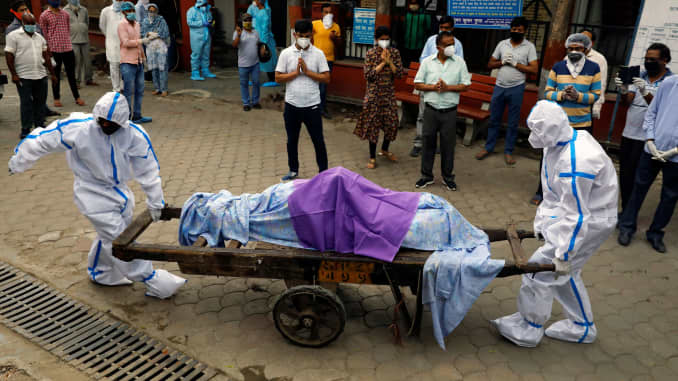
Health workers wearing Personal Protective Equipment (PPE) carry the body of a person who who died due to the coronavirus disease (COVID-19), at a crematorium in New Delhi, India, June 24, 2020.

7:12 a.m. ET — India has reported its highest spike of new cases of infections since the virus took hold in the country of more than 1.3 billion people, according to The Associated Press. 

In 24 hours, the country reported 15,968 new cases and 465 deaths, the AP reported. That means the virus has now infected more than 456,183 people in India, killing at least 14,476, according to data compiled by Johns Hopkins University.

Maharashtra, New Delhi and Tamil Nadu are the hardest-hit states, making up almost 60% of all confirmed cases in the country. New Delhi, in particular, is emerging as a cause for concern in the federal government, the AP reported, due to poor contact tracing infrastructure and limited hospital capacity.

India has the fourth worst coronavirus outbreak in the world, based on total number of confirmed cases, behind only the U.S., Brazil and Russia. —Will Feuer

The EU is discussing reopening its borders, but US citizens could remain barred

A general view of almost desert Pantheon square during Italy's lockdown due to Covid-19 pandemic.

6:51 a.m. ET — The European Union is discussing how to reopen its external borders as the region looks to revive its economies, but visitors from the U.S., and elsewhere, could be barred from entering the bloc for now.

Thirty European countries decided to close their external borders back in March to contain the spread of Covid-19, but that measure is due to be lifted on Tuesday. Representatives of the EU governments are discussing the criteria to lift the travel restrictions from abroad, and at the moment, the main requirement is the coronavirus infection rate in the country of origin.

This means that countries with high rates, such as the United States and Brazil, could remain barred from entering European nations, at least for some time. —Silvia Amaro