Window of Opportunity is Closing for Coronavirus Response

https://www.axios.com/rick-bright-testimony-opening-statement-6817ae7a-5196-4357-b83c-d3ff96990efd.html?stream=health-care&utm_source=alert&utm_medium=email&utm_campaign=alerts_healthcare

Window of opportunity – definition and meaning – Market Business News

A top vaccine doctor who was ousted from his position in April is expected to testify Thursday that the Trump administration was unprepared for the coronavirus, and that the U.S. could face the “darkest winter in modern history” if it doesn’t develop a national coordinated response, according to prepared testimony first obtained by CNN.

The big picture: Rick Bright, the former head of the Biomedical Advanced Research and Development Authority (BARDA), will tell Congress that leadership at the Department of Health and Human Services ignored his warnings in January, February and March about a potential shortage of medical supplies.

  • He will testify that HHS “missed early warning signals” and “forgot important pages from our pandemic playbook” early on — but that “for now, we need to focus on getting things right going forward.”
  • Bright’s testimony also reiterates claims from a whistleblower report he filed last week that alleges he was ousted over his attempts to limit the use of hydroxychloroquine — an unproven drug touted by President Trump — to treat the coronavirus.

What he’s saying: Bright will testify he urged HHS to ramp up production of
masks, respirators and medical supplies as far back as January. Those warnings were dismissed, Bright says, and he was “cut out of key high-level meetings to combat COVID-19.”

  • “I continue to believe that we must act urgently to effectively combat this deadly disease. Our window of opportunity is closing. If we fail to develop a national coordinated response, based in science, I fear the pandemic will get far worse and be prolonged, causing unprecedented illness and fatalities.”

Bright will call for a national strategy to combat the virus, including “tests that are accurate, rapid, easy to use, low cost, and available to everyone who needs them.”

  • “Without clear planning and implementation of the steps that I and other experts have outlined, 2020 will be darkest winter in modern history.”

Read Bright’s prepared statement.


The latest in the U.S.

https://www.axios.com/newsletters/axios-vitals-72173ec6-3383-4391-afbb-a5ed682e5d7a.html?utm_source=newsletter&utm_medium=email&utm_campaign=newsletter_axiosvitals&stream=top

COVID-19 in the U.S.

As of May 12, 2020, 11pm EDT

Deaths       Confirmed Cases

82,376           1,369,574

Trump and some top aides question accuracy of coronavirus death ...


The U.S. will “without a doubt” have more coronavirus infections and deaths in the fall and winter if effective testing, contact tracing and social distancing measures are not scaled up to adequate levels, NIAID director Anthony Fauci testified on Tuesday.

  • He also said that the “consequences could be really serious” for states and cities that reopen without meeting federal guidelines.

Sen. Mitt Romney (R-Utah) criticized the Trump administration’s coronavirus testing coordinator Adm. Brett Giroir at a Senate hearing Tuesday, accusing him of framing U.S. testing data in a politically positive light: “I find our testing record nothing to celebrate whatsoever.”

Millions of Americans are risking their lives to feed us and bring meals, toiletries and new clothes to our doorsteps — but their pay, benefits and working conditions do not reflect the dangers they face at work, Axios’ Erica Pandey reports.

House Democrats released Tuesday their phase 4 $3 trillion coronavirus relief proposal that would provide billions of additional aid to state and local governments, hospitals and other Democratic priorities.

The American Federation of Teachers launched several capstone lesson plans Tuesday to help K-12 teachers measure student progress during school closures and overcome the challenges of a remote learning setting.

Grocery staples in the U.S. cost more in the last month than in almost 50 years, according to new data out Tuesday from the U.S. Bureau of Labor Statistics.

A new study by economists at the University of Illinois, Harvard Business School, Harvard University and the University of Chicago projects that more than 100,000 small businesses have permanently closed since the coronavirus pandemic was declared in March, the Washington Post reports.


Coronavirus likely forced 27 million off their insurance

https://www.axios.com/newsletters/axios-vitals-72173ec6-3383-4391-afbb-a5ed682e5d7a.html?utm_source=newsletter&utm_medium=email&utm_campaign=newsletter_axiosvitals&stream=top

The coronavirus pandemic is hitting Main Street and triggering ...

Roughly 27 million people have likely have lost job-based health coverage since the coronavirus shocked the economy, according to new estimates from the Kaiser Family Foundation.

Why it matters: Most of these people will be able sign up for other sources of coverage, but millions are still doomed to be uninsured in the midst of a pandemic, Axios’ Bob Herman reports.

By the numbers: For the 27 million people who are losing their job-based coverage, about 80% have other options, said Rachel Garfield, a health policy expert at the Kaiser Family Foundation and lead author of the report.

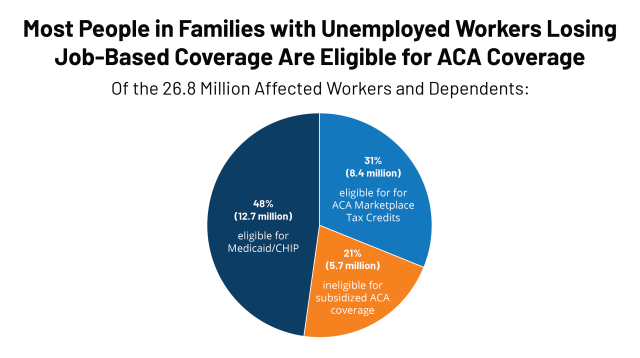
  • Roughly half are eligible for Medicaid or the Children’s Health Insurance Program.
  • Another third are eligible for subsidized health plans on the Affordable Care Act’s marketplaces.
  • The remaining 20% are pretty much out of luck because they live in a state that didn’t expand Medicaid or are ineligible for other kinds of subsidized coverage.
  • House Speaker Nancy Pelosi’s latest coronavirus relief bill would fully subsidize the cost of maintaining an employer plan through COBRA — an option that would otherwise be prohibitively expensive for many people. But that’s a long way from becoming law.

The bottom line: The coronavirus is blowing up health insurance at a time when people need it most.


Eligibility for ACA Health Coverage Following Job Loss

Eligibility for ACA Health Coverage Following Job Loss
Eligibility for ACA Health Coverage Following Job Loss – Methods ...

The economic consequences of the coronavirus pandemic have led to historic level of job loss in the United States. Social distancing policies required to address the crisis have led many businesses to cut hours, cease operations, or close altogether. Between March 1st and May 2nd, 2020, more than 31 million people had filed for unemployment insurance. Actual loss of jobs and income are likely even higher, as some people may be only marginally employed or may not have filed for benefits. Some of these unemployed workers may go back to work as social distancing curbs are relaxed, though further job loss is also possible if the economic downturn continues or deepens.

In addition to loss of income, job loss carries the risk of loss of health insurance for people who were receiving health coverage as a benefit through their employer. People who lose employer-sponsored insurance (ESI) often can elect to continue it for a period by paying the full premium (called COBRA continuation) or may become eligible for Medicaid or subsidized coverage through the Affordable Care Act (ACA) marketplaces. Over time, as unemployment benefits end, some may fall into the “coverage gap” that exists in states that have not expanded Medicaid under the ACA.

In this analysis, we examine the potential loss of ESI among people in families where someone lost employment between March 1st, 2020 and May 2nd, 2020 and estimate their eligibility for ACA coverage, including Medicaid and marketplace subsidies, as well as private coverage as a dependent (see detailed Methods at the end of this brief). To illustrate eligibility as their state and federal unemployment insurance (UI) benefits cease, we show eligibility for this population as of May 2020 and January 2021, when most will have exhausted their UI benefits.

What are coverage options for people losing ESI?

Eligibility for health coverage for people who lose ESI depends on many factors, including income while working and family income while unemployed, state of residence, and family status. Some people may be ineligible for coverage options, and others may be eligible but opt not to enroll. Some employers may temporarily continue coverage after job loss (for example, through the end of the month), but such extensions of coverage are typically limited to short periods.

Medicaid: Some people who lose their jobs and health coverage—especially those who live in states that expanded Medicaid under the ACA— may become newly eligible1 for Medicaid if their income falls below state eligibility limits (138% of poverty in states that expanded under the ACA). For Medicaid eligibility, income is calculated based on other income in the family plus any state unemployment benefit received (though the $600 per week federal supplemental payment available through the end of July is excluded). Income is determined on a current basis, so prior wages for workers recently unemployed are not relevant. In states that have not expanded Medicaid under the ACA, eligibility is generally limited to parents with very low incomes (typically below 50% of poverty and in some states quite a bit less); thus many adults may fall into the “coverage gap” that exists for those with incomes above Medicaid limits but below poverty (which is the minimum eligibility threshold for marketplace subsidies under the ACA). Undocumented immigrants are ineligible for Medicaid, and recent immigrants (those here for fewer than five years) are ineligible in most cases.

Marketplace: ACA marketplace coverage is available to legal residents who are not eligible for Medicaid and do not have an affordable offer of ESI; subsidies for marketplace coverage are available to people with family income between 100% and 400% of poverty. Some people who lose ESI may be newly-eligible for income-based subsidies, based on other family income plus any state and new federal unemployment benefit received (including the $600 per week federal supplement, unlike for Medicaid).2 While current income is used for Medicaid eligibility, annual income for the calendar year is used for marketplace subsidy eligibility. Advance subsidies are available based on estimated annual income, but the subsidies are reconciled based on actual income on the tax return filed the following year. People who lose ESI due to job loss qualify for a special enrollment period (SEP) for marketplace coverage.3 As with Medicaid, undocumented immigrants are ineligible for marketplace coverage or subsidies. However, recent immigrants, including those whose income makes them otherwise eligible for Medicaid, can receive marketplace subsidies.

ESI Dependent Coverage: People who lose jobs may be eligible for ESI as a dependent under a spouse or parent’s job-based coverage. Some people may have been covered as a dependent prior to job loss, and some may switch from their own coverage to coverage as a dependent.

COBRA: Many people who lose their job-based insurance can continue that coverage through COBRA, although it is typically quite expensive since unemployed workers generally have to pay the entire premium – employer premiums average $7,188 for a single person and $20,576 for a family of four – plus an additional 2%. People who are eligible for subsidized coverage through Medicaid or the marketplaces are likely to opt for that coverage over COBRA, though COBRA may be the only option available to some people who are income-ineligible for ACA coverage.

Short-term plans: Short-term plans, which can be offered for up to a year and can sometimes be renewed under revised rules from the Trump administration, are also a potential option for people losing their employer-sponsored insurance. These plans generally carry lower premiums than COBRA or ACA-compliant coverage, as they often provider more limited benefits and usually deny coverage to people with pre-existing conditions. Even when coverage is issued, insurers generally may challenge benefit claims that they believe resulted from pre-existing medical problems; given the long latency between initial infection and sickness with COVID-19, these plans are riskier than usual during the current pandemic. People cannot use ACA subsidies toward short-term plan premiums.

Our analysis examines eligibility for Medicaid, marketplace subsidies, and dependent ESI coverage. We do not estimate enrollment in COBRA, short-term plans, or temporary continuation of ESI. See Methods for more details.

How does coverage and eligibility change following job loss?

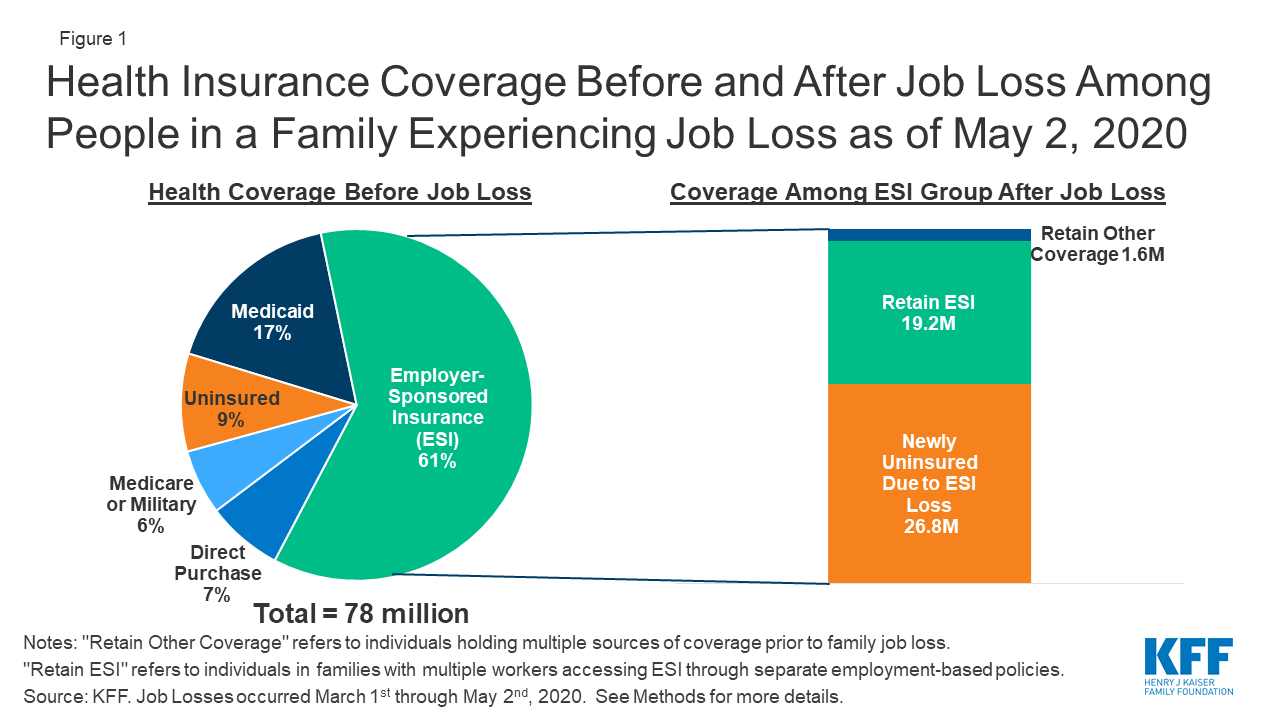
Between March 1st, 2020 and May 2nd, 2020, we estimate that nearly 78 million people lived in a family in which someone lost a job. Most people in these families (61%, or 47.5 million) were covered by ESI prior to job loss. Nearly one in five (17%) had Medicaid, and close to one in ten (9%) were uninsured. The remaining share either had direct purchase (marketplace) coverage (7%) or had other coverage such as Medicare or military coverage (6%) (Figure 1).
Eligibility for ACA Health Coverage Following Job Loss | The Henry ...

We estimate that, as of May 2nd, 2020, nearly 27 million people could potentially lose ESI and become uninsured following job loss (Figure 1). This total includes people who lost their own ESI and those who lost dependent coverage when a family member lost a job and ESI. Additionally, some people who otherwise would lose ESI are able to retain job-based coverage by switching to a plan offered to a family member: we estimate that 19 million people switch to coverage offered by the employer of a working spouse or parent. A very small number of people who lose ESI (1.6 million) also had another source of coverage at the same time (such as Medicare) and retain that other coverage. These coverage loss estimates are based on our assumptions about who likely filed for UI as of May 2nd, 2020 and the availability of other ESI options in their family (see Methods for more detail).

Among people who become uninsured after job loss, we estimate that nearly half (12.7 million) are eligible for Medicaid, and an additional 8.4 million are eligible for marketplace subsidies, as of May 2020 (Figure 2). In total, 79% of those losing ESI and becoming uninsured are eligible for publicly-subsidized coverage in May. Approximately 5.7 million people who lose ESI due to job loss are not eligible for subsidized coverage, including almost 150,000 people who fall into the coverage gap, 3.7 million people ineligible due to family income being above eligibility limits, 1.3 million people who we estimate have an affordable offer of ESI through another working family member, and about 530,000 people who do not meet citizenship or immigration requirements. We project that very few people fall into the coverage gap immediately after job loss (as of May 2020) because wages before job loss plus unemployment benefits (including the temporary $600 per week federal supplement added by Congress) push annual income for many unemployed workers in non-expansion states above the poverty level, making them eligibility for ACA marketplace subsidies for the rest of the calendar year.
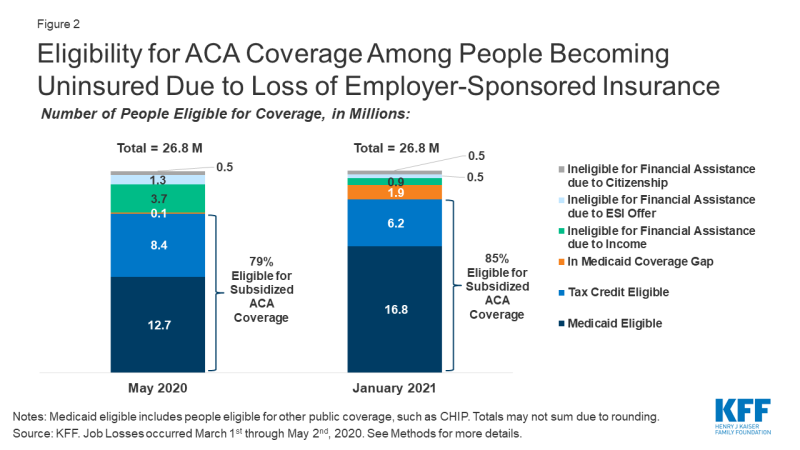
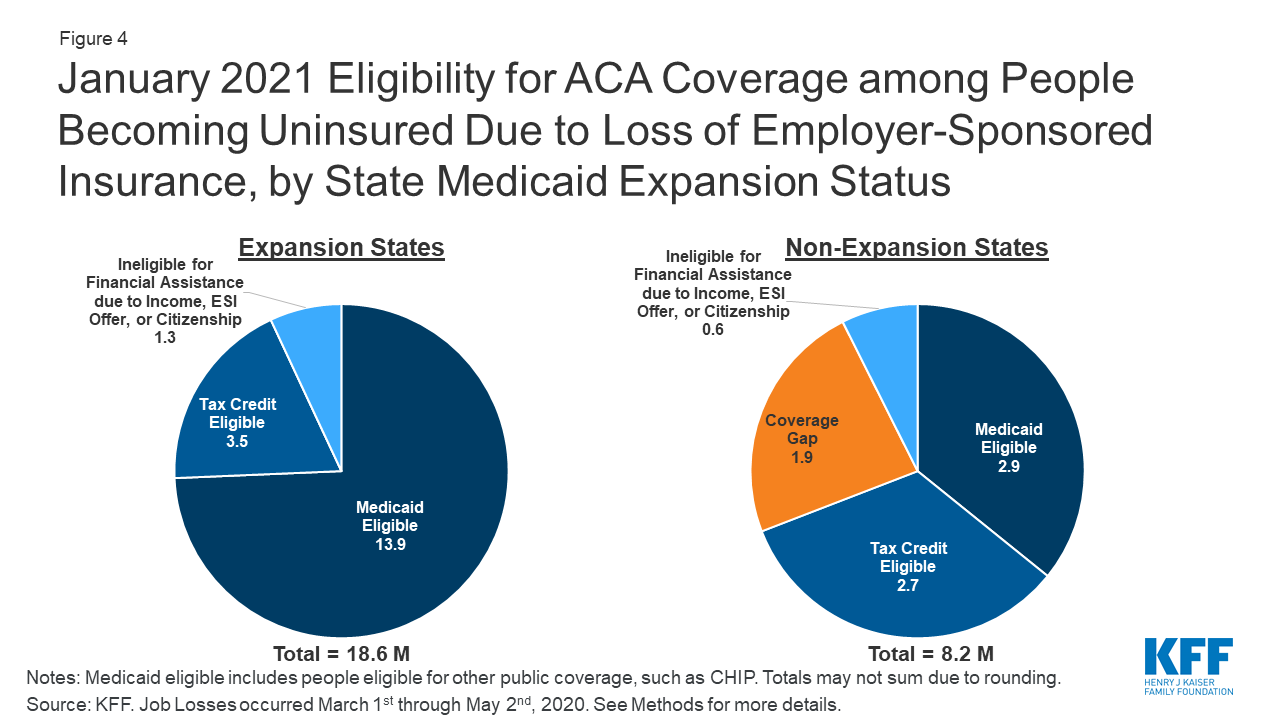
By January 2021, when UI benefits cease for most people, we estimate that eligibility shifts to nearly 17 million being eligible for Medicaid and about 6 million being eligible for marketplace subsidies (Figure 2), assuming those who are recently unemployed have not found work. Many unemployed workers who are eligible for ACA marketplace subsidies during 2020 would instead be eligible for Medicaid or fall into the coverage gap during 2021. The number in the coverage gap grows to 1.9 million (an increase of more than 80% of its previous size), and the number ineligible for coverage due to income shrinks to 0.9 million.

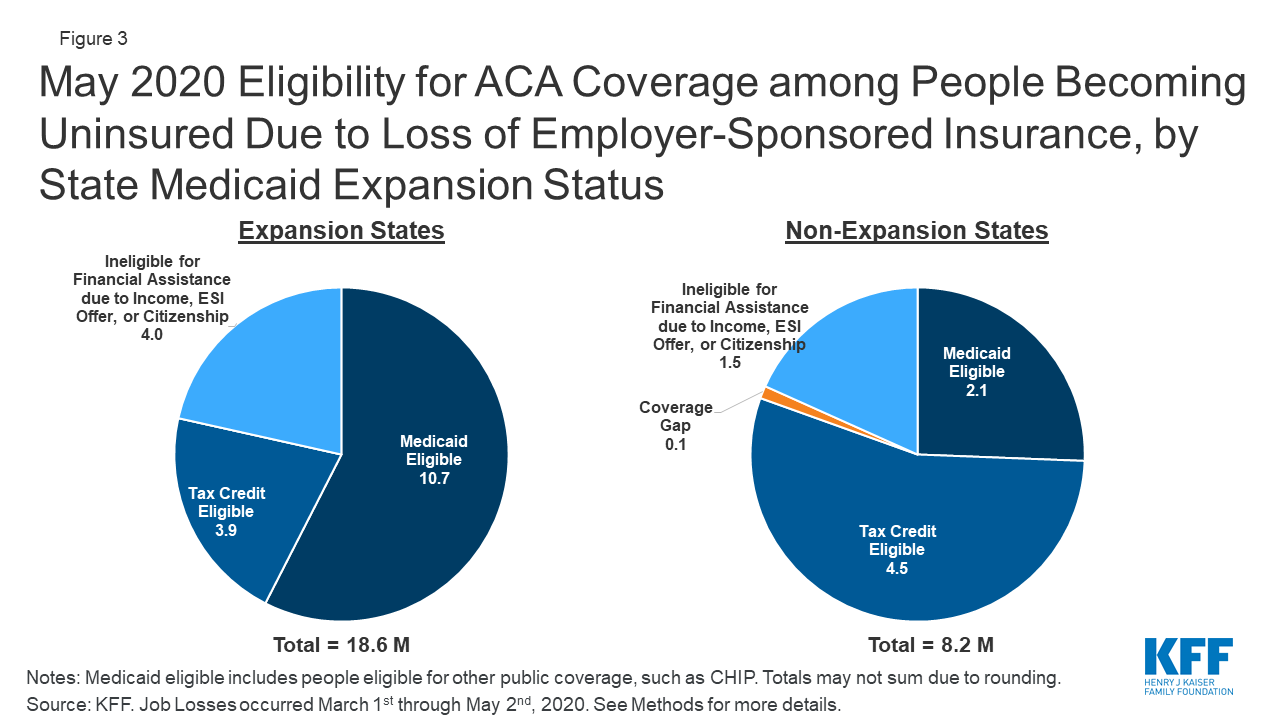
Estimates of coverage loss and eligibility vary by state, depending largely on underlying state employment by industry and Medicaid expansion status. Not surprisingly, states in which the largest number of people are estimated to lose ESI are large states with many people working in affected industries (Appendix Table 1). Eight states (California, Texas, Pennsylvania, New York, Georgia, Florida, Michigan, and Ohio) account for just under half (49%) of all people who lose ESI. Five of the top eight states have expanded Medicaid, and people eligible for Medicaid among the potentially newly uninsured as of May 2020 in these five states account for 40% of all people in that group nationally. Overall, patterns by state Medicaid expansion status show that people in expansion states are much more likely to be eligible for Medicaid, while those in non-expansion states are more likely to qualify for marketplace subsidies (Figure 3). However, the number of people qualifying for marketplace subsidies is similar across the two sets of states, as more people live in expansion states. Three states that have not expanded Medicaid, including Texas, Georgia, and Florida, account for 30% of people who become marketplace tax credit eligible nationally in May 2020. Assuming unemployment extends into 2021 when UI benefits would likely expire for most families, the proportion eligible for Medicaid would increase in expansion states while non-expansion states may see more nonelderly adults moving into the Medicaid coverage gap (Figure 4; Appendix Table 2).
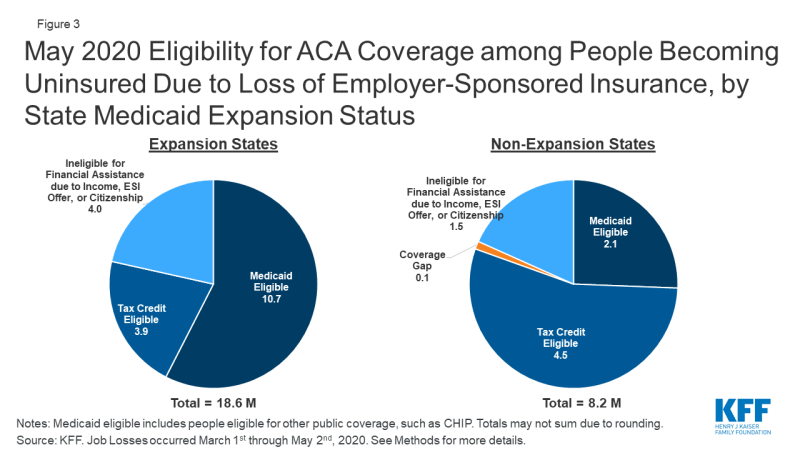
Figure 3: May 2020 Eligibility for ACA Coverage among People Becoming Uninsured Due to Loss of Employer-Sponsored Insurance, by State Medicaid Expansion Status
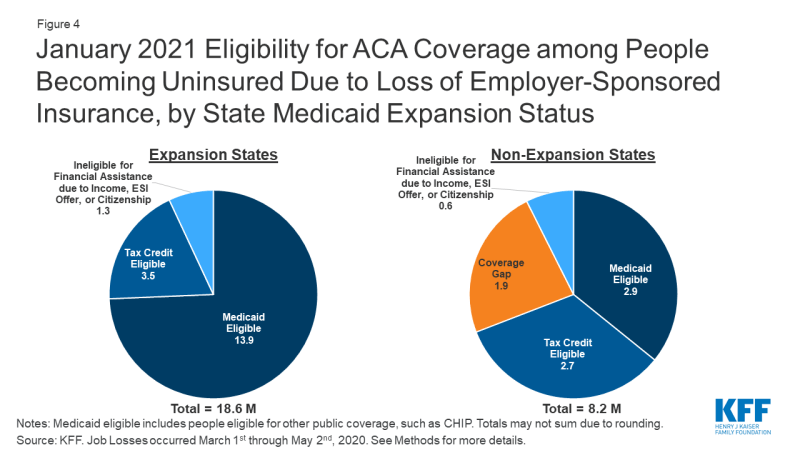
Figure 4: January 2021 Eligibility for ACA Coverage among People Becoming Uninsured Due to Loss of Employer-Sponsored Insurance, by State Medicaid Expansion Status

Nearly 7 million people losing ESI and becoming uninsured are children, and the vast majority of them are eligible for coverage through Medicaid or CHIP. Within the 26.8 million people losing ESI and becoming uninsured in May 2020, 6.1 million are children. Because Medicaid/CHIP income eligibility limits for children are generally higher than they are for adults, the vast majority of these children are eligible for Medicaid/CHIP in May 2020 (5.5 million, or 89%) or January 2021 (5.8 million, or 95%).

Discussion

Given the health risks facing all Americans right now, access to health coverage after loss of employment provides important protection against catastrophic health costs and facilitates access to needed care. Unemployment Insurance filings continue to climb each week, and it is likely that people will continue to lose employment and accompanying ESI for some time, though some of them will return to work as social distancing curbs are loosened. The ACA expanded coverage options available to people, and we estimate that the vast majority of people who lose ESI due to job loss will be eligible for ACA assistance either through Medicaid or subsidized marketplace coverage. However, some people will fall outside the reach of the ACA, particularly in January 2021 when UI benefits cease for many and some adults fall into the Medicaid coverage gap due to state decisions not to expand coverage under the ACA.

Both ACA marketplace subsidies and Medicaid are counter-cyclical programs, expanding during economic downturns as people’s incomes fall. In return for additional federal funding to help states finance their share of Medicaid cost during the public health crisis, states must maintain eligibility standards and procedures that were in effect on January 1, 2020 and must provide continuous eligibility through the end of the public health emergency, among other requirements. These provisions may help eligible individuals enroll in and maintain Medicaid, particularly in light of state and federal actions prior to the crisis to increase eligibility verification requirements or transition people off Medicaid.

Our estimates only examine eligibility among people who lost ESI due to job loss and potentially became uninsured. Additional uninsured individuals—including some of the 9% of the 78 million individuals in families where someone lost employment—may also be eligible for Medicaid or subsidized coverage. It is possible that contact with state UI systems may lead them to seek and enroll in coverage, even if they were eligible for financial assistance before job loss but uninsured.

It is unclear whether people losing ESI and becoming uninsured will enroll in new coverage. We did not estimate take-up or enrollment in coverage options but rather only looked at eligibility for coverage. Even before the coronavirus crisis, there were millions of people eligible for Medicaid or marketplace subsidies who were uninsured. Eligible people may not know about coverage options and may not seek coverage; others may apply for coverage but face challenges in navigating the application and enrollment process. Still others may find marketplace coverage, in particular, unaffordable even with subsidies. As policymakers consider additional efforts to aid people, expanding outreach and enrollment assistance, which have been reduced dramatically by the Trump Administration, could help people maintain coverage as they lose jobs.

This is the first economic downturn during which the ACA will be in place as a safety net for people losing their jobs and health insurance. The Trump Administration is arguing in case before the Supreme Court that the ACA should be overturned; a decision is expected by next Spring. The ACA has gaps, and for many the coverage may be unaffordable. However, without it, many more people would likely end up uninsured as the U.S. heads into a recession.


Cartoon – Market Cure

Cartoon – Your tumor is still growing | HENRY KOTULA

Cartoon – U.S Healthcare Options

Cartoon – US Healthcare Options | HENRY KOTULA

Trump will urge Supreme Court to strike down Obamacare

https://www.politico.com/news/2020/05/06/trump-supreme-court-obamacare-240366?utm_source=The+Fiscal+Times&utm_campaign=f343554e9c-EMAIL_CAMPAIGN_2020_05_06_09_42&utm_medium=email&utm_term=0_714147a9cf-f343554e9c-390702969

Trump will urge Supreme Court to strike down Obamacare - YouTube

Attorney General Bill Barr had urged the White House to soften its attack on the law during the pandemic.

President Donald Trump on Wednesday said his administration will urge the Supreme Court to overturn Obamacare, maintaining its all-out legal assault on the health care law amid a pandemic that will drive millions of more Americans to depend on its coverage.

The administration appears to be doubling down on its legal strategy, even after Attorney General William Barr this week warned top Trump officials about the political ramifications of undermining the health care safety net during the coronavirus emergency.

Democrats two years ago took back the House of Representatives and statehouses across the country by promising to defend Obamacare, in particular its insurance protections that prevent sick people from being denied coverage or charged more because of a health condition. The issue may prove to be even more salient in November amid the Covid-19 outbreak that health experts believe will persist through the fall.

The Justice Department had a Wednesday deadline to change its position in a case brought by Republican-led states, but Trump told reporters Wednesday afternoon his administration would stand firm. DOJ declined to comment.

“Obamacare is a disaster, but we’ve made it barely acceptable,” Trump said.

The Supreme Court later this fall will hear a lawsuit from the GOP-led states that argue the Affordable Care Act was rendered invalid after Congress eliminated its tax penalty for not having health insurance. A coalition of Democratic state attorneys general and the Democratic-led House of Representatives are defending the law in court.

The Trump administration had previously shifted its legal position in this case, but appears to have decided against doing so again. DOJ originally argued the courts should throw out just Obamacare’s preexisting condition protections, before last year urging that the entire law be struck down.

The Supreme Court is expected to hear the case during its next term starting in October, but it hasn’t scheduled arguments yet. A decision is unlikely before the Nov. 3 election. The court has previously upheld Obamacare in two major challenges that threatened the law’s survival.

About 20 million people have been covered by Obamacare, and the law is expected to provide a major safety net during the economic freefall brought on by the coronavirus. Millions more are expected to join the Medicaid rolls, especially in states that joined Obamacare’s expansion to poor adults. Others who lost workplace health insurance can sign up on the law’s health insurance marketplaces, though the Trump administration isn’t doing much to advertise coverage options.

House Democrats in a filing to the Supreme Court on Wednesday said the pandemic showcased why justices should preserve the law.

“Although Congress may not have enacted the ACA with the specific purpose of combatting a pandemic, the nation’s current public-health emergency has made it impossible to deny that broad access to affordable health care is not just a life-or death matter for millions of Americans, but an indispensable precondition to the social intercourse on which our security, welfare, and liberty ultimately depend,” their brief read.

Obamacare has grown more popular since the GOP’s failed repeal bid during Trump’s first year in office, though the law is still broadly disliked by Republicans. Many Democrats are eager to again run on their defense of Obamacare this fall. That includes presumptive presidential nominee Joe Biden, who has advocated for building on the health care law rather than pursuing a comprehensive progressive overhaul like “Medicare for All.”

Top Trump officials have long been split on the legal strategy in the Obamacare lawsuit. Barr and Alex Azar, the Health and Human Services secretary, both opposed a broader attack on the law, but White House officials have been more supportive, seeing it as a chance to fulfill Trump’s pledge to repeal Obamacare. Barr, in a Monday meeting with Vice President Mike Pence and other White House officials, made an eleventh-hour plea for the administration to soften its legal stance ahead of the Supreme Court’s briefing deadline.


States cut Medicaid as millions of jobless workers look to safety net

https://www.politico.com/amp/news/2020/05/05/states-cut-medicaid-programs-239208?utm_source=The+Fiscal+Times&utm_campaign=f343554e9c-EMAIL_CAMPAIGN_2020_05_06_09_42&utm_medium=email&utm_term=0_714147a9cf-f343554e9c-390702969

Medicaid Cuts Could Hurt Seniors Most | Muskegon Tribune

Three states have cut back state spending on the program since the pandemic hit, and more are warning of painful cuts to benefits and services.

States facing sudden drops in tax revenue amid the pandemic are announcing deep cuts to their Medicaid programs just as millions of newly jobless Americans are surging onto the rolls.

And state officials are worried that they’ll have to slash benefits for patients and payments to health providers in the safety net insurance program for the poor unless they get more federal aid.

State Medicaid programs in the previous economic crisis cut everything from dental services to podiatry care — and reduced payments to hospitals and doctors in order to balance out spending on other needs like roads, schools and prisons. Medicaid officials warn the gutting could be far worse this time, because program enrollment has swelled in recent years largely because of Obamacare’s expansion.

The looming crisis facing Medicaid programs “is going to be the ’09 recession on steroids,” said Matt Salo, head of the National Association of Medicaid Directors. “It’s going to hit hard, and it’s going to hit fast.”

Medicaid programs, among the largest budget items in most states, provide health insurance to roughly 70 million poor adults, children, the disabled and pregnant women. The federal government on average pays roughly 60 percent of program costs, with poorer states receiving a higher share. States have the latitude to adjust benefits, payments to health care providers and eligibility requirements with oversight by the federal government.

Now, governors are turning to Congress for help as it weighs a new package to rescue state budgets battered by the pandemic. They’re asking lawmakers to provide a bigger boost to Medicaid payments and provide hundreds of billions of dollars in aid to shore up state budgets.

Medicaid naturally faces heightened demand as economic conditions worsen. But that leaves states facing more need at the same time that they have less money.

“The cruel nature of the economic downturn is that at a time when you need a social safety net is also the time when government revenues shrink,” Ohio Gov. Mike DeWine, a Republican, said Tuesday as he announced $210 million in cuts to his state’s Medicaid program in the next two months.

The vast majority of a $229 million spending cut made by Colorado Democratic Gov. Jared Polis last week came from Medicaid, though new federal funds will forestall an immediate reduction in benefits or payments to health providers. State legislative committee staff have warned Medicaid enrollment there could spike by 500,000 by the end of the year.

In Georgia, where Medicaid enrollment is projected to rise by as much as 567,000, Republican Gov. Brian Kemp and legislative leaders have instructed every state agency to prepare for 14 percent reductions across the board.

House Democrats are pushing to deliver a $1 trillion-plus package in aid to state and local governments and to support safety net programs, which could alleviate pressure on states to make deep cuts to health care during a pandemic. Some Republican lawmakers have questioned the need for more aid, after Congress has shoveled out trillions of dollars in rescue funding.

Congress already gave states a temporary 6 percent increase in the federal portion of Medicaid spending in an earlier coronavirus package. That prompted Alaska Gov. Mike Dunleavy, a Republican, to cut state Medicaid spending $31 million last month, saying the temporary federal boost would make up the difference.

State officials largely agreed the increase was helpful but said it likely will be washed out by an expected enrollment surge. The nation’s governors say Congress — in addition to providing at least $500 billion in direct support to states — must double the Medicaid funding boost to 12 percent as it did in the previous recession. At least one Republican senator facing a tough reelection fight, Cory Gardner of Colorado, said his state sorely needs extra Medicaid funding to avoid “harmful budget cuts.”

Anywhere from 11 million to 23 million more people could sign up for Medicaid over the next several months. The demand will be even greater in roughly three-quarters of states that expanded Medicaid enrollment to poor adults under the Affordable Care Act.

The portion of state budgets devoted to Medicaid spending has grown quickly since the previous recession, making it a riper target for cuts. Medicaid spending on average accounted for 15.7 percent of state budgets in fiscal 2009, a number that jumped to 19.7 percent in fiscal 2019.

Medicaid enrollment data in some states often lags, making it difficult to determine how much national sign-ups have climbed since jobless claims began surging two months ago. Some states have begun to report notable surges, however, and larger increases are expected in the coming months.

Arizona in the past two months saw 78,000 people enroll in Medicaid and the Children’s Health Insurance Program, which receives more generous funding from the federal government. Virginia has seen a 20 percent increase in enrollment applications since mid-March.

In New Mexico, where 42 percent of the population was already enrolled in Medicaid, sign-ups in the first two weeks of April surged by about 10,000 more people than were expected before the pandemic.

New Mexico’s top Medicaid official said the budget is a significant concern for a state heavily reliant on oil and natural gas. She worries a prolonged economic downturn could force the state to roll back pay increases to Medicaid providers enacted last year, and another planned pay raise for next year is almost certainly off the table.

States that accepted the temporary Medicaid payment increase from Congress are barred from cutting back enrollment while they’re receiving the enhanced funds. That leaves states with the option of cutting benefits or provider payments to find Medicaid savings, which could ignite fierce brawls in state capitals.

Michigan state Rep. Mary Whiteford, the Republican chairwoman of a health care appropriations panel, said the state’s Medicaid enrollment could increase from 2.4 million to 2.8 million by the end of the year.

“We are just planning for major cuts moving forward,” Whiteford said.

Before the pandemic, states had socked away $72 billion in rainy day funds — an all-time high, said Brian Sigritz of the National Association of State Budget Officers. But that figure was easily dwarfed by the $150 billion Congress provided to state and local governments in an earlier package, and it’s far short of what states are demanding.

“Now, we’re looking at greater declines than what we saw during the Great Recession and increased spending,” Sigritz said. “If there aren’t more federal funds, states will have to look at cutting funding for key services: public safety, education, health care. That’s where the money is.”


Barr urges Trump administration to back off call to fully strike down Obamacare

https://www.cnn.com/2020/05/05/politics/william-barr-obamacare-supreme-court/index.html?fbclid=IwAR0H0M_pTi9V9W4iEAqWTWKJzopzznh6202z0FgsMbthJS7oS-pDowVGc3M

Barr urges Trump administration to back off call to fully strike ...

Attorney General William Barr made a last-minute push Monday to persuade the administration to modify its position in the Obamacare dispute that will be heard at the Supreme Court this fall, arguing that the administration should pull back from its insistence that the entire law be struck down.

With a Wednesday deadline to make any alterations to its argument looming, Barr made his case in a room with Vice President Mike Pence, White House counsel Pat Cipollone, members of the Domestic Policy Council, press secretary Kayleigh McEnany and several other officials. The meeting ended without a decision and it was not immediately not clear if any shift in the Trump administration’s position will emerge.
Barr and other top advisers have argued against the hard-line position for some time, warning it could have major political implications if the comprehensive health care law appears in jeopardy as voters head to the polls in November.
According to four sources familiar with the meeting, Barr argued for modifying the administration’s current stance to preserve parts of the law, rather than fully back the lawsuit filed by a group of Republican states. As it stands now, the Trump administration’s position seeks to invalidate the entire Affordable Care Act, signed by President Barack Obama in 2010 and commonly known as Obamacare.
Barr and Health and Human Services Secretary Alex Azar have argued against supporting invalidating the law in full, engaging in a heated debate on this point with then-acting White House chief of staff Mick Mulvaney and policy officials allied with him, CNN reported last year. But Barr and others have recently brought an additional dimension to their efforts, highlighting the coronavirus pandemic that has swept the nation. If the justices were to accept the Trump administration position, its decision could cause substantial disruptions to the health care of millions of Americans and cause the uninsured rate to spike.
The Affordable Care Act is expected to serve as an important safety net for the millions of people who lose their jobs and work-based health insurance amid the pandemic. If the unemployment rate hits 15%, nearly 17.7 million Americans could lose their employer-sponsored policies, according to a recent Urban Institute report. More than 8 million people could enroll in Medicaid, particularly in states that expanded the program to more low-income adults under the sweeping health care law. Also, more than 4 million people could obtain coverage through the Affordable Care Act exchanges or other private policies, leaving just over 5 million uninsured, the report found.
Even before the pandemic, more than 11.4 million people signed up for Obamacare coverage for 2020 and roughly 12.5 million were enrolled in Medicaid expansion.
Trump’s domestic policy aides have resisted any change in the Trump administration’s legal arguments at this point, contending that the legal position should move forward without changes because Republicans have campaigned on repealing Obamacare for a decade. Those aides have brushed off the possibility of any new political repercussions, and pushed back on Barr in the meeting Monday.
The Justice Department declined to comment.
The divide has been a long-running battle inside the administration, but it has a new sense of urgency because the administration is up against a deadline on Wednesday if it wants to modify its argument.
The administration currently contends that the individual insurance requirement is unconstitutional, and because that mandate is tied to other provisions of the law, the entire Affordable Care Act must fall. If the administration is going to back off that absolute position, it would likely submit a filing to the Supreme Court within the next 48 hours, based on the court’s current briefing schedule for the dueling parties. Otherwise, the administration’s brief would not be due to the high court until June.
Barr has long favored tempering the administration’s position, which has shifted multiple times since the lawsuit began in early 2018. The administration argued that only two key provisions that protect Americans with pre-existing conditions should fall, but the rest of the law could remain. In a dramatic reversal soon after Barr became attorney general in early 2019, the Justice Department said the entire Affordable Care Act should be invalidated. Several months later, the administration argued before a federal appeals court that the law should only be struck as it applies to the coalition of Republican-led states that brought the challenge.
The argument that the entire law should be struck down already might have been a tough one to make to a Supreme Court majority that has twice rejected broad-scale challenges.
After a decade, the Affordable Care Act has affected nearly every aspect of the health care system. It required all Americans obtain coverage and created a marketplace for purchasing insurance. It also expanded Medicaid for poor people and protected diabetics, cancer patients and other individuals with pre-existing conditions from being denied coverage or charged higher premiums.
The current Supreme Court dispute began when Texas and other Republican-led states sued after the Republican-led Congress in 2017 cut the tax penalty for those who failed to obtain insurance to zero. Because the individual mandate is no longer tied to a specific tax penalty, the states argue, it is unconstitutional. They also say that because the individual mandate is intertwined with a multitude of ACA provisions, invalidating it should bring down the entire law, including protections for people with preexisting conditions.
On the other side are California and other Democratic-led states and the now Democratic-controlled US House of Representatives. The Affordable Care Act has remained in effect through the litigation.
The Supreme Court agreed earlier this year to take up the ACA dispute. The case is likely to be heard in the fall, but a decision would not be expected until 2021, after the November presidential election.
The case will mark the third time that the Supreme Court takes up a major ACA dispute. In 2012, the justices upheld the law, by a 5-4 vote, with Chief Justice John Roberts casting the deciding vote with the four liberal justices over the dissent of four conservatives. Roberts grounded his opinion in Congress’ taxing power.


Cartoon – The Things Medical Science Can’t Explain

Cartoon – Limitations of Medical Science | HENRY KOTULA